Shownotes
Watch Video Version:
https://www.youtube.com/watch?v=Pa-SKjXNtiY
Show Notes:
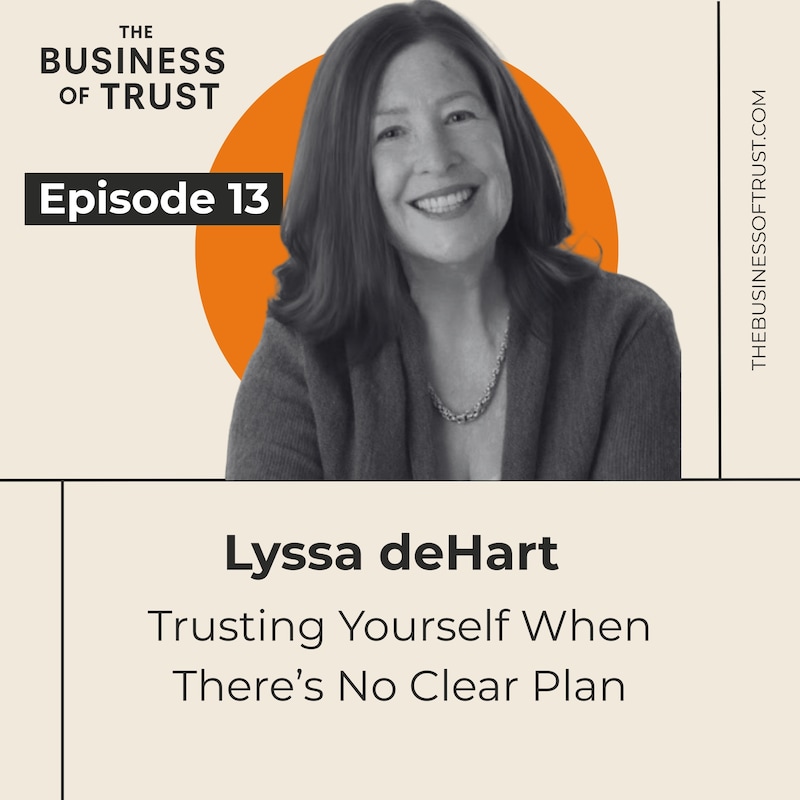
In this episode of The Business of Trust, I sit down with Lyssa DeHart to explore a kind of trust we rarely talk about in business: self-trust—especially when there’s no clear plan.
Lyssa is a master certified coach, former clinical social worker, and author who has worked with more than 10,000 coaches and leaders around the world. But her path into coaching didn’t come from certainty or a perfectly mapped strategy. It came from burnout, transition, and the courage to take the next right step without knowing where it would lead.
We rewind to 2013, when Lyssa shut down her therapy practice after years of working in trauma and PTSD. It was only after stepping away that she realized how deeply exhausted she was—and how much space she needed to rethink not just her work, but her identity.
In our conversation, we talk about:
- Why burnout often hides behind competence and success
- The difference between helping people becomefunctionalversus helping themthrive
- What changes when you move from a fixing mindset to a partnering one
- Why you don’t need a full plan—just the willingness to take the next step
- How trust is built long before money ever changes hands
- The pivotal moment when changes to the ICF credentialing exam reshaped her entire business
- Why every skill and experience you bring with you—even the unexpected ones—can become a real advantage
- What it means to stay relevant as a coach in a world where AI is rapidly evolving
This episode is an honest look at what it really takes to grow a service-based business when certainty isn’t available—and why trusting yourself might be the most important strategy of all.
Connect with Lyssa:
Transcripts
Welcome back to the Business of Trust podcast. I'm your host, Hugo Sanchez. In business, we often talk about trust as something that happens between two people, or maybe between a brand and a customer. But we often overlook the trust that we have with our own internal narrative, you know, the stories we tell ourselves about what's possible. That's I'm super excited about today's guest. She's a master at helping people dismantle the stories that hold them back so they can lead with confidence.
And the guest today is Lyssa DeHart. She's a master certified coach, a clinical social worker, and the author of several books, including the masterpiece, Story Jacking. Lyssa has helped over 10,000 coaches and has worked with everybody from the US Air Force to Fortune 500 executive. She blends neuroscience and the power of metaphors to help people find clarity and trust to lead effectively. So let's welcome Lyssa to the business of trust and let's get started.
Hugo Sanchez (:Lyssa. Welcome to the Business of Trust podcast.
Lyssa DeHart (:Thank you so much for having me, Hugo. I'm very happy to be here.
Hugo Sanchez (:I'm honored that you said yes to being in the podcast. And I was reading through your bio on your website and something that really surprised me was the story that you share about being a therapist and in 2013, you burned out and made a transition towards coaching. I would like to zoom in into that.
life, can you take us back to: Lyssa DeHart (:couple things were converging in 2013. One thing is my husband had gotten a promotion and that required a move. we were looking at therapy as a practice in 2013 was very office bound. So I had an office, had insurance, took and I had clients who came in and I saw them weekly or biweekly.
whatever, right? And my specialty at that time were relationships, PTSD, complex trauma, and dissociative disorders. So these were all fairly heavy topics, you know, just in general. And, and so my husband, Michael had moved up to the Washington State area from where we were living.
ppened then, so at the end of: was at and what I realized in:I didn't know I was burned out until I had a space to breathe into where I was finding myself and that was, I was just really incredibly tired. But then I'd also been working in the space of trauma in one form or another since the late 80s. So it was a fairly long time to be working in the trauma field. I mean, I think burnout's probably normal to some degree,
Hugo Sanchez (:Hmm.
Lyssa DeHart (:depending on the type of work that you're doing.
Hugo Sanchez (:Definitely. And it's really interesting how the importance of giving one space to explore what's next and what emerged for you was coaching. How did that, how did coaching come into the picture for you in that space?
Lyssa DeHart (:Yes. So I had taken a coach training program in 2007, 2008. Again, my husband was like, Hey, there's this thing, this coaching thing. I had heard of coaching in the nineties. ⁓ and then, but I'd been so busy with my, my therapy practice that I just didn't really pay that much attention to it. And, and so he said, I found this program. I think you'd like it. It's on neuro leadership and, and we would be able to go and get this training. It'd be so cool.
ng with him. And honestly, in: omething different. And so in:Federation event ⁓ in Seattle and met some people and started to kind of get a little bit of a feel of this coaching thing and even though I'd had my original training already I decided maybe I'd get some more training in coaching just to sort of see if I liked it or not ⁓ and so as I did that I discovered you know I kind of think there's something to this coaching thing that I had sort of
he transition. So really from:coaching as you know at that time.
Hugo Sanchez (:Beautiful. because this is a podcast about trust, I'm very curious of in the moment where you have so many options, like, I mean, you could go back to school, you could go back to therapy, you could do something else, or you could do this coaching thing. Were you just following instinct or an intuition, energy? What do you think carried you into the coaching path?
Lyssa DeHart (:I'd kind of like to say yes, all of the above. ⁓ so, I mean, one of the school options that I've always defaulted to, I'm not sure why, probably because as a kid, my mom said I'd be a great litigator because I argued about everything. ⁓ so, I don't see it that way. So I always sort of defaulted to, I'll just go to law school. ⁓ And...
faulted to that at the end of:and all of that. And so honestly, after I got through the initial, I'll just be an attorney, ⁓ and I finally just sort of set that down.
There was a real sense internally, head, heart, gut alignment, that coaching was probably a good place for me to explore. Now whether or not I could make it a viable business or not, I didn't have a strong feeling about because the difference between therapy and coaching for many people is that as a therapist you take insurance. And so you have an automatic funnel system into your practice
Plus you get to know other professionals in the the world and they refer people to you because you do something they don't do I'm in coaching is really something that people have to pay for out of pocket usually unless their organization pays for it
or they have to really want it versus therapy. so it's a little bit, it's a different thing at that point, right, than therapy. So it required me to start to really reevaluate how I was doing business because I wasn't having this automatic funnel of insurance into my practice. I think it would have happened in therapy also in the sense that the insurance reimbursements were decreasing.
at that time and I was like I can't afford to work for these prices at that point so I was gonna need to be looking at a transition anyway whether it was therapy into private pay or coaching into private pay but
I chose coaching because I really, again, because of the burnout, I was much more interested in that movement from functioning to really thriving and moving in the direction of a dream.
Hugo Sanchez (:thriving.
And okay, so you lean into coaching, you go through the training of it and then you had to go out and get clients and the funnel of it works very differently than therapy. When you started your coaching practice, how did you go about finding clients at the beginning?
Lyssa DeHart (:lucky in a couple of ways. One,
my husband could afford our family. So that was hugely helpful. ⁓ and I had my mother and my mother-in-law move in with us at the same time. So it's doing a lot of caretaking of our parents. So that kind of became one of my jobs. And so I was able to really start to slowly build my business and it wasn't like this sort of crunch time, like I must find the X number of clients or I'm gonna have to get a real job. ⁓
Hugo Sanchez (:Mmm.
Lyssa DeHart (:And so I was given a bit of luxury of time to start to discover what it was I really wanted to do in coaching, my niche or focus would be.
writing my first book in like:So I just started building relationships, not in the sense of like, hey, Hugo, let's get together and see how I can help you. Right. Like there's I get a lot of that sort of stuff in my inbox on LinkedIn or, know, there's a lot of.
Hugo Sanchez (:Mm-hmm.
Lyssa DeHart (:I think you mentioned it ⁓ earlier when we were talking together, this idea like there's some way to 10x your business overnight. I haven't found that to be the case. I'm not saying it is impossible, but I think the only way to do that is if you're driving over on people's fears. And that wasn't really my style of marketing. ⁓ It wasn't going to fit with me as a human being. So I mean,
My path of marketing and building my business was a slower, more gradual journey and not like a overnight, I had 20 people who were scared because their businesses were failing and they were willing to pay me a bunch of money. So I was making my business work, but theirs was still failing. That just didn't fit with what I wanted to do.
Hugo Sanchez (:Mm-hmm.
Yeah, and it sounds like you had like your set of rules as you were doing this business, like things that were non-negotiable for you. ⁓ When did coaching stop being something you were curious and leaning into? And when did it feel like a vocation, like a very authentic path for you?
Lyssa DeHart (:Yeah. Well, I started teaching at a coaching school in 2017. ⁓ And so I'd been taking all these classes and it was already starting to feel like this is a profession that I'm going to lean into. So I'd already kind of made that decision by the end of 2014 because I was taking classes and I'm like, OK, I'm to continue to invest in this and build this idea, this practice. And
I mean, I think like any new business, it's terrifying because you're a lot of energy and heart and soul into building something that there's no guarantee of what's gonna happen with it, right? So there's a lot of trusting in your...
I don't know, your courage. think it reminds me sort of the Maya Angelou quote of all the... ⁓
values, courage is probably one of the most important and I don't think it's values. It's of all the virtues. The most important is courage because without courage you can't demonstrate any of the other virtues consistently. so there's this sense of, and you talked about self-trust, there's this sense that you have to be courageous enough to trust in yourself to continue moving forward. Even if you have to pivot here, pivot there,
maybe you're doing like side jobs here for this organization or you're doing a side job over there for that organization. So along the way I'm coaching within a school, I'm coaching within organizations, I'm coaching within know platforms, I'm doing all kinds of different ways of
starting to build a business, build a reputation, build connections. I had to start at ground level because I moved up to the Seattle area. I didn't know anybody where I lived. I had a huge network of people, but this was pre-COVID, right? So people weren't doing everything online and clients wouldn't come to you on Zoom. They, you know, they wanted to be in person. so it was a building of
Hugo Sanchez (:Mm-hmm.
Lyssa DeHart (:relationships, whether it was with organizations or with individuals, I was just really having to start at the ground floor and just build up new relationships and my identity had changed. So there was also the getting to be in in with comfort, be able to say who I was and what I did and that.
I found actually it was really difficult also to say this is who I am. I'm listed to heart, I'm a coach. ⁓ What do you do? Leadership, confidence coaching. Now I would say, you know, I'm an author. I do a lot of coach education and development. But to be able to say that with confidence, I did not have that to begin with. And so the practice of even getting comfortable with communicating who I was and what I did took a little bit of time also.
Hugo Sanchez (:Mm-hmm
Did you have a vision at this point of what things were going to be for you, what you were working towards? Or you sort of made that on the go.
Lyssa DeHart (:I would say ⁓ one of the things that I at least have found in my own ⁓ business journey has been that I've always had a desire to learn and develop myself and see what doors open. And what's happened is that that's really kind of carried me through in a lot of useful ways.
siness would be today back in:finding my feet, getting involved with enough different things. I joined the ICF chapter. I became the director of online education for that chapter. It gave me an opportunity to do a ton of network.
I'll have done in, you know,: Hugo Sanchez (:Mm.
Like the...
It's a mixture of trusting the process but also being able to pivot with each step what's the next right move. I used to think that in order to have a plan, in order to take action and a big change in my life, I had to have the full plan laid out and I would hold on my entire execution until I have every possible variable mapped out. I'm an industrial engineer by education so I had to have everything figured out.
Lyssa DeHart (:Yeah.
Hugo Sanchez (:And then it was like working through coaching that I realized I learned that sometimes what you need is the immediate right move to see what's next. it's, yeah, it was an interesting lesson. I mean, as I look at your biography, you have written several books, you have coached thousands of coaches, like if I, 10,000 approximately coaches globally.
Lyssa DeHart (:Yeah, between my
ICF credentialing lab, the credentialing lab for exam takers and my power metaphor programs and my group mentor coaching and then the schools that I worked with, you know, and just all the different places I've worked with over 10,000 coaches at this point.
Hugo Sanchez (:incredible how many lives like you have touched with your, ⁓ you know, when you set into this path, you've also hosted podcasts and you are active at the ICF and at the AEMCC. So I'm so, you clearly work a lot or it comes across that way. Like you're very passionate about this and I'm, and I have a sense that that only comes when you really like what you do. You can't fake that stuff, you know? So how
Lyssa DeHart (:you
Thank you.
Hugo Sanchez (:You kind of glimpsed into it, but what do you think?
Working as a therapist led to burnout, but coaching and all the work you do there didn't lead to burnout. You mentioned something about the heaviness of the work that comes ⁓ with PTSD and all of that. I'm wondering if there's also an aspect of authenticity, of like living closer to something that is... ⁓ But what are your thoughts on that?
Lyssa DeHart (:I mean, if you had asked me in September of 2013 if I was burned out, I'd have been like, no. I mean, I love what I do. And I did. I adored what I did. I adored my clients. I adored the work that I was doing. It was only when I had time to take off and not do therapy for a bit that I was able to sort of
Just sort of, I don't know, de-esque, I don't know. Breathe. I was able to just breathe. And in that breathing, I was able to see how actually tired I was. There's a lot of heaviness that goes on with trauma. And you hear a lot of traumatic stories as a therapist. Whether you need to hear them all or not is a different conversation.
but you hear a lot and you have a heart usually that wants to support people to be able to move through those sorts of things. And I definitely did have that.
And so I didn't realize, I mean, I was happily married. I had a good friendship circle. We were very active in our community and I had lots of friends. So I wasn't like burned out in the way that you would be like, this person can't get off the couch. I was just burned out in a way of I've been carrying a lot of heaviness for other people for a really long time. And
The shift into coaching was not that those things didn't still happen to people. Executives have terrible experiences from childhood as well. I mean, very few people make it to adulthood without some sort of baggage, right? And that comes up in coaching also. But my job wasn't to...
do the work of therapy, my job was transitioning from that into how do you want to move forward? And so there was an inherent understanding that as a therapist, we're going to work on building the skills that you need to get to functional. In coaching, we're starting with people who are functional and it's the movement forward from there. And so it's just a different focus that you have.
you're working with maybe even the same people. They may even have a therapist at this very moment that you're working with them as a coach. But your conversations have a different directionality. And that directionality was like bomb to my heart. Because I wasn't carrying the heaviness of the past stuff. We could acknowledge it, but it was only any of those conversations about the past were only in service of the direction they wanted to go. So we weren't just meandering around in a field.
talking about all the trauma and hurt and negativity of the past, but rather they were ready to explore what they had learned and how to pay that forward towards where they wanted to go.
Hugo Sanchez (:Hmm.
I understand. That makes total sense. And after all these years in business and when you look back at your trajectory, was there a pivotal moment in your business where things took off? Was there like one relationship that really like catapulted the business to a whole other level? Was there a campaign? can you think of a couple of times where that happened? ⁓
Lyssa DeHart (:Yes, I can. So
e things that happened was in:My business was fine. I was working for schools. I was you know doing fine as a coach. I had clients I was busy. I was you know doing stuff ⁓ but ICF changed the rules on the credentialing exam and as a result of that I went into look at this new credentialing exam and I was like, this is gonna be really easy and so I take their mock eight questions and I'm like, moly cow. This is gonna be
hard for people. Like it was hard for me. I'm not even sure I passed the eight questions. And the way that my brain works is I'm like, got to figure this out. Like I've got to, I got to sort this out. Now I have some different learning disabilities. have dyslexia, ADHD, and so I've got some things that challenge me in taking these sorts of exams anyway. So I'm like, I'm not going to be the only person with a problem here. And then in August of 22, when the new test came,
I already was prepared with already having a class ready to start talking to people about what this exam was going to be like and so we I Started like the day that exam started I was already working with people on how to be thinking about this exam and Honestly, it was a first-to-market sort of thing Nobody else had really been paying that much attention to it and so I got probably like a year and a half jumpstart on other people and
then ended up within a few years having you know thousands of people that I had already started working with and then my program just kept developing and developing but one of the things that was also going on was I had already built like a YouTube channel and so I was already giving value to people and I think this is one of the things that's really crucial to building a business is I think we end up thinking of it like everything from a monetary value of and I'm not saying you shouldn't think of it from a
monetary value, but there's an awful lot of worry about getting paid and not enough worry about what do people need and becoming really well known for what people need and then and as a result of that you start to build trust people know you and I mean like I don't I don't know as many people as who know me at this point and and part of that is because of my YouTube channel and I had started the podcast and I was
giving away a lot of value to coaches and so they already knew and trusted me and then with the exam ⁓ credentialing exam lab that I created they got a chance to work with me monthly and learn about the exam and thinking through it and challenging themselves and then I got a lot more referrals but that was a very pivotal moment that really shifted my business completely.
Hugo Sanchez (:In a way, you became an educator too, right? For coaches.
Lyssa DeHart (:Well, and I was
doing education already, so I was already primed for that. So it wasn't like I just accidentally stumbled into educating. I had actually been teaching things since the 90s. I'd been teaching in a college. I was teaching with the military. So I had the skill set also. And I think that's crucial is that I think people think, well, you know.
I'm doing this thing, but it didn't really have value. I look back on my career. Every single thing that I've done has added value to my business to include my art history or my art background. have a minor in art history and I have a degree, fine art degree. ⁓ And I use that in doing publishing of my books, know, like designing things and in all of the stuff that I do, I'm a big part.
of the art that is done within the work that I put out into the world. And so you might say, well, an art degree, doesn't really come in handy. But man, it's really come in handy for me because I've been using Photoshop since the 90s. And so I've been able to grow with it, and I understand it, and I can use all these different programs. And so I've really always looked at every single thing that I've learned. How can I leverage that into supporting me to the next step?
Hugo Sanchez (:Yeah, and I love how when people just bring their whole selves to the table because that is what makes us unique. That responds to the question, why me? You're unique. You bring your whole self to the table and your own self abilities. You use the the dyslexia and ADHD in your favor to create something that works for you, but also for thousands of other people. Now, you've worked with, I get like 10,000 some coaches
for example, is different in: Lyssa DeHart (:Yeah, it's really interesting. So I was having a conversation on my podcast with one of my guests and we were talking and I've got another one coming up talking about AI and this is a really, I mean, this is an important distinction for all of us because at this point AI can coach at the ACC level. So if you know what an associate credentialed coach is, the ACC level of coaching through the International Coach Federation, AI can do that. Like, and so if that is your
level of transactional coaching, people don't need to pay money to use you. They can just create a GPT and have a conversation and get the same value as they would get from a human being, which is one, terrifying and two, the reality of the situation that we live in. So I mean, some of this is also what do you need to be doing as an individual and a human being to make yourself more of a useful thought partner with the thinker?
that you're working with. mean, and so it is this idea of like, how am I continuing to develop myself, not just as a coach, but as a human being, so that when I'm working with people, I can bring my full self into it, but I'm also learning how to partner in a way that an AI can't. And one of the things in one of the conversations I just had is that AI isn't good at humor. So like you can ask AI to tell you a joke and it's
to give you a dad joke, right? And human beings have a way of creating interconnectedness and humor and they pick up on micro expressions and cues and so people can laugh and there's a release ⁓ of...
different neurochemicals in our system, dopamine, serotonin, ⁓ and amongst others that happen when we're bonding with people. There's others and I'm just not thinking of them off the top of my head at this moment, but it is the sense of how we create and connect in relationships. There's a mirroring that happens and then the mirror neurons get impacted and AI is not able to do that. But if you as a coach cannot
do that either because you're trying to stay very formulaic. If you're trying to stay very much in a transactional, I'm not going to get into like emotions. I'm not going to da da da da da da. You're going to be replaced. And so I think, you know, there's it's a tension with how do you stay relevant? And I think that's true for all of us in every profession. How do you stay relevant and and continuing to develop and evolve yourself doesn't mean you have to
take classes necessarily, but what are you reading? How are you applying that? Are you getting supervision in order to notice where you get hooked into telling people what to do? Like what are the different things that you're doing that may or may not support you being as of much.
service as you could be for the people you're working with. And I think that's just part of our developmental arc, right? But how do we bring our humanity into these conversations in ways that are meaningful to the people we're working with? Because some people are always going to want to have a human to human contact. And other people, especially maybe younger people, I don't there's not real good research right now, but younger people may be more comfortable with using a GPT or a app.
Hugo Sanchez (:Mm-hmm.
Lyssa DeHart (:But even young people, they're used to having interactions with people and there are some things you need to run by human beings because you're going to be interacting with other human beings to get a job or whatever, to have them hire you. And so you can't just only rely on an AI to do your coaching, but you need to be a better coach than an AI coach.
Hugo Sanchez (:Definitely.
And I think of what you said earlier of going back to doing something, tapping into what people need and offering something very good for that to satisfy that need. And definitely, think that AI does bring, it's immediate, it's accessible, it's right there. I have a question if I need support, like don't need to schedule an appointment. I can just go there 24 hours a day, tell it everything without any fear of judging me. But at the same time, people are very distrustful.
Lyssa DeHart (:24 hours a day.
Hugo Sanchez (:of AI, like Edelman Barometer did a research on AI, trust in AI in the technology, and it's very low in the United States compared to China or Brazil, for example. In the UK, it's also pretty low. ⁓ And it also goes back to what we were chatting about, the relationship and building that rapport and that trust, that it's a very human aspect. ⁓ It's a very, yeah.
Lyssa DeHart (:Yeah.
know, AI
can pretend to have empathy, but it doesn't have experience. So what is empathy? You can't have empathy without experience. It also tends to be pretty supercilious and like, ⁓ Hugo, you're the most amazing. That's the greatest idea I've ever heard of. And I think there's, you know, a tendency to get feedback that is less than useful because it's not a critical thinker with you, right? It rarely will challenge you on your
Hugo Sanchez (:Yeah.
Exactly. Yeah. There's a.
Lyssa DeHart (:thinking and it hallucinates so it pulls things that aren't accurate. So I think some of the distrust is well founded because it's not perfect and not that human beings are perfect by any means, but it isn't like you can't just go give me like all the details of something and it'll just automatically give you all the details. It's amalgamizing all this different information and giving you something and you have to still use your
critical thinking to determine whether or not this is even useful information for you.
Hugo Sanchez (:And on top of that, I would say also that the channel matters a lot. Like if I hear the same piece of information, but it's communicated through a person, through an actual human, with the right time, with the right preamble, with the right context, with the right... Like if it's a person I respect and trust and I know they know me, all of that is as important as the message itself. And that presence, it matters. It opens the channel because...
We are energetic beings in a way. And there's a lot to us that we don't know, that is not just so formulaic, ⁓ to your point. yes. Well, any, where would you like to send people who are listening to this conversation, and they want to learn more about you and the work that you do, the academy, your podcast? Please let us know ⁓ where would you like to send them?
Lyssa DeHart (:electricity.
Yeah, so you can always find me on LinkedIn and I love to connect with people. And I also have my website, listedtoheart.com and you can find me there. I also have my academy, but you can get to my academy from my website. So it's really easy to listedtoheart.com and then on LinkedIn, I'm the only listed to heart on the planet. So I'm pretty easy to find. ⁓ And
And my books are available pretty much anywhere you buy books. And I have a new one coming out in April. April 7th it'll be published on coaching. So if you want to learn more about coaching also it'll be a useful book, think, resource.
Hugo Sanchez (:I wish I was the only Hugo Sanchez in the world, but there's so many I'm like impossible to find. what, what, tell us about this upcoming book. What is it about?
Lyssa DeHart (:So the upcoming book is Sticky Outcomes and it is really about at the intersection of coaching, neuroscience and lasting change. And so I really walk people through what is coaching number one, but then I'm also looking at like how do we shift our mentality from being a fixing mentality to being a partnered and partnering mentality. ⁓ Things like emotional intelligence, psychological safety, how the competencies really hold these different elements
together and really the value of being part of a professional coaching profession.
and a body like maybe EMCC or ICF or BCC or a professional body because of the need for ethics and ethical behavior that you're aligned with as a professional versus just I call myself a coach and I just do, but I don't have an ethical responsibility to anything, right? ⁓ I don't think if you don't have an ethical alignment with something, you can actually call yourself a professional.
in that particular field, but that's my bias. So take it for what it is. But I think, so what I do is I really walk people through what is coaching, but also how do you develop yourself as a coach? And so yeah, that's what the book is about.
Hugo Sanchez (:It sounds very appropriate to the context that the industry is living right now. So I look forward to it. Well, thank you so much for the amazing conversation, Lyssa. I so enjoyed it. And I am so grateful for you for your time. Thank you.
Lyssa DeHart (:Yeah. Yeah, thank you.
Thank you for having me on the show.
Hugo Sanchez (:for now.
Hugo Sanchez (:Well, that's all for today. I hope that you enjoyed my conversation with Lyssa. Please rate us and subscribe in whatever platform you're listening from. And if you go to thebusinessoftrust.com, you'll be able to subscribe to our newsletter and receive new episodes every time we release one. If you're curious about the work that we do at Mundes Media, the marketing agency that I own, you can go to mundesmedia.com and check out our work. I'm your host, Hugo Sanchez, and I'll see you in our next episode. Bye for now.



