Shownotes
This is your go-to Podcast, where we help parents navigate the complexities of family life. Hosted by Ali Kessler of Greyson’s Choice, we’ll cover everything from understanding domestic violence to navigating the legal system, finding the right therapists, life hacks, family law, mental health, custody battles, and how to protect children in dangerous situations.
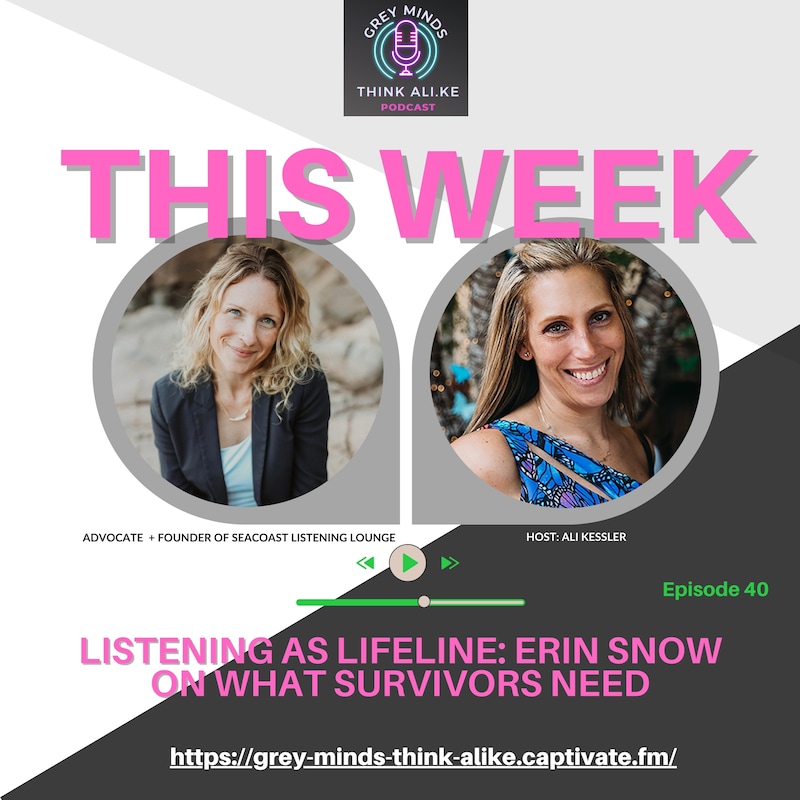
In this episode of Grey Minds Think Alike, host Ali Kessler speaks with Erin Snow, founder of Seacoast Listening Lounge, about the importance of compassionate listening for survivors of trauma. Erin shares her personal journey as a survivor and her professional experiences in the legal system, highlighting the challenges faced by victims of domestic violence and the need for empathetic support. The conversation explores the role of safe spaces, the significance of community support, and the necessity of self-care for those working in trauma-related fields. Erin emphasizes that healing often begins with being truly heard and understood.
About Erin Snow
Erin Snow is the founder of Seacoast Listening Lounge, a compassionate, confidential space where women can share their stories without judgment, fixing, or pressure. With 16 years of experience as a legal advocate for survivors of domestic violence, sexual assault, and stalking, Erin worked in protective order cases, high-lethality family court situations, and custody battles where safety was on the line.
She is trained in trauma-informed advocacy, empathetic listening, and legislative reform. Erin has worked to improve family court practices, strengthen protections for survivors, and raise awareness of the ways systems fail the very people they’re meant to protect.
Today, through Seacoast Listening Lounge, she focuses on giving women what she’s learned they need most: someone who listens deeply, compassionately, and without agenda. Erin is also a mom, step-mom, wife, and dog-mom — grounding her work in lived experience and unwavering empathy.
Contact: www.seacoastlisteninglounge.com
About Ali Kessler
Ali Kessler is a writer, marketing professional, passionate parent advocate, and founder of Greyson’s Choice, a 501(c)(3) created to raise awareness about the risk of domestic abuse on children. Greyson’s Choice was founded by Ali Kessler in memory of her sweet, vibrant, and fearless 4.5-year-old son, Greyson, who was murdered by his biological father in a murder-suicide during an unsupervised, court-approved visit in Ft. Lauderdale, FL, in 2021. This came just hours after her petition for a domestic violence injunction was denied by a Broward County judge, citing that the “petitioner has failed to allege any overt acts by the respondent which would constitute domestic violence under Florida Statute.”
Ali’s advocacy efforts culminated in the successful passage of Greyson’s Law during the 2023 legislative session. This bill now requires the court to consider threats against ex-partners or spouses when making child visitation and custody determinations in the court, expanding to include the following factors: evidence of domestic violence, whether a parent in the past or currently has reasonable cause to believe that they or a minor child is, or has been in imminent danger of becoming the victim of domestic/sexual violence by the other parent, even if no other legal action has been brought or is currently pending in court.
Contact Ali:
Transcripts
Erin Snow Podcast
Ali Kessler: [:Before creating the listening lounge, Erin spent 16 years as a legal advocate for survivors of domestic violence, sexual assault, and stalking. She walked besides women in high lethality divorces, family court battles, protective orders and system failures that should have protected them, but often didn't.
d how safe spaces can change [:I have lived, so. Mm-hmm. I appreciate you coming on and, and talking with us, and I know our listeners will. If you wanted to start, say a little bit about yourself and how you started in this
Erin Snow: horrible
Ali Kessler: field.
Erin Snow: Yeah, absolutely. Thanks Ali for having me. I appreciate being able to talk with you and share my experience.
started going into the legal [:I went to work at the Rhode Island Attorney General's office and worked in the elder abuse unit, and there was really my first experience working with victims.
Ali Kessler: Okay.
Erin Snow: I was working with very vulnerable populations for the first time. I got this sense of accountability that people were doing. People had done things that were wrong, and there was a system that was holding them accountable and hadn't really realized that that was resonating with me because of my experience as a child and things that had happened to me in my teen years.
I was like, okay, this makes sense to me because I didn't have that. Accountability for what happened to me. And then I moved up to New Hampshire and I took a job with New Hampshire Legal Assistance. It's a legal aid organization here. And I started working on the domestic violence advocacy project. And I thought, you know, I was there for nearly 17 years and I was like, this was a job that I, I saw the posting, I applied, I got the job.
[:Ali Kessler: Right.
Erin Snow: I would be able to. Relate so well with the clients I was working with. And I was working with domestic violence, sexual assault, and stalking. Victims and survivors and in the family court system which is a hot mess.
Ali Kessler: Yes.
Erin Snow: That's, that's like a kind way of saying it.
It was, yes. It was a hot mess.
Ali Kessler: I was involved. Everything that you just said, side stalking, domestic violence, everything. Yeah,
Erin Snow: yeah, yeah. Horrific. And the court system does not do its job. In protecting people?
Ali Kessler: No. And why do you think that is? Do you think They just don't believe I,
Erin Snow: I think there's a lot of issues.
I think some of it has to do with resources, right? I think that there are not enough here in New Hampshire anyway, there's not enough judges to cover the amount of cases. I think that they are trying to have cases resolved, and so they're pushing cases through mediation cases are. Resolving through mediation that are not appropriate for mediation because there's a coercive control element involved.
[:I think there's one left now here in New Hampshire, the resources are just not there to protect victims.
Ali Kessler: And if they were, do you think things would be different? Because, a lot of it has to believe with, they just don't believe that these horrible things happen. So they just put it through mediation, they put it through this, they put it through that, because they're like, well, they'll, they'll work it out.
Erin Snow: Yeah, and I think there is a lack of training on domestic violence. So I, right.
Ali Kessler: It all goes back to training.
Erin Snow: Training, absolutely. Training, and then the people that are hearing these cases, so the protective order cases, the divorce and parenting cases, so we had a system here in New Hampshire where the judge hears the case.
tent was for there to be one [:Ali Kessler: Yeah.
Erin Snow: That lasts forever. Like years. These cases are going and there's months in between hearings.
He was in
Ali Kessler: Florida as well.
Erin Snow: Yeah, and then we had. And that's a resource issue because they can't schedule the hearings more quickly. You know, things that don't rise to the level of an emergency hearing get pushed back.
Ali Kessler: Which is what happened with me, the weekend that I was looking for my son, I got, I tried to get a domestic violence injunction, which was denied by one judge.
The next day I tried to get an emergency pickup order, which denied by another judge, and then the stalking injunction, which was finally approved by a third judge. All within a three day span.
Erin Snow: Yeah.
Ali Kessler: All within the same case.
Erin Snow: Mm-hmm. I'm so sorry like that. It's a, and that's an example of people who are let down by the system.
and they're like, I'm never [:So then if you don't get the protective order, either on a temporary basis or a final basis, they already know what you said and there is no protection. And I just,
Ali Kessler: mine was denied, so he was not notified about it 'cause it never got to that point. It was just denied. And then.
Erin Snow: So here in New Hampshire, how it works is you go to the courthouse, you file a petition and what, and you stay there while the judge reviews it and makes a decision, and if the judge is going to deny it, they're supposed to talk to you first before they deny it.
That does not always happen,
Ali Kessler: right?
hey should be saying is, you [:However, if they're not notified, if they're not told, Hey, you might wanna withdraw this, and they don't get connected with the crisis center, then they're served. There's no, if no temporary order was issued, they're getting the petition with everything that you wrote out. They're not. There's no temporary order in place and a hearing is set.
Within 30 days. So that's a super dangerous time. It's just there are systems in place to protect victims. They're not always followed, and that's not to say that those systems that are already in place are the most effective, are the best practices, and there's. Still so much work that needs to be done.
, why do we have to wait for [:Right?
Ali Kessler: Yeah.
Erin Snow: There's just so much bias within the system that,
Ali Kessler: you know, I always say that until something tragic happens to a judge. Nothing's gonna change, which is, you know, really what takes, you know, everyone with me was like, wow, we didn't think this happened. And I'm like, this happens at an alarming rate.
Yes, my son was murdered because I didn't get. The attention that it needed at all. Ultimately, it comes down to, they don't think it really happens, but it does, and which is why I got Greyson's Law passed here in Florida. Do you have something similar or Child Protective laws in New Hampshire? Because I know we're trying, we were trying to get something like Kayden's Law to get the training, but it didn't, didn't pass with Greyson's gloves.
How to take it out.
and some of them don't. And [:And it is not easy to like this. The process, people making the decisions aren't always aware of the issues, and it's really, you know, you have. Experts testifying, and then you have the public testifying. And some of it is very, it's very case specific. And then others are more, Hey, this is a systemic issue.
And you know, I wish there were more bills that got through. Don't think there's one. There was a child protective bill related to who could file for protective orders on behalf of a minor that was passed a few years ago. But not, I think similar to what you have in Florida, unfortunately.
the first year we wanted to, [:Erin Snow: Mm-hmm.
Ali Kessler: Ultimately, so we had to dumb it down, is how I, what I say.
But it, you know, what does that really do?
Mm-hmm.
Ali Kessler: Nothing. It makes it worse. Mm-hmm. So, but I know that there were things passed, like in New York, there was like a Kyra's law I heard about and a Jennifer's law somewhere else.
Erin Snow: Mm-hmm.
Ali Kessler: So hopefully something will make its way into every state, because it should be, this should all be federal.
Not,
Erin Snow: I think, I think protecting families, protecting children, protecting victims and survivors, and it starts very simply with people being believed. I mean, like, let's just start there. Right,
Ali Kessler: right. Well, what's so crazy is I, I've been watching Mad Men, I'm rewatching it from like 20 years ago.
Erin Snow: Yes.
Ali Kessler: And you know, it's just so crazy to see how times have changed in every manner.
the mom, right? And they see [:And then somehow along the way it, it changed. And I'm not saying that's a bad thing because fathers do have rights and I get that. But we lost the tender years doctrine, which is what basically gave more rights to the mother. Mm.
Erin Snow: Mm-hmm.
Ali Kessler: And yeah, that's just not the case anymore.
And that's probably 'cause a lot of men were just power hungry and were like, well, this is my child too. And so I want 50%.
Erin Snow: Yeah. And that's New Hampshire recently passed. 50. 50. 50.
Ali Kessler: So do
Erin Snow: we presumption?
Ali Kessler: Yep.
Erin Snow: Which I advocated against.
Ali Kessler: Sure. I mean, it should never be a blanket statement for every family.
Erin Snow: You know, it was really, it should, it's the best interest standard. Our language was frequent and continuing contact, which can look like a lot of different things that each family within the court system really should be looked at as an individual family and the circumstances of that family. Not
Ali Kessler: right.
because if we do [:Ali Kessler: Right, of course.
Erin Snow: But let's say that they're in an abusive relationship and they, they share children, and mom wants to leave.
And the thing that she's going to protect the most are her children. Right? And if she knows that, if she goes to court, the starting point is 50 50. Like that's, that's the starting point. And it can go up and it can go down, but you have to be able to demonstrate that,
Ali Kessler: right?
Erin Snow: Jumping point is 50 50. As a mom, in your head, are you thinking, Hey, I could go to court and he's made threats that I'm not gonna see the kids, I'm gonna lose the kids.
percent of the time. Be in a [:I'm not there 50% of the time in a position to protect them. And that's terrifying because so many people will not report. I mean, reporting domestic violence, it's under reported anyway, but where that is the situation where you're like, okay, I could be here a hundred percent of the time and it's awful and it's horrible and no one should have to experience and endure this.
Or I can be out of the house 50% of the time without the kids and they might be at risk, and who's gonna protect them? Like it's not, that's not, those are not good decisions.
Ali Kessler: I, I agree.
appening, I think it will be [:I think you'll probably. See a decrease. Some states may have already started to see a decrease in the amount of reports, but yeah, it's just, it's not, those are not decisions that anyone should have to make.
Ali Kessler: Correct. I mean, in my case, I wasn't even living with Greyson's father. We weren't a couple.
So I didn't, you know, it's not like I had somewhere to leave. It was, it was my life.
Erin Snow: Mm-hmm.
Ali Kessler: And, you know, it was very separate. He wasn't even involved in Gr So for someone to just sweep on in, you know, at six months in, you know, and still gets 50% custody to me is
Erin Snow: mm-hmm.
Ali Kessler: Just insanity.
Erin Snow: Mm-hmm.
Ali Kessler: So let's talk. Okay. You said, you know, people don't just wanna be heard, they wanna be understood. What does that mean in practice?
Erin Snow: Yeah, so I think that when we're listening to people, we're listening to hear like that's what we think we need to do. When someone's talking, we listen. We hear physically what they're saying to us, but are we really under.
oesn't mean that you have to [:And what do you need back from me? And so that's why so I created this business Sea Coastal Listening Lounge. It's a safe space, as you said, for women to talk about whatever it is that is going on for them in their lives. We have so much going on in our lives,
Ali Kessler: right?
Erin Snow: And this is a space, it's not therapy.
I'm not looking to fix people. I'm not looking to give advice. If they want it, I will give it as a neutral third party, but really, it is truly a space for listening. And a space for women to put down those things that we carry with us all the time. And we either brush off or we say, it's not that bad, or we think that people aren't going to get it.
fore. I didn't have that. My [:Nobody believes me. And that I got that from what happened to me as a kid. I didn't talk about it. I, I was afraid people wouldn't believe me. And then I got divorced and I didn't tell people that I was getting a divorce because I didn't want the judgment. I didn't want the, oh, but he's such a nice guy.
Like, do you know, he is a nice guy. So that's, they're
Ali Kessler: always nice until they're not.
Erin Snow: Right. Right. And, you know, they're very good at showing up the way that they need to in public. And you know, the real person in the relationship, but that's not always the person that they're presenting us. And so people are like, well, I don't understand why.
Why you would feel that way? Like, I'm not seeing what you're seeing. Okay. Because you're seeing the image that they are working very hard for you to see.
Ali Kessler: Okay. So let's talk about Seacoast Listening Lounge. How is it different than therapy coaching and, and things like that?
n Snow: Yeah, so therapy, so [:I'm very clear. I'm not a therapist. My training is from my legal background and just my own personal experiences of what I was looking for in terms of empathetic listening when I had my own traumatic experiences.
Ali Kessler: Is this group, like a group of people?
Erin Snow: So I do individual sessions.
Ali Kessler: Oh, good. Okay.
Erin Snow: It's individual.
I do run a group, but primarily it's individual. And I'm here in New Hampshire, but I'm also virtual. So I see clients across the country and it's, it's, so I said it's not clinical. I'm not a therapist. I'm not attempting to diagnose anyone.
Ali Kessler: You're just there to listen and offer advice
Erin Snow: if they want it. I have some clients who say, Erin, I need you to witness what I'm going through, and by witness I mean I need you to hear me and nobody has heard me before, and I need you to witness this experience and I don't want you to say anything.
en. And they're like, I have [:They say, Erin, I want, I always ask, how do you want me to listen to you? And some clients say, I want it to be a conversation. I really wanna know what you think. You don't have any skin in the game, you don't know the players, so please just let me know what you think from a human perspective of someone who's not
Ali Kessler: sure.
Erin Snow: And then I have other clients
Ali Kessler: who like, because you wanna get something at the end of it, right? Yeah. You want someone to not only hear you, but also acknowledge and maybe offer a different perspective than what we have ourselves. Yeah,
Erin Snow: yeah. Absolutely.
Ali Kessler: And your friends might be biased in some sort of manner, so it's good to have.
Third
Erin Snow: party. Yeah. Friends might be biased. Friends might be over it. They're like, really? How much longer are you gonna talk about this? And some things like even if they're your best friend, like I get this question a lot. Well, can you just talk to your friends? Well, sure, absolutely. This is not to replace therapy.
replace a coach. It's not to [:How are they receiving it? Like they may not vocalize what they're thinking. Like let's just say your friend comes in, they tell you they're having an affair. Like your reaction might be, that's horrible. Oh my God. Like that's, did you think about dah, dah, dah, dah, dah. And I'm not gonna have that reaction.
And they don't have to worry about what's going on in my head. They don't have to worry about me saying that out loud. They don't have to worry about me saying, okay, when really in my head, I'm like, are you kidding me? Like they don't have to worry about any of that. And I think even with our best friends in our family, we're still always thinking, what are they thinking about me?
. So they can truly like and [:Ali Kessler: fuck
Erin Snow: about what's going on for them.
Ali Kessler: Who is this for exactly. And what happens when someone enters that space?
Erin Snow: So this is for women,
Ali Kessler: okay?
Erin Snow: Any woman.
Ali Kessler: So no men.
Erin Snow: So here's my thing. If there I will see a man is a service for women.
Ali Kessler: Okay?
Erin Snow: It was not, it was always intended that way, but I have really, really believe in access. And if someone were to come to me, or a referral partner were to come to me and say, Hey Erin, I've got this person who really, really just believes in what you're doing and really just want, there's nothing like it.
They really just want that space as well. I'm not gonna be like, no, I'm sorry. I'm not gonna do that. I really believe that everyone deserves to be listened to, but my clients are. It. Was intended for women. It's intended for women and it can be any age range. And I talk to women, women talk to me about lots of different things going through a divorce.
at and, you know, wanting to [:Lots of different, there's no thing that's off the table. I just ask that everyone, anything. Yeah, that you're respectful, right? Like obviously we're not, I'm not gonna have somebody come in here and spew hate, you know, but like, really what is going on with you? There's so many times that I've thought during the day, like, oh my gosh, I just wanna pick up the phone and call this person.
But I know everybody's busy. I, you
Ali Kessler: just wanna vent. So this is everyone's venting session, right? Yeah. Just get it all out there and then. Walk away.
Erin Snow: Yeah. And I've had, I ask clients at the beginning and at the end, what's a word that you would use to describe where you're at in this moment? So a lot of times when they're first coming in, it's hopelessness, it's despair, overwhelmed, frustrated, exhausted.
nd it's, I'm hopeful, I feel [:Ali Kessler: right?
Erin Snow: And yeah, so I do, I meet with people one-on-one in my office if they're local to New Hampshire. And then otherwise I meet virtually and I do 30 minute and 60 minute sessions and I'm just, I'm just really honored to share that space with women and for them.
To trust me that I'm going to listen to them and give them that space, and I'm doing that without judgment. I'm doing it without the intent of fixing. I'm
Ali Kessler: sure that's very trans, like transformational for, for women to not have that judgment or hope of fixing everything because not everything can be wrapped up in a pretty bow.
d it's not, this is here for [:So I have clients that come regularly. I have a membership program, I have people that come regularly, and then I have people who pop in like every couple of months. And then I have people who, you know, I've seen and then. They know I'm here and maybe in six months I'll see 'em again. It's been really interesting.
But what's great is that people are like, oh, I don't have to do this long intake form. I know I can just call Aaron and be like, Hey, I need a last minute vent session like right now. And I'm like, great, let's do it.
Ali Kessler: What happens if someone talks to you? And, but maybe it's something involving domestic violence or something pretty serious.
Do you feel like you may need, may need to intervene in some way? Like if someone's, like, if you hear that, you know, someone's being abused or something, how does that work when it comes to police or large child protective services or, or things like that?
Erin Snow: So there are mandatory reporting laws and requirements in New Hampshire.
Ali Kessler: Okay.
Erin Snow: And well,
Ali Kessler: and this HIPAA doesn't apply to you 'cause you're. Not technically a doctor, right?
. Not a doctor. And so yeah, [:Safe,
Ali Kessler: right?
Erin Snow: And connecting them with the local crisis centers. Thankfully I have those relationships again because of my background and making sure that safety planning becomes like the top. Priority and making sure they are connected to those resources. Also, I am very clear on what I can and cannot handle.
This is therapeutic in nature, but again, I'm not a therapist, so if somebody is having a mental health crisis that is not appropriate for this, that person really does need to see a therapist and I'm completely comfortable saying to somebody, Hey, I don't think this is a good fit, but I know. Connected to some really great counselors and therapists.
his is a good for people who [:Exactly.
Ali Kessler: Alright, well that's, you know, everyone needs to vent. I mean, I'm sure you know, our significant others are tired of hearing about things and, I'm all for, you know, sharing. Now you said you do have a group or whatnot, so can anyone join a group and maybe. You know, a group of women virtually?
Erin Snow: Yeah. So my group session, it's called the Group Smash Out session. And it's a lot of fun. We get together on a Tuesday night and that's in person. Okay. But I, if somebody wanted to, somebody can contact me and say, Hey, I wanna be part of a group. Or, Hey, I have four friends and we're in Kentucky. I'll be like, okay, let's set up a virtual session and we'll do a one hour virtual group smash out.
ust kind of put that on as a [:People are lonely and people, especially those who are going through domestic violence, they, I understand how isolating that can feel and be, and it's, if you don't know that there's other people out there who are experiencing similar things, it also makes it much harder to reach out to ask for help.
Ali Kessler: Absolutely. I mean, you know, just knowing that. There are people, like you said, going through something similar makes it feel like, okay, I am not alone. You know, or maybe hear what someone else did to get out to the other side or, and just get advice from, you know, other like-minded people is definitely the best.
I mean, you know, every, even like Facebook offers groups for just about anything.
Erin Snow: Yeah. Yeah.
Ali Kessler: So, yeah. I do believe that, you know, in the community, because it's, I always say everything takes a village.
Erin Snow: Yeah, [:Start a group. One of the ones that I'm kind of, we're starting a divorce group in January, so that's in person. Okay. But also thinking of doing something virtually online about people who have been. Like had bad experiences in the family court system, not just New Hampshire. Just
Ali Kessler: Right, right.
Erin Snow: Like, hey, this is my experience and I need a space and a platform to talk about it and for people to get support.
So if anyone has an idea like that and they're like, Hey, I'd really would love to have a group. Around this issue, please let me know. I'm always happy to arrange that.
Ali Kessler: How would someone get in touch with you? What is your contact?
ou can email me at Erin ERIN [:I'm on Instagram, Seacoast Listening Lounge. My website is seaco listening lounge.com. There's a text feature on that you can. Text Me too. Okay.
Ali Kessler: I will put all of that in the show notes. I'm just curious, how do you feel about AI and in the talking space? Does it ever come up?
Erin Snow: Yeah, no, it's interesting. I was just talking to someone about an article, doing an article on this and.
I think that, you know, there's positive and negatives. My concern with using AI for somebody who's going through domestic violence, or somebody who is going through a mental health issue, or even somebody who's going through a health issue and they type their symptoms in, right? It's not gonna be specific to you, the individual.
It's gonna give kind of like a compiled answer of what. People who generally have those symptoms are experiencing. I worry that people will rely on that. And also we self-edit, so we're like, Hey, am I in a domestic violence situation? And you kind of put some things in, you're like, no, am I really feeling that?
Is that [:So yeah, I would be concerned. Scary out
Ali Kessler: there.
Erin Snow: It's theory, it's, I mean, it has a lot of benefits for sure. Right? But something like that, if you're talking about domestic violence, if you're talking about mental health, I, your general physical health, like reach out to the experts, there are resources if you need an idea of what those are, also happy to talk about that and connect you to crisis centers and national organizations.
But yeah, I make those connections with the people who are on the ground doing the work, in person, doing the work.
r grounding yourself or self [:Things that people talk about. Yeah. And what, what can you maybe suggest for women listening or women that are going through that they can do for self-care or grounding?
Erin Snow: Yeah, so I would say choose something that brings you joy. It can be something really simple. For me, it's the ocean. So if I'm like, okay, I've had a tough day, whether it's in my personal life or my professional life, I'm going to the ocean and thankfully I'm close to the ocean and I will sit there and I will, if it's nice outside, I'll be outside If it's freezing and like below zero, I will park my car and just look at it.
And that's very calming for me. Also near
Ali Kessler: the ocean as well.
Erin Snow: Yeah, so that's a good thing. You know, for some people it's listening to music. What thing, and again, it doesn't have to be this big thing, but that you can do for a few minutes. Some people it's just taking a deep breath.
Ali Kessler: Breath,
Erin Snow: yeah. Like that resets your brain and gets you out of that fight, flight and freeze mode.
So some [:Ali Kessler: not feeding off people's, you know,
Erin Snow: no problems, nothing like that.
It's just for me, I, I know what it feels like firsthand to not have someone hear me, to not feel like I could talk about what happened to me feeling silenced and. That did to me. And so I don't ever want any woman, any person, to ever feel like they don't have a space where they have a voice. And so that gives me the energy and the ability to keep taking things in
Ali Kessler: purpose.
Erin Snow: Yeah. You know?
Ali Kessler: I know everyone asks me all the time, they're like, how do you do it? How do you get outta bed? How do you
Erin Snow: Yeah.
Ali Kessler: You know, do anything. And I, and I say, well, I have to, I have to make sure this doesn't happen to anyone else. And
Erin Snow: I know
you know, I have to make it [:Right. I, it has, my child's death has to be for some purpose.
Erin Snow: Mm-hmm.
Ali Kessler: So that's a, you know, it does drive you.
Erin Snow: Yeah. Yeah. And it is difficult. It's, you know, understanding that yeah, it's, and being honest with it that there are gonna be days where it is like impossible and there are gonna be days where you don't feel like getting out of bed and honoring those days and going, okay, but tomorrow is another day and what can I do?
Sure.
Ali Kessler: Right. So what is one message that you hope every listener walks away with from this conversation?
Erin Snow: That you have a voice and that your voice matters and that there are spaces if you're finding that difficult, there are spaces. That want to hear what you have to say and believe in what you have to say.
So never doubt that your voice matters. It does
Ali Kessler: well and you make it easy. So I will put all of your contact info into the show notes so that everyone can reach out, because I know, you know, we all vent about something, even if it's just about what to make for dinner. Yep. I thank you for sharing all this, you know, insight and your compassion and your devotion to survivors.
You know, your work [:So thank you so much for joining us. For having. Absolutely. And we'll be in touch. Alright, great.

