Transcripts
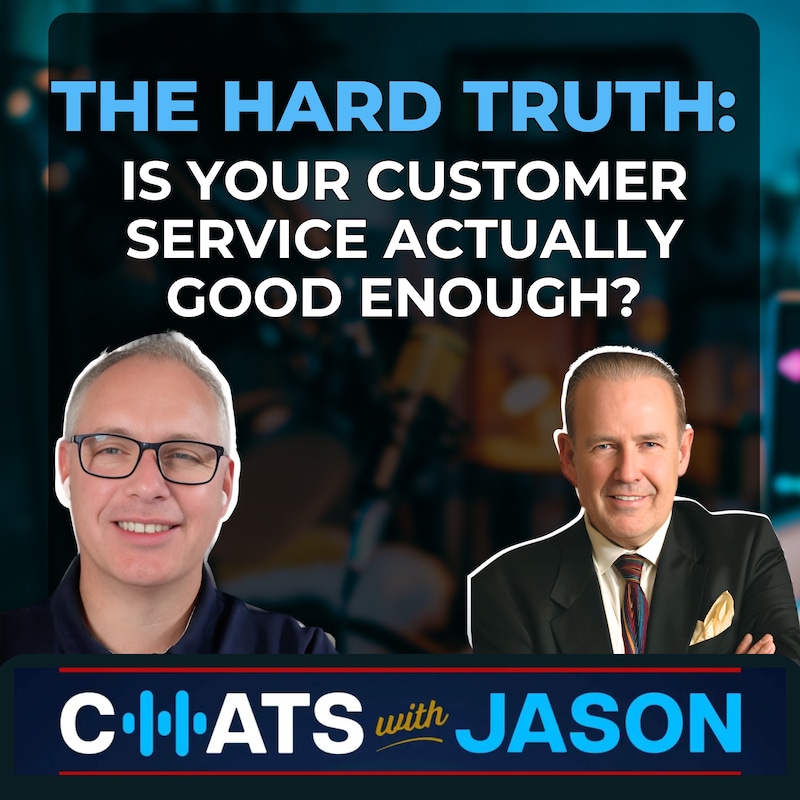
John Tschohl: Relentless / Top 30 CX Global Guru
[:[00:00:05] Jason S. Bradshaw: What if the reason your customers are leaving has nothing to do with the price that you charge the product, or even your competition? What if the quiet killer inside your business is the service you think is good enough?
[:[00:00:29]
[:[00:00:43] Jason S. Bradshaw: For nearly 50 years, John has been helping companies crush their competition, not with gimmicks, but with world-class service strategies that radically reduce defection, energize employees, and skyrocket profits.
[:[00:01:17] Jason S. Bradshaw: So grab your notebook pad and join me in welcoming John to the show.
[:[00:01:23] John Tschohl: Jason, it's good to be with you. I can see why you're so good. You're really good at what you do.
[:[00:01:32] Jason S. Bradshaw: It's an honor to be on the Global Guru's Top 30 list with you, and of course, an honor to have you on the show today.
[:[00:01:46] John Tschohl: Well, it was 1979, before you were born...
[:[00:01:54] John Tschohl: You were... okay.
[:[00:01:55] John Tschohl: I saw organizations spending a fortune on marketing and advertising, and as the customer walked through the door, they would issue baseball bats to the employees and they would hit 'em on the head as hard as they could to make sure they didn't come back. And I just couldn't understand it. I said, this is really stupid. I said, my thought was that if you treated the customer like a king or a queen, they'd come back and they'd give you a lot of money.
[:[00:02:55] John Tschohl: People never understood the power of the employee. So that's how I got started. And today because of COVID, I think customer service is as bad as it was in 1979.
[:[00:03:17] Jason S. Bradshaw: It leads me to my next question, John.
[:[00:03:32] Jason S. Bradshaw: Why?
[:[00:03:54] John Tschohl: If you took- I know this is true in the US- if you took the top 5,000 CEOs and you had them tell you how would you rate your customer service, they'd say, I'm glad you asked, we're at least a nine or a 10. And then if we asked 330 million people in the United States. How would you rate customer service? They'd say it's awful. So the difficulty we got is CEOs have never been in their own company. They don't touch all the different points in their own company, so they don't experience hell every day like everybody else does. I think customer service is awful. I think the CEOs don't understand it. I think they're living in La La Land.
[:[00:05:14] John Tschohl: Nobody wants to compete with Amazon. Nobody wants $65 billion in profit. Nobody wants $65 billion increase in sales. 11% increase in sales last year. Nobody wants to compete with Apple who has $99 billion in profit. These companies make too much money for other companies to wanna compete with them. And Amazon, in my opinion, and Apple are two companies that are a 10 on customer service and they're flawless at it.
[:[00:05:53] John Tschohl: Amazon has a better grasp of service recovery than 99.9% of all companies in the world, including the United States.
[:[00:06:23] John Tschohl: I think the customer satisfaction surveys are slanted to give 'em a lot of bullshit that just feeds their ego. If you take a look at a lot of these top level executives, they don't really get their hands dirty inside their own companies. And as a customer, they have other aides that do all the stuff for 'em. So everything's greased. I don't think they understand how awful it is. I don't think they call their local phone company and get an AI response, which is a chat box with no humans to it. And by the way, AI, as the talk of the town and those are the hot words, what AI really means is screw the customer because we're gonna use robots and you're never gonna talk to a human again.
[:[00:07:23] John Tschohl: Could be stupidity. I was at Walmart earlier this afternoon and my wife wanted to get a dog bed. And we got some other stuff there, 80 to 90% of all the checkout lanes were self-checkout. And it was at the very end, there were two aisles that had humans, and I like humans. I had a bunch of stuff that had to be weighed and I couldn't figure this out.
[:[00:08:24] John Tschohl: There's only a handful, Jason, of companies that seem to understand the power of exceptional customer service. I invested in 2003 in nine service leaders at that time, a thousand dollars each 'cause I wanted to see what happened with numbers. Just, instead of all the bullshit, I'm sorry if I use that word, but I just wanted to see hard numbers.
[:[00:09:33] John Tschohl: They didn't understand service recovery.
[:[00:10:12] John Tschohl: I believe any organization that can build a brand around the customer experience- I'm not talking baloney, I'm not talking a bunch of BS. I'm talking about that really builds a brand where they're known for their customer service can increase the value of the business- 2, 3, 4, 5, 10, 20 times. A thousand times. Not 10%. Not 20%. We're talking hundreds of percent.
[:[00:11:00] John Tschohl: The second thing is the leadership team has to walk the talk. Everybody has to be on board.
[:[00:11:13] John Tschohl: I was on the phone this afternoon with the CEO of Ethiopian Airlines, and I told Mesfin, I said the most important person in your company is not you. It's that little guy that's floating through your system and if he or she does a really good job, you look like a hero. And if they do a lousy job, you look like a bum.
[:[00:12:03] Jason S. Bradshaw: So, with all respect, John, it's not like you hold this secret about the fact that customer experience leaders like Amazon, Apple, Costco, that because they lead in customer service, customer experience, and because they consistently stay at the top, that return on investment in customer experience and their people in that process pays off 10, 100x times fault.
[:[00:12:35] Jason S. Bradshaw: Why? Why do they still consider customer experiences as a cost and not an investment when they can see the fruits of it? Like yes, not everyone wants to be Amazon, but everyone wants to have profit growth like Amazon.
[:[00:13:02] John Tschohl: See, there's nine steps I talk about. And by the way, one of those is price. Price is really important. Most companies are not frugal. They have too many employees. If you leave the United States, you go to Africa, you go to Latin America, you go to Asia, Russia... most of these companies have 25% more people than they need. And their concept of customer service, you put more ornaments on the tree. You have more employees. And the more employees you have, the better customer service. It increases your overhead. They don't understand that if you had high performing people, you don't need as many.
[:[00:14:45] John Tschohl: Do you smile? I live in Minnesota, and in Minnesota it's called "Minnesota Nice". Everybody smiles. I created a brand new program called Smile, and the only place I really can't sell it is Minnesota because everybody smiles. It's just part of the Minnesota nice culture. But as I traveled around the world, I was an Azerbaijan in the country of Georgia, a couple of years ago, and not one person smiled. And I went through a supermarket chain about one o'clock at night- I did it twice, I made eye contact with about 20 people. Not one person smiled.
[:[00:15:53] John Tschohl: They're used to seeing a really bad service and they assume that's the norm. In fact, they think
[:[00:15:58] John Tschohl: bad service is good service 'cause they've never seen good service.
[:[00:16:08] John Tschohl: When you talk about the word empowerment. Jason, trying to get an employee anywhere in the world to make an empowered decision for $5 will take two miracles at one time. And I'm talking about service leaders. Amazon, is the exception. Apple is very good, but I have never had anybody at Amazon ever say "no." But in most companies, the first word we train people on is the word "no." And we think you're empowered as long as you can say no. No, that's not empowerment. Empowerment means you gotta be able to make a decision in favor of the customer, in seconds, and the customer better walk away being over happy.
[:[00:17:04] Jason S. Bradshaw: You're not giving that overhappy customer a reason to look elsewhere, right? Because why would they're in your words, overhappy.
[:[00:17:28] John Tschohl: I'd train your entire staff on customer service, and it better be with something new and fresh constantly. So don't say, 10 years ago.
[:[00:17:48] John Tschohl: So let's say you did something 10 years ago, the chances of some of those employees still being with you is very low. So the people are gone. But we think we did it 10 years ago. And we know that we can take Charlie, and we're gonna put him or her in this magic program- maybe it's from service code answer. And our programs are gonna be so powerful. We're gonna change a person's life and make him instantly perfect. It's not gonna happen.
[:[00:18:23] Jason S. Bradshaw: I have indeed.
[:[00:18:32] John Tschohl: I have really good materials in many different languages, but so what? That's like going, you wanna be a medical doctor and you go to medical school and you take one course for two hours and you're done and you're ready to graduate, you're ready to operate. Or you wanna be a pilot and you take one lesson and you're ready to fly that 747. If you look at the athletes in the Olympics, every gold medal winner either wins by a fraction of a second or a fraction of a point. It's not like there's 20 points difference or 2 minutes differences. Just a tiny fraction, the difference between gold and bronze and silver, and those that win the gold financially are the stars.
[:[00:19:43] Jason S. Bradshaw: So what would you say to the leader that says, I can't afford to train my team members every year?
[:[00:19:54] John Tschohl: I have a program called the Service First Video Library. We charge $199 a month for 10 months to train your whole workforce. If you can't afford $199 a month, wherever you are in the world, you shouldn't be in business. It's a magic program. It's really effective. With that program, we took one of the worst performing banks in China- the Bank of Communications- took their least performing district and moved it to number one in six months.
[:[00:20:34] John Tschohl: You can't give up. You can't say we don't need customer service anymore. Every year, the customer expects you to get better. They don't want you to slide backwards.
[:[00:21:19] John Tschohl: If you were to read Elon Musk's book. By the way, it's a must read for any of your listeners, I think. This book is about 800 pages, and when I read a book, I highlight it. I mark it up. I put stars on it, all my books are highlighted. I always, when I read a book, I grade the book. You might not see it in here, but I put down the date. I read it, I graded the book. I this one an A+. But there's two things I learned from Elon Musk in the book. One is he wants speed. And speed is not twice as fast. He wants it 10x faster than you're used to. And the second thing is he wants to eliminate cost by 10 times. He is done that with his businesses.
[:[00:22:52] Jason S. Bradshaw: Yeah, so much that we could pull out of that.
[:[00:23:09] Jason S. Bradshaw: But at the same time, if I think about Tesla Automotive in specifically. He really disrupted the automotive industry. I spent a number of years as a senior executive in automotive and while people were critical of his product, they were also scared by the level of service that he was delivering.
[:[00:23:50] Jason S. Bradshaw: How does someone get the mindset that says, I can go faster, I can do it cheaper, but I can deliver a better experience?
[:[00:24:06] Jason S. Bradshaw: Yeah.
[:[00:24:24] John Tschohl: By the way, one of my really good books, I don't know where it is... oh, here's one- Built From Scratch. This is from Home Depot. You know these guys built the company around the customer experience. I rated this book an A+. I finished reading at June 17th 1999. Now, with any of my books, I got 'em all highlighted. I could read this book in 10 minutes. But this is what Bernie, Marcus and Arthur Blank did.
[:[00:25:34] Jason S. Bradshaw: which is much better.
[:[00:26:03] John Tschohl: The Elon Musk book would take about 20 to 30 minutes because I got so much stuff highlighted. I mean, it's really good.
[:[00:26:23] John Tschohl: So again, going back to your question, you can't read one book. Let's say you're an employee and you wanna make more money. See, I think any individual listening to this podcast could dramatically increase their income. I think it's impossible not to increase your income if you're customer driven, if you take care of the customer, if you're building your mind, if you do more than what anybody else asks you to do.
[:[00:26:58] John Tschohl: And we're so programmed into what everybody else does that we forget to think differently. Everybody loves great service, I don't care where you are in the world. Everybody loves great service. They just don't see much of it.
[:[00:27:14] John Tschohl: You can't say in May of 2025, we're gonna have great service for a couple days. It's gotta be a sustained commitment. Every day, you gotta get better and better.
[:[00:27:37] John Tschohl: If you look at AWS with Amazon which is now the cash cow for Amazon, they're just bleeding money like it's no tomorrows. But the reason AWS does so well is every single executive uses Amazon, and they see this flawless execution. Amazon comes along and says, Hey, we'll help you in the cloud. And all these CEOs say, if you could do what you do with the retail, I'll sign up. They're growing like 35% a year and it's probably 80% of their profit. The numbers are incredible on what AWS does, but it's an example of how they build a brand. Jeff Bezos does stuff differently. He's probably just spends billions of dollars trying something brand new and put all the effort behind it. And he says sometimes it works and sometimes it doesn't.
[:[00:28:42] John Tschohl: How could it go so fast?
[:[00:28:48] Jason S. Bradshaw: But if you were to explain customer experience to a 5-year-old, how would you explain it to them?
[:[00:29:07] Jason S. Bradshaw: Yeah, words to live by.
[:[00:29:28] John Tschohl: The customer decides where he is gonna spend his money, and it's his decision. And if you want it, you better take good care of the customer.
[:[00:29:39] Jason S. Bradshaw: What a masterclass in turning service into a great competitive advantage, whether you're a CEO, a team leader, or just getting started, John has reminded us today that great service isn't a department. It's a decision. And a decision that you need to implement every single day.
[:[00:30:09] Jason S. Bradshaw: If there's one truth to take away from today's conversation, it's this. When you transform the experience, you transform the outcome.
[:[00:30:20] Jason S. Bradshaw: If this episode sparked an insight, shifted your mindset, or gave you a tool to grow, please do share the episode with someone who needs it.
[:[00:30:39] Jason S. Bradshaw: Until next time, stay intentional, stay inspired, and keep transforming the experience.


