Shownotes
Happy Holidays to all our listeners. Celebrate the season with the Dementia Researcher Podcast Christmas Special!
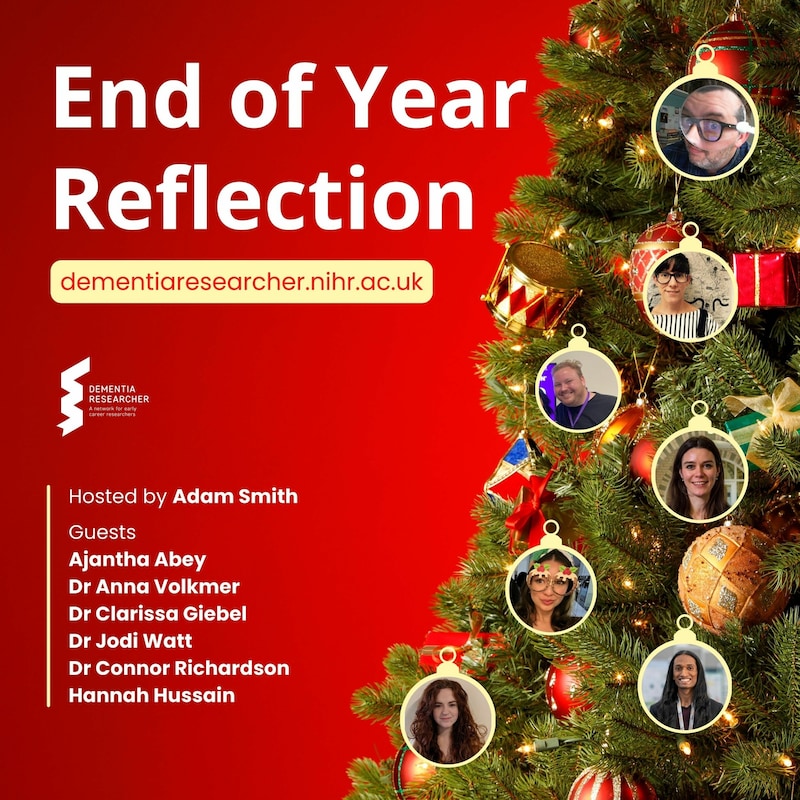
Hosted by Adam Smith, this episode features regular bloggers from the Dementia Researcher website, Dr Anna Volkmer, Dr Connor Richardson, Dr Clarissa Giebel, Hannah Hussain, Dr Jodi Watt, and Ajantha Abey.
Together, they reminisce about their 2023 journeys, discuss groundbreaking developments in their research field and explore what they’re most excited about for the coming year. Laced with humor and camaraderie, the episode includes a fun engaging quiz, making for a delightful mix of reflection, anticipation, and festive fun.
--
A transcript of this show, links and show notes and profile on all our guests are available on our website at https://www.dementiaresearcher.nihr.ac.uk.
If you prefer to watch rather than listen, you will find a video version of this podcast on Apple Podcasts, YouTube, and on our website.
Leave us a tip:
https://dementia-researcher.captivate.fm/support
Follow us on social media:
- https://www.instagram.com/dementia_researcher/
- https://www.facebook.com/Dementia.Researcher/
- https://www.twitter.com/demrescommunity
- https://www.linkedin.com/company/dementia-researcher
- https://bsky.app/profile/dementiaresearcher.bsky.social
Download and Register with our Community App:
https://www.onelink.to/dementiaresearcher
We gratefully acknowledge the support of our funders: Alzheimer’s Association, Race Against Dementia, Alzheimer’s Research UK, Alzheimer’s Society, and the National Institute for Health and Care Research.
The views and opinions expressed by guests in this podcast are their own and do not necessarily reflect those of the producers, funders, or sponsors.
Subscribe to our sister show 'Dementia Researcher The Blogs':
Transcripts
- [Narrator] The Dementia
Researcher Podcast,
Speaker:talking careers, research,
Speaker:conference highlights, and so much more.
Speaker:- Hello and welcome to the
Dementia Researcher Podcast.
Speaker:Coming up in this show,
Speaker:I'll be talking with some
Speaker:of our incredible
Dementia research bloggers
Speaker:in a festive special.
Speaker:If you can't tell,
Speaker:we festive hat.
Speaker:We're gonna be reflecting a little on 2023
Speaker:and talk about plans for next year.
Speaker:And we're gonna test their
knowledge in a fun quiz.
Speaker:So let's get into it.
Speaker:(Christmas song)
Speaker:Hello, I'm Adam Smith.
Speaker:I'm the programme director
for Dementia Researcher
Speaker:and today I have the pleasure
of hosting this show,
Speaker:but that's enough from me.
Speaker:Let's meet our brilliant guest today.
Speaker:I'm joined by Ajantha Abey,
Speaker:Dr. Connor Richardson,
Speaker:Dr. Clarissa Giebel, Hannah Hussain,
Speaker:Dr. Anna Volkmer,
Speaker:and Dr. Jodi Watt.
Speaker:Hi, everybody.
Speaker:- Hi.
Speaker:- Sadly,
Speaker:not all of our regular
bloggers could join us today,
Speaker:but I know they have some
great festive blogs planned.
Speaker:So do remember to subscribe
to our blogs podcast
Speaker:and you'll hear those.
Speaker:So are we feeling all Christmasy?
Speaker:- Yeah, absolutely.
Speaker:- For the benefit,
Speaker:if you are listening to this
Speaker:rather than watching, absolutely.
Speaker:Everybody is wearing a Christmas hat
Speaker:and Christmas jumper.
Speaker:The entire thing is entirely
decorated all around them.
Speaker:It's incredibly festive.
Speaker:If you're watching on video,
Speaker:you'll know I don't always tell the truth.
Speaker:I do, I always tell the truth.
Speaker:If we do normal introductions,
Speaker:I think we're gonna be here all day.
Speaker:So for the first in our
series of challenges,
Speaker:I'm gonna ask everybody,
Speaker:I'm gonna go around
Speaker:and they're gonna have
to describe themselves
Speaker:in 30 seconds or less
Speaker:and I'm gonna set a timer on my phone
Speaker:to alert us when your 30 seconds is up.
Speaker:And I'm gonna go because
Anna is regular guest host
Speaker:and does this all the time.
Speaker:I'm gonna go to Anna first.
Speaker:Anna, your 30 second starts now.
Speaker:- Hi, everybody,
Speaker:my name is Anna Volkmer.
Speaker:I'm a speech and language
therapist by background,
Speaker:but I'm a senior research fellow
Speaker:and IHR-funded advanced researcher at UCL,
Speaker:specialising in dementia
and interventions for people
Speaker:with progressive language difficulties
Speaker:and their family members.
Speaker:I think I beat dark.
Speaker:- You did.
Speaker:That's rubbish.
Speaker:You didn't get to hear
the cool noise at the end.
Speaker:I didn't really think this through, did I?
Speaker:Clearly.
Speaker:- No.
Speaker:- Okay.
Speaker:Connor, you are next,
Speaker:Go.
Speaker:- Hi, I'm Connor Richardson.
Speaker:I'm based at Newcastle University.
Speaker:I'm a biochemist and
biostatistician by background.
Speaker:I'm doing NIHR fellowship
at Newcastle at the minute
Speaker:on dementia epidemiology,
Speaker:looking at the effect
Speaker:of anti-inflammatories on dementia risk.
Speaker:- You beat the clock, too.
Speaker:And have you just come back from your...
Speaker:Because you are a Dem Comm fellow.
Speaker:- I am, yeah.
Speaker:- This is a chance to get a plugin
Speaker:because we're just about to
embark on recording a new series
Speaker:with Dem Comm fellows.
Speaker:I know Dem Comm Fellows
are funded by the NIHR
Speaker:and Alzheimer's Society
Speaker:and there are over 50 of them working
Speaker:in the applied research collaboratives
Speaker:up and down the country,
Speaker:doing amazingly incredible
diverse projects on everything,
Speaker:from eyesight, to falling
downstairs or prevention,
Speaker:falling downstairs,
Speaker:all kinds of stuff.
Speaker:And we live to start a new
podcast series with them
Speaker:where they're all gonna
take a turn at hosting
Speaker:and being guests on the show
Speaker:to talk about their work
with a a co-host who is...
Speaker:For the first series,
Speaker:it's gonna be Chris Roberts,
Speaker:who's somebody who's
been on the show before,
Speaker:somebody lives with Mitch.
Speaker:So watch this space for that.
Speaker:And thank you for joining, Connor.
Speaker:I'm gonna go to Clarissa next.
Speaker:- Yes.
Speaker:Hi, everyone.
Speaker:Can I start?
Speaker:The timer starts.
- go.
Speaker:- Yes.
Speaker:- Go.
Speaker:- So I'm Clarissa Giebel,
Speaker:senior research fellow at
the University of Liverpool.
Speaker:My background is neuropsychology
Speaker:and my research is looking
at dementia care inequalities
Speaker:and how we can find solutions
Speaker:so that everyone with dementia
Speaker:and their families can
access care more equitably.
Speaker:And I'm also passionate
advocate for public involvement.
Speaker:So I run the Liverpool
Dimension Ageing Research Forum.
Speaker:- Thank you very much, Clarissa.
Speaker:And you also beat the clock.
Speaker:This is gonna be no fun
Speaker:if somebody can't take
more than 30 seconds.
Speaker:Hannah, you go next.
Speaker:- Hi, everyone,
Speaker:I'm Hannah Hussein
Speaker:and I've got a background in pharmacy
Speaker:and in health economics.
Speaker:I'm currently a third year PhD student
Speaker:at the University of Sheffield
Speaker:and my research is looking into how
Speaker:to best measure
health-related quality of life
Speaker:for youth in dementia
economic evaluations.
Speaker:- Thank you very much.
Speaker:You did that in 20 seconds.
Speaker:Clearly, this wasn't challenging enough.
Speaker:I needed to give you 15 seconds.
Speaker:I'm gonna go to Jodi next.
Speaker:Jodi, go.
Speaker:- Hi.
Speaker:So I'm Jodi.
Speaker:I'm a postdoc research assistant
Speaker:with Professor Terry Quin at Glasgow.
Speaker:And I'm currently looking
at drug repurposing
Speaker:for Alzheimer's and dementia.
Speaker:I also focus on a lot
of my lived experience
Speaker:as someone who's and neurodiverse
Speaker:and see how that relates to the world
Speaker:of Alzheimer's research.
Speaker:- Thank you very much.
Speaker:Well done.
Speaker:You beat the timer.
Speaker:Top pressure on you now.
Speaker:Ajantha, you are the last to go.
Speaker:Can I drive mine?
- Go on.
Speaker:You're the last to go.
Speaker:And if you don't achieve this,
Speaker:I mean, I don't really know
Speaker:whether I want you to do this or not.
Speaker:We want you to not actually do this
Speaker:so that I waste my time paid
79 pence for a noise effect.
Speaker:Go.
Speaker:- All right.
Speaker:Hi, my name is Ajantha Abey.
Speaker:I am a PhD student at
the University of Oxford.
Speaker:I'm in my final year in
the Wade Martin's lab.
Speaker:I'm pathology by background
Speaker:and I currently work on looking
at collective vulnerability
Speaker:in Alzheimer's and Parkinson's
disease using IPSC models.
Speaker:- Is there anything else
you'd like to add to that?
Speaker:- And I'm having to finish next year.
Speaker:- Oh, do you know,
Speaker:I didn't even play the stupid noise?
Speaker:Do you want to know
what the noise was for?
Speaker:Just so that you've actually heard it
Speaker:after all that selling it up it
Speaker:(Christmas song plays)
Speaker:- Oh, worth it.
Speaker:- It cost me 79 pence did that
Speaker:(all laughing)
Speaker:for the purposes of the podcast.
Speaker:Thank you very much.
Speaker:You wanted did incredibly well.
Speaker:And I'm sure most of our audience,
Speaker:most of our listeners
will have already met most
Speaker:of our bloggers before
Speaker:'cause, of course, you all write blogs
Speaker:and narrate them,
Speaker:which is weird, isn't it?
Speaker:Because everybody feels like they know you
Speaker:even though you might never met
Speaker:because they've heard you talk often
Speaker:about so much work that's going on
Speaker:and what happens in your private lives.
Speaker:But also, as well,
Speaker:some of you have been
on the podcast before.
Speaker:So thank you very much
everybody for joining us.
Speaker:Well, with that out the way,
Speaker:I'm gonna start
Speaker:by asking you all what your
personal highlight was.
Speaker:(Christmas song)
Speaker:so personal highlights of 2023.
Speaker:I'm gonna go to Clarissa first.
Speaker:- Lovely.
Speaker:- Has it been a good year, Clarissa?
Speaker:- I think so.
Speaker:There's always grand rejections
and paper rejections,
Speaker:but we just have to suck
it up, unfortunately.
Speaker:We all get them,
Speaker:but we also get some positives.
Speaker:But I think on the whole,
Speaker:I'm incredibly exhausted from this year.
Speaker:Just one my Christmas break, to be honest.
Speaker:But for me,
Speaker:there's two highlights
that really stand out.
Speaker:One is a lot of travelling
this year for research work,
Speaker:not just conferences,
Speaker:which is one of the many
reasons I went into this job
Speaker:because I like to travel
and meet new people
Speaker:and new communities and new
settings and learn from them.
Speaker:And I went to Bangalore in India
Speaker:and I also went to Medellín
Speaker:and other places in Columbia.
Speaker:So really understanding how people
Speaker:from very different cultures
Speaker:and socioeconomic backgrounds
understand dementia.
Speaker:For me, that's really important.
Speaker:And the inequalities and barriers
Speaker:to getting even a diagnosis
Speaker:or getting any type of care if they do,
Speaker:that's one of the main highlights.
Speaker:But the second highlight,
Speaker:as I was saying earlier,
Speaker:I really love public
involvement and engagement.
Speaker:And this year,
Speaker:we co-produced a game
on all of our research,
Speaker:so dementia inequalities game.
Speaker:It was fantastic to launch it
Speaker:during World Alzheimer's Month
Speaker:with lots of caregivers
and people with dementia
Speaker:and it's available on the
Lewy Body Society websites.
Speaker:So now what we're trying to do
Speaker:as opposed to doing more research,
Speaker:really we are trying to use it
Speaker:as a possible interventional tool,
Speaker:as an educational tool for health
Speaker:and social care professionals
Speaker:and students to learn about
dimension inequalities
Speaker:and maybe actually change
their care practises
Speaker:as a result of playing a board game.
Speaker:So for me,
Speaker:it's really novel and and different.
Speaker:So really interesting.
Speaker:- That's wonderful.
Speaker:Thank you, Clarissa.
Speaker:You've written a blog
Speaker:on your work creating that
game as well, haven't you?
Speaker:And it's available to buy on
the Lewy Body Society website.
Speaker:- Yeah.
Speaker:So all goes back to charity.
Speaker:- Fantastic.
Speaker:What a great year.
Speaker:Thank you, Clarissa.
Speaker:What about you, Hannah?
Speaker:- I've got a few kind of personal
Speaker:and then kind of academic highlights.
Speaker:So I also did a lot of travel this year,
Speaker:but for personal reasons.
Speaker:So I got to celebrate.
Speaker:- Still counts.
Speaker:- Yeah, it still counts
like some nice trips
Speaker:and just getting away
Speaker:and seeing the world a little bit more,
Speaker:which I think is one of the
things about doing a PhD,
Speaker:like it's a lot of work,
Speaker:but it's also you don't need
to request on your leave.
Speaker:So as long as you can
work hard in the times
Speaker:when you need to work hard,
Speaker:you can fit the things that
you wanna do around that.
Speaker:So I think that's one
Speaker:of the things we don't
maybe talk about enough.
Speaker:And it's quite been quite
nice to be able to be present
Speaker:and engage and things like that.
Speaker:And my brother got married this year
Speaker:so I was able to be really hands-on.
Speaker:I mean, I'm catching up now
Speaker:but it's fine.
Speaker:I was there at the time.
Speaker:- Is that because you're
self-funding your PhD?
Speaker:'Cause I imagine not everybody
can just go take time off.
Speaker:- I am not self-funding,
Speaker:but because it's flexi hours for me-
Speaker:- I see.
Speaker:- I can work longer hours
Speaker:after I can work on the weekend,
Speaker:which just means I can
be present in those times
Speaker:when I wanna be present.
Speaker:And I'm not gonna lie,
Speaker:being working from home means
Speaker:that everyone is constantly
asking me to do things.
Speaker:So you just think you're not
working when you're at home.
Speaker:Yeah, 'cause I still
live in my family home.
Speaker:In terms of my academic highlights,
Speaker:I presented at the PROMS conference
Speaker:and that was a big thing for me
Speaker:because I was actually able
to integrate the feedback
Speaker:that I got from that
presentation into a paper
Speaker:that I'm currently working on.
Speaker:So it was quite nice to
actually see that through
Speaker:and get that into the works this year.
Speaker:And another thing,
Speaker:which is one of the things I
blogged about was being able
Speaker:to overcome this learning
curve with statistical mapping.
Speaker:So I'm a pharmacist,
Speaker:I'm not an analyst by background,
Speaker:but now I would proudly
call myself an analyst
Speaker:'cause I've been able
to master this technique
Speaker:and it's just a really big
sense of accomplishment.
Speaker:- Awesome.
Speaker:- Yeah.
Speaker:- Well, look, remind us,
Speaker:what does PROM stand for?
Speaker:- Patient reported outcome measures.
Speaker:- Perfect.
Speaker:And I think there is somebody in the room
Speaker:that might be able to
help you with those stats
Speaker:if you ever get stuck.
Speaker:I'll come to you next, Connor.
Speaker:Connor, our resident statistician expert.
Speaker:- That was a really smooth segue.
Speaker:Also just remembered
I've got Christmas Groot.
Speaker:- Oh.
Speaker:- Well done.
Speaker:- And then we go.
Speaker:Yeah, I feel like I've really sort
Speaker:of ran the gamut of like
the real, real highs
Speaker:and real, real laws of like academic life
Speaker:over the past year.
Speaker:- Oh no.
Speaker:- Yeah, so I've had big
rejections which were horrible.
Speaker:But then I've also had...
Speaker:So I got rejected for a
job that I applied for,
Speaker:which was really sad.
Speaker:But then I got the NIHR fellowship,
Speaker:which I was really not expecting to get.
Speaker:And it was one of those
weird bizarre things
Speaker:where you put loads of
your effort at a job,
Speaker:which I was really thought was mine.
Speaker:And then this ARC fellowship,
Speaker:which I thought they're not
gonna be interested out stats.
Speaker:And then I sort of did
it on a Women of Prayer
Speaker:and then they loved it.
Speaker:But yeah, so yeah, had a few rejections,
Speaker:but the fellowship's been a big, high,
Speaker:travelling as well.
Speaker:AIC was really fun this year in Amsterdam.
Speaker:It was nice not to have
to traverse the globe
Speaker:to get there.
Speaker:It was the first time really
I've been to a conference
Speaker:and already had connections
Speaker:that I knew people were going
Speaker:who I've already networked with.
Speaker:So I felt like a little bit
more grown up researcher
Speaker:and I didn't feel like
I was going there going,
Speaker:"Oh, I need to go and make friends."
Speaker:- Yeah, I know exactly.
Speaker:I was saying next week,
Speaker:I'm going to the motor
neuron disease conference
Speaker:in Switzerland
Speaker:and we don't usually do much.
Speaker:Motor neuron disease,
Speaker:we kind of do with a LS.
Speaker:And the thing that I'm kind of going,
Speaker:"Oh no, I won't know anybody
Speaker:because I don't know anybody."
Speaker:I even emailed some people and said,
Speaker:"Hey, are you going?"
Speaker:And everybody said no.
Speaker:I think it is exciting when you go
Speaker:and you're knowing it feels
like you're catching up
Speaker:with friends,
Speaker:as well as enjoying the research as well.
Speaker:Well, thanks, Connor.
Speaker:And somebody else who knows a lot
Speaker:about applying successfully applying
Speaker:to the NIHR for funding is Anna Volkmer,
Speaker:who I'm gonna come to Anna next.
Speaker:God, I'm getting good at this.
Speaker:- You are.
Speaker:Beautiful segue.
Speaker:Yeah, so I'm in the second year
Speaker:of my NIHR advanced fellowship
Speaker:and one of the big highlights
Speaker:for me was when I put in my application
Speaker:for my advanced fellowship,
Speaker:I included funding for
my very own PhD student.
Speaker:Ah.
Speaker:And they started in September.
Speaker:Ah.
Speaker:So it felt really exciting
Speaker:because I've always-
Speaker:- Wanted somebody else
to do all your work.
Speaker:- I've always loved bossing people around.
Speaker:It's not hard.
Speaker:But equally,
Speaker:so I am mindful that in
speech and language therapy,
Speaker:there aren't very, very
many speech therapists
Speaker:who get NIHR funding.
Speaker:We're one of the least funded
professional groups probably
Speaker:because we don't apply for that much.
Speaker:But it was something I
could really do is offer
Speaker:a fully-funded PhD position
Speaker:for a speech and language therapist.
Speaker:So it's been very exciting
Speaker:to be able to have my lovely
new PhD students start
Speaker:who hopefully you might
see a little bit more of.
Speaker:- They're gonna come on the podcast
Speaker:and talk about their work, aren't they?
Speaker:We've been having that
conversation offline.
Speaker:- Yeah, exactly.
Speaker:So that was one of my highlights.
Speaker:And I guess another one
of my highlights is that
Speaker:for this year is I've been...
Speaker:Is about wrangling people again
Speaker:but one of my big projects
has been about trying
Speaker:to develop a core outcome set for people
Speaker:with primary progressive aphasia
Speaker:and part of that work is actually
getting other researchers
Speaker:to be bothered about it.
Speaker:And I just recently host had
the last phase of that work
Speaker:and managed to wrangle 46 researchers
Speaker:from about 20 different countries
Speaker:from all different professions
Speaker:and forced them to engage with it.
Speaker:So that felt like a really big achievement
Speaker:to actually manipulate people
to do what I want them to do.
Speaker:- I'm sure they weren't
manipulated at all.
Speaker:They saw the incredible value
Speaker:of what it was you were doing
Speaker:and said, "Yeah, we'll have some of that."
Speaker:Because it's funny
Speaker:'cause I think through your blogs as well,
Speaker:because you've told this story
Speaker:for so many years with us,
Speaker:now kind of from back
Speaker:when you were really just
very early stage of your PhD,
Speaker:but through to now.
Speaker:I've had so many people approach us say,
Speaker:"Oh, I always read Anna's blogs."
Speaker:And I think you've picked up
an international following
Speaker:as a result,
Speaker:as I'm sure every many
of you have as well.
Speaker:But yeah, well done.
Speaker:Congratulations on getting your student.
Speaker:Jodi, but I come to you next.
Speaker:- Oh.
Speaker:So yeah, I think I've had
a few highlights this year,
Speaker:thankfully,
Speaker:'cause it's always a bit a bit hard.
Speaker:I've had a few years during my PhD
Speaker:where I did not have any for a year.
Speaker:So yeah, it's nice to
have a few this year,
Speaker:particularly, so I work
on drug repurposing
Speaker:and I'm using some interesting sort
Speaker:of drug wide association study methodology
Speaker:and I'm getting the first
results out of that now,
Speaker:which are really exciting.
Speaker:So I'm hoping next year will
be a lot of dissemination
Speaker:of that and a bit more travel
than I've had this year.
Speaker:I'm also part of something really exciting
Speaker:that's happening in Scotland,
Speaker:which is the Brain Health ARC,
Speaker:which is sort of an alliance
Speaker:of various different groups
for brain health research.
Speaker:So I'm the EDI rep on that,
Speaker:so that's very exciting for me as well.
Speaker:Maybe it's just that I'm
talking about these things more,
Speaker:but I also feel like I've
had a lot more conversations
Speaker:this year around diversity and inclusion,
Speaker:particularly around queerness
Speaker:and disability and your diversity
Speaker:and actually as well with Scotland,
Speaker:the island problem,
Speaker:if any of you're familiar with it,
Speaker:with the fact that, essentially,
Speaker:if you live on an island,
Speaker:often good luck,
Speaker:which is unfortunate,
Speaker:but it seems to be a topic
of real discussion this year,
Speaker:which is very exciting
Speaker:because there's so many
islands in Scotland.
Speaker:So we need to ensure that
dementia care is also accessible
Speaker:and equitable on those islands,
Speaker:as well as on the mainland.
Speaker:- I've read so many of those discussions
Speaker:before where they look at that.
Speaker:We need to bring Hannah in to
look at the economic arguments
Speaker:'cause they argue, oh yeah,
Speaker:that you can do things for
large groups of people,
Speaker:but not for small groups.
Speaker:When you've really got so much money,
Speaker:money is always the excuse, isn't it?
Speaker:- Yes.
Speaker:So this is where a lot
Speaker:of my personal interest comes in
Speaker:because I'm all about the small groups
Speaker:that people are normally like,
Speaker:"But the big group,
Speaker:the big group is fine,"
Speaker:but I'm interested in the small group.
Speaker:- Brilliant.
Speaker:Thank you, Jodi.
Speaker:And last but not least, Ajantha.
Speaker:- Yeah, I guess in terms
of professional highlights,
Speaker:similar some of the answers from earlier,
Speaker:I got to do a lot of travelling
Speaker:to different conferences this year
Speaker:as far like my final year of my PhD.
Speaker:So I went to quite a
few earlier in the year.
Speaker:I really enjoyed ADPD in
Gothenburg in particular.
Speaker:It was a really cool conference.
Speaker:I got to meet a lot of
really interesting people
Speaker:and was even able to go
later in the year to the US
Speaker:to visit some of the labs
Speaker:and some people who I met,
Speaker:which is really nice of them to have
Speaker:and show me around,
Speaker:which is really cool.
Speaker:And then while travelling around the US,
Speaker:I met some friends there as well.
Speaker:I was also there for
the Quadball World Cup,
Speaker:quadball which previously
used to be called quidditch,
Speaker:which, if you're unfamiliar,
Speaker:look it up, it's great.
Speaker:But that was really fun.
Speaker:I got to see some of my
friends from back home
Speaker:in Australia there as well.
Speaker:My brother was on the Australian team,
Speaker:so that was really fun
to watch him playing.
Speaker:And this is not getting him more
Speaker:into the personal
highlights I guess as well.
Speaker:- Did you get Victor Clem's autograph?
Speaker:- That's the dream.
Speaker:- Sorry, I wasn't marking with that.
Speaker:I've been to watch it
Speaker:'cause they play it on the
university fields in Oxford,
Speaker:which is where I've been to
watch a few times before.
Speaker:So you were talking,
Speaker:you were gonna add to that then.
Speaker:Sorry, I interrupted.
Speaker:- Yeah, my big personal highlight
Speaker:for the year really is that
for the last several years,
Speaker:my partner and I have really been playing
Speaker:the two body problem in
that at the start of: Speaker:So like pre-COVID 2020,
Speaker:she started her PhD in
Sydney in psychology.
Speaker:And two months later
Speaker:I got my offer to come
to do a PhD at Oxford.
Speaker:And so I've been doing
sort of like the longest
Speaker:of long distances for
the last couple of years,
Speaker:about 17,000 kilometres,
Speaker:also during COVID,
Speaker:which was a interesting time.
Speaker:But this year,
Speaker:so halfway through the year,
Speaker:she finished her PhD submitted,
Speaker:and she has moved over here SNU now back
Speaker:and living together.
Speaker:So that's a big, exciting moment for us
Speaker:and it's quite a highlight for me.
Speaker:- Brilliant.
Speaker:And how's that going?
Speaker:- It's been-
Speaker:- Being in one place?
Speaker:No.
Speaker:- It's quite exciting, really.
Speaker:It's just like all the
incidental interactions
Speaker:that you miss all hanging out at home.
Speaker:We are not really doing anything together,
Speaker:but you still are together.
Speaker:It's quite nice.
Speaker:- Brilliant.
Speaker:I'm glad it's a success.
Speaker:Well, what an amazing 2023.
Speaker:You've all had such brilliant years.
Speaker:I mean, obviously,
Speaker:there's those highs and lows
Speaker:that everybody's talked about,
Speaker:which I think we've come
to expect in academia.
Speaker:And I don't know if I should add mine.
Speaker:We haven't got time to add all mine,
Speaker:but certainly I think dementia
research will be refunded
Speaker:for the next six years.
Speaker:Five, six years is a good thing.
Speaker:It means I've still got a job
Speaker:and you can still keep
listening to our podcast.
Speaker:That was a good good highlight.
Speaker:I mean, generally speaking,
Speaker:the kind of collaborations
that we continue to forge
Speaker:and the opportunity to work
with so many different people
Speaker:and attend conference events.
Speaker:I love that it's so dynamic,
Speaker:which is what I love most
Speaker:about my job is we get this opportunity
Speaker:to just do fun, cool stuff
Speaker:and we've got some more fun stuff.
Speaker:Go look out for our app in the new year.
Speaker:I'm not gonna say much more than that now.
Speaker:Brilliant.
Speaker:Well, it's time for one of these.
Speaker:(Christmas song)
Speaker:Okay, are you ready?
Speaker:It's time to take a break
Speaker:and move on to the first
part of our festive quiz.
Speaker:This podcast is gonna be two hours long
Speaker:if we take two hours long doing this.
Speaker:So we can do this pretty quickly.
Speaker:We're gonna have five questions.
Speaker:The first five,
Speaker:I've got a bit of a
sciencey Christmas theme
Speaker:and you're gonna indicate
that you are ready to answer
Speaker:by saying your name as quickly as you can.
Speaker:So I was gonna say fingers on buzzers,
Speaker:but that doesn't quite work.
Speaker:Get ready.
Speaker:Are you ready?
Speaker:Question one.
Speaker:What is more common name
Speaker:for frozen water often seen during...
Speaker:Jodi.
Speaker:Go, Jodi.
Speaker:- Ice.
Speaker:- I'm gonna take snow or ice,
Speaker:but I was about to say often
seen in common climates
Speaker:and at Christmas
Speaker:and there you go.
Speaker:- And Newcastle right now.
Speaker:- Oh really?
Speaker:It's snowing in Newcastle.
Speaker:- Oh yeah.
Speaker:- There we go.
Speaker:Oh, let me give Jodi its tick.
Speaker:Question two,
Speaker:what is the name of the process plants use
Speaker:to make food which is
essential for Christmas trees?
Speaker:- AJ.
Speaker:- AJ
Speaker:- Photosynthesis.
Speaker:- Correct, well done.
Speaker:You got a point for you.
Speaker:Question three,
Speaker:true or false?
Speaker:Reindeer have red noses due
Speaker:to rich network of blood vessels.
Speaker:- Clarissa.
Speaker:- Go, Clarissa.
Speaker:- No.
Speaker:- I'm afraid that's incorrect.
Speaker:It's true,
Speaker:it's true.
Speaker:Would anybody else like to go
Speaker:- Anna.
Speaker:- Oh, Anna.
Speaker:I mean there's only one
other option, right?
Speaker:I didn't think this through.
Speaker:Well done.
Speaker:Okay, question four,
Speaker:what do we call scientists
Speaker:who study weather like
predicting white Christmases?
Speaker:- Clarissa.
Speaker:- AJ,
Speaker:- Meteorologist.
Speaker:- Clarissa.
Speaker:Yeah, meteorologist.
Speaker:Well done.
Speaker:That was very close, AJ.
Speaker:And question five,
Speaker:last one in this round,
Speaker:what is the term for the shortest day
Speaker:of the year which occurs
around Christmas time?
Speaker:- Connor.
Speaker:- Connor.
Speaker:- Winter solstice.
Speaker:- Correct.
Speaker:Well done.
Speaker:So at the end of our
first round of questions.
Speaker:AJ, Connor, Clarissa, Anna,
Speaker:and Jodi all have one point each.
Speaker:Hannah and Sam.
Speaker:All right, Sam was not here.
Speaker:- What's the prize for the best,
Speaker:for the most points at the
end of this, by the way,
Speaker:- I'm gonna surprise you at the end.
Speaker:- Okay.
Speaker:- You're gonna be surprised,
Speaker:it might be something you already have,
Speaker:but you'll get another one.
Speaker:Brilliant, thank you so much.
Speaker:So halfway scores all even Stevens.
Speaker:So that's enough of that.
Speaker:We talked earlier about
our personal highlights.
Speaker:What I want to ask you now is,
Speaker:what are the big discoveries
Speaker:or exciting themes that
have emerged more generally
Speaker:from your research fields?
Speaker:Ajantha, you went last time.
Speaker:You can go first this time.
Speaker:- I mean, it's hard
Speaker:to go past the two big drug announcements
Speaker:that came out for Alzheimer's
earlier this year.
Speaker:I guess that's kind of in maybe some way,
Speaker:some sense,
Speaker:everyone's highlight
Speaker:'cause we're all in
the same broader field,
Speaker:so maybe I'll touch on those briefly.
Speaker:Yeah, of course.
Speaker:And that's absolutely huge
news, I think, for the field,
Speaker:no matter sort of where
you stand on on them,
Speaker:just any kind of kind of
breakthroughs both scientific
Speaker:and regulatory, I think,
is really exciting.
Speaker:But maybe a bit more specific
Speaker:to disease mechanisms then,
Speaker:I think it's really interesting
Speaker:how we're seeing a massive
sort of proliferation
Speaker:in looking at targets,
Speaker:looking at pathways beyond
just tau and amyloid,
Speaker:these different proteins that
accumulate in the disease.
Speaker:And we are looking a lot more at things
Speaker:like glia and inflammation,
Speaker:a lot more at things like lipids.
Speaker:There's a huge amount of
research at the moment
Speaker:that seems to be going
into looking at the role
Speaker:of different lipids play in
disease both in Alzheimer's
Speaker:and in Parkinson's disease,
Speaker:which is really cool.
Speaker:And also beyond the sort of
disease mechanisms front,
Speaker:all the stuff in biomarkers, I think,
Speaker:is really, really exciting.
Speaker:And I've written a little
bit about that this year.
Speaker:But I think both those fronts,
Speaker:there's a lot going on just
Speaker:beyond sort of headline
drug discovery type things.
Speaker:And I think they all bode really well
Speaker:for the future as well.
Speaker:- Which talks well, doesn't it?
Speaker:'Cause there's still quite a lot of kind
Speaker:of those amyloid touts,
Speaker:well, amyloid particularly sceptics
Speaker:that we see at conferences.
Speaker:So it's good that there's that
breadth of research going on
Speaker:because I think everybody agrees
Speaker:it's probably not gonna be one thing,
Speaker:it's gonna be it's combination of factors.
Speaker:Thank you very much.
Speaker:- Yeah, it speaks to that
importance like diversity both
Speaker:within researchers,
Speaker:but also in what we research, I think.
Speaker:- Exactly.
Speaker:Thank you.
Speaker:What about in your field, Jodi?
Speaker:- Yeah, so I think you fell
Speaker:on some very interesting points there.
Speaker:I think for me,
Speaker:I struggle a wee bit with...
Speaker:I'm very excited about these drugs.
Speaker:I struggle a wee bit with the
accessibility aspect of them
Speaker:and that that is a huge problem
Speaker:and a huge overarching question.
Speaker:So for me with drug repurposing,
Speaker:or if anyone watching doesn't know,
Speaker:is essentially taking drugs
Speaker:that are already clinically approved
Speaker:and therefore their safety profile,
Speaker:things like that are known
Speaker:and seeing if they have
any utility in dementia,
Speaker:which would save us millions upon millions
Speaker:because we wouldn't have
to start the whole process
Speaker:from the beginning
Speaker:and would also lead us to
the clinic more quickly.
Speaker:So for me,
Speaker:this is a really, really
exciting avenue for development
Speaker:because it's potentially more
equitable and more inclusive.
Speaker:So yeah, I'm a bit more excited about that
Speaker:than I am about the new drugs currently.
Speaker:Currently.
Speaker:- I've come across various
trials over the years
Speaker:that have repurposed particular drugs,
Speaker:but I have to say usually
kind of at the point
Speaker:that they're trying to recruit people
Speaker:and there's a lot of talk at the start,
Speaker:but then I've never followed
them through long enough
Speaker:to see whether they've actually gone on.
Speaker:I'm assuming that they didn't
Speaker:because there hasn't been
been some announcement
Speaker:about, "Oh, this new blood
pressure medication is
Speaker:something we should give
to everybody to prevent
Speaker:or to to deal with it."
Speaker:Is there other any realistic,
Speaker:exciting prospects that
we've found in the last year
Speaker:from drug repurposing?
Speaker:- That's a good question.
Speaker:I think one of those things
Speaker:about drug repurposing as
well is that I would say
Speaker:that a year isn't the greatest
timeframe over which to work.
Speaker:I understand that this is like
a retrospective fund: Speaker:- Definitely, yeah.
Speaker:- But I think, I mean I'm quite excited
Speaker:about my own work as I've said,
Speaker:but I'm at a stage where it requires a lot
Speaker:of validation at the moment.
Speaker:So I wouldn't want to
talk too much about that
Speaker:at this point in time.
Speaker:But I think there is exciting development
Speaker:as we have more in the way of
analytical approaches to it
Speaker:and we have huge datasets.
Speaker:Like I work in UK Biobank,
Speaker:which is half a million people,
Speaker:my analysis is done in
half a million people,
Speaker:which is huge numbers compared
Speaker:to a lot of research in the field.
Speaker:I think that sort of thing
Speaker:and that sort of access
level is quite exciting
Speaker:when it comes to the
purposes of doing things
Speaker:like drug repurposing
Speaker:- And we've heard a lot this year about
Speaker:AI tools being applied
Speaker:to those datasets to kind of...
Speaker:and like the MND-SMART trial
Speaker:from Edinburgh being
employed on other diseases,
Speaker:that slightly new dynamic approach
Speaker:to delivering on repurposed drug studies
Speaker:to practically test and help with.
Speaker:So that's exciting stuff.
Speaker:Brilliant.
Speaker:Thanks, Jodi.
Speaker:What about you, Connor?
Speaker:- Well, I can probably very
smoothly segue from that
Speaker:because my fellowship is in looking kind
Speaker:of a drug repurpose,
Speaker:repurposing drugs with
anti-inflammatories.
Speaker:And my two highlights were going
Speaker:to be the grown amount of AI,
Speaker:which I'm still a bit of a
AI machine learning sceptic
Speaker:in the vast majority
of cases that it seems
Speaker:to be implemented in dementia
research at the minute.
Speaker:But I think it's a
really fascinating debate
Speaker:and you can get into
some very spicy debates
Speaker:between hardcore statisticians
Speaker:and hardcore computer scientists who come
Speaker:and analysing questions in
completely different ways.
Speaker:And it gets quite spicy,
Speaker:but that's what kind of
makes it interesting.
Speaker:But yeah, also there's
more huge data sets come
Speaker:and become more available.
Speaker:You've got dementia platforms UK,
Speaker:which are recruiting
more and more datasets
Speaker:into their platform.
Speaker:Biobank, we just got
access at Newcastle to the,
Speaker:can't remember all the word, but CPRD,
Speaker:the clinical research data link,
Speaker:which is a huge database
of primary care records.
Speaker:So that really helps you sort
Speaker:of tie in together these thing
often things which are...
Speaker:You wanna look at altogether,
Speaker:but you can't.
Speaker:So you can either look at
medication in one dataset
Speaker:and clinical clinical records in one
Speaker:and MRI scans in another.
Speaker:And they're all disjointed
over different areas
Speaker:and I think now you're starting
Speaker:to see these bigger datasets sort
Speaker:of really merge their data together
Speaker:so you can do some much more
exciting analysis with them.
Speaker:- Those advancements
Speaker:in technology are really
making a difference
Speaker:in that space, aren't they, as well?
Speaker:And I doubt anybody's got
Speaker:'cause I don't think anybody here works
Speaker:in biomarkers particularly.
Speaker:So we should throw in
there that the advancements
Speaker:in blood biomarkers are
clearly a hot topic for 20...
Speaker:I mean, they've been a
hot topic for many years,
Speaker:but it feels like we're closer than ever,
Speaker:particularly in the UK
with this new large grant
Speaker:that the charities have come together
Speaker:to actually implement a
blood-based biomarker dementia test
Speaker:in the NHS within five years
Speaker:and test it in the real world.
Speaker:And I suppose interestingly,
Speaker:those advancements in blood
biomarkers must also add
Speaker:into drug trials of repurposing
Speaker:'cause you've got so much
more information you can get
Speaker:from blood now while
somebody's on the trial
Speaker:than you could years before possibly.
Speaker:Brilliant, thank you very much.
Speaker:Hannah.
Speaker:I've got Hannah.
Speaker:Hannah, I confused you though.
Speaker:I was looking at Hannah
Speaker:but talking, saying Hannah.
Speaker:I'm gonna say Hannah,
Speaker:- That's fine.
Speaker:I've always grown up with a
Hannah in my class at school
Speaker:or someone or an Anne,
Speaker:people's names always get mixed up.
Speaker:So I was lucky enough
to be the podcast host
Speaker:for the MAB discussion
that we've recorded.
Speaker:And I think that whole,
Speaker:or I do think that all
these disease modifying
Speaker:all the kind of advances
Speaker:in disease modifying drugs are
super exciting and enormous.
Speaker:Not just because of what they are,
Speaker:but also for people themselves
Speaker:and their family members
Speaker:'cause of the hope it creates.
Speaker:I guess with my clinical hat on,
Speaker:I have been hearing
people ask me for decades,
Speaker:when are we gonna get anything
Speaker:that is anywhere near a cure?
Speaker:And suddenly, this has provided
a lot more hope and money.
Speaker:And although I think
Speaker:there's a huge accessibility issue I do,
Speaker:I completely agree.
Speaker:What I've also noticed is
there's lots more money
Speaker:that's available to do
research into access.
Speaker:I'm quite excited by the work
Speaker:that I'm lucky enough to
collaborate with Clewis Ran
Speaker:who's kind of diagonally
above my head in my picture.
Speaker:Probably not when everyone else's
Speaker:but we've been
collaborating on a big piece
Speaker:of work looking at.
Speaker:I guess access to diagnosis,
Speaker:access to care for
people who have dementia,
Speaker:but who are from more diverse backgrounds.
Speaker:And I think that's
something that's really...
Speaker:And looking more narrowly
Speaker:in speech and language
therapy and dementia,
Speaker:it's certainly a conversation
more people have been having.
Speaker:So not just can a person get a diagnosis,
Speaker:but can a person access an intervention?
Speaker:And if so, what adaptations
do we need to make?
Speaker:So we are doing lots more
projects looking at adaptations
Speaker:of interventions into different languages,
Speaker:but also cultures.
Speaker:We just recently hosted
a bit of a conference,
Speaker:a better conversations conference
Speaker:that particularly focused on that topic.
Speaker:And I think that's super exciting.
Speaker:Given I've grown up in London,
Speaker:I myself a little bit of a
mishmash of nationalities.
Speaker:I feel that's really exciting
Speaker:to be able to be talking about that
Speaker:in terms of real life
Speaker:and how we can rationalise that
Speaker:into day-to-day research and care.
Speaker:- I think that's come up on the drug exam
Speaker:and in care now, isn't
it, that personalised?
Speaker:We talked a lot about
personalised medicine,
Speaker:but personalised care
Speaker:or we used to talk about
person centred care, didn't we?
Speaker:Whereas I think we are
getting more broadly now
Speaker:to talk about,
Speaker:broadly think about people as individuals
Speaker:and what they need both
Speaker:in terms of drugs and medications
Speaker:'cause no one type
Speaker:of dementia is necessarily
gonna be the same
Speaker:or symptoms can progress differently,
Speaker:but also in the care they receive as well.
Speaker:It is an exciting time
Speaker:and I really enjoyed the
Lecanemab, Aducanumab podcast.
Speaker:We did get a little bit of
traction on social media,
Speaker:questioning some of the
discussion that went on there,
Speaker:which I quite enjoyed.
Speaker:It was deliberately provocative,
Speaker:but I think so John and Cath
and Nick did an an amazing job
Speaker:of preventing a very balanced picture
Speaker:of where we're at with that,
Speaker:which is, yes, this is
complicated to implement.
Speaker:Yes, they're not immediately
gonna be available.
Speaker:And yes, not everybody's
gonna sue for them,
Speaker:but it is progress and you're right,
Speaker:it's brought so much extra money
Speaker:and focus that prospect
Speaker:because also the knock on effect has been
Speaker:that everybody realises
that you can't prescribe
Speaker:that drug if we haven't got
good enough diagnostics.
Speaker:So there's also been a lot of
research now money invested
Speaker:in improving diagnostics,
Speaker:which hasn't just been blood biomarkers.
Speaker:It's been about different
scanning techniques,
Speaker:cognitive online, cognitive testing,
Speaker:which has then brought us
more towards prevention.
Speaker:So I agree.
Speaker:Thank you very much.
Speaker:- And actually, I think
there's also realise
Speaker:it's not a feta complete,
Speaker:it's not gonna completely cure everything.
Speaker:I think we also need the care
has to be funded alongside.
Speaker:So I think it's actually
just drawn more money overall
Speaker:to the sector.
Speaker:- Go ahead.
Speaker:- You made a brilliant point
Speaker:in that podcast about if
you prolong people's lives
Speaker:by taking this drug,
Speaker:but they don't get better,
Speaker:they stay the same,
Speaker:then that means people are
going to need care for longer.
Speaker:- They will.
Speaker:- And the kind of interventions
they're gonna need,
Speaker:they're gonna need it for longer as well.
Speaker:I worry that researching
that is gonna be lag behind.
Speaker:We'll get the treatment and the drug
Speaker:and then everybody will go,
Speaker:"Oh, wait a second."
Speaker:But hopefully not.
Speaker:And you are amazing in finding that point.
Speaker:- Thank you.
Speaker:- Hannah.
Speaker:What's going on in the
world of health economics?
Speaker:- So yeah, so for me,
Speaker:'cause my research is kind
Speaker:of it's into health-related
quality of life,
Speaker:so like I said, PROMS,
Speaker:patient reported outcomes.
Speaker:So I've got kind of two
fields I'm interested in,
Speaker:which is PROMS,
Speaker:but also like how economic
evaluations take place.
Speaker:And just a segue from the
point you just made about care,
Speaker:that's the kind of thing
that I'm interested in,
Speaker:in terms of the research developments
Speaker:that have been happening
potentially over the last year,
Speaker:but a little bit longer
Speaker:in terms of what are
being considered as costs
Speaker:as part of an economic evaluation.
Speaker:So typically, we have a
very direct costing system
Speaker:and like we know with
people living with dementia,
Speaker:there's a lot of informal
care that's given,
Speaker:there's a lot of spillover
effects and these costs,
Speaker:but, of course, benefits
Speaker:from treatments aren't
necessarily being considered.
Speaker:So there's this kind of change in attitude
Speaker:and approach in research
that's slowly happening.
Speaker:There's a lot more interest
in spillover effects.
Speaker:That's the term we tend
to use in health economics
Speaker:and just how we can
consider these benefits
Speaker:and, of course, costs to informal carers.
Speaker:So yeah, that's the kind of thing
Speaker:that I'm hoping to see more of
Speaker:and I'm looking forward to seeing more of.
Speaker:- And we keep hearing, don't we,
Speaker:about the kind of...
Speaker:It just seems to be one review
Speaker:after another into the
costs of social care
Speaker:and how we can better deliver social care
Speaker:in an affordable way.
Speaker:The problem is,
Speaker:I'm not sure that there is such thing
Speaker:as an affordable way
to deliver social care.
Speaker:It's expensive and you either have it
Speaker:or you don't.
Speaker:Personally, personal opinion,
Speaker:not the view of the pension researcher.
Speaker:I mean, does there feel
like there's some hope
Speaker:on the horizon for that?
Speaker:- Yeah, I mean, yeah,
I certainly think so.
Speaker:Less in terms of social care directly,
Speaker:but more in terms of how we
are considering the perspective
Speaker:of an informal carer.
Speaker:Like if we were costing the care,
Speaker:the time, the energy,
Speaker:the wellbeing of the carer,
Speaker:when we do economic evaluations,
Speaker:the NHS would essentially
just be bankrupt.
Speaker:Like they're such a central
part of dementia care.
Speaker:So I think there's this
kind of change in attitude
Speaker:towards how we can include those things
Speaker:in economic evaluation,
Speaker:but it's really hard to change
Speaker:how things have always been done
Speaker:and consider how we want them
Speaker:to be comparable going forward.
Speaker:So there's kind of like a move
Speaker:towards a more extensive quality.
Speaker:So that's the quality adjusted life year
Speaker:and how we can extend that.
Speaker:That's happening now.
Speaker:- Which gets me to thinking, actually,
Speaker:'cause it just reminded me that a theme
Speaker:that's come up on the podcast
Speaker:throughout the year
has been implementation
Speaker:or lack of implementation
Speaker:or implementation science,
Speaker:or what more can we better
do to implement the things
Speaker:that we create that we know work.
Speaker:And that economic evaluation seems
Speaker:to be more important than
ever to build on that case
Speaker:for why this should be done
Speaker:to make the argument that this will...
Speaker:It shouldn't come down to money, did it?
Speaker:But if you can prove that,
Speaker:not just about the cost,
Speaker:that it improves the quality of life
Speaker:that then contributes overall to wellbeing
Speaker:and the money side of things.
Speaker:Things will become more implementable.
Speaker:We need somebody like you,
Speaker:a health economist on every study,
Speaker:to add to that
Speaker:'cause I think it would add so much weight
Speaker:because, unfortunately, it's
also often an afterthought
Speaker:as part of a study.
Speaker:Oh, we'll crack in,
Speaker:do the research,
Speaker:and then we'll do the evaluation later.
Speaker:So if you embed it from the start,
Speaker:I think it so much,
Speaker:so many more valuable
interventions would get implemented
Speaker:if they have that evidence
there as part of it.
Speaker:Thank you very much, Hannah.
Speaker:Clarissa, you've been very patient.
Speaker:Well done.
Speaker:- That's all right.
Speaker:- What's hot in the
inequalities research field?
Speaker:- What's hot
Speaker:- Games.
Speaker:I hear games are the thing,
Speaker:the way of the future.
Speaker:- Yes, but I wanna pick up on
Anna's point of social care
Speaker:because that's really what I do.
Speaker:I look at social care and
inequalities and that,
Speaker:and I find it positive, really positive
Speaker:that there's been a much
bigger investment now
Speaker:in social care research, at least,
Speaker:in the past year,
Speaker:not necessarily,
unfortunately, in social care
Speaker:from the government,
Speaker:but in research.
Speaker:So we have a research
programme for social care,
Speaker:for example, that's launched.
Speaker:We've got a new research support service
Speaker:that's based in Lancaster,
Speaker:which is solely focusing on social care.
Speaker:And I'm fortunate enough
to be part of that.
Speaker:And there's lots of other parts
Speaker:that supports investment
Speaker:into how we can improve the lives
Speaker:of vulnerable people
Speaker:and their families from a
social care point of view
Speaker:in terms of research measures.
Speaker:But then you are right,
Speaker:how do we translate that effectively
Speaker:when the social care landscape
isn't really well-funded?
Speaker:So the game may offer a low
cost intervention perhaps,
Speaker:but that's just, obviously, I'm biassed,
Speaker:I love the game.
Speaker:But what we need to do is find,
Speaker:I suppose, low cost interventions
Speaker:to help work around the limited
budget within social care
Speaker:to help people access care more equitably.
Speaker:It's really tough
Speaker:and it's really frustrating
Speaker:as an academic when we
suddenly find things that work,
Speaker:I don't know dementia can navigate
Speaker:as admiral nurses, et cetera,
Speaker:but then there's no more investment
Speaker:because we kind of know they
would reduce inequalities
Speaker:and improve care,
Speaker:but how far can we go?
Speaker:We can go to policymakers,
decision makers,
Speaker:but will it actually be taken up?
Speaker:So I think that's something we all have
Speaker:to work with that sector
organisations a lot with
Speaker:to kind of raise awareness.
Speaker:- I agree.
Speaker:I haven't thought...
Speaker:I mean, so the NIHR this
last year has invested lots
Speaker:in social care, hasn't it?
Speaker:It's kind of renewed contracts
Speaker:with the school for social care.
Speaker:It's got the new lots of new services.
Speaker:I don't know how that plays
out elsewhere in the world.
Speaker:I mean, tell us in the podcast comments,
Speaker:how well-funded is social care research?
Speaker:Where in the world you are?
Speaker:I think in the UK,
Speaker:it's definitely come up the agenda
Speaker:and it's getting a good slice of funding.
Speaker:It's not all money going
Speaker:into fundamental science
like some people might think,
Speaker:but yeah, thank you, Clarissa.
Speaker:And the point about creating
lots of small low cost,
Speaker:I think it's that knowledge, isn't it?
Speaker:It's not necessarily
Speaker:that you need a great, new,
Speaker:expensive multimillion pound service
Speaker:to deliver interventions,
Speaker:but having small things
Speaker:that people can do day in, day out
Speaker:and evidence to back them up
Speaker:and then a way to train people
Speaker:to make them aware of it is,
Speaker:it could actually be
more impactful quickly.
Speaker:- And a lot of buy-in and support
Speaker:from the managers of
all those organisations.
Speaker:That's kind of key to implementing them.
Speaker:- I have a personal bit
of a bug about this.
Speaker:I think over the last 10 years,
Speaker:we've become a little bit too dependent
Speaker:upon relying on digital
methods to reach people.
Speaker:And so when I used to work
on joint dementia research,
Speaker:you kind of fell back on that.
Speaker:Twitter became the new way
Speaker:of telling everybody everything or email,
Speaker:we'd send email bullets,
Speaker:or we'd do Twitter.
Speaker:During the pandemic,
Speaker:we just relied entirely on webinars.
Speaker:And I think that old school method
Speaker:of being face-to-face, in-person,
Speaker:going meeting people, talking to them,
Speaker:presenting something in
front of them standing,
Speaker:arranging meetings,
Speaker:I think some of that's been
lost a little bit, I think.
Speaker:And I think some of these things,
Speaker:we'd like staff in
healthcare systems to do.
Speaker:We need to actually get out of our chairs
Speaker:and our offices and our back bedrooms,
Speaker:wherever we are,
Speaker:and actually go out and talk to people.
Speaker:And I think things will
stick more personal view.
Speaker:Does anybody disagree
or anything add to that?
Speaker:- Yeah, you're right.
Speaker:- I was just gonna say, Adam,
Speaker:at the Dem Comm meeting yesterday,
Speaker:we were kind of...
Speaker:There was a session on
impact and there's somewhat,
Speaker:I can't remember his name now,
Speaker:but he's based at Newcastle,
Speaker:and it has links on the NHR website
Speaker:so you can find him
Speaker:and he has a sort of framework
Speaker:for I think called it like impact analysis
Speaker:and it kind of breaks it down into like
Speaker:who are your stakeholders of your research
Speaker:and in what ways do they
care about your success
Speaker:and does your success matter to them?
Speaker:And he kind of breaks it down
Speaker:into I'm gonna send an
email a week to this person
Speaker:and say this specifically
Speaker:and then try and get a in-person
meeting with that person
Speaker:and try and build those kind of,
Speaker:just like what you're saying,
Speaker:like not just throw it
out into the internet
Speaker:and hope someone cares.
Speaker:Actually, think about who you wanna do
Speaker:and doing a sort of
systematic planned way.
Speaker:- There's a reason why people
Speaker:like drug companies still have drug reps,
Speaker:that face-to-face contact
Speaker:that going out there is
still incredibly powerful.
Speaker:And I think in implementing some
Speaker:of these implement these interventions,
Speaker:we could make more use of that.
Speaker:The problem is it's time, isn't it?
Speaker:It's time now to get out
Speaker:and spend time talking to people.
Speaker:But I think if we can build that in
Speaker:as part of our plans,
Speaker:we might have more success.
Speaker:Well, that was all very
serious, wasn't it?
Speaker:But thank you so much, everybody.
Speaker:Is there anything we think we might miss?
Speaker:There's gonna be people
listening going out.
Speaker:Did you not talk about this big thing
Speaker:that happened in '23?
Speaker:I think we talked about biomarkers,
Speaker:we've talked about new drugs,
Speaker:we've talked about care.
Speaker:Any other hot things that we've missed?
Speaker:We talked about technology.
Speaker:There's so much technology going on now.
Speaker:- I think it mentioned
earlier the sort of, like,
Speaker:you have this interesting divide now
Speaker:between like the sort of amyloid sceptics
Speaker:and the sort of amyloid pushers almost.
Speaker:And there was an interesting phrase used
Speaker:at AAIC this year with the...
Speaker:I think it was the NIH
redefinition of dementia
Speaker:and they used the phrase,
Speaker:if amyloid can be detected in the brain,
Speaker:then it's a move towards saying that
Speaker:that person will get Dementia.
Speaker:It's not a question.
Speaker:If amyloids in your brain,
Speaker:it's inevitable.
Speaker:And I thought that was a really-
Speaker:- Is it, though?
Speaker:I thought we've...
Speaker:Oh, I suppose
Speaker:- No.
Speaker:Well, it's not.
Speaker:I mean there's lots of studies
Speaker:to say that people live with
amyloid in their brains,
Speaker:perfectly healthy until the dying.
Speaker:- I suppose mortem studies have
showed presence of amyloid,
Speaker:haven't they, with people?
- Yeah.
Speaker:But it's an interesting sort of shift
Speaker:in how people are thinking
about the disease.
Speaker:- Maybe if you live long enough,
Speaker:is it a case that if you live long enough,
Speaker:you will eventually, definitely,
Speaker:but you might have to live,
Speaker:some people might have
Speaker:to live till they're like
in their late nineties
Speaker:or something where-
Speaker:- Yeah.
Speaker:I think that's what they were getting at.
Speaker:But it's an interesting
sort of philosophical almost
Speaker:because you can argue if you lived to 200,
Speaker:you would get dementia inevitably.
Speaker:- There was an interesting thing.
Speaker:So yesterday, I went to the IDEAL Study.
Speaker:So the IDEAL Study is programme
run by Linda Clare of Exeter
Speaker:that's been going on for many, many years.
Speaker:I think it was one of the
first big studies funded
Speaker:by the SRC out of the
Prime Minister's challenge
Speaker:on dementia,
Speaker:which is 2012, 2013.
Speaker:But it's delivered so much over the course
Speaker:of many years.
Speaker:And one of the things that
they reported yesterday
Speaker:in their overall review of
findings was that people,
Speaker:and this probably isn't
the news we want to hear,
Speaker:but people who didn't worry
too much about Alzheimer's
Speaker:when they got a diagnosis,
Speaker:they did think about it
Speaker:as a natural kind of part of our,
Speaker:"Well, that's just
'cause I'm getting old."
Speaker:Actually had better outcomes
Speaker:than people who knew all about it
Speaker:and thought about their
disease and their dementia
Speaker:and called it Alzheimer's disease
Speaker:and were very aware of it more,
Speaker:that they had better outcomes,
Speaker:the people who didn't worry
about it kind of thing
Speaker:as opposed to the well-informed
people that went on
Speaker:and knew all about the disease,
Speaker:which I thought was astounding.
Speaker:We spent a lot of time trying to make sure
Speaker:that there's increased
awareness, haven't we?
Speaker:- I don't think that
Speaker:that's all that surprising, though,
Speaker:'cause when you consider
Speaker:like surgical outcomes, for example,
Speaker:positive attitude going into surgery shows
Speaker:that you have better outcome
at least psychologically.
Speaker:So I guess it's just a
variant of that, right?
Speaker:- Yeah, I mean I did.
Speaker:Well, I didn't know that about surgery.
Speaker:But yeah, so that was...
Speaker:And if you head to our YouTube channel,
Speaker:by the time you are
watching or listening this,
Speaker:those recordings from Linda
Claire presenting the outcomes
Speaker:of the IDEAL Study will
be on our YouTube channel.
Speaker:As part of our new push,
Speaker:we'd like to help you share your research.
Speaker:So if you've done a webinar,
Speaker:you're holding an event in the UK,
Speaker:talk to us.
Speaker:We'd love to share your
content on our website
Speaker:and get more people watching it.
Speaker:Thank you very much, everybody.
Speaker:I think it's time for one of these
Speaker:and then we are gonna get back
Speaker:to the second half of our quiz.
Speaker:(Christmas song)
Speaker:Just to recap after round one,
Speaker:Ajantha, Connor, Clarissa, Anna,
Speaker:and Jodi are all on one point each.
Speaker:And Hannah, poor Hannah
was the only one question
Speaker:in round one.
Speaker:You need to be quicker, Hannah.
Speaker:Okay, are you ready for round two?
Speaker:There are no signs elements to these.
Speaker:These are purely Christmas questions,
Speaker:but there might be a couple
of a little bit harder.
Speaker:Question number six,
Speaker:what are the two most popular
names for Santa Claus?
Speaker:- Anna.
Speaker:- Anna
Speaker:- Santa and Father Christmas.
Speaker:- Oh-oh, incorrect.
Speaker:Anybody else?
Speaker:- Connor.
Speaker:Chris Cringle.
Speaker:- Oh, I thought my cover too.
Speaker:- I think you've had too long.
Speaker:Sorry.
Speaker:- I can give you a German one,
Speaker:but that won't count.
Speaker:- Go on.
Speaker:Clarissa, do you wanna
guess two most common names
Speaker:for Santa Claus that
obviously aren't Santa Claus?
Speaker:- Anna.
Speaker:Can I have another?
Speaker:Anna.
Speaker:- Well, Clarissa's got another go.
Speaker:Clarissa said-
Speaker:- Well, for us is
Weihnachtsmann and Christkind,
Speaker:which is baby Jesus, basically.
Speaker:- One more, though.
Speaker:There's one more-
Speaker:- Baby Jesus isn't Santa Claus.
Speaker:- Yes, he or she or it's our culture.
Speaker:- What?
Speaker:- So in Germany,
Speaker:Santa Claus and baby
Jesus are the same person.
Speaker:- Well, Santa Clause comes
on the 6th of December,
Speaker:so your boot will be filled
with chocolates and presents
Speaker:and then we have little baby
Jesus flying as an angel
Speaker:through the window giving you the presents
Speaker:if you're a little kid.
Speaker:- How did I not know that?
Speaker:- It depends what part
of Germany you're in
Speaker:because in East Germany,
Speaker:they didn't get the little Jesus,
Speaker:baby Jesus coming
Speaker:because they were communists
Speaker:and they weren't allowed to have religion.
Speaker:So they got St. Nicholas
Speaker:and so St. Nich and the (indistinct)
Speaker:- Oh Saint Nich.
Speaker:Yeah.
Speaker:Okay, I'm gonna give...
Speaker:Do you know what,
Speaker:you've all had too many girls,
Speaker:I'm gonna give Hannah a go.
Speaker:- I thought it would be Father Christmas.
Speaker:- Just think of two names for Santa Claus.
Speaker:- Not Father Christmas is one of them.
Speaker:- Two clues.
Speaker:Somebody's already said
one of them correctly.
Speaker:It wasn't Father Christmas.
Speaker:- I don't know.
Speaker:I don't.
Speaker:- Okay, I'm just gonna say this.
Speaker:But the answer that I've got
from my book is Chris Cringle,
Speaker:which somebody mentioned,
Speaker:and Saint Nicholas,
Speaker:but nobody mentioned them together.
Speaker:Nobody said both together.
Speaker:Okay, no points that time around.
Speaker:- We forget half a point each.
Speaker:Forget them individually.
Speaker:- Who got Saint Nicholas?
Speaker:- Anna.
Speaker:- Okay, so Anna, you get-
Speaker:- 6th of December.
Speaker:- Ah, you're trying to get half as well
Speaker:and Connor as well.
Speaker:I feel like I'm getting Connor here.
Speaker:Question number seven,
Speaker:what well-known Christmas carol became
Speaker:the first ever song
broadcast in space in: Speaker:Anybody?
Speaker:- AJ.
- First...
Speaker:AJ.
Speaker:- It's a complete guess.
Speaker:Was it "Silent Night"?
Speaker:- No, sorry.
Speaker:Carol or Christmas song?
Speaker:- Christmas Carol.
Speaker:- What's the difference
between a carol and a song?
Speaker:- Well, a song might
be like the pokes song.
Speaker:- Okay.
Speaker:All right, Anna, "Jingle Bells."
Speaker:- Anna, correct.
Speaker:"Jingle Bells."
Speaker:"Jingle Bells" was the first ever
Speaker:Christmas song broadcast in space in 1965.
Speaker:Anna, that puts you one
point in the lead now
Speaker:with two and a half points as we move
Speaker:into question number eight,
Speaker:which you're all gonna know this.
Speaker:Are you ready?
Speaker:Which Christmas movie featured a boy
Speaker:named Kevin accidentally
left behind when he-
Speaker:- I was clearly first.
Speaker:I was very clearly first.
Speaker:It's "Home Alone."
Speaker:But I'm taking it
Speaker:because I was very clearly first
Speaker:and I'm home alone.
Speaker:- And I was struggling to read
Speaker:and look at you all at the same time.
Speaker:My eyes can only be in one place at once.
Speaker:Okay, so, ooh.
Speaker:So now just to recap on scores.
Speaker:Anna's on two and a half.
Speaker:Jodi is on two.
Speaker:Connor and Clarissa are on one and a half.
Speaker:Ajantha's on one
Speaker:and Hannah is still up there
Speaker:at the bottom of the
pack with zero points.
Speaker:Okay, are we ready?
Speaker:Number nine,
Speaker:which country,
Speaker:if you're that confident, Hannah,
Speaker:I only read the first-
- Germany.
Speaker:- Germany is correct.
Speaker:Well done.
Speaker:- What was the question?
Speaker:- The question was,
Speaker:which country?
Speaker:And that's all I said before I stopped.
Speaker:Which country started the tradition
Speaker:of putting up a Christmas tree
Speaker:and it was Germany.
Speaker:- Knew it.
Speaker:Anna's storming ahead now
with three and a half points.
Speaker:In fact, with only one question left,
Speaker:nobody can beat her.
Speaker:So we are just playing for pride now.
Speaker:Question number 10,
Speaker:in the song, the 12 Days of Christmas,
Speaker:which is given on the seventh day?
Speaker:- Jodi.
Speaker:- Jodi.
- Seven swans a swimming.
Speaker:- Well done.
Speaker:It is seven swans a swimming.
Speaker:So that's the end of our
Christmas festive quiz.
Speaker:This could become a
new Christmas tradition
Speaker:because I quite enjoyed that.
Speaker:So in last place with no points
Speaker:because just not quick enough,
Speaker:they're gonna be really big.
Speaker:Hannah, her saying-
Speaker:- I'm okay with that.
Speaker:- Okay,
Speaker:but you look incredibly festive.
Speaker:You've got to go watch the video version
Speaker:of this podcast on our YouTube channel.
Speaker:See Hannah's amazing Christmas jumper.
Speaker:Show your Christmas jumper, Hannah.
Speaker:- It's got like a dog on it.
Speaker:- Oh wow.
Speaker:- Pretty cute.
Speaker:- I think Connor's got one of those dogs.
Speaker:You got one of those dogs, Connor?
Speaker:- Not quite those dogs.
Speaker:- Not quite French.
Speaker:Yeah.
Speaker:- Okay, so Hannah came
last with zero points.
Speaker:Next behind is Ajantha with one point,
Speaker:but it was very impressive one point
Speaker:'cause he got the hard one.
Speaker:Well done.
Speaker:Next is Connor and Clarissa
sharing equal third place
Speaker:with one and a half points.
Speaker:Then Kim, Jodi,
Speaker:you came in very late with the last...
Speaker:All your points, Kim,
Speaker:the last minute there,
Speaker:Jodi on three.
Speaker:But the winner of our Christmas
quiz is Dr. Anna Volkmer.
Speaker:Well done, Anna.
Speaker:You win a dementia research mug.
Speaker:You've already got one of these.
Speaker:- She should have points deducted
Speaker:for dressing for Halloween.
Speaker:- Yeah, we ought to just
address that, didn't we?
Speaker:Just because I know we talked about it
Speaker:before we started recording,
Speaker:but anybody who's watching
will be looking and going,
Speaker:"Why is Anna wearing a bat on her head?"
Speaker:Is this another German tradition,
Speaker:bats related to Christmas in Germany?
Speaker:- No, this is just me
challenging everyone's thinking
Speaker:as all research.
Speaker:You know being a good research.
Speaker:- It's not, is it?
Speaker:That was just still there from your kids,
Speaker:haven't put it away for Halloween.
Speaker:- Thank you very much.
Speaker:Well, that was lots of fun,
Speaker:but it's time that we got on
Speaker:and got to the last part of the show.
Speaker:(Christmas song)
Speaker:So we're running over time.
Speaker:We're gonna keep this nice and quick.
Speaker:What I'm gonna do
Speaker:in this last segment is ask
everybody a really simple one,
Speaker:which is what are they most excited about
Speaker:for the coming year ahead,
Speaker:which is of course 2024.
Speaker:You can pick on a personal
one, professional one,
Speaker:whichever you prefer.
Speaker:And I'm going to go to Hannah first.
Speaker:Hannah, what are you
most looking forward to?
Speaker:More holidays?
Speaker:- No, no, no, not yet.
Speaker:Submitting my PhD.
Speaker:- Is that coming this year?
Speaker:- It's coming April 2024.
Speaker:- Are you not jinxing
that by saying right now,
Speaker:you're definitely gonna do that?
Speaker:- No, I'm confident.
Speaker:I'm looking forward to it.
Speaker:I'm just like going at it
with a positive mindset
Speaker:and manifesting that I get it submitted.
Speaker:So yeah, that and then Viva.
Speaker:- And then holidays, I hope,
Speaker:celebrate.
- Exactly, and then holidays.
Speaker:Yeah.
Speaker:- We should say,
Speaker:is this a busy time of year for you?
Speaker:'Cause you are also a
jobing pharmacist, right?
Speaker:I mean, you work in a pharmacy
Speaker:and dispense medication to people.
Speaker:- Yeah, I was locuming quite a bit,
Speaker:but now I've eased off a little bit just
Speaker:'cause I wanna get my
PhD submitted in time.
Speaker:So I'm more focusing on this aspect
Speaker:before going back into community pharmacy.
Speaker:But it's been a bit tough.
Speaker:I mean there's been a lot of closures
Speaker:of community pharmacies,
Speaker:so workload and demand has
increased on the others,
Speaker:but yeah.
Speaker:- And shortage of
medication as well, right?
Speaker:I mean, you must have to deal with a lot
Speaker:of people are a bit frustrated
Speaker:'cause I know I've stood in the queue
Speaker:and heard people talking
here we haven't got that.
Speaker:- Yeah, there's a lot of shortages
Speaker:that's been ongoing for a long time,
Speaker:trying to find alternatives.
Speaker:People do get angry,
Speaker:but just people, guys,
Speaker:it's not our fault.
Speaker:We're trying our best.
Speaker:- I understand.
Speaker:Well, thank you for all you do, Hannah,
Speaker:and really good luck with that writing.
Speaker:We are looking forward to
reading some more of your blogs
Speaker:to hear how you get along with that.
Speaker:Clarissa, what I come to you next?
Speaker:- Oh, so much going on.
Speaker:I'm very excited to go back
to Columbia in January,
Speaker:especially when it's absolutely
ice cold here and windy
Speaker:and I'm looking forward to
having some nice sunshine there.
Speaker:And just finishing up our ESRC study
Speaker:to look at mental health of older adults
Speaker:and people with dementia.
Speaker:So that's been three years in the making
Speaker:and I think we're all really excited
Speaker:to kind of celebrate
having done something,
Speaker:having done a pilot intervention
Speaker:in a really hard to reach
rural area of Columbia
Speaker:where often our collaborators
weren't allowed to go
Speaker:because of flaring up gang violence.
Speaker:So it's completely new learning for us,
Speaker:but we are really happy
Speaker:that we've completed it
to best of our abilities
Speaker:and I got to travel again,
Speaker:so I'm excited.
Speaker:- Brilliant.
Speaker:And learning that we can employ
Speaker:in the rural parts of
Scotland as well possibly-
Speaker:- Yeah, absolutely.
Speaker:- Which leads me nicely to Jodi.
Speaker:What do you-
Speaker:- Yeah, I mean I hope that
there is both easier access
Speaker:and less gang violence
than rural Columbia.
Speaker:- I don't know, I hear those.
Speaker:They've reintroduced wolves
into Scotland, haven't there?
Speaker:Isn't that a thing?
Speaker:- Wolves?
Speaker:- Wolves, yeah.
Speaker:- Yeah, I'm pretty sure
there's wolves, I think.
Speaker:Yeah.
Speaker:So I'm gonna go for a personal one.
Speaker:I'm getting civilly partnered in May,
Speaker:so that's exciting.
Speaker:I have to make a wedding
dress during the week
Speaker:between Christmas and New Year,
Speaker:so that'll be fun.
Speaker:- Wait, that's a really bad time.
Speaker:Is that post or pre-mince pies?
Speaker:- Well, I'm not a mince
pie kind of person.
Speaker:- I know.
Speaker:- It's mainly chocolate,
Speaker:that will be my downfall.
Speaker:My Yule Log is legendary.
Speaker:- Maybe eat all that before the dress.
Speaker:- Yeah, I know.
Speaker:- That's really good.
Speaker:Congratulations.
Speaker:Are we gonna learn more
about that in your blog?
Speaker:Is that something you'll
talk about in your blog?
Speaker:- I don't know,
Speaker:maybe there's a way to talk
Speaker:about how making a dress
taught me about first year-
Speaker:- Well, they did it.
Speaker:Rebecca Williams talked
about the seamstress
Speaker:in one of her blogs.
Speaker:- I really liked that
Speaker:and it completely stolen
idea I had so that's good.
Speaker:- We should give a shout out
to all of our bloggers who,
Speaker:of course, couldn't be here today.
Speaker:Sam Oxon was supposed to be,
Speaker:but he had an urgent dental
appointment involved.
Speaker:Couch, (indistinct), Alley.
Speaker:Who else am I missing?
Speaker:Gaia Brazo.
Speaker:We've got a brand new
Emily Spencer as well
Speaker:who's just joined us who
was also gonna be here,
Speaker:but she literally just
had a baby a few days ago.
Speaker:But she's gonna write for us
Speaker:throughout her maternity journey
Speaker:to talk about the time
Speaker:before what it's like
being on maternity leave
Speaker:and then coming back to work afterwards.
Speaker:So we're really excited
to have those new blogs.
Speaker:Connor.
Speaker:- Well, I think this
year is really exciting
Speaker:because I know I'm fully funded this year
Speaker:so I know I've got it's-
Speaker:- So the most exciting part
is not having to apply.
Speaker:- Yeah, I've got like finally
got like a long stretch
Speaker:of funding where I'm kind of like,
Speaker:"Oh, I don't have to worry about that."
Speaker:- Do you need money to do stuff?
Speaker:'Cause I know that often,
Speaker:we've had blogs this year
talking about fellowships,
Speaker:how you get your fellowship
Speaker:and then you think,
Speaker:"Great, I don't have to do anything."
Speaker:And then you realise
Speaker:you haven't actually gotten
enough money to do things
Speaker:so you still need to apply for more money.
Speaker:But is it a bit different with you
Speaker:because it's data?
Speaker:- So I don't really need costs to kind
Speaker:of do data analysis.
Speaker:So yeah, I am quite lucky in that.
Speaker:So I think the reason
I've got quite a nice bit
Speaker:of money is because I only
need to fund my salary.
Speaker:So as long as I've got
my laptop and my data,
Speaker:I can do what I want.
Speaker:But yeah, so the other half
Speaker:of my work apart from
fellowship is working with...
Speaker:I do neuropathology data analysis
Speaker:with Steve Wharton in Sheffield.
Speaker:He does the brain stuff
Speaker:so I don't need to worry
about getting money
Speaker:for those costs.
Speaker:Someone else deals with that.
Speaker:So yeah, it should be nice not having
Speaker:to worry about projects and stuff and-
Speaker:- Conferences.
Speaker:Will we be seeing you at AIC?
Speaker:- Hopefully, yeah.
Speaker:I'm looking forward to
have that mythical thing
Speaker:that senior people talk
about is having space
Speaker:to think about where you're going.
Speaker:I've never really had that.
Speaker:- Gets me your own PhD shoots now as well.
Speaker:Thank you very much, Connor.
Speaker:Haven't I gone to yet, Ajantha?
Speaker:I haven't spoken.
Speaker:I haven't asked you that question.
Speaker:How about you?
Speaker:- Mine is gonna be quite quick
Speaker:because we exactly the same as Hannah.
Speaker:I'm also planning to submit
my PhD thesis next year also,
Speaker:hopefully in April.
Speaker:I'm really going for April
Speaker:because that way,
Speaker:it'll be before my birthday
Speaker:so it'll be quite nice.
Speaker:But yes, I'm looking
forward to submitting that,
Speaker:all done and then taking a bit of a break.
Speaker:- Brilliant.
Speaker:Well, good also, good look.
Speaker:And if any of our
listeners have any top tips
Speaker:or are about to submit
their PhD themselves,
Speaker:we've got lots of blogs and podcasts
Speaker:and other things talking
about PhD writing.
Speaker:So do have a look at those.
Speaker:And if you've got any top tips,
Speaker:post them in the comments
Speaker:'cause I'm sure Hannah
and Ajantha would love
Speaker:to hear those.
Speaker:And then last but not
least, our quiz winner,
Speaker:who I know has got a busy year in 2024.
Speaker:Hannah, what are you
most looking forward to?
Speaker:- Oh, lots.
Speaker:But I am going to Australia
Speaker:for the International
Aphasia Rehab Conference,
Speaker:which I've been invited
to as an invited speaker.
Speaker:Not quite a keynote,
Speaker:but an invited speaker,
Speaker:so that's pretty awesome.
Speaker:And that's in Brisbane in Queensland,
Speaker:so that's pretty awesome.
Speaker:And while we are on the
theme you were talking
Speaker:about people going on maternity leave
Speaker:and still doing research,
Speaker:I'm quite looking forward to my...
Speaker:The last,
Speaker:I've got two kids,
Speaker:the last one starting
secondary school in September,
Speaker:which makes them more independent.
Speaker:So I never then have to...
Speaker:Currently, I organise all
my meetings around having
Speaker:to pick him up quite often.
Speaker:So once he's at secondary school, I don't,
Speaker:I can just work and he can come home.
Speaker:- No, you're not supposed
to say just work.
Speaker:You're supposed to say I can
go for a run when I like.
Speaker:- No, no.
Speaker:Well, no, I can do that also.
Speaker:But what I don't have to
do is have conversations
Speaker:with other parents at the school gates,
Speaker:which is always painful and annoying.
Speaker:So I get to actually do this.
Speaker:- This is adding into that
claim you made on your bio,
Speaker:which is you are the scariest speech
Speaker:and language therapist,
Speaker:which I've never believed
from knowing you.
Speaker:I would never believe that.
Speaker:But maybe there's a side
of you I've never seen
Speaker:and you're just nice to me.
Speaker:- Maybe exactly that, maybe.
Speaker:- Wonderful, thank you very much.
Speaker:- Thank you.
Speaker:- Thank you very much, Anna.
Speaker:I should add to our own,
Speaker:so from from a dementia
research perspective,
Speaker:we've got a new community space coming.
Speaker:We're changing the way
some of the website works
Speaker:so you won't need to log in anymore.
Speaker:We're gonna have our app is
gonna come along as well.
Speaker:We've got some exciting new
podcast series built into that.
Speaker:And I'm excited
Speaker:to also be getting out
some conferences next year.
Speaker:I missed quite a few this year,
Speaker:but I'm going to...
Speaker:Definitely, you'll be able
to see me if you want to come
Speaker:and talk to us about being on the show
Speaker:and things at ADPD and some
of the AAIC events as well
Speaker:and Alzheimer Europe again,
Speaker:Alzheimer's Disease International,
Speaker:we've got that conference
this year as well.
Speaker:And some of the working with
our brilliant charities,
Speaker:of course, risk against dementia have got
Speaker:a new funding call open at the moment.
Speaker:We're doing a live
stream with them shortly.
Speaker:You've got the ECR retreat
from Alzheimer's Society,
Speaker:which is advertised right now,
Speaker:running again in June, I think.
Speaker:We've got the AIU Care
Conference in March as well.
Speaker:So lots going on this year,
Speaker:but I think it's time we got round
Speaker:to the last bit of the show.
Speaker:(Christmas song)
Speaker:Well, the last bit
Speaker:of the show is essentially
me just thanking everybody
Speaker:because we run way over
time as everything we do.
Speaker:But I'm gonna allow for it
Speaker:'cause it's a Christmas special.
Speaker:All that is remains is for me
Speaker:to wish all of you a
brilliant festive season.
Speaker:And to thank my incredible guests:
Speaker:Clarissa, Hannah, Anna,
Connor, Ajantha, and Jodi.
Speaker:And of course, you'll find all their blogs
Speaker:on our website
Speaker:and that of our other blogs as well.
Speaker:They write for us
Speaker:on the Dementia Researcher
website every month.
Speaker:You can also hear them reading their blogs
Speaker:in your favourite podcast
app and on YouTube
Speaker:'cause they all do these
wonderful narration,
Speaker:which I really enjoy.
Speaker:I love hearing people read their blog.
Speaker:It kind of really brings them to life.
Speaker:So if you're not already a listener,
Speaker:go look for Dementia Researcher,
Speaker:the blogs in your favourite podcast app.
Speaker:And of course, we also curate playlists
Speaker:for each individual as well.
Speaker:So if somebody's work
really resonates with you,
Speaker:if they work in the same field
Speaker:or you really enjoy what they write,
Speaker:you'll find those curated
individualised playlists
Speaker:in Pop Chaser and on YouTube as well.
Speaker:Thank you so much, all of you,
Speaker:for all the contributions
you make to our website
Speaker:and for joining us today.
Speaker:And thank you very much.
Speaker:I'm Adam Smith and you've been listening
Speaker:to the Dementia Researcher Podcast.
Speaker:Happy holidays, everybody.
Speaker:- Thanks.
Speaker:- Bye.
Speaker:- Bye.
Speaker:- [Narrator] The Dementia
Researcher Podcast was brought
Speaker:to you by University College London
Speaker:with generous funding from
the UK National Institute
Speaker:for Health Research,
Alzheimer's Research UK,
Speaker:Alzheimer's Society,
Alzheimer's Association,
Speaker:and Race Against Dementia.
Speaker:Please subscribe,
Speaker:leave us a review
Speaker:and register on our
website for full access
Speaker:to all our great resources,
Speaker:dementiaresearcher.nihr.ac.uk.







