Shownotes
If you can't beat Wise on FX, and reality is most fintechs can't; then the smarter move is to partner with them. Let’s go into the why!
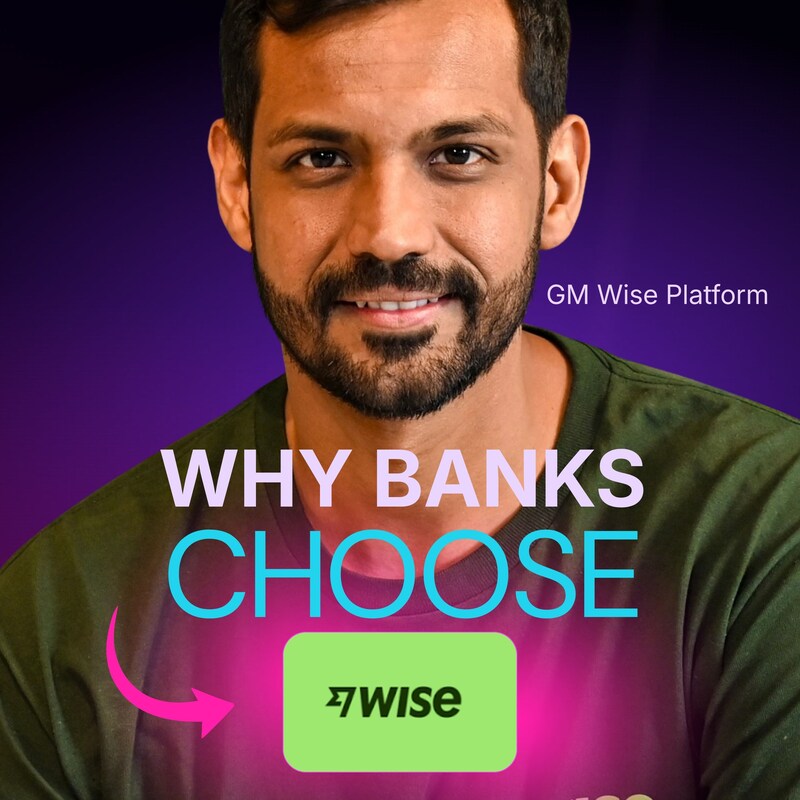
In this episode recorded live at Money20/20 Asia, I speak with Samarth Bansal, General Manager at Wise Platform.
We go behind the scenes and I ask the questions I’ve always had hypothetical answers to. For years my mandate as a Neobank Product leader was to beat Wise, and I knew unless we were to change our business model to properly compete, the answer is we can’t.
But now, FinTechs and banks can partner with Wise through Wise Platform. It’s a fascinating conversation!
We cover:
[01:00] How Wise approaches cost efficiency: the obsession behind the pricing model
[02:30] What actually drives Wise's infrastructure advantage
[04:30] Going direct into local payment rails and optimising treasury FX forecasting
[08:30] How embedding Wise Platform made life easier for banks and their customers
[09:30] Standard Chartered, Bank Mandiri, Morgan Stanley: who's using Wise Platform and why
[17:00] How Wise prioritises market expansion, and what drives corridor decisions
[19:00] Instant payment rails in APAC: PayNet, PromptPay, and what sits on top
[21:00] How Wise achieves sub 20 second transfers: compliance, liquidity, and rail access
[23:00] Where AI fits, and where Wise is being deliberate about deployment
[25:00] Why APAC will redefine global cross border payments standards within three years
👉 Follow Samarth:
LinkedIn: https://www.linkedin.com/in/samarthbansal/
Website: https://wise.com
👉 Connect with Monica
LinkedIn: https://www.linkedin.com/in/monicamillares/
YouTube: https://www.youtube.com/@moni_millares
TikTok: https://www.tiktok.com/@moni_millares
Production and marketing by Monica Millares. For inquiries about sponsoring the podcast, email Monica at [email protected]
Disclaimer: This episode does not constitute professional nor financial advice and does not represent the opinion nor views of my current, past or future employers. The guest has agreed to record and release our conversation for the use of this podcast and promotion in social media.
Transcripts
Wise. Audio Only. Edited v1.2 Static Background. Picture
===
Samarth: [:So we are always, always going to be solving problems on the cross border And that gives us a competitive advantage, which means that you can as the CPO of a Neobank, as a FinTech, not worry about cross border payments. We take that off your plate
Monica: hi, Samarth. It's an absolute pleasure being here in Money 20/20 speaking with you guys, with you .
Samarth: Monica, I have been waiting for this. I'm super excited, but also you stole my line. It is an absolute privilege to be sharing the same podcast that you are hosting.
Monica: Thank you. And [: ch as we know it today around:And I'm like, "We cannot beat Wise." I'm like, and many times that's been my mandate yeah. "How do we beat Wise?" I'm like, "No, we cannot" right. "We just cannot have better effects than Wise" yeah. So that's the topic that we want to explore today, that it's like if you cannot beat Wise on effects, well, let's partner with Wise now, which is cool
yeah. Right? So [:Samarth: Sure. I can spend some time on that, but the one thing I do wanna call out is, Monica, it warms my heart. It really, words coming, you acknowledging that it's hard to do and solve the problems that we have solved is incredible because you've been an operator, you've been building- Yeah
in this space, and you face a lot of the hard challenges that we face as well. Right? Yeah. So incredible. Thank you for that.
Monica: Thank you.
Samarth: Maybe, to- to just take a step back on, I'll try and break this down into two parts, right? One is, what have we done differently? So what is Wise doing that makes us so competitive on the FX side, and why so many fintechs want to try and replicate or are trying to find the same answer?
ner and power a lot of these [:And how do we help build this efficiency and reduce our cost base? So fintechs - We've had numerous cases where some of these, in order to build volume, will charge slightly lower, will start, giving offers and discounts to their customers. But where it starts getting real is to try and do this for 12 months, for a year, or for two years, or three years.
Yes. This is the hard thing.
Monica: Yes.
Samarth: And what has enabled us to do this is, one, we set the why very clearly. So we set the why as saying we want to keep dropping prices. And the only way you can keep dropping prices is by keep reducing your costs, right? By, by building more efficiencies.
y team that you work with at [:And a big important factor there is just the investment that we made in our infrastructure. So the quality of our infrastructure, is, I think I'm very proud of saying very few have replicated that. Yes. That is because it is a combination of, one, going direct into the local payment solutions. And second, we spend a lot of time in optimizing our treasury FX forecasting, as well as looking at what is causing customer contact.
ach means there's a customer [:So it, it is a lot of hard things that we just focus and keep our heads down .
Monica: Now that you say customers and call center, I will go off script 100%. Don't have to answer it if you don't want to. So I'm a Wise customer since many years ago.
Yeah. And once in a while, I do my monthly transactions- Yeah ... 'cause I do a few, and then I get a- an email that says, "Hey, Monica. Here's," I don't know, like, "$5 back," or something back. And I'm always, like, coming up with all these hypotheses on why could have you given me extra money.
e FX, there was some savings [:Yeah. So it's like, what's happening there?
Samarth: The answer is we're just becoming more efficient, and so the more efficient- Oh ... we, uh, we end up dropping prices for customers, and there are ways in which we give this price drop back to customers, right? It could be post the transaction. It could be basis the customers that you've helped refer, hopefully bringing customers on board to Wise with.
As well as just price drops that we do. So One thing that as a consumer I love about Wise is, I don't know if you've seen these emails when we do price drops. We actually send you an email that says how much you will end up saving based on your previous transactions because of those price drops.
Monica: I love the user experience in the you know what? Now that you say that, I send money every month. Yeah. I don't look at the FX rate- Right ... because I don't remember. Because the amount that I send is fixed.
Yeah.
So I'm like, [:Yeah
previous month versus this month? I'm like, yes. Yeah. It's cheaper. Send it now. But yeah, that experience is- Yeah ... it's what makes a big difference. So what was going on through the leadership's team mind when you decided, we've seen enough use cases where banks are basically referring customers to download Wise, it's time to take this as exploration, and then go and build Wise platform?
Samarth: Sure. Do you like stories?
Monica: Yes. Okay. Come.
Samarth: So maybe I'll start with, how we chanced upon this, and then completely honestly and transparently, this is something that we weren't planning for. We saw something change, and then this was an outcome of what we saw change.
lot of Hungarian customers. [:Did we do anything differently that's suddenly given us this growth?" And we realized by speaking with customers that there was a bank, that was the tellers of the bank were actually referring their customers to not do the transaction, not send money through the bank, but to download the app and to send it through Wise.
So these are bank employees who are telling customers that are walking into their branch to do a remittance and saying, "Guys- Mm-hmm ... it is just better for you to download Wise." Some of them helped them through the KYC and got them to do transfers. So this was what we saw, and I think the beauty lies in what we did afterwards.
nderstand why are they doing [:Where is my money? Why was X, Y, Z amount deducted?" Is the teller has to now answer these questions. And most of the times they'll say, "I don't know." Exactly. So in a small country like Hungary, that matters quite a lot. And then the second thing was by us embedding our infrastructure in banks, it made it a lot easier for these customers to access the same benefits without having to download a new app, without having to do KYC, et cetera.
's broken in the traditional [:We want to be where customers access their finances, and they tend to be banks, large online platforms, and we are embedding ourselves there.
Monica: Yes. And it's a beautiful growth strategy as well because we know acquiring consumer customers- Right ... it's mega expensive. So now you go where the customers are. And that's it.
grated with a partner. Yeah. [:whomever gives me the cheapest. Then let's say as a CPO, why would I go and say, if I already have my two or three partners, why should I add Wise platform? Right.
Samarth: So I think you're right, and maybe what the one thing that I'll start by saying is over the last two, three years, we've find ourselves in this sea of sameness.
Everyone sort of looks like the same thing, is talking about the same stuff. But I think payments is one of those things where the details really, really matter. Yeah. You cannot just make general statements. You need to be very, very specific, and I think this is where we stand out.
So you can name the currency corridor, you can name the recipient bank, and we would be able to tell you X percentage of these transfers reached instantly, which we measure as less than 20 seconds.
Monica: Yeah. [:Samarth: We have success rates of Y percent on this currency corridor, and the top three drivers of failures are one, two, three, four things, and this is how we can solve it.
So we are... We go into a lot of detail in being able to benchmark whether or not our product is doing well and keep investing and iterating on it, right? So that I think is one where we get very specific as opposed to talking about just generalizations
Monica: yeah.
And as I hear you speak, I'm like, obviously, that's the, that's the Wise principle. Right. You know? Like if... And I'm assuming you're doing it, like the consumer product is so good. Yeah. It's, to me, it's just like the best.
Yeah. That's it. But then if we use the principles that Wise has used to make the best consumer product, but we apply the same principles in B2B, then it's just a matter of time that you win everybody's business, and you're the best as well.
Samarth: I think this is what's driven a lot of our partnerships, right?
So [:Monica: Yeah.
Samarth: And they want to lead by having a partner that can give them coverage, that can help reduce their operational cost, but more importantly, help them acquire customers from the incumbents.
And, Flip, MOX, ZA Bank, all of these are great examples of where they integrated with us, and we helped them from day one get global with, a very high customer NPS score, acquisition score, et cetera. On the other side, you have incumbents who end up wanting to retain these bank customers, right? So, Mandiri is a great example of this, which during COVID, their entire offline network was obviously couldn't function for cross-border remittances, and so they wanted to do 24/7 digital remittances, and we've enabled them to do this.
they've managed to therefore [:Per month. It's retention. Yeah. The moment a bank is able to retain that customer, you can do so much more with them, right? The lifetime value of that customer is so much more than just the remittance
Monica: yeah.
Samarth: So we see these two things, and I think more broadly, I've been reflecting on this as we've scaled with our partners and spoken with a lot of partners very transparently, and I think it boils down to one thing.
t we can get by just working [:So we are always, always going to be solving problems on the cross border Yeah. And that gives us a competitive advantage, which means that you can, as the CPO of a neobank, as a fintech, not worry about cross border payments. We take that off your plate so that would be my pitch.
I, I know you don't need to be sold to, but that's my pitch.
Monica: No, but that is like I don't need to be sold to as a consumer. Yeah. But as a CPO, I'm like, "Yeah, why, why should I... We should have put my resource to do this," you know? But it's like, but it's a really good pitch. Like what you said at the end, I'm like, "Sounds good."
I'm like, "Tell me more." It sounds good. So I want to change topics because then it's like I want to talk about the region, APAC. Yeah. Yeah. APAC is 20% of Wise's, Wise platform, right? Of
. Oh, that's many questions. [:what makes you choose... Because market expansion is hard. Yeah. What makes you prioritize one market over the other?
Samarth: I won't offend markets, but no. Jokes aside, I think for us we... If you think of, there are two types of essentially customers that we look at, right? So we have the retail or business customers that come directly to Wise, want us to open up a new currency corridor, offer a new feature, and we get a lot of this feedback directly.
So customers, when they're filling out their NDS forms, will tell us very specific things, "I want you to open this currency corridor."
Monica: Oh, okay.
erm view is we want to be in [:We wanna be present everywhere. But there's a lot of time and investment
so we then prioritize based on customer demand. So that's what we do on the consumer or the direct-to-customer side. On the platform side, we look for partners that are thinking of cross-border remittances in a very similar manner to us, right?
So if there are very clear pain points that they have, if they want to go from offline to 24/7 digital, if they want the efficiencies of one currency corridor to another, we find ourselves in a privileged position where we are sort of marketing right? So two days back, we launched, the largest bank in South Africa. Cool ... uh, and we managed to launch this with the largest bank, with 25 million customers.
Monica: Congrats.
Samarth: Yeah. And, we launched in Philippines with GoTyme , Malaysia MBSB . Yeah. But our initial traditional bank, the first traditional bank we launched was in South Korea, with Shinhan, right?
there are, there is value we [:Monica: So then coming back to... Because now that we understand, like, how you prioritize markets, then, like, what is making APAC different to, let's say, Europe, or even LATAM, because LATAM is also booming.
Yeah.
Samarth: I would say between Europe and LATAM, APAC is a lot similar to LATAM.
Monica: Yes.
Samarth: And I think the main things that I see, which is driving, I think we're growing, 22% rapidly year on year in APAC. The main thing that I'd probably try and call out is there are three things that we look at. One is consumers and businesses in APAC generally are very intertwined between markets.
his region. The second thing [:So they do this domestic payments are instant. They start expecting that across border payments. Whereas in some other markets, this is not today the norm. There is still some friction. There's D plus one or whatever. There is friction in you sending domestic payments. And third is, a lot of the population here is very digitally- Yes
and this is, extremely strong tailwind for the growth of the business. I think these three coming together is one of the reasons why I'm very excited about the growth that we have ahead of us in APAC, and also the growth that we managed to get so far.
Monica: Yeah. And then just to add to APAC, APAC has these instant payment rails that we may not see in other parts of the world, uh, PayNet, PromptPay.
How much are you... How do they fit in your ecosystem?
he way that I would think of [:You need to do the FX to manage that risk. So we do work and build on the innovation that we see in the instant payment rails in all of these markets. And we do that in two ways. One is we get direct access to these rails. Mm-hmm.
We just recently announced Japan.
Monica: Nice.
Samarth: And getting access to instant payment rails, which then improves our infrastructure by, leaps and bounds. And then the second thing that we do is we work with partners to help build redundancy
[:So you've been talking about efficiency. That's more, from cost and operations is the other. But, like, how do you keep improving speed?
Samarth: That's a mystery to me as well.
Monica: I'm like, I'm like, how?
I
Samarth: genuinely get very amazed by when we see that we've gone from... I remember when I first, joined TransferWise, I think it was a few years back, and 75% and to where we were then is incredible.
We've just moved in one way, right? We keep making transfers faster. And I'm an engineer by my undergrad degree, so I try and take problems and break it down into these small buckets, right? Yeah.
Monica: Me too. If you take
Samarth: a transaction from point A to point B and you've crafted out every step that needs to be done, we try and make these steps be done more efficiently and in parallel, right?
technology to be able to run [:I need to know that so that I can keep MYR liquidity to be able to do that payout. For that, I need to invest very heavily in forecasting and knowing how much liquidity needs will be there in those markets. So that's one big area that our treasury and treasury ops teams are focused on ensuring that we are, not slowing down payments because of liquidity, right?
the infrastructure. So very [:Monica: Yeah. And then curiosity question as well. Like, you, you said it takes, X seconds or microseconds. So I'm assuming while many people in the industry are trying to automate and using AI, like Wise is like to have, you know, like many things must be automated and using AI right now. So what is your take in,
What are you guys doing in change of ways of working to make everything even more efficient? I'm like, oh my God, if it's already efficient and then they are going to add AI, they'll go even more efficient, or you already have AI embedded everywhere and then it's marginal games, I think we'll
Samarth: probably be on somewhere on that spectrum, right?
hink the main thing that, it [:So finding these inefficiencies, to your point, becomes harder, but the technology keeps pace. So we try and keep seeing new ways in which we can solve this. It could be an engineering problem. It could be how you're architected your infrastructure. It could be using AI. It could be just creating simple workflows.
There are multiple ways in which we can continue building this efficiency. I think the biggest uplift is going to be when more and more instant payment rails, allow for fintechs, banks, non-banks to get direct access. I think that's gonna be the step change. That is going to move the needle quite, quite a lot.
Monica: Okay. So as we are reaching towards the end- Yeah ... you- Already
Samarth: this has been, uh-
ast is always the leadership [:But anyways, so in the past you've said APAC will redefine how we do international payments, cross-border, uh, remittances globally within three years. What... One is like, why? Two, what needs to happen for that to be true?
Samarth: Yeah. I think, um... And we had already seen this, right? So we see the number of conversations outside of APAC where we walk into these conversations and we say, "Hey, you know what?
You can send money from your currency corridor to some other currency corridor instant, in less than 20 seconds." And they're like, "Wait, I thought instant was always two hours or three hours and doesn't work on 24/7 and cannot be done on weekends," right? And that's just... And if you went to someone in APAC, they'd be, "Yeah."
hether those are- Mm-hmm ... [:So, like, this is something that, I, I think I have a small role to play, but in APAC I'm very proud, right? Like that we have, set the standards and continue setting the standards for what instant cross-border pay- instant payments and low cost payments would look like. I think what needs to change is two things.
One is, I, I think a lot of large partners today think of cross-border payments as just something that works, right? Like, they haven't gotten into the details to really understand what is the impact, how many customers have left them because they were suddenly charged a fee that they had no idea about.
ter. More and more banks and [:They need to continuously invest and understand and go deep and understanding what are the use and their costs. So I- I've started seeing the amount of conversations that I walk in, and they've already got the data on saying, "You know what? My failure rates- Yeah ... on cross-border payments is X, Y, Z. I'm seeing this kind of, failures come up.
Is this something Wise can solve?" And that's a brilliant starting point, right? Like, it, it goes beyond just, "Yes, I think I need to do something cross-border payments," right? They've gone, they've looked at the data, they understand what is going on. So that's one. The second thing I think that, will accelerate this, and we've already seen, this, is just more and more domestic payment schemes, becoming instant and opening up access to more and more layers.
saying, "Oh, yeah, you guys [:Monica: Amazing. Samar, it's been an amazing conversation, but I want to summarize. So we say, okay, basically Wise is efficiency play. Yes. That's it. Domestic rails. Right. APAC market. Boom. Winning combination.
Yeah. That's it. It's like, that's it. The hard bit is, like, how do you leverage... Wise is a very large company, so it's like how do you leverage the capabilities, the infrastructure, the relationships, the knowhow, all those details. The devil is in the details. It's how it all comes together, and that makes Wise special.
do this with the technology [:Monica: Cool. Amazing. So everyone, now you have the answer to how Wise operates. Thank you so much. It's been a pleasure. Thank you

