Shownotes
Audio • Season 1 • Episode 11 • Series 1 Episode 11 - Reformation, without Tarrying for Any. (Transcript added).
© 20 26 The Rise of the Protestants., Author, Shaughan Holt.
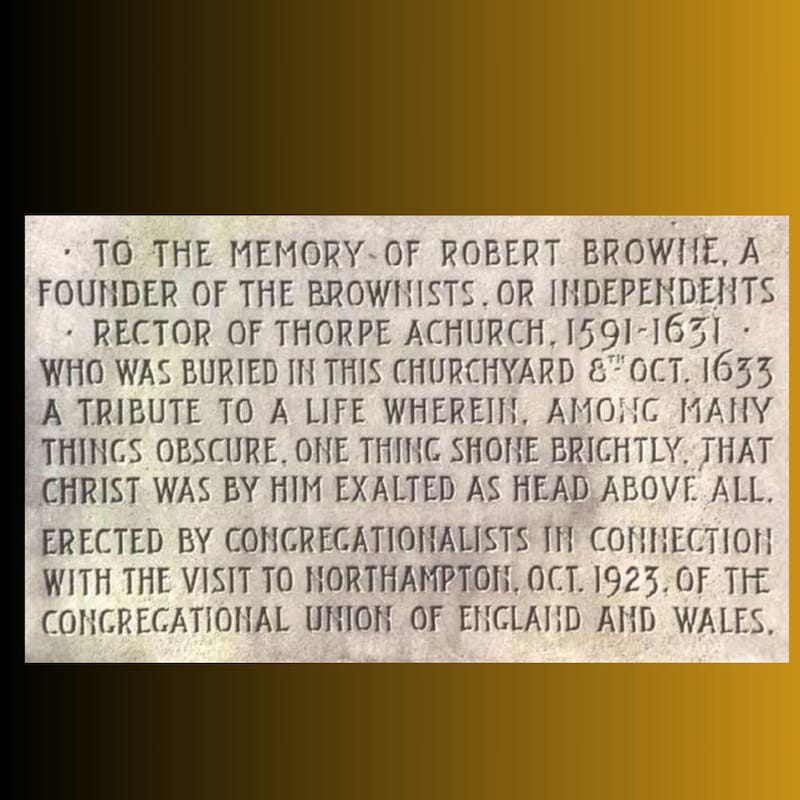
The artwork is a commemorative stone located in the churchyard of St. Giles in Northampton, part of a memorial dedicated to Robert Browne.
The music performed is "This Is the Record of John," arranged by Nico Muhly and played by the San Francisco Symphony Orchestra.
This verse anthem was composed by Orlando Gibbons (1583–1625) and is an Anglican-style piece that draws inspiration from a passage in the Gospel of John from the Geneva Bible. When sung, the lyrics are taken from the Gospel of John in the Geneva Bible, and the composition reflects the distinctive Anglican style that was prevalent during that time.
In late 1581, Robert Browne's congregation, known as the Brownists, was compelled to relocate to Middelburg in Zeeland. Middelburg, a medieval walled city in the Zeeland province of southwest Holland, was a refuge for fleeing Puritans.
After unsuccessful attempts to reform the English Church in Middelburg, Browne shifted his focus to the stronghold of Presbyterianism in Edinburgh, Scotland. While Scottish Presbyterians may have agreed with him theologically, they did not share his views on church organisation.
Upon returning to England, Browne had to confront the consequences of his actions again. Robert Browne was an active Separatist from 1579 to 1585, after which he returned to the Church of England.
Following Browne's compliance in 1587, the Brownist movement revived in London. Henry Barrow and John Greenwood led this revival, both of whom were arrested and placed in custody. While imprisoned, they secretly authored numerous books on Brownist theology and engaged in passionate polemics against perceived societal injustices.
In the early 17th century, John Robinson and John Smyth established religious communities in northern England known as Brownist congregations.
© 20 26 The Rise of the Protestants., Author, Shaughan Holt.
"All rights reserved. No part of this podcast may be reproduced, translated, distributed, or transmitted in any form or by any means, including photocopying, recording, or other electronic or mechanical methods, without the prior written permission of the copyright holder, except in the case of brief quotations embodied in critical reviews and certain other non-commercial uses permitted by copyright law".
Requests regarding translation, licensing, or republication should be directed to: [email protected]
Your feedback matters, send me an email at [email protected], with any comments, suggestions, or criticisms.I read every message.
Transcripts
© 20 26 The Rise of the Protestants., Author, Shaughan Holt.
"All rights reserved. No part of this podcast may be reproduced, translated, distributed, or transmitted in any form or by any means, including photocopying, recording, or other electronic or mechanical methods, without the prior written permission of the copyright holder, except in the case of brief quotations embodied in critical reviews and certain other non-commercial uses permitted by copyright law".
Requests regarding translation, licensing, or republication should be directed to: [email protected]
Your feedback matters, send me an email at [email protected], with any comments, suggestions, or criticisms.I read every message.
Series 1.
Episode 11.
Reformation, without Tarrying for Any.
Middelburg was granted a town charter as early as 12 17, due to its favourable geographical location, and its import monopoly on spices, silk cloth, and French wines.
By the 16th century, it had become a prosperous trading city with a population of approximately 30,000.
The impressive town hall can be seen on the market square, in front of it stands the Onze-Lieve-Vrouwe Abbey, which includes the Choir Church, dating back to around 13 00, and its 85-meter-high tower.
The year is 15 81.
In late 15 81, Robert Browne's congregation, now known as the Brownists, was forced to relocate to Middelburg in Zeeland.
Browne wrote to them from his prison in London, expressing his opposition to their emigration and his decision to remain in England after his release.
Middelburg, a medieval walled city in Zeeland province in southwest Holland, was a refuge for fleeing Puritans.
Protestants, fleeing religious persecution in Europe, established this sanctuary, enabling them to practice their faith freely for centuries.
The town's strategic location, just eight kilometres from the main trading port of Vlissingen, provided a convenient sea route, to and from England.
During the Eighty Years' War, it often garrisoned English soldiers.
At this time, English traders and their families had established a strong presence in the region while working for the Dutch East India Company.
Harrison and his congregation deliberately chose Middelburg, knowing Cartwright had already founded a Puritan congregation in Zeeland.
Initially, it seemed Robert Harrison's congregation would align with the established Puritan colony at Middelburg, where Cartwright served as its minister.
However, in July 15 81, shortly before the Brownists arrived, Cartwright transferred to Antwerp, succeeding Walter Travers as Chaplain to The Merchant Adventurers Company.
Harrison wrote calm, though not entirely convincing letter, inviting Cartwright to return, and join them in Middelburg, but Cartwright did not respond.
Sensing the potential impact of Browne's influence, Harrison soon retracted the invitation.
In England, several Puritan factions began to express their disapproval of the Brownists' decision to leave for Zeeland.
They viewed this departure as a betrayal of the true Church and as an act of disrespect towards their Sovereign, Queen Elizabeth.
The Brownists, however, contended that their migration was necessary due to the persecution and imprisonment they faced.
They maintained that it was their persecutors, not themselves, who had abandoned the true Church.
In early 15 82, despite initially desiring to remain in England, Browne experienced a change of heart and decided to reunite with Harrison and their congregation in Middelburg.
Upon his arrival, the two men agreed to establish a Church, based on their interpretation of the New Testament model.
The provincial capital, Middelburg, sits at the heart of the Walcheren.
Once an island, Walcheren is now a region in the Dutch province of Zeeland, located at the entrance to the Scheldt estuary.
The main port of this area is Vlissingen, which is located 9 kilometres to the south.
Due to its strategic location between the Scheldt River and the North Sea, Vlissingen has served as a significant port and naval base for hundreds of years.
Historically, Walcheren was an island; however, it became connected to the former island of Zuid-Beveland following the construction of the Sloedam in 18 71, which facilitated a railway and lowland reclamations.
Unfortunately, it wasn't long before Harrison and Browne's friendship and collaboration began to show signs of strain.
Robert Browne was highly unpredictable, and their disagreements, along with conflicts with the congregation, ultimately led to a split in the Church.
Later In 15 83, Browne published an account of his time at the Church in Middelburg, in a book titled "The True and Short Declaration".
By this time, Harrison and most of the congregation had become estranged from their pastor, and when Browne fell ill, they secretly plotted against him.
The Zeeland group elected Harrison as their leader because he aligned more closely with their deeply held religious beliefs, effectively voting Browne out of his own congregation.
In private, Browne confronted Harrison, warning him that he had evidence against him which he could reveal if Harrison chose to speak out.
Browne also called Church meetings where members of the congregation could freely voice their accusations against him.
During these meetings, they claimed he was an unlawful pastor and even made petty remarks about his privileged background.
Although Browne resigned, he was later reinstated.
In an open meeting, each member admitted their faults.
However, Robert Browne's Church continued to condemn him repeatedly, leading to whispers and rumours about him.
He was accused of various heresies.
As a result of this division, Harrison decided to remain in Middelburg, while Browne and a portion of the community began searching for a new settlement location.
During his two years in Zeeland, Browne published three treatises to express his views.
These works were released separately in Middelburg, with Robert Harrison's generous backing, before eventually being compiled into a comprehensive edition several years later.
They were:
1. A Treatise of Reformation without Tarrying for Anie.
Browne presents his concept of the separation of Church and State in this small tract.
His purpose in writing the book was fourfold.
To counter the many allegations against the Brownists.
To clarify the roles of Church and State.
To urge for the immediate Reformation of the Church.
To condemn, those preachers who evade their responsibility for reform, by claiming dependence on secular authority.
2. A Treatise upon Matthew 23.
This is perhaps Browne's most thought-provoking work.
Outwardly, it discusses how to handle the Scriptures in preaching, criticises contemporary preaching, and compares it to the practices of the Scribes and Pharisees, particularly referencing Matthew 23 : 23.
"Woe unto you, scribes and Pharisees, hypocrites! For ye pay tithe of mint and anise and cumin and have omitted the weightier matters of the law, judgment, mercy, and faith: these ought ye to have done, and not to leave the other undone".
However, it is much more than just a criticism of the day's preaching.
It urgently calls for a preaching style, as exemplified by Jesus, who spoke with unwavering authority.
According to Browne, church preaching is often misguided and lacks vigour.
The pride of Cambridge graduates is evident, as they stand in the pulpits, resplendent in their scarlet gowns and hoods.
They preach primarily, to showcase their learning, only seeking personal advancement.
3. A Book which Sheweth the Life and Manners of all True Christians.
In this work, Browne outlines his theory of Congregational independence.
The treatises were published both individually, and later as a combined volume.
When the publications arrived in England in June 15 83, Queen Elizabeth issued a stern proclamation, expressing her disdain for them.
Later that month, Elias Thacker and John Coppin were hanged at Bury St. Edmunds for distributing Brownist materials.
As early as 15 76, Coppin refused to have his child baptised by an "unpreaching minister", and also declined to have godfathers and godmothers.
However, their role as sellers and promoters of Browne's pamphlets, led to them being regarded as the first martyrs of Congregationalism.
The United Reformed Church in Whiting Street, Bury Saint Edmunds, has a memorial to the martyrdom of Elias Thacker and John Copping, hanged in 15 83 for distributing Puritan literature and advocating for religious independence.
The United Reformed Church in Whiting Street, Bury Saint Edmunds is one of the earliest Separatist churches in England.
The memorial was erected in 19 04 in the grounds of what was then a Congregational Church.
Cartwright had already read these publications during his time in Antwerp and strongly disagreed with their content.
This suggests that the two individuals in Middelburg would have minimal or no interaction.
Cartwright opposed Separatism and, like many other Puritans, believed that the Church of England needed to undergo internal reform.
The year is 15 84.
After unsuccessful attempts to reform the English Church in Middelburg, Browne now shifted his focus to the stronghold of Presbyterianism in Edinburgh, Scotland.
In 15 84, he departed from the port of Vlissingen in Zeeland, severing all connections with what had once been his Church.
Accompanied by his pregnant wife and a small group of loyal followers, he set sail for Scotland.
He carried a letter from Andrew Melville and travelled from Dundee to St. Andrews before proceeding to Edinburgh.
He aimed to establish his base in Canongate, a burgh just outside the city walls near Holyrood Abbey.
The name "Canongate", originates from the pathway the Canons of Holyrood Abbey, used to take, to reach Edinburgh.
Browne's primary focus was on the Church of John Knox, as he believed it lacked proper discipline.
On 21 January 15 84, he argued that “the entire system of governance in Scotland was flawed” and appealed for reform to the authorities.
Regrettably, Browne had miscalculated the circumstances; Presbyterianism was not receptive to his proposed changes.
While Scottish Presbyterians may have agreed with him theologically, they did not share his views on church organization.
The authorities of the City Church, summoned Browne to explain and clarify his religious writings.
Initially, they placed him under house arrest, and later transferred him to the common jail.
They also sent a report detailing his heretical beliefs to the English King.
However, the local civil authorities, who were not supportive of the Church, released Browne; otherwise, he could have stayed in custody for some time.
After being released, he departed from Edinburgh and embarked on a journey across Scotland, actively searching for individuals to convert to his cause.
However, Calvinist Scotland was not receptive to his new religious message.
Browne graced a few more Scottish jails and prisons during his travels there.
Despair, jail time, and declining health eventually led him back to England.
Later, he would express a rather pessimistic view of Scotland, suggesting that the role of a Presbyter could easily be substituted for that of a Pope or another similar overbearing Church figure.
The poet Milton may have been influenced by his remarks when he wrote; “New Presbyter, is but old priest, writ large”.
In his Poem “On the New Forcers of Conscience under the Long Parliament”, Milton condemns the hypocritical clergy and advocates for religious freedom.
The Canongate Tolbooth stands as an iconic marker of history in the Old Town district of Edinburgh.
Established in 15 91, it served as a tolbooth, the administrative and judicial hub of the then independent burgh of Canongate, which lay beyond the boundaries of Edinburgh's town walls.
In 18 56, its role as a municipal structure concluded, and it is currently the home of The People's Story Museum.
Its significant historical value has earned it the status of a Category A listed building.
To the east of the tolbooth, down the Royal Mile, is the Kirk of the Canongate and the Canongate.
When Browne returned to England, he had to confront the consequences of his actions once again.
He arrived back during the summer of 15 84 and stayed in the family homes of Tolethorpe and Lilford, where he resumed his writing and publishing books.
However, this led to his arrest, though he was released with the help of his Elmes relatives at nearby Lilford Hall, and the politically connected Baron Burghley.
By 15 85, Browne seemed to have exhausted himself, becoming ill both physically and mentally.
The Bishop of London and the Archbishop of Canterbury now took action against him, concerned about the unlawful distribution of his writings.
They moved to arrest Browne and committed him to prison, specifically citing the Proclamation of 15 83, which banned seditious, schismatic books and libellous materials.
In 1 586, Robert Browne's health gradually improved, and due to insufficient evidence, the Church authorities transferred him from prison back to the Lilford family residence.
By early spring of 15 86, he had recovered enough to begin preaching without a license again.
Bishop Howard of Peterborough charged him with illegal preaching and writing.
However, Browne ignored the summons, refusing to appear in court, which led to his excommunication.
Robert Browne now faced a critical decision, - either conform to the Church of England, or continue to face persecution and imprisonment.
Choosing the latter, would undoubtedly subject his long-suffering wife and their six children to a life of poverty, and likely homelessness.
The year is 15 86.
The excommunication may have triggered his change of attitude, leading him to seek the Bishops absolution in 15 86.
To the absolute dismay of his followers, he chose conformity, agreeing to follow the Church's rules, attend his local parish regularly, and publicly recant his previous beliefs and writings.
Browne's freedom in England and the safety and well-being of his wife and family may have mattered more to him than half-heartedly recanting his theological principles to the Church authorities, although the true reasons for his actions still remain unclear.
With the likely help of his relative Lord Burghley, Browne was finally reconciled with the Church of England.
In 15 86, after renouncing his earlier beliefs, Robert Browne was appointed Headmaster of St. Olave's Grammar School in Southwark.
Although he returned to his previous position, signs of potential regression began to emerge.
For example, in October 15 87, a Brownist conventicle was discovered near Southwark, leading to the arrest of its pastor and several members.
This congregation comprised former members of Browne's Middelburg congregation.
The leader of this group, Reverend John Greenwood, was connected to Henry Barrow and the Barrowist movement, which means that Browne was not directly associated with this particular congregation.
Robert Browne was only an active Separatist from 15 79 to 15 85, after which he returned to the Church of England.
Upon his return, he continued to engage in disputes and debates with those who remained steadfast in their separatist beliefs, and they began to see him as a renegade to their cause.
Browne, in particular, responded several times to criticism from John Greenwood and Henry Barrow.
One of his responses, titled "A Reproofe of Certaine Schismatical Persons and their Doctrine," dated from 15 87 to 15 88, sheds some light on the evolution of his later views.
However, London was still a centre for various Separatist congregations, to which Browne would naturally gravitate.
Given the circumstances, therefore, Lord Burghley decided it would be best to remove him from London.
With Burghley's support, Browne was appointed Headmaster of Stamford Grammar School from 15 88 to 15 91, when he transitioned significantly from rebel to accepting conformity.
After his time at St. Olave's, Browne was offered the benefice of the parish Church of, A-church Cum Thorpe, by his cousin, Thomas Elmes of Lilford.
He served in this position intermittently from September 15 91 until 16 33.
A-church Cum Thorpe is located next to Lilford in Northamptonshire, where Browne's cousin Elmes resided.
Thomas Elmes had helped Browne resolve legal issues multiple times, as he had faced imprisonment thirty-two times throughout his life.
A widower for some time, Browne had remarried by this point.
During his time as Rector at A-church, Browne experienced several gaps in his service, the longest lasting from 16 15 to 16 26.
During this period, he resumed some of his earlier dissident activities and stayed with his Elmes relatives at Lilford Hall, where he performed various duties at Lilford Church.
Browne returned to his role as rector at A-church in 16 26.
From 16 18 until his death, he continued to express non-conformist views at The Chapel in nearby Thorpe Waterville.
In 16 32, his cousin and benefactor, Thomas Elmes, passed away, which seems to have led to financial difficulties for Browne in his last couple of years.
He lived and preached at The Chapel until his arrest in 16 33.
In 16 33, Browne found himself in an argument with the constable of the Lilford estate, who was also his godson.
The dispute, revolved around late payments, and quickly escalated into a physical confrontation, during which, Browne struck the constable.
As a result, he was arrested for the alleged assault and taken into temporary custody.
During his hearing, Browne's disrespectful behaviour towards the judge, led to an order for his immediate imprisonment.
At the age of around 83, and with no one to support him, he seemingly accepted his fate in prison.
During the reign of Charles I, it was evident that the Church of England--particularly the Diocese of Peterborough--was not receptive to someone holding Browne's views.
Unfortunately, this imprisonment period proved fatal for Troublechurch Browne, who died in Northampton Jail in 16 33 at the age of 83.
Robert Browne, a significant figure in the Elizabethan Church, is buried at St. Giles Church in Northampton.
He is credited with founding Separatism, which had a substantial influence in both Europe and America.
English and American Congregationalists regard him as the originator of their principles of church governance.
Location: St Giles Church, St Giles' Terrace, Northampton. NN1 2BN.
The year is 15 87.
After Browne's compliance in 15 87, the Brownist movement was revived in London.
Henry Barrow and John Greenwood led it, and both were arrested and placed in custody.
While in prison, they secretly wrote numerous books on Brownist theology, and engaged in fierce polemics against perceived societal injustices.
Their followers, covertly smuggled their works out of prison, and later published them in Holland.
One of their most significant publications was Barrow's "A Brief Discovery of the False Church”.
In an attempt to curtail the movement's influence, the authorities apprehended many Brownists, and a significant number tragically died while in captivity.
Francis Johnson, a Puritan clergyman, was tasked with destroying Brownist literature, but he secretly saved one book for himself, transforming his beliefs.
Another wave of Brownism emerged due to Archbishop Richard Bancroft's campaign against Puritanism in 16 04.
In the early 17th century, two individuals named John Robinson and John Smyth, established religious communities, known as Brownist congregations in northern England.
Later, in 16 08, they relocated to Amsterdam, marking the height of the movement.
Three significant Brownist churches coexist peacefully in a single city.
Henry Ainsworth played a crucial role in co-leading a church in Amsterdam, later known as the Ancient Church.
However, a split occurred when Smyth broke away from Brownism to establish the first Baptist church.
In response to these developments, John Robinson moved his church to Leiden, while Francis Johnson and Ainsworth disagreed and eventually formed separate congregations.
Johnson's faction opted to migrate to Virginia, yet only a handful of congregation members survived the journey and managed to return.
Meanwhile, Smyth joined the Mennonites, while Thomas Helwys led a group of Baptists back to London.
A small group of Robinson's church members also boarded the Mayflower and sailed to New England.
These events highlight the diverse paths that early Protestant communities took, as they sought to establish their congregations, and find religious freedom in different parts of the world.
