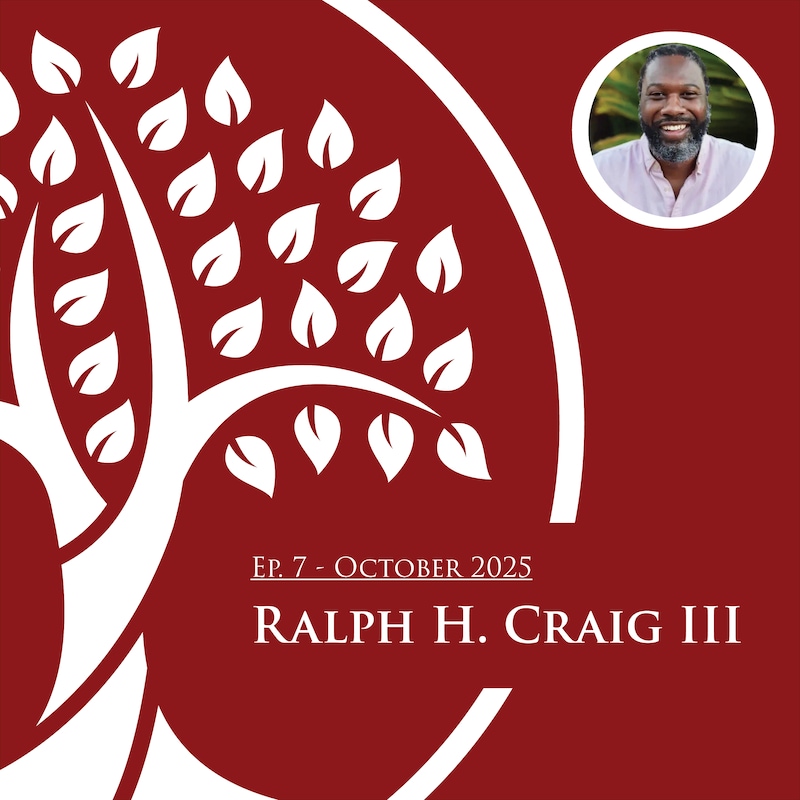
Shownotes
Ralph H. Craig III talks about crafting constructive analogies between Christian and Buddhist liturgies, characterizing the ideal preachers (dharmabhāṇakas) described in Mahāyāna sūtras, and Tina Turner’s contributions to Buddhist pedagogy.
Ralph H. Craig III is an interdisciplinary scholar of religion, whose research focuses on South Asian Buddhism and American Buddhism. He received his B.A. in Theological Studies at Loyola Marymount University and his Ph.D. in Religious Studies at Stanford University. His research interests include memoir, race, popular culture, yoga/meditation theory, religious experience and authority. He works with textual materials in Sanskrit, Pāli, Buddhist Chinese and Classical Tibetan. His work has appeared in the journals American Religion, Buddhist-Christian Studies, and the Japanese Journal of Religious Studies; in Lion’s Roar and Tricycle magazines; on the American Academy of Religion’s Reading Religion website; and the 84000: Translating the Words of the Buddha. His first book was, Dancing in My Dreams: A Spiritual Biography of Tina Turner (Eerdmans Publishing, 2023), which explores the place of religion in the life and career of Tina Turner and examines her development as a Black Buddhist teacher. His next book project is a monograph on preachers in Mahāyāna Buddhist sūtras.
Interview by Miles Osgood.
Transcripts
[Prologue]
Welcome to “The Ho Center for Buddhist Studies at Stanford” podcast. Come join us by the tree.
[music - Ani Choying Drolma, guitar]
One of the primary fixations of many Mahāyāna sūtras is how they will spread, and who will spread them. From the first to the sixth century CE, a title for the ideal teacher begins to repeat itself: the dharmabhāṇaka, or “dharma-preacher.”
Eloquent and creative, skilled as a performer and an exegete, authorized by Buddhas and protected by gods, the dharmabhāṇaka appears almost mythical—so much so that scholars who study dharmabhāṇakas wonder whether these are even real historical figures. But that question itself might be holding us back.
RALPH CRAIG: So I said, “Well, what if we stopped asking a purely historical question and start to think more thematically, and we start to take seriously what Mahāyāna sūtras say about those idealized figures, who would convey them: right, dharmabhāṇakas.” But then I needed language for that. I needed a way to think through these figures. I needed traditions that have a sustained history of studying figures of religious authority, of studying preachers, have language for studying sermons, homilies, right, etc. And that is why I started to look further afield.”
“Further afield” might mean comparing the Buddhist dharmabhāṇaka with the evangelical Christian preacher. But it also might mean leaving the temple or the church altogether, and joining the congregation of a different arena. If the ideal “dharma-preachers” are those dynamic, commanding performers who propagate Buddhism to the biggest crowds, then one of the star dharmabhāṇakas of our time—or, as you might put it, “simply the best”—was Tina Turner, the “Queen of Rock & Roll.”
RALPH CRAIG: Tina Turner spoke about, and considered her life’s mission—from her own words, right? She considered herself to be a dharmabhāṇaka. You know, she didn’t use the language, but she considered herself to be somebody who was using her life and career to spread Buddhism.
[music - Ani Choying Drolma, Oṃ maṇi padme hūm̐]
We’re recording from the Ho Center for Buddhist Studies at Stanford.
I’m your host, Miles Osgood.
My guest today is Ralph H. Craig III, Assistant Professor of Religion at Whitman College in Washington State. Ralph started his academic studies at the New School in New York, majoring in Global Studies at the Eugene Lang College of Liberal Arts, before completing his B.A. at Loyola Marymount University in Theological Studies. He came here to Stanford to do his doctoral work in Religious Studies, with an interdisciplinary focus on South Asian Buddhism and American Buddhism. In twenty twenty-three, he defended his dissertation: “Preachers of the Great Way: The Dharmabhāṇaka in Mahāyāna Buddhist Sūtras.” This will be the subject of his forthcoming monograph.
Ralph is a rarity among scholars in that he also completed a first book during his PhD: a “spiritual biography” on the Buddhist conversion and teachings of Tina Turner, titled Dancing in My Dreams (published by Eerdmans in twenty twenty-three). So we’ll be talking about both that book and the thesis in the conversation to come.
On these topics and others, Ralph has published articles in Buddhist-Christian Studies, American Religion, and the Japanese Journal of Religious Studies, with public essays in Lion’s Roar and Tricycle magazines. Prior to his current position at Whitman, he was a Lecturer at Dartmouth College, and next year he’ll be a Numata Visiting Scholar at Princeton, where he is also a member of “The Crossroads Project” on “Black Religious Histories, Communities, and Cultures.”
For now, we’re glad to have him back at Stanford, and at the Ho Center.
So let’s head into the library.
(bell dinging)
Welcome back and thanks so much for being here.
RALPH H. CRAIG III: Thank you. It's good to be back. And I want to thank you right off the bat for your thorough preparation.
MILES OSGOOD: (laughs)
RALPH H. CRAIG III: I'm very excited.
MILES OSGOOD: Oh, good. Well, no, that's very nice of you, thanks. Well, all right, so let's get into it a little bit. The "dharmabhāṇaka" theme makes me want to ask, as you introduce yourself to our audience, about preachers and teachers, maybe, in your own background, that might have meant something to you on your path to religious studies, turning you on to this field, getting you prepared to be a speaker and teacher in your own right. Who stands out as models of instructors in your past?
RALPH H. CRAIG III: That is a very good question, and as I was thinking about this—I was thinking about, I'm from New Orleans, Louisiana. I was born and raised in New Orleans, Louisiana, and New Orleans has a strong funeral—funerary culture. We have these big "second lines" and jazz funerals, and funerals are a big to-do. And so some of the first people that I was conscious of thinking about as teachers of a kind, as authority figures, as great orators, were actually not preachers but funeral directors. And there were a number of women who were funeral directors, and there were a number of men, and I would—they were just so dignified. And they would—you know that kind of small rows at a funeral in a church. They were kind of a master-of-ceremony kind of thing. And I was always impressed by that. And I wanted to be a mortician. That was my childhood dream. (Ralph laughs) I wanted to go into that. I wanted to—I just thought it was both poignant—I wouldn't have said that as a child.
MILES OSGOOD: Sure.
RALPH H. CRAIG III: But I just—as I got older, I thought it was so poignant, but also a very dignified thing. Aside from that, I knew this pastor, Reverend Murphy, had a big impact on me. He was a very kind of slow preacher, you know? He was kind of methodical, and I was very into that kind of thing. But then there was the home.
MILES OSGOOD: Yeah.
RALPH H. CRAIG III: Right, so there were all these people at home: my mom and... Some of them were educators: my nanny, Miss Blanton, she was an educator. And so these were people who, they would sit and they would do—read the Bible with you. Read, do math problems with you…
MILES OSGOOD: Yeah, yeah.
RALPH H. CRAIG III: ...do all of these things. So, to me, I always saw religious authority,
preaching, teaching, as a part of the same kind of authoritative position holding. And that had a tremendous influence on me.
MILES OSGOOD: Yeah, it sounds like you're meeting folks who are doing exegetical work,
pedagogical work...
RALPH H. CRAIG III: (nodding)
MILES OSGOOD: ...ritual work of various kinds.
RALPH H. CRAIG III: Yes. So you mentioned Reverend Murphy and the funerary rights.
What kinds of denominations were you witnessing, or what kinds of traditions were you witnessing, and were you already a comparativist at that moment saying, "Here's how this church does it. Here's how this denomination does it"?
RALPH H. CRAIG III: I like that way of putting it, a comparativist from the—Yes, because most people in New Orleans are—or many people in New Orleans are Black Catholics, and—but there is a strong, obviously Baptist contingent. And in my own family, the majority of my family is Catholic, but there's a strong missionary Baptist contingent to the family. And there are a few Black Pentecostals in my family as well. So I went to all of them. Whoever's house you were by, that's what church you went to. So you're by your cousins, and they were going to mass: that's where you were going. Or if they were over mass, and we were going to—to Sunday school, that's where we were going. And of course, I was noting the differences as a child. I don't—I wasn't so much thinking formally, comparatively, but I was thinking about the very real differences in the affect, and the actual behavior of congregations. What was acceptable? What—what does the—what is the ritual? What does the liturgy mean in this context? What's expected of me as a—or also my family—as a congregant in one kind of space versus another. In a Catholic setting where you're supposed to stand up, or there's a set ritual, and there is a bodily practice at play, where you stand at this time, and you sit at this time, and you do this and that. Whereas in a Baptist church, you're expected to respond. You know, think of like a "talk-back audience" or "call-and-response audience." So if you sit in a Baptist church, the way you do a Catholic church, and just kind of quietly take it in, the preacher feels that they're doing—something's not right.
MILES OSGOOD: Yeah.
RALPH H. CRAIG III: So all of this I was paying attention to throughout much of my life.
MILES OSGOOD: Yeah, great. So not just the practices of whoever is at the pulpit, but the practices in the pews.
RALPH H. CRAIG III: Right.
MILES OSGOOD: Yeah, absolutely. So tell us a little bit about how then your interest was piqued by Buddhism and maybe the Sōka Gakkai International in particular. How did that come into your view?
RALPH H. CRAIG III: Yeah, I was—I had read the Hermann Hesse novel, "Siddhartha," and that is very—that's an interesting text because it's not really—it's not about Buddhism.
It just uses the Buddha's life as a frame story. But I was very moved by it when I first read it. And the main character said—you know, Siddhartha said, "I can think, fast, and wait." And I was obsessed with that. I would run that line through my mind like a mantra. Anything I wanted, anything I thought about, I was like, "If I can think, fast, and wait, I can do it." Right? And so I went and told my mother, I want to be—I want to learn more about Buddhism. I want to study Buddhism. And my mother was like, "Okay, why not?" Right?
That was the beginning for me, and when I started to research different Buddhist communities in New Orleans, Sōka Gakkai was one of the most prominent. You know, it's pretty small. It's not hard to visit all the Buddhist communities...
MILES OSGOOD: (laughing)
RALPH H. CRAIG III: ...in New Orleans. And Sōka Gakkai was one of them. So that's how I first started to go and learn what they were about. And then I discovered that they have this—this tradition of African American artists, practitioners, kind of major figures: Tina Turner, Herbie Hancock, Wayne Shorter, people like that. But then I also started to learn about this greater story beyond Sōka Gakkai, of Japanese Buddhist traditions in America. Some of the first Japanese—some of the first Buddhists in America, some of the first are Japanese Buddhists.
MILES OSGOOD: Yeah.
RALPH H. CRAIG III: And the establishment of these communities, both in Hawaii and then in San Francisco, et cetera. So I started to learn this kind of greater history, right? And then came to find out how these kinds of communities, these Japanese Buddhist communities, are often written out of the history of Western—or "Western" (air quotes)—Buddhism, American Buddhist traditions, et cetera, et cetera. They're often written out of these histories, and there are particular reasons for that. So all of this started to come together for me in my research.
MILES OSGOOD: Yeah, okay. Fascinating. So this makes me want to ask a little bit about the kind of continued presence of a kind of Christian theological understanding and background and Buddhists in your studies. Because as you were coming into graduate school, I understand, like, you had this publication that you were working on that ended up appearing in the "Christian Buddhist Studies Journal" where you're thinking about Nichiren and the "gongyō" and Christian liturgy together. Then you keep going in your dissertation work and you've got—you're using the medieval Catholic "artes praedicandi"...
RALPH H. CRAIG III: Yeah.
MILES OSGOOD: ...as a way of thinking about what the "Lotus Sūtra" is then saying about the "dharmabhāṇaka."
RALPH H. CRAIG III: Yeah.
MILES OSGOOD: And then you keep going, and you say that there's something about specifically the Afro-Protestant church and the exhortation to kind of "make it plain"...
RALPH H. CRAIG III: Yeah.
MILES OSGOOD: ...that explains the exegetical work that's also being done by these Buddhist preachers back at the turn of the first millennium. And I'm mindful all of that, but also of the fact that early in your dissertation, you acknowledge that there's a potential worry there of a history, an Orientalist history, of kind of imposing a kind of understandable Western framework for Western audiences on an understanding of Buddhism that could persist even in sort of neocolonial projections.
RALPH H. CRAIG III: Yeah.
MILES OSGOOD: So you're clearly thinking about that. You're open to worrying about it, and yet it has such a productive role, it seems...
RALPH H. CRAIG III: Yes.
MILES OSGOOD: ...in your published research, in your dissertation. So tell me a little bit about how you—how you thread that needle or think about the utility of that comparative glance.
RALPH H. CRAIG III: Yeah, so with the Nichiren work, and in the work of Karl Rahner, which I was looking at in that first publication, I became struck by the idea that liturgy teaches you, right, how to be. That the liturgy tells you what to think, what to do, how to form yourself. So liturgy and self-formation go together, right? Liturgy and self-cultivation can go together. And so as I started to think through Rahner, I started to think about his theology of symbol, right? And I started to think of Nichiren along the same lines of like, "How does the practice of 'gongyō' as understood "in the Sōka Gakkai Nichiren Buddhist community, "how does that practice—"Is there a similar work of symbolism there? Does the liturgy function in the same way?"
MILES OSGOOD: Can you talk us through that a little bit? Like what are some of the symbols in both contexts?
RALPH H. CRAIG III: Right. So what, for example, Nichiren's inscribing of the calligraphic maṇḍala that is often called the "gohonzon" or the "honzon," right? Where "honzon" means like object of devotion. So in many Nichiren Buddhist traditions, not all, but in many lineages of Nichiren Buddhism, the "gohonzon" is a calligraphic scroll. So it's not necessarily a statue or something like that, or even a painted image.
MILES OSGOOD: Got it.
RALPH H. CRAIG III: Like a thangka in Tibetan traditions, for example. It's not that: it's an inscribed—there's calligraphy with the "Daimoku," the title of the "Lotus Sūtra" down the center, and then other characters representing either Buddhas and bodhisattvas and this kind of thing. And so that, for Nichiren, is the embodiment of awakening: it both depicts a scene from the "Lotus Sūtra"—like the ceremony in the air in the "Lotus Sūtra"—was kind of a cosmic moment, where Śākyamuni and then "Many Treasures Buddha," you know, Prabhūtaratna, comes up and his stūpa comes up and the congregation gets lifted up, right,
and all of this. And Nichiren embod...he inscribes the "gohonzon" as a graphic representation of that, right? As that is the awakened state.
MILES OSGOOD: Yeah.
RALPH H. CRAIG III: So this as a symbol then of the awakened state: how does it function for Nichiren? That was like my driving question. And how out of this does Nichiren construct a con...a… an anthropology, right? How does Nichiren understand the human being in a liturgical context? That's what I was getting at there. But that work in Buddhist Studies, I found—the way that many have thought about, for example, Sādhanās in like Tibetan tantric traditions, rite practices or—studies of ritual texts and ritual manuals. No one was really asking the question that I was most interested in. Their work was touching on it, and I was drawing on the work of these phenomenal scholars in Buddhist Studies. But no one was really asking what I wanted to know right, in the way that I wanted to know it.
MILES OSGOOD: Sorry, and so what was that—was that the relation between symbol and self, or...?
RALPH H. CRAIG III: Right. Between symbol, liturgy, and self-cultivation, and how a particular Buddhist tradition—in this case, Sōka Gakkai's understanding of Nichiren Daishōnin—how that tradition understands the person as being formed by the liturgy, right? So the way a liturgy is constructed is it tells you what is worth worshiping. What is worth saying? What is worth doing with your body? When the liturgy says, I pay homage to Nichiren, the Buddha of the latter day of the law, or the liturgist telling you how Nichiren is being conceived of, how you should think of him. And what should be your relationship to him, namely as a being as someone who pays homage to him? Liturgy does this work. Right? But in so doing, it also tells you something about how that tradition understands the human being, right. That the human being has a relationship between themself and the Buddha, for example, as mediated by the "Lotus Sūtra," in this case. So Nichiren says that every character—some 69,000 or so characters of the "Lotus Sūtra"—Nichiren says that every character is a Buddha, right? So when you pay homage to the sūtra, you pay homage to every character. That's telling you something. And these were the kinds of questions I wanted to ask.
MILES OSGOOD: Yeah, okay.
RALPH H. CRAIG III: But you're absolutely right, and I have this methodological discussion in my dissertation—there is a risk of taking… First of all, we have to think about Christianity and Buddhism are these two different traditions.
MILES OSGOOD: Yep.
RALPH H. CRAIG III: Then some of the material I'm drawing on from Christian studies is from the late antique period, right? For Buddhist material, I'm talking about, you know, ear(ly)—the pre-modern period, the kind of turn of the Common Era and this kind of stuff.
MILES OSGOOD: Yeah.
RALPH H. CRAIG III: So is it appropriate to apply categories from one context to another? If we do it carefully, right, there can be something methodologically fruitful there, right? In Buddhist traditions, studies of religious authority, like of preaching—despite how many Mahāyāna sūtras talk about the figures who would disseminate these texts and exhort others to become bodhisattvas who spread the teachings—there are very few studies, right, based on Mahāyāna sūtras about figures like "dharmabhāṇakas." Now for some scholars, I think that the issue becomes: it is not clear the extent to which "dharmabhāṇakas"—what their historical social location was. Were these actual figures? Right? We have travelogues from Chinese pilgrims that do seem to have met some of the preaching scenes they described. Seem to match. But does that mean that these "dharmabhāṇakas" were actual historical figures? That question has hung up I think many a scholar. But this is where I think we have to bring in the work of a scholar like Jan Nattier who says, "One thing that we know, we may say that these texts are normative texts." And she has done phenomenal work to show the kind of normative claims that are being made in these texts, and how those claims actually present a very different Mahāyāna than many people think...
MILES OSGOOD: Yeah.
RALPH H. CRAIG III: ...than like popular conception. At the same time, what Jan Nattier points out is that one thing we know these Buddhists did was construct normative depictions, right? So whether, even if it's only a normative depiction...
MILES OSGOOD: Yeah.
RALPH H. CRAIG III: ...and was never maybe actually done—
MILES OSGOOD: Like an ideal individual?
RALPH H. CRAIG III: Right. These texts created those ideas. Real people created those ideas.
MILES OSGOOD: Yeah.
RALPH H. CRAIG III: So what I—the work that I was doing in the dissertation was to leave the historical question aside, I think there have been many dissertations—
MILES OSGOOD: Yeah.
RALPH H. CRAIG III: Well, not that many actually, but a few key dissertations that have kind of looked at this history and kind of thought through this history.
MILES OSGOOD: Yeah. So I say, "Well, what if we stop asking "a purely historical question "and we start to think more thematically, "and we try to take seriously "what Mahāyāna sūtras say about "those idealized figures "who would convey them: 'dharmabhāṇakas.'" But then I needed language for that. I needed a way to think through these figures. I needed traditions that have a sustained history of studying figures of religious authority, of studying preachers, have language for studying sermons, homilies, et cetera. And that is why I started to look for further afield.
MILES OSGOOD: Yeah.
RALPH H. CRAIG III: And I was inspired in this work by a scholar named Stephen Teiser, "Buzzy" Teiser, who's at Princeton, who had an article come out in AAR's religious studies "Journal of the American Academy of Religion," on prayer. And why—is prayer an appropriate term to use for Buddhist practices? And he makes an argument for why even with the baggage of a term like prayer, it can be appropriate to use. He makes an argument for why that is. And in my dissertation, I sought to do something similar, right? To make an argument for why we should understand "dharmabhāṇakas" as preachers and think through them using categories and language...
MILES OSGOOD: Yeah.
RALPH H. CRAIG III: ...drawn from traditions that have studied preachers.
MILES OSGOOD: Yeah, so, in a moment, we should just hear more from you about what the sūtras internally tell us about those preachers, you know, ideal or historical. But while we're on this question of sort of what other religions and their traditions of looking at this kind of category can do for us, I am curious about the fact that you cite, I think Natalie Gummer saying like, yeah, perhaps these "dharmabhāṇakas" are like the evangelical Christian priest.
RALPH H. CRAIG III: Yeah.
MILES OSGOOD: Does that seem right to you?
RALPH H. CRAIG: (smiling) Yeah.
MILES OSGOOD: Or would you refine that definition? Or how do you think about that comparison?
RALPH H. CRAIG III: I think that that's true. I think that the sūtras, many Mahāyāna sūtras imagine their "dharmabhāṇakas" as these charismatic figures who spread the dharma. Now my, some of the arguments that I make are different from the kinds of arguments Natalie Gummer makes. She's interested in different sets of questions. But we share this concern with "dharmabhāṇakas" and taking sūtra seriously when they talk about these figures. And I think that it—yeah, I think that she's right that there are ways in which they can be fruitfully compared to evangelical preachers, insofar as there is a concern with exhortation, a concern with evangelizing, a concern with spreading. I mean, many Mahāyāna sūtras, if they're concerned with anything, it's their own spreading, and then the figures who would do that spreading, right? Something I became fascinated with—and my advisor when I was at Stanford was Paul Harrison—something I became interested in that Paul Harrison has written about, that Natalie Gummer has written about, and other scholars, this self-referential quality of Mahāyāna sūtras that then makes it so that when the sūtras talk about these figures, when they talk about themselves being preached, and you read that...
MILES OSGOOD: Yeah.
RALPH H. CRAIG III: ...or even speak it aloud or even read it, you are participating
and you are becoming a "dharmabhāṇaka" by definition, right? You are by definition doing what the sūtra has asked. And when the sūtra says, you know, "In 500 or a thousand years or whatever, that this message will be disseminated," here I am: I'm a professor in a college classroom (laughing) disseminating these sūtras. So I find that a very interesting thing. You know, when the sūtra says in the 500-year period of the last days, you know, after the Buddha's passing and this and that...
MILES OSGOOD: Yeah.
RALPH H. CRAIG III: ...the dharma will be spread. It's like, yes!
MILES OSGOOD: Yeah.
RALPH H. CRAIG III: We're doing it!
MILES OSGOOD: So we're going to come back to that. So there's the analog of the preacher, but then the analog of the professor and of professing in that respect.
RALPH H. CRAIG III: (nodding) Yeah.
MILES OSGOOD: Yeah, it does seem really—it does seem really interesting. So, okay, let's dig a little bit more into what you learned from within the sūtras themselves about the "dharmabhāṇaka," and you know, and then what you could take on yourself. So what was important to you to add to the discussion that you were seeing out there about these figures? What were you noticing in the selection of sūtras—Mahāyāna sūtras that you took on?
RALPH H. CRAIG III: The first problem, right, is what does "bhāṇaka" mean? This is heavily debated in the literature. It's clear grammatically what it means, right? Comes from a root, that just means "to speak."
MILES OSGOOD: Yeah.
RALPH H. CRAIG III: "To recite," "to say." So there's nothing strange about that. So "bhāṇaka," one who speaks, recites, or says. The question though is, were "dharmabhāṇakas," historically, were they figures who merely recited the dharma? Literally recited the words of the sūtra? Are they, as some scholars have asked, are they figures who created the sūtras, right? Maybe through inspired revelation, maybe in some other way. But are they the actual authors of the sūtras? Or were they actual exegetes? Did they actually preach about the sūtras? In other words, not just recite the words of the sūtra, but expound on those words.
MILES OSGOOD: Yeah.
RALPH H. CRAIG III: What I discovered what the sūtras themselves, often imagine, right—so I'm thinking particularly, for example, of the "Saddharma Puṇḍarīka Sūtra," the "Lotus Sūtra," right? So called "Lotus Sūtra." The Sūtra envisions more of its "dharmabhāṇaka" than simply reciting the text. It speaks of the "dharmabhāṇaka" giving sweet sermons, and it speaks of what their disposition should be and how they should take their seat before the crowd. Right. Many of these descriptions seem to imply that, at least from the standpoint of the authors of the sūtra—anonymous though they may be—at least from their standpoint, this is a figure that is imagined not as simply reciting the dharma, but preaching about it, expounding on it.
MILES OSGOOD: Yeah.
RALPH H. CRAIG III: Now, preaching or expounding upon the dharma is but one of five or six practices in the standard list, right? Copying out the sūtras, reciting the sūtras, sometimes actually carrying the physical—bearing the sūtra, memorizing the sūtra, et cetera. So my argument is not that preaching is—in the dissertation anyway—the argument was not that preaching is like the sole activity described in these sūtras. One of the fascinating things about Mahāyāna sūtras is that they're almost these—and I say this in the dissertation, right—that they're, as a genre, they are almost these encyclopedic works that… It's like a "greatest hits." Almost as if to say, if you only had the "Lotus Sūtra," you only had the "Aṣṭasāhasrikā," "The Perfection of Wisdom in Eight (Thousand) Lines" or something like that. If you only had that manuscript on you or memorized, you would have the entirety of the Buddha's dharma. So there's material in Mahāyāna sūtras that reads like Vinaya text. There's material, you know, like monastic literature.
MILES OSGOOD: Right.
RALPH H. CRAIG III: There is material in Mahāyāna sūtras that are basically jataka tales. These are past-life birth stories of the Buddha. There's material in Mahāyāna sūtras that read like "avadānas." These are kind of narratives that usually pull out some kind of karmic connection about the character that the Buddha is talking about. All of this in any given Mahāyāna sūtra.
MILES OSGOOD: Yeah.
RALPH H. CRAIG III: So my claim is not that these sūtras are only about preaching, but just as people have centered—I'm thinking of the work of somebody like Bryan Lowe who wrote the book, "Ritualized Writing"—just as people have centered how sūtras exhort the copying of them...
MILES OSGOOD: Yeah.
RALPH H. CRAIG III: ...sūtras also exhort the preaching of them. And we should take that seriously.
MILES OSGOOD: And it sounds like the preaching elements of these sūtras must be of a kind of preeminent importance, insofar as this is how that sūtra is going to get out into the world.
RALPH H. CRAIG III: Right.
MILES OSGOOD: This is how to think about it. This is how to properly expound upon...
RALPH H. CRAIG III: Right.
MILES OSGOOD: ...how to read it, and then become maybe a "dharmabhāṇaka" in turn.
RALPH H. CRAIG III: Right.
MILES OSGOOD: Is that right? Yeah.
RALPH H. CRAIG III: Yeah.
MILES OSGOOD: So it's playing this sort of, you know, metatextual role of allowing the importance of this text to grow.
RALPH H. CRAIG III: Right. And the Buddhist tradition, I mean, many texts, not just Mahāyāna sūtras, it's about its own spreading, you know, the narratives of how Buddhism goes to Southeast Asia, how it goes into Central Asia, how it goes into East Asia, how it goes, you know, and then new chapters of that being written even today as diaspora communities, right, of Asian Buddhist diaspora communities that move around the world, and converts and all kinds of things like that.
MILES OSGOOD: Yeah.
RALPH H. CRAIG III: Right.
MILES OSGOOD: Sorry.
RALPH H. CRAIG III: So yeah. So this spreading...
MILES OSGOOD: Yeah.
RALPH H. CRAIG: ...right, is key.
MILES OSGOOD: Yeah.
RALPH H. CRAIG III: This spreading is key. So we should think through the labor of the figures who do that spreading.
MILES OSGOOD: Yeah, absolutely. Well, so you've used the phrase "greatest hits" in passing. [Ralph laughs] So I have to seize on that now and ask you about the other project that you were doing concurrently with writing this thesis. And it seems to be very much still on your mind, even as you're now moving to a book, which is "Dancing in My Dreams," the Tina Turner book. What was it that prompted you to take on this insane undertaking [Ralph laughs] of two books in one go in the same graduate student years, and did they complement one another? Or did you have to kind of go to different sides of your brain and different sides of your calendar to make it possible to write both?
RALPH H. CRAIG III: They complemented each other for me. So the one thing I want to say, you know—and this is a podcast for the Ho Center for Buddhist Studies at Stanford.
MILES OSGOOD: Yeah.
RALPH H. CRAIG III: I think my project—the two projects that I did were possible because I was at Stanford. And that is because there is a—when I was in the program at Stanford, there's a focus on doing the best work that you can, whatever direction that takes you. And so, in many ways, I feel that having been at the Ho Center at Stanford, you know, in Buddhist Studies at Stanford—and in the American Religion subfield as well—but in the Buddhist Studies subfield at Stanford: being encouraged to do actual humanistic work, to do research, right? And to see where that research goes. And so I could not have done the two projects, I think, if I weren't at Stanford. Being at Stanford then, right, it did not require two different parts of my brain. What it required was taking the research skills developed—so I read almost every year in Sanskrit, almost every year, and then, you know, other languages along the way. And so for any grad students out there watching this, take language classes every year, even when coursework is overlaying. Taking those same skills—for example, in other classes as well, but I'm talking specifically about language courses—that same skill, where you pick up a primary source and you learn to read it line by line. Close reading. You learn as a methodology, line by line, inside and out, interrogate it, ask questions of it
ask questions of the questions you've asked, you know, and pursuing that line, by line, by line to take that same methodology and to close read a person: in this case, Tina Turner's life from the perspective of religion. Analyze every interview, right, every writing of hers, everything: where is religion here? What does she mean by religion, right? How is religion functioning for her? What role is it playing in her career? She's also a business, right? Any icon—any figure like Tina Turner is also a commercial entity, right? So for her fans to go see her live, to buy her material, and she's talking about Buddhism in some of that material, right? Then that means Buddhism becomes a part of her commercial business. So how do we think through that? How do I understand that? It's the same skill.
MILES OSGOOD: Yeah.
RALPH H. CRAIG III: Right. Just applied to now a different set of primary sources.
MILES OSGOOD: Yeah, wonderful. And then, you know, while you're doing that, there's the skill of poring over those texts and those materials and doing so in the classroom, perhaps. But you're also going on separate grant-funded trips, right?
RALPH H. CRAIG III: Yeah.
MILES OSGOOD: You're going to Puna, India. You're going to Tennessee. Is the other project still kind of percolating in the back while you're kind of ostensibly, "I'm just here to study Sanskrit," or, "I'm just here to go into the census records, [Ralph laughs] you know, of Tina's family." Yeah, what's the process there?
RALPH H. CRAIG III: Yes. With the research trips, you know, I feel like one of the joys of being a scholar, you're always thinking and always jotting down little ideas. So things would strike me when I was in the archive you know, doing the research for "Dancing in My Dreams." Things would strike me, and I would say to myself, "I should read—I should look at—"now that I'm thinking about Tina Turner in this way, "I should re-look at how I'm reading chapter 10 of the 'Lotus Sūtra,' right?" And so, to give you an example of how these two projects overlap, chapter 10 of the "Lotus Sūtra" is called the "Dharmabhāṇaka-parivarta," the "Dharmabhāṇaka Chapter," the "Dharma-preacher Chapter." That chapter kind of describes what the preacher is like. But it has this very interesting moment that many scholars have written about where it says that these—those who come to—who preach the dharma, right, in the kind of final dharma age, if you will
final period of the world—that they actually are high-ranking bodhisattvas, who have the karma, the propensities, have done, have built the good merit, right, the good fortune to actually be born in other world systems, better world systems. Now, for those listening, our world system's called the "Sahā" world, the difficult world, [laughter] the question mark world, right? The world where everything is hard, right? But there are these other world systems, according to Buddhist cosmology—or Mahāyāna Buddhist cosmology. There are these other world systems where things aren't so hard, and things are much better. So the question becomes, why are these bodhisattvas in the "Sahā" world? If they've propitiated millions and trillions of Buddhas and carried out all of this practice, why aren't they in the good place, right? The "Lotus Sūtra," this chapter, chapter 10, provides an answer to this question. It says, "They, these beings who have come to preach the dharma, they've actually forsaken, they've given up the good fortune that they've built, right? They've forsaken the reward due them, and they've come to this Sahā world to do the work in the text says, "You should know "that they are the envoy of the Buddha. They carry out the Buddha's work." I also think that's very interesting. So as I started to think about Tina Turner and I started to think about the way she talks about her own life, right? What karma in past lives—I talk about this in chapter four of "Dancing in my Dreams," right? In chapter four, I talk about what karma as a notion and what past lives as a notion does for Tina Turner and her understanding of interpersonal dynamics and social connections, right, social, kind of sociality, the social sphere. And so I started to think that is actually very interesting that the way that Turner talks about, right, her relationship with Ike Turner.
MILES OSGOOD: Yeah.
RALPH H. CRAIG III: And what that relationship was, and why it was so difficult, and why she went through that, and from her perspective.
MILES OSGOOD: Right.
RALPH H. CRAIG III: And thinking of this alongside chapter 10 of the "Lotus Sūtra," where it says, "These figures have built the merit "to be born in better circumstances, "but they have chosen to be born "to carry out in these harder circumstances...
MILES OSGOOD: Yes.
RALPH H. CRAIG III: "...to carry out the Buddha's work." So that's just one example of how projects overlap for me.
MILES OSGOOD: No, that's terrific. And so I'm going to pinpoint another one of those moments where the overlap is really explicit. Because in the acknowledgements to your dissertation, you have this really lovely final line where you dedicate the work to Tina, to Tina Turner, and you call her a "'dharmabhāṇaka' of the highest caliber." [Ralph chuckles]
And I imagine you don't use that kind of phrase and that term lightly.
RALPH H. CRAIG III: Right.
MILES OSGOOD: So what's the case? Like what should we see in her life that would merit that kind of title?
RALPH H. CRAIG III: That Tina Turner spoke about and considered her life's mission—from her own words, right—she considered herself to be a "dharmabhāṇaka." She didn't use the language, but she considered herself to be somebody who was using her life and career to spread Buddhism.
MILES OSGOOD: Yeah.
RALPH H. CRAIG III: Right? Even when she wasn't talking about Buddhism. So there's a difference. There's a great scholar, Scott Mitchell, his book, "The Making of American Buddhism," right? He talks in chapter four, a little bit in five as well, about this, like, distinction that he draws from another scholar between "speaking about" and—oh, I shouldn't even brought up. I can't remember. But it's the difference between "speaking for" and "speaking about." And so even when Turner wasn't speaking, wasn't explicitly talking about Buddhism, she saw herself as talking about Buddhism, right? What if we take that seriously? And I think a lot of my work is driven by—again, back to what I was talking about—these reading classes. A lot of my work is driven by that training and that impulse to take seriously what's in front of me. You know, it's a very interesting thing. This is a bit of a tangent, but go with me on this. It's very interesting to me that there are many scholars—there are many who don't do this—but there are many scholars who actually read the material in front of them almost by not reading that material, right? By reading what's on the page and seeing what's there. And then said, "Well, that can't be, you know, this doesn't make it."
MILES OSGOOD: That doesn't fit with my theory or the thesis that I've devised.
RALPH H. CRAIG III: Right. It doesn't fit with how I see it, that way. But I was trained to engage in close reading. I was engaged to—before you jump off the page—to start to read that page well. Every phrase. So I'll give you an example, right. In the phrase "evaṃ," right?
What is "evaṃ," right? Does it refer to what's coming next? Or does it refer to—so "evaṃ" means basically "thus," "as follows" or "as followed," right? Does it refer to what just came does it—or does it refer to what's coming next, right? Now you say, well, okay, well this is an adverb. Like it's okay, let's just let it go. But I was trained: no, you don't let it go. What is—If a sūtra starts with "Evaṃ mayā śrūtam": "The following was heard by me," "I heard the following." What is "evaṃ"? What is "māyā"? What is "śrūtam"? You think you know. But investigate, right? That's what's on the page.
MILES OSGOOD: Yeah.
RALPH H. CRAIG III: And you do that word by word, phrase by phrase, sentence by sentence, line by line, until you know what the page says. Then you can go off page. So my work, a lot of my work, whether it's on Tina Turner and religion and popular culture, and Buddhism and popular culture, on pre-modern Mahāyāna sūtras, it's the same process for me. And being in the archive, looking at kind of figures of American religions in an archive or looking at Buddhist manuscripts or something: the same question. I'm asking the same question. How can I see more carefully what is here? And then how can I understand what is here?
MILES OSGOOD: Yeah, so I imagine that kind of close reading and then re-reading must be part of the project of now turning this work on "dharmabhāṇakas" into a book, right? Of going back over your own writing, going back over the sources of that writing. So in that process, are you finding that there is a new story to be told, new arguments to be made, new cases to be refined? [Ralph laughs] Where are you at in that process?
RALPH H. CRAIG III: Deep in the mud of that process. [both laugh] I'm finding—I think the overall arguments I made, I feel that those hold up. I think I am in the process now of more carefully ironing out some of the sub-arguments, right? So I have certain arguments in chapter two about aesthetics, about preaching traditions, how to understand this notion of—and we were talking about this before doing this podcast—"pratisaṃvid," you know, these kinds of—it's a technical term, right? What exactly—how to translate that exactly. I'm in the process of rethinking that.
MILES OSGOOD: Yeah. These four qualities that...
RALPH H. CRAIG III: Yeah, these four qualities.
MILES OSGOOD: ..."dharmabhāṇakas" are supposed to have...
RALPH H. CRAIG III: Right.
MILES OSGOOD: ...and how to translate that or articulate that.
RALPH H. CRAIG III: Right.
MILES OSGOOD: Yeah.
RALPH H. CRAIG III: How to accurately understand—again, we're that close, like what is, what's it actually trying to say?
MILES OSGOOD: Do you want to give a try at it now? Is there a way you would describe those four qualities now to kind of lay listener?
RALPH H. CRAIG III: Yeah, for the lay listeners, it's fundamentally talking about the skills when we talk about preaching, you know. So, it's not only "dharmabhāṇakas" that are thought to have these skills, right?
MILES OSGOOD: Yeah.
RALPH H. CRAIG III: But in my project, when "dharmabhāṇakas" are said to have these skills, they are essentially a set of skills, pedagogical skills, that enables a "dharmabhāṇaka"
to, in brief, understand the dharma and communicate that understanding effectively. Now, that's the simple version. But to actually unpack these descriptions to actually accurately translate them. And that's a kind of ongoing process.
MILES OSGOOD: Yeah, fair enough.
RALPH H. CRAIG III: It was never really satisfied.
MILES OSGOOD: Well, okay, but I'm glad we've gotten to pedagogical skills, because I think the thing that I'd love to close with is just asking you a little bit, from prospective mortician now to assistant professor, [Ralph laughs] and as someone who's studying the work of, you know, exegetically and passionately and charismatically conveying knowledge, how this maybe has influenced your own teaching or how you reflect on your own time in front of a classroom? What there is useful? What's different in the circumstance of a university classroom that can't fit this model that you've been researching historically? Where do they align or disalign?
RALPH H. CRAIG III: Well, sometimes it feels like universities and colleges are designed to prevent the things that they want to see. But I think that they—I think any good—I think in many ways pedagogy is pedagogy, right? How do you speak and convey information in a way that your listener can understand? Sometimes on multiple levels at the same time. And definitely in the college classroom, like a congregation. So studying the—so studying the historiography, right? Especially the research I was doing for this Tina book, something I'm very interested—and this is true of any of many religious communities that I've had the opportunity to engage with, to encounter, to study. Everybody's there for a different reason, you know. Some people are there because they love the philosophy, right? Or there's this phenomenon of like "dharma talks," you know, at like Buddhist centers and things like that. Some people are there because they love the dharma, they hear philosophy. Some people are there for community. They don't really care about the dharma, you know? Some people just like, they just like, it's something to do: something that seems wholesome to do. Some people, they're there because their life needs to change. Definitely in the Sōka Gakkai Buddhist community. Like when I interviewed people who were there at some of their earliest meetings that Tina Turner attended. And I interviewed some of these people. So some of their stories are in chapter three and five—three, four and five of the book. They, you know, they describe how she came and she just, she sat in the back—it was very quiet—and just took it in, you know, and turned that into "Tina Turner," right? To from where she was when she left her ex-husband Ike Turner and the kind of, the disarray that her life was in and all this stuff. To becoming "Tina Turner," right? That's what she was getting out of this. Somebody else was going through something different. Et cetera, et cetera, et cetera. So I think that that's also true of the college classroom. There are students who were there—maybe few these days—who love the material, right? They signed up because they love it and they saw it was a class, an "Intro to Buddhism" class and they're taking it. "Buddhism and Pop Culture" class: they're taking it. Some students, it fulfills the distribution requirement, [Miles laughs] and it's the last class they could get into. Some students, they heard that you don't have any papers due at the end of it. Some heard that you have papers to due at the end of it and they know that they write well. Right? Some, none of the above. Some are straight-A students. Some are hovering somewhere around C and its cousins, right? [Miles chuckles] But they're all there. So how do you work to all of them being there? How do you teach all of them, right? Now, it is not—I do not consider it, as a teacher, I do not consider it my responsibility to reach everybody. I consider it my responsibility to reach anybody, right? So how do I teach in a way that that can happen? That something can happen.
MILES OSGOOD: Yeah.
RALPH H. CRAIG III: I think that is much the same work of—that any teacher, any preacher, anybody who's interested in their message being conveyed. And I just, I think, close with tying this, you know, back to even the Tina Turner project. As a Buddhist—Tina Turner once said, or is recorded as saying that, "I play to whoever's there. "If a hundred people are there, "if a hundred thousand people are there, "it's the same show, and I am the same Tina." Right? That, I think, is what a teacher is trying to do. And in many different settings, you know—as I researched for the book—in many different settings, Tina Turner tried to do—disseminate her understanding of Buddhism in ways that were germane to the person listening to her, but also germane to—also accurate to how she understood it. And in the same way, I am trying to convey that when I'm teaching, you know, my "Intro to Buddhism" class and my "this" class and my "that" class, I am trying to accurately convey to the best of my ability what I understand Mahāyāna sūtras, for example, to be saying, where I see that to fit in global histories of knowledge production and literary production. Right? And if I'm lucky, if I'm lucky, to also say a little something about what I think that can do for a student. What I think that learning this kind of literature and the religio-literary traditions of South Asia and East Asia and so on, what I think that can do, right, in their own self-formation.
MILES OSGOOD: Yeah. Well that's a perfect note to end on. What a story and parable: not only Tina's, of being the student at the back to the perfect teacher filling the stadium, but then what that means for you as a mission. Just, yeah, lovely, and so beautifully put.
RALPH H. CRAIG III: Thank you.
MILES OSGOOD: Thanks so much Ralph for doing this, for coming back to Stanford, for talking to us, for being on the show and for sharing that wisdom on all fronts.
RALPH H. CRAIG III: Thank you so much. Thank you for having me. And I want to say thank you to the Ho Center: Irene, Paul, John, James, Stephanie, everybody, you know. Thank you. I thank you for preparing so well for this. And we'll do it again.
MILES OSGOOD: Yeah, we'll do it again. That's for sure.
[Epilogue]
[music - Ani Choying Drolma, guitar and bells]
[music - Ani Choying Drolma, guitar and bells]
Thanks again to Ralph Craig for coming on the show.
If you want to learn more about Tina Turner’s Buddhist conversion, I highly recommend reading Ralph’s Dancing in My Dreams. We’ll be waiting for his forthcoming book on the dharmabhāṇakas, and we’ll be keeping an eye out, too, for an upcoming documentary reader on Black Buddhism, co-edited with fellow Stanford and Ho Center alum Adeana McNicholl. We’ll share more information about these titles when the details come out.
[music - Ani Choying Drolma, Oṃ maṇi padme hūm̐]
As always, the music for this episode is a recording from Ani Choying Drolma’s “Buddhist Chants and Songs,” performed at Stanford’s Memorial Church in twenty seventeen.
Until next time, this has been “The Ho Center for Buddhist Studies at Stanford” podcast.
[music - Ani Choying Drolma, Oṃ maṇi padme hūm̐]

