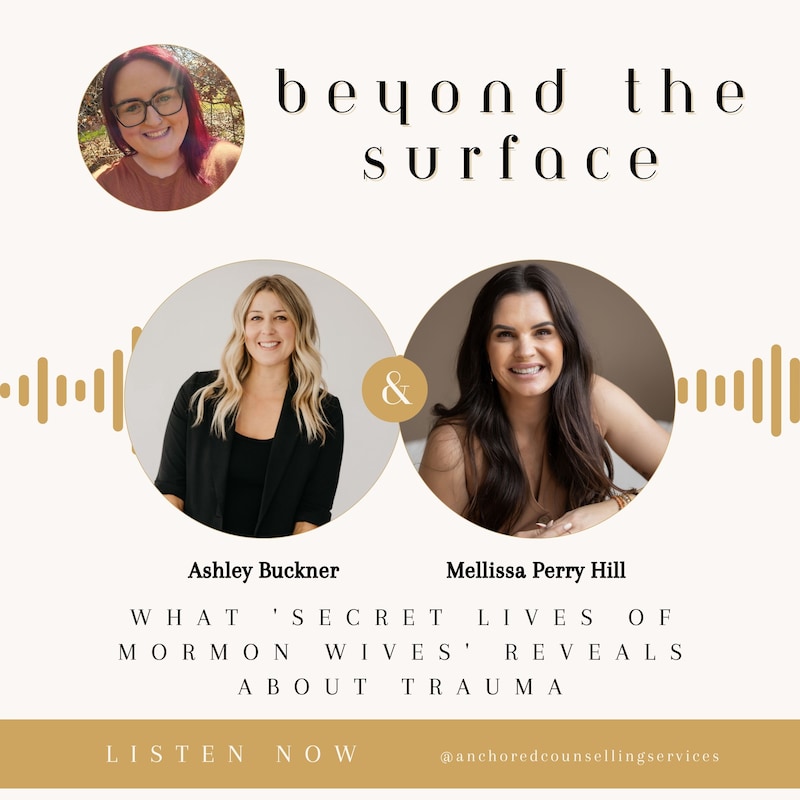
Shownotes
In this bonus episode, Sam sits down with ex-Mormon therapists Ashley and Melissa to unpack the latest season of Secret Lives of Mormon Wives through the lens of religious trauma and deconstruction. Drawing from both their lived experience and clinical work, they discuss the heavier themes woven through the show; sexual assault, childhood trauma, purity culture, and the emotional toll of life inside a high-control religious system. Ashley shares how confronting it can be to watch stories that echo her own, while Melissa highlights the importance of understanding the hidden dynamics that shape these women’s lives. Together, they explore what healing can look like after Mormonism, the power of community, and why compassion is essential for anyone navigating their way out of a restrictive faith.
Who are Ashley & Mellissa?
Ashley Buckner is a Licensed Marriage and Family Therapist in Utah and California. Specialising in a form of trauma therapy called Brainspotting that works to help people find more regulation in their nervous system. She has the additional speciality of religious trauma and faith transitions. Ashley was raised in the Church of Jesus Christ Latter Day Saints (aka: the Mormon Church) and later left in 2008.
~~~
Mellissa Perry Hill, MS, LPC is a therapist, supervisor, educator, and founder of Inner Compass Counseling & Consultation, LLC—a Gilbert-based practice specializing in Mormon religious trauma, Mormon faith transitions, and nervous-system-centered recovery after high-control religion. As a clinician who left the LDS church herself, Mellissa blends lived experience with deep clinical training in EMDR, IFS-informed care, DBT, and trauma-responsive narrative work. Her approach is warm, grounded, slightly sassy, and rooted in the belief that healing begins when we stop outsourcing our authority and start listening inward.
Mellissa has been featured on multiple podcasts, panels, and professional mental-health platforms, where she speaks about the intersections of spiritual abuse, identity reconstruction, complex family dynamics, and the physiology of trauma. She is also the author of the Faith Transition Journal on Amazon and hosts an online clinician community dedicated to ethical, inclusive, anti-shame mental-health care.
Outside the therapy room, Mellissa is a mom of three, a sunrise yogi with a soft spot for nervous-system regulation flows, and an unapologetic lover of big books—the kind that sit proudly on your nightstand whether you’re actively reading them or spiritually absorbing them through osmosis.
Her work centers on helping people return to themselves: to the body, to intuition, to inner authority, and to a sense of safety strong enough to hold both the grief and expansion of a faith crisis. Whether she’s supervising clinicians, running groups, creating educational content, or speaking on air, Mellissa reminds people that their inner compass isn’t broken—just waiting to be reclaimed.
Connect With Us
- Find out more about Ashley via her website – https://www.ashleybucknerlmft.com/about
- You can also connect over on Instagram
- You can find out more about Mellissa via her website - http://www.inner-compass-counseling.com/
- You can also connect over on Instagram
- You can find out more about Sam on her website – www.anchoredcounsellingservices.com.au
- To connect with Sam on Instagram – @anchoredcounsellingservices
- Want to contact with Sam about the podcast or therapy? Use this contact form.
- Also check out The Religious Trauma Collective
Transcripts
I would like to begin by acknowledging the traditional custodians of the land on which I live and work, the Gundagara land and people. I pay my respects to their elders, past, present and emerging, and extend that respect to all Aboriginal and Torres Strait Islander people.
I also want to acknowledge the traditional custodians of the lands on which you, our listeners, are joining us from today.
I recognize the deep connection that first nations people have to this land, their enduring culture, and their commitment to the preservation and care for their country. This land was never ceded and it always was and always will be aboriginal land.
Hey there and welcome to this special bonus episode of beyond the Surface.
In these episodes, we take a break from the personal stories and I get to chat with experts on all things related to to religious trauma, cults and deconstruction. These conversations are foundational and educational.
They provide deeper insights and understanding into the complexities of the experiences we hear in the stories.
Whether you're just beginning your journey, this is the first episode you're listening to, or maybe you're looking to expand your knowledge in general, These episodes are packed with valuable information that will help you navigate wherever you are. I'm your host, Sam, and this is beyond the Surface. Welcome, Ashley and Melissa. Thanks for joining me.
Mellissa:Thanks for having me.
Ashley:I'm so excited to be here again. Sam, thanks for having us.
Sam:And so soon. I know I flagged this with you after we finished recording and I was like, it's going to happen. I just need to find the other perfect person.
And then Melissa came along. Yay. So today's episode is a bonus episode that we flash put together.
I've never been able to organize a time with international guests as quickly as I did with the both of you, so I'm appreciative. We are talking all things Secret Lives of Mormon Wives with two ex Mormon therapists. Two of my favorite ex Mormon therapists, just for the record.
And I'm excited to talk. I've been wanting to do a a bonus episode for pretty much each season and we're now at season three. So we got there in the end.
But I feel like there is so many different places that we can start this with.
But I want to just like get your initial reactions to what was it like for both of you as ex Mormons who also work with other ex Mormons to watch the most recent season, Season three?
Ashley:Absolutely.
Sam:I.
Ashley:So for me personally, it was very heavy to watch. I am such a reality TV girl. I love reality tv. I think it's entertaining and Fun. And I don't love this reality tv. It's. It's heavy.
I think it just hits so close to home. Not only do I see my clients in the women, I see myself in the women. And to watch them on such a large platform navigate things.
That I'm holding space for clients for and that I've also navigated myself and then to know that some of them are not navigating them at all. Right. And they're just still so lost in this system. And, and, and not even. I don't even mean that in a mean way.
Like, they just don't even have the maturity or the recognition or the self awareness of what is causing some of these deeper wounds. So initially it was very heavy to watch. I also watched the whole thing because I couldn't help myself, but it was heavy.
Mellissa:Yeah. Yeah. I felt like the first few episodes were pretty light and silly and fun and my notes were like fairly light.
And then we got maybe episode three or four, and I was like, okay, you can't watch this and not see the very clear themes that both LDS women and LDS men struggle with, you know?
And it just became this whole different beast to me towards like the middle and end of the season where I was like, wow, like, this is just layering a headlight on so many issues. And honestly, it is, it is heart wrenching because those issues, I mean, the sexual assault and the childhood sexual abuse, the.
The protecting family members that perpetrated childhood sexual abuse, I mean, it just was a lot and also incredibly reflective of what I do here in my office. And also even like my own family genogram, you know, even my own family history. And so just like you, Ashley, it was, it was a lot.
Sam:Yeah, Yeah.
Ashley:I have to say, sorry to interrupt when you, when you're talking about the sexual abuse piece and the protecting family members.
Michaela, I've been following, well, I've been tuning into her the whole time, but when she said that part, because my abuser is a family member and I feel like I had a visceral reaction, I was like, oh, my gosh, I feel that I can't. I can't name him. And I'm a therapist and I'm in the mental health space and I've done all this work.
Mellissa:Right.
Ashley:But it doesn't matter. It's so real.
And I was so as heavy as that was, there's also this side of me that's so grateful this is coming to the surface and it's on a huge platform that's being Seen across the world by millions of people.
Sam:Yeah.
And I think for a quick caveat, I want all of the listeners who are not ex Mormon to stay listening because these are the same dynamics we see across the board in any high control religion. Because I'm seeing them in my ex JW clients, in my like ex occult clients.
Like all of any sort of like high control system, whether it is religious or not, we are seeing the same dynamics. So don't drop off on this conversation just because you might not be an ex Mormon or work with ex Mormons.
And the other thing is, if you haven't clued in already, there will be spoilers in this episode if you haven't watched the season. We are just going to talk freely about this.
And like, I want to start with Michaela because I think her story in not just this season, I think it very much has gone over all three seasons, but has just been probably one of the most heartbreaking things to watch. And I know that you actually have talked quite a bit about Michaela on social media and things like that. And.
And so yeah, I, I want to preface that all three of us understand that we are only seeing a very small portion of this content. So when we reference particular parts of the episodes, we understand that we are not seeing the full story.
But it still doesn't mean that it can't kick start a conversation about this. And so what are both of your initial thoughts around Michaela and her story and you know, Jace's role in all of this as well?
Mellissa:Oh, man, it's so loaded.
Ashley:It's.
Mellissa:Where to begin?
Ashley:Oh.
Mellissa:I, I, I literally don't know where to begin.
I think just kind of echoing what Ashley said about when it was clear that it was a family member that she was still protecting and that, that, you know, here she is a mother of what, three now? Three little ones. And, and this hasn't. Become clear yet. And she's been functioning with all this trauma. Just my heart just goes out to her so much.
As far as her husband for the majority of the seasons, I felt like for the most part he was pretty, like pretty great and pretty supportive. And. I think I still feel that way. I just think that they really need help.
I think that they really need some really good individual and couples therapy, which will take me on a whole different tangent about individual therapy and couples therapy. And. Mostly my heart just goes out to her.
Like I said, in my own family genogram, we have almost identical types of situations where here we are 35 years old, whatever, 40 years old and naming something that should have been named a long time ago, because how many victims have. Have been lying in the wake? Not to say that in any way to judge her, but it's. It shows the patterns that we see.
Sam:Yeah. I wonder whether it might be interesting, particularly for you, Ashley.
Why, Like, I think people are probably sitting with this, like, why is she protecting this person? And why it's so autumn. Automatic for her to protect this person?
Ashley:Oh, yeah. I mean, what came up for me, and again, I don't know. So this is just purely speculate speculation.
She, in my opinion, this person who violated her was a young person. I would imagine they were probably. That's. That's what I'm guessing just the nature of, like, the guilt and protection.
The person who violated me was 12 at the time, and I was like three or four. And not. I'm not saying that that makes it okay or that that person is. Could.
Could have gone on to harm someone or, you know, whatnot, but I think you develop. It's a. It's a really messed up relationship because there's a part of you that cares, especially when it's a family member.
And I think that when it happens at such a young age, you have a really difficult time taking, like, saying that out loud. I. I didn't tell anyone until I was 20. Till I was 20 years old.
And when I told my mom, it was like, kind of brushed under the rug, and I was like, well, we knew about it and they got all this help and it never happened again. And it never did happen again. And I would say I'm really fortunate in that. But I think the hardest part is when it's.
He was also a child, and I, like, I feel sad for him. It's. It's so complex and it's so complicated. And when she was talking, that's what I felt in my body. I was like, oh, my gosh, this is.
This is so real and so layered. And she's not alone. I feel this. How many other victims feel this? Right. Because.
Sam:And.
Ashley:And this is especially true in Mormon families, I would say, especially, you know, I have lots of, like, my entire maternal side of the family grew up Mormon sexual abuse is, like, just a part of it. And that's why I was abused. Right. Like that generational trauma. And it's just normalized accepted behavior. And it, It. It was fascinating to watch.
And I will say, when I watched season one with Michaela, before she ever came out about it, I knew, like, I, I don't know what it was. But when she was having all of her symptoms and her skin issues, I suspected that she had trauma, and I suspected specifically sexual trauma.
And then. So when she came out, I was not surprised. I was heartbroken for her.
I think that's the hardest part is the amount of sexual abuse is shockingly not shocking. And that breaks my heart. I don't know if I answered your question. Sorry. Go ahead, Melissa.
Mellissa:I really hope that you're right. That, that. And also, I'm so sorry that that happened to you, Ashley.
And I. I really hope that you're right, that it was at least a developing brain that was. That.
That she was in this situation with which we know happens very often in large LDS families, because we have a lot of babies, and it's just like, there's another kid, there's another kid.
Sam:Good luck, child.
Mellissa:And we're not supervised appropriately. We're not given the sex education that we need. I really hope that that's what it was.
That's not where my brain went, especially with health issues and things my brain went to. You know, was this grandpa, was this dad, this an uncle?
This is something that I see unfortunately a lot, and that is kind of the story of my family member is in jail. And so I hope. I hope that's what it is. And I. I hope that she gets the healing that she needs. But there's a lot of pedophilia also.
Sam:Yeah, I. I had the same instinct as Melissa. Thinking. Thinking. And. And. And I mean, like, I don't think that there. Like you said. No, we're all just speculating.
And it's not necessarily to speculate, to try and find who that is, but just to create a conversation. Because Michaela is not the only person who is protecting their abuser in their world.
Ashley:Right.
Sam:So, like, this is a common experience.
Ashley:Absolutely. And I. And it's so, like, it's. As you guys were both talking, I was like. And this is why we have conversations. Because for me, I was.
I was activated within my own trauma to zoom out, you know, and. And then to hear Melissa say, like, no, I didn't think it was that. And I'm like, well, you're exactly right.
Like pedophilia and like grandpas and uncles, you know, this is happening so commonly.
And I think the thing that maybe I would say I connected to the most is the wanting to, like, the, like, love or, like, the guilt she has for naming him. Like, that's what I would say I connect to the most is that piece. Because I still to this day, like, I don't want to like, make it an issue.
And that is, and I'm not saying that's okay. So I just want to like, own that. That I think that's still my own area to work on, but I've done a ton of work and it is still so hard.
And so I hope this helps someone else feel validated too. That's like maybe protecting and maybe not coming forward.
Because I think it is one of the hardest things we do, especially in a culture, like in a purity culture world where this is shameful and sinful and something that shouldn't happen, which is why it does happen.
Sam:Yeah. Quick side conversation, because I talk about purity culture a lot, but it's usually in an evangelical context.
What does purity culture in the Mormon context look like?
Mellissa:Oh, let's put it this way.
When I would put my sweet little two year old, three year old daughter in a like a little halter summer dress or something like that, there was usually some conversation. Around if that was appropriate without a onesie underneath it.
Sam:Yeah.
Mellissa:I mean, amongst my, my other mother friends, the young mothers that we were amongst, like Relief Society conversations, it was normal to look at a little baby girl living in Las Vegas, Nevada, where it's hot.
Sam:Yeah.
Mellissa:Wondering if she should be showing her little shoulders yet.
Which it's such, it's such an interesting situation because at the same time we're so carefree with our children that we are bringing them, dropping them off at a church building with who knows who and letting them run around like in bedroom or in church rooms, a big building. We don't know where they are.
So it's this very interesting kind of complexity where we see a really intense, like, sexualizing of young girls and also just not actually protecting them.
Sam:Yeah, yeah.
Ashley:And I would say, like, in terms of purity culture. Right. No sex before marriage, no masturbation, no like curious sexual explorations allowed.
But to Melissa's point, and I think what makes LDS purity culture unique is the generational history of the religion. Right.
We're talking about a religion that was founded on child brides, where having sex with young girls was normalized and accepted, and to this day is normalized and accepted culturally in the church and in the doctrine. And so I think that has a huge impact on purity culture in Mormonism and adds a different flavor.
Just to really speak to the point that Melissa was talking about why young girls are so targeted and sexualized at such a young age. They always have been since the birth of Mormonism.
Sam:Yeah, yeah. I Think one of the biggest things that got talked about, particularly in therapist circles, with the.
With this season, was the EMDR and the couples therapy session, and there was a lot of conversation around it. And again, we know that we are only getting a portion of what that looks like, but.
And I don't know about you both, but the part of the EMDR session that I was had the biggest issue with was the referral that we saw at the end. I think my brain kind of made sense and was like, yeah, okay, we're not seeing, like, actual processing here.
We're seeing, like, snippets and things like that. But I had an issue with the referral, and I'm seeing both of you nod, so I'm assuming both of you did as well.
Ashley:I want Melissa to go because I know she's an EMDR therapist, and I. And I already know she has really solid insights. So, Melissa, you. You're up.
Mellissa:Well, I. I definitely had a lot of issues with that. The referral was a big one.
I was just consulting with an EMDR specialist this morning, and we were talking about how long it takes to go through each phase of emdr, and it's not that fast, right. To. To be, you know, reprocessing using bilateral stimulation right there, out of nowhere.
I mean, unless we're missing weeks, potentially months of treatment, I'm very confused about. About it. And. And then also, yeah.
Her working through her own trauma and being able to desensitize and reprocess before being able to appropriately, like, communicate with her husband about, like, what does she even need? Right. She's not sure yet. And so that was interesting to me.
And then I just also had to remember to give this therapist so much grace, because I have no idea. I don't know if they had multiple sessions before, if they didn't have multiple sessions before.
I'm thoroughly confused, though, about what just happened because it's. Yeah, it's. Yeah.
I don't want to talk poorly about the therapist, but I'm sure it was an interesting situation to be in, but it just seem aligned with the type of EMDR that we're doing here at Inner Compass, for sure.
Ashley:Yeah. I. I don't. I'm not, like. I don't know. I know barely anything about emdr. My specialty is brain spotting. Right.
And so as a brain spotting, that's how I looked at that session is. And not to say anything like, I'm. I'm with Melissa. I have a lot of grace and compassion for this therapist. I cannot imagine I don't know.
Like, that would be so hard to put yourself out there, right. And do that. So I just looked at it. How would I approach this case? How would I approach Michaela?
With the knowledge and insight that I use in, in terms of brain spotting and neurophysiology. And as you, your brains, your brain spotting therapist, Sam.
So as you know, like you, it's not uncommon to brain spot in the first session with a client. It's not uncommon to do that.
And so I, I absolutely, I feel like I absolutely could have with Michaela, obviously would have been a very resourced approach, but I think it's a really good assessment tool to see where she's at, her nervous system, but to then just refer her and tell her to go do. Couples therapists, I really had a problem with, because she doesn't, I do think they need couples therapy, but she needs individual therapy.
Like, she needs to go and she need a, she needs a body based approach to go in and get this trauma and work through it so that she can then show up in her relationship with her partner. I think couples therapy will be ineffective if she does not do body work. And I think we're seeing her still run into that.
Like on the reunion, she immediately starts crying. And there's nothing wrong with that. But to me, that activation, let's work with the activation.
Let's go all the way into the physiology of that so she can start to work through and process and, and make movement. And I just want her to have a really good therapist. Like, that's all I want. To be honest, you guys, I'm gonna be straight up. I did message her.
I was like, I was like, michaela, here, not, not for me, but like, can I, can I help, like, guide you to the right therapist? I know so many therapists I haven't heard back, but like, maybe Michaela, please message me back so I can get you set up.
Like, I, I clearly obviously have like, such like a connection to her.
But I think for me, as someone who is a survival survivor of sexual trauma, as someone who has experienced intimacy, intimate intimacy issues with my husband, post having babies and has.
I have done so much nervous system work, so much somatic work and gotten to the other side and just known the freedom that comes through moving through this trauma. I just want that for her. I want it so bad.
Sam:Yeah.
And I think these conversations are important because most people who are watching the show are not going to be therapists who know that this is not how it goes. This is like the Lack of resourcing, the immediate processing, the immediate referral.
Like, there are people who are going to be watching that and go, oh, is that what it is supposed to be like? And. And I think that's the difficulty, because what that looks like is really overwhelming and re.
Traumatizing to somebody who is watching that as a survivor, that does not look enticing as a survivor to go to therapy, it looks overwhelming. Michaela does not look comfortable. And so. And I think that's part of the issue as well. Only seeing this tiny snippet of that.
Do we need to have a conversation around trauma therapy? Yes, but there are so many survivors who are going to watch that, who are going to be like, yeah, I'm not signing up for that. Like, and fair.
If I watched it and I wasn't a therapist, I'm not signing up for it either. So it just looks overwhelming. And. And I think the lack of resourcing around it is. Is really tricky.
So how did you both, like, I don't know whether either of you do couples therapy.
Mellissa:I do.
Sam:Okay. Right. So I'm curious, particularly then Formalissa as a couple, because I'm also a couples therapist.
What did you think about the session where Jace was in the room?
Mellissa:You know, my brain is a little foggy right now around that moment. What did you notice? Give me a refresher.
Sam:Yeah, the biggest. I'm just looking at my notes.
The biggest thing that there was a couple of things, which was that there was a comment that he made about she like Michaela not having the motivation to do the work. And I was like, oh, why is all of the responsibility being put on Michaela here?
And comments from the practitioner around, like, sex being, like, a level of vulnerability.
And I was like, I just feel like we are missing so much around what it is like for a CSA survivor in particular to engage in sexual intimacy with someone and it being so much more than vulnerability. And I was like, oh, we're just missing the freaking point. Like, so much.
Mellissa:You can see that burden on her. You can see, oh, my whole heart just breaks when they go on the trip. And she's like, we're gonna get freaky tonight. We're gonna do this.
And she wants to be there. And then you can just see how this. This burden is on her. It's like, get better. It's like, look forward to it.
Treat it like it's the funnest thing ever. Like, and then you can see that, you know, as the time goes by, it's time to get close to becoming intimate.
And you can see her body just trying to get away from that moment as much as possible. And my heart just breaks for her. That in that session as well, it was like, this is something that you need to figure out.
And that's one thing where I really started to have some issues a little bit with the way Jace was handling it when he was like, you know, I don't. Like, you need to figure this out. And I don't know if. If I can keep doing this. It needed to be framed differently. Yeah, absolutely.
Sam:It just felt a little bit like it was being framed as like, Mikayla needing to make this conscious choice about it. Even in the conversations that Michaela would have with Macy about it.
And she's talking about her own experience of going, like, I just want to be able to do it. Like, I don't understand why. Like, I can't enjoy it. And. And I just think.
And I know that we are watching a reality show, not a therapy show, but I just wish that there was even a snippet of conversation before the reunion when she was talking about it being in her body. I just wish there was more conversation about it being, like, trauma responses and her nervous system response and not being conscious and.
And all of these things to just really highlight. Michaela is not just being a shitty partner here. Like, she's just not making, like, a conscious choice to withhold sex from her husband.
And so, yeah, I mean, I want to jump to, like, because can I say. Yeah, go.
Ashley:Can I say one thing? Because I just have a little bit different perception of Jace. And. I think part of the problem is the lack of education, exactly what you were.
You guys are talking about, and the lack of understanding of. And I think that's where the therapist really missed the mark, to help Jace understand what is happening with Michaela.
Because I also think Jace is really open to learning. Like, I. I get that impression from him.
And I think also he grew up in a culture that hasn't taught him anything, quite frankly, when it comes to women and bodies. And then obviously he's not going to know anything about sexual abuse. Right. Or what happens after you have birth, after you've been sexually abused.
I mean, he has no information on that. But I do want to give Chase credit in that. I think he would be. I get the impression from reality TV that he would be open to learning.
And I think that's a really important part in. In a partner who. When you have another partner who has sexual. Sexual abuse, sexual assault history.
Sam:Yeah, absolutely.
I want to use a moment from the reunion as a bit of a bridge into a different conversation, because I don't want to spend the whole episode talking about Michaela, though I feel like we could.
But there was a moment in the reunion where, after they were talking about Michaela, where the conversation turned to Jesse, who shared that she had also been raped at 19.
Connor came into the conversation talking about his child sexual abuse as well, and Demi came into the conversation talking about the sexual assault from the season as well. And, and I just want to, like, throw this out to whoever wants to talk about it, essentially, but I am not one to compare traumas.
I just don't think that's an important or helpful conversation.
But I do think it is important to highlight that childhood sexual abuse comes with a developmental impact that is not there when an adult is sexually assaulted.
And so I would love whoever wants to talk about that to talk about that, because I think it's just an important part of the conversation that obviously was never going to be part of the relationship reunion.
But I think it is important as to why Connor and Michaela are perhaps responding the way that they are in ways that other people who have had sexual violence or physical violence, even Macy, in that conversation, are potentially responding and reacting differently.
Ashley:I think for me, what, what comes up is every single one of these women grew up in purity culture, and purity culture is often a form of sexual abuse in and of itself. So I think that that is already a layer that they all carry from early childhood. Right.
I, I, I've found everything with Demi to be very interesting and curious. I do think that Marciano absolutely, like, touched her or grabbed her.
This is what also comes up for me, and this is probably maybe an unpopular opinion, and I do not want to victim shame at I, that's, I've been, I, I don't want to do that. I also know that, like, for most survivors, the story doesn't change.
Like, it's fairly consistent over time, and her story has changed a lot, at least from what we saw on reality tv.
But I, I think that when you, when you do, especially when you grow up in a culture like Mormonism and you do things with boys or men that you wish you didn't do. You can feel guilty for those things. Right.
And I almost wonder if this is, like, her way to deal with the guilt of what she did is to then say he violated her, because that's a much more socially acceptable thing to say.
Sam:Right.
Ashley:In the grand scheme of things. So. But then in the reunion, when I was watching her talk, I was like, oh, but she has some other stuff under there.
Like, you could see that there's some other stuff under there, you know, and so that's kind of like. I thought that was a really interesting part of the reunion. I thought it was really interesting for Jesse to say what she said after Mikayla.
But I also, at the same time, I'm like, well, it's hitting all those same wounds. They all grew up in the same culture. So that's kind of my take in what came up for me. And also throughout the season with the whole Demi Marciano.
Debacle, I also listened to Marciano on a podcast, and he shared a lot of his side of the story. And I thought it was really fascinating, though he.
He never, like, he really did a good job to not throw Demi under the bus and, like, share her dark secrets. And I was, like, really impressed by that, given what was happening. So anyways, I have lots of nuance.
Mellissa:Yeah. I mean, I think nuance is so important. What. What I noticed is how normalized. Adverse sexual experiences, sexual assault, childhood sexual abuse is.
Yeah. And as a woman, there is an internal struggle. There is an internal anger and pain and grief.
Even if these things haven't happened to you because they've happened to your sister, your aunt, your cousin. And there is a major difference between what Michaela and Demi went through. But you see the. You see the boiling point for these women.
You see, well, I was sexually assaulted. Oh, no. Even Jen as well. Right. Because Demi says, well, you know, you've never been through this. And Jen goes, actually, I have.
And I'm just sitting there going, yeah, because this is a part of the experience of being a woman in a culture that is hyper fixated on sexuality while making it so taboo and so incredibly high stakes that harm is done. And so whatever was boiling up over and over and over again for Demi, I want to have so much compassion for.
And at the same time, it really also is upsetting to see her again and again, kind of put herself right there with Michaela. Because what I'm seeing in Michaela's body is. Is very, very different. So I think that should be said as well.
Ashley:Yeah, I absolutely agree. And I had the same thoughts, too, actually. My husband, he's never, like, he's never Mormon. Knows nothing, like, really about Mormons.
And we're watching the reunion, and he goes, wait, how many of them have been sexually assaulted? I was like, yeah, I know, I know. It's just so prevalent for all the reasons Melissa just Said, yeah, absolutely.
Sam:There was. I feel like I could have taken a lot of notes about Demi in this season. It's just been a very focal point.
But I think the, particularly the conversation around her raising the sexual assault with Marciono, I feel like, brought up two things for me, though. I was like, I need to narrow this down into two points.
The two things that came to mind, and the second one came out of the reunion when she referred to the contact that she was having with Marciono as fawning, essentially that she was having a trauma response by continuing contact. And, and I would love to have a conversation around how the both of you saw that comment and what fawning looks like in this situation.
Before I, because I don't want to double barrel before I get to the second thing.
Ashley:I mean, I was like, oh, Demi's gone to therapy. That's what I, that's what I, like, think.
You know, I, and I also, I just, like, I do have a lot of compassion for her and the way she's being attacked and, like, taken down, it makes me sick. Like, I just, you know, she's still a human being and, and I'm not also justifying some of her mean behavior or, or whatnot.
I, I don't know if I would actually say what she was doing was fawning. I, I, it just doesn't feel in alignment with me. Like, fawning is appeasement. Fawning is like, keep sweet, pray and obey. Fawning is people pleasing.
Fawning isn't what she did with Marciano. It's not. And I think if, like, you were truly fawning, you wouldn't keep engaging with him. You would just get really small and quiet and move on.
Right? I, I don't know. Like, am I incorrect, Melissa?
Mellissa:No, Like, I want to send love to Demi. Like I said, like, I know she's totally attacked.
At the same time, I really see clearly that she was in her, yes, most of the time she's in her emotional mind, but when it came to specific thing, I feel like she was also in her logical mind quite a bit. We see her talking to him about Jesse's situation and like, also, like, like figuring things out and, and telling people how to respond to things.
And there's a lot of, a lot of high level cognition happening there. And when we fawn, it's just about, just about the opposite of that. So I don't really see that.
Just as the, as a trauma therapist, that's not what I would call it, but I. I do see how when she's confused at her own behavior, she was in the car talking to Whitney. She started crying and she said, I don't know why I'm doing.
She was talking about like she's not sure why some of her behaviors were the way that they were. And I don't know if she's been to therapy. I mean, she could have just read something on chat GPT.
Ashley:Right.
Mellissa:Real quick. And she has some language. But I don't think that Demi understands why she's feeling so much. She's very young. She got married very young.
She's with a much older man. Who knows what she has been through that she is not disclosing. And so I don't know that she understands why she's doing what she's doing.
But I think she is looking for language for it. I think that's awesome. And as she maybe reaches out for some help, like we all do. Like, I have my own therapist, hopefully we all do.
Like, I hope that she gets the answers that she needs, but I do not see that as a fun response. No.
Sam:Yeah. And the second thing is that I thought it opened up a really interesting conversation around when there has been any sort of sexual violation. This.
This conversation around there being, you know, quote unquote, perfect victim and it looking like everybody looking the same, responding the same. And.
And I think that that opens an interesting conversation because I think whilst there was some discourse around from the other women around, like whether this was adding up, whether it was lining up. Irrespective of that, I think it opens a conversation of like, not every woman in particular looks like the quote unquote, perfect victim.
What were your thoughts about that?
Ashley:I. I mean. Yeah, I don't. You got any thoughts on that? It's a hard question, honestly.
Mellissa:Like one thing that comes to mind is just how you live your whole life. You can, you can have. Oh, I. If there was a story that I could tell right now without over disclosing a member of my family, I'd just tell it.
You can live like a whole lifetime, right? You can. You can present one way. You can. Like. There'S no one way to be a victim and there's no one way to.
To finally share what happened or to conceptualize what happened. But when we get high, control, religion and that level of purity, culture and the obsession with sex and the hypersexuality of.
Of young girls, also the enabling of men to not be like, to feel like they are out of control. We. We teach boys and men that they're, that they don't have as much control as they do have. That this is just, this is just what happens.
This is going to happen. We're actually orchestrating perpetrators and victims. We're creating them with this dynamic. We will continue to create them. And so.
And we also create a story that works to where you don't have to talk about it until you're 50 years old. Maybe, maybe then it will come out. I mean, so, yeah, absolutely.
Ashley:I think also too, what's coming up for me is like the policing of sexual behavior. They were all policing each other's sexual behavior to so much so that they were going to do a lie detector with this guy. And I even, I'm.
I like, I don't. I wasn't obviously never. I didn't even watch the Villa episodes.
But I go back to Demi in that situation and, and like, let's just say she was being flirty and doing all those things with Marciano. The way they all policed her after. I can only imagine how activating that was. And again, it's like, then does she start to question herself?
Did I, did I really want that? You know what I mean? Like, I think all this whole scenario was created based on like this idea of how we should be interacting with males.
The policing of sexual behavior, like all of it, right? Even, even Jesse's affair. To me, like, yes, she kissed him, but it's being blown out of proportion.
Like this woman had a full blown blown affair for years having sex. Like, she did not do that. And then it goes back to the whole swinging thing of them swinging.
Well, they didn't really swing you guys, like, you know, by definition of what swinging is. And it's like so on brand for Mormon culture.
And I think that's what also comes up for me with Demi, which is like, I, I think she believes that it really did happen. And I think that makes sense to me if I think about it from a trauma lens and just the history of it all. Does that make sense?
Sam:Yeah, absolutely.
Mellissa:Yeah. I would have to agree with like that over monitoring part of the culture. You know, it doesn't.
It's not just about talking behind each other's backs, whether it's a ward council meeting or women or whatever. It just goes way deeper than that.
It goes like, many of my clients not only had their priesthood interviews as youth, but they also had secondary interviews with their parents, with their father, where, you know, we just keep monitoring you and we check where you are sexually. And what you've done. And the mistakes that you've made.
And this, you know, really keeps us in a shame loop where we desperately, desperately need to be saved, we desperately need repentance, and the adversary is blamed for much of our behavior. So I also think there's a bypass to a lot of where we can have like, very real internal growth.
Like if we do something that's out of our alignment sexually, that maybe it's not aligned with our values, that like, we can reflect and we could go, oh, that didn't feel good. Here's what I'm going to do next time. There's not very much of that. It's like I was lost on the wrong path.
And then I'll repent, I'll be monitored, it will come out, I'll be shamed, I'll repent. And then we start like it never happened. Because remember, when you repent, it never happened. And so what did we learn?
Sam:Yeah, yeah. I want to like clue in on that shame point because there was one person and, and it will sort of like shift the conversation as well.
But there was one person who I feel like in the first two season. We saw enough of to get to know them, but we didn't see them personally as much.
And then this season happened and we saw the deep internalized shame and self loathing and conditioning of Mormonism in Jesse. And I just think it was absolutely palpable.
I think like we see it overtly in some of the other women and I think that we saw like the shame and the self loathing in her this season far more than we did in any other season in particularly in her own therapy session that we saw as well.
But I wonder whether we can just like open the conversation around like what that conditioning is, like how deeply wired it is to the point that it just becomes part of who you are. I have so many. Ex Mormon, ex JW clients who just refer to it as like, it's just part of my DNA. It's just so, like wired into you.
And so I would love to hear what both of you thought about seeing more of Jesse this season and what it is like for her individually.
Mellissa:Well, yeah, I'll just maybe a little bit here. I thought it was so interesting to hear her, you know, kind of really, really own in a brave way some of those insecurities.
And in the first two seasons she did, she presented as like the most confident. Right. Like she had disrupted. She had like she was this boss and like just like on top of the world.
And then in this season she's So I do, like, really respect her for how vulnerable that she became.
But it was interesting, isn't it, to see how we can present when we're kind of functioning out of our different parts, the part of us that's a boss, the part of us that, you know, left Mormonism or whatever. But this season, she really was able to share more of that part of her that's like, I don't like any part of myself.
And that was just absolutely heartbreaking for me to see.
Ashley:Yeah, that, that. But that, like, clip, I think, was on the very first episode, maybe when she went to therapy or the very first. What first one or two.
And when she was just kind of acknowledging when the therapist asked her what she liked about herself and she said nothing, you know, and it just is. That's so real in this culture. And I think one way you survive that is to present how Jesse did in season one and two.
Like, that is absolutely your survival. You have it all figured out. You have it all put together. You're a boss woman. You look perfect.
You get all your procedures to continue to look perfect. Right. That is your survival skill. And I think the women in Mormon culture do it better than. Better than, like, Hollywood. Okay.
You know, they are so put together and perfect, and they. They embody that in a lot of ways. And. And for me, like, yes, Jesse has left Mormonism, but. Right. And I think, Melissa, you know this as well as I do.
If you do not deconstruct and do the. The nervous system work to work through how that is wired into your DNA, you can leave Mormonism, but it still comes with you. You know, like, it.
It still is going to show up. And I think even as you deconstruct and you heal, it's still going to show up because it's been with you since you were 0 years old.
If you were born into this religion, the messages that you receive and how you should behave and how you should act are so real. And I think Jesse, too, right. She. Her parents weren't. Both members of the church, so she grew up in this kind of like that Mutt family.
And I think sometimes you try a little bit harder, too, when you have that scenario. I. That was my scenario. And I worked so hard. I wanted to be perfect.
And it does eventually all come crashing down, and we got to watch it come crashing down for her. And I also thought her vulnerability was really beautiful and courageous, too, to let us in.
And I think the first two seasons, she's just, like, locked up tight. But to me, that's purely survival. That's her trauma response, right?
Mellissa:Yeah. I also think there's something to be said about her relationship.
We got a little glimpse of the way that her husband to her, the level of just the condescending, the, you know, he was the parent and she was the child, and she had been a bad girl girl. And she. She felt she melted right into that role. That's something that I have really kind of intimate experience with.
And I think not liking yourself and not being able to say what you like about yourself is also really reflective of, you know, the person she's sleeping next to and the way that he speaks to her. Even when it's really kind of like coded and layered and it's. It's not even in the words. It's in the affect. It's in the tone.
To feel small and to feel like the things you're doing are just not enough because you that up. So you may be killing it at work, but you're this up. So I just really feel for her.
Sam:Yeah. On that note, how do we feel about Jordan, Jesse's husband?
Ashley:So, interestingly enough, I listened to him on the Vial files, him and Jess. So Jesse did an interview, and then they came on together. I didn't mean to prep this much, you guys, but, yeah, I was like.
Sam:You'Re saying you didn't have any notes, but you've watched all of the side.
Ashley:I've done all this stuff behind the scenes. And so Nick actually interviewed Jordan by himself, and then they came together. And I will say. I don't. I, Like, I want to have hope.
Like, I want to have hope this guy can heal and do his work and he can let go of this, like, toxic masculinity that comes from this system. And I think for me, as a therapist, what I think is essential in a catalyst of change is ownership. Your ability to take ownership for how your stuff.
I'm like, I'm thinking of the reunion now.
Sam:Accountability. Yeah.
Ashley:But your ability to own how your shit is showing up in the here and now. Right? Like. Like to own and say it like, this is how we got here. I see how we got here.
But in this interview, whenever he's asked that, it's just like, well, she had an affair, bro. We know she had an affair. Like, stop. He.
I think in order for them to have to move forward, he has to be able to be like, yeah, and I was also an emotionally abusive for the entire part of our marriage. So it makes sense that we got here.
But I. I don't know if he has the self awareness or if he's done enough of his own internal work to take ownership for that. Because I think that's also a very shameful thing to have to take ownership for, to know that you have been an abusive partner.
And I just have seen so much in this culture, in a high control religion culture, how shame keeps people from ever taking ownership. I mean, look at the church as a system. It's founded on a system of shame and it never takes ownership for any of the harm it causes.
So for this, which is so funny that they, that none of them could take ownership. Right. That's the system. They come from a culture that does not do that.
And that's where kind of in the same breath we're talking about has Jesse deconstructed in, in her neurophysiology? I don't think Jordan has and I see that being an issue. I hope he can change. I'm a therapist. I hope everyone can change.
But I, I didn't get, I didn't see much of it in the interview that I watched Listen to.
Mellissa:Yeah, I mean we can have grace for all of these men because these men respond the way that they react the way that they do because of an unhealthy level of conditioning as well.
Sam:Yeah, the system creates it. Right. Like they're, they're in a system built on power, control, patriarchy, hierarchy, all of those, those things.
It is a system built for them essentially to thrive in the way that they do. So like. Like we, again, we can hold nuance and go like behavior. Not okay.
But we also have an understanding of like the system that he has been conditioned, a part of, has been wired in and is, is the reason why he is the way that he is currently as well.
Mellissa:Yeah.
Ashley:I just want to go. Oh, oh, sorry. I just want to go on record and say that I think every single member of the cast could benefit from a body based approach to therapy.
I'm just gonna walk out and say that. Great.
Mellissa:Absolutely. The, the resistance to discomfort would be to sit in discomfort of like, okay, I feel some shame, I feel some guilt. What does that mean?
Does that mean I need to repent? Does that mean instead of one drink I'll get faced, like, how am I.
Ashley:Going to take this?
Mellissa:And if there's not much like in between of like, well, I could say that didn't work for me. I learned from it and then I'm going to do something different.
I think there's been a lot of developmental kind of passes things that have been missed. And so it's maybe just a later maturing or continuing to deconstruct or doing some more reflective work. And also that body based work.
Ashley:Absolutely, yeah.
Sam:And also like the difficulty, like the not sitting in discomfort and, and then just like, rather than sitting in it, just throwing it onto other people, like just the automatic, like I'm just going to go on to, on the attack and the, and the, and the defense.
Mellissa:So yeah, there's a little bit of like an allergy to shame.
Ashley:Right.
Mellissa:When we grow up with someone pouring it all over us like, hey, you're inherently bad. The natural man is an enemy to God. Cover up your shoulders, don't touch your penis. All of these things. Right.
At some point when people throw that shade at us, when people throw something that makes us feel guilty or, or shameful, we literally are like having an allergic reaction. Right. Well, she cheated on me. She cheated on me. How could I have any part. She cheated on me. It's like, okay, pause, sit with what's uncomfortable?
Your marriage wasn't great. We're kind of a dick. And with that and let's see where that takes us.
But we do we get this allergy to shame, this allergy to guilt where then we're looking for blame, we're looking for instant solutions, we're looking for our savior, whatever, whatever might be that it's going to like fix everything quickly and make it make sense again, make it black and white again.
Ashley:Yeah. Well, what I was going to say, what comes up for me is just the level of emotional immaturity all of this creates.
Everything mostly just talked about creates so much emotional immaturity and ability to understand one your own emotions or other people. And I think it's that that's very common in high control religion.
You're very stunted emotionally because you are told certain emotions that you feel are of like the devil or you're not allowed to feel certain things. And you're never taught to actually sit with things. You're not taught how to be uncomfortable. If you're uncomfortable, you go pray or you go repent.
Right. You don't actually go inward and notice what is the anxiety, what is the anger, what is the confusion? You don't ever sit with that.
And I think then that comes out as emotional immaturity. And the inability to not react in situations are also reactive, which is very on brand.
Sam:I mean, I think it's interesting because if we were having this conversation last season or at the end of season one, the conversation around who was like, the dick in the season would be very different. And it's interesting to see the shift from season one to season three. Zach, Jen's husband. And I am curious.
I mean, we're talking about change, and I'm curious what both of you think about the new and improved Zach that we see.
Ashley:I. I actually, I was actually really proud of Zach. I think that Zach. It's very evident Zach has done some work. Do I still think that there's farther to go? Absolutely. And do I am.
I am I also cognizant he's being filmed and we do not know what happens behind the scenes with him and Jen. I think that's also real. I also, you know, he was going to medical school, and he's no longer going to medical school. He's supporting her. He did.
She did Dancing with the Stars. He moved to la. I am gonna really celebrate that for him. And I, I believe people can change. I also believe these people are. We're talking.
They're young.
Mellissa:Yeah.
Ashley:Some of them are. Some of them are in their early 20s. Their brain's not fully cooked yet. They have the potential to grow and evolve as human beings. Brett.
Maybe not, but, you know, the rest of them, I'm gonna. I'm gonna say celebrate. I. I really genuinely believe that, and I wouldn't do what I do as a therapist if I didn't believe that.
So, yes, I actually, I noticed that in Zach, and I'm going to honor and celebrate it.
Mellissa:Yeah, I felt the same way, Ashley. I felt like Zach and Connor really killed it this season. Husbandry. I was like, come on, guys. Amazing job. And, yes, it is a. It is seisho.
We don't see what happens behind closed doors, but I don't know. I think that Mormon men have the. The sweetest, most tender, wonderful hearts when they really want to do what's right.
And they really are humble enough to kind of let that ego state of. You are the presiding priesthood holder when they can let that go. And there's so many good parts, too.
And I really think that there was a lot of that with Zach and Connor.
Ashley:Yeah, I love that you said that, Melissa. Like, I don't know why that's making me emotional, but it.
Mellissa:It.
Ashley:That's exactly what he represented and exactly what Connor represents. And I think, you know, maybe it's making me emotional as someone. And I know you.
You both probably feel this to get so much criticism and, like, I'm anti Mormon or I'm anti faith or I'm anti, you know, like all of this stuff, it's like, no, I'm not. And I, I recognize the good parts and there's, there are incredible individuals that are a part of this system.
And we're, we're also talking about someone who. He was like, Zach was really attacked on season one, and so he had to go inward and he had to dig deep. And it shows what is possible. Right.
What exists in all of them. I actually have always really liked Connor. I think he's always embodied the LDS man for me. But I, I'm really glad you said that.
Like, that just like touched my heart. So thanks for saying it.
Sam:Yeah. Speaking of Jen and Zach, I want to ask a quick question because.
And I'm just going on a bit of a limb here because I know that it's not framed well in any other high control religion that I know of. What is it like for women in the LDS who experience pre and postnatal depression. Especially when their God given gift is to be a mum?
And that just there is like palpable levels of spirituality layered onto that.
To be experiencing any sort of mental health concerns around being a mum or having a baby and being pregnant, I can't imagine that that is represented well in those communities.
Mellissa:No. Your, your purpose is to bear and raise children.
Sam:Yeah.
Mellissa:And it is.
Not that big of a deal because we start doing it when we're 18, 19, 20 years old, and it's expected and we do it one after another after another after another after another.
And it's often so traumatizing that it's not until years down the road when your nervous system has regulated and you've kind of become who you are, that you look back and you go, I was going through so much. I was not okay. One of my favorite things is to support LDS women and young girls who are, you know, having baby after baby after baby.
Just help support them in their mental health because it's just run of the mill. It gets to the point where it's like, okay, there's another baby. Oh, you popped another one out. It's a joke.
It's, you know, then mom is handling everything at home, Dad's back at work, we're back to the picket fence life. That really isn't working, by the way. And these women are just not taken care of. Unless by other women. Right. The Relief Society will show up.
But culturally, the expectation on LDS women is something that just kills me. And also that's related to personal experience. Me and my family members, my mom generational. For me, my mom had eight kids back to back to back.
And it was just you lose connection with your body. Right. It's a disembodying experience.
Ashley:Yeah, I think, like, I don't have the same level of personal experience as Melissa because I did get married until I was 28. But in symbolism, like, please interject. I feel too part of the problem is women can't say that they're like struggling with being a mom.
You're not allowed to say, I don't know if I want another kid or I'm having a hard time being a mom, because that is your divine purpose. And I would even argue, I think some women aren't even allowed to go there consciously. Their body probably feels it to some degree and.
But they can't even like think about that.
And I think for me, I've been actually thinking about this a lot personally, because I didn't get married till I was 28, I didn't have my first kid till I was 30. But one thing I've really kind of been unpacking and taking a little bit of ownership.
There's that word again, is did I actually choose to have children? And I love my kids so much, I wouldn't change it.
And I again, I didn't make the choice to have kids until I was 30, but I actually don't know if I chose it. I think I slid into it. So if you guys have heard of sliding versus versus deciding, right.
When you're talking about couples that are cohabitating, did you actually. You could probably apply it to couples growing up and I control religion. Did you actually decide to get married or did you slide into it?
Was it just like the next thing you were supposed to do? And I think about how hard that has been for me to acknowledge in my own journey as a mom.
And I cannot imagine that as like an 18, 19 year old, 20, 21, 22 year old mother, like that is so hard to even name. And it's been so hard for me to name. And that's what comes up for me. And I think then a lot of times their mental health stuff is spiritualized.
Well, if you just pray more. Are you reading your scriptures enough? Are you wearing your garments?
I've had a lot of clients who have experienced miscarriages or fertility issues and they are often met with God wouldn't give you anything you couldn't handle. Pray more. Have. Are there things you haven't repented of?
You know, it's not actually addressing the real core issue and the real struggle and having empathy and compassion, too. So I think that's another component of the mental health, too. I. I don't think women.
I think women are suffering so much in this culture, but they are not seen, they are not heard, they are not believed.
Mellissa:And what's confusing is that where do you get your power? You get your power from securing a priesthood holder and then bearing children.
And so if the very thing that's giving you validity is also causing you, you know, that dissonance internally, a lot of times we're not even ready to go there in our internal world. No, let's talk about it externally. But I do think that's why there's so much autoimmune chronic health. So many.
My mom tells this story about, like, there she had this moment where she looked around and all of her little babies were around her, and she had this moment where she said, I can't do a good job. She's very Mormon, but she'll tell this story. Like, she.
She looked around and she recognized I cannot meet the needs of all these little kids and how sobering that was for her. And I think that does happen. I think that that happens. And some of us talk about it and some of us don't.
We just swallow it and we feel back to our best friend shame. Right. Like, I must be bad.
Ashley:There's something a matter with me. Right. I. I don't. I can't care for all these babies. And instead of me being told I need to have babies is the problem. I'm the problem. I'm the issue.
And I think that is so on brand for Mormonism. And I would argue high control religion in general. We do not see anything that the religion teaches does as a problem.
We survive it by making ourselves a problem. We're the issue. And that's what's really unfortunate.
Mellissa:We take so much accountability. We take so much accountability. The things that the system are responsible for, the institution are responsible for.
We swallow that and we take accountability. Yeah.
Ashley:You just call this episode ownership and accountability.
Sam:Yeah, Accountability.
Mellissa:Yeah.
Sam:We've got our own. Our own word.
I want to talk about one other part of the reunion before we get to, like, a couple of, like, random things that are just, like, nice and also just random who are not parts of, like, big aspects of the season's storylines. And also, like, the last mention of one of the men in dad Talk. When did dad Talk become a thing? Like, when did we start moving the.
Mellissa:How.
Sam:I feel like a good portion of the reunion was just the men.
Ashley:It became a thing after Jordan this is.
Sam:Get this.
Ashley:I learned this on the vial files. It became a thing after Jordan found out Jesse had had an affair with Marciano.
Sam:Oh, that's so interesting. Like, the perfect, like, sacred lies of woman was fangirl.
Ashley:So it was on the bio via Vile. I don't know if I'm saying that correct.
Sam:Yeah.
Ashley:Podcast. And that's when he shared. Because he. He did that to try to get closer and better into her world. So.
Sam:Right.
Ashley:I believe that was last September that that happened. I don't know.
Sam:Right. That's really interesting. The person that I was going to bring up was. Was Dakota.
Mellissa:And.
Sam:And what. And I'm like, I'm mainly curious about what you think of.
Like, I was watching the other men's reactions in particular to what he was saying as opposed to actually just like watching Dakota. But I. I was really intrigued by, you know, Zach and. And Connor and Jace, and I can never remember Macy's husband name. Jacob.
Yeah, like, particularly those four. And there I described it as like a very, like, bored reaction to hearing what Dakota was talking about.
And so I'm curious what you both thought about that portion of the reunion and the apology laden with excuses.
Mellissa:Well, I think that you can put me on record for saying this. I think that the Mormon Church creates deception and teaches little boys to become adult liars. And so bless Dakota's heart.
Honestly, my heart breaks for him.
Ashley:Yeah.
Mellissa:I think that if he. He has a problem with telling lies, and I think that that happens when we're conditioned to tell lies. Very, very, very, very young.
Eight years old is when we start or before. And I think that we are creating that. So bless his heart, I hope the best for him.
I think that he's lost credibility at this point, which does happen. And sometimes hitting that rock bottom of losing credibility is one way that we can then build something new.
I also think that Taylor's family is, like, really good at shame. So I do feel. I felt horrible for him in that moment and just he was deeply being shamed publicly.
Sam:Yeah.
Ashley:I feel like Melissa just said everything that I think. I don't like. Dakota is not truthful. And he is, like, broken Taylor's trust and all of that is so real.
And I think that when I look at Dakota, I just see this broken boy. Like, I. He's like a boy to me in his. In his own skin. Like, he just had. There's so many wounds. And I would. I'd be so curious.
The therapist me is so curious about his history, his history in the church, his own childhood trauma. It's just it. The woundedness is so present and that makes me sad.
He reminds me of just a lot of the Mormon men that I grew up with, and I see that in him. I, I think that Taylor's parents are a lot for me.
Sam:Yeah.
Ashley:And I, I just, I don't. I guess what comes up for me is like, what was the point of shaming him like that? Where does that get us? And I love, like Taylor's my.
One of my favorite characters in the show. And I, I really admire and like Taylor a lot. And I also think that, like.
That the shame is still so much a part of her, her driving force too, because I don't really think that's who Taylor is in terms of being so mad at him, hating him, having to shame him. You know, I think what he did was very inappropriate, wrong. And they should never be together again after this.
But the, the shame with the parents was a lot for me.
Sam:I mean, and we've seen in other seasons.
I know we're focusing on this season in particular, but we've seen in other seasons Taylor's parents shame Taylor, like in very public, out in the open settings, like palpably, like it was horrific. So, like, it's really interesting.
I, I also just like really wondered what it was like for Taylor to sit there having her parents like finally defend her against Dakota in that moment, even if it was laden with shame.
I'd be really curious to know what it was like for her when in all of those other episodes that we've seen, we've seen her parents defend Dakota to her detriment using really shame based language against Taylor. I think it would be really curious to know what it would be like to feel like her parents are finally on her side in this.
Ashley:Absolutely.
Sam:Yeah. I also love Taylor. I think Taylor's great. She's fun. She'd be a good time. I also think she's had a glow up. Right.
Like, we've seen her shift and change so much from season to season. And so I would. Yeah, I'd love to know what you both think about that and the way that we've seen her shift and, and grow and glow.
Ashley:I absolutely agree with that. It's. Her work is. Her work is so evident. It was evident throughout the season.
Like even with the situation with Jesse, some of the things Taylor was saying and the way when you remember when they were in the hotel room in St. George and Taylor kind of pushed Jesse a little bit to, to bring some stuff up, I thought that Was really powerful and incredible and also spoke to where she was at. I always think Taylor takes a lot of ownership. That's my. Probably why I like her so much, because she is owning her struggles, her. Her stuff.
Even when she, like, does stupid things like go back to Dakota.
Sam:Right.
Ashley:She still owns it. It. And that's why I love her. I. I think she's made a ton of progress. I think there's more to be done.
But I also think she's in a really tough position to be in the limelight and in the way she is. I can only imagine the pressure that comes with that. But I will say, from season one to now, she's made tremendous amounts of progress. In my opinion.
Mellissa:Maybe. Maybe Taylor's next step will be owning less or taking accountability for less and looking honestly at the. It came out of. And looking at.
Hey, mom and dad. You know, it's not okay that you spoke to me this way, because your. Your voice to me became my own internal voice. And I think. I don't know.
It's so complicated, the Bachelor now happening. Like, there's just so much in here, like, systemically and with sexism and with what it means to be a valid woman coming out of that culture.
There's just so much that these women have to prescribe to. To be taken seriously. And I'm, like. Part of me is looking at them, and I'm, like, so happy that they're being taken seriously in so many ways.
I have these opportunities, like, we're seeing Whitney go on Broadway and, like, all these things. And another part of me is just remembering what it was like to look in the mirror and go, but if I'm pretty, then. If I'm pretty, then. Then I'm valid.
If I'm pretty, then I'll have opportunities if I'm attractive, because that is what gives me value to the men. The boys. The men and the boys are the key to my power.
Sam:Yeah.
Mellissa:And I see that. I see that here, and that's a societal thing, but it's really. Really a Mormon thing.
Sam:Yep.
Ashley:No, I was just gonna say that. I think that's all the. That really speaks to the heaviness that I feel when I watch the show. Melissa is just like, these women.
Living their lives, and also now they're being thrown into fame, but we also know how unhealthy they are right? In. In their wounds and what they're navigating and what they're also not addressing. And. And they're getting launched into this.
Mellissa:This.
Ashley:This world of fame. And I, I think I said to my husband the other night, it'll be so fascinating to see where they're at in like 10, 15, 20 years, what happens. Right.
Because we've also talked about they are very young and they're at this, like, crucial brain development stage. And I think it's kind of this opportunity where you can go one way or the other and what happens. And so I'm curious to see that.
Sam:Yeah, there was a moment and I don't know that this is going to produce a whole host of conversation, but there's a moment that as like a queer woman, I cannot not talk about the episode where they spoke about the queer community in the lds. And it was really interesting because. Was it beautiful and lovely? 100. Is it the reality? Not really.
Like, and, and I think that it's like, is it lovely that Jacob's, like, cousin, I think it was, is like, able to be out and is not experiencing the, the shunning and the, you know, the estrangement and the trauma and the harm and all of that from his family? Yes, it's lovely, but it is not the reality and it certainly is not the norm.
And so I am curious as to ex Mormon women, what it was like for you to watch that Sane.
Ashley:Well, the rebel in me really loved the you to the Mormon Church of like, you know, like, that this is an issue and that this is a problem and the Mormon Church does not treat queer people the way they deserve to be treated. So I appreciated that aspect.
But I'm also completely with you that one of my biggest problems with the show is that we actually don't name how the Mormon Church treats queer people. The black history. Right. Like purity, culture, worthiness, like, that's not really being named.
And maybe that's not the job of the women, but like, yay, Macy, I'm really glad you put that flag in your yard, but how are you using your platform? And maybe she is. I don't follow her that closely to really talk about the impact to mental health for the queer community in the LDS Church.
Sam:Yeah.
Mellissa:For me, as a post Mormon queer woman, it felt. It just felt like a little hug.
It was pretty simple for me maybe with just my experience of being like, so exiled, my queerness being so exiled and so deep, like my deepest rooted shame, the one that I only went and visited very, very late at night when I was all alone in my brain, like. That part of me was just given a nice warm hug and I was like, oh, I love these ladies. Thank you for Doing that. Thank you for. And one of them.
Who was it? I don't remember.
One of them was like, yeah, the, the Mormon Church is getting a little bit better, but they still have a really, really long way to go. She said that. I don't remember who it was, but I was just, I felt, I felt great about it. It was pretty simple for me.
Sam:Yeah, it was really beautiful to see it spoken about, even if it was in a. Like, that there were like watered down elements, I guess.
And again, we're watching a reality TV show and they're not going to necessarily give us a play by play of like, the reasons why this is not what it is like, or the reality or the norm that this is like in some cases a rarity that someone is able to come out and not necessarily experience the layers of shame and suppression and estrangement from their family. And so it was again, nuance. Maybe we have a second word in this episode. We can like, love that it was platformed and a conversation was had.
And is there missing aspects of that conversation also? Yes.
Ashley:So, yeah, absolutely.
Mellissa:I think it's a really good part of like the limelight on the Mormon Church right now is just, it's inexcusable. The discrimination is so obvious. You just, you can't even defend it. It's so obvious. Right.
And so I think, you know, if, when I rewind myself to like maybe my 24, 25 year old self, if I had seen something like that, I think it might have been, it might have been really healthy for me.
And so I think I was kind of thinking about earlier versions of me just seeing like, no, like they love the gospel and also they love their queer cousin. Like, what if, what if I was their queer cousin? Like, maybe people would still love me.
There wasn't even room for that, like back when I was LDS and secretly queer.
Ashley:Yeah, I feel like I actually really appreciate you sharing that, Melissa too, because I think that's what the women also represent. Represent that in a lot of ways too, that they break the Mormon mold of what, what Mormonism has always looked like.
And even like myself growing up in the church, I would have never thought any of those women were Mormon. Right. Because of what they wear, how they show up in the world, how they celebrate the queer community. Like, none of that is allowed.
And so I, I do think for them to put this on such a public sphere for the world to see, it's. I. That's why I was like, yes, so happy, so happy for this good luck Mormon church that's what I thought.
Sam:Yeah. And as an extension of that, because obviously she was a pretty, like, sizable part of all of this, seeing as she is the wife of Jacob. I love Macy.
To me, I've left, like, my favorite person to the last part of this conversation. I love Macy. I think her ability to call out the toxic shit in the men in the group is just, like, my favorite part of her personality.
But she doesn't do it cruelly, she doesn't do it aggressively. And so I wonder how you both see Macy in all of this.
Ashley:I. I really like Macy as well. I. I think that she is outspoken and she speaks what's on her mind.
And I. I don't get the sense that she and Jacob have, like, that traditional marriage that you see in the LDS Church.
With that being said, I think the thing that I'm super curious about is what is it like for Macy, like, in terms of her own inner self, her own inner work, because she's a part of a system that says you have to do all of these things. You have to check all these boxes, you have to behave in this way. You know, how does that impact her on a neurophysiology level?
Like, you're not even conscious. Right. Is there any, like, any lingering impact of that to go to church? And no, you're not following any of the things that you're supposed to.
And I guess, you know, what I'm hearing, and especially from the younger generation of LDS members, is that you can be progressive and do all these things. But I just get super curious about how that impacts. Affects you when you're not following the rules. I don't know, Melissa, what you think.
Mellissa:But. I think it's tricky when you're swimming in the water and it's all, you know, you're swimming in that pond.
And for the pond that she's swimming in, I think she's such a baddie. Totally love her. My heart was really just going out to the women that were, like, postpartum and having babies and.
And my favorite thing about her was, like, her relationship with pregnancy this whole season. Like, I just loved it. She's like, I'm pregnant. I do what I want.
Ashley:I loved it.
Mellissa:I loved it. I love how she was, like, enjoying her pregnancy. And. Yeah, I thought she was great.
I love the conversation that her and her husband had in her backyard. Right. Like, she. I love how she held her ground. And she, they. They spoke as. As equals, I felt. And she, she didn't question herself in that. Yeah.
Sam:In fact, at One point, I think she, she said, why are you not saying these things?
Like, she's calling him out on his role in these conversations, going like, you're standing here recognizing it with me, but like, why are you not saying it in the actual thing and in the actual conversations? And so there's an element where she's, she's certainly not coming underneath him in any of those. Not what we're saying anyway.
Ashley:Yeah, yeah, I would absolutely agree. That's why, that's why I'm like, they have. In terms of the best relationship that we've seen on the show. It is. It is them.
Sam:Yeah, absolutely.
We have answered most of the questions that I did throw a Instagram story out and we have answered most of the questions, but I'm gonna throw one of the broader ones at you because we've talked a lot about it. It in this episode already, I think.
But I just want to see if there is anything else that either of you want to add, which is whether, like, Secret Lives of Mormon Wives is a realistic picture of what it is like to be a woman in Mormon life.
Mellissa:I think a lot of the core issues are very real.
Sam:Yeah.
Mellissa:And I think that these women actually experience a lot of privilege that stes. Women don't have. And so when it comes to the core issues, many of them, yes, that's real.
But is that what it's like for, you know, my, my nieces sitting in church, my active family that I love? No. They don't have as much access to the freedom and. The platforms and.
Many, many of the things that we're seeing these women have access to, even just the friendships. Not that those friendships are super high quality, but, but even that. I mean, because you're at home caretaking, right. You're.
You don't have money for child care, you're living on a one household income and you've got three under three or whatever. Like so. So no. No. But yes.
Ashley:Yeah. My, my answer is similar. I like that. I really agree with the privilege aspect for sure.
I think too, like, I, I understand why Mom Talk got started for all the reasons why.
Melissa just said they're like women at home taking care of babies and then they started getting together and tick Tock's big and it's fun to make videos together. It makes sense to me. Mom Talk came out of being a part of this system that was very restrictive.
I think that majority of LDS women do not live the lives that these women live. But I will also fully agree with what Melissa said, that the Core issues are the same.
When I'm watching the show, I am like, this is my clients playing out on the big screen, and big screen in a more dramatized way, obviously.
But their mental health issues, their relationship issues, their sexual issues are everything I am seeing in my office, and I think that's a larger conversation. And. And also, too, there's a big part of Mormon culture of what it means to be a good Mormon and what it means to be a bad Mormon.
And that's also how these women are being evaluated, too, culturally. Like, well, they're not actually. More like, that's not how Mormons behave. And that, to me, is so cultural. Right. I grew up like that.
Like, that was the world I lived in. And I think that they also, in a lot of ways, because of their privilege, because of their.
Their ability to be privileged in this culture, they represent what I think so many women would like to do. I think so many women would like to be able to wear whatever they want on a. On a television show and not think twice about it.
I think that's a huge reality in this culture, and they represent that, and I think that could be very activating if you are an LDS woman in this culture.
Sam:Do either of you have, like, I'm just gonna throw, like. Do either of you have a highlight that you want to mention or something from this season that you want to mention that we haven't already?
Mellissa:I feel for Jen. Yeah, I feel for. I think the way that she came back this season. I just, like, my heart is with her. I guess that kind of experience that she had.
It was the previous season. Right. And then she kind of came out this season. I don't know.
I feel like she's a really honest member of mom talk in terms of, like, her mental health, and I'm really proud of her for taking the space that she needed and also talking openly about it this season and kind of paving the way for. For maybe some of the other women to be able to talk more openly about mental health. Who knows?
You know, maybe that was the seal that we needed to break. There was a lot that came out, you know, like, Jesse's experience in therapy. Who knows what doors Jen opened for the other women?
Ashley:So, yeah, I would say, in general, I think the vulnerability piece of all of them and what they're willing to put on television and the way it is becoming this, like, huge case study for Mormon culture is definitely a highlight for me. I think that I also really, like, kind of found that I was really liking Whitney, and it's probably because her owners.
Because of her ownership for why she was coming back.
Sam:Yeah, I mean, she didn't hide it.
Ashley:She was like, I'm here for Dancing with the Stars. And I was like, you know what? I can get, I can get with that. And I, I.
So I've, I've seen Whitney in a different light, and I really, I think she's kind of a character. I think she plays a character, and I like, like watching her videos, and I enjoy. I think she did a phenomenal Dancing with the Stars.
I didn't watch it, but everything I saw was phenomenal. So. So, yeah, that's another highlight that I would. That was an unexpected one. But she can take ownership, you guys. Let that be known. That's.
Sam:I mean, that's a big, controversial statement considering I feel like Whitney's the one who gets hauled over the coals as being, like, the one who can't take accountability. So I love that. But to be fair, you're right. Like, she was upfront and honest. She was back for Dancing with the Stars. And I was like, sure, go for.
For it. Like, why not? Like, why is that deemed a bad reason in this case? Yeah.
Mellissa:Whitney is who Whitney is. And I feel like she's been like that always. And I kind of love that about her.
Ashley:That I think, I think that's what it is for me, too, is you. Like, she is who she is. Like, you get what you get, and she's gonna put it all out there in a different way than Taylor puts it all out there.
Like, Whitney is just her own person. And I think that's. I'm like, okay, I know where Whitney stands, like, in that, in that regard.
Sam:Yeah. Yeah. I am going to finish this episode in a similar way that I finish my regular episodes, which is, like, some form of encouragement.
But I'm wondering if both of you can speak to the current LDS women who might be engaging with this content, either completely or even impartially, whether, like, out or secretly, who are watching this.
Mellissa:Play out in any way, I would just encourage you. If you're watching the Secret Lies of Mormon Wives or you're listening to this episode or you're listening to any of our work.
To just don't be afraid to be curious and to be curious about yourself and to be curious about the world. And if anyone, anyone tries to make you feel like being curious is wrong, I want you to know, woman to woman, that that is not okay.
You are entitled to curiosity and exploration, and you are entitled to safety. And safety looks different starts to look different once you are able to be curious. And so please just know that.
I am here for you because I've been there.
So many of the things that we're saying today, like, I'm sitting here literally having parts of me come up where I'm like, Melissa, you were, you were 100% that, you know, you did that. You were that shaming. You were that girl. Like all of those things, because I have been all of those things, I feel like.
And so just know that compassion and curiosity are your friends and you are not alone.
And I will say that I have been so pleasantly surprised not only at how the world and the universe opens its arms to us post Mormonism, but also how other post Mormons and ethnic Mormons open their arms. And there's. There's a gentle place to land. And I just hope that you feel safe enough to explore knowing that.
Ashley:Well, I can just say I know why Melissa and I are friends, because I was literally going to say to be curious. So every. I don't, I don't want to repeat what she said. So everything Melissa said, I would agree with wholeheartedly 10 times.
I. I also would just really encourage you to allow yourself to be where you are. You don't have to make any sort of decision. You do not need to decide whether you believe or you don't believe.
You can just be where you are and that there isn't a right or wrong way to do any of this to, to really lean into that, that curiosity piece Melissa was talking about, to be open.
I think openness to all possibilities, put everything out on the table, let everything exist and know that the people who are safe and who care about you won't have an opinion on where you should be or where you should land. Right. Like, that's what I want to say.
I think as someone who works with LDS women and former LDS women, it doesn't matter where to me where you land on that spectrum, because I'm here to show up for you. I, I love to just be right here with you wherever it is that you're at.
And I think when we can be right with ourselves in that moment can be super powerful, like giving ourselves a hug, to know that we can get through this.
Because when you're in that place where you're questioning or maybe you're more nuanced and it feels stressful, we can become more anxious and more stressed, and what do we need? We need someone to hold us and be there for us.
And if you don't have anyone in your immediate, immediate environment that can provide that support for you. Can you seek Go inward and seek it yourself or we are all on social media. Seek us out on social media. We are a safe place. Find your safe people.
Sam:Beautiful responses. Thank you. And if people do want to find you, the details will be in the show notes. But what is the quickest way to find you both?
Ashley:I am at Ashley B. Therapy on Instagram and I'm also on TikTok now. It's my new thing. Tik Tok's like the wild, wild West. You can do a lot more stuff on there.
Mellissa:I saw that actually. I was so impressed. I'm so scared of Tik Tok.
Ashley:I'm trying.
Mellissa:But. You can find me at Melissa Perry Therapy. Two L's and two S's in Melissa. It's a little weird. Or inner compass counseling on Instagram.
That's the easiest way to get to me. All of my links are from there. Whether you want a book, a session, you want to buy a faith transition journal, you want to join a group, whatever.
Sam:Beautiful. Thank you both for having this conversation with me. It has been so fun.
Mellissa:Thank you for having me.
Ashley:Yeah, thank you for having us. It was so fun. Could do this every day.
Sam:Thanks for tuning in to this episode of beyond the Surface. I hope you found today's conversation as insightful and inspiring as I did.
If you enjoyed the episode, be sure to subscribe, leave a review and share it with others who might benefit from these stories. Stay connected with us on social media for updates and more content. I love connecting with all of you.
Remember, no matter where you are in your journey, you're not alone. Until next time, keep exploring, keep questioning, and keep moving forward. Take care.
