Shownotes
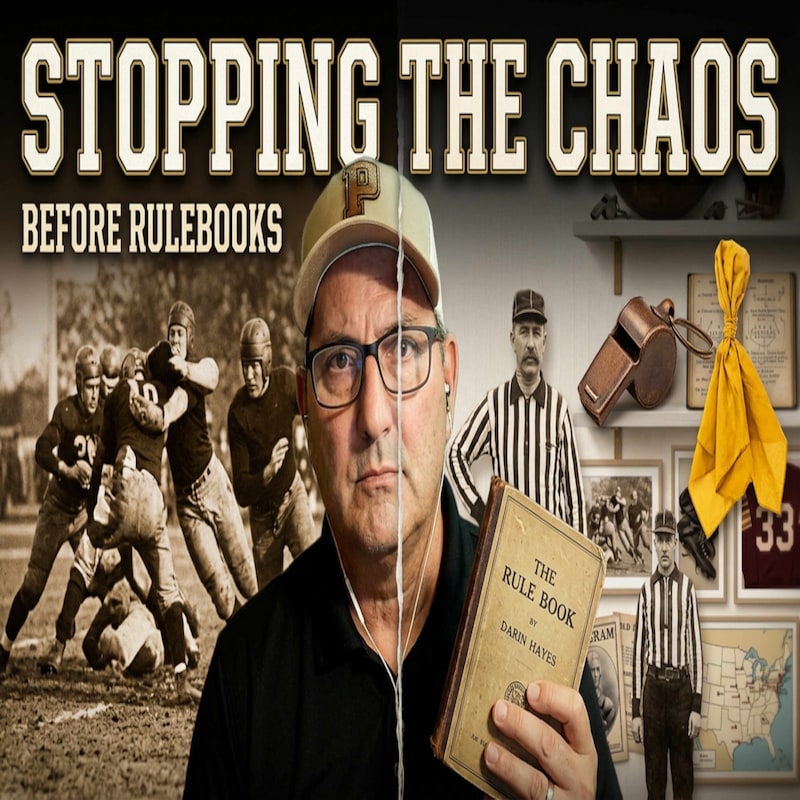
The episode embarks on an exploration of the intricate evolution of rule enforcement within the realm of football, elucidating the historical transition from rudimentary punitive measures to the sophisticated system of penalties we observe today. We delve into the nascent days of the sport, characterized by mass formations and tumultuous collisions, where rules were often regarded as mere suggestions rather than stringent regulations. Our discussion highlights the pivotal shift in 1880, which introduced a necessity for precision in the game, ultimately leading to the implementation of graduated penalties in response to the growing concerns about safety and fairness. We also engage with esteemed historian Timothy P. Brown, who provides valuable insights into how football's penalties have evolved over time, reflecting a broader understanding of the nature of fouls and their corresponding consequences. This episode serves to illuminate the historical context behind contemporary officiating practices and the ongoing significance of rules in maintaining the integrity of the game.
The conversation is based on Tim's recent article titled: The Origins of Football’s Distance Penalties
⏰ Timecodes ⏰
00:07 The Evolution of Football Rules
00:18 The Evolution of Football's Distance Penalties
08:24 The Evolution of Football Penalties
09:50 Evolution of Officiating in Sports
11:47 Exploring Football's Evolution
Do you want more football history? Grab a copy of our Award-Winning book, "The World's Greatest Pro Gridiron Team: The 1903 Franklin All-Stars" at https://amzn.to/4rG6uVe
Don't forget to check out and subscribe to the Pigskin Dispatch YouTube channel for additional content and the regular Football History Minute Shorts.
Miss our football by the day of the year podcasts, well, don't, because they can still be found at the Pigskin Dispatch website.
Do you want more football history? Test your Gridiron Knowledge, we feed you Daily with our new FREE activity, The Pigskin Trivia Drive.
Grab a copy of our latest book, "Marooned," on the 1925 Pottsville Maroons NFL franchise saga.
*OR* Grab a copy of our book on Western Pennsylvania football history, "World's Greatest Gridiron Team" on the 1903 Franklin All-Stars
Drop us a line at PigskinDispatch@gmail .com and check out and subscribe to the Pigskin Dispatch YouTube channel.
Contact us directly at [email protected]
Miss our football by the day of the year podcasts, well, don't because they can still be found at the Pigskin Dispatch website.
The evolution of rule enforcement within American football is a topic rich with historical significance and complexity. In this discussion, we delve into the nascent days of the gridiron, a time characterized by mass formations and brutal collisions, when the enforcement of rules was often merely a suggestion rather than a mandate. The conversation unfolds with a retrospective examination of how penalties were originally administered, highlighting the transition from a rudimentary system of disqualification and loss of possession to a more structured and graduated system of yardage penalties. The insights provided by our esteemed guest, Timothy P. Brown, illuminate the multifaceted nature of this evolution, detailing the influences of early collegiate football and the formative changes brought about in the latter part of the 19th century. As we explore the historical context, a narrative emerges that not only captures the essence of the rule changes but also reflects the broader societal attitudes toward violence and safety in sports, thus providing a profound understanding of how the game has adapted to the demands of time and culture.
Transcripts
Picture the earliest days of the gridiron.
Speaker A:Mass formations, brutal collisions, and rule books that were treated more like polite suggestions.
Speaker A:But what happened when a team actually crossed the line?
Speaker A:Before yellow flags rained down and referees started meticulously marching off 5, 10, or 15 yards?
Speaker A:How did the sport actually punish a foul?
Speaker A:Welcome back to Pigskin Dispatch.
Speaker A:I'm your host, Darrin Hayes.
Speaker A:And for today's football fix, we're diving into the messy evolution of rule enforcement.
Speaker A:To break down this fascinating article, the origins of football's distance penalties, we're bringing in our favorite gridiron detective, the historian behind footballarchaeology.com Timothy P. Brown.
Speaker B:And Tim Brown.
Speaker B:Welcome to the pig pen.
Speaker C:Hey.
Speaker C:Thank you, Darren.
Speaker C:Look forward to chatting.
Speaker C:And I do want to say that I want you to.
Speaker C:Depending on how this episode goes, you need to swallow your whistle.
Speaker C:You can't be making a game changing call on some cheap shot thing near the end of the end of the episode.
Speaker C:So just let things, let things play out and see how it works out.
Speaker B:All right, I'm.
Speaker B:I'm tossing the yellow hanky on that one.
Speaker B:On you.
Speaker B:That's, that's a personal foul on.
Speaker B:On you.
Speaker B:Two of those and you're gone.
Speaker C:Yeah, I was talking back to the referee.
Speaker C:Not a good thing.
Speaker B:Yeah, well, that fits right in because you wrote a tidbit recently that really piqued my interest and made me want to get the stripes out again and dust them off a little bit, because you had some history of some rules and just some great stuff and some really, some officiating equipment and officials.
Speaker B:You titled it the Origins of Football's Distance Penalties.
Speaker B:And what can you tell us about this story?
Speaker C:Yeah, so, I mean, I guess the kind of, the way I started approaching this is just the.
Speaker C:I think it was actually because I was watching, you know, World cup when I wrote this, and, you know, obviously there's, you know, both games, you know, you're kicking the ball down the field and trying to claim territory, and eventually you gotta kick the ball either over crossbar, under it, you know, but they came out of the same stew.
Speaker C:And then obviously rugby, from which, you know, football derived.
Speaker C:But, you know, those two games never went in the same direction as football in terms of, you know, yard lines and all that kind of stuff.
Speaker C:So everything is less precise in terms of their, you know, and like, their penalties tend to be.
Speaker C:They don't use yardage penalties.
Speaker C:I mean, maybe they do a little bit to step back on a penalty shot or something like that.
Speaker C:But.
Speaker C:So like, when football began you know, it being rugby, they basically had, the penalties were loss of possession, free kick and disqualification, you know, and typically, you know, there, those were things like for, they didn't have that many fouls really.
Speaker C:I mean, they had various kinds of roughing, throttling, kicking, you know, you know, kind of what we generally consider unsportsmanlike conduct.
Speaker C:And then offside was a huge thing.
Speaker C:You know, you'd get, boom, you know, lost possession and in some cases for some periods you were disqualified, you know, if you were deliberately offside like twice in a row or something.
Speaker C: point when it changed in, in: Speaker C:And we talked about that kind of issue a couple, couple of episodes ago.
Speaker C:But it was during that period when, you know, there was a lot of concern about the dangers of football.
Speaker C:That was really kind of the first time it was really, really emerging.
Speaker C: u know, faculty, you know, in: Speaker C:But during the time when they wouldn't let him play, the students were trying to figure out, okay, well how do we, how do we listen to the faculty and propose some changes?
Speaker C:And so they, they proposed that, that there be graduated penalties, you know, because the game as it was, you kind of either got disqualified or you didn't, or you lost possession, you didn't.
Speaker C:And so they were, they were saying, you know, let's find a way to, you know, enforce the rules but have some kind of graduated system of penalties.
Speaker C:And at the same time, the Princeton students who were the guys behind the, you know, the block games, they were saying, let's award points as punishment, you know, so just like, you know, it was only a couple years before that they had awarded one point for safety, and then the next year they made it two points for safety.
Speaker C:So that was kind of the new thing in the air, which is, you know, basically it's a safety is basically a penalty.
Speaker C:I mean, we don't think of it quite that way anymore, but at that time it was a penalty.
Speaker C:So then, you know, so kind of, you know, whether the Harvard kids and the Graduated idea really had much to do with it or not, I don't know, but kind of the only source I found.
Speaker C:But in 85 they said, okay,.
Speaker B:You.
Speaker C:Get disqualified in a five yard loss for intentionally delaying the game, which fairly big problem back, back then.
Speaker C: yards for defensive files in: Speaker C:The CFL still has 25 yard penalties for major type 2 falls or major falls.
Speaker C: yard penalties came in in: Speaker C:So it was this whole thing of just gradually the penalties became less severe, it became difficult to be disqualified and then instead of loss of possession, you know, even though that continued, I mean like forward pass incomplete forward passes were a loss of possession initially.
Speaker C:So that, that kind of idea carried on for quite a while.
Speaker C:But they still, you know, they started using, you know, there were more penalties and they tended to use yardage as the way that you penalize a team.
Speaker C:But like today we've got, you know, 5, 10, 15 yard penalties.
Speaker C:You got lost it down, automatic first down and disqualification.
Speaker C:That's pretty much about it, right?
Speaker C:You know, I mean, I looked through the rule book, that's where I pulled that off.
Speaker C:So, but you know, it's the general sense of calibrating the punishment so it's in line with the nature of the foul, which, you know, I mean, for the most part, you know, I mean, I think that's what we do, you know, you know, like targeting and a couple things.
Speaker C:There's, you know, disqualification, you know, second unnecessary roughness or you know, unsportsmanlike conduct.
Speaker C:Boom, you're out of the game.
Speaker C:But you know, it's pretty rare there, you know, other, you know, targeting.
Speaker C:You've seen a lot more guys getting DQ'd, but other than that, guys just don't get kicked out of games very much.
Speaker C:Right.
Speaker C:And then the, the loss of possession, I mean, do we have any loss of possession penalties?
Speaker C:I'm just off the top of my head.
Speaker C:I'm, I'm trying to, trying to think.
Speaker B:I think you might, you might have an illegal, illegal forward pass in some instances.
Speaker B:Possibly.
Speaker B:I don't know.
Speaker B:I have to, I'd have to get my head back in the rule book.
Speaker B:That's the only one I can think about.
Speaker B:I don't think, I think you're right though.
Speaker B:I don't think there is any.
Speaker C:So I mean, it's just, it's, you know, to me it's just one of those interesting evolutions.
Speaker C:I mean, what we have today makes perfect sense to us, but it's very, you know, it's dramatically different than the way it was in football's early days.
Speaker C:So, I don't know, I just find stuff like that kind of fascinating.
Speaker B:No, I think you're right.
Speaker B:I think.
Speaker B:But it's almost like, you know, especially the last 10 years, you know, with the.
Speaker B:The targeting penalties like you talked about, and the illegal horse collar coming in last 15, 20 years, those are disqualifying penalties in some instances now, you know, where now you are getting people DQ'd more frequently than we did 30 years ago, let's say.
Speaker C:Yeah, yeah.
Speaker C:And.
Speaker C:And so, like, early on there were, you know, you'd get DQ'd, like, even for, you know, whatever it was being intentionally delaying the game.
Speaker C:Right.
Speaker C:But for the most part, it was targeted at some kind of roughness issue.
Speaker C:You know, you got DQ'd for safety reasons.
Speaker C:And that's really where we're at today.
Speaker C:So, you know, I mean, it's kind of what goes around, comes around kind of thing, I guess.
Speaker B:Yeah.
Speaker B:I love the aspects of some of the things that you touched on in your article and you did here too, as how, you know, the print, I believe it was the Princeton guys that were promoting, you know, some of the penalties for score.
Speaker B:But they were also helped evolve the officiating positions.
Speaker B:You know, the referee once upon a time was by himself with a captain from each team on side, and he had to consult with them over penalties.
Speaker B:And that sort of got abolished when the umpire came in and they said, okay, these are the two guys.
Speaker B:And the referee has jurisdiction for things that are not in a rule book to cover them, which that rule is still in the college and high school and I believe the professional level today, where for something not covered by the rules, a referee can make a decision that's equitable and keep a fair and level playing field.
Speaker C:So, yeah, the unfair acts.
Speaker B:Right.
Speaker C:You know, and actually that's a point that I, that I.
Speaker C:That I didn't make.
Speaker C:I think it's in the article.
Speaker C:But the Princeton, either Princeton or Harvard students, one of the two, you know, they were.
Speaker C:They were arguing for the referee to.
Speaker C:To become like all powerful.
Speaker C:Right.
Speaker C:You know, because they'd had captains initially and then.
Speaker C:Well, and then they had these judges, you know, who advocated.
Speaker C:Each team named the judge and they advocated for the team in discussions with the referee.
Speaker C:But eventually, I mean, the game just got complicated enough.
Speaker C:They just had to keep adding officials and they become.
Speaker C:They became, you know, kind of, you know, whatever Dispassionate.
Speaker C:You know, they.
Speaker C:They were not.
Speaker C:They were supposed to have no feelings or, you know, they weren't supposed to be influenced.
Speaker B:Impartial.
Speaker C:Impartial.
Speaker C:Yeah.
Speaker C:Yeah, that's the word I was failing to find.
Speaker B:Yeah.
Speaker B:I wonder what they would, the forefathers of football would think today if they.
Speaker B:They looked out there and saw, you know, eight officials on the field at one time.
Speaker B:That's.
Speaker C:Yeah.
Speaker C:All of them wearing some funny striped shirt.
Speaker B:Right, right.
Speaker B:Think they're escaped from the local prison or something?
Speaker B:Probably.
Speaker B:But yeah.
Speaker B:So that's some interesting stuff and really explains, you know, the.
Speaker B:How football evolved from rugby and soccer to what we now, you know, call and admire and watch on TV every Saturday, Sunday, and every other day of the week.
Speaker B:And you do this a lot with your tidbits, Tim, and you help us recognize the.
Speaker B:And how can people take in some of these tidbits that you write?
Speaker C:Sure, just go to footballarchaeology.com and it's, you know, you can subscribe, you can just bookmark it, go whenever you want.
Speaker C:But if you subscribe, then you'll get an email every time I send out a new.
Speaker C:Every time I publish a new story so that the email will contain the story itself.
Speaker C:You can also, you know, go to my.
Speaker C:My page on.
Speaker C:On Amazon.
Speaker C:You know, we've got five books out there if you're interested in pursuing something a bit more in depth.
Speaker C:All right, that's about it.
Speaker B:All right.
Speaker B:Well, we appreciate you coming on in here and giving us a little bit of depth into the football history, and we'd love to talk to you and tread in those waters again next week.
Speaker B:Very good.
Speaker C:Thank you, sir.
Speaker A:That's all the football history we have today, folks.
Speaker A:Join us back tomorrow for more of your football history.
Speaker A:We invite you to check out our website, pigskindispatch.com not only to see the daily football history, but to experience positive.
Speaker B:Football with our many articles on the good people of the game, as well.
Speaker A:As our own football comic strip, cleat marks comics, pigskindispatch.com is also on social media outlets, Facebook, Twitter, Instagram, and don't forget the Big Skin Dispatch YouTube channel to get all of your positive football news and history.
Speaker A:Special thanks to the talents of Mike.
Speaker B:And Gene Monroe, as well as Jason Neff for letting us use their music during our podcast.
Speaker C:This podcast is part of the Sports History Network, your headquarters for the yesteryear of your favorite sport.
Speaker C:You can learn [email protected].




