Shownotes
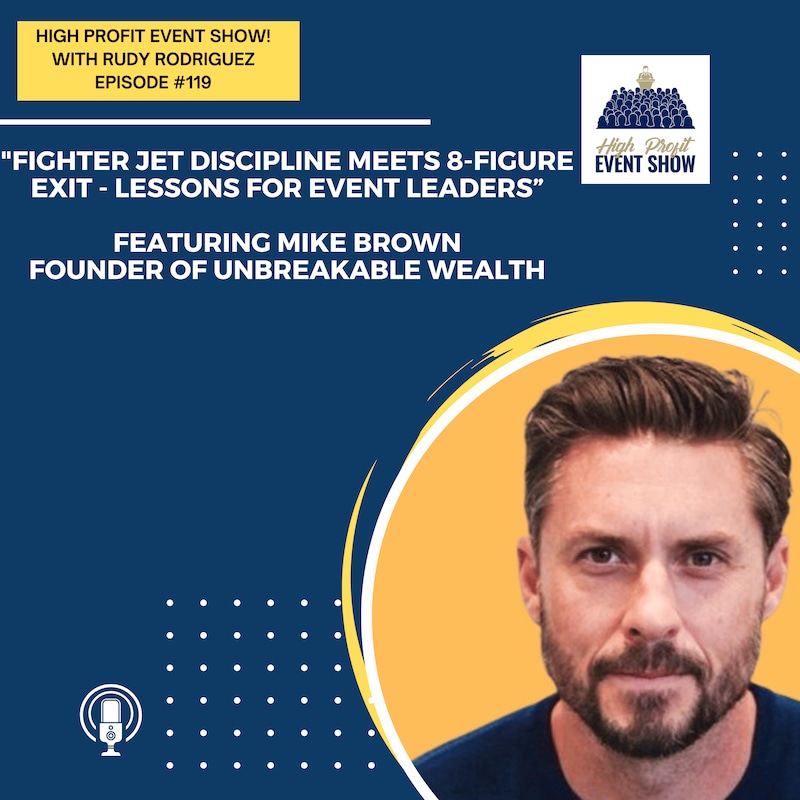
This week on The High Profit Event Show, Rudy Rodriguez sits down with accomplished and uniquely reflective leader, Mike Brown. Michael is a graduate of the United States Naval Academy, a former F-18 Super Hornet pilot, an entrepreneur who built and exited an oil and gas investment firm for eight figures, and the creator of the Unbreakable Wealth community and its pinnacle live event experience. He is also the host of the Money Stories podcast and the visionary behind a custom-built home in Morrison, Colorado—designed specifically for hosting intimate, transformational retreats.
In this powerful and unconventional conversation, Rudy and Mike explore how deep inner transformation shapes the way leaders design and deliver meaningful live events. Mike shares openly about the post-service healing journey that reshaped his identity, worldview, and approach to entrepreneurship. After reaching the peak of societal success—combat deployments, high performance aviation, major financial wins—he found himself unfulfilled and searching for deeper meaning. That search led him into meditation, coaching, personal development, and psychedelic-assisted therapy, which ultimately became the foundation for how he now helps founders pursue both wealth and inner freedom.
A core theme of the episode is Transformational Event Design Rooted in Deep Personal Work. Mike explains that his events are not constructed from business frameworks alone, but from the lived experience of unwinding old patterns, integrating trauma, and redefining wealth from the inside out. His healing journey informs every part of how he supports attendees—ensuring the event container facilitates real reflection, breakthrough, and clarity around what a truly rich life looks like.
The conversation also highlights the philosophy behind Crafting Premium, Intimate, High-Impact Live Events. Mike’s signature Unbreakable Wealth workshop is intentionally capped at sixteen participants, hosted in his home, and infused with high-end hospitality. Everything from the culinary experience to the carefully curated attendee selection is designed to create a safe, luxurious, and deeply connected environment. He emphasizes the importance of mutual fit, genuine vibe checks, elevated details, and designing the retreat he himself would want to attend.
Finally, Rudy and Mike dive into the essential role of Community, Integration, and Long-Term Transformation. Mike explains that meaningful change doesn’t happen from a three-day event alone. For this reason, attendance at his pinnacle event includes ninety days of community membership, weekly calls, structured integration practices, and real-time support as attendees apply what they learned back in their daily lives. His program blends wealth psychology, financial strategy, intention-setting, and consistent peer connection, helping founders stay accountable as they design a more present, purposeful, and financially sovereign life.
This episode is an invitation for event leaders to widen their lens—recognizing that transformational events are born not from tactics alone, but from the inner evolution of the host. Mike’s journey, insights, and philosophy offer a profound roadmap for anyone committed to designing experiences that shift people at the deepest level.
Want to connect with Mike?
Join the Newsletter: https://unbreakablewealth.com/newsletter/
Website: https://unbreakablewealth.com/
Money Stories Podcast: https://podcasts.apple.com/us/podcast/money-stories/id1809182577
LinkedIn: https://www.linkedin.com/in/mikebrownactual/
Facebook: https://www.facebook.com/mikebrownactual/
Instagram: https://www.instagram.com/mbrown.co/
X (Twitter): https://x.com/mbrown_co
Transcripts
Welcome to today's episode of the high profit event show. Today, I have a special guest with us here. A fellow alumni of The United States Naval Academy, five years my senior at the Academy, graduated the class of 2003, Mr. Mike Brown. Welcome, sir. It's fun to have you here man. I'm really curious to hear your perspective on live events and how that ties into wealth philosophy because I know that's your area of expertise and it's so cool in the circles that we run in. It's not every day you run into a Bo school graduate. So I just think it's really unique and interesting that you and I met at an event five years ago roughly. I think it was Elliot Roe’s Control Room Mastermind and I love the fact that we're super hornet guy as well and unlike maybe a lot of our brothers and sisters from The Naval Academy you left the box. You went on to be an entrepreneur and you went on to pursue your interest and went into the oil and gas industry as an investor, created a firm and exited for eight figures plus and continued on as an entrepreneur to go and educate other people on how you know on both philosophies and well principles which is super cool. For those of you guys who are like, what's an F18? Well an F18 super hornet is that super fast jet that you saw in the movie Top Gun, Top Gun To Maverick. That's it. Actually my two roommates from the academy, Nick Klaus and Mike Scott, they both went on to fly the F18 and my buddy Mike, he rode the, what they call it, the gray jet as long as he could and then when they said he couldn't ride it anymore, he went over to The Air Force and he started riding the, I think the F16, over there. He's been flying now for like over 15 years. He’s a lucky, lucky guy.
Mike Brown:Yeah, it was a great career. Seems like a lifetime ago.
Rudy Rodriguez:Yeah, we'll have to hear some stories today on the show to pull something out of you here. In addition, it's just background for our guest here so they can learn more about you right away. Mike also runs the Money Stories podcast. So we'll put a link to that here around this podcast and know people who listen to podcasts. They like this one, they'll go listen to another one and you speak on stage about money sovereignty and living richly in the present. You live now with your wife Claire and your two kids there in Morrison, Colorado and your beautiful home that you custom-built and designed to be able to host events at your home. You've been the host of the Unbreakable Wealth workshop and live event which has been the pinnacle experience for your community since 2022. Super excited to learn more from you today, man. It's not every day I get an F18 guy on the show, so I know people think that's cool. I'd love to, if you don't mind sharing a little bit of background, of maybe something cool about your experience in the Navy and how eventually that led you to becoming an entrepreneur because I think that's a good connection for our listeners and a cool thing to hear.
Mike Brown:Yeah, I mean look. As far as military service goes, I often say there is no amount of money that you could pay me that would replace my military service and you couldn't pay me any amount of money to be back in the Navy. So I think it's a great place to be from. I love my time. There is a young man flying Super Hornets. I think it's one of the coolest things a human can do but at the same time, military service comes with a great cost and lost a lot of friends along the way and over time recognized that there were aspects that I was struggling with post-service. So that healing journey has been foundational to my evolution both as an entrepreneur and a coach so you can file my military service under it's complicated. It comes with a lot of amazing positive aspects and not without cost.
Rudy Rodriguez:Yeah, I appreciate you sharing that so openly Mike because oftentimes it's overlooked. Either gets overlooked or under looked as far as like what the cost and the trade-off is for that? Yeah, it can be glamorous. Definitely. I'm in the same boat as you. I wouldn't trade it for any amount of money and I definitely would not want to go back for any amount of money. I guess it's a great place to be from but for me personally, definitely has given me the opportunity to appreciate a bit more of some of the freedoms that I know even today I sometimes still take for granted, but I remember especially having conversation like this or talking to people who are still in or people that are going in. It's like yeah, like freedom isn't free and that's not just sovereignty of our country, but it's also individual freedom. Like we had to work really hard as entrepreneurs to get to a point where we can appreciate some of the freedoms that perhaps you are able to have right now and people that are listening to this podcast have in their businesses as well Mike and you also pointed to a little bit of the the post service healing and recovery process. Again, that's something that oftentimes isn't really highlighted too closely and I know it's not the topic of the show per se, but I do think it's relevant and interesting because ultimately people are running events because they want to help people and oftentimes it's hey, we want to help you with your money because that's what people want but in reality they come to events and we discover they have some psycho pseudo cycle whatever in their bodies in their minds and their spirits of problems that are holding them back and it's not just their money. Would you be open to sharing a little bit about your journey and that process, that healing process that you kind of were alluding to there?
Mike Brown:Yeah, definitely because I think it's foundational and when we talk about the types of events I'm running they really are born of this experience and so my healing journey really started in 2017. I was basically standing at the top of the mountain. I had done everything that I was supposed to do. That society told me would make me happy. I went and tested myself in combat. I flew jets to pick a pinnacle of human performance, got out, founded a company and hadn't quite sold it at that point, but was really at this place where I was standing at the peak of success. I woke up the next day and I was still the same person. I went oh, no, like everything that was supposed to make me happy. I've got the house. I've got the cars. I've got the money. I've got the success. And here I am and there's still this hole inside of me. Like now what do we do? And you know as my friend Jeff Burningham likes to say, I stood at the top of the mountain and there's nothing up there but a cold howling wind. So I started the hard hard work of going, okay, if all of this external stuff, if all of these achievements that this worldly success didn't make me happy, then what's going to? Started working with coaches and I was fortunate to support some veterans organizations specifically that were focused on psychedelic assisted therapy for treatment of PTSD and basically started going down the rabbit hole of personal development, healing, and learning how to meditate. That was really the start of my healing journey.
Rudy Rodriguez:That's now, we're nearly 10 years in. Well, thanks for sharing all that Mike. You hit on quite a few different things there, one of which that jumped out to me right away. It was the psychedelic therapy and I think that's a topic that is, in some circles, a bit taboo. Definitely taboo in the circles that you and I came from. I'll just mention my own experience here for this audience and that's something I haven't talked about ever on the show. Being in the military, they're very strict. I mean, you have at The Naval Academy when I was there, I don't know what it's like for you Mike, but it's like you have more than three drinks, need a little more than 0.08. Like those are grounds for a dismissal. So they were extremely strict on even the legal substances, much as the thought of anything beyond that. So I was programmed very much so to think that just about everything that's out there is bad. It's illegal. It's bad. It's evil, it's immoral etc. I also had some of that in religious programming. But it wasn't until I too was going on my own entrepreneurial, and then eventually healing journey. Actually because of Elliot Roe. Coincidentally now I think about it. He's the one who told me about his experience. It was specifically with the philosophic and psychedelics combined with therapy and how it was the most powerful healing modality for him. That started to be in my mind, wait, is this not all bad? It's not all evil. There's something because it'd be actually something for it from this that can be helpful or healing. I eventually had my own experience specifically with psilocybin and that really opened up my perspective and quite a few things and started me down a path of personal growth that I didn't know was available.
Rudy Rodriguez:I now know that there's a lot of misinformation I think out there when it comes to this subject. So anybody listening to this like well, why are we talking about psychedelics? I would say do your own homework, do your own research, don't take anybody's word for it but one of the books that for me was a good education piece was How to Change Your Mind because I really had to do a lot of research before I even touched anything of the sort and that was really helpful. So thanks Mike for taking this help and going on a little tangent here.
Mike Brown:Yeah, absolutely. They can be a critical part of the healing process. What I would just also point out for anybody listening is that these medicines are incredibly powerful tools for opening the doors of perception, for maybe blowing the lid off of some things that have been bottled up. The Navy's really good at teaching compartmentalization as a framework for keeping you safe in combat and by the way, that's a really effective technique for staying safe in combat. Unfortunately, they don't necessarily teach people how to unwind that compartmentalization. So these medicines and psychedelic compounds should be held with deep reverence. This is not a casual undertaking and then the other piece that's incredibly critical is the integration on the backside. Doing the work to translate that experience into your everyday life. I think that's a part that's often overlooked. They really go hand in hand and so for anybody wanting to go down that particular rabbit hole, just make sure that you do a lot of research. Find a trusted provider and then make sure you have a plan for integrating the experience on the backside.
Rudy Rodriguez:It's oftentimes some of these, this can be found in recreational use cases or found amongst circles of people who are using things recreationally and they get confused. They don't have the reverence or the appreciation or the sacrament or the intentionality that they're meant to have, at least from a healing perspective. I think having it from a trusted source, with a trusted facilitator and a good integration process is super critical to actually get what the medicine that is possible from the experience. Mike, I've come across people who've done things recreationally or done things with the wrong facilitator or didn't have integration. They had a bad experience and all of a sudden in their mind, it became all bad. So I just want to emphasize everything that you said. Okay, great tangent, let's bring it back over here to events and I think it'd be cool to sort of tie some things together. You're a veteran. I'm a veteran. I'm sure you and I probably attract, I know I have attracted some veteran clients. I imagine you have as well. How do we tie this together into events and how we have impactful and profitable live events? I know, Mike, you've been running events since ‘22 in your home around a wealth philosophy, wealth psychology helping people become I guess bulletproof financially. Maybe tell us a little bit more about your philosophy at large or financial philosophy and how events kind of integrate into that and then we can talk about tactically what specifically you do with your events.
Mike Brown:Yeah, I can start with the genesis of how my first event came to be. So I sold my company in 2019 for a life-changing amount of money, should have never had to work again. Two years later I was waking up more stressed out, full of anxiety. There was days I didn't want to get out of bed to face the day because I was losing a heroic amount of money in a failed business venture and sort of fell back to the power of debrief from the Navy and went, wait a minute, how did I get here? And number two, like how can I get myself out of this situation? Like what happened? Number one is, I was deploying my capital into deal after deal after deal. I was really following this old adage. It takes money to make money. I was going all -in. I was swinging for the fences and I was doing that because I thought that's what rich people did. We have this hero culture in our society around venture capital and angel investing. So I thought I was following the playbook and as I started to educate myself, again hiring coaches, going to therapy, digging into my own wealth psychology, I realized that I was taking way more risk than I should have been and it was doing that, for a lot of reasons. A lot of them stemming back to my childhood, my military service. I've been risk on all the time just trying to feel alive and that was driving a lot of my decision-making. That really wasn't in my best interest so as I healed my own relationship to money, and I decided in the summer of 2022 that, it's sort of a classic. I don't know who needs to hear this but I have some valuable lessons learned and some battle scars and I think I'll just put together an event and and share what I've learned along the way and that first event became really the catalyst and the genesis for my coaching work in the online community that I've built today. But it really just started with drawing, putting a circle on a date on the calendar and going hey, I'm gonna host 16 of my friends to my home and just teach them what I've learned.
Rudy Rodriguez:Amazing, man and sounds like you learned a lot from just that period of time where you were just deploying capital like crazy. It sounds like you had some things probably working and some things that didn't, have failed or it didn't work as well. We could say pain is a great teacher. I love learning the hard way, but I'm trying to quit. Wow, I'm genuinely curious here, what would you say is like one of the top lessons that you took away from that summer ‘22 or just prior to that? All between 2019 and you know ‘22?
Mike Brown:Yeah, I mean, I think the biggest thing is I thought I needed a hundred million dollars to be wealthy and you know what I realized is that I actually have everything that I already need because true wealth is only an internal experience. We chase external success trying to create this sense inside of us and the eternal punchline is that it's already there available for any of us right in the present moment. So, how do we sort of balance this western achievement based more is better type philosophy with the fact that just being present and waking up and being able to spend time with our family doing the things that we love that light us up? How do we kind of reconcile that? The reality is that money should only be used for two things in my opinion. Number one is to close the anxiety loop of paying bills. Like we all have to have money to live, and so how do I get enough money to live my desired lifestyle and essentially kind of put to bed these open like if I don't have enough money to pay my rent that's going to keep me from living and enjoying the present moment. So step one is how do I get enough money to kind of step out of that anxiety loop that we all are stuck in and then beyond that now, how do I use my money to increase joy and fulfillment in the present moment? So it's not necessarily going down this path of renunciation and saying hey, I want to live like a monk in a cave like in western society.
Mike Brown:Some money is better than no money. I've been rich and I've been poor. I'm going to choose rich every time but I need to be using my money in service of the life that I actually want to create.
Rudy Rodriguez:Yeah, so one, close a loop on paying bills, making sure your needs are met period and then to do the things that bring fulfillment and joy and oftentimes those things are not as expensive or complex as we think they are. This is the way I'm interpreting what you're saying. Things like enjoying quality things with family, etc. and you don't need 100 million dollars to be.
Mike Brown:Yeah, it turns out I have way less than 100 million dollars and I'm living my dream life now. So, definitely proof that it's possible.
Rudy Rodriguez:That's awesome. It reminds me of an experience that I had. I was in this Tony Robbins group, this mastermind program called Platinum Partners and one of his events that he held was a finance event. He did it in Sun Valley and it was a room full of really awesome, in my mind, what I perceive to be very successful wealthy people and he asked a similar question: how much do you think you need to have to be wealthy? I just remember him making an example of someone who raised her hand and they needed to have a billion dollars and someone's like 500 million and somebody's like 100 million and then he actually took the time, he was making a point, he took the time to actually help, I think it was like the person needed 100 million. I think that's what it was. He drilled down and figured, okay, what is it actually that makes you happy? What is it you actually want and need? What amount of assets and cash flow is actually required to cover that? And it turned out that generally most people in the room needed half or less of what they thought they needed. When they actually took the time to do that and some people in the room, including one of my buddies sitting right next to me, his jaw hit the ground because he's been working like a dog as an entrepreneur for 20 plus years feeling like he didn't have enough and he hit the ground when he realized he was beyond wealthy. He had more than enough money to meet all the things that he ever wanted to have but he didn't stop to realize that. He didn't stop to realize that.
Mike Brown:Yeah, and this is essentially the foundation of what I'm doing here is helping people realize that we are chasing something externally that's always available to us from an internal experience perspective. Most of the entrepreneurs that I work with are already wildly successful by external measures. The punchline really is that when we drill down into what is the life that you actually wanna create, most of the founders that I work with already have enough or are within striking distance of having enough to live the exact dream life that they plot out on paper. But we are constantly bombarded with this message that more is better. If you're not growing, you're dying, like all of these deeply woven societal beliefs that we never step back and question and go, hey, like, what am I doing here? What am I doing here in the first place? Why did I get into this business? For most of us, it's to create freedom, and it turns out that you don't need $100 million to be free. You just have to get really clear on what is the life that I wanna live? What does freedom look like for me? And then design a very intentional life around that freedom.
Rudy Rodriguez:Yeah, and it sounds like this is the work that you do for people at your events or in your community.
Mike Brown:Yeah, exactly. This is the basis for the community. It's called Unbreakable Wealth, and it's really a place to have conversations about money, meaning, and what makes a truly rich life. I don't wanna burst anybody's bubble, but it turns out that money is really just a Trojan horse. It's a way to get people to think more deeply about what actually makes a rich life and typically, they're coming to answers that have nothing to do with money.
Rudy Rodriguez:Yeah, interesting. Interesting. So you have a community that you've developed, and then your event is the pinnacle experience of that community. Can you tell us a little bit about your business model, and let's talk about tactically your event and how it fits together with your community. Because I think that's very interesting for people listening to this. Like, hey, I run events. I'm thinking of running events. Maybe I'm listening to this, and I wanna run an event that's related to money or finance. I mean, almost every event in some way is. You hit on it in some way. So if you don't mind sharing your model and your philosophy with your event.
Mike Brown:Yeah, so going back to summer of ‘22, hosting that first event, number one, I always had a dream of hosting events or retreats and so I designed my home around hosting retreats. Once I closed and moved into the house, I was like, well, I guess I better do it now. So that was really the catalyst for hosting that first event and I just remember sitting there on Sunday afternoon as the guests left saying like, oh man, this was it. I've never felt more alive. I've never felt more fulfilled. I know that what I just put into the world was something of value. It created a unique experience for the attendees and really helped them shift their mindset. I knew from that point forward that this was something I was gonna continue to do. So over the next few years, I think I've hosted seven at this point here at my home and then other locations around the world. Eventually I took the curriculum that I designed for that initial event and then I launched an online community so that I could reach more people, so that I could sort of have a more evergreen model of helping bring this work to the world and what that allowed me to do was that now people coming into my community get that baseline curriculum as sort of the onboarding, as the going in, and then beyond that, that allowed me to really open up what was possible in events and do that deeper layer of transformational work.
Mike Brown:So the events have evolved over the years to now, it's really, I view it as the pinnacle experience of the work that I do in the community, taking a few days off, no cell phone, diving deep, taking space, and really asking the big questions about what matters. I think it's really important that we all do that at least once a year is to take a step back from our businesses, from the daily flow of life and go, okay, what is it that I really want and how do I become really intentional about getting that?
Rudy Rodriguez:Wow, that's big, especially the no cell phone piece. One of the biggest problems we have today, we're in an attention deficit economy. Everything and everyone is vying, is competing for attention and that's one of the common problems. It's like, if I have an event, people are on their phones or whatever, not present and it's not like you just say no cell phone policy, like, hey, there is none.
Mike Brown:Yeah, well, and to be fair, so my events are no cell phones during the day, during the thing, and people are allowed to take their cell phones back to their room at night, but I actually invite everyone to put it away for all three days if that's something that they're into.
Rudy Rodriguez:I personally attended an event a couple of years ago, a few years ago. It was more of a meditative event, so it made sense, but it was very much put the cell phone away for the duration of the experience as the encouragement in the locker. It was incredible to me how much attention, more free attention I had just knowing the cell phone wasn't on me, just knowing it was away, and I could really think about those bigger questions as you're pointing to as well. So for an event leader listening to this, you're wondering, hey, how do I deal with people on their cells? Maybe just invite them to literally put it away for the three days, and of course, create a good enough experience where it's worth it for them to put it away for that period of time. Mike, you mentioned your event is the pinnacle experience. I imagine those three days are at a premium as far as the investment goes. I think I saw on your website, it was $10,000. Is that right for the three days?
Mike Brown:Yeah, so, the event is $8,500 for a single individual or, man, now you're making me do my prices on the spot. I think maybe $12,500 for a couple to attend, but then with discounts for people that are already in the community, if that makes sense.
Rudy Rodriguez:A very premium event. I mean, I think I'd say anything $5,000 or higher for an event is a premium event. This is not a $99 come to the hangout for three days type of experience. No, this is deep and I also assume you keep it a fairly small group or limited in size.
Mike Brown:Yeah, so I designed the event around 16 people for a few reasons. One, because of the physical limitation of space in my home, I really like having the intimate experience here in my home and in the environment that I designed and curated creates a really safe space for people to do that deep transformational work and I think 16 is sort of a magic number because we can break out into groups of four. So that's a really nice size, but we can also come together in a circle and still have an intimate experience with everybody else there. So that's kind of the number that I've landed on as the ideal for the way that I format the events currently, but certainly open to changing that in the future as things grow and evolve.
Rudy Rodriguez:Yeah, I appreciate you sharing that, man, because I think that is a premium pricing, but it also is, like I said, premium experience here when you have 16 people or so. I think my personal experience has been minimum of five, maximum of 30 kind of keeps like a very, like a good critical mass, but even going above 16, it starts to be harder to separate those clicks and goes, just depending on what your outcomes are. But I love that you keep it at 16 and it keeps the intimates in your home. It's a very personal type of experience. So when it comes to having clients join your program, because this is like a top of mind problem for oftentimes, like, hey, how do I enroll people into my $8,500 or $12,500 with a spouse type of experience? What have you found to be like best practices when it's come to inviting people to be part of your premium experience?
Mike Brown:Yeah, great question. I mean, number one is, I think you have to believe. Like you have to believe deeply in what you're doing, in the transformational power of the nature of work, and then also know that you're truly providing a premium experience. I sort of disagree with the advice that you hear a lot out there, like fake it till you make it, just raise prices. Like, I actually think that's b*******. I think that I subscribe to an evidence-based confidence model. And so, if you are just starting out, it's actually okay to not be super profitable on your first one, like just fill the seats, provide a premium product, get some testimonials, and then start to build over time and raise prices like as consummate with the value that you're providing. But like, you better be damn sure that you are providing that level of value. So I think it's really bad advice to just go out and charge a crazy amount on your first event, if you're unproven, if you have an unproven model, if you haven't been doing something sort of similar. So number one is like, don't press yourself out of being able to deliver, like over deliver on value. Then the next piece is, again, I think it really depends on the experience that you're providing, because I don't have to pay for a venue because I own the venue. I am allowed to go outsize on the culinary experience, the wine experience that's provided. So everything feels ultra lux, the swag that I provide. I don't wanna spoil too many surprises, but like I give a ridiculous swag gift that it blows people's minds, because again, I have the budget to overspend on that sort of Ultra Lux type experience.
Mike Brown:And ultimately I designed the event that I wish I could attend. I think that's one of the things that is really great advice for people. It's like, I would have loved when I was exiting my company to have a 16 person deep dive on how I should structure my finances, how I should use that to create freedom. Then I would wanna do it with other like-minded founders, with a premium food and wine experience. Like that to me sounds like a rad event that I would attend. So that's what I made.
Rudy Rodriguez:Nice dude, yeah. Make the event that you wanna attend. That makes sense. You're gonna put a lot of time and energy and effort into design, filling, facilitating, all of that. You might as well enjoy what the heck you're putting together and that includes, I think, with selecting the people that you bring there for three days. Would you mind sharing your experience when it comes to that because I imagine you have a little bit of a criteria when you're selecting the people to bring together and how you go about that.
Mike Brown:Yeah, everything is based on mutual fit. So I know a lot of events or masterminds will use an application form as sort of a marketing tactic to say, hey, not everybody gets in, but then they take anybody's money that is willing to pay. This is not that. This is, we're gonna apply, we're gonna have an interview call and just do a vibe check. I mean, my criteria, yeah, okay, you need to qualify from a certain income and business size level. Typically it's seven figure plus founders, but really it's, would I have a dinner with you outside of this event? Are you interested and interesting? Are you asking questions about other people or are you just talking about yourself? Like if that's gonna be it, this is probably not your event. So it's really for curious, intentional, conscious founders. For me, first of all, I believe that my job is to facilitate the knowledge that this entire group comes with. So, yes, people are there to learn, but we're also there to learn from them. All of us have unique experiences. I think that the term mastermind really is sort of beaten a dead horse at this point, but like, I want this to be a mastermind experience where not only are you learning from the material and learning about yourself, you're providing experience to the rest of the group because to build a seven figure company, plus you have a lot of a wealth of experience that you can provide to other people, and if we can learn from each other, like I think that's really where the richness is.
Rudy Rodriguez:Awesome, man. I'm hearing you say mutual fit and like an actual vibe check, not just collecting people's money because they're going to fill out a form and hand it to you. I know one of the things that maybe is oftentimes overlooked by people is the work that you're doing to not just determine whether or not they should join your program, but to also figure out who else is gonna be a good fit for the other people that are in the program because you're like the gatekeeper. That's one of the key value representations of a true mastermind is who is the gatekeeper? Who's the one that's organizing and selecting the other minds that are gonna be part of this experience? Great to hear that you have a real criteria for you. You're not just collecting cash for anyone who'll throw it your way.
Mike Brown:Yeah, I mean, I think you have to be the steward of your community. If you're gonna be a community builder, you have to really hold that responsibility with intention. The reality is, that like one bad apple could actually ruin an experience for everybody else. If someone is bragging, talking about themselves, it can really derail the experience. So making sure that the right people are in the room, I think is one of the biggest responsibilities that anybody who's organizing an event can have.
Rudy Rodriguez:Yeah, most certainly. Let's talk a little bit about integration post-event, because I think that oftentimes is a subject that isn't super talked about, but I can tell it's important to you. So people come to your event, three days full immersion, not their phones, et cetera. They've answered some of the big questions in their life, maybe they haven't answered before. How do you go by ensuring that when they leave the event, that they continue to take the actions and get the results that they're set on getting? What's your approach to that?
Mike Brown:Yeah, so because my events are sort of that pinnacle experience for the community, most of the attendees have been in the community for some amount of time. That price that I quoted earlier is for people that are just stepping in, but it actually includes a, I believe 90 day membership to the community on the backside. So they're gonna have that support with weekly calls, with showing up and being in conversation consistently with other founders about not only, because look, I think we've all kind of seen this cycle of you go to an event, you learn a bunch of stuff, you answer big questions, you get really hyped, and then you go back to your life and life smacks you in the face. And six months later, you're like, oh man, I was so motivated back then. Why didn't I do any of those things? And then the cycle repeats itself. So how do we secure that permanent and lasting change? Well, I think that is really the power of community and showing up every week. Being in that conversation of, okay, I tried to implement this, here's the challenges that came up around that. What do you guys do when you see this, these types of challenges pop up? I think that is really critical, is not just walking away with a plan, but walking away with an understanding that you're not just gonna be able to pull the lever and make all of these things happen. Life is messy. It's not a clean, linear, up and to the right type experience. So when we get off track, when setbacks occur or when challenges surface, like who are we gonna lean on in order to make sure that we're still able to stay on track?
Rudy Rodriguez:Yeah. Community, that's the thing. People leave the event and if they don't have community, they fall back to old ways. I love that your people are already in community, coming in and also have that community support them beyond the event and someone just getting started, they still have 90 days perhaps from that pinnacle experience to be in community. Let's chat a little bit about that community and maybe we can give people a way to learn more how they can be part of your community. Can you again give us like 60 seconds on what the community is and what you focus on and who it might be for?
Mike Brown:Yeah, so Unbreakable Wealth is really for anybody who has reached some sort of entrepreneurial or financial success. It's not just for founders, we've had artists, we've had athletes, we have more corporate type folks, but essentially you're reaching that inflection point where you have excess money to invest every month. That's sort of the low end of the criteria that typically looks like, maybe bringing in $15, $20k a month, but it's actually not a specific financial number. It's more, am I out of struggle and starting to think about becoming the author of my own experience? So that's really the inflection point. Then beyond that, we have a sort of framework is weekly calls, Wednesdays, 10 a.m. mountain time, but there's eight foundational onboarding lessons that people step through that should give them a very deep sense of, okay, what is the life that I wanna create? How much money does it take to create that life? What is my plan in order to reach that financial freedom that allows me to become work optional and start increasing my fulfillment? Then once we have that wealth plan in place, now it's really diving into the questions of meaning, purpose, and fulfillment and how do I continue this journey of self-authorship and creating a truly free and rich life in the present moment? So I would say that the community is really for anyone who is ready to stop putting off their life in service of some goalposts that continues to move, and they want to be the author of their own journey in the present moment.
Rudy Rodriguez:Awesome, man. Then you also have a newsletter. Is that newsletter one in the name of the community or is that something?
Mike Brown:Yeah, so the newsletter is a great way to learn more. I spend anywhere from two to four hours writing that every week. It's a big part of sort of sharing this philosophy with the world. It's long form and you can subscribe at unbreakablewealth.com/newsletter.
Rudy Rodriguez:Okay, we'll be sure to include the link to that here around this audio or video, depending on where people are listening to this. So we'll have that there. Great, and so people can listen to your newsletter and if they want to apply to be part of your community, what's the step for them there?
Mike Brown:Yep, also there at unbreakablewealth.com, we'll make sure and put that link in the show notes, and if this sounds interesting to you, please reach out, let's have a conversation, we'll do that vibe check, and go from there.
Rudy Rodriguez:Awesome, man. Mike, this has been super interesting and I would say definitely a different episode than, I would say, our typical interview but I really like that we went down a few different paths, per se, on today's interview, and I hope someone listening to this, not only found value for themselves, but maybe they know someone who might need to hear this message, whatever rabbit hole that we went down today together. For my audience here, I know this has been an unconventional interview, but I highly recommend go check out Mike Brown's information, go to his website, check out his newsletter, check out his community. I can tell you from personal experience that what he's pointing to is truly it doesn't matter how much money you make or have. It is not an external game, it is an internal game, and Mike is holding the light bright to help guide people through that journey of finding the joy from within, and also creating the financial structures to support living that ideal lifestyle as well. So it's not one or the other. It's both.
Mike Brown:Yeah, how do we have both hands? I mean, that's really what we're doing here, because they're not mutually exclusive.
Rudy Rodriguez:Yes, you don't have to just be completely impoverished and happy, and you don't have to be completely wealthy and unhappy. It's like, how can you have the wealth and have the joy and the happiness and fulfillment? Mike, any kind of just final words of advice for the audience as we bring our interview to a close here?
Mike Brown:I mean, I really appreciate the way you framed that, and thank you for the compliment. I've walked through the fire, I have a lot of battle scars to prove it, and it's just my greatest honor and privilege to be able to share what I've learned along the way, and look, I don't have it all figured out. I'm still learning just like everybody else, but it's really, truly, my greatest joy to be able to share what I've learned with other folks and help them along the path with the few things I have figured out.
Rudy Rodriguez:Awesome, man. Thank you, Mike, for sharing, and for being out there and teaching what you've learned through your personal experience, and I love what you shared earlier about, price things based off of evidence, do things based off of evidence-based thought and behavior and action, and it makes me think of, like, the OODA loop thing that we learned back in the day.
Mike Brown:Yeah, absolutely.
Rudy Rodriguez:Thanks, bro, this has been a great interview, man.
Mike Brown:Yeah, thanks for having me, I appreciate you.
Rudy Rodriguez:Absolutely.



