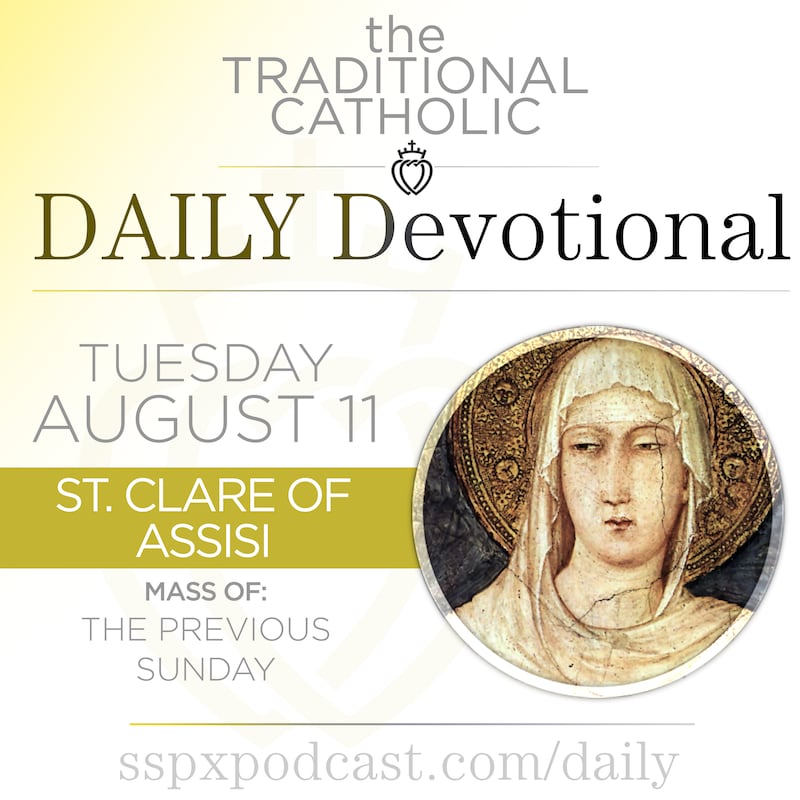
It's the Feast of
Feria,
4th Class, with the color of
Green. In this episode: the meditation: "Liturgical Rituals", today's news from the Church: "John Senior: What the American Professor Thought About the Crisis in the Church (3)", a preview of this week's episode of The SSPX Podcast: "Episode 9, Chapter 12: In the Turmoil of the Council", and today's thought from the Archbishop Marcel Lefebvre.
Have feedback or questions about the DD or our other shows?
[email protected]
Sources Used Today:
- "Liturgical Rituals" — From Trinity Sunday to the Assumption
- "John Senior: What the American Professor Thought About the Crisis in the Church (3)" (FSSPX.news)
- The SSPX Podcast: "Episode 9, Chapter 12: In the Turmoil of the Council" (SSPX Podcast)
- The Spiritual Life — Archbishop Marcel Lefebvre (Angelus Press)
Please support our new project, the Archbishop Lefebvre Biography Audiobook!
Saint Clare of Assisi is often introduced simply as the female counterpart to Saint Francis. But Clare was no supporting character in someone else's story. She was strong-willed, remarkably determined, and spent much of her life fighting to protect one very simple idea: she wanted absolutely nothing except Christ.
Clare was born in 1194 into one of Assisi's wealthy noble families. Her future was basically planned for her. She would marry well, raise a family, and remain part of the comfortable world of medieval Italian nobility.
Then she heard Francis preach.
Something clicked.
At eighteen, Clare secretly left her family home on Palm Sunday night and met Francis and his friars at the little Portiuncula chapel. There, she exchanged her expensive clothing for a rough habit and had her hair cut short as a sign that she belonged entirely to God.
Her family was furious.
Relatives actually came to drag her home. Clare reportedly clung to the altar and revealed her shorn head, making it perfectly clear that she wasn't changing her mind.
Before long, other women joined her, including her sister Agnes and eventually even her mother. Their community settled at San Damiano, the little church Francis himself had once repaired.
Clare's version of Franciscan poverty was radical. She didn't simply want individual sisters to own nothing. She wanted the entire convent to own nothing. Church officials repeatedly worried that this was impractical and tried to persuade her to accept property that would guarantee the sisters a reliable income.
Clare politely refused.
For decades.
She even obtained from the pope what became known as the "Privilege of Poverty," official permission for her community to possess no property and depend entirely upon God's providence.
One of the most famous stories about Clare came when soldiers threatened the convent. Too sick to walk, Clare had herself carried to the doorway with the Blessed Sacrament. According to tradition, she prayed before the Eucharist, and the attacking soldiers suddenly withdrew. This is why artists often depict her holding a monstrance or ciborium.
There's also a surprisingly modern connection to Clare. Near the end of her life, when illness prevented her from attending Mass, tradition says she miraculously saw and heard the Christmas liturgy projected onto the wall of her room. Because of that story, she was later named patron saint of television.
Clare died in 1253 after more than forty years at San Damiano. Just two days before her death, Pope Innocent IV finally approved the rule she had fought so long to preserve.
Visitors to Assisi today can pray before her incorrupt remains in the Basilica of Saint Clare and see the original San Damiano Cross that played such an important role in the Franciscan story.
Saint Clare of Assisi, fearless daughter of poverty and lover of the Holy Eucharist, pray for us.
- - - - - -
Explore more:
What is the SSPX Podcast?
The SSPX Podcast is produced by Angelus Press, which has as its mission the fortification of traditional Catholics so that they can defend the Faith, and reaching out to those who have not yet found Tradition.
What is the SSPX?
The main goal of the Society of Saint Pius X is to preserve the Catholic Faith in its fullness and purity, to teach its truths, and to diffuse its virtues, especially through the Roman Catholic priesthood.
Authentic spiritual life, the sacraments, and the traditional liturgy are its primary means of bringing this life of grace to souls.
Although the traditional Latin Mass is the most visible and public expression of the work of the Society, we are committed to defending Catholic Tradition in its entirety: all of Catholic doctrine and morals as the Church has always defended them. What people need is the Catholic Faith, without compromise, with all the truth and beauty which accompanies it.
https://sspx.org