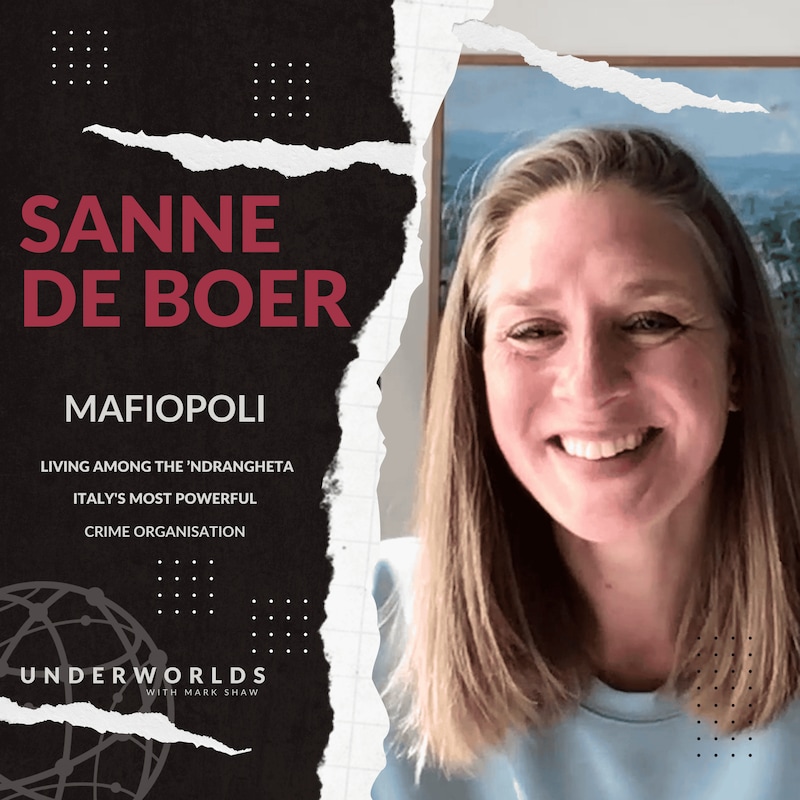
Shownotes
Mafiopoli: Uncovering the ’Ndrangheta, Italy’s Most Powerful Mafia.
In this episode of Underworlds, host Mark interviews Dutch journalist and author Sanne De Boer about her book, Mafiopoli: Living Among the ’Ndrangheta – Italy’s Most Powerful Crime Organisation. Based in Calabria, home to the rugged Aspromonte Mountains, De Boer reveals the ’Ndrangheta’s rise as Europe’s cocaine trade kingpin, with growing influence in the Netherlands, Belgium, and Germany.
Mafiopoli exposes the mafia’s grip on business, politics, and even the Catholic Church, spotlighting the 2007 Duisburg killings that highlighted their violent reach. De Boer discusses Europe’s struggle to counter the ’Ndrangheta, alongside Calabria’s youth-led resistance. She also shares Pope Francis’s bold 2014 condemnation of the mafia as “evil” during his Calabria visit, effectively excommunicating them.
Learn about De Boer’s investigative process, diving into Italian court documents while navigating personal safety risks.
Listen now to explore the ’Ndrangheta’s power and Calabria’s fightback!
Timecodes:
0:00 - Intro
01:53 - What does "Mafiopoli" mean?
03:24 - Encountering the 'Ndrangheta in Calabria
06:00 - The Duisburg Massacre in Germany
09:25 - Quiet growth of the 'Ndrangheta
11:53 - Background to the Duisburg Massacre
14:54 - 'Ndrangheta investments in the Netherlands and Germany
17:03 - European countries unprepared to deal with 'Ndrangheta
21:03 - Talking to Dutch Law Enforcement
23:01 - Petra Reski
25:13 - Infiltration of politics
28:54 - 'Ndrangheta excommunicated by Pope Francis
31:05 - Calabrian resilience to the mafia
33:56 - Threats and Security
36:26 - Writing Mafiopoli
42:09 - Pessimistic or optimistic about the growth of the mafia
43:57 - Next Book & Outro
====================================================
Sanne de Boer's book Mafiopoli: Living Among the ’Ndrangheta – Italy's Most Powerful Crime Organisation is available here.
Audible version.
====================================================
Underworlds with Mark Shaw YouTube playlist.
====================================================
🌎 VISIT US! Global Initiative Against Transnational Organized Crime
🎧WHY NOT TRY OUR OTHER PODCASTS:
🎧Deep Dive: Exploring Organized Crime
===================================================
FOLLOW US
X - @gitoc
LinkedIn - @Global Initiative against Transnational Organized Crime
IG - @gi_toc
===================================================
Transcripts
What caught my attention was an incident that happened in Duisburg.
Speaker:We're speaking about mafia organisations
Speaker:as organisations that are defined by their political and economic power.
Speaker:So many years later, one of the people that had
Speaker:sued her at the time is now one of the people that has been arrested and
Speaker:is actually on trial in Italy.
Speaker:I am now much much more aware of the fact that, of course, there is a big capacity
Speaker:problem in all of our countries to deal with this problem.
Speaker:Welcome to Underworlds from the Global Initiative Against
Speaker:Transnational Organised Crime.
Speaker:My name is Mark Shaw.
Speaker:In today's episode, I speak to Sanne de Boer, who's a courageous Dutch journalist
Speaker:who relocated to Calabria and wrote a book called Mafiopoli, which is
Speaker:a story of the 'Ndrangheta.
Speaker:It's a slightly different story from other accounts.
Speaker:For a start, Sanne is something of an insider-outsider.
Speaker:She's well-integrated into Calabrian society while not being a local.
Speaker:And she begins to write the book based on a set of incidents that occur around her.
Speaker:What's really important about the book, in my view, is not only is it a story about
Speaker:the role and growth of the Calabrian mafia, but it is also looking at its
Speaker:connections, the 'Ndrangheta, its connections into Germany
Speaker:and the Netherlands.
Speaker:She focuses on a particular massacre in the town of Duisburg in Germany, and she
Speaker:draws on that to show how unprepared the authorities in the wider European
Speaker:continent had been for the growth of the Italian mafia.
Speaker:It's a fascinating and, again, courageous piece of work by an
Speaker:investigative journalist.
Speaker:Sanne, welcome.
Speaker:Sanne, the book has a very interesting title, Mafiopoli.
Speaker:I'm not even sure I'm pronouncing it correctly, but tell us a little bit about
Speaker:the background to the title of the book. Sure.
Speaker:The word "Mafiopoli" means a place governed by the mafia's interests.
Speaker:It was actually used by a very iconic Sicilian anti-mafia activist,
Speaker:Peppino Impastato, who used it to mock the mafia interests in his village.
Speaker:The reason I chose it for the title of the book is because I really wanted to stress
Speaker:the political aspect of mafia power.
Speaker:It's an aspect that is less well known to a Dutch audience and a
Speaker:non-Italian audience.
Speaker:I wanted to really stress that aspect the way the mafia can influence
Speaker:society through this political power.
Speaker:Sanne, the book, what's interesting in my reading of it is actually
Speaker:it's a bit of a personal story, too.
Speaker:You moved to Calabria, you settled into a small village,
Speaker:you came upon the mafia, so to speak, and you then began to get an interest.
Speaker:You moved away, you moved back.
Speaker:Tell us something about, if you like, the life of the book, your own life, but the
Speaker:life of your book intermingled with your engagements in and around Calabria.
Speaker:Yes, of course.
Speaker:Well, I have decided to write the book after having lived in Calabria
Speaker:for at least 10 years.
Speaker:I didn't want to rush into the topic, of course.
Speaker:I had been making reports about the topic for Dutch media, for television and radio,
Speaker:and for print media, so for newspapers.
Speaker:But I came to the conclusion that these reports didn't allow for a lot of
Speaker:space to go deeper into the more complicated reality.
Speaker:Also, especially to speak about the inconvenient truth about
Speaker:the fact that our country, the Netherlands and our neighbouring countries such as
Speaker:Belgium and Germany, are a very important factor in the success of the 'Ndrangheta.
Speaker:They smuggled a lot of cocaine through our countries, especially the
Speaker:Netherlands and Belgium.
Speaker:In a way, as a Dutch person living in
Speaker:Calabria, I felt that I had a responsibility to
Speaker:emphasise this reality, to speak about it.
Speaker:And so I decided to write this book and to also make myself a figure in the story.
Speaker:It would felt cowardly, maybe even to exclude myself from the story.
Speaker:And I hope that it also helps people to relate to
Speaker:the subject, to make it become a little bit more closer to their reality, the fact
Speaker:that I, as a privileged outsider, speak about this problem.
Speaker:However, I have known that region for a long time.
Speaker:I've seen daily life there.
Speaker:I've seen the struggles there.
Speaker:I've seen a lot of courageous examples of people speaking out.
Speaker:That's also a reality I really wanted to stress in this book.
Speaker:Sanne, it comes across really well, I have to say, and you don't overdo your presence
Speaker:in the book, but you are there, and that's a guiding narrative,
Speaker:which I must say personally is very interesting and sometimes unusual, I
Speaker:think, at least in accounts of the mafia.
Speaker:But maybe just before we move on, the book, you move to the village, but
Speaker:you don't immediately meet the mafia.
Speaker:You recall the mafia or the 'Ndrangheta.
Speaker:Just explain how it became more and more of a presence or your knowledge of its
Speaker:presence became greater and then that influenced your decision
Speaker:to work on the subject.
Speaker:Well, it's not a subject that is easily spoken about in Calabrian society, of
Speaker:course, although that is definitely changing.
Speaker:I've seen this change.
Speaker:People are coming a lot more outspoken about it in recent years, which I
Speaker:think is a very good development.
Speaker:But at the time, and this is we're speaking now, we're talking about more
Speaker:than 15 years ago now, I had trouble finding people who I would be also
Speaker:comfortable speaking about this topic, too, and who would be able to
Speaker:explain this situation to me.
Speaker:I did, however, read a lot of things, of course, in the newspapers, and I was able
Speaker:to understand more and more about it with time.
Speaker:What caught my attention was an incident that happened in Duisburg,
Speaker:which it happened during my first summer in Calabria, which was in August 2007.
Speaker:What happened was that six men were shot in front of a restaurant in the city
Speaker:centre of Duisburg, Actually, it was a restaurant that was on the ground floor of
Speaker:a very big office building, the biggest office building of the city.
Speaker:These killings were connected to a feud in Calabria, in San Luca,
Speaker:which is a well-known village for people who know a little bit about the
Speaker:'Ndrangheta, because a lot of clans connected to these villages
Speaker:are often in the news.
Speaker:What happened was, in a way, Germany woke up to the reality of the presence
Speaker:of the mafia in their country.
Speaker:Duisburg is a city that is only about a half an hour away from the
Speaker:border with Netherlands, and it revealed also the connection to the Netherlands,
Speaker:especially after one of the killers of the Duisburg murders was found in a
Speaker:suburb of Holland, of Amsterdam.
Speaker:I woke up to the reality of this Calabrian
Speaker:mafia that had a lot of business in the Netherlands, in Germany,
Speaker:a reality that was not easy to penetrate or come to grips with at the time.
Speaker:But as I learned more and more, I found out what was actually
Speaker:happening, of course.
Speaker:This was one of the most important reasons, I think, that I
Speaker:became interested in the topic as well.
Speaker:I would have become more and more interested just living
Speaker:in Calabria for sure.
Speaker:But the fact that there was a connection to Holland, such a strong connection, made
Speaker:it even more important or urgent for me to find out more about it.
Speaker:Sanne, actually, this is a very interesting part of the book because it's
Speaker:not only about the 'Ndrangheta in its Calabrian setting,
Speaker:although you are there, it's very much about the expansion of
Speaker:organised crime in Europe.
Speaker:You use the massacre you've described in Duisburg in Germany as a
Speaker:thread that runs through it.
Speaker:You explain or you cover this very interesting section
Speaker:around a particular German journalist, which I want to get to.
Speaker:But before moving on, maybe just to explain, because the book has a very
Speaker:readable history of the Calabrian mafia.
Speaker:It's probably a good place to start, maybe for you just to recount that,
Speaker:where it developed from, how it's evolved, its expansion into Europe, just as a
Speaker:scene setter for the book as a whole.
Speaker:A lot of people around the world have known about the
Speaker:presence or the existence of the Sicilian mafia, Cosa Nostra, and mafia of
Speaker:Campania, which is the Camorra.
Speaker:These are much more well-known mafias than the 'Ndrangheta.
Speaker:Maybe in recent years, we hear a lot more about the 'Ndrangheta,
Speaker:but 20 years ago, this was very different.
Speaker:This is very much connected to its success.
Speaker:The 'Ndrangheta has made a very strategic choice to avoid violence abroad.
Speaker:Then, of course, this sounds like a contradiction to what I've just said about
Speaker:the Duisburg Massacre, but this was definitely an exception
Speaker:that proves the rule.
Speaker:They avoid using violence abroad, especially abroad.
Speaker:They do avoid also using violence against important state figures in Italy,
Speaker:although there are definitely exceptions to that rule.
Speaker:But they've made different choices than, for instance, Cosa
Speaker:Nostra, who had waged a open war against the state in the '80s and '90s and got a
Speaker:very big blow from law enforcement because of that.
Speaker:During those years, especially in the '90s, the 'Ndrangheta has grown very much
Speaker:in their drug trafficking, their international drug trafficking.
Speaker:They did this in a very smart way by, of course, keeping saying under the radar
Speaker:and integrating very well also in and foreign societies, I guess.
Speaker:Basically, you describe the historical development, basically
Speaker:making the argument that the 'Ndrangheta is different from the Cosa Nostra and the
Speaker:Camorra, and it's now become extremely powerful because of that.
Speaker:Maybe just for a wider audience, the Duisburg Massacre was covered a lot,
Speaker:obviously in the German and I guess the Italian press.
Speaker:But just give us, who was killing whom?
Speaker:Why did that massacre take place in Germany?
Speaker:It clearly shook the German establishment.
Speaker:Just give us a little bit of background on that because as I read it, it was a
Speaker:reflection of the expansion of the 'Ndrangheta and conflict
Speaker:related to that expansion?
Speaker:Would that be broadly correct? I think so.
Speaker:The massacre was connected to a very long feud that had been
Speaker:going on since '91, I think.
Speaker:It was a conflict between two clans in San Luca.
Speaker:Of course, these clans have both interests in drug
Speaker:trafficking, and they are both prominently present in, especially that area of
Speaker:Germany and other areas of Germany, to be able to launder
Speaker:this money also in through investments maybe
Speaker:in various business sectors, but especially in restaurants and other
Speaker:hospitality sector investments.
Speaker:The actual shooting happened Because it was a reaction against a very tragic
Speaker:murder that had happened around Christmas time in Calabria.
Speaker:But of course, there was also a very…
Speaker:It was a conflict that came out of some jealousy for in business.
Speaker:It was a massacre related to internal tensions back home.
Speaker:You describe it very well in the book, I have to say.
Speaker:Sanne, when you read about the Duisburg Massacre, did you start
Speaker:covering it for the Dutch press?
Speaker:Clearly, the book is not about the massacre entirely,
Speaker:although it comes up in several places.
Speaker:But as you said, it was the hook for you to write the book, did you realise
Speaker:immediately that you would want to write around that?
Speaker:Was there a demand for more coverage?
Speaker:Sure.
Speaker:I started writing about the topic much later, actually.
Speaker:I didn't immediately decide to cover this for the Dutch press.
Speaker:You read about it.
Speaker:It was covered in Calabria. Yes.
Speaker:Of course, I tried to inform myself about it, but these things also have a very long
Speaker:It's a very long process.
Speaker:Even just bringing one of the killers to trial, the definite
Speaker:conviction of the murderer took years and years, of course.
Speaker:If you want to write about these stories and know a little bit more about
Speaker:developments and backgrounds, what is very interesting to me is that we
Speaker:still find in even in recent arrests, the same clans come up in the arrests that are
Speaker:happening in Holland or mostly in Germany, Belgium.
Speaker:We're still talking about the same clans, and actually they've decided to
Speaker:collaborate again right after the Duisburg Massacre.
Speaker:I think it's even more revealing to know the current situation and to know,
Speaker:to realise how well they've been able to stay put in this territory, actually,
Speaker:even after the Duisburg Massacre happened.
Speaker:Sanne, what for me was interesting, well, a Apart from the tragedy of the
Speaker:massacre itself, it was connected in and around a restaurant.
Speaker:I don't remember the exact details, but it took place either in the
Speaker:restaurant or close by.
Speaker:You talk a lot about restaurant investments, actually, in the Netherlands,
Speaker:in Germany, and the connection to the Calabrian mafia.
Speaker:Tell us about that.
Speaker:Investigations do show that the 'Ndrangheta's investments in
Speaker:restaurants, also outside of Italy are important to
Speaker:their business, let's say, in that they use these restaurants often as
Speaker:ways to connect with also important figures in local politics
Speaker:and local businesses.
Speaker:It's a way also to create an important network for them to grow,
Speaker:to have more profit.
Speaker:In a sense, also, sometimes it's been shown in a recent investigation
Speaker:in Germany to organise their own impunity, which is, of course, very
Speaker:worrying, should be worrying to us.
Speaker:My real motivation is to have people think about international organised crime
Speaker:as a way that can, in subtle ways, influence our own reality,
Speaker:our own daily lives as well.
Speaker:To also maybe remind them of the fact that this is one of the problems
Speaker:we deal with today that is connected to all kinds of other problems.
Speaker:I must say I really appreciated your report, Intersections, that shows the
Speaker:interconnectedness of organised crime with so many other problems
Speaker:we're dealing with today.
Speaker:The fight against organised crime, it's necessary to have a solidarity, to have an
Speaker:international solidarity as it is with all these other global problems
Speaker:that we're facing today, I feel.
Speaker:Even if it is very specifically about the 'Ndrangheta, my intention was to point
Speaker:your attention towards this reality.
Speaker:Sanne, just to make it very clear, and I said it already, the
Speaker:book is about more than Calabria.
Speaker:It's these connections to Germany and the Netherlands.
Speaker:You say at several points in the book that neither the authorities in Germany, in
Speaker:particular, as I read it, but also the Netherlands necessarily understood or were
Speaker:prepared for the level of the threat that the 'Ndrangheta faced in other countries.
Speaker:Give us some insights there.
Speaker:I mean, did this become clear to you talking to authorities in
Speaker:both of the other countries?
Speaker:Yes.
Speaker:I remember also speaking...
Speaker:Of course, I had done a lot of research while writing the book.
Speaker:I had already studied so many court documents.
Speaker:I'd study all these cases.
Speaker:I remember also speaking to some Dutch investigators who had done
Speaker:an investigation into the 'Ndrangheta in Holland.
Speaker:While realising that, it almost seemed as though I knew more about
Speaker:the subject than they did.
Speaker:I was very surprised about this.
Speaker:Still, what I'm very surprised about and also happy about is that
Speaker:my book has found a lot of readers in law enforcement in Holland, and at least
Speaker:I'm not sure about the other countries.
Speaker:It's been translated also into German and, of course, into English.
Speaker:I'm very happy about this because it allows me to also...
Speaker:Some of these readers, they reach out to me.
Speaker:The conversation that I have with them also make me more aware of
Speaker:the challenges that they face.
Speaker:Because maybe perhaps when I finished the book, I think I was a little bit naïve
Speaker:in a sense that I was hoping that when people would become more aware of
Speaker:this problem, it would really help them do something about it more easily.
Speaker:I am now much more aware of the fact that, of course, there is a big capacity problem
Speaker:in all of our countries to deal with this problem.
Speaker:Also of the simple fact that the 'Ndrangheta is very lucky in
Speaker:a way with the way it's been doing its business, because avoiding violence,
Speaker:obviously, makes them less of a threat to our societies.
Speaker:It is almost impossible for crime fighters to
Speaker:convince their superiors about the necessity to do something against
Speaker:these criminals in our countries.
Speaker:This is the unfortunate reality, and it's something that is understandable but still
Speaker:very frustrating and very unfortunate, especially because in a sense,
Speaker:with international cooperation, it has been happening in our countries.
Speaker:We've had some very important investigations and
Speaker:some joint investigations teams from Eurojust that have been proven to be able
Speaker:to do a lot more than had been happening in the past.
Speaker:Then again, I realised also from talking to crime fighters here,
Speaker:it's a very difficult problem to tackle.
Speaker:You made this very interesting point for me, and given that this is a podcast about
Speaker:non-fiction books on organised crime, that a lot of your readers were in Dutch law
Speaker:enforcement, people who wanted some background to the issue, who wanted to
Speaker:understand some of the history and symbols of the 'Ndrangheta.
Speaker:What were those sorts of discussions like?
Speaker:Did these people come up to you when you presented the book in public or people
Speaker:contacted you after they had read the book?
Speaker:Well, actually, the book came out in Holland.
Speaker:It's already four and a half years ago now.
Speaker:We were in lockdown, actually.
Speaker:We were in COVID.
Speaker:But a lot of people reach out to me through email or other otherways.
Speaker:Since we can meet people in public again, I've been meeting up with a lot of people.
Speaker:Also travelling through Germany and Holland to give presentations about this.
Speaker:It's been very surprising to me, actually, that so many crime fighters
Speaker:really want to hear more about the topic, tell me that they've actually changed the
Speaker:way they look at their work in some cases as well.
Speaker:Most interesting maybe is that they recognise a lot of these dynamics,
Speaker:even in the groups that they study, which means that, to me, it says that
Speaker:mafia behaviour or mafia tactics are, of course, more widespread than
Speaker:mafia clans themselves.
Speaker:Even regular organised crime groups do implement these tactics.
Speaker:Also, in that sense, it seems that it's been a helpful
Speaker:book for this public as well.
Speaker:Parallel to that, Sanne, you tell the story of a German journalist, Petra Reski,
Speaker:who, I must say, I didn't know much about at all.
Speaker:She had written a book linked to the Duisburg mafia Massacre.
Speaker:She had quite a hard time with her publication.
Speaker:You recount that almost It's really parallel to your own story.
Speaker:It's quite an interesting way in which you've done it in the book.
Speaker:Tell us a little bit about Petra and the struggles she had and whether that changed
Speaker:your own opinion about how you should pitch the narrative and
Speaker:content of of your book.
Speaker:Petra Reski, she's written beautiful books about 'Ndrangheta presence in Germany.
Speaker:Her experience was that she faced lawsuits for this and
Speaker:she faced censorship for what she wrote.
Speaker:It's been important for me to speak with her and to visit her in
Speaker:Venice, where she lives.
Speaker:Also because it made me more aware, obviously, of the specific risks
Speaker:involved in writing about the topic.
Speaker:You tell the story of presenting at a book festival
Speaker:in Germany, Petra presenting and the response in the audience in a particular
Speaker:town, which I have to say as an author
Speaker:presenting at a book festival, that's pretty challenging environment
Speaker:and maybe unexpected.
Speaker:You remember the incident very well I think.
Speaker:Yes, she was threatened during that presentation in a very unsettling way.
Speaker:It seemed that the people present had almost been plotting against her and
Speaker:prepared this as an attack against her.
Speaker:What is interesting is that now, so many years later, one of the people that had
Speaker:sued her at the time is now one of the people that has been arrested
Speaker:and is on trial in Italy.
Speaker:Sometimes it takes a long time for these things to actually come out and for
Speaker:her to now perhaps be proven right about what she wrote.
Speaker:This only emphasises the importance of free press and the importance of
Speaker:protection of journalists, I think, especially related to this topic.
Speaker:I do realise that the German laws are different from the Dutch laws, and there's
Speaker:a lot more protection of privacy, which is a very helpful situation
Speaker:for 'Ndrangheta members, of course.
Speaker:One really interesting, in some ways, frightening part of the book is you
Speaker:talk about the 'Ndrangheta in politics.
Speaker:Of course, you talk about it in Calabria and Italy, but you also talk about it
Speaker:around a European level, infiltration.
Speaker:You make the point, I guess for Calabria and Italy at least, but with implications
Speaker:for Europe, that there are a number of higher-level silent partners, let's say.
Speaker:You don't say it exactly like that.
Speaker:But I think that's the implication that then 'Ndrangheta has
Speaker:very senior level political connections, not all of which are visible, and
Speaker:there's not always evidence to show that.
Speaker:Is that the case?
Speaker:Have I captured the message that you wanted to send through the book correctly.
Speaker:Yeah, I think so. I find it very interesting.
Speaker:There's a specific anti-mafia prosecutor working in Calabria, Giuseppe Lombardo,
Speaker:who I've spoken about in the book.
Speaker:I've interviewed him extensively, and he deals with this, exposing this ecosystem
Speaker:in Calabria very much in his work.
Speaker:He has been partly successful in in revealing these connections to very
Speaker:respected people in society in Calabria.
Speaker:Of course, in a way, it is to be expected because we're speaking about
Speaker:mafia organisations as organisations that are defined by their political
Speaker:and economic power in a way.
Speaker:Otherwise, there would be mafias.
Speaker:This aspect is to be expected, but he speaks about it in a way that is
Speaker:interesting because he emphasises the importance they have
Speaker:for their organisational structure.
Speaker:He's trying to prove this aspect, too.
Speaker:It sounds a little bit like a complot theory when you speak about this.
Speaker:It's very tricky territory.
Speaker:But he's been able to prove the existence of these figures and their importance
Speaker:for the 'Ndrangheta up until now.
Speaker:This is an ongoing process, and I think some of the convictions are only
Speaker:in first instance, at this point.
Speaker:One of the figures that have been convicted in these trials is, for
Speaker:instance, the priest of the village of San Luca.
Speaker:That's an interesting fact.
Speaker:This priest that was also a very important figure for the people involved in the feud
Speaker:of San Luca and actually related to some of the people that died in the
Speaker:massacre, if I'm correct.
Speaker:You talk about the priests, but the higher-level figures are at more
Speaker:senior level in politics, in government, in the criminal justice system, judges.
Speaker:I think, as you've carefully stated it, it's easy to verge into a bigger
Speaker:conspiracy, but there's clearly evidence of higher forms of protection for the
Speaker:'Ndrangheta, and your book covers that well.
Speaker:One thing that's really fascinating in the book, you talk about Pope Francis.
Speaker:He arrives in Calabria and lots of people gather around, and he says something very
Speaker:interesting, The 'Ndrangheta is this, the worship of evil and the
Speaker:contempt of the common good.
Speaker:You've pointed to the priest in San Luca.
Speaker:The connections between the Catholic Church and the mafia
Speaker:is covered in the book.
Speaker:Yes, it was very interesting to be present that day when the Pope visited Calabria.
Speaker:Because it felt like a very revolutionary thing to do, what he was doing at the
Speaker:time, was I think it was the first time that a
Speaker:Pope actually spoke explicitly about the 'Ndrangheta, and then he
Speaker:was doing this in Calabria.
Speaker:What he did that day was excommunicate the 'Ndrangheta.
Speaker:He was telling people it was not allowed to be both a mafioso
Speaker:and a Catholic, in a sense.
Speaker:As obvious as this may sound to some, it is, of course, the
Speaker:reality is very different.
Speaker:This was unprecedented and very important, I think, for Calabrian
Speaker:society for exposing this.
Speaker:He was exposing the complicity of the church
Speaker:with the power that 'Ndrangheta clans have over certain territories in Calabria.
Speaker:It was an important moment, I think, for Calabria, because, of
Speaker:course, the way the mafia uses this Christian symbolism is
Speaker:to legitimate itself.
Speaker:This can be done through carrying around the statues during processions or in other
Speaker:ways using Catholic symbolism in their own rituals.
Speaker:The way the Pope exposed this toxic connection was very
Speaker:important and significant, I think.
Speaker:You talk at different points in the book, and actually you've hinted it about it in
Speaker:relation to local journalists about the resilience of local Italian communities,
Speaker:people coming out in public opposing the 'Ndrangheta and
Speaker:standing up quite courageously.
Speaker:What do you think that takes?
Speaker:Why do you think that occurs in some communities and not in others?
Speaker:What do people talk about it?
Speaker:Could you Can you speak to people about that in your long period that
Speaker:you had lived in Calabria?
Speaker:Yeah, it's becoming more and more easy, I think, to speak about it with people.
Speaker:What is interesting to me is, of course, you have the instances of people maybe
Speaker:speaking out and refusing to pay protection money.
Speaker:What makes these acts even more courageous in Calabria is
Speaker:that there's often a lack of institutional support for these people, and therefore
Speaker:the communities around them are even more important.
Speaker:What is very important in order to make this resistance happen, I
Speaker:think, is for these kinds of people to have a support system.
Speaker:It really depends on a sense of community in these areas.
Speaker:Of course, the amount of fear and the amount of mafia presence differs
Speaker:from place to place in Calabria.
Speaker:It's hard to say what is necessary.
Speaker:I mean, these acts of resistance can come up at any
Speaker:time, at any moment, I think, as long as there is enough willingness and
Speaker:energy to do it and support.
Speaker:But an interesting aspect, I think, of these anti-mafia initiatives, even
Speaker:associations that are being set up, often by very young people as well, is
Speaker:that they do not call themselves anti-mafia associations so much.
Speaker:They keep this explicit.
Speaker:There may be various reasons for this.
Speaker:They may want to avoid provoking certain people in the community.
Speaker:But also, I think it reveals that a lot of the time, what
Speaker:they do is take care of the environment.
Speaker:They take care of the community.
Speaker:They remind people that it's our share of responsibility to take care of our natural
Speaker:surroundings, to take care of the cultural traditions, to take
Speaker:care of the community itself.
Speaker:This exact attitude really helps to oppose
Speaker:or to avoid the grip that the negative
Speaker:influence of the mafia can have on these same communities, I think.
Speaker:It's almost like what you're saying, this broader resilience.
Speaker:It's a broader community resilience that's required, whether on
Speaker:social issues, environmental issues, or the like, rather than just specific,
Speaker:I suppose, anti-mafia-style, more direct organisations.
Speaker:This comes through very well in the book, I must say.
Speaker:Sanne, can I ask? You said you're an outsider.
Speaker:Did you feel threatened yourself?
Speaker:Were you threatened?
Speaker:Has anyone as the result of the book threatened you or you haven't experienced
Speaker:any of that in the period in which you've done the research, which is clearly a very
Speaker:long period, and then been presenting and engaging around the book?
Speaker:There have been instances of uncomfortable encounters.
Speaker:But it's been a very…
Speaker:I think it's very typical of the 'Ndrangheta to be quite
Speaker:subtle in this respect.
Speaker:I must say, I think when I was writing the book, I had no idea, really.
Speaker:It felt like a bit of an experiment to be able to do this as a first foreign
Speaker:journalist living in Calabria.
Speaker:I wasn't sure about, well, whether I had enough sensibility to
Speaker:make the best decisions because, of course, my
Speaker:purpose or the intention of the book was certainly not to provoke
Speaker:intimidation or violence, because what I would like to do is prove with the book
Speaker:that it's definitely possible to write about these issues.
Speaker:I feel an infinite responsibility to show that it is possible.
Speaker:I wrote about my personal life.
Speaker:I wrote about the village where I live.
Speaker:I name a lot of the locations and the people and the families that I
Speaker:cover a lot of very different figures in the mafia, and I name them by their name.
Speaker:I did avoid, however, naming the village where I live in Calabria, naming the
Speaker:families involved there, because that was something that I was explicitly warned
Speaker:about and told by friends and journalists that this was probably a very smart
Speaker:choice not to be explicit about.
Speaker:It's very difficult sometimes to answer this question regarding the risks of
Speaker:this work and the decisions I've made, and I do not want to give too
Speaker:much attention to it either.
Speaker:But I guess what was important for me is to talk about
Speaker:these dynamics, the mafia power, the way it can influence the societies
Speaker:further away, but also nearer to our homes.
Speaker:I wanted to try and find the right way to do that
Speaker:for people also to be inspired to do something against it and not to be
Speaker:afraid of doing something against it.
Speaker:The book, it's got a lot of material.
Speaker:I guess the obvious question is, you've mentioned some of this,
Speaker:but you clearly you've read a lot.
Speaker:There's a list of books in the back.
Speaker:You've interviewed a lot of people.
Speaker:You've looked at a lot of court cases.
Speaker:What was the decision you made about arranging the material?
Speaker:We've spoken about the Duisburg mafia as a thread that runs, that appears at
Speaker:different places, that ties it together, the connections to the
Speaker:Netherlands, Germany.
Speaker:How did you make those choices?
Speaker:Did you have to leave things out?
Speaker:Were there frustrations?
Speaker:I think there's always frustrations in putting together a book like this.
Speaker:How was the process of both researching it and then writing it?
Speaker:When I started writing it, I had already accumulated a lot of material.
Speaker:It was more about choosing what a reader could handle, basically.
Speaker:Handle, you mean in terms of just detail that there's so many stories to tell?
Speaker:Is that what you mean? Right.
Speaker:What is very lucky for people who are like me who were able to use the material of
Speaker:court documents in Italian court documents, is that they're full of detail.
Speaker:The information that I had gathered from interviews, from just observing reality,
Speaker:from all kinds of material that I had gathered that allowed me
Speaker:to write 10 books, maybe.
Speaker:I tried to organise the material, I think, mostly chronologically.
Speaker:It turned out while I was writing it, this decision allowed me to treat the subject
Speaker:very organically and very truthfully as it happened in my own life.
Speaker:I didn't have to bend reality to my narrative.
Speaker:It was a great relief also to find that this was possible while I was writing it.
Speaker:It helped me also come to sometimes, well, I don't want to talk about the therapeutic
Speaker:aspect of writing, but it did definitely help to make sense of what had happened to
Speaker:me and make sense of the decisions that I was making about it and had been faced
Speaker:with also during these years in Calabria.
Speaker:The series is about interviewing people who've written non-fiction
Speaker:books on organised crime.
Speaker:What do you think the value of that is?
Speaker:You've obviously done it, so you think there's value, but having now done it and
Speaker:reflecting on that, you've talked about your engagements with Dutch law
Speaker:enforcement, for example, people coming up to you and talking about the book.
Speaker:What do you think is the value of this beyond just journalism,
Speaker:covering the issues?
Speaker:What I wanted to do with the book was to really try to make a book that
Speaker:was not about sensationalism.
Speaker:The cover slightly, the cover of the English version, I must say, slightly.
Speaker:It does not bring this across.
Speaker:Authors don't always like their covers.
Speaker:I think was probably the truth.
Speaker:Anyway, carry on.
Speaker:I can show you the versions in Dutch, but this is probably podcast
Speaker:that's mostly listened to.
Speaker:But the versions in Dutch and German are very different.
Speaker:They're more like- Do you have them there, Sanne?
Speaker:Do you have them close by? Yes.
Speaker:Shall I show them? Yes, Yes, get them.
Speaker:That's good.
Speaker:This is the original Dutch version, which is more like a travel book.
Speaker:This is the German version that...
Speaker:An octopus. Yes, La Piovra.
Speaker:It's a reference to La Piovra that a lot of people know this
Speaker:series about the mafia.
Speaker:You think the Anglo-Saxon, do you think English-speaking people need a
Speaker:more dramatic blood-filled cover?
Speaker:It appears that my publisher decided that was necessary.
Speaker:There's a bit of attention, I think, with the actual contents of the book in
Speaker:that I wanted to shy away from a sensationalist attitude.
Speaker:I really wanted to stress that this is about a beautiful place, a
Speaker:beautiful region of Italy that has been unfortunate in that it has had its
Speaker:local government, its regional government, and also national government, compromised
Speaker:in a sense that allowed this mafia influence to grow and that allowed it to
Speaker:keep it small and to keep the people in a sense isolated from each other.
Speaker:It's about people's struggles.
Speaker:It's about their daily lives.
Speaker:It's about also a problem of framing in the media.
Speaker:It's about misconceptions about what mafia is.
Speaker:It's very important, I think, for me to stress that mafia groups are becoming...
Speaker:There's less and less killings in Italy, even in recent years.
Speaker:But that does not mean that the mafia has become less prominent in society or less
Speaker:influential in creating economic and democratic
Speaker:situations that are not actually good for most of the population.
Speaker:You cover some of the follow-on events in the Netherlands, the
Speaker:assassination of a journalist, other cases, again, very much connecting
Speaker:cocaine trafficking, Rotterdam, the threat to your own country and the
Speaker:role of the 'Ndrangheta.
Speaker:After finishing the book and presenting, and some time has gone past, obviously,
Speaker:since you've written it, are you more pessimistic, optimistic about
Speaker:the growth of the mafia in Europe in your engagements?
Speaker:Does it still worry you?
Speaker:Yes, it does worry me.
Speaker:Like I said, I think I've become more realistic about the challenges we're
Speaker:dealing with, the current impossibility with
Speaker:our current system of fighting crime, to really fight these criminal networks
Speaker:efficiently and in the long term, let's say.
Speaker:But I do see that a lot of people are involved in thinking about how to improve
Speaker:the situation, both in the Netherlands and in other countries, and
Speaker:definitely also in Italy.
Speaker:I see how journalists keep reporting about the issue.
Speaker:That makes me hopeful, and it makes me inspired, I think, to continue
Speaker:to speak about the subject.
Speaker:I do believe that indifference is something we should all watch out for.
Speaker:It's challenging sometimes to be both realistic and not become, in a way,
Speaker:indifferent because you see how challenging the situation is.
Speaker:But I'm not an indifferent person, and I will not become a cynic.
Speaker:So that helps.
Speaker:Sanne De Boer, thank you so much. There you go.
Speaker:The English-speaking cover, read it than the others, Mafiopoli.
Speaker:Thank you very much for taking the time to speak with me on the podcast today.
Speaker:Sanne, we're really grateful and thank you for your work.
Speaker:Are you working on other issues in the mafia sphere at the moment or you
Speaker:want to write on other topics?
Speaker:I'm currently writing a new book.
Speaker:It's difficult to say what it's about because while you're in such a project,
Speaker:it's always one big chaos of topics and angles.
Speaker:But I think I've hinted to what it's about during this interview.
Speaker:Great, Sanne. Thank you very much.
Speaker:Thank you. Thank you so much for talking.
Speaker:Thank you.. Thank you.