Shownotes
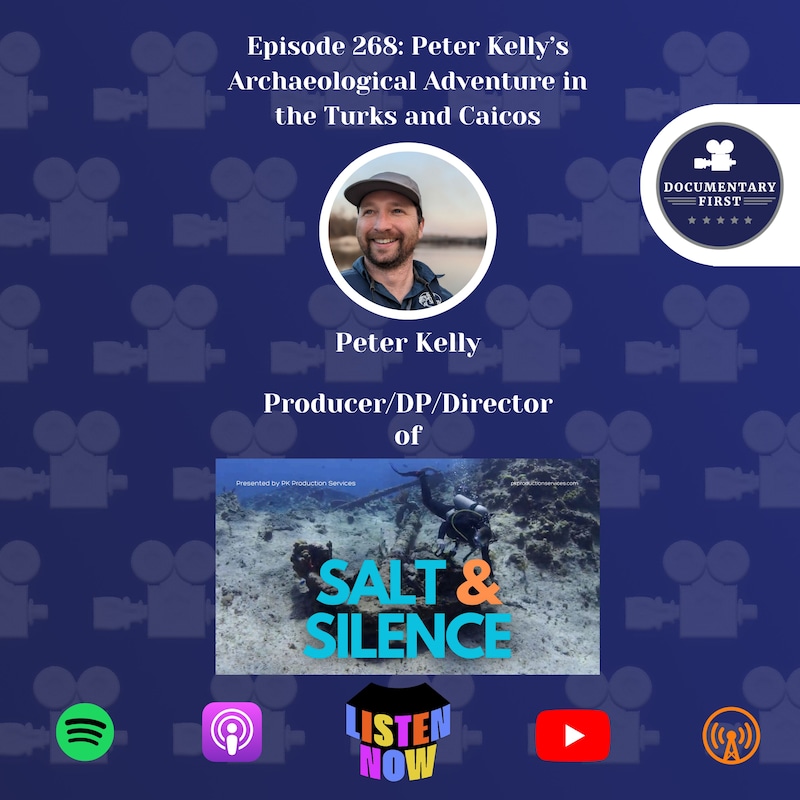
In this episode of Documentary First, host Christian Taylor sits down with filmmaker Peter Kelly to explore his remarkable journey from his Mississippi roots to documenting the rich cultural and maritime history of Salt Cay in the Turks and Caicos. Peter reflects on how growing up in a small Mississippi community shaped his storytelling sensibilities, his love of history, and the creative instincts that now guide his work.
The conversation dives into the realities of filming in a remote island location—limited resources, environmental challenges, and the unexpected surprises that come with working far off the grid. Peter shares the thought process behind crafting his documentary: how he chose his subjects, the equipment he relied on, and why capturing a holistic portrait of the island mattered deeply to him.
Ultimately, this episode celebrates the art of discovery—of place, of story, and of self. It’s a thoughtful look at the creative process behind documentary filmmaking and the passion that drives filmmakers to preserve cultural heritage and amplify unheard stories.
Links:
The ShipwreckSurvey: Home - The Shipwreck Survey
Prom Night In Mississippi: Prom Night in Mississippi (2009) ⭐ 7.2 | Documentary
Cotopaxi: Cotopaxi - Gear For Good | Free shipping on orders $99+
Ikelite: Ikelite
PK Production Services: Peter Kelly | Storyteller // Adventurer // Speaker
Socials: instagram.com/PCKELLY1369
https://www.instagram.com/salt_n_silence/
DocuView Déjà Vu
Virunga, 2014, 100 mins, Watch on Netflix, IMDB Link: Virunga (2014) ⭐ 8.1 | Documentary, War
Time Codes
00:00 — Introduction: The Art of Documentary Filmmaking
01:30 — Growing Up in Mississippi: The Roots of Peter’s Storytelling
11:04 — Discovering Salt Cay: The Heartbeat of the Documentary
15:34 — Creative Decision-Making: From Writing to Filming
20:13 — Filming on a Remote Island: Gear, Environment & Resourcefulness
27:19 — Maritime Archaeology: Uncovering Hidden History
28:45 — Surprises, Setbacks & Learning Opportunities on Location
33:02 — DocuView Déjà Vu: Documentary Recommendations
Sponsor: Virgil Films http://www.virgilfilms.com/
Support us by buying merch or watching our films: https://documentaryfirst.com/
Transcripts
All right, and I'm gonna just tell you real quick, we're just gonna dive in and have a
conversation.
2
:And it's just gonna be about your experience and everything that you've written in your
articles.
3
:I'm gonna kind of ask you the same question and we're gonna talk about that.
4
:All right, all right, here we go.
5
:Welcome everybody to Documentary First, an inside look at the art, heart and hard work of
documentary filmmaking.
6
:I'm your host, Christian Taylor, a documentary filmmaker myself.
7
:And every week I sit down with storytellers.
8
:who capture real life on camera one frame at a time so we can learn from their
experiences, sharpen our craft and get inspired on our filmmaking journeys.
9
:Today we're heading off the beaten path way off to one of the most remote islands in the
Caribbean, Salt Cay in Turks and Caicos.
10
:My guest is fellow Mississippian Peter Kelly, writer, explorer and filmmaker behind the
upcoming documentary, Salt and Silence.
11
:You may have seen his travel writing and travel in leisure and travel mag.
12
:Travel World magazine where he captures the haunting beauty and harsh realities of Salt
Cay, a place with fewer than 50 residents and a lot more donkeys, limited power and
13
:endless salt flats and coral.
14
:And now Peter's bringing that world to the screen.
15
:So we're going to talk about what it takes to film in an environment like that where the
heat, salt and remoteness test every ounce of creativity and endurance and the packing may
16
:drive you crazy.
17
:Welcome, Peter, to Documentary First.
18
:It's so incredible to have you here.
19
:Thanks, I'm really excited to be here.
20
:I can't wait to dive in.
21
:Yeah, well now before we dive into the island, no pun intended, let's start at home.
22
:We're both Mississippi folks.
23
:So how did growing up in Mississippi shape your storytelling eye and your filmmaking
journey?
24
:That's a great question.
25
:You know, when I was a little kid, grew up all over the Southeast.
26
:And when I was a really little kid, we lived in Texas.
27
:I remember watching Indiana Jones and Star Wars and all these adventure movies as a kid.
28
:I know a lot of kids, including myself at one point, are like, oh, I want to be those
people.
29
:But I remember even as a little kid thinking, I want to be the person that tells that
story.
30
:you
31
:And I've always kind of been fascinated by stories and I've always been somewhat of a
writer.
32
:And then when I, my family moved to Mississippi in 2002, I was going into eighth grade and
I got a video camera for Christmas one year.
33
:And it started with me and friends, some friends making uh skateboard tapes and bad
skateboard tapes.
34
:Cause none of us were good, but we thought we were awesome.
35
:And then actually shot uh our first documentary.
36
:which was all about haunted places in the Mississippi Delta.
37
:A lot of them.
38
:Yeah, and we had a lot of fun with it.
39
:And as kids, you you get so worked up over stuff.
40
:We had a great time doing that.
41
:It was a really unique experience.
42
:It was not a good movie, but it was a lot of fun to make it.
43
:And so I kind of dove into it there.
44
:so I actually went to a high school in Charleston, Mississippi.
45
:And until 2008, the public school had a segregated prom.
46
:uh And there was a white prom and a black prom.
47
:uh there was a documentary filmmaker, there is a documentary filmmaker named Paul
Saltzman, who actually uh came to Mississippi to film a documentary about Charleston High
48
:School and about the first year the prom actually integrated.
49
:ah Now, unique thing about that is this, in this town, Morgan Freeman, this is Morgan
Freeman's hometown.
50
:And Morgan Freeman actually agreed, uh
51
:that if the school would integrate the prom, he would pay for it.
52
:And so he footed the goal.
53
:Yeah, it's pretty neat.
54
:And it's a great documentary.
55
:It's called, Prom Night in Mississippi.
56
:It's a great doc if you haven't seen it.
57
:kind of combining my love of storytelling and seeing Paul work on that project.
58
:Now that was the year after I graduated high school, unfortunately.
59
:I graduated in 2007.
60
:The prom was integrated in 2008.
61
:Okay.
62
:And so uh a very unfortunate thing because a vast majority of the students vied for and
pushed for an integrated prom for years and years prior to this.
63
:And the public school got away with it by saying it's not a school sanctioned event and it
was hosted by parent committees.
64
:And that's a long story for another day.
65
:But uh I just always loved storytelling.
66
:And I got this camera and started making these documentary films and uh having Morgan
Freeman be
67
:in my hometown, I kind of connected with that and uh I ended up, uh I don't know why,
something in my head kind of told me like, you'll never work in film, it's a pipe dream.
68
:And so I ended up going to Ole Miss and studied broadcast journalism.
69
:I did, yeah.
70
:and mom both went and my husband went to law school.
71
:There you go.
72
:Yeah.
73
:I went for...
74
:Yeah, Oxford's a great town.
75
:ah
76
:in fact, that ties us our Morgan Freeman connection right there.
77
:I ended up eating with Morgan Freeman at City Grocery.
78
:And so I tell everybody, yeah, I ate dinner with Morgan Freeman.
79
:I love it.
80
:Yeah.
81
:Well, it's funny.
82
:When I was a kid, we'd, we'd, um, we used to go out to him and, his ex-wife, Myrna, Collie
Lee, we'd go to their house for like parties and Halloween events.
83
:And my mom and Myrna are really good friends.
84
:And, uh, I remember telling him when I was like a junior in high school, said, Mr.
85
:Morgan, I'm going to work with you one day in the movies.
86
:And, um, so I went to Ole Miss and, um, dicked around.
87
:Oh, sorry.
88
:don't know if this is PG 13 or not.
89
:Sorry.
90
:It was around.
91
:I,
92
:went to Ole Miss and did not, was not taking school seriously.
93
:I was studying broadcast journalism and uh I did uh the news show, the student news show,
News Watch 99 and was on air talent for the sports team.
94
:And that was a lot of fun and got to do some field reporting.
95
:um But I realized very quickly, I didn't want to do broadcast journalism.
96
:And so I ended up uh just having a great time.
97
:I transferred away, went to South Alabama, um University of South Alabama is in Mobile.
98
:what year?
99
:uh I never graduated from Ole Miss.
100
:I transferred after a year and a half from being there.
101
:uh And so I went to South Alabama for a semester, had no idea what I wanted to do.
102
:So I dropped out, worked in sales, worked in a hotel, worked for a uh credit repair
company that helped people negotiate negative items on their credit.
103
:Miserable.
104
:I had like forgotten what it was like to be happy.
105
:So I hit pause on life, uh moved back to Jackson.
106
:decided to get back in school and I went to Heinz Community College.
107
:And while I was at Heinz, I was bartending for another Broken Egg Cafe.
108
:And yeah, and I was actually one of the first waiters they hired here in the Jackson
store, the Ridgeline store.
109
:And so I was bartending and this guy came in and he was talking about movies.
110
:I was like, I love movies.
111
:I used to want to do that.
112
:And he's like, oh, well, you know, my friend's dad is working on a set tomorrow.
113
:This was back in 2010.
114
:He's like, I think it's a volunteer only thing because it's for nonprofits.
115
:And he said, you know, if you want to go, I'm sure he'd be happy to have you.
116
:So I volunteered and I just went out on a film set, took the day off and P.A.'d and helped
grip and absolutely fell in love.
117
:Yeah, it was awesome.
118
:And then I ended up, you know, one set turned to two, turned to four, turned to eight,
turned to a 15 year career in film that spread across, started as a grip and then key
119
:grip.
120
:then
121
:Did a lot of producing, did a lot of directing, and then uh I've worked on projects.
122
:uh My last, I guess, five or six years, I was in the art department, production designing
and art directing, but I've worked on projects with uh Netflix, uh Apple, TV +, uh
123
:Spotify, A24, History Channel, Discovery Channel, Hallmark Channel.
124
:And uh funny enough, uh in 2021,
125
:I it was 2021.
126
:uh I got hired on as the production designer for a uh documentary series called Great
Escapes on the History Channel.
127
:And uh it's with Morgan Freeman.
128
:And so I actually went up to him and I said, Mr.
129
:Morgan, I don't know if you remember this, uh but I told you in high school one day I was
going to work with you and today is that day.
130
:He's like, I absolutely remember that.
131
:So that was kind of a cool moment for me.
132
:yeah.
133
:Yeah.
134
:cool.
135
:And I'm so glad you kind of got your bio in there because I forgot to read your bio in the
beginning.
136
:Yeah.
137
:Yeah, it really, really does.
138
:Well, do you think now you're a storyteller?
139
:You know, you've got this documentary coming out.
140
:Do you think like growing up in the South, like, you know, kind of guided your
storytelling tradition, like the slower pace and the love of place and people, did that
141
:influence the way you kind of
142
:approach your stories at all?
143
:Yeah, and I'm glad you brought that up.
144
:ah I was gonna mention that earlier and I got lost in my own thought.
145
:ah So yeah, that was one of the things about Mississippi and the Mississippi Delta and
moving here.
146
:It is a slower speed, um a slower speed of life, not slow people.
147
:And that's something I think that the rest of the world often misconstrues about
Mississippi.
148
:There are a lot of incredibly brilliant and talented people here.
149
:Yeah, that's right.
150
:But and storytellers specifically, mean you have you Dora Welty you have Richard Grant
It's just so many authors Absolutely.
151
:Yeah, so many so many authors And so many writers and storytellers and filmmakers.
152
:I mean even today John Norris and Tate Taylor uh Have turned Natchez, Mississippi on its
head with the Kirklander studios um But yeah, Mississippi, I think that's that kind of
153
:sparked that connection for me and and
154
:seeing a lot of these storytellers and because it is a smaller state, prior to living
here.
155
:We lived in San Antonio, Texas, moved here and it was very much culture shock.
156
:And then as an adult, um, I started working in film and then I moved to Houston and then I
moved back and then moved back to Houston, Texas.
157
:And then I moved back in 2020 and from Houston is almost five or 6 million people to a
state with like 2.9 million people.
158
:So the, the state has
159
:fraction of the population of the city.
160
:um And when you come, when you step away and then come back, you can really take advantage
of the fact that uh you get the opportunity to see that um there's a lot of opportunity in
161
:a place like this.
162
:And there's a lot of opportunity to make moves and you don't have to be a millionaire to
be a mover and shaker.
163
:And if you want to do it, the small population means that there's likely somebody who
hasn't done it before.
164
:And if that's the case, that's likely that the people who are hearing about it are going
to be excited about it and they're going to support it and uplift it.
165
:And so it's a very uplifting space for creative people and businesses for that matter.
166
:mean, Mississippi has a hugely growing economy and it's something in the ballpark of, I
don't want tell you the wrong number, but there's billions of dollars currently being
167
:invested in developing infrastructure for AI in the state.
168
:So, but yeah, Mississippi is a storytelling place and as an artistic community is,
169
:I honestly believe it's unlike any other.
170
:uh
171
:There are a lot of possibilities there.
172
:The other thing I think is interesting is that you crisscross with, because it is a small
state, you can crisscross with creative people who have the ability to uplift you as well
173
:and connect with you as well.
174
:so I think you're in a great place for sure.
175
:you've written, let's turn to your new project.
176
:You've written about Salt.
177
:which which if people who don't know about salt Kay, it's in the Turks and Caicos and some
people can say, uh, kike, kike us.
178
:How do you say it?
179
:Yeah.
180
:So you've written beautifully about it.
181
:Um, and you've written about it in travel world magazine and travel and leisure.
182
:So for those listeners who haven't read those pieces, can you describe what drew to this
Island and like how it became like the heart of this next film?
183
:Yeah, that's a great question.
184
:um Turks and Caicoses, I went when I was a very small kid, not to Salt Key, but I went to
Providencialis.
185
:And I love history.
186
:love storytelling, obviously, but I love history.
187
:I love anthropology.
188
:I love archaeology.
189
:I love the idea of the science of studying the past world and the people who get to
actually put their hands on the history that made us.
190
:and the history that brought us to be where we are today.
191
:And I'm also, I also love to scuba dive.
192
:I'm a big diver.
193
:so I uh started looking for field schools and I was curious.
194
:was like, is, know, great question.
195
:Yes, yes, yes.
196
:So a field school, archeology field schools are uh basically uh programs where uh people,
typically college students can go and sign up and
197
:go on a trip and learn how to do archeology.
198
:uh And so I was looking at field schools and I was curious about the storytelling behind
field schools and the process.
199
:And I stumbled upon a field school called the Shipwreck Survey uh run by Alex Hinton and
Ruth Stilton.
200
:uh And it's out of Australia and they take people from all over the world uh to different
places across the planet and train them how to dive shipwrecks.
201
:from an archeological perspective and how to study uh the actual cultural history uh
that's hidden beneath the waves and sometimes protected and sometimes uh deteriorating.
202
:uh And so I reached out to Rud and I talked to him on the phone uh via email for a couple
of times and then we chatted over Google Meet a couple of times and uh he and just kind of
203
:built a connection and I realized like, this is really cool what you're doing.
204
:Like this is a really neat program.
205
:This is unlike anything else because it's also a public field school.
206
:You don't have to be associated with a university to attend.
207
:Um, anybody can go really unique.
208
:Yeah.
209
:Super cool.
210
:um, so no, no, there's not, no, there's not.
211
:We, uh, there were, there were people when I went down, there were people from 18 to I
think north of 40.
212
:Um, you gotta know how to dive.
213
:Yeah.
214
:Yeah, but they teach you how to dive, uh, technical, like not technical diving, uh they
teach you how to dive.
215
:That's right.
216
:Yeah.
217
:Yeah.
218
:And so I was chatting with him and, uh, we basically kind of came upon the mutual
decision.
219
:Like, this is a cool story.
220
:This is a cool idea.
221
:Let's tell it.
222
:Where do we want to tell it from?
223
:Cause they offer different programs throughout different times of these of the year.
224
:And so he started telling me.
225
:And he told me about Salt Key and at first I was like, ah, that's kind of interesting.
226
:And then he told me more and we talked about its remoteness and you know, the closest
grocery store to Salt Key, they have one little sundry shop on the island that's, you
227
:know, a 12 by 12 room and they have like five goods.
228
:The closest grocery store is a 35 minute boat ride away on Grand Turk.
229
:And so it is remote, remote, remote.
230
:It's a very cool spot.
231
:And my first thought was, man, this is cool.
232
:I'm gonna get to go to a beautiful tropical lush island and our boat pulls up and it's,
know, other than the crystal clear bathtub blue water, it was kind of a hellscape.
233
:It was low land flying, lying bush, acacia scrub bush with thorns this long, two to three
inches long.
234
:And...
235
:But the people from the time we landed were lovely.
236
:It's just a really tight knit community.
237
:And so getting to Salt Key, I know, I'm sorry.
238
:Come on.
239
:Yeah.
240
:you're skipping ahead to the island and to the people, but I wanna take you back to the
decision-making.
241
:All right?
242
:So I'm gonna take you back to the decision-making.
243
:You called them, you decided, okay, this is a great place.
244
:We're gonna go to Salki.
245
:Now,
246
:Did you decide I'm going to write a story or did you decide I'm going to make a
documentary?
247
:And then how is all this being funded?
248
:Yeah, great question.
249
:um So after talking with Dr.
250
:Stelton and the crew at the Shipwreck Survey, and we did decide to go to Salt Key, uh the
decision was made based on its remoteness.
251
:We wanted to tell a good story, and the first thought was, okay, this is a documentary.
252
:um After going there, uh well, right before I went,
253
:I really dug in on a lot of research and realized, man, this would be a really great
article too.
254
:uh So the idea of the documentary came first.
255
:The writing was absolutely secondary and just kind of tacked on.
256
:uh But the decision to do Salt Key was rooted in its remoteness and the fact that uh
257
:Considering how remote it is, just makes for a much more interesting story of how do you
organize the logistics of this?
258
:you ever done this before?
259
:Because there are people that specialize in sort of this extreme photojournalism type
stuff and they have had a lot of years with this.
260
:Is this something you've been doing all your life?
261
:No, this is, uh so I've worked in film for the last 15 years, but a project like this, an
undertaking like this, this was my first time, uh first international uh shoot, first
262
:project that I've directed and produced.
263
:uh
264
:yourself?
265
:Are you like a one person crew?
266
:Yeah, so I got this all situated and set up uh and talked with Dr.
267
:Stelton from the Shipwreck Survey and I got him on board with the project and got him
really excited.
268
:So they actually covered the cost of me coming out on the trip.
269
:And so um they paid for my hotel and my airfare and my food while I was out there.
270
:Now I didn't get paid.
271
:Pretty much, yeah, so there are, that's.
272
:there are actually some really nice houses on the island and some really nice like hotel
Airbnb type stays.
273
:So, you know, I was kind of put up in a bunk house with them and it was a really cool
experience, but they covered the bill on that front.
274
:And, you know, I basically had to cover all of my equipment and do a little fundraising.
275
:And then after I shot it,
276
:is not, listen, you're making that sound like that is no problem.
277
:But I have taken a film crew to France for three weeks and had to decide on the equipment,
which is in itself, and this is not even like a hard, you know, hard, difficult journey,
278
:deciding on the camera gear.
279
:I'm not even going underwater.
280
:And it's difficult to decide what camera gear, what size, what is allowed, know, what can
we get in, you know, just the different weights, just the things that made my head
281
:explode.
282
:So I cannot imagine what you were having to jump through to think about because I did read
you were only able to go on certain planes and you only can take certain luggage.
283
:And I'm thinking, how the heck did you make that happen?
284
:No, honestly that was helpful.
285
:It was helpful because of that.
286
:So having weight limits um on baggage, knew, okay, I'm not gonna be able to take the world
with me.
287
:And uh realistically, I identified in advance the style in which I'm gonna be shooting.
288
:I this is not gonna be, we're not going for art with this.
289
:The story is the art.
290
:This is run and gun shooting.
291
:And so um I opted for a small kit.
292
:uh
293
:I instead of bringing some big camera or a red camera or a black magic camera or something
like that, I got a Sony FX 30.
294
:ah I got a small little, I think the small rig brand carbon fiber tripod, something
lightweight and easy to tote around.
295
:uh I only took two lenses.
296
:ah I took one lavalier kit.
297
:drone?
298
:somebody else on the trip brought their own drone.
299
:And so I opted not to bring a drone because they already had one there for doing the
archaeology research.
300
:And so I just borrowed it to go get some shots.
301
:And, pardon me?
302
:Oh, very sorry.
303
:making drones smaller and smaller and more maneuverable, you know.
304
:yeah, for sure.
305
:And actually, that's something I've looked into for this trip.
306
:uh But uh because of the geography of Salt Key, is a...
307
:Salt Key is famous because of salt production.
308
:And what makes it so great for salt production is the highly salinic water.
309
:It's really salinic.
310
:So there's a lot of salt in the water and it's really dry and there's a lot of wind coming
across the island.
311
:And so the smaller the drone, the harder time it has keeping up with wind.
312
:And so, yeah, so I just let somebody else bring a big drone and uh not a big, big drone,
but I think it was a Mavic or something like that.
313
:But uh yeah, and then I bought a camera housing.
314
:I was going to rent a Notacam underwater housing.
315
:uh And for cheaper than buying the Notacam housing, was able to, or renting the housing, I
was able to buy an Ike light housing for the Sony FX30.
316
:with a big dome port so that it created a little space between the lens and the water.
317
:And so you could kind of capture, I'm you've seen those shots where you can see above the
water and below at the same time.
318
:uh So yeah, I was able to get that and uh it's been, uh getting it all packed together was
not so much an issue.
319
:uh Deciding how many layers of clothes I needed or what clothes I could sacrifice.
320
:was where the, oh but what's funny is.
321
:because you knew that the filming was the priority.
322
:So we're taking this equipment and so I can decide on that.
323
:And we know that if I have to only wear swimming trunks or if I have to wear one pair of
clothing, well, I'll deal with that.
324
:But then you know, okay, I'm gonna have more than that.
325
:So exactly how much more do I have?
326
:So how much more did you have?
327
:Yeah.
328
:No, great question.
329
:I actually sacrificed a lot of my clothing options.
330
:uh I packed and then I removed about 75 % of my wardrobe.
331
:ah So I uh didn't pack a single pair of underwear.
332
:uh I did not.
333
:I got rid of all my underwear.
334
:got rid of, uh I packed three pairs of socks, two pairs of long pants that are really like
fine, thin, quick drying pants.
335
:a...
336
:Yep.
337
:And I packed two swimsuits.
338
:I packed...
339
:two cotton t-shirts and two long sleeve, like sun shirts, like fishing shirts.
340
:And those are the only clothes I packed.
341
:Yeah.
342
:pack in a backpack and like a carry-on or something?
343
:Yeah, yeah, yeah, have a, so there's a brand called Kodopaxi.
344
:They make this fantastic travel bag, it's not endorsed, but they make this fantastic
backpack.
345
:they, so it's, yeah, they're great.
346
:It's C-O-T-O-P-A-X-I.
347
:And it's the, like, Alpha 45 is the backpack I took.
348
:It's fantastic.
349
:It fit all of my clothes.
350
:It fit all of my gear for my camera.
351
:And then all of my dive gear, have another Kodopaxi.
352
:It's a big duffel bag.
353
:It's like a 70 liter duffel bag.
354
:So I put all of my dive equipment in there uh and then put that inside of a big mesh dive
bag and checked that onto the airplane.
355
:uh But yeah, all of my camera stuff uh I carried on in my Kodopaxi bag.
356
:And then my underwater camera housing, I actually carried it on as my personal item for
the plane.
357
:So.
358
:you're tricky like that.
359
:Okay.
360
:it worked out great.
361
:I'm looking off screen because I've got my gear here next to me and I'm trying uh to see
it.
362
:So this is the housing.
363
:Yeah, and worked great.
364
:only listening, you really ought to check on YouTube and check out the housing that he
just showed you.
365
:What else you got there?
366
:Can you show us?
367
:love visual.
368
:sure enough.
369
:here's the housing.
370
:Here is the dome port that I was mentioning a second ago.
371
:This is Ike light, I-K-E-L-I-T-E.
372
:And this dome port is great because it's a big, let's see, a big bubble, but it creates
that distance between the lens and the water's edge so that you can actually get a little
373
:bit more.
374
:you get to see a little bit more.
375
:It kind of opens up the space, the viewing space.
376
:So, but yeah.
377
:Yeah, I am.
378
:got, so I was there for 16 or 17 days.
379
:And in that time period, I ended up capturing over
380
:2200 different separate video clips.
381
:uh So I had about 2200 clips and that includes uh about nine and a half hours worth of
interviews.
382
:And those were interviews with the...
383
:uh
384
:the Shipwreck Survey team, the people who were participating, and islanders, people who
live on the island.
385
:uh And that's kind of the approach I wanted to take too.
386
:I wanted to capture a holistic look at not just Salt Key, or not just the Shipwreck
Survey, not just the science, but why the area, why the Shipwreck Survey, or I'm sorry,
387
:why Salt Key, uh and the historical significance, uh as well as kind of the modern take
to...
388
:uh
389
:you know, you've 40 plus people living on this island full time.
390
:How do they feel about people coming out and scuba diving and doing this archeological
research on their islands and what is life for them like now?
391
:So it really is an exposition on...
392
:maritime archaeology, but I wanted to kind of highlight the whole world in which.
393
:what's the story arc beginning, middle and end?
394
:ah What is your, know, how are you putting the story together?
395
:What's the question you're answering?
396
:What do want your audience to walk away thinking and feeling?
397
:a great question.
398
:ah When I first started putting this together and first started getting this project
together, ah the question was, what is maritime archaeology?
399
:What does that mean?
400
:Like people talk about scuba diving and shipwreck diving and watch movies like Fool's Gold
and want to go find treasure.
401
:And ah I've just always been a curious person.
402
:And I've always wanted to know, you know, what's the reality there?
403
:ah And that's the question I set off to answer for myself.
404
:uh In doing so, ah now that I've gone and I've filmed and I've looked back at these
interviews many, many times, uh the story that's really unfolding is what's the human
405
:connection?
406
:Why, instead of what is it, is why is it important?
407
:One of the wrecks we dove, excuse me, is the Endemion shipwreck.
408
:It's a fifth-rate British warship that sunk in 1790.
409
:And if you go out to the spot today, I there's 30 cannons laying on the ocean floor and we
found a lead sounding weight and five minutes before they wrecked, that sounding weight
410
:was in the water identifying their depth.
411
:So there's a story there.
412
:And so being able to see uh the deterioration of these shipwrecks and the deterioration of
the island of Salt Key, it is a...
413
:It is something that we are never going to get back.
414
:And so getting to be a part of uh the memory and getting to help build part of that memory
and protect that memory and protect the history, I think is a big part of the reason I did
415
:it.
416
:As far as story art goes, the question is, um why are they doing this?
417
:And to capture that, was a lot of um identifying the culture, identifying um
418
:what they are actually doing and getting to see this team uh actually get their hands wet
and get their hands into the sand and uplift pieces of wood with copper sheathing on the
419
:side um that belonged to a ship years and years ago.
420
:And instead of bringing it to the surface, they put it right back down and cover it right
back up to protect it.
421
:uh And I think that's an important piece of this.
422
:I think the story arc is just that.
423
:It's an exploration of um what is it, why are we doing it?
424
:I want people to watch this movie and think, wow, what can I do to protect cultural
heritage and what can I do to uh help pursue the craft of maritime archaeology?
425
:uh While also making sure that people, when they do watch it, if they go and find
something in the ocean like a gold coin uh or an old piece of, uh an old musket ball or
426
:cannon ball or whatever, uh either leave it there.
427
:or give it to the right people who can take care of it and make sure it doesn't
disintegrate and get completely destroyed.
428
:Yeah.
429
:Well, and what is your hope for what will happen to this film?
430
:Yeah, that's a great question.
431
:we ended up, we being, after I shot this, I actually ended up partnering with uh an old
friend, Monte Kraus, who's kind of stepped in as an executive producer, and two additional
432
:friends uh that are also co-executive producing.
433
:uh The original thought was, let's shoot this thing, let's get it into film festivals.
434
:um And if that doesn't work, then let's work on selling it.
435
:into the academic world.
436
:School libraries, college libraries, licensing it out so that they can use it as a
teaching piece for their archaeology programs and their anthropology programs.
437
:And then the process of getting this thing shot and running through interviews, we've
started talking and uh that is still part of the plan.
438
:But I think our next steps are actually going to be to try to utilize
439
:this piece as a proof of concept for a series to highlight the shipwreck survey uh and the
work they are doing in different countries around the world.
440
:uh So going and following them on different specific shipwrecks, different specific
countries, and being able to capture the people and the interaction and the engagement
441
:while also diving into the actual history and the significance of their findings.
442
:that sounds fascinating.
443
:I think that would definitely be uh interesting to pitch.
444
:Now, when you were doing this work, let's talk a little bit about, I wanna know two
things.
445
:One, oh what was the most surprising thing that happened to you or uh thing that surprised
you most?
446
:And then talk about the hardest challenges of filming in that kind of environment, the
things that gave you the most challenges.
447
:Yeah, I can actually answer both questions.
448
:Yeah, they're kind of tied together.
449
:So ah something that was really surprising as well as challenging ah was the fact that uh
if you have it, the Caribbean will break it.
450
:ah Doesn't matter what you have.
451
:will probably break it.
452
:I did.
453
:I took so many backups.
454
:The one thing I didn't take enough backups of was flip flops.
455
:ah And shoes to walk around in.
456
:ah
457
:And I was surprised by that.
458
:the salt in the air, uh I ended up having to clean my tripod uh legs once a day because
the salt in the air would accumulate and I couldn't shut or open the tripod legs.
459
:actually had to wash my tripod, ah which is a weird thing.
460
:I never thought I'd really have to do.
461
:ah And then my flip-flops broke, I think, two days into the 17-day trip.
462
:uh And so I was...
463
:run around in duct tape flip flops, uh interchanged with some tennis shoes when my socks
weren't drying on uh a banister.
464
:uh And so the, but the challenging piece of that, I think as a filmmaker, uh this was my
first time really doing anything, any kind of major filmmaking underwater.
465
:This is, I was breaking new winds, so to speak.
466
:So it was uh a challenge trying to get my buoyancy right.
467
:as a diver and if you don't have your buoyancy right you're gonna end up with shaky camera
footage moving up and down and bobbing.
468
:um That's right, yeah, 100%.
469
:And so getting my buoyancy right was uh really tough.
470
:I was surprised by how tough that was.
471
:uh And then the current, the current underwater.
472
:Several of our dives there was a lot of current and I'd get a shot lined up like, this is
perfect.
473
:And then I'd start getting pushed and the other person get pushed the other way.
474
:No, so yeah, kept driving away, uh I think just dealing with the elements.
475
:And I think that's, it was surprising and it was challenging, but honestly, it was kind of
one of those welcome surprises and welcome challenges.
476
:I have had a dream my entire life of being uh an expedition filmmaker and uh an
explorational filmmaker.
477
:And uh so I knew going into it that there would be some of that.
478
:just...
479
:uh
480
:I don't know, I think it's all in perspective.
481
:You're gonna have problems.
482
:Anybody who's worked in film for any amount of time will tell you stuff's gonna break and
things aren't gonna work out and stuff is gonna change.
483
:But I think being able to embrace that and roll with the punches, because in the end of
the day, you can either get pissed off and be upset that something didn't work out or you
484
:can find a new way to tell a story and shift and change gears and keep rolling.
485
:filmmaking.
486
:And I remember when I learned to be a filmmaker, one of the first things I did was watch a
Ken Burns masterclass.
487
:And he basically said, you just got to get out there and do it.
488
:Just film class doesn't really help.
489
:You just got to do it.
490
:And then he said, being a filmmaker is solving a million problems.
491
:And you just can't stop.
492
:You just have to keep solving the problem.
493
:And that's really what it is.
494
:Every single time you're out there, you're going to run into problems, be it weather, be
it people.
495
:be it emotions, be it script problems, know, and everything is always going to change,
always.
496
:And um you just have to be nimble and be able to flex.
497
:And I think the people that have that ability to ride those waves, no pun intended, and
figure out how you can get the story that's coming to you.
498
:um
499
:I think those are the filmmakers that can find the success um as opposed to fighting
what's happening.
500
:yeah, I think so.
501
:And I think to build on that, going back to what you'd said earlier as well, um when you
get those challenges, just, yes, you can prepare and you can, you know, it's nice if you
502
:have a five ton grip truck right behind you, but at some point you just got to do it.
503
:uh Casey, Casey Neistat is a documentary filmmaker and a creator and he's got an
interesting quote.
504
:It's somebody, people always ask him like, what's the best camera?
505
:What should I get?
506
:And his response is always, whatever camera helps you tell the story.
507
:And was every camera is gonna capture the story.
508
:And I love that quote, like, cause even on this, on this shoot, there were times when my
Sony ran out of battery or uh I also had a GoPro 9 black with me and uh my GoPro kept
509
:overheating because it's a little bit of an older model.
510
:And so there were multiple times where I just picked up my phone and started shooting.
511
:Exactly, I was gonna say it's almost whatever phone you have with you at the moment
because sometimes the story happens and you got your iPhone with you and you gotta use
512
:that.
513
:And thank goodness iPhones now are movie worthy.
514
:So yeah, that is a great quote to end on.
515
:You have been so generous with your time and we are now almost at your time.
516
:And before we end, we have a beautiful segment here called DocuView Deja Vu.
517
:where filmmakers share a documentary that they love.
518
:You've already shared one, which is Prom Night in Mississippi.
519
:Do you have another documentary you'd like to share with our audience before you leave?
520
:Yeah, one of my favorite documentaries I've ever seen is Varunga.
521
:It's a Netflix documentary and it's about Varunga National Park and it's fascinating.
522
:They highlight the animals and the people who are keeping this park alive and protecting
the animals that are endangered that live there.
523
:But it also kind of exposes some of the seedy underhandings of uh some oil companies that
are trying to uh basically wipe out some of these animals so that it's no longer a
524
:protected area and they can go in and dig for oil.
525
:uh Drill for Oil, but it's a great documentary, Varunga, and it's on Netflix.
526
:V-I-R-U-N-G-A.
527
:Yeah.
528
:you have it, everybody.
529
:We need to check that out.
530
:It's always wonderful to learn about new documentaries.
531
:So thank you for sharing both of those with you and your time.
532
:I'm really looking forward to seeing this next new work.
533
:Everybody can follow you by going to your website, I'm sure.
534
:So why don't you tell everybody about your website?
535
:Yep, my website is PK, that's P as in Peter, K as in Kelly, production services.com.
536
:And my social media handles, same across the board, it's P-C-K-E-L-L-Y 1369.
537
:That's PC Kelly 1369.
538
:All right, everybody, there you have it.
539
:Well, Peter, thank you so much for being with us today.
540
:It was a delight to talk to you.
541
:I learned a lot.
542
:I'm sure our listeners did too.
543
:Everybody, thank you so much for listening to Documentary First, where we believe
everybody has a story to tell, and you could be the one to tell it.
544
:Bye, everybody.






