Shownotes
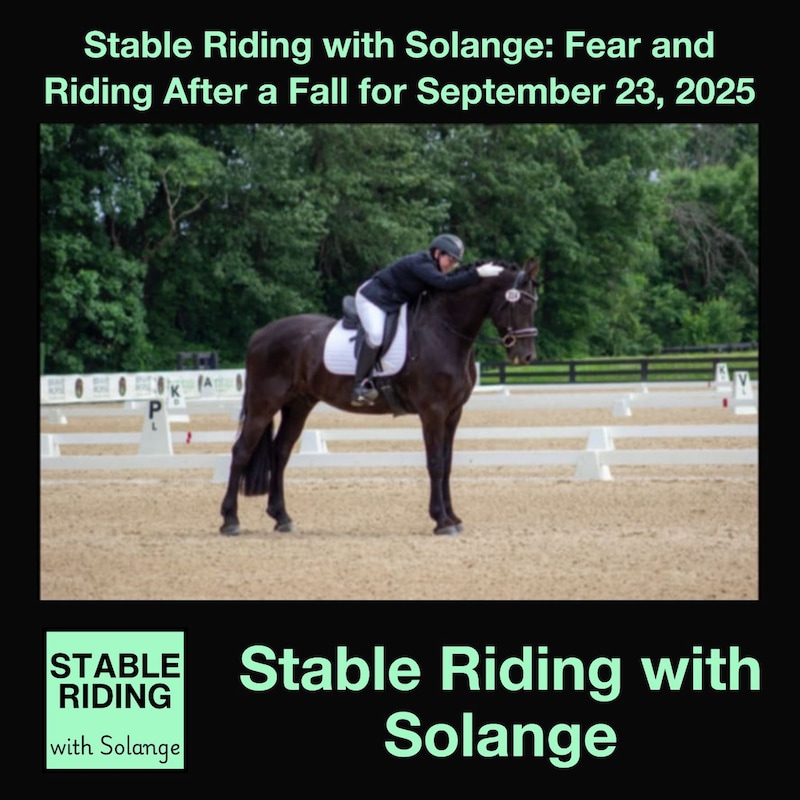
Today we tackle something that happens to All Riders. Riding after a fall and how to navigate the physical and mental rehab needed to return to doing what we love. Our guest Lisa has successfully returned to riding after 3 terrible falls that all resulted in injuries. She shares with us her experience healing her body and most importantly overcoming the natural fear that comes from that experience. Solange's Rider Tip and Exercise for the week is all about Hands and Shoulders! She tells you how to find the correct hand position for your individual body. Listen in...
Horses in the Morning Stable Riding with Solange Episode 3781:
- Host: Solange of Stable Riding
- Sponsor: Stable Riding
- Guest: Lisa Meringolo
Time Stamps:
- 07:17 - Lisa's Journey: Overcoming Fear and Injury in Riding
- 18:20 - Making Good Decisions in Riding
- 22:27 - The Evolution of a Rider: Overcoming Fear and Finding Confidence
- 31:00 - Embracing the Journey of Recovery
- 33:01 - The Importance of Professional Help in Overcoming Rider Fear
Takeaways:
- The episode emphasizes the significance of addressing both the physical and mental rehabilitation of riders after experiencing a fall or injury, which is often overlooked in traditional riding instruction.
- Listeners are encouraged to embrace their emotions and fears as normal responses to riding incidents, rather than viewing them as signs of weakness or failure.
- The podcast highlights the importance of compassionate instruction and the need for judgment-free understanding to foster a supportive environment for riders during their recovery process.
- The conversation illustrates how creating a calm and stable atmosphere for riders can help alleviate anxiety, allowing them to regain confidence and enjoy their riding experience once again.
Transcripts
You are listening to the Horse Radio Network, part of the Equine Network family.
Speaker B:What a beautiful day for Horses in the Morning.
Speaker A:You are listening to the number one horse podcast in the world.
Speaker A:Here's your entertaining look at the horse world and the people in it.
Speaker B:Foreign.
Speaker A: ,: Speaker A:I'm here on the fourth Tuesday of every month to talk to you all about the rider and how we can make ourselves better in the saddle.
Speaker A:Today's episode touches on something that's so very common in the horse world, fear and injuries after a fall.
Speaker A:So many of us riders at some point have to rehab after a fall physically to get back into the saddle and go back to doing what we love.
Speaker A:But we also have to rehab mentally after any kind of confidence losing event which could be a fall or not for riders of a certain age.
Speaker A:We will all remember the Cowboy up hospital or on mentality of riding instruction and while admittedly that can give us some results in a short term, that kind of bullying and shaming, I mean if we're being honest, that's what it is.
Speaker A:It's bullying and shaming is not a long term sustainable solution for a rider who needs to heal and evolve into the next phase of their riding.
Speaker A:I've always said that yelling relax at someone strapped to the back of a moving flight animal never makes them relax.
Speaker A:So here's the real truth.
Speaker A:If you are prepared correctly both physically and mentally, you don't need courage, you don't need bravery.
Speaker A:Or in the case of some of the fox hunters, I don't.
Speaker A:I've ridden with.
Speaker A:You don't need a flask to be able to get back up on your horse and go back to doing what you love.
Speaker A:What a person needs in that hard phase of the riding journey is judgment free understanding followed by appropriate logical steps that meet them where they are.
Speaker A:Whether it's stuck on the mounting block or I can get on but now I can't walk or I can walk but now I don't want to trot or I can trot, et cetera.
Speaker A:I have personally always referred to myself in my instructing and coaching career as like the Dr. House of Riding instructions.
Speaker A:I love a good tricky case.
Speaker A:I adore nothing more than a rider who needs a little bit more or maybe a lot more than just the usual riding instruction.
Speaker A:That's what helped drive me to create the stable riding system and the Rider Lab When I discuss the all rider nature of my work, I will often mention two different kinds of riders.
Speaker A:Riders with a complex rider history and riders with a complex body history.
Speaker A:When I talk about a complex rider history, I mean someone who's usually ridden for many decades and along the way they've ridden many different horses and sometimes different disciplines.
Speaker A:They've had lots of different instructors, multiple coaches, multiple trainers.
Speaker A:They've been to clinics, read tons of books, maybe they subscribed to different like online training platforms for them and their horse.
Speaker A:These riders end up with a lot of conflicting narratives which make it tricky to know what serves them in their horse right at this minute currently.
Speaker A:And I spend a good chunk of my time pulling apart all that information and helping them know what's really working for them and their horse right now, in present time.
Speaker A:Now, a complex body history rider is really interesting to me because that's someone who has something in their physical body which may impact on their ability to ride and their riding motion.
Speaker A:This can range from an old high school sports injury to joint replacements, joint resurfacing fusions.
Speaker A:I have some riders who have varying degrees of scoliosis, Ms. or cerebral palsy.
Speaker A:Illness can play a factor in that and be a role in how somebody's riding.
Speaker A:And for female riders there's pregnancy and C sections.
Speaker A:Others have sustained body altering injuries from horse falls and accidents.
Speaker A:And these are a double whammy as they carry a strong emotional reaction to the injury.
Speaker A:I say constantly, every day in my instruction, fear is a normal, healthy human reaction.
Speaker A:I'm going to say that again for all the cheap seats in the back, fear is a normal, healthy human reaction.
Speaker A:True physical fear is as natural to us as hunger or thirst.
Speaker A:Yet when you think about it, in the horse industry, we have terrible tools in response to rider fear.
Speaker A:And that's something that I'm really passionate about changing because frankly, I'm done.
Speaker A:I'm done seeing riders riding in fear.
Speaker A:It's unnecessary.
Speaker A:And not to mention it's pretty unfair to the horse who the riders strap themselves to.
Speaker A:The riding lab and its tools, especially all my equi sizers, give riders a calm, stable environment to explore the boundaries and current abilities of their body.
Speaker A:If they are in physical rehabilitation, a lot of times they'll get on an equa sizer and experiment with what strength and stamina and range of motion they have before getting on a live horse.
Speaker A:Or if they've already started riding a live horse, we can utilize that tool to kind of do a systems check before they move on to more Complicated riding, newer, younger horses, faster gates jumps, trickier terrain.
Speaker A:On the mental side, it really often provides riders with a quiet, private place where they can work through their emotions and help process what they need to mentally.
Speaker A:Now, you might say, this is all great, Solange, but I don't have access to these special tools.
Speaker A:So what am I going to do?
Speaker A:Well, I tell everybody, never fear, all you need is a really good, really old school horse.
Speaker A:And when I say a good old school horse, I'm talking about a good old school horse who comes out and Moses around.
Speaker A:I call them.
Speaker A:This meeting could have been an email.
Speaker A:Horses that come out of their stall and they're like, why am I here?
Speaker A:This meeting could have been an email.
Speaker A:That's the kind of horse that you want to ride.
Speaker A:I have observed time and time again that when a rider understands what their body can and cannot provide for them in terms of stability, their anxiety level decreases and their fear starts to dissipate because now they have the data and knowledge needed to move forward in their riding journey calmly and logically.
Speaker A:That's one of the T shirts I always want to print.
Speaker A:It will say, it's not you, it's your instruction.
Speaker A:My guest for this episode is really the ideal person to speak on this subject.
Speaker A:She has both a complex riding history and a complex body history.
Speaker A:See, Lisa came to me after three terrible falls, which left her with severe injuries and the normal emotional response that comes after that kind of experience.
Speaker A:She started in the lab on an equa sizer and then moved on to one of my tried and true old guy school horses to incrementally work through the physical skills necessary to meet her goals.
Speaker A:Lisa is a perfect example of a success story, and I'm so glad that she's willing to share her experience here and let other writers know what's possible for them.
Speaker A:Lisa, thank you for being a part of the Stable Writing podcast.
Speaker B:Thrilled to join you.
Speaker A:Well, you know, you are truly a shining example of a stable writer, and I'm so excited to share your story with the audience.
Speaker A:Now, before we talk about, like, how we met, I'd like to ask you the usual questions that I ask everybody to give background about their riding.
Speaker A:Are you ready?
Speaker B:Ready.
Speaker A:Okay.
Speaker A:How old are you now and how old were you when you started riding?
Speaker B:So I am 43 now and I started riding when I was 10 years old.
Speaker A:What made you want to learn to ride a horse?
Speaker A:Did you always love horses?
Speaker A:Did you kind of fall into it?
Speaker A:Did you have family who had horses?
Speaker B:So I have been a animal Lover, of course, my entire life.
Speaker B:But my best friend actually started taking riding lessons, and that is actually why I started riding.
Speaker A:Oh, that's so cute.
Speaker A:Does she still ride, do you know?
Speaker B:She does not.
Speaker A:She was like, that's enough of that.
Speaker B:Yep.
Speaker A:Now, what kind of riding were you doing as a little kid?
Speaker A:Did you start English?
Speaker A:Did you start Western?
Speaker B:I did.
Speaker B:So I've always written English.
Speaker B:You know, obviously started with the basics.
Speaker B:When I started showing, I started doing hunters first.
Speaker B:I moved up to jumpers, I started eventing, and now I strictly just do dressage.
Speaker B:So I've done a little bit of everything.
Speaker A:I feel like that's a real common flowchart, like hunters and the jumpers and then eventing, and then you have to, like, grease your horse's legs with Crisco, and then you're like, how about dressage?
Speaker A:Have you noticed that that seems to be, like, the little flowchart that everybody sort of takes?
Speaker A:Yeah.
Speaker B:How about.
Speaker A:We're.
Speaker B:We're 43 years old, and we.
Speaker B:We.
Speaker A:Now, were you able to ride straight through to adulthood, or did you have a period where you needed to, like, take a break and then return to it?
Speaker B:I've ridden mostly pretty steadily through.
Speaker B:I have had.
Speaker B:Had some time off here and there for some surgeries that I've had, but for the most part, ridden straight through.
Speaker A:That's really wonderful.
Speaker B:Yeah.
Speaker A:So you can really safely say riding's been a very big part of your life for 30 years.
Speaker B:Oh, yes, absolutely.
Speaker A:Now, we met in my booth at Equine Affair in last year.
Speaker A:So It'd be, what, 20, 24 is when we met, and your fabulous friend Crystal pulled you over into my booth.
Speaker A:Huge shout out to Crystal if she's listening.
Speaker A:She's great.
Speaker A:And she brought you over because you had experienced some falls and injuries prior to us meeting.
Speaker A:Do you feel comfortable telling the audience about the falls you had and the injuries that that came from those falls?
Speaker B:Sure.
Speaker B:Yep.
Speaker B:So I was working with a young horse.
Speaker B:He was five at the time, I think, and just out.
Speaker B:He.
Speaker B:I broke him.
Speaker B:He had never been ridden.
Speaker B:He had hardly ever been handled.
Speaker B:So we were out riding, and I was in my dressage saddle.
Speaker B:Probably wasn't the best thing.
Speaker B:I should have been in riding him, but he did buck me off the first time, and I ended up breaking nine ribs and 11 vertebrae.
Speaker A:That is so many ribs and so many vertebrae.
Speaker B:It was one.
Speaker B:One vertebrae short of breaking my entire thoracic spine.
Speaker B:So the second time he dumped me, I tore my meniscus in my left knee.
Speaker B:And the third time he dumped me and the last time I broke four more ribs.
Speaker B:Yeah.
Speaker A:Did you have any surgeries?
Speaker A:Did you have like knee or back surgery from these?
Speaker B:I did not.
Speaker B:There was nothing really surgically they could do me.
Speaker B:I've just been, you know, keeping up with my physical therapy at home.
Speaker B:So it's.
Speaker B:It's pretty steady.
Speaker A:I deal with so many riders and I meet so many riders in my business that come to me because they've had a fall and they need to do, like, some of the physical rehab and some of the mental rehab.
Speaker A:And would you say that in your experience the mental rehab was harder than the physical rehab?
Speaker A:The same.
Speaker A:Equal to.
Speaker A:Because sometimes I find that the emotional part is sometimes more difficult than the physical healing.
Speaker B:I will definitely say the mental part was significantly worse than the physical.
Speaker B:I mean, there was obviously a lot of pain, physical pain, but the mental was extremely difficult.
Speaker A:It's a natural thing really, in a way, isn't it, to have that fear after you have an accident or an incident like that, because it's your body reminding you of what happened and trying to protect you from it.
Speaker A:So it's overcoming and working with some of your body's most natural instincts is to go, I understand you're telling me this is dangerous, but I've made changes and I can, you know, proceed through carefully.
Speaker A:When everything in your body is screaming, don't do this again, something bad happened.
Speaker B:Yep.
Speaker A:You know?
Speaker B:Absolutely.
Speaker B:Yep.
Speaker A:And I find that writers judge themselves for it and don't want to process it or feel it.
Speaker B:You know, we are our own worst enemies.
Speaker A:Yes.
Speaker A:Yes.
Speaker A:I talk a lot with, especially the female writers I teach about not judging our emotions because I find that women, particularly of, like, our generation, get very judgy wudgy when it comes to our feelings.
Speaker A:And that doesn't help us move forward at all and not move forward in our riding, which is when we get back to.
Speaker A:Because that's what we love.
Speaker B:Yes, absolutely.
Speaker B:Yeah.
Speaker B:We are very hard on ourselves very much.
Speaker A:I teach a lot of women and partway through their first lesson, I'll go, are you an eldest daughter perfectionist?
Speaker B:Yes.
Speaker A:And they'll be like, how do you know?
Speaker B:Yeah.
Speaker A:And I always say I love teaching my perfectionists until the absolute second.
Speaker A:I don't anymore.
Speaker A:It's like, so fun.
Speaker A:And I'm like, oh, yeah, a perfectionist?
Speaker A:A high achieving eldest daughter perfectionist.
Speaker A:And like, is that what I'm teaching right now?
Speaker A:Now, you'd mentioned that you were in your dressage saddle when you had one of the first falls on the young horse.
Speaker A:And I remember when you came to me because we met at equine affair and then you came up to the lab to get on the equi sizer a few times and kind of work through everything there and then moved on to one of my, you know, old steady school horses.
Speaker A:I think I put you on, baby, but I feel like I put you in a western saddle when you first came up to me.
Speaker A:And I know that often some of the English riders aren't super willing to try out a western or an endurance or a trail type saddle.
Speaker A:And one of the things that I'd like to try and eliminate is some of that association, like social clique association that people have with tack and instead encourage them to view it as just a tool that might perform a different but equally valuable task.
Speaker A:And you're now back to successfully riding and you're back in your dressage saddle.
Speaker A:Can you talk a little bit about.
Speaker A:Do you feel as though what you learned in the western saddle you were able to translate into the dressage saddle?
Speaker B:For sure.
Speaker B:So the western saddle, what I discovered with my saddle, it just, it wasn't going to work for my from.
Speaker B:For what I needed to do.
Speaker B:The western saddle was kind of a security blanket for me at first.
Speaker B:You know, it helped me feel a little bit more secure in my position.
Speaker B:And I actually now own a western saddle.
Speaker B:So I bought a new dressage saddle and I bought a western saddle.
Speaker B:And I still, I mean, I am a traditionalist when it comes to dressage.
Speaker A:Right.
Speaker B:You know, my white saddle pad, my.
Speaker B:Everything is traditional.
Speaker B:And after riding in the western saddle, there are times where even, I mean, my horse is fantastic.
Speaker B:But if he's feeling a little frisky or if I haven't been on him in a couple of weeks, I will get on him in that western saddle.
Speaker A:Yeah.
Speaker B:And it just gives you an.
Speaker B:To me, I feel an extra bit of comfort and security too with kind of saddle.
Speaker B:So we're not asking, you know, we're not saying you, you're obviously not showing in this, but.
Speaker A:Right.
Speaker B:It definitely serves a purpose.
Speaker A:I remember when I was young riding saddle seat, we didn't wear helmets.
Speaker A:That's how old I am.
Speaker A:And then helmets came in and then everybody started wearing them.
Speaker A:And there was kind of a break over point in my riding where if I didn't put my helmet on, I felt weird about it.
Speaker A:Like I couldn't ride fully because I was concerned that I didn't have, I guess, this layer of protection.
Speaker A:And I teach so many riders now who wear safety vests either when they're out or when they're jumping or when they're trotting or every ride.
Speaker A:And I think for them it's that same.
Speaker A:I feel more free to move forward in this interaction, having this other layer of protection, this safety vest, and to allow yourself access to more supportive tack to be like, I'm going to have a grab strap.
Speaker A:I'm going to put my western salon.
Speaker A:I'm going to choose, you know, different stirrups.
Speaker A:It's making a wise decision to help stack the odds in your favor.
Speaker B:Yeah.
Speaker B:You know, yeah, it really, it really did help.
Speaker B:And it still, like I said, I still use it.
Speaker A:It's like lunging your horse sometimes before you're like, you know what?
Speaker A:Good pop on the lunch light.
Speaker A:Let's just see how it is.
Speaker A:And I was on trail recently with one of my longest running students.
Speaker A:I've been teaching her for, well, if I've been married 15 years, I've been teaching her at least 17 years.
Speaker A:And we were talking about riding.
Speaker A:Now she's in her late 30s.
Speaker A:I just turned 40.
Speaker A:And that we don't make like crazy decisions.
Speaker A:I had a friend who called it lowercase extreme.
Speaker A:Like we wouldn't do extreme stuff, but, like, not really that extreme.
Speaker A:Like, we want to have fun, but we want to have like, er, room fun.
Speaker B:Yes.
Speaker B:Oh, I look at some of the fences that I used to jump and I'm like, no, thank you.
Speaker A:Right.
Speaker A:It's just not as appealing as it was.
Speaker B:It's not.
Speaker A:You're allowed to evolve in your riding.
Speaker A:But also some of the decisions where we go, I'm gonna choose to not jump that or I'm gonna choose to safety vest or I'm gonna lunge him first or I'm gonna make this, this decision.
Speaker A:To me, that's not being a, a wuss.
Speaker A:To me, that's making a logical decision.
Speaker B:Absolutely.
Speaker B:I mean, for the first couple of weeks when I actually started riding my new horse, I wore my.
Speaker B:Yep.
Speaker A:Yeah.
Speaker A:I think that we should normalize and applaud.
Speaker A:Good decision making.
Speaker A:Right.
Speaker A:Make good decisions.
Speaker A:I had a barn rat, like a teenage girl that, you know, I taught to ride, that worked at my barn.
Speaker A:And she was.
Speaker A:Had a very dry wit and was very, very intelligent.
Speaker A:And she was probably 17, 18, she was driving and she would kind of mind the younger, newer generation of barn rats that were like 12, 13, 14.
Speaker A:And she's like, I'm constantly putting up one hand and going, stop.
Speaker A:And then I put up my Other hand.
Speaker A:And I go, make good decisions.
Speaker A:And she's like, I need winter gloves that just say stop and make good decisions on them.
Speaker B:I like that.
Speaker A:Her name is Hannah.
Speaker A:Shout out Hannah.
Speaker A:I'll text you, let you know.
Speaker A:I mentioned you in the pod.
Speaker A:I was like, remember your stop.
Speaker A:Make good decision gloves.
Speaker B:Nice.
Speaker A:I like that.
Speaker A:You know, that's what allows us to keep doing what we love for as long as we want.
Speaker A:Because we're not just, you know, crashing all the time.
Speaker B:Exactly.
Speaker B:And I mean, there's no problem.
Speaker B:And people.
Speaker B:I see people showing in them, you know, that aren't eventing.
Speaker B:I've seen dressage riders wearing them.
Speaker A:Yeah.
Speaker A:I think that anything that's safety related should be normalized and accepted.
Speaker A:But even, you know, all the fox hunts here in the US are now.
Speaker A:You need actual helmets.
Speaker A:Like it used to be you just need a hunt cap.
Speaker A:But your.
Speaker A:You could have a hunt cap, but it needed a harness.
Speaker A:And now they're like, no, yo, you really need a helmet.
Speaker A:But even when I was in Ireland right before COVID and these are like five foot stone walls, people still have just the little velvet hat on.
Speaker A:I'm like, no way.
Speaker B:No.
Speaker B:Because that first fall that I had off of my horse, I cracked my helmet.
Speaker A:Yes.
Speaker A:I'm pro helmet.
Speaker A:Yes, I wear helmet.
Speaker A:My students wear helmets.
Speaker A:If you're at my facility, you need to wear helmet.
Speaker A:But I do clinic places and I travel places where there are riders that don't wear helmets.
Speaker A:And they look at me and they go, is it okay if I don't wear a helmet?
Speaker A:And I go, it's.
Speaker A:You're an adult.
Speaker A:It's your choice.
Speaker A:But if I get on your horse, can I wear my helmet?
Speaker A:And they're like, sure.
Speaker A:And I'm like that.
Speaker A:Everybody agrees.
Speaker B:Yeah.
Speaker B:Yep.
Speaker A:Then everyone agrees.
Speaker A:But yeah, it's really interesting how the safety equipment has changed and how much more accessible and affordable the safety.
Speaker A:The air vests are.
Speaker B:Yes.
Speaker B:Yeah, they're.
Speaker A:They're.
Speaker B:I.
Speaker B:It had to use it once, and.
Speaker A:It deployed when they were new.
Speaker A:One of the masters at the hunt that I was hunting at got it, and he kept getting off to, like, get gates and forgetting to unplug it.
Speaker B:Oh, no.
Speaker A:And it would inflate and then the noise would scare source and his horse would run away.
Speaker B:Oh, geez.
Speaker B:And then you have to replace the canister and find your horse.
Speaker A:Yeah.
Speaker A:But, you know, you go your whole life without having to clip in and clip out.
Speaker A:Now you have to.
Speaker A:You know, it was funny for a season.
Speaker A:I mean, to us.
Speaker A:It was funny to us.
Speaker B:Yeah.
Speaker B:We took bets to see how many times I would actually do that.
Speaker B:I didn't do it, but I. I was certain that I was definitely gonna get off and the vest would go.
Speaker A:Well, I tell people just put like neon pink tape on it or something in the beginning.
Speaker A:So it's like, really?
Speaker A:You're like, what's that?
Speaker A:And I was like, oh, I gotta so on to a happier note.
Speaker A:You have a fabulous new horse who has, I think, the coolest last name of any horse I've ever seen.
Speaker A:Can you tell us, tell us his name, his breed, his age, his details.
Speaker A:We want about know all about the new man in your life.
Speaker B:So his name is.
Speaker B:His registered name is Victor T. Carson.
Speaker A:God, isn't that just so great?
Speaker B:It comes in handy when you need to bust out the full name.
Speaker A:Oh, yeah.
Speaker B:He's only five.
Speaker B:He is fantastic.
Speaker B:He is three quarter Friesian, quarter standard bread.
Speaker A:We've talked about my undying love of standard breads.
Speaker B:Yes.
Speaker A:They're just the coolest dudes.
Speaker B:Good, good, good brain on that horse.
Speaker B:Incredible brain on that horse.
Speaker A:How long have you owned a Victor?
Speaker B:I just got him last year in March.
Speaker A:Wow.
Speaker A:You guys have done really incredible stuff together in such a short period of time.
Speaker B:Yes, I am thrilled with him.
Speaker B:He is a smart little cookie and just as kind as they come.
Speaker A:You came to mind the second that I talked about sort of the theme of this podcast, because I really wanted the theme to be all riders.
Speaker A:And I knew one of the rider like types that I really wanted to highlight was riding after fall.
Speaker A:And I thought of you immediately because I thought of all the beautiful pictures you put on Facebook of the show you had with Victor.
Speaker B:Yes.
Speaker A:I remember thinking, wow, Lisa went from all those falls and all those physical injuries and all that, you know, perfectly natural fear and anxiety to showing so happily on such a fabulous horse.
Speaker A:Can you share some details about how great that experience was for the two of you?
Speaker B:Yes.
Speaker B:It was his first show.
Speaker B:His first dressage show.
Speaker B:Well, first show ever, really.
Speaker B:And my first show in probably over a decade.
Speaker A:Wow.
Speaker B:And you know, he's five.
Speaker B:He was very excited, but I felt secure in my position and I just got on him and we went and did our thing.
Speaker B:We won both our classes.
Speaker B:So, I mean, he got.
Speaker B:It was a recognized show.
Speaker B:So he got a 68 something and a 69 something.
Speaker B:What a good guy.
Speaker B:Absolutely thrilled with him.
Speaker B:Just absolutely thrilled.
Speaker B:He's.
Speaker B:He's a one of a kind.
Speaker A:Well, and it's.
Speaker A:When you see a Horse and rider that are really good match.
Speaker A:And when you see a rider who really gets how great their horse is, right?
Speaker A:Like, they're.
Speaker A:You know, we're the sadder but wiser gals at this point in our riding career.
Speaker A:We've ridden some things, learned some things, and when you get that horse that's really fabulous, you appreciate them so much, and.
Speaker A:And being able to be stable and secure and confident on them allows you the ability to fully utilize them and enjoy them and get to have these experiences with them and guide them through these experiences and communicate to them really empathetically and clearly and calmly because he's wonderful, but he's still also five, and sometimes he's got, like, the mom what's going on, Right?
Speaker B:Yeah.
Speaker B:At that age, he.
Speaker B:And you could really feel him.
Speaker B:He was looking for me to say, it's okay.
Speaker B:We're fine.
Speaker B:You're gonna be okay.
Speaker B:And I had the wherewithal to be able to do that again.
Speaker A:And that's the amazing success story of how you've evolved to this next phase of your riding.
Speaker A:Because when riders are plagued with fear or anxiety or nerves or low confidence, they look to the horse to keep them safe.
Speaker A:They offset.
Speaker A:The horse has to be perfect so that I'm safe, or the environment has to be perfect so that I'm safe.
Speaker A:So, you know, it can't be windy, or the shavings truck can't come, or don't pull out the hose or don't lunge that young horse, or I can't do it while the, you know, the farrier truck's here, and it causes you to be like.
Speaker A:You get funneled into this innocent bystander role where you feel like everything's just happening to you and you have no control or agency over it, and it's unpleasant for the rider.
Speaker A:They can't.
Speaker A:You know, you're not having fun when you're caught in that loop, but also, you're not providing the guidance for your horse and putting an unfair burden on them.
Speaker A:So what I love to hear is how you really understand and acknowledge that you were at a place in your riding where you were able to be the mom to him, be the one who's in charge, the calm one, the one who's been to a show before.
Speaker A:Just stick with me, buddy.
Speaker A:I'll show you the ropes.
Speaker A:It'll be fine.
Speaker A:And that gave him such a positive experience with you that you've created this positive behavior loop that now the next time you take him somewhere, he'll go, oh, well, mom will tell me.
Speaker B:Yep.
Speaker A:I don't have.
Speaker B:I went literally from having panic attacks trying to get on.
Speaker A:Yeah, yeah.
Speaker B:To being his rock.
Speaker A:Yes.
Speaker A:Oh, God, I got chills.
Speaker A:Isn't that just the most incredible sentence?
Speaker A:It.
Speaker B:Yeah, it's an incredible feeling.
Speaker A:Do you feel like there was a point in this progression in this riding journey post fall that led you to this incredible place that you're at now?
Speaker A:Do you feel like there was one thing where you really had, like, that, aha, light bulb moment where you were able to make a change and realize this was something that you could do and come back from?
Speaker B:So there was a specific instance that immediately comes to mind.
Speaker B:I was out.
Speaker B:My horses are boarded at my house.
Speaker B:House.
Speaker B:My arena's at my house.
Speaker B:So it's right here.
Speaker B:I was out in my arena, and I was riding Victor.
Speaker B:And he is five.
Speaker B:He's five.
Speaker B:He's young.
Speaker B:He did a pretty significant spook at something.
Speaker B:And I remember processing it almost in slow motion.
Speaker A:Oh, yes.
Speaker B:Where I just told myself, position.
Speaker B:And I immediately said, you're fine.
Speaker B:You're okay.
Speaker B:And it was after all that it was like, I didn't die, I didn't fall.
Speaker B:I felt secure, and I honestly laughed at his spook.
Speaker B:And it was like, I can do this.
Speaker B:I just did it.
Speaker B:This is doable.
Speaker B:And it was like, yeah.
Speaker B:Yep.
Speaker A:And I hear this that often.
Speaker A:It's the first time they spook or the one time they tripped or the one time they bucked, like, they move out from under you.
Speaker A:That time that catches you by surprise.
Speaker A:You don't have time to anticipate it because it's so unexpected and sudden.
Speaker A:And it occurs to you, and you realize in that moment that you've achieved unconscious competence.
Speaker B:Yes.
Speaker A:Right.
Speaker A:And you know it's coming, and your body falls into place and puts you skeletally in a position that's stable for you.
Speaker A:And then you get on the other of it.
Speaker A:And the laughing, it's like.
Speaker A:It's an elation.
Speaker A:It's like, oh, my God, I did it.
Speaker B:Yes, Absolutely.
Speaker B:Yeah.
Speaker B:I mean, I.
Speaker B:My prior to working with you, I would have curled up in a ball and panicked.
Speaker A:Yeah.
Speaker B:But I immediately.
Speaker B:My body just went to where it needed to be and rode through it, and it was.
Speaker B:It was nothing.
Speaker A:I know.
Speaker A:And that's where the practice comes in.
Speaker A:Because your horse only spooks so often.
Speaker A:Your horse only trips so often.
Speaker A:Your horse only bucks.
Speaker A:You know, it doesn't happen enough that the action of just living through it in real life gives you competency.
Speaker A:You can't gain mastery over something that happens a handful of times a year.
Speaker A:Right.
Speaker A:So you have to prepare for it.
Speaker A:And when you are appropriately physically prepared, it's easier to be mentally calm.
Speaker A:And then when the thing happens, you're like, I got this.
Speaker B:Yep.
Speaker B:That was exactly.
Speaker B:And that's exactly what I told myself.
Speaker B:I'm like, you got it.
Speaker B:You got this.
Speaker B:This is.
Speaker A:And you had mentioned earlier that it was panic attacks at the mounting block.
Speaker B:Yes.
Speaker A:And I've seen this.
Speaker A:I've seen riders who get up the stairs and they can't bring themselves to get on.
Speaker A:Or they can get on, but they can't bring themselves to walk.
Speaker A:Or they can walk, but they can't bring themselves to.
Speaker A:The really interesting is look up.
Speaker A:I have a lot of riders who can't lift their chin because they're stuck in like this curled.
Speaker A:And it's giving yourself the grace and understanding to meet yourself where you are and go, then I just need to do this work, you know, and have this little, little crying moment on the mounting block and let myself process my emotions.
Speaker A:And maybe I have to just stand next to the horse on the mounting block five or six times for money to put my foot in.
Speaker A:You know, there's a.
Speaker A:There's a presence to that and there's a mindfulness to that that I think is the thread throughout riding.
Speaker A:And when you learn to practice it under those circumstances, it's easier to find it up to a jump at your can or depart before the end gate.
Speaker A:Right.
Speaker A:Because it's that same self soothing, self regulation process that you go through to be able to accomplish the next step.
Speaker B:Yes.
Speaker B:Every time I get on, I immediately go into my stable riding position until I assess what kind of mood we're in or.
Speaker B:And anytime I.
Speaker B:Especially his canter, because it is massive and you got to see.
Speaker B:Sit back.
Speaker A:Yes.
Speaker A:That's a big.
Speaker A:That'd be a big canner.
Speaker A:Yep.
Speaker B:Every time I ask for that canner, I'm like, am I where I need to be before I ask?
Speaker A:Which just sounds like good, logical thinking.
Speaker A:Really?
Speaker A:It doesn't sound offensive.
Speaker A:It sounds.
Speaker B:No.
Speaker A:Like a pre flight checklist.
Speaker B:It is.
Speaker B:Yeah.
Speaker B:Am I where I need to be?
Speaker B:Because it helps him.
Speaker B:It supports him by me being where I should be.
Speaker A:Correct.
Speaker A:Which at 5 is handy because he's still a growing learning dude.
Speaker B:Yes.
Speaker B:Yep.
Speaker A:Okay, one last question.
Speaker A:I think that statistically, there's probably a good chance that there's a rider who's listening to this right now who might be dealing with the same evolution or journey in their riding, they might also be having some physical rehab or some mental rehab from like a fall or a confidence losing event.
Speaker A:Knowing what you know now, is there anything that you would say to a rider who's in that phase of their riding journey, who's coming back from a fall and is dealing with that kind of rehab?
Speaker B:So if you are like me and you know that you are meant to be in the saddle, don't let it stop you.
Speaker B:Don't let it stop you from doing what you love, from being happy.
Speaker A:Yes.
Speaker B:Just give yourself grace.
Speaker B:It is going to take time, but trust, Trust your body, trust your mind that you can do this.
Speaker B:You kind of have to build your own brain back up to be.
Speaker B:To let it know this is okay.
Speaker B:But keep going because I can't imagine stopping right.
Speaker B:So give yourself the pain, you know, give yourself the grace.
Speaker B:Give yourself some peace of mind.
Speaker B:Give yourself time, but don't give up.
Speaker A:Oh, I love that.
Speaker A:That was really beautifully said.
Speaker B:Thanks.
Speaker B:It's, it's, it's from the heart, honestly.
Speaker A:Well, you can always tell when somebody's really genuine and when they really mean it.
Speaker A:That always, that translates across all media, you know, you can tell.
Speaker A:Oh, man.
Speaker A:Thank you so much, Lisa.
Speaker A:I can't tell you how much I appreciate this.
Speaker A:This was, I think, a really fabulous conversation.
Speaker A:I hope it helps any of those writers out there who are feeling the same way know that there's hope and there's success.
Speaker A:And like you said, give yourself a little grace, give yourself time.
Speaker A:But if you really, if this is your passion, if what's bringing you joy and, and you love it, don't let it rob you of it.
Speaker B:Know that you can do it.
Speaker A:We can do hard things.
Speaker B:We can and we do every day.
Speaker A:Do you feel like you could have gotten to the place you're at now in your riding without having had professional help?
Speaker A:Like, I know you came to me and that's how we met and that's how you were able to do it.
Speaker A:But even if you didn't have me in particular, do you think you could have gone through this physical and mental rehab process and gotten back in saddle as successfully as you are without having a professional help you?
Speaker B:I don't think I would have been able to because it is knowing that I can be in a position where I am safe that has given me the peace of mind to be able to do it.
Speaker B:Had I not learned to be where I need to be, I would have been still curling up in a ball, panicking over everything.
Speaker B:It's just the fact that my brain knows that I, where I need to be to be safe and it's, it relies on that.
Speaker B:And I don't, I don't think I could have done it without it.
Speaker A:I find that oftentimes what helps riders through any sort of blip or blump, blip or bump or fall or confidence losing event in their riding is having a professional who they trust look at them and go, you're not unsafe, you're uncomfortable.
Speaker A:Because when you're in that, you know, that flight, fight, adrenaline stage where you're like, oh, man, what.
Speaker A:What used to read as uncomfortable now reads as unsafe.
Speaker A:And then you stop and then you never progress.
Speaker A:So having someone that you trust look at you and go, listen to me, you can do this.
Speaker A:I'm looking at you with my eyes.
Speaker A:You're not unsafe.
Speaker A:You're just uncomfortable.
Speaker A:Do it again.
Speaker A:Go.
Speaker A:Three more strides.
Speaker A:This is fine.
Speaker A:Helps you.
Speaker A:You need almost like that second layer of logic and reason because your brain is hijacked from your emotional state and you can't make that discernment yourself.
Speaker B:And I worked with my therapist on trying to overcome the fear, but it is a completely different perspective to work with someone like yourself that is specifically doing it with the horse.
Speaker B:With the horse.
Speaker B:And writer is very different from, you know, what my therapist can try to help me overcome as far as fear goes.
Speaker B:But it was, it was critical to my being able to function again as a rider.
Speaker A:What a great conversation with Lisa.
Speaker A:She was just, man, what a wonderful story.
Speaker A:I'm so glad that she was able to share her success with us and hopefully inspire other riders to seek out the help they need to get back into the saddle.
Speaker A:Before we move on to this week's rider tip and homework, I want to just say one more thing about rider fear, because it really is that important.
Speaker A:We all have to realize that whether we choose to admit it or not, we will all feel fear to some degree at some point in our riding career.
Speaker A:What I want to tell everybody, because this is so important, I just really want everybody to listen.
Speaker A:I've never met a rider who labels themselves as any of the following words.
Speaker A:Scared, nervous, anxious, timid, or low confidence, who were totally stable in their tack and on their horse's back.
Speaker A:They always, and I do mean always, have large structural position faults that make them unstable.
Speaker A:So since they know they're unstable, they're not confident and they're worried.
Speaker A:So these riders, these nervous, timid, anxious, low confidence, scared riders, they're not wrong.
Speaker A:They are in fact totally correct.
Speaker A:They don't need the usual stuff.
Speaker A:They don't need sticky pants or prayer beads or dream journals or calming CBD drops.
Speaker A:These riders need compassionate and technically correct instruction that gives them stability, because when that happens, their concern melts away, which is exactly what Lisa described.
Speaker A:Okay, on to today's riders tip.
Speaker A:We're going to talk about hands and shoulders.
Speaker A:When a rider is not accessing stability in their stirrups or in their seat bones, they look for it elsewhere and it comes out their hands and tying back into our fear after fall nervous rider sort of theme that we have for this episode.
Speaker A:Anxious riders in particular always have very tight hands and tight arms, which then communicate their emotional state right through the horse to the horse, right through their reins.
Speaker A:And the horse then, of course, gets more worried, and it creates a negative feedback loop that never ends good for anybody.
Speaker A:So to figure out how to have the appropriate hand and shoulder structure, we need to think about our bodies.
Speaker A:Right?
Speaker A:How often have you heard hands down immediately followed by shoulders back?
Speaker A:Riders struggle with the hands down, shoulders back position so much.
Speaker A:There are a million weird things that social media is trying to sell you to tie your hands together or pull your shoulders back or pull your elbows back.
Speaker A:And what normal traditional riding instruction and these tools that you can strap to your body do not take into account is that humans have different length arms.
Speaker A:Okay?
Speaker A:We also have different length torsos, and we have different width shoulders and different torso circumferences.
Speaker A:And some of us have boobs.
Speaker A:I didn't get any, but I know plenty of women who did.
Speaker A:I have, in my own personal riding, in my own personal body, what I call freaky long Abraham Lincoln arms.
Speaker A:My arms are really long, and I have a teeny, tiny, short little torso.
Speaker A:So I can put my hands down and together in front of me without my shoulders being pulled forward.
Speaker A:But that's not very common.
Speaker A:The overwhelming majority of riders carry their hands too far in front of them because they think that's where they should be.
Speaker A:And it pulls their shoulders forward and then it pulls them down and forward, causing a negative weight distribution waterfall effect in their upper body.
Speaker A:So my rider tip is to try bringing your hands close to your body and see if your shoulder posture improves.
Speaker A:Now, the exercise that you can try is so easy, you don't even need to be sitting on your horse.
Speaker A:You can do this sitting on any hard surface that lets you feel your seat bones.
Speaker A:In fact, I specifically recommend that you do this not on your horse, and try it on, like a chair or a stool or a bench before Moving on to your actual horse.
Speaker A:So here's what you're going to do.
Speaker A:You're going to start sitting on whatever hard thing you've chosen with your arms just hanging down loose at your sides.
Speaker A:And keeping your arms loose, you're going to find your seat bones and make sure they're touching the hard thing, right?
Speaker A:You should feel two hard bones driving down into what you're sitting on.
Speaker A:Now, once your seat bones are down, keep them there and lift your rib cage up so that your chest is pointing straight ahead.
Speaker A:And I'm going to tell you right now, dear listener, it's going to be higher up than you think.
Speaker A:So really take a deep breath and lift your rib cage up.
Speaker A:When you lift your ribs up high enough, your shoulder blades fall flat in the back.
Speaker A:So, see, you don't need to pull your shoulders back or push your shoulders back or strap your shoulders back.
Speaker A:What you need to do is lift your ribs up.
Speaker A:I'm going to say that again because this is the important part.
Speaker A:You don't need to pull your shoulders back.
Speaker A:You need to lift your ribs up.
Speaker A:So now you're sitting on that hard surface, you feel your two seat bones.
Speaker A:You've pulled your ribs up, and now you're going to start to lift your arms up in front of you like you're holding your reins or your one arm if you neck rein.
Speaker A:A good rule of thumb is that your hands should remain below your belly button unless you're riding saddle seat.
Speaker A:I grew up saddle seat, so I get that.
Speaker A:But other than that, you're going to have your hands below your belly button.
Speaker A:Now, how far in front of you your hands go while keeping your ribs up, keeping your shoulder blades flat, and keeping your seat bones down.
Speaker A:That's your personal hand position.
Speaker A:That's based on how long your arms are, how tall your torso is, and your chest and torso circumference.
Speaker A:And if you're done growing, that's not going to change.
Speaker A:Riders often ask me how wide their hands should be.
Speaker A:And if you're riding with one rein in each hand, your hands should be as far apart as your shoulders are wide.
Speaker A:Do this exercise a few times sitting on a hard surface.
Speaker A:Find your seat bones, lift your ribs, let your shoulder blades fall fat, fall flat, hold your imaginary reins.
Speaker A:And if you can do it in front of a mirror, that's even better.
Speaker A:Or if you can have someone film you on your phone, that's even better because now you can see the skeletal alignment of your torso in real time.
Speaker A:Once you can do all this and you're sitting on your hard thing and you're like, okay, I got it, lady.
Speaker A:I've got my seat bones, my ribs are up, my shoulders are flat, my hands are in front of me.
Speaker A:Now what I want you to do is mess it up.
Speaker A:I want you to do the whole thing wrong, right?
Speaker A:Put your hands too far in front of you, Curl your.
Speaker A:Curl your hips so you don't feel your seat bones.
Speaker A:Drop your ribs, drop your head and see how different it feels.
Speaker A:This is important.
Speaker A:The contrast of doing it correctly and then subsequently incorrectly on the ground is what helps you learn how to feel what right is when you're in the saddle and, you know, busy riding a whole horse.
Speaker A:So the next step, do it on your horse.
Speaker A:You can do it just standing still or walking on a loose reinforcement.
Speaker A:Find those seat bones, lift those ribs, and then pick those reins up.
Speaker A:Remember that if you go to lengthen and shorten your reins, don't move your hands.
Speaker A:Just lengthen and shorten your reins to your personal hand position.
Speaker A:I want to tell you, dear listener, your hand position when you do it this way, when you go seat bones, ribs, hands, shoulders, it's unique to you.
Speaker A:Every rider has their own unique hand position.
Speaker A:It's night one.
Speaker A:It's not right or wrong.
Speaker A:It's yours.
Speaker A:And I tell all the writers I teach, I don't want you to ride like this spectacular Olympian.
Speaker A:I don't want you to ride like this famous trainer.
Speaker A:I don't want you to ride like your idols.
Speaker A:I want you to ride like you.
Speaker A:You can find our show notes and links to today's guests and products in the show notes on your podcast player or on my website @stableriding us.
Speaker A:You can like us on Facebook, Instagram and TikTok.
Speaker A:We're on there is just stable riding super easy to find.
Speaker A:It's usually a black and mint logo.
Speaker A:We are here once a month on the fourth Tuesday of every month.
Speaker A:We have our own RSS feed.
Speaker A:Just search stable riding with Solange in your podcast player or you can find us on the main horses in the morning feed.
Speaker A:All riders can be stable riders and a stable rider makes for a happy horse.
Speaker A:Sam.