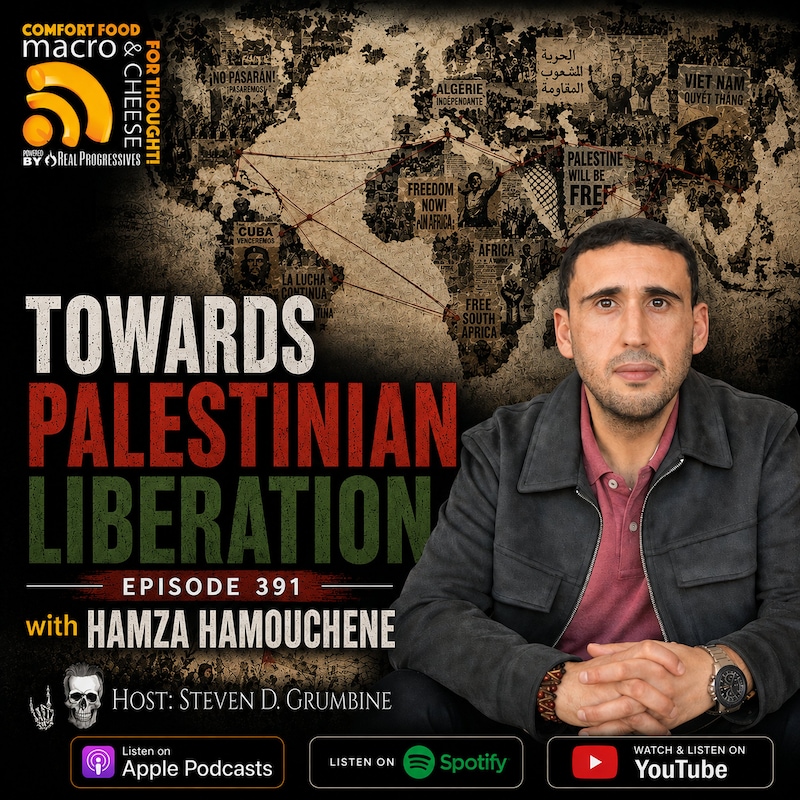
Shownotes
This week, Hamza Hamouchene returns to the podcast to talk about Towards Palestinian Liberation: Global Perspectives on Anti-Colonial Resistance and Solidarity, the new collection he co-edited with Abi Bae. Palestine, he argues, cannot be understood simply as a “conflict” or humanitarian crisis, but as a national liberation struggle against settler colonialism embedded in a larger system of Western imperialism and global capitalism.
Hamza traces Israel’s role within the imperial order, the class interests of Arab ruling elites, and the political economy of occupation and dispossession. Drawing connections to Algeria, Vietnam, South Africa, and other anti-colonial struggles, he emphasizes the revolutionary potential of international solidarity and the necessity of connecting struggles against colonialism, capitalism, and imperialism.
Steve brings MMT into the discussion, arguing that an analysis of real resources is incomplete without confronting the imperial power and violence through which those resources are controlled. The conversation ultimately points beyond solidarity with Palestine toward a larger project of liberation. As Hamza wraps it up:
“We need to be in solidarity with movements that are fighting for their rights, fighting against land grabs, against extractivism, against neocolonial plunder. Be with the Palestinians in their struggle for liberation. Because what we want, Steve, is not just a liberated Palestine. We want a liberated Palestine in a liberated world.”
Too often, mainstream narratives on Palestine are narrowly focused on Israel, the West Bank, and Gaza. Solidarity is reduced to a matter of human rights and international law violations. Hamza stands firm in his refusal to treat Palestine as an exception to the global struggle against imperialism.
Dr. Hamza Hamouchene is a London-based Algerian researcher-activist, commentator and a founding member of Algeria Solidarity Campaign (ASC), Environmental Justice North Africa (EJNA) and the North African Food Sovereignty Network (Siyada). He is currently the Arab region Programme Coordinator at the Transnational Institute (TNI). His work is focused on issues of extractivism, resources, land and food sovereignty as well as climate, environmental, and energy justice in the Arab region. He is the author/editor of five books: “Towards Palestinian Liberation: Global Perspectives on Anti-Colonial Resistance & Solidarity” (2026), “Dismantling Green Colonialism: Energy and Climate Justice in the Arab Region” (2023), “The Arab Uprisings: A decade of struggles” (2022), “The Struggle for Energy Democracy in the Maghreb” (2017) and The Coming Revolution to North Africa: The Struggle for Climate Justice (2015).
Transcripts
All right, folks, this is Steve with Macro and Cheese. I am excited to have my good friend Dr. Hamza Hamishen back with us.
And just so we all know, Hamza has been with us many times before.
I strongly recommend going back into the archives and looking for every single conversation we've had because every one of them is amazing and it doesn't run from hard issues, which is why I enjoy speaking with Hamza so much. You get tired of hearing the Pollyanna stuff. You want to hear the real because you want to take real action. You want to know what to do.
You want to be able to think clearly. And I believe that Hamza is incredibly on point with his breakdowns and his discussion points.
But today we're going to do something a little different. It had been a while since we talked because he has been working on editing a book that has recently been released.
This book was released by TNI and Daraja Press. He's co edited with Abi Bey and it's called Towards Palestinian Liberation Global Perspectives on Anti Colonial Resistance, the Solidarity.
And it is not just one author writing, it is many authors writing to describe the conditions and the solution set towards a Palestinian liberation and what that would mean.
And that is going to be the subject we're going to discuss the book, but we're really going to discuss the subjects that the book covers in a more direct way.
So with that, let me just properly introduce Dr. Hamza Hamishin, who is a London based Algerian researcher, activist, commentator and founding member of Algeria Solidarity Campaign, ASC Environmental Justice, North Africa EGNA and the North African Food Sovereignty Network siata. He is currently the Arab Region Program Coordinator at the transnational institute tni.
His work is focused on issues of extractivism, resources, land and food sovereignty, as well as climate, environmental and energy justice in the Arab region. And of course, he is author of many books and editor of the one that we'll be launching into this discussion today.
So without further ado, Hamza, welcome to the show, sir.
Hamza Hamouchene:Thanks C for having me again. Always a pleasure to be at Macro and Cheese podcast, which has become one of my favorite podcasts out there.
Steven Grumbine:That means an awful lot to Me, Hamza, I just. I want to ask you if it's okay. Let's just talk about the book momentarily.
You worked on this for quite a while now, and it's been something you've been getting out there into the public pretty steadfastly. Can you describe what this book is and what it's about and why it's so important?
Hamza Hamouchene:Steve, for this question and for giving me the opportunity, talk about the book that I co edited with Abibe, which is a collective book with various contributions from many parts of the world, mainly from the global south, from Africa to Asia to Latin America, but also from perspectives from the north, mainly from indigenous communities.
That book journey started during the genocide when we realized that there were many misconceptions, multiple framing, that were not present in the Palestinian cause of the Palestinian liberation issue from the right angle.
So we thought that we needed to fill a gap in the scholarship, especially coming from the Western media, from Western universities and Western scholarly spaces.
So we wanted to analyze the reality of the situation, to reframe, but as well as challenge and debunk certain myths and misconceptions about the Palestinian cause, about Palestinian liberations, and bring various perspectives that center anti colonial resistance and anti colonial solidarity.
So we had multiple contributions from activists and scholars themselves that are engaged in the struggles in their own regions, in their own countries, in their own contexts, not just on Palestine, but on various issues that touch on anti imperialism, anti colonialism and anti capitalism.
So we thought it was really important to reframe the discussion, to center Palestine and Palestine liberation as the paragon of anti colonial struggles, anti and for true decolonizations, but also as fundamentally an anti imperialist struggle that needs to be at the center of our efforts to bring a better world.
Steven Grumbine:Thank you. I appreciate that. Now, I do have the book in my hands and I took a very ugly selfie with it to show you that I have it.
But I want to just say for the record, I mean, this thing is thick. I hope folks will go out and buy it.
These are the kinds of things that we need to fill in our minds and in our soul so that our actions are directed towards the things that matter.
And I believe that centering the Palestinian struggle as part of a broader understanding of class relations and understanding capitalism and a host of things including the environment and colonialism. I mean, there's so many things that can be captured in this one spot. And that's going to take me right into my first question.
It's a multiple kind of question, but I think it will set the stage for the rest of what we're talking about.
And I guess the question I have is why do you think Palestine needs to be understood as a national liberation struggle as opposed to just a conflict with Israel or a humanitarian tragedy? And what do you think the language that we use does in terms of how the world sees it?
Because I think a lot of people try to categorize it as a conflict. Oh, this has been a conflict that has just been going on forever. Nothing to see here. What are your thoughts on that?
How would you lay that out to someone listening?
Hamza Hamouchene:Great question. So I think there is a short answer to this and there is a longer answer and I'm going to do both if you allow me, please. The short answer is simple.
Palestine Liberation is an anti colonial struggle or is a national liberation struggle because simply the enemy, the Zionism, Israel is a settler colonial state. So we need really to look back at the colonial origins, let's say settler colonial origins of Zionism that go back to the 19th century.
When you look at that history and when you look at it from honest point of view, you realize that Zionism since the 19th century was a colonial project to colonize Palestine, to take away the land from Palestinians in order to build home for European Jews. And from the start the Zionist movement was white supremacist as well. And it had its interest within Western imperialism and Western colonialism.
So without the British sponsorship, British colonialism sponsorship for the Zionist project, the state of Israel wouldn't have been established.
eir Mandate of Palestine from:There have been big resistance from Palestinian workers, from Palestinian peasants, from Palestinian urban classes against that Zionist colonization that has been creeping for decades, starting from the late 19th century.
prising or Arab Revolution in:I can't say more in terms of the founders who of Zionism themselves. And we can go back to Theodore Herzl, he was clear in his mind about the white supremacist and colonial nature of the Zionist endeavor.
You just need to look at his writings. He wrote in his pamphlet, you know, the Jewish State, these words, exactly these words.
We should there in Palestine form a portion of, of a rampart of Europe against Asia, an outpost of civilization as opposed to barbarism.
Also in his diaries he wrote, if it is God's will that we return to our historic fatherland, we should like to do so as representatives of Western civilization and bring cleanliness, order and the well distilled customs of the Occident to this plague ridden blighted corner of the Orient.
So and these accounts were not just, you know, shared or promoted by the Zionists, let's say the Jewish Zionists themselves, they were promoted by the Christian Zionists that were at the time who were also anti Semites.
So when we talk about Lord Balfour that we all of us know, the Balfour Declaration that allowed for a home of Jews in Palestine, Balfour himself was an anti Semite. He didn't do that because he loved the Jews. No.
The Europeans at the time, including the British, wanted to resolve the Jewish question in Europe by externalizing it, by pushing for Jews to migrate from Europe. And they facilitated that in Palestine. So this is the longer answer. Zionism origin, are colonial, are settler colonial.
And settler colonialism is built on the need to eradicate the indigenous and the native communities, dispossess them, take away their land and eliminate them. And the genocide that we've been seeing in the last three years is part of the Zionist Israeli settler colonialism.
Steven Grumbine: has been going on since what,:I mean, how long has this been going on exactly?
Hamza Hamouchene: y important. So you mentioned:This is what the Palestinians called Nakba, which means the catastrophe when the Zionists established the State of Israel on the ruins of more than 500 villages and towns by expulsing and ethnically cleansing 750,000 Palestinians. And it didn't start just then. I was mentioning that the Zionist movement goes back to the late 19th century.
And because the colonization started in a haphazard way, not in a systematic way, but it started in the early 20th century, facilitated by British colonialism till they got their power and they saw the opportunity, I mean, the Zionists, so then they went to establish the state of Israel by ethnically cleansing, displacing people, destroying Palestinian homes and agriculture. And that has been ongoing, if we count all of that. More than a century. More than a century.
So that's why it's really important to look at the Palestinian cause from a long duration perspective.
And I always compare, you know, the Palestinian cause to, to the cause of my home country of the Algerian revolution, the Algerian suffering under French colonialism. French stayed in my country 132 years. We ended up expulsing them. And I hope that will happen in Palestine.
There will be no freedom, no justice, no peace in that region without the dismantling of the Zionist entity, without the dismantling of settler colonialism. Settler colonialism is at the heart of all the problems that we see right now in the Middle East.
The wars, the displacements, the killings, the genocide, the attacking of all countries, Lebanon. The Zionists are repeating what they've done in Gaza right now. And it's just crazy.
But I wanted to come back, Steve, to the question of language, because what the book is trying to do, and it's not just our book that is trying to do this, there are multiple books by Palestinian scholars, authors and their allies trying to center the question of settler colonialism.
Because if you look at Western mainstream media, if you look at Western mainstream scholarly spaces and academia, the question of settler colonialism is completely absent, erased. We don't talk about settler colonialism. We just talk about conflict between two people over one piece of land.
It's about human rights, it's about morality. No, of course these matters a lot.
But the moment you talk about settler colonialism, the moment you come back to the basics and you try to understand why are the Palestinians claiming back their lands, why the Palestinians are trying to assert the right of return, why the Palestinians are still fighting and resistance with multiple means, including armed trouble. Then you start seeing things under a new light.
October:Palestinians are fighting against settler colonialism, against the Zionists that stole their land and resources. And then these Zionists claim that they are the only democracy in the Middle East.
Well, this is just, allow me to say, I don't know how this has been allowed, but this is not unique for Israeli settler colonialism, These, how can I say, muddying the water, framing the issues in the wrong way, trying to blame everything on the native.
It, it has been there with the Vietnamese, it has been there with the Algerians, it has been there with the South Africans, it has been there with the Cubans.
That's why the book takes a long Duray perspective and try to situate or let's say re situate Palestine within the long wave of anti colonial resistance and decolonization struggles. We wanted really to put that at the center of the discussion and then we can think of what is the way forward.
Steven Grumbine:I'm going to make kind of a statement question here that I feel is necessary. It's like the elephant in the room. None of these struggles for independence were able to be completed at the ballot box. Not a single one of them.
And people oftentimes have in their head. And I think a lot of it has to do with the comforts of their existing lives that they currently enjoy.
It's hard to fathom that a slave trying to escape slavery would kill the slave master to get his family free from slavery. Or a nation that has been colonized by the British or by the Americans or by the French or any of these other imperialist kind of forces.
There is no ballot box initiative that they can vote to just eliminate colonialism.
And so being able to handle kind of the dirtiness of reality, which is struggle, doesn't always come in the form of a philosopher or a ballot initiative. Sometimes it has to be won by force.
And when you have been taken away from the ability to vote your way out of things, when voting doesn't achieve anything, you leave people with only so many options. And I think it's important to center that as people try to assess what happens when they think about retaliatory behavior.
People are trapped and they are fighting for their freedom. Have I said anything that's incorrect there?
Hamza Hamouchene:No, not at all. You know, Mandela, Mandela, that the west right now sacralize in a way, that's what they do. Usually they co opt revolutionaries.
They hide the history, the real history, the radical politics, the revolutionary ideals. That's what they've done to Chequara as well. But let's come back to Mandela. Mandela said it clearly.
It's the oppressor who dictates the nature of the struggle. If the oppressor uses violence, the oppressed has the right to use their violence, including armed struggle.
And this is, you know, in the un, under the UN law, international law, people colonized have the right to use armed struggle to liberate themselves. We're not saying anything like Extraordinary. It is part of international law. So why isn't that the right for Palestinians to fight for their rights?
And then the other issue that we need also to think about, Palestinians, like their former colonized people, like the Algerians, like the South Africans, they've tried peaceful means, they've tried political means, they've tried the ballot. They've tried to lobby their apartheid and colonial masters, but it failed.
And the colonized, they realized that this is limited, that the colonial powers, the colonialists, won't understand. They will only understand the language of violence because, and that's what Fanon has said, colonialism is a system of violence.
It's violence in all its forms. It's not just like weapons and arms, but the inequality, the dispossession, the displacement, the impoverishment. So all of that needs to change.
And when we look at history, people fought through violent means to recover their dignity. You mentioned, you know, the slave and slave master. There is another quote by Walter Rodney saying exactly that.
How do we judge in what kind of morality or moral compass that we have to judge the slave when they revolt against the slave masters? And we are like equating the violence of the colonizer with the violence of the colonized. No, you cannot do that.
One violence, which is the violence of the colonizer, is used in order to maintain systems of oppression, domination, dispossession and injustice.
The other violence, which is the revolutionary violence, the violence of the colonized, is used to recover dignity, to fight for freedom, to fight for equality and justice. Big difference here. If we talk with morality, it's a big difference. But you know, the Western powers or the Western media never say this.
They just reduce. Let's say when we focus about the Palestinians in 7 October, as if these people are just bloodthirsty.
Like there is this kind of eternal violence in them, natural violence in them. These people are barbarians now. You forgot what the Israelis have been doing in, in. In the last hundred years.
Let's just see what they've done in the last three years. You know, they killed around 200,000 Palestinians at least. They are starving them. They are still killing them right now. And they are expanding.
There is a colonial expansion in the region. Syria, Lebanon. They are trying to destroy Iran. They are trying to destroy Yemen now. It's. It's just crazy.
This is a disease, the disease of imperialism and settler colonialism.
Steven Grumbine:Yeah, I am extremely embarrassed to be an American citizen sometimes. And right now is one of them, as our Congress has voted to enmesh the US Military with the Israeli military.
And there's a lot of people out there that I don't even understand how they could be so asleep.
vidence from Gillens and Page:So when I think about what's going on, that brings me back over to Israel, which I want to make another slightly off point about, which is Zionism is really anti Semitism at its finest. They did not want these people in their country. They did not want them in their nation.
They wanted to get them, ship them away and get them away so that they could be away from them. It wasn't a hey, let's do something nice for the Jewish people. This was a. A Zionist is not always Jewish. You nailed it there as well.
Christian Zionist. There's a million forms of Zionist people that believe that the Jews need to go to a place away from them and in its own terrain.
But somehow or another the United States is knee deep in this. And so that's going to bring me to my follow up question is what role does Israel play within the imperialist system?
Why is Israel so important to Western imperialism and which capitalist interests are involved?
Hamza Hamouchene:Another great, great question, and I think this is the heart of the matter, honestly, Steve, we need to talk about that. And the book tries to do this throughout its chapters.
There are two important chapters in the book, I think, that frames that matter and centers Palestine as a struggle against US led imperialism and against global force of capitalism, but also centers Palestine in the third worldest for vision started in, you know, the 50s, 60s, 70s and 80s and showed Palestinian revolutionaries shaping that project and that vision and playing a crucial role in pushing forward that kind of politics and that kind of vision. One of them is by Adam Haniyeh and the other one is by Wael Omar and both of them are Palestinian scholars and activists.
But let me go back a little bit like in history, so we understand the position that Israel plays today in the US Imperial order, right? Or maybe we should say disorder, honestly.
So I mentioned the implication, or let's say the alignment of the Zionist intentions with British colonialism in the 20th century.
So British colonialism at the time, they thought that Palestine played a very strategic role in terms of helping the British to protect the Suez Canal, an important maritime route, trade route, that it really wanted to control and dominate and protect so it can protect its own interests, but also as a gateway for other countries in the region like Iraq, Iran and India.
And many officials at the time, including Balfour himself and Churchill, another imperialist and war criminal, said this clearly that Palestine plays that role. So we needed to control that area of the world.
So the Zionists happened to be at that time trying also to go and colonize Palestine, so the interests align and they converge together.
And the Zionists were clear from the start that we need to ally ourselves with British colonialism to facilitate our project and to play that role in terms of helping them protect, you know, the Suez Canal and also as a gateway to India. So there is this quote by, I think we put it in the introduction of the book by a French Hungarian Zionist leader called Max Nordau.
etings in London, that was in:Without British sponsorship, the State of Israel would have never existed. But then it was not just the British.
he establishment of Israel in: was raging at the time, since: ip evolved. And starting from:So the United States saw the usefulness of Israel as the imperial advanced outpost that can protect America's, let's say the United States geopolitical and geoeconomic interests and crush Arab nationalist forces, leftist forces. Let's not forget that we were at the time it was the Cold War against the Soviet Union.
So the US really was keen to, to not allow the Soviet Union to root itself in the region. So Israel played that role since day one. I will tell you another thing.
We were talking about the Zionists, Christian Zionists are anti Semites, most of them. You go and hear what Churchill says about the Jews, you will be shocked. Same thing with Balfour, same thing with other officials at the time.
Really anti Semite. The Jewish Zionists themselves, they were collaborating with the Nazis at the time, you know, because they were pragmatists, to be honest.
Sometimes people get shocked. No, they were pragmatists. They were seeing Nazism at the time as serving their interests in terms of pushing Jewish migrants to come to Palestine.
And this is documented. I'm not saying anything like far fetched or exaggerated. Go and read the history.
You'll find Zionist leaders themselves collaborating with the Nazis in terms of approving Germans regulations and laws, in terms of expulsing Jewish and pushing for the Jewish to migrate to Palestine. So all of this just tells you about the colonial and white supremacist nature of such a movement, which is cruel and violent.
k now to today, because since:So he says that US Imperialist domination of the region rests on two key pillars.
The first pillar is Israel as a Euro American settler colony and an imperial advanced outpost that can protect the US geopolitical and geoeconomic interests in a region. That is really important. And I will come back to that in a bit. The second pillar is the Arab reactionary Gulf monarchies.
These are oil rich, they have huge resources. We're talking about Saudi Arabia Emirates, Qatar, Bahrain, Kuwait and Oman.
So these two poles or two pillars, these constitute the US Imperialist domination of the region.
eals that started in the late: andate presidential Monday in:I'm talking about Saudi Arabia because apparently Trump yesterday, he mentioned he's saying that the nuclear, the civilian nuclear deal with Saudi Arabia won't go ahead until Saudi Arabia normalizes with Israel. So you see the thinking of the imperialists, why, why do we need to create those normalization deals? For a simple reason.
It's rooted in a political economy Analysis of US Imperialist domination in the region. First of all, you do that, that would mean you cement US Imperialist domination of the region and its vast resources.
Not just oil and gas, but also petrochemicals, fertilizers, but also shipping and maritime routes. We're seeing with the war in Iran right now how the Strait of Hormuz is very important to trade on maritime routes.
One in five barrels of oil pass through the Strait of Hormuz. One in five, and then you have 20% of natural gas in the world passes through the Strait of Hormuz.
And then you have the Bab El Mandab Strait that the Houthis are trying now to block. There is a huge amount of commodities that go there through the Suez Canal in the north.
So that region lies at the heart of the global capitalist economy. Not just fossil economy, but the global fossil capitalist economy. You control that region, Steve. It means you control the global economy.
It means you can undermine China, you can undermine its economic ascent, because a lot of Chinese commodities go through the ports and the logistical spaces of the Gulf countries, you know, so cementing US Domination of the region.
The second thing in terms of these normalization deals is to integrate Israel into the political and economic order, regional order, from a dominant position.
So we want Israel to be dominant in terms of technology, in terms of, you know, desalination of water, in terms of energy projects, in terms of renewable energy, in terms of agriculture. And we've seen massive deals with the countries that normalized with Israel in terms of agrib business, energy, desalination of water.
What would that do?
That would create dependencies and subordination of other Arab countries to Israel, which becomes a kind of a sub imperialist or even an imperialist force that the United States want to be the dominant force in the region. You create those dependencies.
Then the consequence of that is that the energy security, food security, water securities of those Arab countries that depend on Israel and its technology and know how and investments become much more important than the Palestinian cause. What happened is the idea, by doing all these normalization deals, is to liquidate the Palestinian cause so we will forget completely about it.
The actions of Palestinian resistance on 7 October disrupted all of that and put Palestine again at the table in terms of talking about it, discussing it in terms of international solidarity, but at a very, very heavy price. Genocide is being committed, a huge displacement, huge suffering in the people of the region. So.
So Israel plays that role in the imperialist structure of the world and it wants to maintain it by integrating itself in a dominant position in the region.
And by expanding as well, we are seeing how it tries to expand in Lebanon, into Syria, and try to eliminate any threat from whomever tries to challenge Israel's domination in the region. We're talking about Iran here and the axis of resistance.
Intermission:You are listening to Macro N Cheese, a podcast by Real Progressives. We are a 501c3 non profit organization. All donations are tax deductible.
Please consider becoming a monthly donor on Patreon Substack or our website realprogressives.org now back to the podcast.
Steven Grumbine:This is really important and I'm going to take a moment to pivot into modern monetary theory for those that listen to this podcast.
One of the core elements of the activists that speak to MMT is that the nature of a currency issuing nation is that the real limits of their ability to spend are not about financial ones. They are about real resources, where the real resources are. And unfortunately a lot of folks will just soft play this.
They'll say it, they'll repeat it like a robot and they'll say it maybe even with some passion and so forth. But when you push them to address how these real resources become part of their national fabric, they go silent. They don't.
They, oh, that's beyond mmt. That's, you know, I can't be an expert in everything. How can you ask me to care about this?
But if you're going to say real resources are the limits of a nation's ability to spend, and you're watching imperialism occur on the national stage and slaughtering just unbridled genocide to accomplish whatever it is that they're trying to do.
And you look at the geopolitical space with China and what the US empire is doing through its relationships with Israel, I don't see how you can have a ledgers based conversation and claim that real resources are the limits while simultaneously not paying attention to how a nation is getting its real resources, how it's slaughtering people, how it's destroying the workers, and not just the workers, just the indigenous people of regions.
I don't see how they can even remotely claim, oh yeah, the limits of spending are real resources, but then refuse to understand how they got those real resources. Which kind of brings me to my next question, which is how does a class analysis reveal the occupation? What does it reveal?
And within that, how does occupation operate as an economic system, which you did touch on, but not just for territorial domination, but put it together because this is like a system of inputs and outputs tools and techniques. And to ignore that is to literally ignore 9, 10 of the real conversation.
I believe that far too many get caught up in, oh, well, you know, my accounting says this works and that works, and we can do xyz.
Failing to appreciate how enslaving nations through IMF debt through a host of other things are the literal means of creating the supply chain to fatten the imperial core.
Hamza Hamouchene:Yeah. So let's say it clearly. Israel or the Israeli regime is not just about occupation.
It's also settler, colonial, it's apartheid, it's white supremacist. We need to put all these systems together, because reducing it just to an occupation, I feel it does not do justice to what is happening.
Even the word settler colonialism on its own, separated from other systems of dispossession and domination, feels insufficient in terms of describing the current colonial situation in. In Palestine.
And I find that maybe we don't have yet the right lexicon to describe the utter destruction and suffering that is unleashed on the Palestinians today from genocide, ecocide, herbicide, epistemicide. Like many scholars, are using all these terms, trying to make sense of what is happening.
So in terms of class analysis of settler colonialism, I think settler colonialism, as I said, is about the elimination of the native of the indigenous.
It tries to do that, and it's just not the elimination of the native and indigenous, but it's also about the erasure of their environments, erasure of their culture, the erasure of their identity. So we try to do everything to dominate them at multiple levels.
You know, I work a lot on environmental questions, as you know, and I wrote this article last year entitled Ecocide, Imperialism and Palestine Liberation, where, you know, I argued that colonialism or settler colonialism, not just in Israel, but in other former colonies like Algeria, was about the domination of the environment as well. It's about ecological domination is about ecological erasure. It's about the alienation of the local environment and replacing it by something else.
In most cases, replacing it by Western environments. That's why we have all those cheese imported by colonialists, including the Israelis, in order to Europeanize the landscape.
So it's much more than people think. You know, it's a systematic system in terms of its domination, dispossession, elimination, and erasure.
But then not all experiences are about the total elimination of the indigenous and the native. It didn't work out in Algeria. It didn't work out in South Africa. It didn't work out in other places.
And I really hope that it won't work out in Palestine, Palestinians are proving that they continue to resist linked to their land despite, you know, the relentless and omnipresent catastrophe that is being unleashed on them. But when that doesn't work, you try to use the local, the indigenous.
And in here we can talk about also Algerians and Palestinians in terms of proletarianize them, use them as workers.
First of all, like I'll give you an example from Algeria, what they've done is they dependized the Algerian peasantry, basically stealing their land, displacing them, confiscating their land, starving them.
So a lot of the Algerian peasantry had to escape the rural areas, the agrarian areas, the mountain areas to go to the cities and towns so they can work for the colons or the colonizers or the settlers, basically selling their labor. So that happened also in Palestine, by the way.
A lot of the Palestinians, including from Gaza and the west bank, were going to what we call today Israel in order to sell their labor and to work there.
That changed, that dynamic of that changed in the last, I think decade or two where Israel has tried to replace Palestinian labor by other labor coming from Southeast Asia, so from Nepal, from India, from Bangladesh, because Palestinian labor was playing a destructive role in the Israeli economy. So they needed to rely on something else. I don't know if I answered your question very well, Steve, but I think these are my main thoughts.
Steven Grumbine:No. Then that's all I can ask you for.
As a Marxist, I'd like to understand this, but I guess just as a regular human being, a working class person trying to understand what should we take from the role of the Palestinian Authority in the Arab ruling classes?
Why do Arab governments express rhetorical support for Palestine but maintain relations with Israel and the U.S. and you know, is there like a class line between the people or the region and the rulers of their nations? And I guess how does a Palestinian liberation threaten the Arab ruling classes?
Hamza Hamouchene:Very good question, and I think I can say a lot on this. But let me start by answering your question directly in terms of the class line between the Arab ruling classes and the people.
Of course there is most of the ruling classes in the Arab region right now, if not all are comprador classes, which means they are submissive to US imperialism or US led imperialism. They are reactionary forces. They are looting the resources of their own people.
They are opening up the economies of their own people for foreign capital to plunder them. They are facilitating what Fanon described in the early 60s as the legalized robbery of people.
Fanon had a Huge critique for those national bourgeoisies, post colonial national bourgeoisies, because he saw their limits. Of course there are differences from country to country because some countries tried to do a kind of rupture. I'm talking here about Algeria.
Then, yeah, the ruling classes just, you know, went down and not really serving the interests of their people. So if we see Palestine, why Palestinian cause is threatening the rule of these comprador elites? First of all, I'll give you a concrete example.
the fall of Hosni Mubarak in:So if you go back 10 years earlier, you see that the mobilizing and the organizing that took place within civil society, within progressive forces, within anti war movements, where around Palestine. So Palestine is this rallying call, is this cause that will make you connect the dots.
So you start with Palestine and you realize you need to overthrow your ruling classes because your ruling classes are oppressing you and allowing for settler colonialism, for Israeli settler colonialism in the region, allowing for imperialist interest to root themselves in our region and to plunder our resources and our lands and continue the domination. Some of us, you know, use words like neocolonialism and imperialism and I think they are apt in describing what is taking place today.
other example From Algeria in:You know, there were many slogans, many posters talking about Palestine. People realized that they cannot be free, they cannot be liberated without the liberation of Palestine.
They realize and see the interconnectedness of the struggle and that's what make the ruling classes rich, really scared of people connecting the dots. That's what the Egyptian have done. The Sisi, the Egyptian military dictatorship.
In: e Egyptian revolution back in:Same thing with Algeria. The Algerians went into the streets in the first months of the genocide in support for Palestinians and against Israeli genocide.
Algerian regime allowed that.
arted chanting the slogans of:So I think it's clear to us as Arab activists, Arab populations, Arab scholars, Arab trade unionists and progressive forces that Palestine is the litmus test. Palestine is the guiding compass for our liberation. And Nihair Al ASR, in her chapter on Egypt, make that clearly obvious and direct.
She says the condition of liberation is for the Egyptian masses to go to the streets. And that's what it is. There will be no liberation in Egypt without the liberation of Palestine.
And likewise there will be no liberated Palestine until the whole Arab region is liberated. And we've seen that in the attempt in the Arab uprisings there were two waves.
There was one wave in:Yes, we need some of that, but it's really about economic justice, about sovereignty. And you were fundamentally anti imperialist.
But what the imperialists did, from the European Union to the United States trying to sponsor the counter revolution and the Gulf countries played a very reactionary role in that. So of course the ruling classes in the region are scared of the liberatory potential of the Palestinian cause.
But then I'll finish by talking about the Palestinian Authority.
And I think a lot of people avoid, for understandable reason to talk about the Palestinian Authority in the context of the genocide right now and saying, okay, this is not the time to discuss, but the Palestine Authority is a traitorous authority.
You know, since after the Oslo Accords, the Palestinian Authority has been turned into this subordinate subcontractor for Israeli surveillance, repression and militarism. The Palestinian Authority represses the resistance. The Palestinian resistance. The Palestinian Authority does not like Hamas.
The Palestinian Authority is so corrupt. And this is really a testimony of what Fanon warned us about.
Those national bourgeoisies, Palestinian authorities, not part of the resistance to Israeli colonialism. Palestinian Authority want just to negotiate a piece of the ground and to become that subcontractor for Israel.
Steven Grumbine:So one of the things that I think about when I talk to you is I frequently forget that you're Algerian or that you have Algerian heritage. And so there's a lot to be learned from that struggle as well. And you mentioned Vietnam and other anti colonial struggles earlier.
But what are some of the things that we can learn from them?
I mean, when, when you touched on Them it made me really, you know, I, I, and I apologize for not being more proactive in asking about this, but I want to make right that wrong. Tell me more about the Algerian struggle and how that pertains to this overall conversation.
Hamza Hamouchene:Yeah, before I do that, just to continue the previous idea in terms of why, you know, Palestine liberation of the Palestinian cause is a threat to the Arab ruling classes.
And I remember here, Ghassem Karafani, a Palestinian revolutionary intellectual that was assassinated by the Israelis in the 70s, said about, you know, the nature of the enemies of our enemies in the region. And he said our enemies are threefold. For him, first of all, it's US imperialism.
You have Palestinian reactionary bourgeoisie and the reactionary Arab ruli classes. And within US imperialism he puts Israel, of course, because without US imperialism, Israel wouldn't be able to do what it does now.
Just wanted to put that in there.
Steven Grumbine:I appreciate that.
Hamza Hamouchene:Yeah. Because the analysis goes back a long time. It's not nothing new and still applicable and very relevant to today, but Vietnam and Algeria.
rote that chapter that was in: th of October:But much more importantly, what I wanted to do in that chapter, Steve, is to draw the linkages between the different struggles because Algerians were inspired by the Vietnamese.
about it at the MBM Fu in May: truggle against the French in:The second thing that I wanted to do through that chapter, and it's not just me who's doing that, by the way, in the book, other people as well, is to show that solidarity between colonized people was a driving force for change in the previous century. Solidarity between, you know, colonized people in terms of concrete actions. So we've seen how the Vietnamese called on North African revolutionaries.
f Edwell. I think that was in:But he still had a stature and he was well known at the time. He was in Egypt.
The Vietnamese contacted him saying, you know, we need to do some political activity, political education, so we block the North African soldiers from joining the French efforts to crush the Vietnamese. And Abdicream Khattabi at the time said, the defeat of French imperialism in one part of the world is its defeat in another part.
And they've done that work. Many workers in Algeria blocked ports in terms of not allowing for weaponry and other commodities to go to the French armies in Vietnam.
r independence, of course, in:And the Palestinians learned from the Vietnames, learned from the Algerians, learned from the Cubans, and took the torch of anti colonial revolution and resistance forward and helped shape the world at the time of Third Worldism.
Palestine at the time was part of those efforts, played a crucial role, not just as a recipient of solidarity, but also as helping other revolutionary movements in Latin America, in Africa, in Asia, in Europe, helping them financially, helping them by providing weapons, by providing training in the refugee camps, by also political and ideological education. So Palestinian played an important role because they understood their struggle not just as against Israeli colonialism, but against US Imperialism.
And then if you defeat imperialism in one part of the world, you defeat it in another part.
And Israel also was playing the role of supporting the reactionary forces, military dictatorships all over the world, including in Latin America, arming military dictatorship against revolutionary movements. So it's really important to center this anti colonial history, learn from it. Of course, without romanticizing it. There were a lot of mistakes.
There were a lot of failings and shortcomings, but we need to See and learn from the vision of those revolutionaries that were fighting imperialism, colonialism and white supremacy at the time. And some of them were also fighting capitalism. They were seeing their struggle as an anti capitalist struggle.
They had their vision, they connected the dots, they created transnational movements of solidarity. They were helping each other. That inspiring era, we need to revive it.
Today we are seeing some glimmers of it, some traces of it, in terms of the outpouring of international solidarity, in terms of certain south south relations that we are seeing in terms of certain assertive actions from global south countries. And I'm talking here, for example, about South Africa taking Israel into the International Court of Justice.
But I think we need push and pressure from below and push that solidarity even further because we are fighting one system, a system of death and destruction, which is the imperialist and capitalist system. If we don't unite, if we don't organize, I think the fate of Palestinians will be visited upon many of us in the world.
Steven Grumbine:It brings me to a question that I didn't anticipate asking, but I think is important as part of the militarization and the public spending that goes into militarizing the world right now through artificial intelligence and the like. What has been the role of these kind of tech oligarch type groups in terms of testing weapons on the Palestinians themselves?
I mean, it feels like they're using it as a test bed to launch operations beyond that region. Can you touch on that or is that beyond your specialty?
Hamza Hamouchene:I can touch on it a little bit. It's beyond my specialty. But we've been following how AI and how this tech has been, let's say, colonized by the military industrial complex.
We've seen how tech and AI companies are really in bed with the military industrial complex because that's where they are trying their softwares and that's where they think they're going to make a lot of money. And in here it brings us to the question, who controls these technologies and for what purpose?
And clearly these technologies are designed just to make profits and it's a killing machine. And Israel has, it's not just Israel, you know, multiple armies.
We've seen how in here also in Europe, in the United States, how they try to control the AI companies and AI technologies and to mobilize them as death machines. And if you leave that in the hand of the capitalist, that's what you get, Steve. You know, just profit and death and nobody cares about human life.
Steven Grumbine:Hamza, this has been an amazing conversation. I'm so glad I have this book.
Another person who's written about this, Omar Zaza, who we've had on this program before, is in the process of writing another book to cover this as well. Probably due out next year. We'll be having him on as well. I want to know, what did we miss today? What are things that the listeners should know?
As we leave this discussion, I want.
Hamza Hamouchene:To end by a note of hope, because when we analyze these things, systems of death and destruction, it may seem as gloom and doom, not giving hope. And actually in the introduction that Abby and myself have written, have tried to inject some sense of hope.
Not just a romantic hope, no, a hope that is based on histories of struggle, resistance and solidarities. A hope that is built on experiences of oppressed, dominated and colonized people who freed and liberated themselves through struggle and organizing.
But also we know that hope cannot be decontextualized or dehistoricized. So we need to look at the reality that we live in.
And you know, it's the hope and the optimism, let's say the optimism of the will, you know, in the Gamian phrase, it is intentions, always intentions, with feelings of powerlessness and pessimism of the intellect.
So Abi and myself, we wanted to nurture that hope by conveying the complexity of liberation struggles and the need to view them, as I said earlier, from a long dura perspective, as protracted fights against systems of dominations, oppression and exploitation. And then in these struggles, there is always a potential for victory.
But victories, as Amilka Cabral said, are never easy and they are never guaranteed. Things can turn much, much more worse before they start changing for the better.
So we felt that our intellectual and militant choice is to join the struggle, to continue fighting for a better world through our ideas, through our words, through our actions.
And it's really important to keep that hope up by looking back at history, by getting inspired from that beautiful history of decolonization, third Worldism and anti colonial struggles and bring it up to today, to the actions of today. What do we need to do today and see things from a long duray perspective? We're not going to, you know, win over imperialism overnight, Steve.
It takes a lot of time. This is a protracted struggle, but we cannot just wait. We need to organize now. We need to connect the dots.
We need to learn about histories of struggle. We need to connect our struggles together. We need to weaken imperialism in the cores of empire in the United States, in Europe.
We need to be in solidarity with movements that are fighting for their rights, fighting against land grabs against extractivism, against neocolonial plunder. Be with the Palestinians in their struggle for liberation. Because what we want, Steve, is not just a liberated Palestine.
We want a liberated Palestine in a liberated world. And I think we cannot separate these two from each other.
Steven Grumbine:That's a very powerful statement. I think we should end right there. I really love this conversation. I am so grateful for you, Hamza.
I wish that I could have you on far more often than your time allows for. You are an amazing speaker. Where can we find more of your work?
Obviously, the book we talked about, Towards Palestinian Liberation, Global Perspectives on Anti Colonial Resistance and Solidarity. Please pick that book up. But where else can we find more of your work?
Hamza Hamouchene:Well, a lot of my work is in various parts and outlets, but I think you can visit the website of the Transnational Institute, www.tni.org. You find all my work there. Based in North Africa, the Arab region, on various topics including Palestine Liberations.
But I write and I participate also in podcasts like Macro and Cheese. So yeah, awesome.
Steven Grumbine:Well, I. I'm so glad we're part of that ecosystem. All right, well, let me go ahead and take us out here, folks. My name's Steve Grumbine.
I am the host of Macro and Cheese and the founder of the nonprofit Real Progressives. We are a 501C3, not for profit, and we live and die on your contributions. Please consider becoming a donor.
You can go to patreon.com/real progressives. You can go to our [email protected] realprogressives forward slash real progressives.
You can also go to our website realprogressives.org and become a monthly donor as well. You can also become a volunteer if you're interested in helping us do the work that we do.
Every Tuesday night we have a webinar called Macro and Chill where we cover that week's podcast and we have an open discussion in a community format so that everybody can participate, everybody can learn, and everyone can ask questions. We post that every week on our website. We also post it all over social. So by all means, please come join us.
It is at 8:00pm Eastern Standard Time or New York City Time and 5:00pm Pacific Standard Time. Hamza, it was amazing. I really appreciate your time here. I hope we can have you on again much sooner this time.
But in lieu of that, folks, on behalf of my guest, Hamza Ham, myself Steve Grumbine, the podcast Macaron Cheese, we are out of here.
End Credits: with the working class since: End Credits:To become a donor, please go to.
End Credits:Patreon.com realprogressives realprogressives.substack.com or realprogressives.org sa.







