Shownotes
EPISODE SUMMARY:
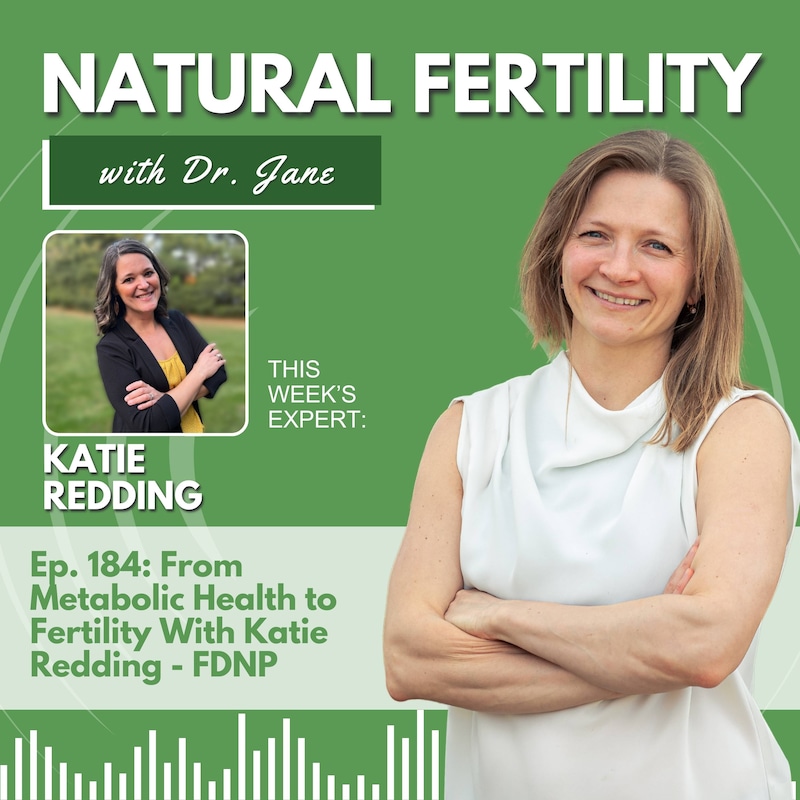
In this episode, I introduce Katie Redding, a Functional Diagnostic Nutrition Practitioner and the newest member of our team. Katie shares her journey from nursing to functional medicine, her personal health transformation, and why she’s passionate about helping women, especially those 35+, take charge of their fertility and hormonal health. We talk about methylation, perimenopause, fertility testing strategies, and what it truly means to help women heal from the inside out.
ABOUT DR. JANE’S PRACTICE:
Dr. Jane is a Naturopathic Doctor and a Natural Fertility Expert. She and her team of expert practitioners help couples navigate infertility for 1+ years, get to the root cause of their struggles, heal, and bring healthy babies home.
After having a family member struggle with infertility and experiencing a miscarriage herself, Dr. Jane realized how little support and education women receive. She is on a mission to change that. Since 2020, she has dedicated her practice to fertility, where she and her practitioners work with couples 1:1, running functional lab work, customizing treatment plans and providing her couples with the support they need to get pregnant, have a stress free pregnancy and a healthy baby.
Learn more about Dr. Jane’s practice: www.drjanelevesque.com/practice
Apply to work with Dr. Jane & her team: www.drjanelevesque.com/application
Join to receive Dr. Jane's weekly Fertility Files: https://link.getcmm.com/widget/form/JStvkHpRAamc7VwPMEQE
CHAPTERS:
00:00 Introduction to Functional Diagnostic Nutrition
02:59 Understanding Perimenopause and Its Impact on Fertility
06:03 The Shift from Conventional to Holistic Health
08:58 The Importance of Individualized Care
11:48 Empowering Women in Their Health Journey
15:00 The Role of Support in Fertility Treatments
21:38 Nurturing Intuition and Self-Care
24:30 The Power of Testing in Fertility
27:46 Understanding Methylation and Its Impact
29:47 The Importance of Couples in Fertility
32:06 Optimizing Health for Pregnancy
34:46 Navigating Fertility Challenges
38:58 Transformative Healing Journeys
TAKEAWAYS:
Katie has over 15 years of experience in health and wellness.
She focuses on metabolic health and functional holistic approaches.
Perimenopause is often misunderstood and affects many women trying to conceive.
Holistic care can provide answers that conventional medicine may overlook.
Methylation plays a crucial role in fertility and overall health.
Couples should be involved in fertility treatments for better outcomes.
Katie's personal health journey led her to functional medicine.
The importance of individualized care in women's health is emphasized.
Testing options in functional medicine can significantly impact fertility strategies.
Empowering women to advocate for their health is essential.
ABOUT NATURAL FERTILITY:
Pregnancy is a natural process, so if it’s not happening or it’s not sticking, something is missing. Join Dr. Jane, a naturopathic doctor and a natural fertility expert, every Tuesday at 9am for insightful case studies, expert interviews and practical tips on optimizing your fertility naturally.
If you’ve struggling with infertility, pregnancy loss, women’s health issues or just want to be proactive and prepare yourself for the next big chapter in your life… this show is for you.
SUBSCRIBE TO & FOLLOW NATURAL FERTILITY:
Spotify: https://open.spotify.com/show/0WjrEeP...
Apple: https://podcasts.apple.com/us/podcast...
CONNECT WITH DR. JANE:
Website - www.drjanelevesque.com
Instagram - www.instagram.com/drjanelevesque/?hl=en
Facebook - www.facebook.com/dr.janelevesque.nd
YouTube - www.youtube.com/@dr.janelevesque7319
Individualized care is essential for effective treatment of chronic fertility issues.
Transcripts
Hi guys, welcome to another episode of Natural Fertility with Dr. Jane. I of course am Dr. Jane and today I am joined by Katie Redding, who is a functional diagnostic nutrition practitioner and she's actually a new practitioner joining my team. So I'm super, super, super stoked for you to meet Katie. Thanks for being here, Katie.
Katie Redding, FDNP (:you're pretty sure you're enjoying it.
Katie Redding, FDNP (:Yeah, thanks for having me.
Dr. Jane Levesque (:Yeah, tell us a little bit about who you are. I'll tell people about how I found you, but I mean, it's just the job post really, but I do think that you've been following me for a while. So just talk about the functional diagnostic, how long you've been practicing for, what your experience is, who you are, what you're bringing to the table. And they will dive into all the needy, greedy details.
Katie Redding, FDNP (:Thank
Katie Redding, FDNP (:Yeah, well I'm excited to be here. So thank you for inviting me and for inviting me to join your team because I'm so excited to get started. I have been in the health and wellness space for over 15 years, worked with women and couples on their metabolic health and their metabolic journey to really lay a really good foundation and really transform their health. And then over the past four years,
been working with clients more on a functional holistic level, really diving deep into root cause issues and true transformation, utilizing some functional lab testing and really helping couples connect the dots with what's missing. So that's what I have been working on.
Dr. Jane Levesque (:Yeah. And you've been doing some perimenopause as well. You switched. That's what you were talking about before. Hormone.
Katie Redding, FDNP (:Yeah, yeah. Really helping women optimize their hormones, right? Like we're in this age where perimenopause is a big thing right now. I have entered that stage myself and a lot of the clients that I worked with.
Dr. Jane Levesque (:Me too, I think we'll talk about perimenopause in a little bit, like most, if you're over the age of 35, you are in perimenopause.
Katie Redding, FDNP (:Yeah. Yeah. Yeah. And a lot of my clients who were working on metabolic health for years and really being successful suddenly, you know, hit this brick wall. And that's actually what got me to go back and work more, get more training and functional diagnostic nutrition, because we needed more answers than just throwing darts at the wall and trying new things, trying new supplements, trying new strategies. We need more information. So
That's what prompted me to start my journey of getting more information, more education to be able to help women really optimize their hormones and optimize their health.
Dr. Jane Levesque (:Yeah, I've recorded a whole podcast on perimenopause because this is something that was new that I've learned from Dr. Leah Hetchman to just understand the actual transition into menopause and that it's a 15 year journey, not a one to two years. And that most women will start to notice a decline in their hormones after the age of 35. And as when I was watching that lecture, I was just like, yep, yep, yep. Like these are all the things that I'm experiencing at 39 years old. And these are all the things that my patients are experiencing.
Katie Redding, FDNP (:It's just like,
Dr. Jane Levesque (:why they're struggling with infertility. But I have so many patients who are scared of that word because they're just like, I can't be in perimenopause. I'm trying to get pregnant. It's like, no, no, most women now are trying to get pregnant in perimenopause. That's what we help you do is figure out how to slow down and optimize the, cause you can still get pregnant in every stage up until menopause, obviously, when the cycle stops. But.
Katie Redding, FDNP (:that.
Katie Redding, FDNP (:Yeah.
Dr. Jane Levesque (:you know, it's like, what we do. We help you figure that out so we can continue to optimize the eggs and extend that process as opposed to like, no, it doesn't exist. Like it's just this thing that happens very far down the road.
Katie Redding, FDNP (:like
Yeah, yeah, that's the stigma is that it's like the old lady. It happens when you get old and it's really happening much earlier. And I think that's why so many women are struggling with infertility is because, you know, they think they have all this time and the egg supply is diminishing and the quality is diminishing. And so that's certainly going to impact their journey.
Dr. Jane Levesque (:don't.
Dr. Jane Levesque (:Yeah, and I think it was you and I that talked about like the 20 year old personal trainers that are trying to tell women at 35 or 40 what to do to lose weight and it's not working. And it's like weird, this 20 year old dude that has no idea what's going on with your hormones is just telling you to work out harder. Yeah, yeah, and that's not working. What did you do before being a functional diagnostic practitioner?
Katie Redding, FDNP (:Yeah. Just eat less and move more. Yeah. Yeah.
Katie Redding, FDNP (:Yeah, so I actually had a metabolic health clinic that I owned. had two brick and mortar locations, helped thousands of people. We opened that up in 2011 and really worked with diet, lifestyle, movement, exercise to optimize health. So been working with
couples since: Dr. Jane Levesque (:Kind of nervous for you again.
Katie Redding, FDNP (:I actually worked in admin because I was always trying to solve people's problems and make them be able to or help them be able to reach their goals faster. And so I have always been on that side of things to be able to help solve the problems, help problem solve. So, but I made the switch because I got to, I ended up on my own health journey where I lost 50 pounds to transform my life. And I did that through, you know, nutrition.
lifestyle and it was so life-changing for me that I wanted to be able to help other people with that and I knew you know pharmaceuticals while they have their place in certain seasons it's not the only answer and we have so much power when we have the right tools and the right support I would just believe that wholeheartedly and I was given the right tools and support to be able to to be really successful and then
Dr. Jane Levesque (:Yep.
Katie Redding, FDNP (:went on to help others do that.
Dr. Jane Levesque (:Yeah, losing a lot of weight is such a big, big, transformation. I don't like, yeah, I don't know if there's a lot of people that can relate to that. I had 25 pounds that I was carrying and I wouldn't say that that was like, it was still a big transformation. But when we're talking in the 50s and 60s and seven, like you're literally becoming a different person with every like 10, 15 pounds that you're losing.
Katie Redding, FDNP (:Yeah, it's like peeling the onion. Yeah.
Dr. Jane Levesque (:That's right. Yeah, that's it. And then in the, you know, why join the fertility space? And really the goal, as I introduced you guys and where you're going to come on once a month, we're going to talk about, you know, patient cases, what you're seeing, different perspective, what are we seeing in the labs? But the goal of this podcast is in the introduction one is so people understand that you're not coming as a brand new practitioner that's new to this space. You're new to the team, but you're not new to.
whether that's the fertility space or metabolic health space or hormone space, it's just doing it slightly different, joining the team. So two questions that I have for you is like, why join the team? And then why switch to fertility?
Katie Redding, FDNP (:Yeah, I think it really is just looking at health through a different lens, right? It's just switching that lens a little bit. I personally...
Dr. Jane Levesque (:You
Katie Redding, FDNP (:I had such an amazing experience with childbirth and with having my, have three children. They are all getting very old now, but I remember each and every one of those experiences. And I guess I didn't realize at the time how blessed I was. Like it came pretty easy for us and didn't have complications. Now, looking back, there are a lot of things I would change to optimize things knowing what I know now, but
It wasn't until a few years after that I noticed everybody was having difficulty conceiving. And, you know, even working with the clients that I have, the population that I have over the last 15 years, so many of them were ending up with me still struggling later in life and come to find out they had fertility issues or their journey was longer. Maybe they had children naturally, but they were spaced out really, really far apart because it took them so long.
to conceive. And what I'm realizing is like, yeah, these people were struggling all along. This isn't a new problem that I am learning for the first time is happening. It's actually been happening all along. And these people have not had answers. They have not had solutions. They have not gotten to the root of their issues. And so fast forward into their 40s, whether they've had children or not, they're still struggling with their health.
and not optimizing things. And so for me, kind of making this shift over from one end of the hormone spectrum to another, it's really about helping provide women and couples with just the education, the strategy to be able to get to their goal, right? And I really think...
Dr. Jane Levesque (:Mm-hmm.
Katie Redding, FDNP (:Everybody can do that when they have the right information and when they have the right tools to get there, which is what we do. We take a look at strategy versus just totally guessing and kind of throwing darts at the wall. And it's so powerful. Everybody can be in control of their health. They just need those tools and those resources.
Dr. Jane Levesque (:Yeah, you just, think there's a couple of things that have been happening. Like the standard for health has really declined. And I never blamed the, you know, the person sitting in front of us because the, our patients usually come and they're like, I've been trying to get some help for the last three years. And I haven't been able to because my doctor keeps telling me everything is normal. Even though you look even at the cholesterol panel and it's elevated, but it's not that bad. So it doesn't really matter. And it's not.
that's not the thing that's impacting it. And I think that when I decided to switch into fertility, so for me that, you know, practicing for 10 years switched five years ago into fertility, I could see the menopausal women who were struggling with crazy menopausal symptoms, that weight gain that came all of a sudden, the hair loss, the...
hot flashes, the insomnia, you name it. They just started to not feel like themselves. And sure enough, you go and look at the history and you're like, they struggled with infertility or they struggled with pregnancy or they struggled postpartum. Like there were so many other signs leading up to it. And that was like, hey, how do we get them before that? So we don't have to go through hell in the last five years of their menstrual cycle or longer for some women.
Katie Redding, FDNP (:the other side.
Katie Redding, FDNP (:Absolutely. Yeah.
Dr. Jane Levesque (:Yeah, it's, I lost my track. But the idea is that it's, we need to understand there's signs and symptoms way before the actual problem is there. It's just nobody's paying attention to it. And so how can we validate you and say, no, you're right. Something is off and let's run some lab work and let's show you what that is. And let's look at some data because there's absolutely something off.
Katie Redding, FDNP (:Thank
Dr. Jane Levesque (:We just need to have more concrete information instead of you should eat more protein, you should eat more vegetables, you should go outside. Like totally, you should do those things. But in what order? You know, and which one's actually moving the needle?
Katie Redding, FDNP (:Thank you.
Katie Redding, FDNP (:Yeah, yeah. You know, and I think everything's so medicalized. You know, we're taught to rely on medicine, rely on our doctor. If something is wrong, we call the doctor, they have the answer. And I think what a lot of women are finding is that, unfortunately, the doctor doesn't have all the answers because each and every person is unique and individual. And the reason you're not conceiving or the reason you're struggling in your health.
is different from person to person to person. It's based on your history and your genetics and your lifestyle and your environment. So many things impacted. And unfortunately, you know, the medical system doesn't have the time or the tools to be able to sit down. Yeah, they don't have the time to sit down and break all of that down for you and really look at what could be going on, what we could try and then to trial it out and then
Dr. Jane Levesque (:In the five minute appointment, you have a go.
Katie Redding, FDNP (:retry or pivot when necessary. And I think that's the big difference between when we look at holistic care versus conventional treatment. And certainly there's a time and place for the great resources that we have in the conventional space, but we've lost track of the fact that the body can heal. The body is miraculous. God made it so that it should create life. And if it's not creating life, then something like you say all the time, then something's missing. And that's
what our job is. That's what I love helping figure out for clients and really connect the dots so that we can reach that goal a lot faster.
Dr. Jane Levesque (:Yeah, and I think, you know, when I first started practicing, I was like, I'm very pro natural pregnancy and natural birth and all these things natural. But again, medicine is individualized and you have to look at the couple sitting in front of you. You have to look at what the obstacles they're facing financially, health-wise, like everything. Their age is a big factor of what they've tried already. And even if we are going to rely on conventional medicine and go through ART, how
Katie Redding, FDNP (:Mm-hmm.
Dr. Jane Levesque (:Like how beautiful is it that we can use this medicine to help us bring babies into this world, but can we still know exactly why we need that ART, where the body needs that nudge and that help because it has quote unquote forgotten how to do it. And we just need to help to nudge it in that direction. As opposed to, have no idea what's going on. You're super inflamed. You have all of this other stuff.
Katie Redding, FDNP (:super inflatable instead of stuff. I it's like transparent.
Dr. Jane Levesque (:Nutrients are deficient, methylation is out of whack, hormones are out of whack. Let's just do ART and hope it works out. Let's say, yeah, I think we can do better than that. And that's what we're here for.
Katie Redding, FDNP (:should do it.
Katie Redding, FDNP (:Absolutely, absolutely. And increasing the chances of it actually working. If that's the route that is best for you, then that's great. But let's optimize that and increase your chances so that you're not doing this over and over and over again. That's time, money, energy, emotions that get spent each and every time. Yeah. yeah.
Dr. Jane Levesque (:Yes.
Dr. Jane Levesque (:In your health, in your health. After like five rounds of IVF, I've never seen somebody be healthier.
Katie Redding, FDNP (:Yeah, you're not getting healthier after the treatments. Yeah, there's a lot of damage done and a lot of risks that are taken and yeah, it's a lot to consider and women don't realize that going in, you know, what do want? They just want a baby. Yes.
Dr. Jane Levesque (:Yes, yeah, yeah.
Dr. Jane Levesque (:Mm-hmm. Yeah. Yeah, because it's just like sign on the dotted line. Just sign on the dotted line. If you actually read through a lot of the stuff, like it's horrifying.
Katie Redding, FDNP (:Absolutely. Well, like you said, I have been following for a while. I'm not even sure how I came across your page. Probably another colleague of mine recommended you because I'm always looking for resources for people, know, in the functional space. We're always referring out when we it's not our our nation, specialty. But I really connect a lot with
Dr. Jane Levesque (:Yeah, why join the team? What a line for you.
Katie Redding, FDNP (:fertility in general. I just, started before even having kids, my husband and I were married six years before we had kids and I was a doula for those six years. And I have always, even in nursing school, I was like, that's what I'm going to do. I'm going to go be a nurse midwife because just that joy of childbirth and having children and experiencing life is amazing. So I think it's always been just a joy to watch you, to follow you and your team.
and to see the work that you're doing because this is giving women hope and that is priceless, right? Like there is nothing better than that. And I think the conventional space, is a lot of, it starts out very hopeful, many people do. And then time after time, when it's not successful right away, there's a lot of that that's lost. And I think what your team, what our team is doing is giving
Dr. Jane Levesque (:Fisher.
Katie Redding, FDNP (:because we're addressing things, not just in hopes of getting pregnant, but also optimizing health and being the best that we can be, which lays the foundation for our family. Because let's face it, not everybody will conceive, right? But they may start a family through adoption or through another way, through a surrogacy. And so no matter what, we want to be healthy so that we can have healthy families and continue that. So.
So I've been watching for a while. I love your team. And I'm excited to work with other amazing practitioners and learn and grow because that's really important to me as a practitioner to constantly be learning. I learn from my clients. I learn from mentors. I learn from colleagues. And I think that's really important. you're working with somebody, you want them to be constantly learning and not just relying on something they learned 20 years ago in school.
Dr. Jane Levesque (:Yeah, we were just talking about that on a meeting. I'm like, I don't remember anything I learned in school. There's stuff for sure, but like, that's not the stuff that I'm using every day in my practice. Do you remember what you said on, I think it was one of the interview questions where, and it was probably one of our final interviews where I'm like, why help women? Like, why help them get better?
Katie Redding, FDNP (:Yeah.
Katie Redding, FDNP (:Do I remember what I said? I don't know, but I'll tell you what I think now. I think women rule the world. you know, everything that we do in life, I think comes from somewhere deep inside. Like we struggled with something. And I think when I was young, I didn't have a voice. And so having a voice is very important to me.
Dr. Jane Levesque (:Please tell me, I'm curious. I'm going to fact check. Yes, that's what you said.
Katie Redding, FDNP (:And a lot of the work that I do, it doesn't matter what niche I'm in, I'm always going to be helping women advocate for their best health care, for their best care, and how to make the best decisions for themselves. And I think that's such a huge piece of this, learning how to navigate this entire system. And so when women are given those tools and resources and the support to thrive,
Dr. Jane Levesque (:Yes.
Katie Redding, FDNP (:then we can change the world. We're moms, sisters, friends, coworkers. We have a lot of jobs. We wear a lot of hats. And we want to feel our best so that we can do that. So is that what you were looking for?
Dr. Jane Levesque (:Yeah, that's what you said. That's what you said. I was just doing some fact check. You said, and that was your answer. You're like, women run the world. I'm like, yes, they do. And it's really, what I love is I took my integrative gynecology course with Dr. Leah Hedgman and one of her first lectures, she goes about the development of the brain for the woman and how it really starts from like infancy and through teenage years. And then obviously like pregnancy and postpartum and how those periods.
Katie Redding, FDNP (:Yeah.
Dr. Jane Levesque (:really changed the female brain and menopause. But what happens during the puberty stage is the woman goes into the caretaker role. Like that is just, she starts to become aware of the surroundings and thinking a lot more about how to take care of the people and making sure that they're okay. That is a natural state that happens because it prepares her for having children. So of course there is the birth control and the environmental toxins and a lot of other stuff that's happening that
Katie Redding, FDNP (:No.
Katie Redding, FDNP (:Mm.
Dr. Jane Levesque (:prevents the woman from developing those certain portions of the brain and, you know, different conversations to have around there. But the aha moment for me was that like, that's our natural state. Like we're just gonna wanna take care of people around us. And whether you become a mother or not, and whether that's a choice for you or not, that is your natural state. You want to take care of other people. And so the issue that we have, and I think, you know, everybody can relate to that as a woman,
Katie Redding, FDNP (:stations.
Katie Redding, FDNP (:Mm-hmm.
Dr. Jane Levesque (:is you will actually take care of other people before you take care of yourself, which means you are now gonna be running on empty and trying to take care of everybody while you don't have very much to give. And so what I wanna teach women is to, A, empower them in their journey and not have somebody else. Like I literally had somebody on the call go, I think I just did IVF because I just wanted to please the doctor and my husband. I knew it wouldn't work.
Katie Redding, FDNP (:Yes.
Katie Redding, FDNP (:talking.
Dr. Jane Levesque (:Do you know what mean? I'm like, how about you make a promise with me that you'll never do that again. If you want to do IVF, you better have so much confidence that this is the thing that's going to work and this is what I need. And you're going to get all the support that you need, whether that's from your team or your family members, your husband, whatever, as opposed to like, I don't think this is going to work, but I feel the pressure to do it because we're here, you know? So how can we help women take care of themselves? Because you're naturally as a woman.
Katie Redding, FDNP (:Yeah.
Katie Redding, FDNP (:Yeah, absolutely.
Dr. Jane Levesque (:are going to want to take care of people around you.
Katie Redding, FDNP (:Absolutely, absolutely. Yeah, if you get started and you already know from the get-go that whatever you're trying isn't going to work, you know it inside, that intuition, then it's probably not.
I think we, along with the innate nurturing that we have just in general as women, we also have that tendency to just automatically put ourselves on the back burner and hush. Sometimes we hush our intuition for the greater good of other people. ironically, stepping into motherhood, have to, that's a great quality because you want to be looking out for that other human.
Dr. Jane Levesque (:You need it. That's the only thing that's gonna take you through.
Katie Redding, FDNP (:Yeah, but that's what gets us in the health trouble that we're in, right? Like, I can totally resonate with that. I still do it. I'm a health practitioner and I still put my health on the back burner all the time.
Dr. Jane Levesque (:Yes. Mm-hmm, for sure.
Dr. Jane Levesque (:Me too. Yep. No, no, no. I do it as well. And I think this is where data becomes really powerful because I just look and I see I'm like, OK, I'm depleted over here or this is going on and I need to. And sometimes what I've started to do, because sometimes I'll do so much more for my husband, like in terms of his health, because I'm like always curious to figure something out, which he loves. He doesn't. He was like, you can't run any more tests on me this year. I'm like.
Katie Redding, FDNP (:Yeah.
Dr. Jane Levesque (:But just one more, it's very simple. It's just a urine analysis versus like spit in the tube five times a day and then you can't, the looks he gives me anyways, but I was like, treat yourself like you treat your husband. I'm like, I should run this on myself instead of on him. I'll leave him alone for a little bit, but it's hard. Like my brain totally goes to, I should do this for my kids. I should do this for my husband. I should do this for my mom or my sister, as opposed to like, maybe I should figure this out for myself, you know?
Katie Redding, FDNP (:It's not a box.
Yeah.
Yeah.
Katie Redding, FDNP (:Yeah, yeah. And ironically, most of the time they don't want your help, right? So yeah, yeah. I want you to want you to be. Yeah.
Dr. Jane Levesque (:Yes, I want to want you to help me. There's a really good song. I think it's Lady Gaga, like the cure. I'm gonna love you anyways. And it's my husband just replaces it with I'm gonna heal you anyways. It's like, I don't want any more healing. I was like, I'm gonna do it anyways. I can't.
Katie Redding, FDNP (:Yes, yes. All of my family would say amen to all of that.
Dr. Jane Levesque (:And then, you need to listen to the song after and you just insert heel instead of love and you'll have a good laugh. Tell me what, as you're like, you know, kind of drinking from a fire hose and onboarding and learning about the processes, because again, you're not a new practitioner, but you're just getting familiar with the system. What has been kind of different from how you've done things?
Katie Redding, FDNP (:That's funny.
Katie Redding, FDNP (:Yeah.
Dr. Jane Levesque (:you know, what are some aha moments for you or some things where you're like, I really like this and I can see why this is really helpful for patients.
Katie Redding, FDNP (:Yeah, I think a couple of things. One, I would say the amount of testing options blows my mind. You know, in functional health, the world is our oyster. If we have enough money, there are just tests upon tests that we can do. But when it comes specifically to fertility, the strategy of which test at which time for which person.
Dr. Jane Levesque (:Mm-hmm.
Katie Redding, FDNP (:the amount that's available. You know, if we could run all of them, of course we would. But if not, which would be the five top ones that we want to run? Like taking a look at that, really understanding that that's a switch from what I've done. You know, a lot of what I did before was kind of sticking with three or four main functional tests and getting really good at those and running them on those people because they they do a good job of looking at an overview.
But the testing specifically for fertility has been really like, again, just mind blowing. And what we can extrapolate from that to be able to get so far ahead in the journey. That's what, that's where it's just shocking to me because that's what we want. These women are on a timeline, right? We don't have time to do one little thing at a time and guess and.
Dr. Jane Levesque (:Mm-hmm.
Katie Redding, FDNP (:Just the information that we can get that gets them months and months or years even ahead in their journey is fascinating and I love that. And the other thing I would say is the impact of methylation. my goodness. And I don't know if your listeners know exactly what that is, but certainly.
Dr. Jane Levesque (:What's he gonna
Dr. Jane Levesque (:I've been talking about it for a while. Like I've been trying to break it down and there's still people, and even when I present the labs, I'm always like, Hey guys, this is for me, not for you, because it's like so far down the biochemistry pathway. But I find it fascinating looking at the couples and you can almost see how they're either complimentary or completely like opposing one another. And it's interesting to see how the couple gets along. they're
complimentary and they have an easy time getting along versus they have a hard time getting along and what they're working through. And if you look at it from the biochemistry perspective, there is a lot that happens with methylation right on fertilization and this kind of demethylation, remethylation, where the baby is trying to essentially, like this I go to is just trying to download their methylation pattern. And so I'd find it so valuable to look at the two partners.
and just to be like, this is where it's getting stuck because both of them are missing this and it's in the red, or this is the cycle. So when it's trying to remethylate, methylate and download all the genetic code within that first two days, it can't do it because there's too many glitches. And I just hope that people, whether it's practitioners that are listening to us or patients who are going, huh, maybe I should look into this instead of just the MTHFR gene.
Katie Redding, FDNP (:Yeah.
Dr. Jane Levesque (:What are the other 13 genes and what is everything else that it's impacting it? So it's not oversimplified because the MTHFR gene, think most people have heard, not, you know, maybe not most, but it's like people have heard of it. But methylation, when you see it in that circle, you're like, oh, this is cool. And it is everything.
Katie Redding, FDNP (:Yeah, yeah. Yeah, and we talk about it in functional medicine and where however you're trained, you talk about it. But just in the context of fertility and thinking about, I think a lot of fertility really focuses on women only, right? And when we look at it through the lens of methylation and how important healthy DNA is from dad.
Dr. Jane Levesque (:Mm-hmm. Sure.
Katie Redding, FDNP (:that changes everything too. Just that concept of like, you know, if one's DNA or one's methylation and DNA is not on point, then that other person's DNA and methylation process has to make up the difference. And I just, I think I listened to some of that information like two or three times. I was like, see what, is this really? This is, but it makes so much sense. And then you look at, you know, I look at different,
family members and the results of their children and from a DNA perspective and I'm like, my gosh, it makes so much sense now. Yeah.
Dr. Jane Levesque (:Yeah, it's fascinating. Cool. Anything else I know we went on a side tangent, methylation, the testing, those are the two biggest things.
Katie Redding, FDNP (:Yeah, and definitely working with couples. That's another part that I love about your team, about what you've built is we work with couples. We don't work with one or the other. And that is how you build health and optimize health to create a healthy pregnancy. But you can't have one without the other. And so often that's missed. And so I love that.
Dr. Jane Levesque (:Yes.
Dr. Jane Levesque (:Yeah, it was a hard choice for me to make because I knew that I had a decline in how many clients I could work with because there was women who were like, but my partner doesn't, he's not the issue. And so I had less patience that I could take because it was a big barrier. But I knew early on in my kind of practice in those first five years, I'm like,
Katie Redding, FDNP (:Mm-hmm.
Dr. Jane Levesque (:If I don't stick to my guns, I'm lying to these women. Like I'm just straight up lying to them and I can't do that. There's, I have too much integrity and I hate it. But I just like, can't tell them that I can help you have this really high success rate and he doesn't have to be part of it. It is you and you do need to fix it. You do need to fix your issues knowing that everybody who's in our life, like,
Katie Redding, FDNP (:Yeah.
Katie Redding, FDNP (:Mm-hmm.
Dr. Jane Levesque (:We're all just balls of energy. And if we think about the concept of like attracts like in everything that we attract in our life is a reflection for us in some way, or form, including our children, including our partners, including even our family members that we are chosen family, if you will. We choose family as babies. We choose why we decide to come into.
Katie Redding, FDNP (:Yeah.
Katie Redding, FDNP (:to prepare.
Katie Redding, FDNP (:Thank
Dr. Jane Levesque (:the world into that family for whatever reason. And I think that's our lifelong lessons, you know? That's kind of my filter. And so if I only know about her world and nothing about him, there is almost always instant. And then knowing how much you share the microbiome, knowing how much you share hormones like cortisol or even testosterone, if he's taking anything or if she's taking anything, how through touch we can see the numbers be impacted and you have to be careful.
Katie Redding, FDNP (:Thank
Katie Redding, FDNP (:Thanks.
Dr. Jane Levesque (:If he's on testosterone, that is going to impact her hormones. If she is on estrogen, that is going to impact his hormones, let alone parasites or bacterial infections or whatever. And so it was hard at first. And now I think I like, just, we've, we've calculated success rate and with a couple, it's over 70 % when it's just her, when I first started practicing, it was like 50, 56%. And so it's like,
Katie Redding, FDNP (:done.
Dr. Jane Levesque (:50-50, if I can get another 50, it's like I can bump up that success rate 20 to 30%. That's a pretty big jump, you know? And so I'm going to stick to my guns.
Katie Redding, FDNP (:Yeah.
Katie Redding, FDNP (:Yeah, that's it.
Good for you. And it's paying off, right?
Dr. Jane Levesque (:It's, I mean, yes and no, obviously. I just, the way that I've set it up is I want people to succeed. And so I talk a lot about personal training because I spent a lot of years in the personal training, you know, in the, my husband and I owned a CrossFit gym. And I remember we used to have a 10 drop pass for personal training. So people could go to classes, but then you can come and get a class with one of us or one of our trainers.
just to tweak some things or get a little bit of a boost. And they will literally take like six to 10 months to go through that 10 punch card. And then I was like, you know, I don't know if this is the best use, let's switch it to membership. they even like it's minimum once a week they have to come and see us, but we also offer twice a week or three times a week. And the results for people who showed up either one to three times a week were exponential.
So even though they did the same 10 sessions, but now they did them in a month, because we forced them to do it in a month, they got so much more out of, they got even better than the people that it took 10 months. So in 10 months, like they got better in one month instead of 10 months. And that's when, when I was designing like my program and how, you know, we see people every two weeks and the onboarding is very strategic and the amount of labs we run is very strategic.
Katie Redding, FDNP (:Okay.
Dr. Jane Levesque (:all of it is to make sure that we set up the couple force excess. Instead of like, just come whenever you guys want or whenever you feel like it. What I realized is like, people don't know what they need. So I'm gonna tell you what you need right now. And then when I get you to a certain point, you're gonna start telling me what you need. Because obviously like if, you know, some people will still wanna continue to personal train for the rest of their life for three times a week while others are like, you know what, I'm good.
Katie Redding, FDNP (:to ensure that it's a effective process.
Thank
Katie Redding, FDNP (:Exactly. I was just going to say that.
Katie Redding, FDNP (:Mm-hmm.
Dr. Jane Levesque (:I don't need the motivation, I learn the skills and then I can just go and do the regular classes now. That's kind of how I see our program is like, I need you to, I'm gonna put you in this container, you're gonna get better and then I'm gonna give you the choice. Do you wanna keep going? Yes or no? You know?
Katie Redding, FDNP (:Absolutely. Yeah, they don't know what they don't know. And that's what we're here for, to help them navigate that.
Dr. Jane Levesque (:Yeah, absolutely. Tommy, is there any particular type of patient, if you will, that you feel like you're more equipped to help?
Katie Redding, FDNP (:I would say I love working with women of all ages. You know, even working in peri and postmenopause in that age range, you know, I still help women with PCOS and endometriosis in their younger years. But, you know, I do have a heart for women who are shocked that their time is running out, that their eggs are dwindling, the quality isn't so good. So...
you know, women 35 and over who just maybe were taken off guard that they don't have all the time in the world, that they've done other amazing things with their life. And now they're ready to do something amazing with starting a family and they're struggling. So I enjoy helping connect the dots for those women and help them on their timeline, speed things up a little bit.
But I would say, you know, those 35 and over who are ready to experience life.
Dr. Jane Levesque (:Yep. Well, because now you're mixing perimenopause, but you're in...
Katie Redding, FDNP (:instead of not helping them avoid pregnancy now, now we do want to get pregnant.
Dr. Jane Levesque (:Now let's help them get pregnant. That's it. I think if it's triggering for you to hear, I'm like, I'm not in perimenopause. I'm 35. That was hard for me to, that was a big pill to swallow. But then if I looked around, I was like, yeah, I am carrying weight differently. don't, my muscle mass is changing. My skin is changing. My hair is changing. It's just so gradual, you know?
look at your picture from five years ago to now and you go, yeah, I'm not, it's hard, you know, it's hard to, to admit those things. But in general, we want to try to optimize your quality, the quality of your follicles, of your eggs, as long as we can. Cause that is what is equating to longevity and healthier hormones, all of that.
Katie Redding, FDNP (:Absolutely. Yeah. It's not just getting babies, but it's about being healthier for longer. Yeah. Yeah. Yeah. There's so many things that impact our menopausal experience and can kind of speed up that timeline. You know, when we have too much stress in our lives, you know, just too much going on and our environment around us can impact it. So the things that speed up perimenopause happening.
are also going to prevent, obviously prevent women from achieving their goals. So they kind of, it goes hand in hand, the women that I've already been working with, we're just kind of switching the goal now.
Dr. Jane Levesque (:Yep, for sure. Exactly. Anything else that you want to tell people and let them know about you?
Katie Redding, FDNP (:Hmm. I would say while I have not struggled on my own fertility journey, I have been through difficult seasons in my life where I know what it feels like to want something really badly and not be able to achieve it, even though you're doing all the right things. You know, I was in a really bad car accident in 2013 that changed my life and for
Literally eight years. I went from doctor to doctor to doctor to get help and Never did you know I just kind of got that run around and go here go there and I spent an enormous amount of time energy and effort and money And at the end of the day when my husband finally looked at me and said you cannot keep doing this you have to do something different That's when I found functional medicine and learned
There was so much more to healing than just take the pill do the surgery or even take the supplement list, you know Or give it time yeah wait three months and come back and It wasn't until I stopped and started listening to my body until I got some help with somebody who could help me navigate my journey That's when I finally I was no longer throwing spaghetti at the walls
Dr. Jane Levesque (:Or give it, give it time.
Katie Redding, FDNP (:Right? Like that's what I felt like. And I feel like, you know, that's how I connect with a lot of women because my goal wasn't to achieve a pregnancy. It was to get healthy. was to live again after some significant physical issues. that experience is similar in feeling like you're getting the run around, feeling like no matter how hard you try, it's not, you're not achieving that goal. And that's what I want. Yeah.
Dr. Jane Levesque (:Feeling broken too, right? Like you're already doing all the stuff that you can and it's just the body's not responding. And I think that's when we go into the spiral of like, I'm just different. Like my body is just not able to heal anymore. Yet you keep showing up to doctor's appointments because you believe that you don't want to believe the fact that nah, this isn't, you know, this is it. You don't want to believe that. And I think that's really important to listen to that instinct to go, no.
Katie Redding, FDNP (:Yeah.
Dr. Jane Levesque (:there is something there and God bless your husband for going, you can't keep doing this. You should keep doing stuff, but just not this, because it's not working. Find something else and that's the eye-opening experience.
Katie Redding, FDNP (:Bye.
Katie Redding, FDNP (:Yeah.
Katie Redding, FDNP (:Yeah, yeah, and that's where transformation happens. So, yeah.
Dr. Jane Levesque (:Yep. Well, thank you for sharing that. Thank you for being here. I'm super stoked. I think by the time this goes live, you probably are going to be live on the calls already. We are going to get this life in a couple of weeks, but super excited to have you here and have the experience that you do have. And yeah, I'm glad you answered the question of like, why help women? You answered it in the same way and you couldn't even remember your answer from the interview, but that's how I know it is truly what you believe and just what
Katie Redding, FDNP (:you
Katie Redding, FDNP (:Thank
Dr. Jane Levesque (:you your guiding light is, and that's the same very much for myself as well, is if we can heal the woman, we can heal the world. If you heal the mother, you heal the world because we as women are going to be natural caretakers. So if we help women and ourselves, as an example, I'm always sharing things on social media like here is what I'm doing because the best version of me is, you know, the best mom, the best wife, the best sister, daughter, all of those things.
Katie Redding, FDNP (:Absolutely, All right. Thank you. Thank you for having me.
Dr. Jane Levesque (:So we'll see you lots more, but thank you for being here. Of course.




