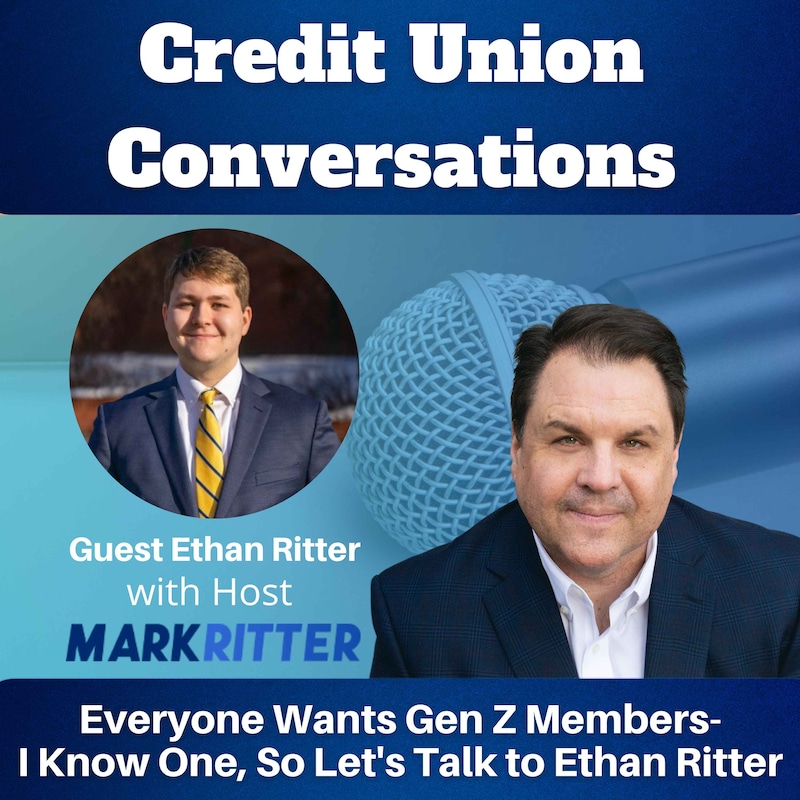
Shownotes
Gen Z banking preferences take center stage as Mark Ritter, host of Credit Union Conversations, interviews his son Ethan Ritter, a University of Pittsburgh finance student. This episode explores what credit union membership means to younger consumers and reveals surprising insights about mobile banking apps and digital engagement. Ethan shares candid perspectives on financial technology expectations, explaining why online account opening capabilities are non-negotiable for his generation. The conversation challenges conventional wisdom about how to attract Gen Z members to credit unions through social media advertising, revealing that technology quality trumps traditional marketing approaches for younger consumers.
What You Will Learn in This Episode:
✅ Why mobile banking apps are the most critical factor for Gen Z banking customers, who prioritize app functionality over in-person branch visits and website experiences
✅ How credit unions can leverage financial technology and digital banking experience to attract younger members instead of relying on traditional member engagement strategies
✅ The truth about personalized marketing effectiveness with Gen Z consumers and why social media advertising may not deliver the results financial institutions expect
✅ Real insights into student banking behaviors, including common financial mistakes like sports gambling and food delivery services that impact young consumers' saving potential
Subscribe to Credit Union Conversations for the latest credit union trends and insights on loan volume and business lending! Connect with MBFS to boost your credit union’s growth today.
TIMESTAMPS:
00:00 Introduction to Gen Z banking featuring Ethan Ritter
02:09 Ethan shares his educational background and his work in finance at both the university and a local credit union
05:19 Mobile banking apps versus in-person branch banking: Ethan explains why Gen Z banking customers see financial services as a transaction, not a relationship
08:30 Online account opening requirements and why requiring in-person visits causes younger consumers to choose different financial institutions
11:38 Gen Z consumers never discuss their banks or credit unions with peers, even among finance majors managing real investment portfolios
13:43 How Gen Z consumers waste money, discussion of cryptocurrency and home ownership
20:10 Technology-first strategy for credit unions to attract younger members: why financial technology quality matters more than rates or traditional member engagement
KEY TAKEAWAYS:
💰Gen Z banking customers rank app quality as their top priority—if they have to open a website or call someone, the financial institution has already failed to meet their expectations
💰Credit union membership isn't a topic of conversation even among financially savvy finance majors; younger consumers only consider switching institutions after major service failures
💰Personalized marketing through social media platforms like Instagram and TikTok doesn't resonate with Gen Z consumers for serious financial decisions, as they prefer researching options independently when needed
💰Credit unions must prioritize showcasing their financial technology and app capabilities over traditional messaging about rates and member care to attract younger members successfully
ABOUT THE GUESTS:
RESOURCES MENTIONED:
SEO KEYWORDS:
Credit Union Conversations, Mark Ritter, MBFS, Credit Unions, CUSO, Gen Z Banking, Credit Union Membership, Mobile Banking Apps, Financial Technology, Online Account Opening, How To Attract Gen Z Members To Credit Unions, Digital Banking Experience, Member Engagement, Personalized Marketing, Gen Z Consumers, Financial Institutions, Student Banking
Transcripts
[00:00:28] And also, uh, while you're at it, go ahead and subscribe to Credit Union Connections on your favorite audio platform. So today is a, uh, uh, an episode that's a little bit different as you'll find out in a minute. And it's a, it's to placate a pet peeve of mind and. Every credit union talks about getting younger.
[:[00:01:20] The second one is my son Ethan, who's a little more financial savvy and, uh, a little bit more tech oriented and is also now currently helping out a credit union. So in in, in the interest of, uh, having, bringing a Nepo baby on here as a podcast host. Welcome aboard Ethan Ritter, Ethan. How's your day going?
[:[00:01:45] Ethan Ritter: What's up dad? How's it going? Uh, it's my first Nepo podcast for, so thanks for bringing me on. Yeah, I just came from, uh, my 11 o'clock class and I'll be going to my three 30 after this, so.
[:[00:02:09] Ethan Ritter: Sure. So I'm a junior majoring in finance and business analytics at the University of Pittsburgh. Um, in addition to that, I'm involved on campus as a business manager for, and a senior analyst in the Panther Equity Student Investment Fund. Uh, specifically I am a senior analyst in the healthcare sector.
[:[00:02:51] Mark Ritter: Tell people how you chose Pitt.
[:[00:03:16] Not too big to the point. It's like, who are these people? And you know, I'm in a beautiful, the beautiful city of Pittsburgh, which allows me to, um, have access to all of these city amenities. I enjoy like a, a nice Asian grocery store.
[:[00:03:34] Tell people a little bit about that.
[:[00:04:00] Um. And it's real. I, it's really been a great opportunity so far. Um, being able to actually take my academic skills, apply them to real data, do some crunching in Excel and also on Python through various data analytics tools, and be able to present that back to the, um, company and kind of change business decisions, expand knowledge of things that are already happening, and, uh, kind of bridge the gap between data and understanding.
[:[00:04:53] So I wanted to hit some of those topics on what old people think is [00:05:00] important to Gen Z in fi for choosing and working with a financial institution. Sure. And you can feel free to talk about your experiences so far. You know, and the first one is about really boosting and improving their online and mobile banking offering.
[:[00:05:30] Ethan Ritter: So I, as a Gen Z banking customer. I can can order my desirability to interact with the firm. I have absolutely no desire to go in person to do my banking. I don't wanna use a website, I wanna use an app.
[:[00:06:06] Mark Ritter: What about people like me who want to walk into a branch and, uh, I hate using the app. I'm always on their websites doing the mobile banking. So I guess you're like the bizaro version of me.
[:[00:06:32] Um, you want to go in, you wanna talk to, you know, Judy who's been helping you with your account for 25 years. I don't wanna use an app. Okay.
[:[00:07:09] You know, he, here's your offering that we can help you out with.
[:[00:07:36] I mean, avoid putting spam in people's inboxes if you could actually put, uh, relevant financial services. I think that's extremely important in value adding for a firm in any marketing plan.
[:[00:07:56] Every credit union he went on [00:08:00] in his area, had the forms on site for people to print out and take into the local branch. What do you have? Have you, I, I don't know if you've ever even opened an account because you, most of your accounts are from when I was a kid. But if you were to, to switch accounts for whatever reason, open a new account.
[:[00:08:30] Ethan Ritter: I'd say as a last resort, I'd go in person it, it'd take a lot for me to get off the couch, get off the app, get off the website. If your website says, come in person, I'm going to the next website until I can find one that says I can make an account online.
[:[00:08:59] Mark Ritter: Alright, [00:09:00] and then the last one they had, uh, the, from one of the ones that I saw quite commonly was talking about giving you ads, offers in platforms used by young people.
[:[00:09:37] Ethan Ritter: Um, if I saw an offer for, for a financial service, even from a company I'm already engaged in on my Instagram reels algorithm.
[:[00:10:01] Whereas in Instagram, you might actually be able to capture a lot of the younger audience. Um. But yeah, I, it's hard to say. I mean, financial services are kind of an old, older, um, more professional, serious service. I mean, you're making a big decision, um, when you're pursuing a loan or, um, opening an account with the firm.
[:[00:10:27] Mark Ritter: Okay. So it really doesn't make a big difference to you.
[:[00:10:32] Mark Ritter: Yeah, probably if you need something, you're gonna go shop it out to the people online. So
[:[00:10:47] Mark Ritter: All right, so, and then I have some questions for you, which would be, once again, what old people ask young people about banking and financial services and things that I've been curious [00:11:00] about. So you are a finance major. You are in finance money. Organizations. So you kind of live in the middle of this, you know, you're not in, you're, you're not an art major, you're not a music major where, where, or people have no this, you are in the middle of people who are interested in money in Pittsburgh.
[:[00:11:38] Ethan Ritter: Out of the people I talk to regularly on Pitt's campus, I'd say 90% of them are finance and accounting majors.
[:[00:12:13] And my answer for them was never once in my entire life. And that's kind of a similar thing to why would you bring up, uh, money is kind of a, a bad topic of conversation anyway, but. What credit you use, what are their offerings, kind of, what do you like about their service? N has never come up.
[:[00:12:38] In terms of service for people to even think about it.
[:[00:12:52] Mark Ritter: like, like I've seen a few times where, uh, there was one famous one recently where, um, the, they [00:13:00] launched new mobile apps in banking and it completely was screwed up and people didn't have access to their account for like a week.
[:[00:13:25] Ethan Ritter: I do. Mm-hmm.
[:[00:13:41] I.
[:[00:14:09] So I'd say that was it. Is a great example of a poor use of finance and a poor use of financial tools. Um, I'd say specifically on campus, uh, poor use of money I see is sports gambling. It's pervasive everywhere all the time. People are doing it in class. I mean, uh, that's a huge waste of money. I see. Um, a lot of my friends participate in it and I think that's just a terrible waste of money.
[:[00:15:05] But generally it doesn't work out.
[:[00:15:22] Poorly age verifying or, you know, using another person's information for an account and being able to sports gamble in class. I mean, constant. I see it all the time. Uh, the other thing I'd say is DoorDash, food delivery services, just a terrible waste of money that, um. The average pit student has really gotten deep into, um, I have a friend who had DoorDash Premium last year, and it actually tells you how much money you've saved on fees and such using DoorDash premium.
[:[00:16:11] Mark Ritter: Do you, have you seen much crypto activity?
[:[00:16:28] Mark Ritter: Okay. Fair enough. And then we always, you know, we, everybody hears about the prices of homes, the prices of homes, the prices, and, and you're in Pittsburgh, which relative to other areas and cities, is a moderately priced marketplace.
[:[00:17:06] Ethan Ritter: later, um. Definitely later than newer generation.
[:[00:17:30] And a lot of the stories of success you see young people being able to buy homes. It's because of financial assistance from family. Uh, I think one of the, one of the famous articles I read was, you know, about a young woman and how she was able to afford a home in kind of a more expensive market through, you know, smart budgeting and saving.
[:[00:18:09] So they're being pushed towards more long-term rentals and kind of saving hard and saving a long time for a new.
[:[00:18:34] I mean, that, that's almost like another car payment. Uh, another car payment each month, which can bury you for years or. You get out and you know, you're, you, you, you might not have a big support structure and you get into credit card debt and car loans. Uh, yeah. If, if you're in your early to mid twenties with a lot of debt, it, you know, the, the concept of raising 20% for a home is almost unthinkable.
[:[00:19:19] Um, to say, to be able to actually afford that down payment. So, um, even the expectation of home ownership has gone away for a lot of the Gen Z population. I mean, I'm still too young to consider it, but from what I've seen and read and heard, um, that's kind of the reality of today. Awesome.
[:[00:19:44] It's not talked about, it's not a lot of discussion. If you become a consultant, what can credit unions do to kind of increase that Gen Z membership? Uh, whether it be for checking accounts, car [00:20:00] loans, you know, whatever student loan, whatever you need. What, what do you think they can do to, to make them relevant and get people to act and consider a credit union?
[:[00:20:28] So if I go on your website, it looks like crap. I think I might find somewhere else. So. If you're marketing to them and you direct them to your technology to make an account and it's bad, you failed. So I'd say the biggest thing for companies to be able to market to Gen Z consumers is highlight technology.
[:[00:21:08] I call on the phone. It's a fantastic app so I don't have to call anyone.
[:[00:21:36] Ethan Ritter: I just came from class in the, uh, PNC technology center and the back of my student ID has PNC on it. So that is the financial institution I see most. And I mean, if I was a, you know, clueless hapless consumer, I might be inclined to go off that. But even, even then, I'd still shop around. And that marketing really hasn't, you know, impacted me other than I [00:22:00] see it on the door when I walk in.
[:[00:22:11] Ethan Ritter: I, yeah, I'd agree with that.
[:[00:22:25] I appre, I, I, I, I wanted you on here for the feedback, but also so other. Credit unions can hear the feedback of somebody directly as opposed to a consultant who doesn't really talk to people. Alright, so you're a big LinkedIn person. Give your plug if people wanna reach out to you, uh, any of your socials, how can they connect with Ethan Ritter?
[:[00:23:04] Mark Ritter: All right, well, thank you. Uh, this is Mark Ritter. Uh, joining me today was my youngest Ethan Ritter.
[:[00:23:24] Ethan Ritter: Turn that camera around. It's not much better in that room.
[:[00:23:34] Uh, connect with me on LinkedIn and make it the combo. Uh, please subscribe on your favorite audio platform. We'd love to hear from you. If you have show ideas, uh, guest ideas, we'd love to hear from you. So this is Mark Ritter, and we hope to talk to you soon. Thank you. All right. Thanks for having me, Deb.
[: