Shownotes
What if the most important measure of your leadership isn't what you achieve while you're in the role, but what continues after you've moved on? It's a question most senior leaders avoid because the answer is often uncomfortable. You've built the strategy, delivered the results, transformed the culture. But if you left tomorrow, how much of it would actually last?
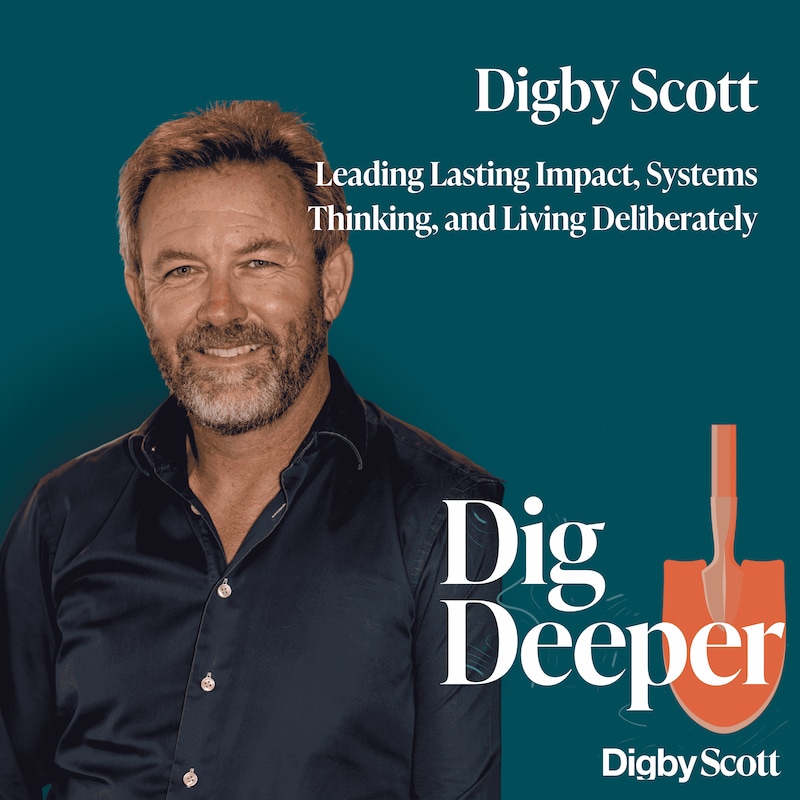
In this special Year in Review episode, Digby reflects on five interconnected themes that emerged from a year of deep conversations with remarkable leaders, change-makers, and systems thinkers. These aren't isolated insights, they're facets of the same question: how do we create change that endures? From understanding complex systems and shifting from hero to host leadership, to embracing unhurried productivity and living with deliberate authenticity, each theme builds toward a powerful framework for leading lasting impact.
This episode is Digby's invitation to step back and see the bigger picture. Drawing on insights from over 50 conversations, personal experiences of burnout and breakthrough, and years of working with leaders across sectors, he maps a journey from crisis-driven leadership through to creating change so embedded that people don't want to go back. You'll discover:
- How to assess where you sit on the spectrum from crisis-driven to lasting impact leadership (and why most leaders get stuck at stage two)
- Why systems thinking is essential for addressing root causes rather than just treating symptoms, and how the dragonfly metaphor reframes our understanding of generational impact
- How shifting from hero to host leadership transforms dependency into capability, and why your job isn't to be the answer but to create conditions where answers emerge
- Why unhurried productivity isn't about slowing down but about creating spaciousness within the work itself, and how this becomes the foundation for everything else
- How living deliberately means making daily choices that align with who you truly are, not who you think you should be
- Why these five themes aren't separate ideas but interconnected pieces that, when working together, create leaders whose impact outlasts their tenure
- How to measure leadership success differently, focusing on what continues after you're gone rather than what you achieve while you're there
Leading Lasting Impact self-assessment
Other References:
- James McCulloch Podcast Episode
- Dr. Richard Hodge Podcast Episode
- Adam Cooper Podcast Episode
- Jennifer Garvey Berger Podcast Episode
- DK Podcast Episode
- Kate Christiansen Podcast Episode
- KP (Kirsten Patterson) Podcast Episode
- Derek Sivers Podcast Episode
- Antonia Milkop Podcast Episode
- Simon Dowling Podcast Episode
- Rachel Paris Podcast Episode
- Jordan Harcourt Hughes Podcast Episode
- Cynefin Framework
- Leading Lasting Impact | Digby Scott
- Unhurried Productivity Diagnostic
Timestamps:
(00:00) - Introduction & Leading Lasting Impact
(10:25) - Systems Thinking and Complexity
(15:54) - Hero to Host Leadership
(22:39) - Unhurried Productivity
(25:53) - Authenticity & Living Deliberately
(32:28) - Leading Lasting Impact Synthesis
(41:27) - Closing
Check out my services and offerings https://www.digbyscott.com/
Subscribe to my newsletter https://www.digbyscott.com/subscribe
Follow me on LinkedIn https://www.linkedin.com/in/digbyscott/
Transcripts
most important thing about your leadership isn't what you achieve while you're there, but what continues after you're gone. Well, that's a question that's been increasingly coming up in my mind through the course of this year. And it's what this episode's all about. Welcome to this special year in review episode of Dig Deeper. I'm Digby Scott. And over the past 12 months, I've had a bunch of brilliant conversations with some remarkable people, leaders, change makers, deep thinkers.
People who've leaned into the challenges of leadership change in life while they've stayed true to themselves. And through those conversations, a few major themes just kept emerging. There was five patterns that I've identified that kept showing up again and again. There's like five pieces of like a puzzle that when you put them together, it creates something powerful, this ability to lead lasting impact. So today I'm going to have a go at pulling it all together.
rtantly, where we're going in:Which leads us to the third theme, which is what I call hero to host leadership. That's shifting from being the answer to creating the conditions for answers to emerge. And then we'll get into the fourth one, which is unhurried productivity. You might've heard me go on about this before a few times. It's all about creating spaciousness in a world that's obsessed with busyness.
And finally, the last theme is all around authenticity and living deliberately and crafting a life that's true to who you are so you can sustain your efforts over the long game. So at the end of the episode, I want you to have a clear framework for creating sustainable impact. And I reckon you'll know exactly where you sit on a continuum from crisis driven leadership to lasting impact leadership. And I'll get into what that means. And
Digby Scott (:I want you to have some practical steps. So I'm at the end of each section as I go through each of the themes, I'm going to just suggest some ideas for things you could do, know, actionable insights, if you like, that you can just take from after you've listened to this episode. So this isn't really just a reflection. It's a bit more of a roadmap. Let's dig in. So the first thing, leading lasting impact. This theme emerged from a pattern that I couldn't really ignore. So
You know, over years I've worked with all sorts of brilliant leaders who they'd create real change in their organisations and their teams and they grow capability and culture would shift and results would improve. And then they'd move on and they go to a new role or a new organisation or they kind of shift sideways in a restructure. often within months and sometimes within weeks, it was kind of like they'd never been there.
was talking to a client this morning actually, whose head of people and cultures just resigned and she's due to some personal stuff. She lived pretty quickly, really great operator, well regarded in the organisation. And yet within just a few weeks, you could see that the impact that she'd had and the work she'd done, it just started to get eroded. And this idea doesn't really sit that well with me and not because
the leaders that I've worked with weren't good enough, they're exceptional. But more because the way that we've been taught to lead is all set up for individual heroics rather than lasting impact.
I'm going to talk you through a four stage evolution. So think of it like a spectrum. Now these four distinct stages. The first one, stage one, is crisis driven leadership. Now this is when you're firefighting, everything's urgent, it's reactive, and it's exhausting. And you're running from one crisis to the next, never really getting ahead of the curve. Do know that feeling? I've been there and it's just, you're a rat in a wheel. It's just so tiring for you and for everyone around you. That's crisis driven leadership. And we really
Digby Scott (:don't want to be there, but I actually think we see this all too often too much. Stage two, better place to be. call it performance focused leadership. So this is where you've got your act together. You're delivering results, hitting targets, you're being recognised, but there's a catch, which is that it's all dependent on you. You're the bottleneck and you're the hero that everyone waits for. So when you're away, things start to slow down or stop and
you get this inertia starting to happen. And when you come back, you got to get the whole machine moving again. It's okay, but it's not really set up for success over the long term. Stage three is where stuff starts to happen differently. This is called systems building leadership. And you're starting to think differently. You're creating infrastructure, you're investing, you're building capability in others, you're developing systems that work when you're not in the room.
But it's also fragile and it needs you to maintain those systems, that infrastructure. You've still got to be around just to keep it healthy. Stage four, which is, reckon what we need a lot more of is what I call lasting impact leadership. And this is where the magic happens. You're creating change that's so embedded that people don't want to go back. The systems self renew, capabilities multiplying by itself.
And your measure of success isn't what you achieve while you're there, it's what continues after you're gone. So just a quick summary, stage one, crisis driven leadership, stage two, performance focused leadership, stage three, systems building leadership, and stage four, lasting impact leadership. And most leaders I reckon get stuck at around stage two. They're really good at delivery. They're smashing all the KPIs, but they're exhausting themselves and everyone around them. And when they leave,
it all unravels. And there's some research to back this up. You leadership transitions are constantly disruptive to organisational performance, especially when succession isn't planned. But organisations that have sustainable leadership practices where the focus is on building long-term capability and self-reinforcing systems, they weather those leadership transitions far, far better. So it's not really about avoiding leadership
Digby Scott (:change or transition, it's about whether your leadership is designed to last. Now, back to the podcast and what I've talked about with some guests this year, episode 42, James McCulloch, he's the CEO of Victim Support New Zealand. And he shared something that really stuck with me. He said, and I'm quoting, I don't like the word legacy. I prefer lasting impact because it's not about me.
It's about whether the organisation feels like a better place to turn up every day after you've been there. And does some of that stuff last? End quote. And I reckon that distinction between legacy and lasting impact is key. Legacy, I think, is about you. Whereas lasting impact is about what you enable in and for others. So here's some stuff that I'm going to invite you to think about to maybe put into action.
at the individual at your level, just assess yourself, ask yourself, where am I on that spectrum from crisis driven to lasting impact leadership? Am I stuck in crisis mode? Am I performing well, but creating dependency? Am I building system or am I creating lasting impact? Now I've created a little diagnostic tool that takes about three minutes to do, and it'll show you where you sit along that spectrum. And you can check that out. If you just search digbyscott.com and then
type in leading lasting impact it'll take you to a page where can do the free assessment the actual url is digbyscott.com for leading-lasting-impact so that's at the individual level at a team level you might want to change the conversation perhaps in your next team meeting just ask if we all left tomorrow what would continue and what would disappear and that really shines a light on you know what do you actually hear
to do? Are you here just to keep things moving or are you actually here to set up something that can move without you? And I reckon that conversation alone will shift how you and the team think about your work. At the organisational level, if this is where your focus is, measure what matters. And I reckon you could add one new metric to your leadership review. So you could ask what impact from your work will continue after you move on?
Digby Scott (:Now, wouldn't that change where you put your focus if you had some accountability to answer that question? So build that in, make it formal, make it count because what gets measured gets managed. The world doesn't need more brilliant individual leaders. We've got plenty of those. What we need are leaders who can create brilliance in others. And that's leading lasting impact. And it starts with understanding the other four themes. So let's keep going.
Digby Scott (:Okay, so the second thing is all around systems thinking and complexity. So if you want to create lasting impact, where do you start? You start by understanding that you're not solving isolated problems. You're working within a complex set of interconnected systems. And if you don't understand the systems, you'll just be treating symptoms rather than addressing the root causes. And that's what systems thinking is all about.
In episode 12, I had this brilliant conversation with Dr. Richard Hodge and he shared something that really reframed how I think about leadership and he used the metaphor of a dragonfly. The dragonfly spends most of its life up to five years as a nymph underwater, as quietly developing and it's building capacity. And then it emerges, lives for maybe about six weeks as a dragonfly and in that
brief window, it reproduces and ensures the next generation. And Richard said, what have we thought of our impact in generations rather than in quarters? And that question, that reframe, I reckon that's profound, don't you think? Because we're trained to think in quarters and in financial years and in electoral cycles and short-term wins, get quick results.
The lasting impact requires us to think in decades and generations and play our part just like the dragonfly does. In episode 14, I talked with Adam Cooper and Adam's a natural systems thinker, literally. He studies how ecological systems work and applies those to principles and organisations. And he introduced me to this idea, work with what is, not what you wish it were. Work with what is.
not what you wish it were. And most of us spend so much energy fighting reality, wishing our team was different, wishing our organisation had more resources, wishing the market wasn't so competitive, but systems thinkers, well, they don't spend too much time on wishing. They start with reality and they observe and they ask, what's actually happening here? What are the patterns I can see and what are the leverage points, those kind of surface piercing questions that ask,
Digby Scott (:What is going on?
Adam is great. talked about nervous systems, both in nature and in organisations. And when a system's dysregulated, when it's in this fight or flight mode, it's nervous systems really activated. It can't think clearly. It can't create. It's just surviving. And I think if I look around organisations I'm working with and maybe you're in one, there's definitely that heightened nervous system mode going on. There's more survival.
than creativity. And if we want to be thriving, we need to create the conditions for creativity to come forward. So I reckon one of the most important things you can do as a leader is to help regulate the system, to create safety, to create spaciousness, to create the conditions where people can actually think. And here's the thing about complex systems. They're not complicated.
They're complex and there's a difference. And this comes from the work of Dave Snowden, who developed the Cynefin model. can dive into that. We'll put something in the show notes about that. Complicated things are predictable. If you understand all the parts and how they fit together, you can predict the outcome. Like a car engine is complicated. You know, it might not be an expert on it. You might need to get someone to come and have a look at it. You need to fix it, but you can predict where the problem might be and you can predict the outcome. Whereas with
Complex things, they are unpredictable. The parts interact in ways that create emergent properties. Small changes can have massive effects. organisations, cultures, human systems, they're all complex. And Jennifer Garvey Berger, she taught me back in episode 22, she said, most of our leadership training assumes that the world is complicated when it's actually complex. So we...
Digby Scott (:try to control things that can't be controlled and we try to predict things that can't be predicted. And then we're frustrated when it doesn't work. So here's some things you can try around this whole idea of systems thinking and complexity. A quick win might be just to map your system. Just pick a challenge you're facing and draw it out. Not just the problem, but everything connected to it. Like who's involved? What are the feedback loops? Where might little changes create big effects?
And even I reckon 15 minutes of this kind of thinking will help you see patterns that you couldn't see before. You might also want to try something a little bit deeper and adopt the dragonfly question. So before your next big decision, ask, what does success look like in five years or 10 years or for the next generation? And this forces you out of that short term thinking and into systems thinking. At the team level,
I reckon practice working with what is. So in the next team planning session, start with the question, what's actually true about our current reality? Not what you wish was true, not what should be true, what is true. And from that place of a clear-eyed reality, you can start to identify genuine leverage points, genuine places where you can launch off from. Leaders who think systemically create more sustainable change.
in the research. They see patterns that others miss. They find leverage points that create lasting shifts rather than temporary fixes. If you want to go deeper on this idea, check out episode 12 of the Richard Hodge, episode 14 with Adam Cooper, and episode 22 with Jennifer Garvey Berger.
Digby Scott (:Okay, we're into theme three, which is hero to host leadership. So you understand systems and your thinking and generations. And here's the next piece. You need to shift from being the hero to being the host. And I reckon for me, this is maybe one of the most confronting themes because I've spent years as the hero. I get paid to come in and bring expertise and
While I'm a great facilitator, I'm also paid to bring in ideas, frameworks, ways of operating and all of that. And you know what, there's something very gratifying about that, isn't there? When people come to you and you're the one, we need to be needed. We like to be needed. And so it works for me until it doesn't. And I think it's the same for anyone who's in a leadership role. There's this hero trap.
Here's what happens when you lead from the hero place. You become the bottleneck. Every decision waits for you. Every problem needs your input. And you're working ridiculous hours just to keep all the plates spinning. And your team then becomes dependent. They stop thinking for themselves because they know you'll have the answer and their capability doesn't grow because they're not getting the reps, if you like. And when you leave, it can all fall apart because nothing was really embedded.
And it was all dependent on you. I was talking to a client the other day and he's a member of executive team. He runs a function for this organisation and he was doing a team offsite. He had this team offsite planned to do some kind of reflection of the years, some looking forward to next year, that kind of thing. And the morning of the offsite, one of his kids got sick just after he dropped him from school. He got a call from school saying, you your son's really sick.
You're going to need to come pick him up. So he's like, Oh, there's my day shot. And of course, you know, he did the right thing and he went back to the school and took his kid home and he called his team and said, look, I'm not going to be able to make for the offsite. The upshot of the offsite was they had a brilliant day. They were super productive. had really high quality conversations and they made some really good decisions and had some great reflections without him there. And.
Digby Scott (:I reckon that's all credit to him. It got him wondering, what is my role as a leader? What am I actually here to do? And it's a lovely story of actually, you don't have to be the hero here. You don't have to be the one with all the answers or telling people what's happening. You play your part, but maybe we overreg the need to be the hero. Also want to come back to James McCulloch's conversation with me. When he started at victim support, he had this moment of brutal honesty and staff would
give him long lists of things that needed fixing. did this tour around the country, know, and he'd go to get these lists from the staff. But instead of saying, I'll sort it out like a hero would, he said, look, I'm just the CEO. I can't actually do that much about it myself. All I can do is take your lists and go away and find some people to help me. And that's more host leadership. It's saying my job isn't to be the answer. My job's to create the conditions where the answers can emerge.
A host creates the space. They set the conditions. They ask the questions and then they get out of the way. DK in episode three, that's his real name by the way, DK. He's a former TEDx curator and he taught me about this idea of the deliberate design of spaces. He said most people focus on the content, what's being said, what needs to be said, but the host focuses on the context.
how the space is designed and what's possible within it. Think about a great dinner party, the host doesn't dominate the conversation, hopefully. They create the conditions where great conversations can happen. They introduce people, they ask provocative questions, they notice when the energy's dropping and they will shift things. They're more orchestrating than they are performing and that's what host leadership is. In episode 32 with Kate Christiansen, she talked about
the answer trap and she's got a great book called that the answer trap. And this belief as a leader that you should always have the answer. But when you always have the answer, your team stops developing their own capacity to think and they become order takers. And when you're not there, they're lost. Kate said something brilliant. The power of a leader is in the questions they ask, not in the answers they give. So what if instead of giving answers, you asked, well, what do you think we should do? What have you already tried and what would success look like here?
Digby Scott (:and suddenly you're building capability, not dependency. And by the way, episode 26 with KP, who's the CEO of the Institute of Directors in New Zealand, we talk about the same stuff, breaking out of answer mode. So Kate's episode 32 and KP in episode 26, really strong themes there around, learning to ask better questions. Here's what you could try. What about for a quick win, you did a question audit. So for a week,
track every time someone asks you a question at work and instead of answering immediately, respond with a question. What's your thinking of this? Or maybe if you were me, what would you do? And watch what happens. People will start coming to you with solutions, not just problems. And this in my work, bears out time and time again. Another thing you could try is design your next meeting where you're the host.
So before that next team meeting, ask yourself, what are the conditions that I want to create? What questions will unlock thinking and how can I ensure everyone contributes? Then run the meeting focusing on your role as host, not hero, and just notice the difference. At an organisational level, you might want to measure capability growth. Add a metric to your leadership dashboard. How much is your team's capability grow in this quarter? Because if you're doing all the thinking, their capability isn't growing.
And that's a problem. And all the research backs this up. Teams led by hosts outperform teams led by heroes because capability is distributed, knowledge is shared. And when the leader leaves or is away, the team just keeps performing. So if you want to get more on this, out episode three with DK on deliberate space design, episode 32 with Kate Christiansen and episode 26 with KP on asking better questions and episode 42 with James McCulloch.
backing yourself rather than proving yourself.
Digby Scott (:Theme four, unhurried productivity. This is something that affects every single one of us, this relentless pace. Here's some data that should make us all pause. 57 % of the New Zealand workforce, and if you're not in New Zealand, I reckon it'll be similar in your country, is at high risk of burnout. And Microsoft's research shows that 68 % of people don't have enough time
to a focus on important tasks. And Deloitte found that 41 % of employee time spent on work that doesn't actually contribute to value creation. Think about that. Nearly half of what we're doing doesn't actually create value. And yet we're exhausted. Something's not working. In episode 17, I had one of the most memorable conversations of the year with
Derek Sivers. Derek's a musician, entrepreneur, author, and one of the most intentional thinkers I've ever encountered. And he told me about a pivotal moment in his life. He was feeling completely overwhelmed running his business, CD Baby. And he called a friend to vent about all the things he had to do. And his friend said something that changed everything for him. You don't have to do any of that. Derek pushed back. said,
Yes, I do. I've got to pay my employees. I've got to ship the items people paid for. And his friend said, no, you really don't. You're choosing to do it, but you don't have to do it. You could right now just get up and walk away, change your phone number, go to Hawaii. Eventually the courts would work themselves out, but you don't have to do any of this. It's really important that you understand this distinction. And that hit Derek.
really profoundly. So years later, he still uses it as a circuit breaker question. Who am I doing this for? Am I choosing this or am I on autopilot? And I've adopted that question myself and it's uncomfortable, right? Because when you really sit with it, you realize how much of what feels urgent is actually optional. What does unhurried productivity actually mean? When people hear me bang on about
Digby Scott (:unhurried productivity, they'll often think I'm suggesting we all slow down to a crawl or take constant holidays, and that's not it at all. Unhurried is a state of mind more than a state of movement. A hurried mind full of clutter, constantly reactive, jumping from one urgent thing to the next, that's the mind that struggles to do anything worthwhile, even when it's moving fast, it's not actually productive. Whereas an
Unhurried mind has spaciousness. can focus. It can discern what actually matters. And ironically, it often gets more done because it's not wasting energy on what doesn't matter. I've actually written quite a bit about this on my website. There's an article called, how unhurriedly productive is your culture? Where I've walked through these four stages and levels that organisations move through. And you can check that out at digbyscott.com.
There's also a free diagnostic tool that you can use with your team, which I'll talk about a bit more in a second. What I've learned from my own practice on attempting to be more unhurriedly productive is comes from this big burnout I had at 30. I was a national manager for a recruitment company. was completely in over my head saying yes to everything driven by this belief that if I wasn't seen to be busy, I wasn't valuable. And that belief
led me to a massive crash, big hard crash, and it took me years to recover my mojo. But that experience taught me something I'm still learning today, years later, that busyness is not the same as impact. In episode 24, my friend Antonia Milkop actually interviewed me. We turned the tables on the podcast and she asked me about unhurried productivity. And I said something that surprised even me.
unhurried productivity is that state of mind more than a state of movement. It's about learning how to create just that little bit of space. It might be a minute every hour, valuing spaciousness and just learning to let go. And that's a practice that I'm definitely still honing. You know, I'm not necessarily taking a week off every quarter, although that's a good idea. It's more the discipline of creating those micro moments of space throughout the day. Maybe it's a walk before an important conversation or 30 seconds of silence before
Digby Scott (:responding before responding to some email. Maybe it's five minutes of journaling before jumping into the work. Just little practices repeated consistently that compound. Episode 18, Simon Dowling. He said something that stuck with me ever since, creating space matters more than efficiency.
more than efficiency in a world obsessed with doing more faster. Here's this highly effective operator saying the opposite. Simon talked about how leaders often say, yeah, I love the idea of space, but you can see my world. We don't have time to stop. And in that, there's this assumption that to create space, you need a two day retreat in the hills, but that's not really it. The real question is how do you create space within the busyness, within the work itself?
Simon shared an example from his own practice, he had this compressed day with people coming over to his house and contractors to do work. And before our conversation on the podcast, he had a choice. He said to the next thing on the list, or do instead, do I go for a 30 minute walk to arrive more present for our conversation? And he chose the walk. And not because it was efficient, but because he was focusing more on the emotional quality of the outcome.
rather than the efficiency of how many things you could get done in the day. And that's the shift. Not waiting for things to be quieter, but building spaciousness into the way you work right now. Here are some things you can try. So you might want to ask yourself that circuit breaker question. Next time you're feeling overwhelmed, ask Derek Sivers question, who am I doing this for? And write down everything on your list. And just besides each item, ask, am I choosing this?
Or am I on autopilot? And what would happen if I just didn't do this? I reckon you'd be surprised by how many things are actually optional. Another practice you could try is doing the unhurried diagnostic. I've created a free tool. It takes about five minutes at the end of each day for a week. You simply track how unhurried or hurried you felt throughout the day. And that increased awareness by itself can create a significant shift.
Digby Scott (:You can download that at digbyscott.com. can search unhurried productivity. I'll put a link in the show notes as well. At the team level, how about you audit your meeting culture? Track how much time the most senior person talks in your meetings. And if it's in, it was maybe more than 20 % of the time, I think you've got a problem. You also might track how many meetings could have been an email. How many meetings have a clear outcome defined before they start?
Or how much white space is in people's calendars for deep work? At the organisational level, experiment with creating focus time. So for example, Salesforce, they ran this two-week experiment encouraging regular breaks and the results were a 21 % increase in productivity scores, 230 % increase in the ability to manage stress, 90 % increase in focus.
and 63 % increase in overall satisfaction. Just through regular breaks, what if you piloted something similar, even just no meeting Fridays or protected focus time from say a nine to 11 every day, start small and measure and then iterate. We're not gonna solve busyness or our productivity problems by working harder or faster. We solve it by working differently.
by valuing outcomes over activity, by creating systems that build in slack rather than running at 110 % capacity all the time. Here's what's fascinating. The research is clear that organisations optimising for sustainable human performance outperform those that don't every time. This isn't about being soft, it's about being strategic.
2026, this is work I really am going to double down on because I've seen too many brilliant leaders burn out, too many good ideas die because there's no space to think them through properly. Too many teams running so fast, they can't even tell if they're heading in the right direction. If you want to go deeper on unhurried productivity, check out episode 17 with Derek Sivers for this full conversation on slowing down and intentional living. Check out episode 18 with Simon Dowling on creating space and episode
Digby Scott (:where Antonia Milkop interviews me about my own unheard productivity practices and plenty of resources at digbyscott.com. You can't create lasting impact if you're thinking constantly about the next thing to do. It's just exhausting. If you can't think systemically, you never have time to think. And if you can't host others effectively, if you're in that hero mode all the time.
Unhurried productivity to my mind is not a luxury, it's the foundation for everything else we've been talking about.
Digby Scott (:Okay, theme five, last theme, authenticity and living deliberately. So here's where we get to the heart of what this is really about. Living a life that's true to who you are, not who you think you should be. Because you can build all the systems, develop all the complexity of mind, learn to host brilliantly and create all that spaciousness in your world. But if you're doing it while living someone else's idea of success, well, you'll still feel empty.
Episode 44, Rachel Paris. She shared her journey from being a corporate law partner to a novelist and her story, I reckon, is a mirror that a lot of us need to look into. Rachel made partner the pinnacle of aspiration for many lawyers. It was that thing that she'd been working toward for years. And when she got there, she realised, well, this isn't it. This isn't the life I actually want. How often do hear that?
And she described feeling like a rat in a mill, just surviving from one deadline to the next. The partnership that was supposed to bring all that freedom instead brought exhaustion. Her professional training in law had created plenty of advantages for sure, but it also had created this trap. And here's what struck me. Rachel talked about redefining success in her own terms, not what society says success is, not what her profession says, what actually sustains her.
She said something I've been thinking about ever since that conversation. think she said, when you're in a corporate life, you're wearing a bit of a mask. And so by the time you get to your real life, your friends and family, you're often depleted. You're not taking enough time to rebuild your store of energy for the really important things in life. How's that for an insight? And that really hit me.
Because I reckon most of us can relate to that. We're performing all day at work and by the time we get to the people who actually matter, we've got nothing left. Then there's Jordan Harcourt Hughes from episode 38. And she had what she calls an early midlife crisis at 19. She was studying English at university on track to become a writer when she had this profound realizations, words aren't enough. Traditional language wasn't the complete.
Digby Scott (:picture for human connection. So what did she do? Well, she walked away. She walked away from the degree her parents were paying for from the path that everyone else expected. And her parents were devastated. They said, just go and finish it. It won't hurt you to stick around for another year. But Jordan said something I love. She said, I felt as a statement of living intentionally, I couldn't go through with it. I had to leave that place because I knew it wasn't enough.
living intentionally, not reactively, not following the script intentionally. So she moved to Scotland. She studied metalwork. She lived alone. She learned to be with herself on the journey. And she said, I want to live intentionally. I knew that I had to carve out my own path and I didn't know what that was going to look like. But I knew I wanted to be with the journey to make the most of it, to make the most of the hours and the time that we've got here on the planet.
That's authenticity. That's courage, And it's rare at any age, let alone 19. And I've mentioned earlier that my own version of this at 30 I burned out. You know, was climbing this ladder trying to prove myself, show that I was worthy enough, successful enough. And I crashed and it took me years to recover. But that breakdown became a bit of a breakthrough because
I realised I was living someone else's definition of success. was measuring myself against external markers like title and salary and status. Instead of asking, well, what actually lights me up? What kind of work do I want to be doing in 25 years time? And that's when I made the choice to step away from that recruitment game and to retrain, to build a practice around what mattered to me, helping leaders create change that lasts, building capability, working at the intersection of human,
and the organisational and was it scary? Hell yeah. Did people think I was a bit mad? Probably. Actually, definitely. I know people from my former life that thought, what the hell are you doing with your career, Digby? But all this time later, I'm still doing it because it's mine and it's authentic and it's deliberate. Living deliberately isn't really about having it all figured out. It's not making one big decision and then you're done. It's about
Digby Scott (:lots of small choices repeated over time that add up to a life that feels like yours. If we go back to Derek Sivers episode 17, he reminded me, you don't have to do any of this, you're choosing it. And that distinction between obligation and choice, that's what it's all about. And Rachel Paris talked about redefining success and asking what truly sustains me, not just what looks good or what pays well, what actually gives me energy. Jordan,
And she talked about being with the journey, not rushing to the destination, making the most of the hours we got here. I love that. And if you go to episode 24, when Antonia Milkop interviews me, I get into talking about the shift from being a people pleaser to someone who stands for something, from seeking external validation to backing myself. And they're all facets of the same thing. Essentially, it's about living deliberately, choosing authenticity over performance and trusting that who you are is enough.
Here's some things you can try around this idea. So perhaps just do an audit, maybe this weekend or if you listen to this in the summer break, just track how you spend your time and then ask yourself how much of this is what I want to be doing versus what I think I should be doing. And then ask what one thing could I let go of and what one thing could I add? If you want to go deeper on this, perhaps even just
Ask yourself about what success means. Maybe grab 30 minutes and write down your answers to these questions. What does success actually mean to me? Not my parents, not my industry, not society, me. What sustains me? What gives me energy rather than depletes it? If I knew I couldn't fail, what could I be doing or what would I be doing differently? If I knew I couldn't fail, what would I be doing differently?
What am I tolerating that I don't actually have to tolerate? So they're tolerating is really powerful. think we are conditioned that actually, yeah, you got to tolerate stuff. I don't know. I think perhaps we don't. Maybe we just need to challenge that idea a bit and go, well, maybe I don't need to tolerate that. Maybe I could cut that out. So with those questions, be honest. It's not for anyone else. It's just for you. Another practice you could try.
Digby Scott (:and other activities, make some deliberate choices. Identify an area of your life where you're on perhaps autopilot more than you could be. Perhaps an area where you're just going through the motions and make one deliberate choice to shift it. Maybe it's saying no to something that everyone else expects you to say yes to, or perhaps hopes you to say yes to. Maybe it's finally starting that thing you've been putting off. Maybe it's having that conversation you've been avoiding. Just make one choice, make it deliberately and see what shifts.
Because you can be successful by every external measure and still feel like you're living someone else's life. I've lived that. The antidote isn't more achievement, it's more authenticity, more deliberateness, more alignment between who you are and how you're living. And in the year coming up, I'm inviting people, including you, to get serious about this, not just in your leadership, but in your whole life. Because you can't really lead with authenticity if you're not living it.
If you want to go deeper, check out episode 17 with Derek. He's one of my heroes, one of my inspirations. I shouldn't say hero, should I? One of my inspirations where he's so deliberate, so about living intentionally. Check out episode 24. I'm sharing my own journey and also episode 44 with Rachel Paris on redefining success and freeing up your future. Cause at the end of your life, you won't regret the risks.
that you took to live authentically. I reckon you'll regret the times you played it too safe and lived someone else's version of your life. So what's one choice you can make right now today to live more deliberately?
Digby Scott (:All right, so here we are. We've gone through these five things. Systems thinking, hero to host, unhurried productivity and living deliberately, all wrapped up in the big theme of leading lasting impact. And these all came from great conversations I had on the podcast, but also great conversations I've had with clients through the year and the work I've been doing with them. And I'm realizing that they're not separate ideas. They're all different facets of the same diamond. They all point to one.
thing, which is creating impact that endures beyond your tenure. Let me show you how these themes connect. So when I look back at leaders I've worked with over plenty of years, this is pattern, right? The brilliant leaders are the ones whose work disappeared when they left. They were missing one or more of the different pieces of the puzzle. They didn't understand the systems that they were working in. So they treated symptoms instead of root causes or
They stayed in hero mode, so everything depended on them, and when they left, it all fell apart. Or they were constantly hurried, so they never had that space to think strategically about sustainability or regenerative work. Or they were living through someone else's version of success, so they burned out before they could see their work through. But those leaders, where their impact lasted, they had all of these pieces working together.
Now here's how this works in practice. First, you need systems thinking. You've got to understand that you're not just solving isolated problems. You're working with complex interconnected systems. Richard Hodge’s dragonfly model teaches us to think in generations, not quarters. And Adam Cooper shows us how to work with what is rather than fighting reality. Without this, you're just rearranging deck chairs. You might get some quick wins, but nothing fundamental changes.
Second, you need to shift from hero to host. And James McCulloch said it really well. I'm just the CEO. I can't actually do much about that myself. All I can do is take your lists and go away and find some people to help me. And that's not weakness, that's wisdom. Because your job isn't to be the answer, it's to create the conditions where answers can emerge. Where capability builds, where the system becomes self-renewing. Third, you need unhurried productivity.
Digby Scott (:Derek Sivers reminds us that we don't have to do any of this, we're choosing to. And Simon Dowling shows us that creating space matters more than efficiency. Without this, we're just perpetuating the same exhausting, unsustainable patterns that burn people out and make lasting change impossible. Fourth, you need to live deliberately. Rachel Paris, so inspiring, walking away from a partnership because it wasn't actually her version of success. And Jordan Harcourt Hughes,
leaving university at 19 because she knew that that path wasn't enough. And without this authenticity, without this deliberateness, you might build something impressive, but it won't be yours and it won't last because it wasn't rooted in what actually matters to you. Put them all together and something powerful emerges. You're thinking systemically so you know where the leverage points are. You're hosting rather than heroing, so you're building capability, not dependency.
You're creating spaciousness, so you have time to think strategically about sustainability. And when you're living authentically, you have that conviction and energy to see it through. And that all results in leading lasting impact. And it's really rare. So remember that model from the beginning. I'll just bring it back to you. So stage one, crisis-driven leadership. This is where you're firefighting and everything's urgent and you're the hero that everyone depends on. Stage two is performance-focused leadership.
You're delivering results, hitting targets and proving your worth, but it's all dependent on you. Systems building leadership is stage three. This is where you're creating infrastructure and building capability and thinking beyond the immediate and you're starting to embed real change. And stage four is lasting impact leadership. This is where you're creating change so embedded that people don't want to go back. And you're measured by what continues without you.
And most leaders get stuck at stage two. They're brilliant at delivery. They're smashing the KPIs, but they're exhausting themselves and everyone around them. And when they're not around, it starts to unravel. To get to stage four, you need all of these themes working together. And I spent years at stage two myself, like proving myself and trying to be the expert and having all the answers and building my reputation, you know, on being the one who's the go-to person.
Digby Scott (:And it worked until it didn't because I burned out and I realised that nothing I was creating was really lasting. And the conversations I've had this year have really contributed to my own journey towards stage four. So I'm taking these lessons, I'm finding ways to embed them into my own practice, getting clear about what I'm actually here to do. And this isn't about being brilliant. Leading Lasting Impact is not about being
It's about being intentional. It's about making choices. It's daily hourly that build towards something that endures. I think this matters because we're living in this age of constant disruption, of heaps of leadership churn or short-term thinking driven by quarterly results and short election cycles. But it doesn't have to be this way. What if we measured leadership success differently?
Not by what you achieve while you're there, but by what continues after you're gone. Not by your personal heroics, by the capability instead of what you build in others. Not by how busy you were, but by how strategically you created spaciousness for what matters. And not by how impressive your CV looks, but by how authentically you lived your values. That's the shift. And that's what the coming year and years
is all about for me. Here's some things I'd love you to do. Just a bit of a recap here, just to do a couple of things as a result of this, and I'll give you three. So do that diagnostic, that three minute assessment, digbyscott.com leading-lasting-impact. Check that out and get clear on where you are and what your next step is. At the team level, have the conversation about if we all left tomorrow, what will continue and what will disappear? And I reckon that will shift how your team.
thinks about how it works. At the organisational level, change what you measure and just build in that question, what impact from your work or our work will continue after I or we move on? Make it a formal part of how you evaluate and develop leaders. Because we don't necessarily need more brilliant individual leaders. What we need is leaders who can create brilliance in others, who can build systems that work and who can embed change so deeply that people
Digby Scott (:want to go back. That's the leading last EMPAT.
Digby Scott (:So there you go. We're at the end of 2025. I've just gone through five big themes with one big idea, uniting them around this leading, lasting impact. And just to finish off, I want to reflect a little bit about my own journey as a podcast host. I've hosted a bunch of conversations since I started this podcast, around 50 episodes out there now. And hosting, and I'm using that word deliberately,
has really taught me a lot about a different style of leadership. At the beginning, I reckon when I was kicking off this podcast, I did a lot of work on designing the questions I wanted to ask. And I still do that, to be honest. And then having quite a strong structure around, okay, what's the next question? What's the next question? Kind of anticipating. But that was pretty hard work. And I've noticed as I've
done more of this hosting, I've let go of the need to have all the questions, let alone all the answers. And just start trusting the process. Just kind of ease my way and settle my way into a conversation and trust that if I create the space to ask some good questions, something's going to emerge that neither me or the guest or maybe you as the listener had thought of before. And I reckon that's the essence of hosting.
And I think the broader idea of how hosting applies to leadership works exactly in the same way. It's about creating that space. It's about communication beyond words. You know, it's about being able create the space for something just to emerge that feels good, not just sounds good. And that slowing down is going to be moving fast every time when it comes to the quality of the experience you want to create. And all of the guests in their own way have really
demonstrated what it means to lead with that authenticity, with that slowing down, thinking systemically. It's been such a pleasure. And I want to just thank all of those guests. Every single one who has trusted me to go deep with them, digging deeper, who brought their vulnerability, their wisdom, their stories to the conversations. So if you're listening and you've been a guest, you've shaped not just this podcast, but my practice.
Digby Scott (:and my thinking and my life. So thank you. Also want to thank my team, Gabby White, who is my practice manager, who essentially is in charge of wrangling me to do what I need to do and be where I need to be. She's outstanding at that. Thank you, Gabby. And Kane Power, who produces the polished audio experience that you get in your ears every week without question, just a master at what he does. Thank you, Kane. Also to you,
As a listener, subscriber, sharer, someone who's engaged with this stuff, you're the reason I do this. Your messages, your questions, your feedback about your own journeys. That's what fuels my own journey. I'm Digby Scott. This is Dig Deeper. Until next time, go well and lead in a way that lasts.



