Shownotes
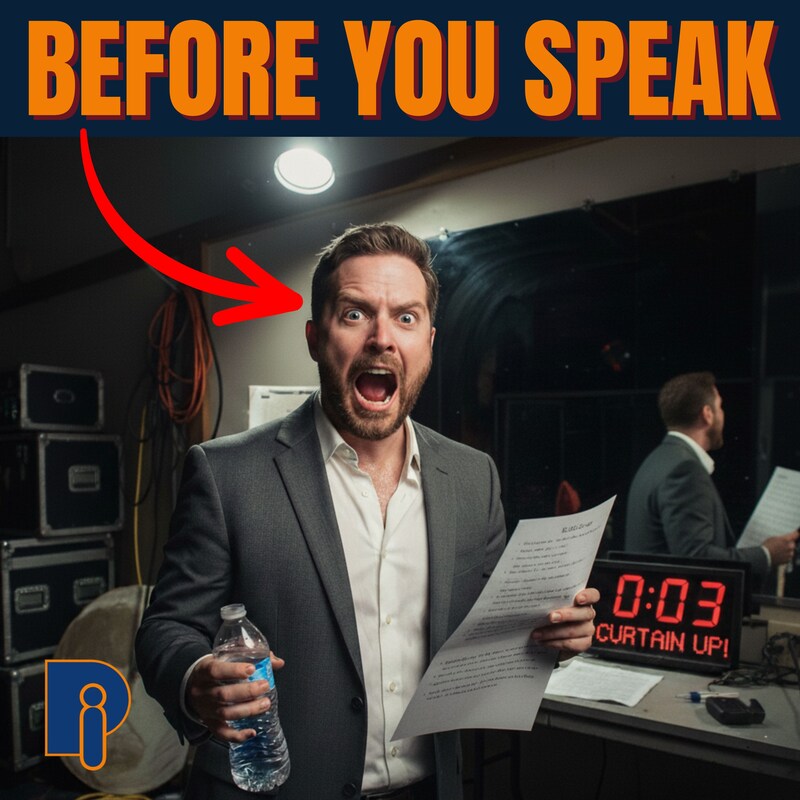
Most speakers sabotage themselves before they even get on stage.
Some wing it. Others over-hype themselves. Many cling to lucky charms or last-minute cramming. The result? Nerves, shaky delivery, and lost connection with the audience.
In this solo episode, John shares a practical pre-game system you can actually use to get stage-ready without superstition or overthinking.
You’ll learn how to:
- Reset your mindset in two minutes with Stoic reframing, box breathing, and a simple nerves-to-excitement shift.
- Prepare your body and voice with easy warm-ups (that won’t make you look ridiculous backstage).
- Prime your message by locking in your opening, closing, and key beats — without cramming.
- Avoid common pre-game mistakes that drain your energy or ramp up nerves.
Whether you’re about to step on stage, record a podcast, or present to your team, these tools will help you show up calm, confident, and connected.
👉 Next time: John speaks with Joel Benge about Message Mastery and why tech leaders need to “talk good” (his words, not mine).
👉 Coming soon: A solo deep dive on the ethics of influence and the tricky line between genuine credibility and manufactured status.
🎥 For behind-the-scenes extras and visuals, subscribe to the YouTube channel: Present Influence
Visit presentinfluence.com/quiz to take the Speaker Radiance Quiz and discover your Charisma Quotient.
CHAPTERS:
00:00 Introduction: The Importance of Pre-Game Preparation
01:03 Personal Story: Overcoming Stage Fright
02:37 Mental Preparation Techniques
03:30 Breathing Exercises for Calmness
06:34 Vocal Warm-Ups and Physical Preparation
09:41 Effective Rehearsal Strategies
16:45 Common Pre-Game Mistakes to Avoid
21:05 Final Tips and Conclusion
For speaking enquiries or to connect with me, you can email [email protected] or find me on LinkedIn
You can find all our clips, episodes and more on the Present Influence YouTube channel: https://www.youtube.com/@PresentInfluence
Thanks for listening, and please give the show a 5* review if you enjoyed it.
Mentioned in this episode:
Last Call For Founding KBPB Mebers
There's one last spot in the founding membership of The Known, Booked & Paid Blueprint. This is the only time you can get the program at 50% off. After that, it goes to the full program price, which is still great value, but it's not half-price value. Find out if it's the right fit for you at presentinfluence.com/kbpb
Transcripts
Here's the problem.
2
00:00:00,890 --> 00:00:04,489
What you do in the 10 to 30
minutes before you speak can
3
00:00:04,489 --> 00:00:05,869
make or break the whole thing.
4
00:00:06,049 --> 00:00:11,450
Yet most speakers either wing it or over
hack themselves or fall into superstition.
5
00:00:12,439 --> 00:00:16,700
Here's my promise to you today, I'll
give you a practical pregame system
6
00:00:16,760 --> 00:00:21,590
You can actually use no rabbit's, feet,
no power poses unless you want to.
7
00:00:21,980 --> 00:00:26,960
Just approval ways to get your mind,
body, and message ready to show up.
8
00:00:27,109 --> 00:00:29,270
Calm, confident, and connected.
9
00:00:30,600 --> 00:00:33,045
Welcome to present Influence the
show for professional speakers
10
00:00:33,045 --> 00:00:36,555
who want their communication to
impact, influence, and inspire.
11
00:00:37,005 --> 00:00:39,915
I'm John Ball, keynote coach and
professional speaker and your
12
00:00:39,915 --> 00:00:43,845
guide on this journey to a mastery
level communication skills.
13
00:00:45,176 --> 00:00:49,676
too many speakers treat the pre-game
as optional and then wonder why they
14
00:00:49,676 --> 00:00:51,866
feel shaky once they're on stage.
15
00:00:52,226 --> 00:00:55,876
And I've done it myself and I've
always regretted it when I have,
16
00:00:56,446 --> 00:00:58,816
think of it like a pilots checklist.
17
00:00:58,816 --> 00:01:01,726
If you skip this, then you're
gonna risk a bit of turbulence.
18
00:01:01,996 --> 00:01:03,166
A bit of a bumpy ride.
19
00:01:04,066 --> 00:01:08,776
So I'm gonna share a quick story of
when my own pre-game went wrong and how
20
00:01:08,776 --> 00:01:11,206
one tiny adjustment changed everything.
21
00:01:11,656 --> 00:01:17,866
Now, my first time doing open mic comedy,
I've wanted to do it for years, but
22
00:01:17,866 --> 00:01:20,116
never really, never really had the nerve.
23
00:01:20,116 --> 00:01:21,795
I was terrified of it.
24
00:01:22,186 --> 00:01:22,545
I was.
25
00:01:23,086 --> 00:01:25,876
Really too scared of that
vulnerability of putting yourself
26
00:01:25,876 --> 00:01:30,616
on a stage in the hopes of being
funny and then bombing out big time.
27
00:01:31,336 --> 00:01:35,746
The shame and the self-criticism that
would follow something like that might
28
00:01:35,746 --> 00:01:37,906
just shred my confidence completely.
29
00:01:38,596 --> 00:01:40,636
If there's any one way I
could get myself to do it.
30
00:01:41,556 --> 00:01:44,426
I gave myself permission to bomb badly.
31
00:01:44,876 --> 00:01:48,896
The biggest win would no longer be
getting the laughs, but just getting
32
00:01:48,896 --> 00:01:54,536
up on that stage on the open mic and
sure laughs would be really nice.
33
00:01:54,896 --> 00:01:59,156
And so many people had come to support
me that I didn't want to let them down.
34
00:01:59,156 --> 00:02:02,606
But I also knew I didn't
have to be funny for that.
35
00:02:02,846 --> 00:02:04,976
They were there to support
me no matter what happened.
36
00:02:05,026 --> 00:02:09,556
When I lowered the stakes for myself,
the nerves mostly disappeared.
37
00:02:10,096 --> 00:02:12,886
Did I still stumble a bit on stage?
38
00:02:12,886 --> 00:02:14,086
Trying to remember myself?
39
00:02:14,116 --> 00:02:14,806
Yeah, I did.
40
00:02:15,226 --> 00:02:16,426
Did it matter?
41
00:02:16,426 --> 00:02:20,746
Well, not so much did I get some
laughs I did and it was amazing.
42
00:02:21,136 --> 00:02:25,126
But I don't think I could have
done that if I'd needed to get
43
00:02:25,126 --> 00:02:26,806
those laughs to feel successful.
44
00:02:27,491 --> 00:02:31,091
It may also have helped that the
two acts on before me both bombed,
45
00:02:31,091 --> 00:02:33,101
so the bar was set pretty low.
46
00:02:33,426 --> 00:02:35,196
That certainly worked in my favor.
47
00:02:37,381 --> 00:02:41,161
Your brain can turn into a
saboteur right before you speak.
48
00:02:41,211 --> 00:02:42,351
It can start your thoughts.
49
00:02:42,351 --> 00:02:44,631
Racing, escape, fantasy.
50
00:02:44,631 --> 00:02:46,041
Shall I make a run for it?
51
00:02:46,041 --> 00:02:47,751
The field imposter syndrome.
52
00:02:48,051 --> 00:02:48,921
Am I good enough?
53
00:02:48,921 --> 00:02:49,851
Can I do this?
54
00:02:51,341 --> 00:02:53,981
You can restate your state
in under two minutes.
55
00:02:54,191 --> 00:02:59,861
I'll show you how stoic reframing a visual
exercise, a simple breathing pattern
56
00:03:00,311 --> 00:03:05,651
and a nerve to energy reframe can shift
your head space from panic to presence.
57
00:03:05,651 --> 00:03:11,081
So think of this as espresso for
your confidence without the shakes.
58
00:03:12,311 --> 00:03:14,951
This is the mental setup that
I go through before a keynote
59
00:03:14,951 --> 00:03:17,381
or a workshop to start this.
60
00:03:17,441 --> 00:03:18,881
Lower your ego.
61
00:03:19,001 --> 00:03:20,111
Ego is your enemy.
62
00:03:20,951 --> 00:03:23,171
Remind yourself, this is not about me.
63
00:03:23,291 --> 00:03:24,761
I am not what's important here.
64
00:03:24,791 --> 00:03:25,991
It's about the message.
65
00:03:25,991 --> 00:03:27,071
It's about the audience.
66
00:03:27,101 --> 00:03:28,901
Be here for your audience.
67
00:03:30,851 --> 00:03:34,271
Then you can try something called box
breathing, and you may have come across
68
00:03:34,271 --> 00:03:35,831
this before, and it's really simple.
69
00:03:35,831 --> 00:03:39,011
It's breathing in through your
nose for four seconds, holding the
70
00:03:39,011 --> 00:03:42,461
breath for six seconds, and then
breathing out for eight seconds.
71
00:03:42,511 --> 00:03:44,461
Now, it doesn't have to be exact seconds.
72
00:03:44,461 --> 00:03:48,180
You can count those numbers in your
head at whatever speed you wanna go,
73
00:03:48,481 --> 00:03:51,930
but it is that thing of having the
breathe in for four, hold for six,
74
00:03:51,930 --> 00:03:53,911
breathe out for eight, will help you.
75
00:03:53,911 --> 00:03:55,981
Now, there are many
different variations on this.
76
00:03:55,981 --> 00:03:59,281
If you practice something similar, a
little differently, count on doing that.
77
00:03:59,311 --> 00:04:02,401
You do not have to implement
exactly this, but this is the
78
00:04:02,401 --> 00:04:04,621
simplest method for box breathing.
79
00:04:04,921 --> 00:04:08,161
There's alternate nostril breathing if
you want to try all that kind of stuff.
80
00:04:08,161 --> 00:04:10,021
So like yoga kind of breathing.
81
00:04:10,431 --> 00:04:13,911
If you have knowledge and insight
that by all means, use those instead.
82
00:04:14,721 --> 00:04:16,671
The other trick to use
here is peripheral vision.
83
00:04:17,091 --> 00:04:18,111
A peripheral focus.
84
00:04:18,560 --> 00:04:22,041
And this is something that really just
shifts your way from being focused in
85
00:04:22,041 --> 00:04:23,631
singularly on one particular thing.
86
00:04:23,631 --> 00:04:30,471
Like right now, I am looking very directly
at my camera at you, and I'm also.
87
00:04:30,876 --> 00:04:33,636
In peripheral vision, which
means I can kind of see what's
88
00:04:33,636 --> 00:04:35,046
going on at the side of me.
89
00:04:35,436 --> 00:04:39,186
And one of the ways you can check in on
that is, is holding your hand by your
90
00:04:39,186 --> 00:04:43,956
head and wiggling your fingers or trying
to see what's on the wall or what's in
91
00:04:43,956 --> 00:04:46,236
the surroundings to the side of you.
92
00:04:46,236 --> 00:04:48,876
And it starts to shift you out
of what we call direct focus or,
93
00:04:48,936 --> 00:04:51,486
foveal vision into peripheral focus.
94
00:04:51,726 --> 00:04:52,236
And this.
95
00:04:52,286 --> 00:04:53,666
Does help to relax.
96
00:04:53,666 --> 00:04:57,566
You see if you can stay in peripheral
vision, it's a good thing to
97
00:04:57,566 --> 00:05:00,506
practice for the whole of your talk.
98
00:05:00,836 --> 00:05:04,496
It will mean that you'll take in much
more of how your audience is responding
99
00:05:04,496 --> 00:05:10,416
and reacting, and you're less likely
to feel nervous you're just less likely
100
00:05:10,416 --> 00:05:15,126
to be experiencing any intense emotions
whilst you are in peripheral vision.
101
00:05:15,276 --> 00:05:15,936
So give it a try.
102
00:05:23,166 --> 00:05:26,766
Now, the final part of this is to
remind yourself that your nervous
103
00:05:26,766 --> 00:05:31,116
feeling is physiologically exactly
the same as feeling excitement.
104
00:05:31,116 --> 00:05:34,656
Listen to the recent episode with
Rebecca Williams where she talks exactly
105
00:05:34,656 --> 00:05:36,606
about this and why that is the case.
106
00:05:36,876 --> 00:05:39,636
So instead choose to be excited.
107
00:05:39,756 --> 00:05:43,406
Recognize that feeling and say,
right, maybe I can just decide
108
00:05:43,736 --> 00:05:47,816
that that is excitement rather than
fear because it feels the same.
109
00:05:47,816 --> 00:05:49,586
How do I know that it's not?
110
00:05:49,846 --> 00:05:51,136
It could be excitement.
111
00:05:51,216 --> 00:05:56,256
So which is the more attractive
emotion to feel nervous or excited?
112
00:05:56,316 --> 00:05:57,546
I'd go with excited.
113
00:05:57,846 --> 00:06:00,906
That choice when I made it for
myself, is the thing that led me
114
00:06:00,906 --> 00:06:05,106
to falling in love with speaking
and presenting and getting excited.
115
00:06:05,106 --> 00:06:08,116
Generally now feeling excited when I get.
116
00:06:08,486 --> 00:06:09,086
On a stage.
117
00:06:09,086 --> 00:06:13,196
So try a two minute reset
before your next talk.
118
00:06:13,586 --> 00:06:16,376
Go through that Stoic practice
of reminding yourself that it's
119
00:06:16,376 --> 00:06:19,376
not about your ego, it's about
your message and your audience.
120
00:06:20,036 --> 00:06:21,896
Put yourself into peripheral vision.
121
00:06:22,736 --> 00:06:26,983
Spend a minute or so doing box
breathing, maybe just three or five
122
00:06:26,983 --> 00:06:32,023
cycles of breathing with box breathing,
and then reframe your nerves as
123
00:06:32,023 --> 00:06:34,028
excitement and see how that feels.
124
00:06:34,445 --> 00:06:38,675
A common issue with speakers about to go
on stage is that dry throat, the stiff
125
00:06:38,675 --> 00:06:42,180
shoulders, and the unwarmed voice that
can make you sound flat or strained.
126
00:06:43,205 --> 00:06:47,555
Simple physical resets will make your
voice stronger and your presence grounded.
127
00:06:47,555 --> 00:06:52,235
And I encourage you to check out the
episode that I did not that long ago with
128
00:06:52,235 --> 00:06:54,455
Jimmy Cannon Voice Coach, amazing guy.
129
00:06:54,875 --> 00:06:58,205
Gives us some great vocal exercises,
some great ways to think about
130
00:06:58,205 --> 00:07:01,145
your voice and how you sound and
that you can definitely implement.
131
00:07:01,145 --> 00:07:02,375
But let's give you something simple here.
132
00:07:02,375 --> 00:07:05,345
So I'm gonna share with you the
quickest warmups that I know.
133
00:07:05,645 --> 00:07:07,835
They don't make you look
ridiculous backstage.
134
00:07:07,835 --> 00:07:10,445
Well, maybe one of 'em a little
bit, but they'll keep your voice
135
00:07:10,445 --> 00:07:12,545
from crackling on the opening line.
136
00:07:12,545 --> 00:07:16,110
So I say check out the episode with
Jimmy Cannon, but one of the simplest
137
00:07:16,110 --> 00:07:19,260
vocal exercises you could do is kind
of just humming and humming up and
138
00:07:19,260 --> 00:07:23,010
down the vocal range and trying to
make that hum as smooth as possible.
139
00:07:23,010 --> 00:07:27,970
Now, if you are not too shy, if you
don't mind people thinking might be a
140
00:07:28,135 --> 00:07:30,595
bit silly, try and add into the hum,
141
00:07:30,625 --> 00:07:33,475
a bit of a blowing raspberry with your
lips or your lips together and your.
142
00:07:33,710 --> 00:07:35,120
Blowing them in the raspy sound.
143
00:07:35,120 --> 00:07:36,695
It won't sound funny or sound a bit like.
144
00:07:39,010 --> 00:07:40,510
It's not a nice noise.
145
00:07:40,820 --> 00:07:44,270
But going up and down your vocal
range with that and smoothing that
146
00:07:44,270 --> 00:07:47,540
out as much as possible is going
to help you warm up your voice.
147
00:07:47,540 --> 00:07:50,810
Now of course, you probably do want to
make sure you have some water available.
148
00:07:51,170 --> 00:07:54,370
Ideally, room temperature
rather than cold, which might
149
00:07:54,370 --> 00:07:55,845
just affect your voice more.
150
00:07:56,305 --> 00:07:57,770
So that's a good thing to have as well.
151
00:07:57,800 --> 00:07:58,500
I also kind of like.
152
00:07:58,790 --> 00:07:59,659
Licorice tea.
153
00:07:59,659 --> 00:08:03,333
I find that, licorice tea or those
licorice tabs you can get, to be
154
00:08:03,333 --> 00:08:06,183
careful with tabs 'cause they can make
some of them make your tongue black.
155
00:08:06,463 --> 00:08:10,393
But licorice in itself can be a great
thing for helping to soothe your voice and
156
00:08:10,393 --> 00:08:12,703
give you a little bit of vocal resonance.
157
00:08:12,703 --> 00:08:14,983
So I do highly recommend that.
158
00:08:15,033 --> 00:08:16,653
One vocal warmup is probably enough.
159
00:08:17,013 --> 00:08:18,783
Licorice, if you want
to add that in there.
160
00:08:19,623 --> 00:08:20,313
Power poses.
161
00:08:20,313 --> 00:08:21,453
I don't care about those.
162
00:08:21,753 --> 00:08:26,133
I mean, they're, if they help you or
they make you feel good, then great.
163
00:08:26,163 --> 00:08:27,033
I've tried them.
164
00:08:27,063 --> 00:08:28,413
It honestly does nothing.
165
00:08:28,413 --> 00:08:33,363
For me, the evidence of power poses
working is not conclusive, unfortunately.
166
00:08:33,633 --> 00:08:37,533
But I would say this, if it helps
you to stand like Superman or Wonder
167
00:08:37,533 --> 00:08:41,403
Woman in a big power pose and you feel
good for that, go ahead and do it.
168
00:08:41,643 --> 00:08:43,982
But the posture that I
do think you should do.
169
00:08:44,943 --> 00:08:46,593
Something we'll call presenter stance.
170
00:08:46,593 --> 00:08:49,153
So you want your feet for
this, shoulder width apart.
171
00:08:49,333 --> 00:08:52,993
And shoulder width is generally,
usually not as far as you think it is.
172
00:08:52,993 --> 00:08:56,803
So it should be in line, feet in line
with your shoulders as best you can.
173
00:08:57,163 --> 00:08:58,363
And facing forward.
174
00:08:58,843 --> 00:09:01,153
You want your knees, your
legs straight, but not locked.
175
00:09:01,153 --> 00:09:02,623
You don't want your knees locked up here.
176
00:09:02,623 --> 00:09:06,673
So you wanna keep a fairly loose posture
always by your side and head up straight.
177
00:09:07,033 --> 00:09:07,548
Now it might.
178
00:09:07,833 --> 00:09:11,553
Feel a little unnatural because we're
very used to often having our hands
179
00:09:11,553 --> 00:09:14,573
by our side or talking with our hands,
and you can still do that, but it's
180
00:09:14,573 --> 00:09:17,033
gonna come from the size of your body.
181
00:09:17,033 --> 00:09:21,983
You're gonna maybe start your first
line in that posture with your hands by
182
00:09:21,983 --> 00:09:25,853
your body, and so you can practice that
whilst you're doing your vocal warmups.
183
00:09:26,033 --> 00:09:29,483
The more we practice these things,
the more likely we are to do them
184
00:09:29,753 --> 00:09:31,343
when we're on the stage as well.
185
00:09:31,403 --> 00:09:33,623
So nice and simple more
than anything else.
186
00:09:33,623 --> 00:09:34,848
One simple vocal warm up.
187
00:09:35,623 --> 00:09:38,173
Standing presenter starts,
give yourself a posture check.
188
00:09:38,413 --> 00:09:39,583
You are good to go.
189
00:09:41,203 --> 00:09:43,883
Now sometimes the message is the problem.
190
00:09:43,943 --> 00:09:49,488
And, one common mistake that speakers
make is trying to cram in the wings.
191
00:09:49,488 --> 00:09:54,558
So whilst you're backstage, you're trying
to go through your whole talk and that's
192
00:09:54,608 --> 00:09:56,048
a lot of pressure to put on yourself.
193
00:09:56,098 --> 00:09:59,848
You're gonna ramp up your nerves
whilst you're doing that particularly,
194
00:10:00,208 --> 00:10:03,568
and especially if there's a bit
that you just can't remember.
195
00:10:03,628 --> 00:10:08,428
So it can also lead to things coming
out a little robotic as you're trying
196
00:10:08,428 --> 00:10:10,618
to remember, line by line perhaps.
197
00:10:11,678 --> 00:10:15,278
Having a whole talk memorized is
generally not the best idea anyway.
198
00:10:15,578 --> 00:10:18,938
You wanna be able to still sound natural
while you're speaking and presenting.
199
00:10:18,938 --> 00:10:23,558
So whilst you may, to some degree follow
a script, you also want to have the
200
00:10:23,558 --> 00:10:26,408
flexibility to talk around it as well.
201
00:10:26,828 --> 00:10:27,998
You should know.
202
00:10:28,278 --> 00:10:31,968
Your subject matter, your stories and
everything else going into your talk
203
00:10:32,508 --> 00:10:38,508
reasonably well anyway, to be able to not
need it to be exactly as you wrote it.
204
00:10:38,818 --> 00:10:42,958
But you wanted to still follow
the pathway that you take.
205
00:10:43,008 --> 00:10:46,068
The key beats of your talk are the
most important part, and certainly
206
00:10:46,068 --> 00:10:49,848
many people will say this just to make
sure the bits that you do memorize
207
00:10:49,908 --> 00:10:52,158
are your opening and your closing.
208
00:10:52,338 --> 00:10:57,078
Once you've got those, everything in
between is more likely to flow you.
209
00:10:57,168 --> 00:10:59,838
You know you're gonna open strong,
and you'll know you're gonna close
210
00:10:59,838 --> 00:11:04,428
strong, and you can practice those bits
to make them as natural as possible.
211
00:11:04,728 --> 00:11:07,558
So if you're gonna practice
anything backstage, I would
212
00:11:07,558 --> 00:11:09,238
say practice your opening.
213
00:11:09,718 --> 00:11:12,628
Maybe you're closing as well,
but definitely your opening
214
00:11:12,628 --> 00:11:13,618
if you're gonna practice that.
215
00:11:13,828 --> 00:11:18,958
However, it could actually be just as
good, and it may be even more beneficial
216
00:11:18,958 --> 00:11:20,968
to have something more like a set list.
217
00:11:21,208 --> 00:11:22,618
Comedians have a set list.
218
00:11:22,618 --> 00:11:26,128
When they go on stage, they know
what they're gonna be leading into.
219
00:11:26,383 --> 00:11:28,153
From here to there and so on.
220
00:11:28,153 --> 00:11:29,803
So what's the first bit
I'm gonna talk about?
221
00:11:29,803 --> 00:11:31,153
What's the next bit I'm gonna talk about?
222
00:11:31,573 --> 00:11:35,593
It could just be a word or a phrase or
a sentence that reminds you, all right.
223
00:11:35,623 --> 00:11:37,993
That's what this part of the talk is.
224
00:11:38,563 --> 00:11:40,393
It gives you a lot more confidence.
225
00:11:40,633 --> 00:11:44,803
I've seen, I know, and I do know speakers
who will have essentially their set
226
00:11:44,803 --> 00:11:49,663
list on the stage, take to the floor in
front of them so that they don't have
227
00:11:49,663 --> 00:11:53,653
to go to a podium or they don't have
to pull a card out of their pocket.
228
00:11:53,923 --> 00:11:54,943
That set list is there.
229
00:11:54,943 --> 00:11:55,813
Or it might be on a.
230
00:11:56,033 --> 00:11:59,153
Teleprompter for them as well,
if they're working with that.
231
00:11:59,153 --> 00:12:02,483
And they don't want a full on
script 'cause they want to be
232
00:12:02,513 --> 00:12:04,193
more natural and improvised.
233
00:12:04,793 --> 00:12:07,883
So if you're gonna memorize,
memorize your opening and closing
234
00:12:08,213 --> 00:12:11,933
and have your set list, have your
run list for what you're gonna talk
235
00:12:11,933 --> 00:12:13,763
about, available to you as well.
236
00:12:13,763 --> 00:12:16,003
So you just have the key beats there.
237
00:12:16,368 --> 00:12:17,291
let me explain why.
238
00:12:17,321 --> 00:12:22,241
Why rehearsing your wedding vows
in the taxi is a terrible idea
239
00:12:22,241 --> 00:12:24,041
and what you should do instead.
240
00:12:24,251 --> 00:12:28,031
So look, I don't think
cramming is ever a good idea.
241
00:12:28,031 --> 00:12:30,131
It doesn't really tend to work too well.
242
00:12:30,491 --> 00:12:34,881
You might get away with it once
in a while, but it suggests that
243
00:12:34,931 --> 00:12:38,561
you haven't fully prepared and
that really is the issue here.
244
00:12:38,901 --> 00:12:41,361
I'd much rather you do that
than no preparation at all,
245
00:12:41,361 --> 00:12:43,011
but it's still not great.
246
00:12:43,251 --> 00:12:45,801
Cramming the night before
an exam isn't great.
247
00:12:46,131 --> 00:12:51,261
It might get you through the exam,
but how much better could you do if
248
00:12:51,261 --> 00:12:54,441
you were fully prepared and relaxed?
249
00:12:54,441 --> 00:13:00,561
I will tell you this, my experience of
cramming in my degree was nightmare-ish
250
00:13:00,591 --> 00:13:05,831
because when it came to my final
exams for my degree, I was a wreck.
251
00:13:05,891 --> 00:13:11,591
I wasn't sleeping well, I was cramming
too much information in, and I knew
252
00:13:11,681 --> 00:13:17,021
I could have done so much better
if I really just had put more work
253
00:13:17,051 --> 00:13:19,931
into being prepared for those exams.
254
00:13:20,231 --> 00:13:21,671
It's the same with your talks.
255
00:13:21,671 --> 00:13:26,631
If you don't practice and prepare
fully, and not just on the day or
256
00:13:26,631 --> 00:13:29,961
just before then you are not prepared.
257
00:13:30,531 --> 00:13:36,801
You must consider your practice time,
your preparation time to be just as
258
00:13:36,801 --> 00:13:39,381
important as the actual performance.
259
00:13:39,651 --> 00:13:42,141
These are a part of the performance.
260
00:13:42,411 --> 00:13:46,371
These are the, maybe in terms of an
iceberg, the bits that are underwater,
261
00:13:46,401 --> 00:13:47,540
bits that the audience don't see.
262
00:13:48,126 --> 00:13:51,726
You audience get to see the iceberg,
your performance, but all the
263
00:13:51,786 --> 00:13:56,676
preparation, the pre-time, the putting
stuff together, the rehearsals, the
264
00:13:56,946 --> 00:14:00,216
whatever run-throughs you're doing,
that's all part of the iceberg.
265
00:14:00,216 --> 00:14:03,606
The stuff that the audience just
don't ever get to see, but it's
266
00:14:03,606 --> 00:14:05,376
the biggest part of the work.
267
00:14:05,516 --> 00:14:09,116
Your talk or your keynote, you know,
might, your talk might be by day you
268
00:14:09,296 --> 00:14:11,066
doing Toastmasters, five to eight minutes.
269
00:14:11,396 --> 00:14:14,636
If you're doing something a
bit bit bigger, it might be
270
00:14:14,636 --> 00:14:16,946
10 minutes, 15, 20 keynotes.
271
00:14:17,216 --> 00:14:20,666
Generally around 30, 45, 60 minutes or so.
272
00:14:21,566 --> 00:14:24,226
That's a long time to be on stage,
but it's not nearly as long as the
273
00:14:24,226 --> 00:14:25,996
time you should have spent preparing.
274
00:14:25,996 --> 00:14:28,426
If you don't practice, you
haven't really put in the work.
275
00:14:28,426 --> 00:14:30,796
You're just showing up
and winging it really.
276
00:14:30,826 --> 00:14:31,036
Okay.
277
00:14:31,036 --> 00:14:34,396
You may not be improvising the whole
thing, but you are putting extra
278
00:14:34,396 --> 00:14:40,006
pressure on yourself to deliver something
that you haven't really prepared for.
279
00:14:40,696 --> 00:14:44,566
Your delivery is gonna be much better
and more natural when you are practiced.
280
00:14:44,926 --> 00:14:48,646
Your comfort level is gonna be
much better when you know that
281
00:14:48,646 --> 00:14:52,336
you know your material and.
282
00:14:52,726 --> 00:14:56,236
Your audience is going
to sense this as well.
283
00:14:56,236 --> 00:15:03,126
So whilst you might get away with it, you
will know that you could have done better.
284
00:15:03,526 --> 00:15:07,696
If you are still getting, could do
better on your internal report card,
285
00:15:08,026 --> 00:15:12,946
it's time to fix that and know that you
can do better and you will do better
286
00:15:13,216 --> 00:15:18,316
by committing yourself to preparing
thoroughly for your presentation.
287
00:15:18,316 --> 00:15:19,516
You don't need to over rehearse.
288
00:15:19,516 --> 00:15:23,776
You just need to rehearse practice
to the point where you know that
289
00:15:23,776 --> 00:15:25,171
you know it, where it's kind of
290
00:15:25,651 --> 00:15:28,231
in you, it is part of you.
291
00:15:28,406 --> 00:15:32,546
You can't really forget it because
you've been through it so many times.
292
00:15:32,546 --> 00:15:35,306
It does not need to be
verbatim, of course.
293
00:15:35,665 --> 00:15:40,376
It really just needs to be so well
practiced that it's gonna be natural
294
00:15:40,376 --> 00:15:46,586
for you because practice will come as
you deliver your talk more and more.
295
00:15:46,676 --> 00:15:51,415
But in the early days of doing
that, without the practice and
296
00:15:51,415 --> 00:15:54,176
preparation, it's going to be,
297
00:15:54,251 --> 00:15:55,271
it can be hard.
298
00:15:55,271 --> 00:16:00,401
You are just making life harder for
yourself, and I do think it's that thing
299
00:16:00,401 --> 00:16:03,131
that it always feels like is boring.
300
00:16:03,131 --> 00:16:04,781
It's not the sexy part of presenting.
301
00:16:04,781 --> 00:16:07,601
You just wanna be out there doing your
talk on your presentation, getting
302
00:16:07,601 --> 00:16:12,581
the applause or whatever else, getting
the sales for your product or service,
303
00:16:12,671 --> 00:16:14,731
whatever else you might be offering.
304
00:16:15,301 --> 00:16:19,501
Those are the fun and the sexy
and exciting parts of speaking.
305
00:16:20,041 --> 00:16:25,411
The stuff that isn't so sexy or exciting
is the prospecting, is the follow up
306
00:16:25,411 --> 00:16:31,151
calls, the CRM, the personal reviews or
the event reviews the calendar management,
307
00:16:31,151 --> 00:16:35,981
the travel plans, and the preparation
and rehearsal time for your talk.
308
00:16:36,401 --> 00:16:42,581
These are much less fun, but they're
super critical for you to have
309
00:16:42,581 --> 00:16:45,101
success as a speaker or presenter.
310
00:16:45,985 --> 00:16:47,515
not all rituals are gonna help.
311
00:16:47,515 --> 00:16:51,805
Some are just gonna disguise your
anxiety and some are just pointless.
312
00:16:52,255 --> 00:16:55,735
So spotting the traps can save
you from draining your energy
313
00:16:55,735 --> 00:16:56,765
before you've even begun.
314
00:16:56,835 --> 00:17:01,635
So let me reveal three pregame
mistakes that do more harm than
315
00:17:01,635 --> 00:17:03,825
good and how to avoid them.
316
00:17:04,645 --> 00:17:05,385
Overwarming up.
317
00:17:05,685 --> 00:17:06,285
Big problem.
318
00:17:06,845 --> 00:17:09,515
If you are warming up your voice
in your body until you actually
319
00:17:09,515 --> 00:17:11,425
feel exhausted, not great.
320
00:17:11,454 --> 00:17:16,125
Now, I do have, a playlist that I can know
if I have time and this right environment.
321
00:17:16,335 --> 00:17:20,385
I can pop my earbuds in, pop
my pre-stage playlist on.
322
00:17:20,385 --> 00:17:25,214
And it's all stuff that's help helping
me to increase my energy, to turn
323
00:17:25,214 --> 00:17:30,135
on my energy, not to be ridiculously
high energy, but just to get to a good
324
00:17:30,135 --> 00:17:33,525
energy level that I know I'm gonna
feel good out going out on stage.
325
00:17:34,350 --> 00:17:38,340
I want it still to feel natural, but I
want to be pump up because I know that
326
00:17:38,340 --> 00:17:44,850
my energy, my emotional state, which
I can manage is going to be leading
327
00:17:44,850 --> 00:17:46,560
the emotional state of the audience.
328
00:17:46,610 --> 00:17:50,450
It's very important that I get myself
into the emotional state that I want
329
00:17:50,450 --> 00:17:55,130
my audience to experience as well, so
that I can help to lead them there.
330
00:17:55,955 --> 00:17:57,035
Word for word rehearsal as well.
331
00:17:58,145 --> 00:17:58,655
Avoid it.
332
00:17:58,655 --> 00:18:03,215
Avoid it because especially at the last
minute, it's just gonna mess you up.
333
00:18:03,215 --> 00:18:05,225
It's especially being, oh,
I didn't remember that bit.
334
00:18:05,465 --> 00:18:10,955
You will wind yourself up even further
and probably struggle to remember.
335
00:18:10,955 --> 00:18:12,125
'cause you're gonna go, what did I write?
336
00:18:12,125 --> 00:18:12,815
What did I write?
337
00:18:13,060 --> 00:18:16,480
That's what's gonna be coming up in your
head rather than just, alright, let's
338
00:18:16,480 --> 00:18:19,270
find another way of saying this because
I can't remember exactly how I wrote it.
339
00:18:19,670 --> 00:18:21,890
And that would also be fine.
340
00:18:21,950 --> 00:18:23,240
No one will notice.
341
00:18:23,510 --> 00:18:28,190
You can take the pause, think about
what comes next, remind yourself of your
342
00:18:28,190 --> 00:18:30,260
mental playlist of what you just said.
343
00:18:30,620 --> 00:18:32,390
And then carry on forward.
344
00:18:32,750 --> 00:18:36,950
You can take 30 seconds or more
as a pause if you really need to.
345
00:18:37,330 --> 00:18:38,740
Your audience will stay with you.
346
00:18:38,770 --> 00:18:39,880
They will give you benefit.
347
00:18:39,880 --> 00:18:43,510
But if you start to panic, if you start
to get yourself caught up in your, oh
348
00:18:43,510 --> 00:18:44,830
my goodness, I can't remember a thing.
349
00:18:45,380 --> 00:18:47,780
You're gonna stay stuck in that
and you might end up having to
350
00:18:47,780 --> 00:18:49,280
stop the presentation altogether.
351
00:18:49,280 --> 00:18:50,120
I've seen that happen.
352
00:18:50,630 --> 00:18:53,000
Or you might just end
up running off stage.
353
00:18:53,240 --> 00:18:54,470
I've also seen that happen.
354
00:18:55,320 --> 00:19:02,250
Skipping post-game reflection is gonna
mean that you never really improve your
355
00:19:02,280 --> 00:19:06,150
pre-game, so we must always look at how
we got on reflection review are really
356
00:19:06,150 --> 00:19:08,460
important parts of the process for you.
357
00:19:09,085 --> 00:19:11,725
You're gonna get feedback and you're
gonna want it from your audience,
358
00:19:11,725 --> 00:19:15,055
ideally from your bookers, from
whoever else is involved in the event.
359
00:19:15,415 --> 00:19:17,845
Get as much feedback as you possibly can.
360
00:19:18,445 --> 00:19:21,505
Hopefully it's gonna be great feedback
'cause you've done all these things to
361
00:19:21,505 --> 00:19:23,565
prepare yourself and you are good to go.
362
00:19:23,985 --> 00:19:28,645
But if, but if it's not, it's potentially
gonna help you to develop and grow.
363
00:19:29,875 --> 00:19:33,205
But the feedback that you give to
yourself is even more important.
364
00:19:33,205 --> 00:19:38,095
So it can be great, especially in
earlier days of speaking, to record your
365
00:19:38,095 --> 00:19:40,225
presentations, to record your talks.
366
00:19:40,555 --> 00:19:44,425
Not only does that potentially give
you material for your demo videos,
367
00:19:44,425 --> 00:19:45,610
which is, really good to have.
368
00:19:46,240 --> 00:19:50,650
It also gives you the opportunity
to watch yourself back, to get used
369
00:19:50,650 --> 00:19:54,220
to the sound of your own voice,
to how you look on stage and to be
370
00:19:54,220 --> 00:19:56,080
able to see, do I look all right?
371
00:19:56,080 --> 00:19:57,880
Am I doing weird hand gestures?
372
00:19:58,330 --> 00:19:59,290
How's my voice sounding?
373
00:19:59,290 --> 00:20:00,580
Is my intonation right?
374
00:20:00,610 --> 00:20:02,380
What's my energy like throughout this?
375
00:20:03,260 --> 00:20:08,300
You may not be able to give yourself a
fully detached view of your performance,
376
00:20:08,300 --> 00:20:12,260
but you will have some level of that just
by being able to watch yourself back.
377
00:20:13,100 --> 00:20:15,470
Very different to trying to
rehearse in the mirror, which
378
00:20:15,470 --> 00:20:16,610
I've heard people suggest that.
379
00:20:16,610 --> 00:20:17,810
I hate that as advice.
380
00:20:17,810 --> 00:20:19,190
Never practice in a mirror.
381
00:20:19,540 --> 00:20:23,440
You're never gonna have that on stage and
you're gonna be distracted by silly things
382
00:20:23,440 --> 00:20:26,440
whilst you are rehearsing your talk.
383
00:20:26,440 --> 00:20:27,730
So please don't do that.
384
00:20:28,090 --> 00:20:32,375
But, it's a good idea to get used to
hearing the sound of your voice, to
385
00:20:32,375 --> 00:20:37,085
seeing yourself on camera, because
whilst they can feel uncomfortable,
386
00:20:37,085 --> 00:20:41,285
robbers don't like looking at ourselves
or hearing our voices initially.
387
00:20:41,795 --> 00:20:42,875
You do get over it.
388
00:20:42,875 --> 00:20:47,465
You do with repetition, move past
it, it becomes irrelevant and.
389
00:20:47,915 --> 00:20:48,815
Just get used to it.
390
00:20:48,815 --> 00:20:50,315
It becomes normal for you.
391
00:20:50,795 --> 00:20:54,485
It might not be right now, but when
it is, you'll know that that's a
392
00:20:54,485 --> 00:20:58,385
good thing to get over because it
is one of the things that sometimes
393
00:20:58,385 --> 00:21:00,455
stops people from moving forward.
394
00:21:01,805 --> 00:21:05,375
So, reflect, and review for
yourself more than anything else.
395
00:21:05,966 --> 00:21:10,646
So by now you've got the principles
and here's the completely stripped
396
00:21:10,646 --> 00:21:11,936
down version that you can steal.
397
00:21:11,936 --> 00:21:17,156
So before your next talk test,
this three step ritual, two minute
398
00:21:17,156 --> 00:21:18,956
breathing and posture reset.
399
00:21:19,016 --> 00:21:21,986
So your box breathing and
your presenter stance.
400
00:21:22,416 --> 00:21:24,396
One short vocal warmup.
401
00:21:24,396 --> 00:21:25,086
So you're humming.
402
00:21:25,086 --> 00:21:27,186
It could be you're humming
with the bur sound, though.
403
00:21:27,246 --> 00:21:28,086
Raspberry blank.
404
00:21:29,196 --> 00:21:29,766
Rehearse.
405
00:21:29,826 --> 00:21:31,446
Only your opening.
406
00:21:31,746 --> 00:21:34,776
Maybe your closing as well,
but only really your opening.
407
00:21:34,776 --> 00:21:36,756
If you've got that, you are good to start.
408
00:21:36,756 --> 00:21:41,106
You're getting the momentum, so try
it and you will feel the difference
409
00:21:41,106 --> 00:21:43,296
before you even hit the stage.
410
00:21:44,721 --> 00:21:45,711
So there you have it.
411
00:21:45,771 --> 00:21:48,621
A simple pre-game system
that actually works.
412
00:21:48,831 --> 00:21:52,311
Now, the problem that most speakers
face is that they either do too many
413
00:21:52,311 --> 00:21:55,011
of these things or none of them at all.
414
00:21:55,311 --> 00:21:57,861
So the promise is simple
and the premise as well.
415
00:21:58,071 --> 00:22:02,751
If you manage your mind, body, and
message in these crucial minutes, you're
416
00:22:02,826 --> 00:22:07,581
gonna walk out and present confidently
and ready to connect with your audience.
417
00:22:08,371 --> 00:22:12,661
So next time on Present Influence, I'm
gonna be speaking with Joel Benge, and
418
00:22:12,711 --> 00:22:17,631
joel is an expert on Message Mastery and
he helps people in the tech world to be
419
00:22:17,631 --> 00:22:20,481
able to talk good as his words, not mine.
420
00:22:21,111 --> 00:22:25,101
Next solo episode though I'll be taking
a look at the ethics of influence
421
00:22:25,101 --> 00:22:30,621
and the tricky line between genuine
credibility and manufactured status.
422
00:22:30,861 --> 00:22:32,061
So that's one you won't want to miss.
423
00:22:32,481 --> 00:22:35,121
Follow the show to get new
episodes as they're released.
424
00:22:35,171 --> 00:22:38,861
If you want the visuals, extras, and
behind the scenes content that I can't
425
00:22:38,861 --> 00:22:43,301
squeeze into the podcast, head over to
my YouTube channel Present Influence.
426
00:22:43,721 --> 00:22:45,781
Thanks for listening, and
I'll see you next time.




