Shownotes
Audio • Season 1 • Episode 7 • Series 1 Episode 7 - Mary Queen of Scots.
© 20 26 The Rise of the Protestants., Author, Shaughan Holt.
Audio • Season 1 • Episode 7 Mary Queen of Scots
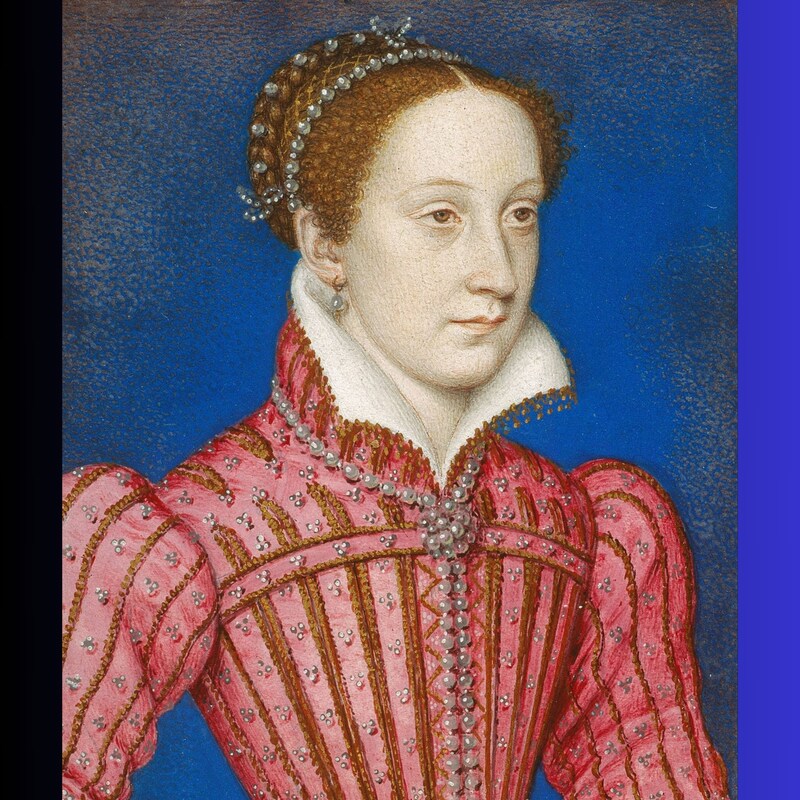
The Artwork is A Miniature of Mary Queen of Scots. c 1559 by François Clouet.
This exquisite miniature is related to a drawing by the artist François Clouet, held in the Bibliothèque nationale de France Paris, likely dated slightly earlier to 1555. Her clothing is updated in the miniature, particularly the detail of the ruff in the drawing, which is changed into an open-standing collar.
The original drawing is only bust-length, whereas the miniature includes the sitter's hands, indicating their significance to the portrait's function. The gesture of placing a ring on the fourth finger of her right hand is thought to allude to Mary Queen of Scots’ marriage to the French Dauphin, the future Francis the Second, in 1558.
This portrait was commissioned by the French royal family from their court artist to commemorate the royal marriage. The size and details of the miniature are: A watercolour, 8.3 x 5.7 cm, on a canvas panel stretcher.
The miniature was almost certainly Queen Elizabeth I's personal possession and would later become part of the Royal Collection.
The Royal Collection of the British Royal Family is the most extensive private art collection in the world. It is held in trust by The King, as Sovereign, for his successors and the nation. He does not own it as a private individual. The Collection was formed mainly after the Restoration of the Monarchy in 1660. Following Charles I's execution in 1649, most of the King's possessions were sold by order of the Lord Protector, Oliver Cromwell.
The Music is Alas Madame. French, Bayeux Manuscript (English: Alas my Lady)
The Bayeux Manuscript is an illustrated manuscript that contains one hundred and three songs, and was compiled by Charles III, Duke of Bourbon, in the early 16th century. These songs were composed in the late 15th century, shortly after the conclusion of the Hundred Years' War. The manuscript is housed in the Bibliothèque Nationale de France.
Some contents of the episode are:
The Thirty-nine Articles of Religion.
The Convocation of 1563.
The second part of the Vestiarian Controversy.
Foxe's Book of Martyrs.
© 20 26 The Rise of the Protestants., Author, Shaughan Holt.
"All rights reserved. No part of this podcast may be reproduced, translated, distributed, or transmitted in any form or by any means, including photocopying, recording, or other electronic or mechanical methods, without the prior written permission of the copyright holder, except in the case of brief quotations embodied in critical reviews and certain other non-commercial uses permitted by copyright law".
Requests regarding translation, licensing, or republication should be directed to: [email protected]
Your feedback matters, send me an email at [email protected], with any comments, suggestions, or criticisms.I read every message.
Transcripts
© 20 26 The Rise of the Protestants., Author, Shaughan Holt.
"All rights reserved. No part of this podcast may be reproduced, translated, distributed, or transmitted in any form or by any means, including photocopying, recording, or other electronic or mechanical methods, without the prior written permission of the copyright holder, except in the case of brief quotations embodied in critical reviews and certain other non-commercial uses permitted by copyright law".
Requests regarding translation, licensing, or republication should be directed to: [email protected]
Your feedback matters, send me an email at [email protected], with any comments, suggestions, or criticisms.I read every message.
Series 1.
Episode 7.
Mary Queen of Scots (15 42-87).
Sir James Melville, who lived from 15 35 to 16 17, was a Scottish diplomat.
He was the third son of Sir John Melville, the laird of Raith in Fife, who was executed for treason in 15 48 by the English Queen Mary I, due to his allegiance to the Protestant cause.
In 15 49, the teenage Melville travelled to France, to serve as a page for Mary Queen of Scots.
Melville was injured, and captured while fighting for the French, against the Spanish forces, at the Battle of St. Quentin in 15 57.
After his release, he undertook several diplomatic missions, for King Henry II of France.
Upon Mary's return to Scotland in 15 61, Melville planned to pursue his career in France or the German Palatinate.
However, despite the limited personal gain, he deemed Mary worthy of dedication, and accepted her offer of employment.
In late September 15 64, Mary Queen of Scots sent Melville to England, to open negotiations with her sister Elizabeth.
His responsibilities also included, delivering messages to Lady Margaret Douglas, meeting with the Spanish Ambassador and maintaining contact with her supporters.
Melville needed to proceed cautiously, to learn which topics would be discussed, in the upcoming English Parliament.
Mary knew that Parliament was urging Elizabeth to name a successor.
Although Elizabeth had declined, Parliament might have to compel her to decide.
It was during one of his meetings with Queen Elizabeth, that Sir James Melville, the Ambassador of Mary Queen of Scots, was shown some portrait miniatures, belonging to Elizabeth.
Melville explained that, during his visit, the English Queen took out a miniature portrait of Mary, and kissed it.
It's possible that Melville was referring to a specific miniature, which would later become part of the Royal Collection.
The way Elizabeth handled the piece, suggests, that these small-scale paintings, were often used in a personal and intimate fashion.
By the reign of Charles I, the miniature, was mounted in a frame, together with eight other miniature portraits, of King James's ancestors.
The size and details of the miniature are a watercolour, 8 point 3 by x 5 point 7 cm, on a canvas panel stretcher.
This exquisite miniature, is related to a drawing by the artist François Clouet, held in the Bibliothèque nationale de France Paris, likely dated slightly earlier to 15 55.
Her clothing is updated in the miniature, particularly the detail of the ruff in the drawing, which is changed into an open-standing collar.
The original drawing is only bust-length, whereas the miniature includes the sitter’s hands, perhaps indicating their significance to the portrait's function.
The gesture, of placing a ring on the fourth finger of her right hand, is thought to allude to Mary Queen of Scots marriage to the French Dauphin, the future Francis the Second, in 15 58.
This portrait would most likely have been commissioned by the French royal family, from their court artist, to commemorate the royal marriage.
The Royal Collection, of the British Royal family, is the largest private art collection in the world.
It is held in trust, by The King, as Sovereign, for his successors and the nation.
It is not owned by him as a private individual.
The Collection, was largely formed after the Restoration of the Monarchy in 16 60.
Following the execution of Charles I in 16 49, most of the King’s possessions, were sold, by order of the Lord Protector, Oliver Cromwell.
The year is 15 60.
In France, a remarkable turn of events was about to occur, adding an unexpected twist to our story.
Following her father's death on 14 December 15 42, in Falkland Fife, Mary Stuart, King James the Fifth's only surviving legitimate child, inherited the Scottish throne at just six days old.
The following September, catholic Cardinal David Beaton, the Archbishop of St Andrews, crowned the nine-month-old Mary Stuart, Queen of Scotland, in the Chapel Royal at Stirling Castle.
During Mary's childhood, Scotland was governed by James Hamilton, the Earl of Arran, heir presumptive to the throne, and later by her mother, Mary of Guise.
Mary of Guise, a noblewoman from France, was the Queen Consort of Scotland from 15 38 until 15 42.
In an effort to shield her daughter, the now "Mary Queen of Scots", from the ongoing Anglo-Scottish conflicts, she made the decision to send the young girl to France when she was just five years old.
There; - Mary was brought up in the court of King Henri the second, where she received a French royal education and upbringing.
Henri's reign, from 15 47 to 15 59, was marked by the persecution of Protestants, mainly the Calvinists or Huguenots.
Hoping to establish a dynastic claim to the Kingdom of Scotland, Henri planned to marry the young Mary to his son, the even younger Dauphin, François.
François the Second was born in January 15 44, the eldest son of King Henri the Second and Catherine de Medici.
On 24 April 15 58, Mary Stuart, Queen of Scots, married François the Second in Notre Dame Cathedral Paris.
Wearing a lavishly decorated white gown, her auburn hair and pale complexion, gave her a strikingly unconventional impression.
By tradition, in France, white was primarily reserved for royal mourning, - for this wedding, - that would be changed.
At the time, Mary was fifteen years old, while François was slightly younger, at fourteen.
Their male issue would have been the King of both France and Scotland, and a strong claimant to the English throne.
On 10 July 15 59, less than a year after his marriage, François, unexpectedly ascended to the throne of France.
His father, King Henri, had met with a tragic accident, during a jousting tournament at the Place Royale in Paris, which ultimately proved fatal.
A broken lance had pierced his right orbit, causing severe damage and leaving behind numerous wooden fragments.
Although his skull remained intact, an infection spread intracranially.
And so, on the fateful day of 10 July, King Henri the Second of France, received his final sacraments in the morning, and passed away that afternoon, at the age of forty.
Throughout its history, the French city of Reims had been witness to a significant number of royal coronations.
The city’s cathedral, housed the Holy Ampulla of chrism, or the holy anointing oil, and from 10 27 to 18 25, twenty-nine French Kings would be anointed and receive their crowns there.
On 21 September 15 59, aged 15, François the Second was crowned King of France, in the Cathedral of Reims, by his uncle Charles, the Cardinal of Lorraine.
However, François’s reign, was marked by religious turmoil.
A sickly and weak-willed young man, François soon became a tool of the Guises, who saw an opportunity for power, and a chance to break the Huguenots' influence, within the French kingdom.
His oppressive, and unwarranted acts against Protestantism, led to the Amboise plot, a conspiracy that sought to overthrow not just the King, but also the House of Guise.
Tragically, it was only a matter of time before disaster would strike at the heart of the French monarchy once again.
François the second, the young king of France, succumbed to a septic ear infection on 5 December 15 60, in Orléans, at just 15 years old.
His wife, the seventeen-year-old Mary, was said to be utterly heartbroken.
While their marriage, was primarily arranged to strengthen the ties between France and Scotland, Mary, had genuinely grown fond of François.
However, it was believed that the marriage had not been consummated, due to their young ages.
Mary summed up the contemporary ideal of a Renaissance Princess, with a tall, slender figure, red-gold hair, amber-coloured eyes, and her appreciation of music and poetry.
She had been brought up at the court of King Henri, and his Queen Catherine de Medici, and, as a result, Mary identified herself more as a Frenchwoman than a Scot.
Crowned Queen of Scots, at just nine months old, married, crowned Queen Consort of France and widowed; all by the time she was 18 years old, Mary Stewart's life, was nothing if not eventful.
The year is 15 61.
Following the death of her husband, Mary was advised by the Guises to return to Scotland.
On 19 August 15 61, Mary Queen of Scots, sailed into Leith and took up residence at Holyroodhouse Edinburgh, returning to a country she had last seen aged five.
Her sheltered upbringing in France had not equipped her to deal with the challenges she would encounter as the Queen of Scotland.
While still living in France, no doubt influenced by the French court, Mary had incorporated England's heraldic emblem into her own, implicitly proclaiming her legitimate claim to the British monarchy.
As a result Queen Elizabeth harboured, some resentment towards Mary Stuart, and was now refusing to recognise her as her legitimate heir.
During Mary's absence, Scotland had transitioned to Protestantism; while she had remained a Roman Catholic, leading many, John Knox included, viewing her as a foreign Queen with a different religious belief.
Despite Knox's strong opposition, Mary governed successfully and with moderation during the early years of her reign.
Supported by her half-brother James, Earl of Moray, her policy of religious acceptance contributed significantly to her success.
Nevertheless, Knox's powerful influence always posed the risk of division, bitterness, and disaster.
Upon Mary’s arrival, John Knox, organised a welcoming committee, which arranged for the singing of Psalms outside her window.
Aware, that this was intended to promote Protestantism, Mary politely expressed her enjoyment of the music, and hoped they would soon return.
On the first Sunday after her arrival, Mary attended mass in her chapel, along with some of her Catholic nobles.
The following week, from Saint Giles's pulpit, Knox delivered his most strident sermon to date, crying:
“A single catholic mass fills me with more dread, than would a thousand armed adversaries storming our land”.
“By tolerating this Queen's idolatry, you will unleash the wrath of God upon us”.
Queen Mary, keen to establish her authority, and perhaps eager to meet her opponent, immediately sent for him.
She accused him of promoting rebellion, and encouraging her subjects to defy her authority, and all because, she was a woman.
Knox responded that, whilst he did not believe women had any right to be monarchs, if the Scottish nation accepted her, he would live under her rule, as contentedly as Saint Paul had lived under that of Nero.
Further adding, that any monarch, regardless of gender, could be defied if they became tyrants.
The year is 15 62.
The influence and impact of John Knox's Book of Common Order was significantly enhanced by his return to Scotland.
In 15 62, the Scottish General Assembly, recommended using Knox's Book of Common Order, in the administration of sacraments; marriage ceremonies and funerals.
Although initially drawn up and printed on the continent, by now it had become so popular in Scotland, that it warranted publication by Robert Lekprevik of Edinburgh.
In December, Knox preached a sermon, publicly criticising Mary's fondness for dancing, accusing her and her wider household of indecorum at best.
This was a serious accusation.
A Queen who led an immoral life, or condoned it in her servants, would swiftly lose respect and authority.
Mary understood this, and once again summoned Knox, angrily accusing him of bringing her into disrepute.
Knox denied it, adding, that those who would not listen to God’s truth, might have to listen to false rumours.
Knox further stated, that he did not entirely object to dancing, provided it did not lead to the neglect of religion.
Mary drew back a little, saying that his remarks had been reported to her differently, and in future, if Knox had any reason to criticise her behaviour, he should first come to her.
However, Knox declined her offer, remarking he would continue to express his beliefs in his sermons, regardless of whether Mary approved them or not.
St Giles Cathedral, or the High Kirk of Edinburgh, is a parish church of the Church of Scotland, in Edinburgh Old Town.
It is one of Scotland's most important medieval parish church buildings.
The first church of St Giles was a small Romanesque building, of which only fragments remain.
Likely founded in the 12th century, and dedicated to Saint Giles, the patron saint of lepers, the church was elevated to collegiate status by Pope Paul II in 14 67.
In 15 59, the church became Protestant, with John Knox, the foremost figure of the Scottish Reformation, as its minister.
Its role in the Scottish Reformation and the Covenanters' Rebellion, has led to it being called "The Mother Church, of World Presbyterianism".
In 15 13, Alexander Lauder of Blyth, commissioned an aisle of two bays, at the eastern end, of the outer south nave.
The Holy Blood Aisle is the eastern most and only surviving bay.
The firm of James Ballantine & Son were responsible for its stained glass.
It depicts the assassination, and funeral of the Regent Moray, the only window in the church, that depicts events from Scottish history.
The lower section of a window shows Scottish Reformer John Knox, preaching the funeral sermon for the Earl of Moray, a leading opponent of Mary Queen of Scots.
James Stewart, the 1st Earl of Moray, was assassinated in Linlithgow on 23 January 15 70, by James Hamilton of Bothwellhaugh, a supporter of Mary.
Moray, the half-brother of Mary Queen of Scots, had lost her favour by supporting the Calvinist reformer John Knox, and by opposing Mary’s marriage to Henry Stewart, Lord Darnley.
Lord Darnley had one child with Mary, the future James VI of Scotland and first of England.
The Thirty-nine Articles of Religion are the historically defining statements of doctrine and practices within the Church of England.
They were developed amid the disputes that arose during the English Reformation.
The Articles form part of the Book of Common Prayer used by the Church of England, the U.S. Episcopal Church, the Anglican Church in North America, and various other denominations.
This also applies to the communities that are part of the global Anglican Communion and the Anglican Continuum.
The Thirty-nine articles were crucial in defining the Church of England's doctrine regarding Calvinist beliefs and Roman Catholic practices, and went through five major revisions before being finalised in 15 71.
The first attempt was made in 15 36, under Henry VIII, - with the Ten Articles, which had some Protestant leanings, due to the English desire for a political alliance with German Lutheran Princes.
Next came the Six Articles in 15 39, which moved away from all Reformed positions; - and then, in 15 45 came the King's Book, which set about re-establishing, most of the earlier Roman Catholic doctrines.
For a brief period in 15 53, the forty-two Articles were the official doctrinal statement of the Church of England.
Written by Archbishop Thomas Cranmer and published by King Edward VI Privy Council, it represented the height of official church reformation, before the reign of Queen Elizabeth.
It staked out a position among the Protestant movements of the day, opposing Anabaptist claims and disagreeing with the Zwinglian position, without taking an explicitly Calvinist or Lutheran approach.
Matthew Parker, the Archbishop of Canterbury, led the Convocation of 15 63 which introduced the Thirty-nine Articles of Religion.
The Thirty-nine Articles were finalised in 15 71 and incorporated into the Book of Common Prayer.
The book, despite not ending the struggle between Catholic and Protestant monarchs and their citizens, did help to standardise the English language.
Its widespread use has had a lasting effect on religion in the United Kingdom and elsewhere.
After becoming Queen in 15 58, it became clear to Elizabeth and her ministers, that a new statement of doctrine was required.
In 15 63, an assembly of clerics, known as the Canterbury Convocation, embarked on its task to restructure the forty-two Articles.
Their decisions, helped consolidate the Elizabethan religious settlement, and would bring the Thirty-Nine Articles closer to their final form.
The Convocation, opened on 15 January with a sermon by William Day, Provost of Eton College and Supporter of the previous Six Articles of 15 39.
The Convocation approved the Thirty-Nine Articles, as a confessional statement for the Church of England.
The Ministers also planned to propose alterations to ecclesiastical law, and the religious ceremony.
Their goals, included; eliminating certain clothing items; banning kneeling during communion; altering the usage of the cross in baptism ceremonies and amending the choice of music, played within church services.
Some clergy members introduced these reforms privately, to their congregations in the following years.
For example, at Cambridge, William Fulke convinced his students not to wear their surplices, and to hiss at students, who did.
To address the issue, Archbishop Parker issued a series of notifications, demanding consistency in the attire of clergy members.
Born in London, William Fulke received his education at St John's College Cambridge, graduating in 15 57/58, and becoming a fellow at St John's in 15 64.
In the Vestiarian dispute, Fulke took on a prominent role, urging the college to stop using the surplice; - his behaviour, resulting in his removal from St John's.
However, in the year 15 67, he was welcomed back into the college, and assigned duties, as a Hebrew lecturer and preacher.
After standing unsuccessfully for the headship of the college, in 15 69, he left to become chaplain to Robert Dudley, the first Earl of Leicester, and close friend of Queen Elizabeth.
In 15 78, he was elected master of Pembroke Hall Cambridge.
As a Puritan controversialist, Fluke was remarkably active.
In 15 80, the bishop of Ely appointed him to defend Puritanism against the Catholics, and in 15 81 he was involved in a dispute, against the Jesuit Priest Edmund Campion.
The year is 15 63.
A third confrontation, between Knox and the Queen, occurred at Easter 15 63, when Mary was informed that Catholic priests in Ayrshire had been caught conducting a mass - an act forbidden by law.
She summoned Knox and asked him to persuade his co-religionists to refrain from persecuting anyone for their religion.
Knox defended the Protestants' actions, replying that it was her duty to enforce the law.
He further explained that others would have God's approval, if the Queen did not uphold the law.
Mary was irritated but surprised Knox, by agreeing to bring the priests before the courts to face justice.
On 24 June 15 63, a further heated and intense exchange, occurred between Mary and Knox.
Knox, had annoyed many of his supporters, by preaching against Mary’s intention to marry, and so had only limited support when he answered her summons.
She had not yet identified a suitable spouse, but was in negotiations with various Catholic princes, including Don Carlos, the mentally unstable eldest son and heir apparent of King Philip II of Spain.
The Queen, still only twenty-one, was now at her wit’s end.
Telling Knox, that she had endured his verbal attacks against her, and had tried every possible way to reconcile him, but without success.
Knox responded, declaring, that once divine enlightenment allows her to acknowledge her mistakes, she will understand, that there is no reason to be disturbed by my honest sermons.
Mary asked; what divine authority granted him the right to discuss her marriage.
He replied, that it was his duty, to ensure that none of her nobles, agreed to a marriage with an ungodly husband.
If she were, to marry such a man, they would implement restrictions, preventing her and any future husband, from harming the church.
Mary cried again, and Knox told her that he took no joy in her tears; for he could scarcely bear to see his sons cry, when they were punished.
But, as he had spoken only the truth, he would have to endure her tears.
Knox was sent from the room, whilst Mary took time to compose-herself.
Afterwards, Mary couldn't bear to see Knox return.
Although persuaded not to reprimand him for his comments, she never again requested his presence in a private setting.
From then on, there was no hope of them finding an understanding.
From 15 63 to 15 69, the second part of the Vestiarian Controversy, took place during the English Reformation.
This controversy, emerged early in Queen Elizabeth’s reign, particularly in 15 49, when she reintroduced the tradition of wearing vestments in the Royal Chapel.
Starting in 15 60, bishops made it mandatory for clergy to wear a cope during Holy Communion, and a surplice during other church services.
Despite objections from some Protestant members in Parliament and Convocation, the authorities continued to enforce these requirements.
In February 15 60, a Bishops' Conference reached a compromise: while they rejected the use of the crucifix, they decided to allow the wearing of the cope during Holy Communion and the surplice during other services.
These, "Rags of the Roman Antichrist", aggravated the extreme Reformers, who sought to purify worship from any influence of Popery.
Elizabeth therefore demanded that the bishops take action, to restore uniformity and resolve the ongoing conflict.
In response to the Queen's directive in 15 63, Archbishop Parker collaborated with Edward Grindal the London bishop and others, to compile a Book of Ecclesiastical Articles.
Parker forwarded the manuscript to William Cecil, anticipating its acceptance by the Queen.
To Parker's intense frustration, Cecil delayed and did not give his approval or forward them to the Queen; instead, he requested that modifications be made, and the Articles resubmitted.
The Articles were later titled as Advertisements.
Richard Bancroft, born on 12 September 15 44 in Farnworth, Widnes Cheshire, was the second son of John and Mary Curwen Bancroft, who were members of the upper class.
He began his university education in 15 63 when he was nineteen, initially enrolling at Christ's College Cambridge.
However, he successfully transferred to Jesus College Cambridge, wishing to escape from the ardent Puritanism present at Christ's.
The ‘Actes and Monuments’, popularly known as Foxe's Book of Martyrs, is a famous work by the Protestant English historian John Foxe.
First published in 15 63, John Foxe's Actes and Monuments is a Protestant martyrology, and history of the English Christian Church.
The publisher produced and illustrated the book, with over sixty distinctive woodcut impressions.
At the time, it was the most significant publishing project ever undertaken in England.
Known as Foxe's Book of Martyrs, this remarkable piece of literature stands out for its powerful anti-Catholic bias, using unprecedented documentary sources in English writing.
Foxe, describes King John's sudden death in 12 16, portraying him in a favourable light, as a noble monarch, who defied the papacy, which contrasts with how he is depicted in later historical accounts.
In the work, Foxe reiterated a 13th-century allegation, that monks, loyal to the Pope, had poisoned King John.
An accompanying woodcut, illustrates the story across six separate scenes.
According to the narrative, a fanatical monk from Swineshead Abbey in Lincolnshire tested the venom on a frog, before poisoning King John and then committing suicide, an act for which his fellow monks praised him eternally.
This book had a profound impact and significantly shaped enduring negative perceptions of Catholicism among the public.
It presented a compelling narrative, detailing the hardships faced by Protestants under the Catholic Church, with particular emphasis on England and Scotland.
During Foxe's lifetime, the book was published in four-editions, with several later editions and abridgements, including, some that specifically condensed the content, into a Book of Martyrs.
Following its publication in 15 62, an enlarged and revised edition of Knox’s Book of Common Order was printed in Edinburgh in 15 64.
The General Assembly made its use obligatory, ordering that every minister, preacher, and church reader have a copy, and use it for marriage, the sacraments, and prayers.
The book, embodied the law of the Church of Scotland, regarding public worship for over eighty years, from 15 64 to 16 45, and effectively replaced the Second Book of Edward VI, at ordinary service.
On 26 March, 15 64, John Knox sparked a minor controversy, by marrying Margaret Stewart, the daughter of his old friend Andrew Stewart and a distant relative of Mary Stuart, Queen of Scots.
The marriage was notable because Knox was a fifty-year-old widower, while his bride was only seventeen.
Little information is available about their home life, but it is known that they had three daughters.
