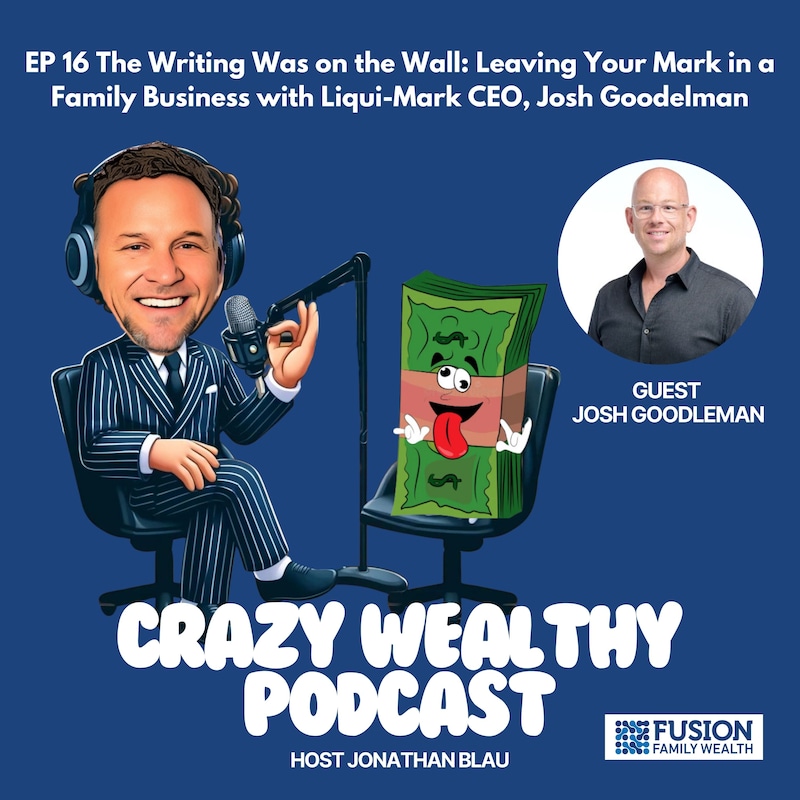
Shownotes
Josh Goodelman, President and CEO of Liqui-Mark Corp., joins Jonathan Blau on the Crazy Wealthy Podcast to share the real story behind building and leading a family-owned manufacturing business on Long Island. Josh walks through the entrepreneurial origin of the company, the leap from importing to U.S. manufacturing, and what it takes to serve major retailers, school and office distributors, and a growing promotional products division with many Made in the USA offerings.
Jonathan and Josh also explore the psychology of decision making under uncertainty, including how entrepreneurs must often unlearn control-driven behaviors when they shift from building wealth in business to investing wealth in the markets. The conversation highlights resilience during challenging moments like losing a major account right after buying a facility, navigating tariff disruptions, and keeping a steady mindset through volatility.
What You’ll Learn in this Episode:
How Liqui-Mark evolved into a second-generation, family-owned manufacturer serving major retail and distribution channels
Why entrepreneurs often struggle as investors, and how reframing risk can improve long-term decision making
How to balance emotion and rational leadership in high-stakes moments inside a family business
Want to make smarter financial decisions grounded in clarity and confidence? Subscribe and share the Crazy Wealthy Podcast. To learn more about Fusion Family Wealth’s evidence-based investment strategies, visit www.fusionfamilywealth.com and request our current disclosure brochure.
TIMESTAMPS:
00:00 Podcast disclaimer and introduction
01:00 Meet Josh Goodelman and Liqui-Mark’s family business legacy
02:00 The company origin story: a big order, a bold leap, and early growth
06:00 Importing to manufacturing: building operations and capability in the U.S.
09:00 How Liqui-Mark serves retailers, distributors, and promotional customers today
11:00 The entrepreneur-to-investor shift: what founders must unlearn
13:00 A pivotal moment: buying a facility and losing the biggest account
17:00 Real-world volatility: tariffs, COVID, and keeping costs covered
24:45 Working with family: roles, balance, and decision-making dynamics
31:30 Values, humility, and the mindset behind sustainable success
36:45 Not overplaying the win: defining “enough” in business growth
39:45 Advice for leaders: emotion belongs in decisions, but not in the driver’s seat
42:00 Wrap-up: building wealth vs investing it
43:08 Jon and Amy recap the episode
KEY TAKEAWAYS:
Liqui-Mark’s growth shows how calculated risk, resilience, and long-term thinking create staying power in manufacturing.
The skills that build wealth in business can backfire in investing, where patience and discipline matter more than control.
Strong leadership means acknowledging emotion while keeping decision-making grounded in rational inputs and values.
ABOUT THE GUEST:
Josh Goodelman is the President and CEO of Liqui-Mark Corp., a second-generation, family-owned and operated manufacturer of writing instruments and school and office supplies located on Long Island, New York. Liqui-Mark sells to major retailers, school and office products distributors, and operates a promotional products division offering a large variety of Made in the USA products.
Josh Goodelman - LinkedIn: linkedin.com/in/josh-goodelman-3a87bb4
Liqui-Mark Promo - Website: liquimarkpromo.com
ABOUT THE HOST:
Jonathan Blau is the President and CEO of Fusion Family Wealth, a fiduciary wealth management firm he founded in 2013 to help families achieve clarity, confidence, and purpose with their money. With a deep focus on behavioral finance, Jonathan teaches investors how to recognize emotional biases and make evidence-based decisions that support long-term success. A sought-after speaker in wealth management, Jonathan previously held senior roles in tax and estate planning at Arthur Andersen. He has a BS in Finance, an MS in Taxation, and an MBA in Accounting.
Transcripts
A copy of Fusion's current written disclosure brochure discussing our advisory [00:00:15] services and fees is available upon request or at www.fusionfamilywealth.com.
're just starting out or are [:And now here's your host.[00:01:00]
d generation. We'll get into [:So Josh, welcome to the Crazy Wealthy Podcast. I'm appreciative of you joining us today.
osh Goodelman: Thanks, John. [:Jonathan Blau: All right, good. That means that you don't have much going on in life, but that's,
Josh Goodelman: oh, nothing.
something. I gotta tell you [:Jonathan Blau: So I wanna talk about a few things. I want, I want to talk a little bit about, um, to [00:02:00] begin, uh, the origins of the business and, um, the story about your, your, your grandfather.
duction to the pen business, [:So [00:02:30] that, that, that won't be what people expect.
n, his whole career from the [:Come on Stu. Come work for me. You can be a salesman. I'm gonna teach you about the [00:03:00] pen business. So he did. And he was doing something totally different. You know, he was in sales and, and, uh, and, uh, you know, he, he was doing that for a couple years and about two years in, uh, someone approached my grandfather to buy his business.[00:03:15]
moved to Florida. Um, and my [:And, uh, he went to go on a sales call and my [00:03:45] father was 24 at the time, and the buyer was probably more than twice his age and said to him, Stu, I like you, but I don't like the company that bought your company, the company, you know, the company you work for. So I want you to go start a company. I'm gonna, and my father [00:04:00] looked, he says, what, what, what do you want me to do?
He said, and he was selling pens. I think
Jonathan Blau: at that point your father saw the writing was on
, he says, how am I gonna do [:This was my brother at the time. I, I have an older brother, Craig, and he, and he says, if I'm lucky if when I get home, my wife didn't spend all the money for me to pay the rent. You know, and he said, listen, I'm putting [00:04:30] you into business. I'm gonna give you an order for a million packs of coloring markers and, um, we're gonna private label 'em with our own brand and uh, we're gonna do it for back to school and go figure it out.
the meeting and went to the [:Jonathan Blau: our listeners at
Josh Goodelman: the younger, I don't even know what that is,
Jonathan Blau: right. That means, right, yeah.
Josh Goodelman: You called collect.
t call, and then they had to [:Jonathan Blau: Well, by the way, just a funny story when we used to do that with my grandparents in Florida. We made a collect call to them, not from a payphone or from our house.
l. So she'd call, they would [:Josh Goodelman: you know, can you imagine? So, uh, he, my father called my grandfather collect and said, you know, I got this situation. My grandfather said, okay, you know what, I'm getting on a plane, [00:05:30] uh, and we're, I'm gonna come back to New York and then we're gonna get on a plane and we're gonna go to Italy.
ure the order. You know, and [:Similar sizes and. Um, and he, they went to Italy and they, they met with the factory and they, you know, pro produced the product there. And Somar got started, um, and they imported it from Italy, the product. And [00:06:15] then, uh, within the next two years. And my father, he needed to legitimize himself. He rented a desk.
ater, you know, the business [:And that's how the business got started. This
y, saw something in him that [:Josh Goodelman: that
Jonathan Blau: was real, know
Josh Goodelman: he did. And it, and, and that's, and then that's how Manu the manufacturing started, you know? And, uh, within a couple years, um, you know, and we, uh, to this day we still have.
t are running, you know, our [:And then we have a promotional products division that we started about 25 years ago. When I first jumped
Jonathan Blau: in, and is, is everything done in the us?
uct line is made here in the [:We do business, you know, we bring product from all over the world. Um, uh, to [00:07:45] compliment our product line on all divisions of the company. And, uh, you know, but we still make product here, you know, and, and, uh, just a couple years ago, you know, when my father bought machines, he had to hire, he used to fix the machines himself and he had to hire a mechanic.
And that gentleman, uh, [:Jonathan Blau: that's great.
Josh Goodelman: Well, that says a lot
Jonathan Blau: about
Josh Goodelman: you guys.
Jonathan Blau: It's
Josh Goodelman: pretty wild story. Yeah, it's a pretty wild, it's a pretty
Jonathan Blau: great story. So, so tell me a little bit about the company in terms of the number of clients that you serve.
u know, there's not, there's [:Josh Goodelman: no. It's, we're a, we're a manufacturing company, so we manufacture the finished product. You know, I should, I should probably have product here, but like, for example, here, I'll grab something to show you [00:08:30] so you know.
u'll see our brand or you'll [:Right.
Jonathan Blau: But it looks like your product,
de, we sell major retailers, [:You ask about the quantity of customers on the promotional product side. There are thousands and thousands of customers to sell. So we sell through a network of distributors. [00:09:15] We would work through a marketing and advertising firm, you know, as our distributor, who would then sell you directly, and you would go to them and, and and, and come say, here, I wanna use, you know, our fusion logo and we want to have it on hats and shirts and pens and, and Frisbees and [00:09:30] drinkware and, and you know, they would help you with the creative and the artwork and.
don't sell school districts [:Jonathan Blau: Well, one of the things that I've, uh, you know, I met you through, through your friendship initially with Amy, my wife. Yeah. And, um. She, [00:10:00] she always, uh, told me I'd like you and I, and I, and I do like you as I got to know you each. The more I get to know you, the more I like you. One of the things I always liked is you're in a, in a successful business that's, um, really I guess third generation, what I've seen in [00:10:15] my business over the years, dealing with people and their wealth, uh, that they've created either in business or as executives or inheritance, um, how to, how to handle their emotions generally and deal with, with the wealth.
ifferent than the way it was [:And we feel we need to control all these things. And when you're investing, uh, after you build a wealth, the the skills that you, that [00:11:00] you, uh, had. As an entrepreneur, you actually need to unlearn. 'cause instead of being, wanting to get things done quickly and be in control, uh, and, and take outside risks, you need to do things slowly and be very patient and not take very many risks at [00:11:15] all and let compounding happen.
hat the skills that we have, [:And, and in fact, what happens is it's, it's the opposite. We get overconfident and, and, and we tend to make [00:11:45] missteps. So along those lines, do you feel like you've seen in, in business, um, uh, any, any decisions that you've had to make? Where you've seen emotions creep in, you know, may maybe the timing of the decisions [00:12:00] or, or, or, or something like that, uh, where emotion crept in and, and you, if you look back and say, well, I can think of those things and maybe what would you have done differently?
Josh Goodelman: Yeah, definitely. To
Jonathan Blau: slow it down. Right? To slow down. I mean, decision, process.
one thing I think I learned [:You know, when we, um, you know, and, and I'm not ashamed to say, you know, when we, we were in Brooklyn for, you know. Uh, for a very long time. And then, you know, we moved, uh, the company moved to, um, to [00:12:45] Long Island, not in the building we're in now. We were in Westbury for 11 years and we had to move the, we rented a building.
my father wanted to take a, [:It was a big number. You know, we, we bought a 30,000 square foot building in the hot pug industrial park, and, uh, I, I kid you not, I remember, you know, no more than five minutes after [00:13:15] closing on the building, we lost our biggest account, our biggest customer, and it was de it was, it was a detrimental time for our business because, you know, we had, it was, uh, you know, we were, had a, a tremendous amount of expenses and move, you know, infrastructure moving as [00:13:30] a tremendous cost.
And now we had, you know, this higher operating cost of, you know, uh, of paying a mortgage draw for, for a, a piece of real estate we had to still operate and less revenue
Jonathan Blau: available
yes, like was did, but do I [:And my father said, he used to, he used to tell me like, don't worry, we're gonna figure it out. It's gonna be fine. We'll be fine. It'll be, we'll [00:14:00] figure it out. That's great.
Jonathan Blau: So it
Josh Goodelman: was actually calm
Jonathan Blau: attitude.
Josh Goodelman: Yeah. Yeah. Totally.
Jonathan Blau: And is that the crisis when we talked recently that you said about 20 years ago?
Josh Goodelman: Yeah.
Jonathan Blau: He had a crisis.
and his business partner, I [:And my father, you know, and I was watching it and I was, this is crazy, you know? And, but you know, and I look back on that and [00:14:30] I, and I see that he had faith and like, not to take those risks and, you know, roll the dice, right? Because he had confidence in himself that he'll correct it. And, and, and he did. We all did.
You know, we all worked there.
remember, because I know you [:Josh Goodelman: Seven. Seven. Seven, half years ago. Yeah.
th, do you feel that he had, [:So in other words, if he invested in the capital markets, did he have the same confidence when the markets. Were going through challenges, whether it's because of, he wasn't around, but the pandemic or things like that. Yeah. Yeah. Or, or did he feel like 'cause [00:15:15] he wasn't in control? I, I wish I didn't have much outside of my business.
Josh Goodelman: You know what I think, I think. Yeah, I think he was, if I, you know, I look back on, I gotta, you know, think about it, how he,
Jonathan Blau: yeah,
now, he did, he, he took the [:You know? So think so.
Jonathan Blau: He was a good investor too. He wasn't
times he took a conservative [:Having had never having, had never done that previously. No
Jonathan Blau: experience with it. Right.
t. If we, okay. You know, in [:You know, that was really what, how we thought, you know, and
esting because what you said [:Yeah. And, and so now when they're investing [00:16:45] after they retire or they sell a business, they're not in control. And we say being more conservative, usually people mean they're gonna buy more things like bonds, right? Things that don't fluctuate. And that gets to the heart of. Entrepreneurs versus investors.
Where for, for [:Josh Goodelman: Course. Yeah.
Jonathan Blau: Very much. Can't control that, so, right.
It hurts. [:Josh Goodelman: Oh, it
Jonathan Blau: hurt.
Josh Goodelman: It hurt. It hurt everybody Big time.
to bonds to control. Or mute [:So they freeze our money. If I buy a 10 year bond at 8% a year in, in 10 years, I need 12% a year to buy what? 8%. I don't have that. And my, and my million dollars and I put in [00:17:45] the bond is still a million dollars in 10 years. And I, I need a million, 1,000,004. So, so it, it's just, it's. Most people need to be, um, reframing when they retire, when they're investing.
y think about risk. Risk is, [:They're [00:18:15] relying on an intangible. So they tend to make a decision that's actually. Going against what their long-term goal is, which is to protect their purchasing power. They don't understand it. Uh, by the way, you do, you have, you got, how do you think about those things?
lman: You know, I mean, I, I [:I'm willing to throw. You know, money at a new product and product [00:18:45] development or, um, you know, uh, a marketing campaign or an investment in a customer. Uh, you know, so a lot of our customers require us to make certain investments in, uh, their own marketing. You know, if you, it's kind of, you have to ba kind of buy into the.
To [:Jonathan Blau: show you have skin in the game.
now, my, my gut instinct is, [:You know, uh, if I'm questionable on it sometimes, you know, I think a little differently where I'll say, you know what, what's the worst that can happen? We made a little bit of an investment in trying something we, we have to prove to ourself if it's gonna work or not. If it doesn't work, then we go back to what we were doing previously, you [00:19:30] know?
But
Voiceover: yeah,
e stress, more stressful for [:Was stressful. You know, if we're not shipping product, we're not generating any revenue. And how are you paying your employees?
the costs aren't going away. [:Josh Goodelman: They're not, the costs don't go away. Right. Right. So, you know, navigating these things and taking certain risks and making certain decisions, you know, um.
h, you know, I, I, I make a, [:But no, you have to take those
e way, you, what you, what I [:Yeah. As which said, you're taking a calculated risk. That's what you're talking about. Yeah. And so at the end of the day, for, for example, I had a client last year who sold the business for a lot of money, and they were ready to start their plan. That we, that we imp that, that we, uh, [00:21:00] devised for them. That they said, should we be investing the equity money like all at once or should we.
ional wants, you don't do it [:And so what I explained is, is there's over 1100, um, 12 month periods going back to NI 1926, so January 26 to December. [00:21:30] February 26th to to January 27 and so forth, over 1100, they call rolling 12 month as opposed to annual periods. And so 75% of those or so are positive. So I said to them, by you holding back [00:21:45] any money.
the day you have it, you'll, [:All the day you have it and it, and always behave that way. Yeah. And it's the same thing you're saying, right? Take a rational. Approach to to, to an opportunity [00:22:15] or a problem, and always do that. And sometimes the outcome isn't gonna reflect what you hope for. It's the way it works.
Josh Goodelman: You're right, you're right.
e approaches, you know, I've [:And. I would say more [00:22:45] times than not, the results are positive. The results are good,
're rational, they might not [:And then you learn from it,
Josh Goodelman: and you learn from it, and you can only beat yourself up so much. Right.
Jonathan Blau: Yeah. Well, you know, you know, it, it, so what it was Wayne Gretzky said, you, you miss all the shots.
Josh Goodelman: Yeah.
Jonathan Blau: That you never take. Right,
t's true. You know, and, uh, [:Retail's brutal. You know, I mean, it's not just, you know, I have friends that sell retail and I'm sure you have a lot of, you know, your network and people that you know of or some, somehow some way is [00:23:30] connected into the retail world and in some, some capacity. Yeah. And it doesn't matter. I have a friend who's, you know, manufactures a totally different product line than me in the apparel world, and.
u know, the thing that I can [:And those are calculated risks too, you know, at one point. Of course there's a lot of, there's a lot. I know you talk a lot about your, your [00:24:00] background in psychology. We've talked about this, right? And, and you know, there's a lot of psychology in sales. You know, there's, of course I might say something that's gonna piss them off or, you know, I may some say something that's going, you know, make them more interested, you know, so, uh, those are risks [00:24:15] too.
And,
Jonathan Blau: and sometimes you don't know, right? You're
Josh Goodelman: the time, most of the time you don't know, right?
ite reflects dads, does your [:Does that also reflect ads?
Josh Goodelman: I would say,
Jonathan Blau: like do you find that that's the same
risks. You know, I recently, [:And that was, you know, a big risk for me. You know, that was a big, it was a risk, and it was also, there's a reward behind it. And, you know, I took myself, uh, I have a, a friend, a family friend who once told me, you [00:25:00] know. You gotta put yourself outta your comfort zone once in a while. And he, he did a similar thing a long time ago and took the risk and it paid off and made it, you know, it changed your life, you know?
zone. Still, still does, you [:Jonathan Blau: Of course. Look, that that's, that's always the case. It's also changed whenever we have a big change like that.
Josh Goodelman: It makes fun. But I feel like that was also a good way to ask about like, you know, from an investment standpoint, it's also an investment, you know?
ly an investment and I think [:Jonathan Blau: no. Well, that's also an investment in quality of life, right? Yeah.
, the homes we buy, like our [:Josh Goodelman: get the, then you get your, you get all your electric bills come at once for all these different
Jonathan Blau: reasons. Right. You know what I mean? That's what really, that's what my reminder isn't Investments.
Yeah. But, but it's an [:Josh Goodelman: Yep.
Jonathan Blau: And there's [:Josh Goodelman: Yeah.
Jonathan Blau: But yet you tell me that she's the one that has the most experience of all of them in the Penn business.
onths ago, you know, I don't [:Engaging in one of the challenges we have on, you know, I was explaining one of the challenges I have on the, the retail side. Every, you know, we're with major retailers, whether it's Walmart or, or Target. You know, you're [00:26:45] connected to all these people, but you can't get their attention. To, to establish a rapport like we used to.
u know, which I would never, [:So one day it just, I was drinking my coffee on a Sunday morning and it just, I was thinking about that conversation I had a couple days [00:27:15] before. And how to use LinkedIn differently. And it dawned on me, I said, you know, I had, I had taken this screenshot of my mother. I, she, you know, my mother will FaceTime me, you know, at least 10 times a day.
And I'm, I'm, I'm good with [:My mother's gonna be 75 in June, 75 years. She's in the pen business, you know,
Jonathan Blau: see
bout the business. You know, [:My clients, my who became my [00:28:15] friends, they, they know my mom. They've met my mom, you know, um, and have built a relationship with her. And, and, and the truth is, is she's been in the business longer than all of us. And it's, uh, and you know, she's lived it, she's lived the, the, the, the, the [00:28:30] constant discussion of business at every dinner table, uh, every holiday meal, um, you know, on a Saturday afternoon at my, uh, on, on the, on the soccer field, my niece or nephew's soccer game, or baseball game, whatever it [00:28:45] may be.
Somehow something's coming up. You know, dad, I got an email from this customer, you know, whatever. And you're just sitting there. It's constant discussion. Um, so she's been in it for longer than everybody. And, uh,
Jonathan Blau: and Josh, you, you're in the business still with your brother?
Josh Goodelman: Yeah.
an Blau: Um, what, you know, [:I have a couple of clients who run family businesses and they all come with, um, uh, a balancing act that's needed. Right. So, so how do you, uh, and your brother manage the business together? What are the biggest challenges, the biggest rewards of [00:29:15] working with family that you've, that you've found in your experience?
dad and, you know, that was [:It's one of the most rewarding things that can happen, you know, and you see. You know, um, the people that, [00:29:45] that work with us, uh, who've been working with us for a long time, who've become, you know, we're all part of our family, you know, and we're all, we're all working for the same cause to, you know, listen, at the end of the day, we all need to earn a living.
make people's lives better. [:And were working here for 27, 35, 40 years. And it, it's mind blowing to me. I think it's important that you find the balance of, you know, um, of responsibility, you know, and in, in what areas each person [00:30:30] focuses on, you know, but collaborate and, you know, and coordinate together to make decisions. Um, you know, sometimes, you know, uh, sometimes I think it's good when one person's, the half, the, the glass is half full and one's the half empty, [00:30:45] uh, approach because, you know, the optimist doesn't always see may, doesn't always look at all the risks or doesn't
Jonathan Blau: consider all the risks.
s. Right? So the optimist in [:Fueling the fire to be more [00:31:15] and more, they're support, they're
Josh Goodelman: supporting them, they're supporting their own choice and decision,
u find yourself, um, without [:Optimism bias. Uh, then you don't, we wanna make sure that you check confirmation bias activities that when you're doing [00:31:45] searches and you want to challenge your thoughts and then come up with a decision, it slows you down and reduces, um, overconfidence a little bit. Uh, what, what you, one of the things I always admired about you, Josh, is um, you're in, in, in, in [00:32:00] my business, I've come across a lot of families.
They're either in business or they're inheriting money, and I always refer to as, as the, uh, generation, uh, the, the younger generation. Yep. They, they were born on third. They think they hit a triple.
Josh Goodelman: [:Jonathan Blau: And they act like that. You never acted like that. No. You are, you're, you seem to have very good values and so what, what led to that?
d, and, and that helped. But [:10 or more, probably more than 10, uh, FaceTime today, of course. But talk about what, what [00:32:45] shaped your value system that
was, you know, he was within [:I watched him firsthand, you know, take care of, you know, my, my mom who was paralyzed, you know, and, and had to go through a tremendous amount of [00:33:15] therapy and physical therapy, speech therapy, um, to overcome and, and, and, you know, live a normal life, uh, at all while, you know, running, uh, running two businesses.
father, you know, we have a [:And my father used to tell me, he's like, you know what a pain in the ass it is to coach a 12-year-old and then coach seven year olds. It's two different worlds. Right. And I was like, that's your biggest complaint today. You know, that's, that's, but I, [00:34:00] but I watched, uh, you know, I watched him do all that and, you know, um, and he worked hard until, you know, he worked hard.
now. My father, you know, we [:You know, he, um, he was always. Modesty is a good policy. Right? [00:34:30] And, and I watched him work hard and I watched him get his hands dirty and you know, and he never, you know, it didn't matter who, you know, who was respected people. And my father, uh, even last week I was at a trade show on Sunday. I went to the toy fair and I ran into a, I ran into a [00:34:45] manufacturer from Italy who knew my dad and like it humbles me.
e, you know. Yep. Um, people [:Jonathan Blau: what's nice is you, you took all those great qualities and
then
Josh Goodelman: Yeah.
Similar scenarios of people [:Jonathan Blau: you know what I see in you as you're a happy person, you know, you, you're happy, you spend time with your mom.
oking, you do all the things [:Josh Goodelman: gotta
Jonathan Blau: find a balance in life,
Josh Goodelman: right? Yeah.
ivating people and, and, and [:Uh, so they're, they're looking to, um, what I call their external benchmarks. To show the world I have this as opposed to the internal benchmark. This is, I'm doing this 'cause it's important to [00:36:00] me. You're living life to the internal benchmarks. And because of that, those people are generally much happier.
car, the new car, the bigger [:Those two things, [00:36:30] you usually don't go together or often don't go together. So I want to finish up with a couple of questions. One of the things I, I've learned sitting with entrepreneurs over time is that once they win the game, whatever that means to them, right? Business is good. They, they've achieved a lot of what they're gonna achieve.[00:36:45]
Or what they wanted to achieve. The real challenge tends to become not overplaying it. And does that resonate at all with your experience?
and, um, you know, I had to [:Jonathan Blau: Right.
You know, I, I, right? Yeah. [:Then, you know, we did a good job. That's it. I don't [00:37:45] need to be, uh, greedy. I, you know, I don't, I don't need to be a, I don't, would it be nice to have our business to be 10 times the size of what it is? I suppose it would be, but it comes with 10 times as many problems too.
Jonathan Blau: Right.
Josh Goodelman: And you have to hard 10 times as
Jonathan Blau: many people
Josh Goodelman: and Yeah.
And that's deal with [:Jonathan Blau: abso Absolutely.
Josh Goodelman: So I would say that would, that would be, that would be, I would say that, you know, I'm, it's finding the right balance of.
eep keep a healthy business. [:Jonathan Blau: One of the things I always try to teach people, a lesson I learned is, um, no matter how much money someone has or what size business someone has, that's multiple times the size of my business in what I do or your business or what you do. [00:38:30] You have to, as the smaller business owner or the, or the less wealthy person, have to always recognize that you need to always be able to have something that, that that bigger business and wealthier person can never have.
. 'cause once you don't have [:And I don't want to be a big firm. Of course, it'd be nice to have a big firm like you said, but, but that's not, but it come, the stuff that comes with that. It's good to
erybody's happy, everybody's [:I mean, I know that may sound like a very basic approach, but I'm okay with it. I'm okay
e degree, and, and, and some [:So there's, there's nothing big enough that's worth trading those things off. So the last question I have for you is, is, um, if you were advising someone who's building something meaningfully a business now and is now thinking of how not to [00:39:45] undo it emotionally or behaviorally. What might you tell them to watch out for?
Right. I, I very, you know, [:Um, and I think that, [00:40:15] you know, emotion should play a role in every decision you make. But it shouldn't, it shouldn't overpower your decision. Uh, you know, you have to, we're, we're all human. We're gonna have emotions about everything. We, we, we do, we see, we hear, we think [00:40:30] about, we react to. Right. Um, and you know, if, if, if you're talking about somebody who's in a, you know, somebody who's in a family business, a generational family business, I think it's, that can be harder.
out of it because there's a [:Jonathan Blau: like you're gonna let down the predecessors on top of everything else,
know, before he passed away, [:But, you know, he did say to me, he says, you, you know, I want you guys to do whatever you want to do with this business and never feel. Like you have to be. It's something you have to do forever. You know, it's whatever you decide to do with it at some point. If you ever [00:41:15] wanted to sell it, if you ever wanted to merge, if you ever wanted to keep doing it, it's you'll never let me down and I don't, I want you to, you know, he, he, some, some people need to hear that, you know, and that gave me a lot of confidence to know that whatever I, I wouldn't feel, you know, I wouldn't feel guilty that [00:41:30] if, if I were to ever make those choices one day.
And I think that that was important. In, in a generational business, in a succession plan. It's good. The leader should say that to the next phase of who's taking it on because,
a great, that's a great, uh, [:Josh Goodelman: percent. Yeah, because you never, you don't, you know, you don't wanna leave too much emotion in it.
So,
Jonathan Blau: yeah.
Josh Goodelman: Until then, I gotta, until then, I'm gonna keep doing what I'm doing.
r those listening. So what I [:Um, so, so that's, that's, that's the last thought I wanna leave the audience with and I thank you so much for Thank you John.
ce things you said about me. [:It's great. And, um, and, uh, I can't wait to hear what Amy has to say about it all.
in the closing act, you know [:Josh Goodelman: All right,
Jonathan Blau: John, Emma, I look forward to seeing you when you're coming down to Florida.
Josh Goodelman: Yeah. All right. You got it. I'll let you know.
Jonathan Blau: All right.
Josh Goodelman: All right.
all of our podcasts on your [:Amy Blau: Hi honey.
Jonathan Blau: Hi hun. How [:Amy Blau: I'm good. I'm just getting ready to go out on a Friday Eve.
Jonathan Blau: Me too. Coincidentally.
th my best buddy Josh today. [:Jonathan Blau: I did. Josh Goleman. What a nice guy.
Amy Blau: He is the nicest guy, but funny, funnily enough,
Jonathan Blau: I say second nicest, but that's just my
Amy Blau: right. Well, that's true.
s the nicest guy. But we met [:Jonathan Blau: It was great.
ho want a private label, and [:[00:44:30] And, um, and so that's how it started. It's really, Josh is the third generation, just like, um, Samantha Bird is the third generation of her ma and, and it's a manufacturing business manufacturer, markers, you know, reasonable markers and things like that.
larities you saw between the [:Jonathan Blau: Well, the two things I saw is, um, the amount of like love and respect that Samantha has for her grandmother who's no longer around is the same that Josh has for his father, who's no longer around, [00:45:00] and they weren't motivated by money. They were motivated by seeing great people that they revered. Um, laying out a, a foundation and they wanted to continue it, you know, they, they, they were proud to be able to continue it.
So that's [:Amy Blau: Well, I personally see [00:45:30] that in Josh all the time 'cause I don't.
r his father. How does that. [:Jonathan Blau: What do you mean? How did [00:46:00] the way the father made money decisions,
Amy Blau: how does that affect, how does that affect how Josh,
how
Jonathan Blau: Josh makes it?
Amy Blau: Yes.
cess and everything. Josh, I [:Roll the dice. Josh, I think has the same attitude. So I see that it, um, it was, it was like, uh, nurture over nature, right? He, he followed what his father did. Um, the interesting thing is his [00:46:30] father started the business because when his grandfather had the pen business, I think a couple of years after Josh's father started working for him as a salesman.
n Josh's father was like the [:And that's how Josh's father started his own business.
Amy Blau: Wow. That's crazy. [:Jonathan Blau: Well, you know, there's a lot of behavioral aspects to it, so there's something called the endowment bias. So we value something that we own, like our house. If it, if we were putting our house up for sale and our broker told us your [00:47:30] comparable houses are selling in your neighborhood for 1,000,002, then what we would do is we would, we would say, if it's selling for 1,000,002, the comparables, I'm gonna ask 1,000,002 to 1,000,004.
Voiceover: Right,
you were bidding on the same [:'cause he, he might not go out and say, oh, if I had a million, I'd buy this stock. But if my dad left. Be a million worth of it, I'm gonna keep it right. You see what I'm saying? So it's a same that. And the other thing is regret aversion. So if you sell the kind of things that your dad owned, right, [00:48:15] instead of keeping them and then the outcome isn't as good as the outcome your dad had, by holding those things, you're gonna regret that.
And the long term regret never goes away. So to avoid regret, I'm just gonna keep the same types of investments my dad had 'cause that's what always worked.
not always the best thing to [:Jonathan Blau: no, normally not. That's an emotionally driven decision that's not rational and it's actually a bad thing to do.
But that's what we do as human beings.
Amy Blau: So how, as an advisor, how do you overcome something like that?
le, for example, I would say [:And they're gonna look at you and say, of course not. And then they [00:49:00] realize that they're making an irrational decision that's not in their interest.
Amy Blau: Got it. Got it. So that
Jonathan Blau: if you make them answer the question right in a different way so that they see through the emotional part of it to the rational side, I get it.
Amy Blau: I get it. Well, [:Jonathan Blau: All right, honey, thank you for the
let's talk to some more, uh, [:Conversation. Go back to Crazy Wealthy Podcast and listen to it. It's a great listen.
Jonathan Blau: It is. Okay, hun. Thank
Amy Blau: you. Have a great week. Bye.
Jonathan Blau: You too.[:Voiceover: Thank you for tuning into another episode of The Crazy Wealthy Podcast. For more insights, resources. And to sign up for our newsletter, visit Crazy wealthy podcast.com. Until then, stay crazy [00:50:00] wealthy.
ther investment professional [:Be suitable for your portfolio or individual situation. Neither fusion's investment advisor registration status, nor any amount of prior experience or success should be construed that a certain level of [00:50:30] results or satisfaction will be achieved if Fusion is engaged or continues to be engaged to provide investment advisory services.
Fusion is neither a law firm nor accounting firm, and no portion of its services should be construed as legal or accounting advice. No portion of the video content should be construed by a client or perspective client as a guaranteed that he or she will experience a certain level of results if Fusion is engaged or continues to be engaged.
To provide [: