Shownotes
00:00:29 Acts of Kindness as Cognitive Control
00:04:14 Finding Purpose and Fulfillment through Helping Others
00:07:37 The Good News in Bad News
00:08:20 Building Resilience through Negative Visualization
00:13:36 Embracing Voluntary Hardships
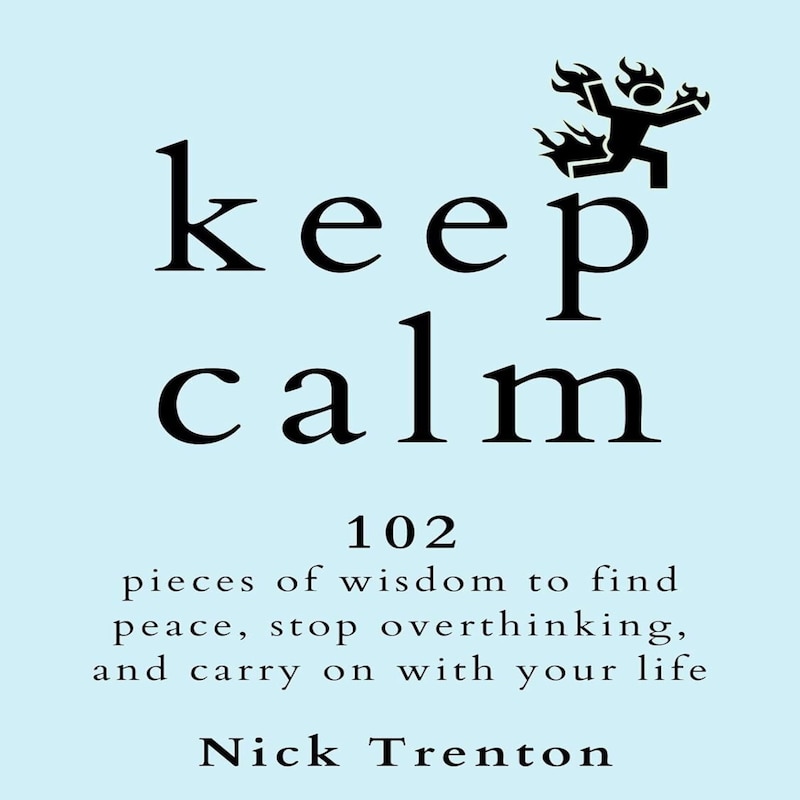
KEEP CALM: 102 Pieces of Wisdom to Find Peace, Stop Overthinking, and Carry On With Your Life (The Path to Calm Book 18) By: Nick Trenton
Hear it Here - https://bit.ly/3TyNTLb
https://www.amazon.com/dp/B0CRRCXNHW
Stop living in your head and get into your life and the present. Life can be peaceful, so come discover how.
A peaceful and happy life starts with our thoughts. But what if you can't stop spiraling or ruminating? Let's turn that frown upside-down.
Wisdom from philosophers, scientists, writers, and emperors -
all made actionable.
KEEP CALM is a book that understands where you’ve been through,the exhausting situation you’ve put yourself into, and how you lose your mind in the trap of anxiety and stress. Acclaimed author Nick Trenton will walk you through the obstacles with detailed and proven techniques to help you rewire your brain, control your thoughts, and change your mental habits.
What’s more, the book will provide you scientific approaches to completely change the way you think and feel about yourself by ending the vicious thought patterns.
Learn to control the root of your happiness.
Nick Trenton grew up in rural Illinois and is quite literally a farm boy. His best friend growing up was his trusty companion Leonard the dachshund. RIP Leonard. Eventually, he made it off the farm and obtained a BS in Economics, followed by an MA in Behavioral Psychology.
Stop worrying, overthinking, stressing, and living in a cloud of anxiety.
-Understanding the surprising and underrated root of your fears and anxieties.
-Mastering your inner voice and how we are all doing it wrong.
-How "mental distance" is a powerful weapon in protecting your calm state of mind.
-The massive power of the mindset of "So what?!".
-Needs versus wants and how this distinction is keeping you in agony.
-Separating between the past, the future, and the present -
and figuring out which one you spend the most time in.
-How to "ride the wave" to success and more about this unique technique.
-Finding our default states and altering it to our advantage.
Become your own best ally. No more sleepness nights, grinding your teeth, and always wondering "what if..." .
Transcripts
While it may seem counterintuitive to some, helping others may turn out to be the most reliable way of helping ourselves.
Speaker:It could be that the corollary is also true: Relentless self-focus is the fast-track way to unhappiness.
Speaker:Acts of Kindness as Cognitive Control
Speaker:By shifting your attention toward helping others, you may experience improvements in your own mental well-being.
Speaker:It sounds nice, but why should this be the case?
Speaker:We’ve already seen that engaging actively with the present brings us out of our minds and out of endless impotent rumination.
Speaker:Engaging in acts of kindness, however, can also serve as a form of cognitive control, allowing you to redirect your thoughts and emotions in a positive and constructive manner.
Speaker:It can be difficult to stay grounded and pragmatic when caught up in our own neuroses—but it’s easier to see the way forward when it comes to other people.
Speaker:Kindness, then, is simple.
Speaker:Consider the story of Emily, who, amidst her own struggles with anxiety, started writing letters of encouragement to hospital patients.
Speaker:As she penned heartfelt words to uplift others, she found herself less entangled in her own anxious thoughts.
Speaker:Simply, all that anxious mental energy was put to some real use in the world.
Speaker:It was channeled and directed.
Speaker:Emily not only felt less alone, but she was distracting herself from useless ruminations, finding a purpose, and increasing her self-efficacy.
Speaker:So, the next time you find yourself mired in negativity, extend a helping hand—it might just be the lifeline you need.
Speaker:You may find even more paradoxical benefit in giving to others what you most feel you lack.
Speaker:If you’re lonely, volunteer to help with isolated older folks trapped indoors.
Speaker:If you’re feeling unloved, work at the orphanage.
Speaker:If you’re feeling directionless in life, offer to coach wayward teens at a summer camp.
Speaker:You get the idea.
Speaker:Consider the butterfly effect of kindness.
Speaker:When Daniel, a teacher dealing with chronic anxiety, decided to start a small scholarship fund for his students, he couldn't have foreseen the ripple of positivity it would create.
Speaker:Not only did he provide opportunities for his students, but he also experienced a remarkable shift in his own well-being.
Speaker:The act of contributing to others' futures acted as a magnetic force, pulling his attention away from anxious thoughts and directing it toward a brighter, altruistic focus.
Speaker:Remember, acts of kindness need not be grand gestures to yield transformative effects.
Speaker:You don’t have to do something flashy or work with a major organization in an impoverished country.
Speaker:Just look around your world and see who is struggling.
Speaker:Struggling with depression, Jane decided to challenge herself: She would express gratitude to a different person every day.
Speaker:Whether it was a heartfelt note or a simple text, Jane's commitment to spreading positivity not only uplifted others but rewired her own thought patterns.
Speaker:She was suddenly aware of just how blessed she was and how many kind, well-meaning people surrounded her.
Speaker:As she shifted her attention toward brightening others' days, her own days began to shine a little brighter as well.
Speaker:Finding Purpose and Fulfillment through Helping Others
Speaker:Anxious minds can be like labyrinths.
Speaker:You don’t want to turn continually inward and get further trapped in the maze.
Speaker:Instead, allow kindness to help you turn outward into the world and into connections with others—who, it won’t be a big surprise, struggle just the same as you do.
Speaker:Helping others can give you a sense of purpose, meaning, fulfillment, and satisfaction that can lower your stress.
Speaker:One afternoon of meaningfully connecting with other human beings can be more powerful than six months spent in therapy, churning endlessly over the same old stories of trauma and victimization.
Speaker:Meet Sam, a father striving to balance the demands of his job and family life.
Speaker:Feeling like a hamster on a wheel, he found solace in mentoring a group of teenagers in his community.
Speaker:As he shared his experiences and insights, he discovered many things:
Speaker:42 00:05:24,680 --> 00:05:35,000 • That he knew a lot more than he thought he did—in fact, he possessed loads of wisdom and experience that others needed and wanted.
Speaker:• That he felt an enormous sense of satisfaction by contributing to the growth and development of young people.
Speaker:• That, to put it bluntly, his life was challenging but it could have been a lot worse!
Speaker:Grumbling about his family took on a fresh perspective when he worked closely with kids who never knew what it was to have a family and never had the privileges he did.
Speaker:• That just as these kids struggled but would work things out, he, too, would have difficulty with his life stage, but he’d learn and grow, too.
Speaker:• That at the end of the day, the value of life was not in the next paycheck, but in being a person of virtue, in connecting with others, and in being a force of good in the world.
Speaker:This gave Sam more resilience and determination than he believed possible.
Speaker:The act of helping them navigate life's challenges provided a perspective that shifted his own worries into the background.
Speaker:This narrative echoes the study's conclusion—when you're engaged in assisting others, you're simultaneously anchoring yourself in the present and gaining a renewed sense of purpose.
Speaker:Think about the last time you performed an act of kindness, whether it was a small gesture like holding the door for someone, or a more substantial effort like volunteering at a local shelter.
Speaker:Remember the warmth that spread within you, the feeling of contributing to someone's happiness.
Speaker:You immediately felt like you wanted to do more, right?
Speaker:This sense of fulfillment is like a balm for your mind, a countermeasure to the turmoil of overthinking and anxiety.
Speaker:It's a reminder that there's more to life than the worries that often consume us.
:The Good News in Bad News
:58 00:07:41,120 --> 00:07:48,960 In a world where we're bombarded with negative news headlines and distressing information at every turn, it's easy to feel overwhelmed and anxious.
:However, recent research conducted by Tel Aviv University's School of Psychological Sciences sheds light on an intriguing phenomenon that can help us navigate the turbulent seas of negativity and regain control of our emotions and cognitive abilities.
:The study suggests that repeated exposure to negative events can have a surprising impact on our mood and cognitive functions.
:Building Resilience through Negative Visualization
:Imagine this scenario: You wake up one morning to a barrage of unsettling news headlines, and your mood takes a nosedive.
:Your mind races with worst-case scenarios, envisioning a bleak future filled with challenges, losses, and setbacks.
:Sound familiar?
:This is where the first tip comes into play: negative visualization.
:Instead of shying away from these distressing thoughts, embrace them.
:Picture those potential challenges vividly, as if they were unfolding before your eyes.
:By repeatedly imagining these realistic negative scenarios, you're doing more than just acknowledging their existence—you're taking control of your emotional response.
:The Tel Aviv University study reveals that initially, exposure to negative information can indeed put you in a bad mood and impair your cognitive abilities.
:Through repetition, however, something remarkable happens.
:These negative scenarios begin to lose their emotional grip on you, resulting in an improved mood and enhanced cognitive performance.
:In other words, you are becoming desensitized to them.
:Naturally, this study isn’t permission to consume hours of mood-damaging online content—most of which is not necessary or beneficial.
:Rather, it’s pointing to the fact that sometimes, our anxiety makes us mentally pull back from certain situations we’ve convinced ourselves are unbearable.
:But by strenuously avoiding and fearing this fear, we only give it more power.
:Imagine you are eaten up with worry over your marriage.
:Things aren’t great, and you are unable to sleep at night stewing over the thought that your spouse is going to file for divorce, leaving you sad, alone, and a little poorer to boot.
:This thought is so unbearable that the more you stress about it, the more it seems to hurt—and the more you stress about it.
:Unfortunately, just lying in bed, ruminating on “What if I get divorced?” over and over is not likely to have therapeutic effects.
:Rather, face the fear head on.
:Typically, you’ll notice that your mind stops at a certain point—but push it onward and follow it through.
:This will help you engage with and eventually counteract “catastrophizing.”
:“What if I get divorced?”
:“Well, so what if you do?”
:“I’ll be sad and all alone, and it’ll leave me destitute, too.”
:“Okay .
:.
:.
:and then what?”
:Notice that this pushes you past your point of catastrophe—the point at which your mind can’t even bear to go further.
:“Well .
:.
:.
:then I suppose I’ll be all alone.
:I’ll have to go live in some crummy apartment for a while and lick my wounds.”
:“You’ll be sad for a while.
:How long?”
:“I don’t know.
:A year?
:Two?”
:“And what happens after two years?”
:“Well, I guess I’ll start moving on eventually .
:.
:.
:but I’ll still be sad.”
:“Of course you will be.
:But will it be the end of the world?”
:“No, it won’t be the end of the world .
:.
:.
:It’ll just be really difficult.”
:“But you would survive it.
:You’d move on, and in a few years, you’d be doing something else.”
:“I guess so.”
:As you can see, the authors of the study are not suggesting that you do more endless catastrophizing.
:Instead, they’re pointing to the act of de-catastrophizing and taking some of the power out of your “worst-case scenarios.”
:Every day, set aside a few minutes to visualize the worst-case scenarios you’re worried about.
:Picture missing a crucial deadline, making a significant mistake, or being rejected or humiliated.
:Don’t pull any punches.
:At first, it will feel uncomfortable.
:But as you persist, notice how this discomfort is really not the end of the world.
:Notice how, as you get familiar with a scenario, it loses some of its emotional power.
:Notice that you can survive it, even if it is unpleasant.
:Notice that life can and will go on, even if the most unthinkable thing comes to pass.
:This is what makes you more resilient.
:Embracing Voluntary Hardships
:Cold showers, insanely early mornings, fasting, deliberately delayed gratification .
:.
:.
:some people use these things to increase their happiness.
:This might sound counterintuitive—why would you willingly add discomfort to your life?
:However, the goal is not masochism but to build resilience, become more present, and reduce anxiety and overthinking.
:Begin with simple challenges, such as taking cold showers or practicing intermittent fasting.
:These might seem like minor inconveniences, but they can have a profound impact on your mental fortitude.
:Cold showers, for instance, force you to confront discomfort and focus your mind on the present moment.
:Likewise, intermittent fasting challenges your impulse control and helps you develop a deeper connection with your body's signals.
:As you become more comfortable with these manageable hardships, gradually increase the difficulty.
:Perhaps you can take on more extended fasts or expose yourself to even colder temperatures.
:By willingly subjecting yourself to these challenges, you're training your mind to adapt and stay present in the face of adversity.
:Even more importantly, you’re teaching yourself that adversity is temporary, and that you can survive it—in fact, it can make you stronger, more grateful, more focused.
:Let me tell a story about my cousin Mike.
:He’s a software engineer plagued by constant overthinking and anxiety, and he decided to implement the concept of manageable voluntary hardships in his life.
:He started with something as simple as a daily cold shower.
:The first few days were excruciating—the shock of cold water on his skin sent shivers down his spine.
:But he persisted.
:With each cold shower, he focused on his breath, learning to embrace discomfort instead of resisting it.
:As weeks turned into months, Mike's capacity to handle discomfort grew.
:He no longer dreaded the cold shower; instead, it became a meditative practice that allowed him to stay grounded and present.
:Encouraged by his progress, he decided to tackle intermittent fasting.
:Skipping breakfast and extending his fasting window challenged his cravings and taught him to listen to his body's hunger cues.
:Mike’s journey wasn't about seeking unnecessary suffering; it was about deliberately introducing challenges to build mental resilience.
:Over time, he found himself less anxious, his overthinking had diminished, and he was better equipped to handle life's uncertainties.
:As a nice side effect, he noticed he was able to quit smoking—because he had trained himself to ride out discomfort and craving and come out the other end unbothered.
:What could you use that skill for in your own life?
