Shownotes
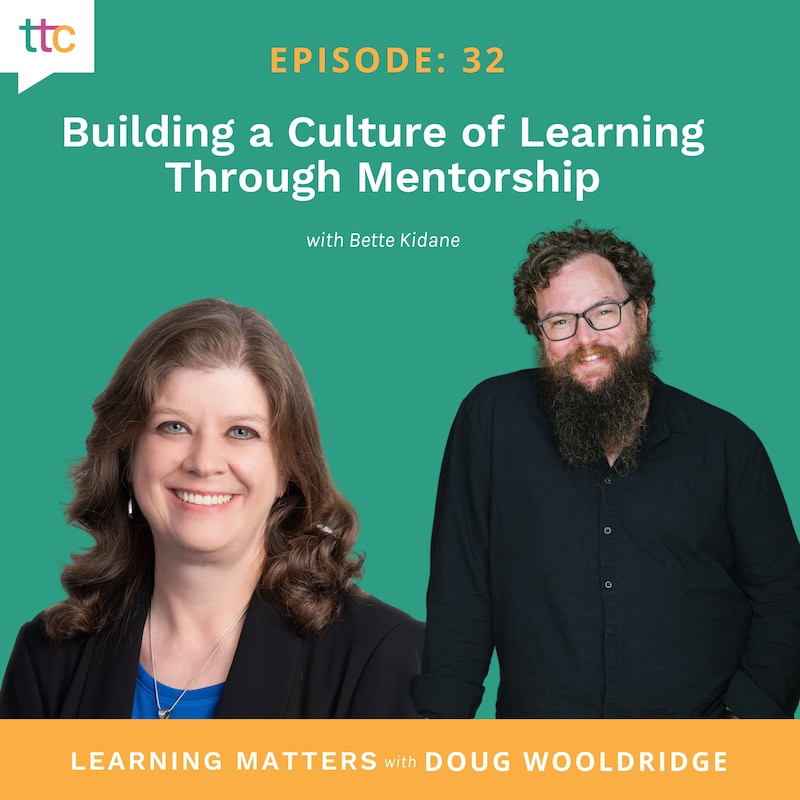
In this episode of Learning Matters, we sit down with Bette Kidane, Senior Director of Learning & Development at Intermountain Health, to uncover how her team completely redesigned their training strategy—and achieved a 747% ROI in the process.
🔗 Connect with Bette Kidane: https://www.linkedin.com/in/bette-rogers-kidane-ms-pmp-crp-cit-9b58776/
What's Inside This Episode?
The power of peer mentoring in onboarding and performance
How structured on-the-job training created deeper engagement
Lessons from a $1.9M/year savings initiative
Bette’s take on AI in L&D—and where it fits (or doesn’t)
Why coaching is the leadership development trend to watch
Bette’s personal journey from shy facilitator to award-winning L&D leader
At ttcInnovations, we help businesses create lasting change with immersive learning experiences. Through instructional strategy, design, and content development we empower employee confidence, performance, and results.
💡 Looking for custom learning experiences without licensing fees? Contact us for a free consultation! https://bit.ly/4aOhPKq
🤝 Need extra hands fast? Try staff augmentation! Click here to get matched with experts in 48 hours - no job posting needed. https://bit.ly/3RiEfLT
🚀 Simplify outsourcing with our subscription plans - predictable pricing and limitless innovation. Book a meeting for your free first week! https://bit.ly/3RiEfLT
🎯 Boost results with serious games for optimal retention and results. Contact our Sales team to learn more: https://bit.ly/3RiEfLT
Transcripts
Welcome back to Learning Matters. I'm Doug Wooldridge, your host. And today I'm very excited to chat with our guest. She's a world strategist that has developed and executed learning strategies for Fortune 500s. She's played a pivotal role in award-winning teams, contributing to 16 awards over four years. She's an author featured in multiple journals through the ROI Institute, and she's senior director learning and development at Intermountain Healthcare.
Bette Kidane, welcome to the show.
Thank you, Doug. I'm really happy to be here today.
Wonderful. Well, today we're going to go over some of the latest innovations in the learning and development world. I'd like to start with this first bet. What strategy matters most in learning and development today?
Let me first say that throughout this interview today, these views are mine only and not the views necessarily of Intermountain Health. So I just want to put that out there. Strategy and learning and development today, I think it is very critical for organizations to create a culture of continuous learning. How can you make learning something to be desired? How can you engage learners in both their career growth as well as helping their teams? A lot of adult learning comes from discussions and thinking things through.
(:So providing opportunities as well for people to come together in a forum to discuss key strategic areas is really not only a great opportunity for learning as well as a great opportunity for connecting and finding solutions. So providing opportunities for people to innovate and also be recognized for their contributions.
Yeah, I think that's so important that we don't just look at learners as individuals that are learning, but as a group of folks, because at the end of the day, what makes an entire corporation run is an entire group of people that are doing different things. So without having communication during the learning cycle, I feel like you're just missing out on opportunities there to build bonds with folks and get them
super engaged within the learning as opposed to just sitting on a computer with a headset on clicking next, next slide.
Absolutely. Oh my gosh. And I think that as part of a learning culture, if you're able to leverage others and leverage peer-to-peer learning, that is an amazing strategy. When people get excited about learning, they want to help others. They want to share what they know. And we've been able to partner peer mentoring with new hired training using structured on the job training framework. And it has really enabled us to leverage the knowledge of the people doing the job.
to help their new teammates and being mentors. And in return, those mentors get new skills as well and they get opportunities. And the mentees of the new hires are getting dedicated support, friendship, inclusion in their teams. I think that leveraging the workforce as trainers is really exciting.
(:Yeah, who better to help train than someone that's already doing the job that you're doing or has done that job in the past? When did you guys first start implementing the peer mentoring program?
Well, it started back in:electronic health record systems and train functionality. And maybe there was some workflow just based on the flow of the system, but it was more focused on the system. So we redesigned it, broke it down to the studs and rebuilt it. We added operational workflows, focus on that. We had a practice, had skill checks or competency validations and
Then we really drastically revised how we delivered the program. It used to be done in full day trainings about a week long. And we changed that up and had it be half day with an instructor and paired the other half day with peer mentoring. So we got people in the teams to be mentors for those new hires coming into their teams.
And we used a structured on the job checklist or competency list that was created with the leaders of each team to structure that program and help those mentors know exactly what to cover, not just be, hey, Joe, come sit with me today. You you're going to watch what I do.
(:That's an incredible reduction of time to complete training there. That's unbelievable.
We had some great results and we were able to reduce the time to independent performance by 41 % across the division, which was amazing. that equated to $1.9 million a year for the life of the program. So we're seeing returns from the program. Very excited about it.
That's got to feel good five years into it.
Yes.
And do you think the success of that was that the learners just felt much more comfortable that they had a helping hand with them throughout the second day of the process?
(:Well, what we found, we did an ROI study on the whole program. so there were the financial benefits of the ROI. was 747 % ROI, which is amazing. Much higher than I ever anticipated it would be. Yeah, yeah. And never thought I'd say, know, hey, we just saved $1.9 million in
productive time, you know, but in addition to that, we were able to do a qualitative analysis of our participants in the program. And they, the mentors reported that they were really excited to be able to help people in their team get, get set up for success, to welcome them into the team, to learn themselves, the workflows better. You know, when you train someone else on something, you become an expert in that content.
So they, learned their jobs even better, but they also learned leadership skills, which was a great boom to them. And many of them reported that they were able to get promotions and move to the next level. So that was pretty exciting. The mentees reported that they felt welcome. They felt included in their team. They were excited and they felt like they had some.
And they also, was really cool. We had some people report that they felt like Intermountain really cared about them because they invested so much in their learning and their training. So the mentees really enjoyed it. And then our team leaders reported that their teams were more engaged. They seemed happier. They also reported a reduction in the time to proficiency. And we're just very excited for this type of learning approach.
How did you come to this learning approach? you set up mentoring, peer mentoring type of things before in the past?
(:Not at all. was basically looking into what's going to provide our best results. So we leveraged cognitive behavioral theory, which is peer modeling. So the modeling of behaviors by a peer encourages someone to do those behaviors the same way as the peer. So there was that. And then there was structured on the job training, which provides that reinforcement on the job of what is learned in class.
So I'd been doing structured on the job training for years and across various organizations. So I thought, well, we can even bring in structured on the job training as well. And then that peer mentor program is going to even take it to the next level because of that psychosocial benefit that the, that the payers have. They have, they bond, learn from each other. They have a relationship that grows with them and there it brings that personal approach, you know,
much more so than the instructor and the group or the e-learning, which is very impersonal. So it really kind of cemented everything together with that personal approach.
I would love to know how your stakeholders took the idea that we're going to take this training down from seven days to basically two half days. Were they a little trepidatious about it?
It went from maybe five days to 10 half days. it moved out longer. But actually we got really good adoption, really good support of it, partly because our senior leaders of the division of the revenue cycle, as well as the learning and development group, were very supportive of it. And also that the leaders of the operations, the teams, they knew that what we were doing already wasn't working. So we needed to be
(:be able to try something else. And I think it made sense to them. So they are supportive. think we've had pushback in terms of, don't have the people to do this, or it's hard to get people to be mentors. We did create a mentoring development program for those mentors. So they learn how to provide feedback, how to evaluate performance and tasks and basically how to be a mentor, how to, you
what's the best approach to teach this type of skill or support someone to learn this type of skill. So that has been a good thing, but we did get pushback from leaders in terms of, does everybody have to go through this training? We don't have enough people to be mentors, you know, that kind of thing. And we've really encouraged, especially as we've expanded into our medical groups or our clinics, which often maybe just have one person up at the front desk, they don't have.
more than one or a very small staff to be creative in who they get to be their mentors. Maybe somebody at a different job that also does that job as a backup can be the mentor, or maybe someone at another location can be a mentor. You can pool them. You can get maybe a float pool to get to be mentors. we've really tried to support the leaders to think creatively in terms of sourcing those.
When you have to take an entire training program and go down to the studs, what's your first step in the rebuild after you've reached those studs and pulled all the wires out?
Well, the very first step is determining, you know, what does this position do? What is most difficult? What is most important and what is done most frequently? And then you can rank those things in terms of those, those differentiators. And then you can really kind of call down. What does this program have to include? Because there's always going to be enough to train somebody for a full year on their job.
(:Sure.
But you can't do that. have to really focus it. So that's the process we followed. We did a job analysis for every group and determined what are the most impactful tasks that they need to be able to do at least 30 to 60 days into the role. And then from there, we figured out what skills were needed. How are we going to train those skills? How many practices would those skills require?
just very classic, instructional design.
Back to base.
(:Are there any trends up and coming in the world of learning and development that are most exciting to you or maybe scary?
Well, there is AI and I think we'll probably touch on that a little bit. But I think that what I am really excited about that I see organizations adopting more and more is coaching, coaching for leaders. And I really like that that is taking off because it's very impactful. Our organization has a pretty robust coaching program and I am fortunate enough to be a coach in that program. And so I really see the impact that that
that approach has on leaders. They're kind of sounding more. They have somebody that's really interested in them, listens to what their concerns are, their issues are, helps them kind of grapple with them and figure out what they need to do. And it's such a great gift really for a leader to have that person who, no judgment, you know, I'm here to listen to you and to help you get to the next level of whatever it is that you want to do.
So, I mean, just that open-ended goal of what do you want? What do you want from your career? What do you want from this job? What do you want from this project that you're on? It can be anything. So, I really believe that organizations that are using either internal or external coaches are really providing a great service and a valuable asset. And I think the research also shows that, that coaching really increases engagement.
not only from those people who are being coached, but their teams as well. And also it helps with operational results. So I really, really like that coaching is becoming more and more of a tool within organizations.
(:Do you think that that's kind of a new trend or do you think that that is something that is circular in the corporate world where a couple years go by and folks are like, wait, we need to really focus back on our leadership.
Well, think leadership development goes in cycles. are certain trends that happen. think coaching and mentoring has always been in the leadership space, whether or not you had a formal program or a very informal program. Working with someone who you feel is somebody that you trust and that you can work with has always been how people learn to do their work and how modeling someone who's
the way that you want to be. That's just classic mentoring right there. But I think the formal programs have been really great because now there's organizations that you can hire that have teams of coaches that can come in and be at the fingertips of the people that need it. Just like, I have a coach available. Amazing. The first time I heard that somebody in our organization had the opportunity to have a coach, like,
How'd they get a coach, huh?
Hey, I, you what am I gonna do to get a couch?
(:We've told us a bunch about this massive initiative that you guys took on. Is there a new initiative this year that you guys are working towards that you're most excited about?
there's even more massive initiative that we're doing right now. boy. So in healthcare, the spine of our operation is our electronic health record system. So we have a massive system. It's epic. It's a very well-known electronic health record system. And we currently use that only in one region of our organization and the other two regions use a different system. Yeah.
I came from the division that has the legacy Epic system. And then when we learned that we were going to move the rest of the organization to Epic, it was one of those moments like, yay! And then it was like, whoa!
No.
Oh my goodness, what is that going to mean? And then you start panicking, right? So we are about six months away from our implementation date. August, no September 6th. And we've been working on this for about a year and a half now. And it's been really, really cool because we've been able to come together as a training team in our electronic medical record space.
(:Okay
(:both on the clinical side as well as the revenue cycle side and the health informatics information management side came all together as a learning team and were really able to define what processes are we going to use? How are we going to find space for all this training? And it's also a big bang go live. So it's like one day on, done. So that makes it a big challenge for training.
because you don't have those phases where you can tweak and get better and tweak and get better and everything has to be ready and done for the one day that goes live. So that's been a big challenge for the scale. It's 45,000 users that we're turning on in September. So we've been planning for this literally for a year and a half now.
I can only imagine.
(:And our learning architects have been working on the development of the training, scheduling those course offerings, mapping the roles to to Epic Security Access and training assignments, like what classes are each role going to take and change management. Just the change management has been huge. So the scale of this has been just unparalleled, really.
Yeah, has it gotten easier over time or I would imagine much more difficult?
Yeah, it has gotten a little easier once you kind of get yourself in that mind frame of you know, I'm not talking a hundred people I'm talking 45,000 Then we kind of get into that mindset and that's been that's been good but We're moving into our training delivery phase next week. So Okay, we're credentialing our trainers. We have contractors that are helping we got a vendor that were that
does part of our revenue cycle and a part of our organization, we're credentialing their trainers. along the way, we are making changes to our legacy system to bring it up to the same level as the what's going to go live timber. there's, there's, you know, one region changes, there's the whole changes, there's everything going on with all the different courses and the different.
roles we're training. So it's just been really all-encompassing.
(:Well, I hope you have a vacation plan for like the week after it goes live.
I think our whole team is going to be out the month of October.
that's awesome. Well, before I transfer or change pace to more personal questions, I got to bring up AI. So how are you guys leveraging AI currently in your work?
you
(:Well, we're just in the beginning stages of using AI on our learning and development team. In healthcare, it's very regulated and it's very careful. So we have to use products that have been vetted and approved for us. So just this year, we were able to get co-pilot and we have several on our team that are using that now and we're coming up with more more use cases for it. I see great potential for
helping with research for new programs, helping with some of those mundane things like note taking and agenda writing. I have the opportunity to attend various learning and development conferences and AI is always the number one topic these days. I see a lot of organizations using it very proactively and very cutting edge. I think in
Healthcare is a little bit more conservative of approach, but we are using some AI role plays in some of our leadership programs, and we are actively looking for different ways where we can leverage AI. Our division has implemented automation, machine learning a little bit more than some of the AI things because of some of those mundane routine tasks in the...
the billing and the work queues kind of world where we can take some of that mundane stuff away from folks and automate it. So we've done quite a bit of that and I anticipate seeing a lot more of that in the near future. we're adopting it, learning it, trying to find opportunities for it.
Any advice for folks that are just trying to dip their toes into the world of AI?
(:I just say, find out if you have a need for it, what your need is, and then what tools would you need because anybody can get Microsoft Copa right now and jump right in. But some of those larger models are a little bit more difficult to bridge the gap. And I have to say that on a personal level, I think AI is great in terms of helping with efficiencies, but
I find that it's, that it's average, you know, the output is average. If you think about it, if you're feeding into a large language model, you know, content that is done, that's amazing, know, Pulitzer Prize winning content, and then you've got content from average everyday person, all that gets fed in, it's going to be average because all the thing in there is the full continuum.
100 % agree.
(:All that's getting in there is from the full continuum. So I find that the outputs that I read, can tell right away if it's AI generated. It's flat. It doesn't have that nuance to it.
It's not flat is a very good way to put that.
Not as creative and interesting, I find.
So no true person
Your personality is very flat.
(:When we spend so much time talking about the importance of communicating people to people, you don't want to lose that just because you don't want to spend five extra minutes to write an email. Yeah.
I think that the creativity that the human person brings in is, it's going to be difficult to emulate that from a machine. And it's really just emulating one person's view of what's funny or what one person thinks could be a poem. I'm not saying that some of those poems that it cranks out are not interesting or entertaining, but they just don't have that special spark.
Chat GPT is no Shakespeare.
Well, let's get to some more personal side of things. Tell me about you, Beth. Take me back to little Beth days and what led you here to become senior director learning and development at Intermountain Healthcare.
Well, I've always loved learning, especially reading. I was always a little reading nerd and loved to participate in those summer library reading contests. I think I enjoyed winning the little Snoopy stuffed animal more than anything, but I reading and I enjoyed school, but I never really considered teaching as a career.
(:Yeah
(:partly because it would have required me to be in front of group and I was extremely shy. No, it's true. I was extremely shy. I always get report cards that said, know, that is great. Love, you know, does really well in school, but we would really like her to participate more in class. I'm like, nope, not happening. But I always really enjoyed helping people, interacting one-on-one.
Ha
(:and learning about different cultures. So I went into international business in college and studied international business in French, and then went into international trade right out of college. worked in Seattle. I worked as a US customs broker. I cleared ship loads of imports through US customs and all the other government agencies that regulate those things. And really loved that area. I found it fascinating.
But I had a boss or a VP that I reported to that I worked up my way over time into an operational leadership role of a centralized customer service unit for customs brokerage. And she went to another organization and she called me one day and said, you know, I've got this role that I think you'd be amazing at. I'm like, really? What would that be? And she's like, it's a training manager.
What?
training. And I'm thinking myself, have you seen me in front of a group doing bar, I literally shake and my voice cracks. So I'm thinking, I don't know about this one. And she said, I think you'd be really good at it. So I thought about it, and it was a great opportunity. And I thought, you know what, this might be just the kick in the pants I need to get over my shyness. So I took the leap. And I have to say those first few times where I had to train in front of a group.
It was so painful. was just awful. Face was red, voice was shaking. mean, it was just incredible. But over time, I was able to really become much more comfortable to the point where now I can address groups of, you know, hundreds of people without a blink. So it's, it's really helped me in that area. So I would encourage anyone who is struggling with
(:no.
(:public speaking or shyness to, hey, come train a class. Not just one class, but like a lot of classes is in my team. Yes. But I also never really understood what training entailed. And I never knew that there was a position called instructional designer who was offstage behind the scene. So that was really where I felt the most at home. And I really loved being able to
kind of think creatively and put myself in the shoes of the learner and think, what would I need to learn this thing, this task? how could I learn it so that it wasn't just boring? And that was one of the things that I learned how to do as an instructional designer. And one of the things that I really loved in terms of learning different cultures is I worked as a consultant for many years at a training
company, and was able to go into companies all over the world and learn what they did and was able to put myself in the shoes of their learners and think about how am I going to learn how to train someone learning how to sew? You know, I actually trained some trainers at a apparel factory in Hong Kong and China.
So I'm thinking, okay, so if they're training people who are learning how to sew, what do they need to know? What do they need to be able to do? What are the skills they need? So I just love that about the learning industry is that you can learn so much about so many different jobs, so many different types of life, so many different ways of being that is truly fascinating and helping them. I really enjoy that.
I think that's the coolest part about the learning and development world is that a lot of folks tend to be in that consultant role where they're just picking up contracts here and there and potential positions at a place to help with training needs for a big initiative. And you just get to immerse yourself in a whole life that you most likely never even thought of.
(:Yeah, yeah, I've trained things, everything from like, auto parts sales to how to talk to people on the phone as as a healthcare, healthcare customer service agent, how to sell cell phones. It's just very broad, all the things that I've been able to learn about. So it's been cool.
Do you have a favorite industry that you have latched onto?
Well, you know, I really enjoy healthcare. Yeah. I really enjoy healthcare and the ability to help the patient. So it's that altruistic side. I really enjoy being able to make a difference in our communities.
When did you transition into healthcare?
was about 10 years ago. And I came into Intermountain Health, was at SCL Health at the time, as a training manager over instructional design, quality, learning analytics, and instructional design methods. So I was brought in to train the trainers, how to be trainers, because many times in healthcare and probably a lot of other industries.
(:people that come into training are usually really high performers in that industry. they're not necessarily trained how to be trainers. So since I'd been working as a trainer of trainers, as a consultant for many years, I came in to help provide that solid methodology for the group. And for a period of maybe four years, the group went from
collection of people that knew various parts of healthcare to very high performing learning and development team. Very proud moment when we won our first award as a learning and development team for best learning team. It was really exciting.
That's a drastic difference, turning yourself into a professional on one thing and then a professional in learning and development. Even if you are the subject matter expert, it's tough to get to that point of where you're having success with engagement and getting people up to speed. Well, I have one final question for you here. if you could go back in time.
Let's say just out of college and you were able to sit down with younger bet on a park bench. What advice would you give to yourself?
Hmm, I think I just saying you got this
(:I love it. Just that little bit of pep. You got it. I do got this.
Don't worry about what others think. Don't be shy. Be confident in yourself. Embrace opportunities that are outside your comfort zone. Seize the moment and don't give up. know, just do things that you want to do, not that you feel like you have to do. And then I've tried over the course of my career to really be vocal and advocate for what I want in my career, where I want to go. And that's part of that.
being confident in yourself. So I think that that's something that I wish I had learned earlier. Just go with it and be confident that you're going to do great.
Yeah, who would've know you'd be in front of hundreds of people telling them how to do their jobs.
Don't rub it in, it's still a little daunting sometimes.
(:I love it. Well, before I get you out of here, where can people connect with you, bet?
Well, I'm on LinkedIn, so you can look me up. It's vet.kadani, K-I-D-A-N-E. And I work with Intermountain Health and would love to hear from folks.
Awesome. Well, this has been an incredible conversation and thank you for giving me such a wonderful deep dive into your world. Really appreciate you coming on the show today. Thank you listeners. If you learned something today or if you had a laugh, tell someone about it. Thanks again, Beth. Thank you. This has been another episode of Learning Matters. As always, like and subscribe wherever you get your podcasts and don't hesitate to reach out to us here at TTC Innovations.
Thank you.
(:to learn more about how we can help you with your training needs. See you next time.


