Shownotes
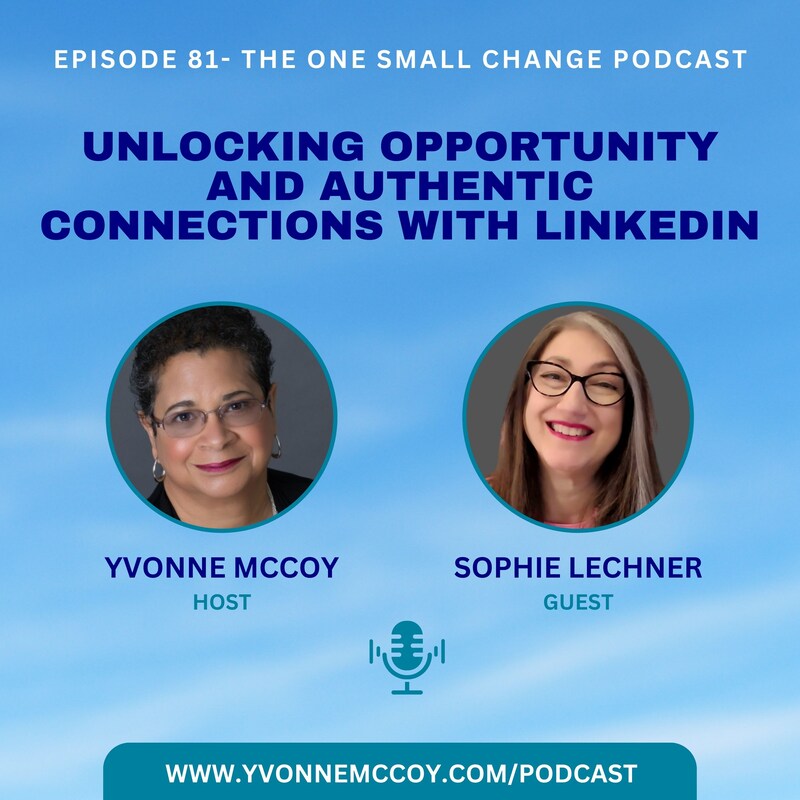
In this episode of The One Small Change Podcast, Yvonne McCoy sits down with Sophie Lechner, a marketing coach with a passion for authentic relationship-building on LinkedIn. Sophie Lechner shares how an unexpected pivot during the pandemic led her to discover the untapped power of LinkedIn—not just as a resume platform, but as a hub for real, meaningful engagement. Together, Yvonne McCoy and Sophie Lechner explore the value of small changes, the importance of quality over quantity in marketing, and give tactical advice for anyone looking to make LinkedIn a richer, more fulfilling experience.
Guest Bio:
Sophie Lechner is a seasoned marketing coach who helps entrepreneurs and professionals use LinkedIn as a tool for authentic connection and sustainable business growth. With over 20 years of experience leveraging LinkedIn, Sophie Lechner guides her clients to market with intention, prioritize relationships, and find their unique voice. She is the creator of The Magnet Model and the author of "Unlock Your Impact."
Chapters:
00:00 "One Small Change Podcast"
04:35 "Authentic Connections Platform"
09:25 "Algorithm Tips: Comments Matter"
11:01 "Authentic Engagement in Posting Parties"
15:04 "Quality Over Quantity in Posting"
18:05 "Consistency Builds Trust and Momentum"
21:02 "Joyful, Authentic Marketing Strategies"
26:18 "Beach Reset and Staying Curious"
26:59 "Podcast Growth and Small Changes"
Quote from the Guest:
"The power of LinkedIn is in those exchanges, in those conversations that lead to, you know, DM exchanges, a couple of which, after which you say, let's get on a call. So it's the relationships that you build that really are the core."
Link:
Sign up for Sophie’s free monthly co-working here. It's a 2-hour session with other mission-driven entrepreneurs where you’ll get work done, with 15 to 20 minutes of office-hour style Q&A on anything related to LinkedIn, marketing or book writing. She also provides a prompt (human, not AI) that usually inspires several posts.
Transcripts
Hello, everybody, and welcome to the One Small Change. I am so
Speaker:thrilled that you took time out of your busy schedule to be on this
Speaker:journey of exploration and transformation with me. I'm your host,
Speaker:Yvonne McCoy, and I bring almost 30 years of entrepreneurial experience,
Speaker:and I have a passion for discovering growth through the power of
Speaker:seemingly small change. So, again, I want to thank you for taking time out
Speaker:of your busy bus, your busy business, your busy week,
Speaker:so that we can talk about the things that can make
Speaker:your business better. And I have a fabulous guest for you today,
Speaker:and she's going to share how a smaller, unexpected
Speaker:decision sparked a remarkable transformation and growth
Speaker:in her personal and professional life. And Sophie
Speaker:Lechner is the person who is going to do that for you today.
Speaker:I am so glad that you took time to do this, Sophie, for my people.
Speaker:Thank you. Thank you for having me, Yvonne. It's really fun to
Speaker:be here. It's gonna be fun. So, Sophie, tell us
Speaker:what you do, and tell us what was the thing that made you, you know,
Speaker:the change that brought about this change that makes you particularly good at what
Speaker:you do? Yeah. So 20 years
Speaker:ago, when LinkedIn first came out, I started using
Speaker:it and fell in love with it because it was a way for me to
Speaker:continue doing what I had loved doing all my life, which
Speaker:was to connect with people all over the world
Speaker:and get to know new people and connect with them and, you know, build
Speaker:relationships. So I started using it 20 years ago. And
Speaker:what happened? There's a long, you know, story, but
Speaker:I'm sorry, Yvonne, I am hearing some weird sounds. Are you as
Speaker:well? No. Okay, so sorry. Did
Speaker:you hear a beep? No, I. I'm hearing some
Speaker:sort of a weird, echoey sounds, but I'll
Speaker:ignore it if you don't hear it. I apologize. Now you'll have to cut that
Speaker:out. No, but it. We're live, and it is what it is. Oh, it
Speaker:is what it is. Okay. All right.
Speaker:So I got to a point I was.
Speaker:I had a business, and I got to a point where
Speaker:the pandemic happened, and my business didn't, you know, was. Did
Speaker:not really survive that. And in that moment, I
Speaker:said, well, you know, we're all stuck and frozen in time. What can I do?
Speaker:And there were a lot of entrepreneurs around me who were just really
Speaker:panicking and not sure what to do for their, you know, business
Speaker:development. And I kept telling them, well, you can use LinkedIn.
Speaker:And that's when I realized that a lot of people didn't know how to use
Speaker:LinkedIn. Were just really in the dark about
Speaker:how amazing a tool it is. And I
Speaker:started offering free coaching on how to use
Speaker:LinkedIn just to everybody around me as a thing to,
Speaker:to help out. And, and, you know, I was, I was not able to do
Speaker:anything in my business at that moment, so it felt like the right thing to
Speaker:do. And lo and behold, I had a lot of demand. A lot of
Speaker:people kept coming back and saying, that was so helpful. I want more.
Speaker:And from that evolved my current business,
Speaker:which is now actually broader than
Speaker:LinkedIn. It's really grown into marketing coaching.
Speaker:But that's the little decision that I made that one day that
Speaker:actually really grew into the business I have today. And,
Speaker:and I have to tell you, my story is somewhat similar that, you know,
Speaker:I was working with nonprofits, and on a Monday I had a business, and on
Speaker:a Friday I didn't. And so, you know, the part that I
Speaker:think is really important for entrepreneurs to take a look at is,
Speaker:is that the flip side of failure or
Speaker:chaos is opportunity. Right. If you
Speaker:take a minute to take a look at it and see what's going on, if
Speaker:you know that as a, as a, an entrepreneur,
Speaker:everything is constantly changing, and so you have to be agile and look for
Speaker:opportunities. And you did that because I think when I first
Speaker:met you, you were doing something with
Speaker:overseas companies, trying to get people. Yeah, so.
Speaker:Yeah, yeah, yeah. Companies from abroad to enter the
Speaker:US Market. So, you know, at that moment of the
Speaker:pandemic, it just, it was just not. Yeah. Conducive. Let's put
Speaker:it this way. So, so, so, you know, it, it may not look
Speaker:like a straight line, you know, because this is something totally different.
Speaker:So tell us about what it was that you found so amazing
Speaker:about LinkedIn. Oh, well,
Speaker:I think it's a platform where you can just have
Speaker:really authentic relationships and authentic
Speaker:conversations, like Facebook, Instagram,
Speaker:the other ones. You know, it feels to me very
Speaker:superficial. There's not the same
Speaker:ability to really go straight to the crux of the matter and have
Speaker:a conversation about, you know, any topic that you're writing
Speaker:about or commenting about. So it, it, there's.
Speaker:That there's real people behind it that you can really
Speaker:have connections with that can bring you business and
Speaker:connect you with other people. And the, and the platform
Speaker:just has a lot of different functionalities,
Speaker:searches, comments and dms and
Speaker:a lot of ways to just find the kinds of people that you want to
Speaker:talk to and the kinds of topics that you're interested in.
Speaker:So I, I just really love it. And a lot of people that I
Speaker:know love it too. Well, I know I came very late
Speaker:to social media and for one of the reasons that you said, I didn't want
Speaker:to dance and I didn't want to show people pictures of my food.
Speaker:Right. So I, I am probably one of the people who,
Speaker:having come late to all of it, not using LinkedIn
Speaker:to the best of my ability. So maybe this is
Speaker:a good place for me to ask you three things that people should definitely be
Speaker:doing to get the most out of their LinkedIn.
Speaker:Sure. So the first thing, and this is,
Speaker:regardless whether you are going to use LinkedIn for your business
Speaker:or not, you should definitely have a very
Speaker:well completed profile that really captures
Speaker:the essence of who you are, who you can help,
Speaker:how you can help them. And then I always say add
Speaker:your mission, your vision and your passion, which is very
Speaker:much missing. So a lot of people have a LinkedIn profile that's a, that's a,
Speaker:a resume, you know, at best, or just a bio in
Speaker:the third person. It's very dry. And what you want to do is really
Speaker:make it come alive and look at your
Speaker:profile as a. Imagine it's a shop
Speaker:window. Right. So anybody walking past, you really want them to
Speaker:stop and really come in and explore and
Speaker:see everything they could possibly want to check out to get
Speaker:to know you better and know like, and trust you. So
Speaker:definitely have a profile. So can I just
Speaker:say one thing and that is, and I say this for
Speaker:me, because I did this and it's once you put
Speaker:it up there, check it regularly to see if it's still
Speaker:relevant. Because, like, somebody had me put on a LinkedIn
Speaker:profile, which I put in, and then, you know, a year later I was doing
Speaker:something totally different and never had, never went back to update
Speaker:it. Yes,
Speaker:definitely go back and make sure it's up to date. You
Speaker:should know that when people Google your name, the first thing that comes
Speaker:up is your LinkedIn profile. So if you have, you know,
Speaker:tumbleweeds on there, it just, it gives a very negative
Speaker:impression. It's not just, you know, neutral,
Speaker:it gives a bad impression. So make sure that you have a really good
Speaker:profile. The other thing I would say is
Speaker:really use LinkedIn as a way to, to build
Speaker:relationships. A lot of people say, oh, I need to post, I
Speaker:need to post. And it's a drag, you know, and they go ahead and they
Speaker:throw stuff over the wall and, you know, post, post, post. And
Speaker:if you're not engaging with your content and you're not, you know,
Speaker:getting into conversations with people who are commenting
Speaker:then, or comment on other people's content,
Speaker:then it's just, you may as well just do nothing. You know, have your, have
Speaker:your profile and just go do something else. The power of LinkedIn
Speaker:is in those exchanges, in those conversations
Speaker:that lead to, you know, DM exchanges,
Speaker:a couple of which, after which you say, let's get on a
Speaker:call. Right? So it's the relationships that you build that
Speaker:really are the core. And it's just business overall, Right?
Speaker:That's how you do business, is you build relationships. So it's the same thing on
Speaker:LinkedIn. So those. Yeah, so let
Speaker:me, let me, you know, I've heard lots of things about comments. You know, some
Speaker:people say,
Speaker:you know, it's not enough just to put a reaction, you need to put a
Speaker:comment. The comment needs to be, you know, six, at least
Speaker:six words or longer. I mean,
Speaker:they're just a whole lot of things that, and, and I don't know what's
Speaker:true and what's not true. Yeah, so the thing about,
Speaker:yeah, the likes don't do much, but the thing about the comments, you want to
Speaker:have more than six words, that's simply an algorithm
Speaker:thing rule that you want to follow. If it's less than,
Speaker:it won't be counted by the algorithm as a comment, and
Speaker:so it won't promote the,
Speaker:the post as much in the algorithm.
Speaker:I'm not crazy about having conversations about the algorithm. There's a couple of things
Speaker:to know, but other than that, I don't think it's worth really researching.
Speaker:Some people put out these hundred plus pages, you
Speaker:know, guides to the algorithm. In my mind, that's
Speaker:a waste of time because you really should be spending your time
Speaker:having real conversations. And so when you're putting
Speaker:a comment, if you say anything of any substance at all, even if
Speaker:it's just, just really basic, it's going to be more than six
Speaker:words, right? So the point is to start a conversation
Speaker:and if you're commenting on other people's content, in order to
Speaker:begin that relationship, if you just say, nice
Speaker:post, it's not going to start a conversation.
Speaker:Right? So you need to say something, ask a question, make a comment, say
Speaker:something you disagree with or agree with, or you know, give
Speaker:an example, whatever that might be. So
Speaker:I don't know if this is an algorithm question or not, but I know people
Speaker:have LinkedIn posting parties.
Speaker:Does that actually help you or is that.
Speaker:Yeah, so, so there's, you have to be
Speaker:careful if you're doing posting parties
Speaker:that, that they,
Speaker:that they really are with people who will have
Speaker:an actual relationship and, and actually make
Speaker:real good comments. What I mean by that is there was one
Speaker:point in time where everybody was doing posting parties and,
Speaker:you know, they would send like 60 or 100 links
Speaker:and everybody would go and say, nice post, nice post, nice post. And, you know,
Speaker:and LinkedIn cotton onto that. And so really cracked down
Speaker:on some people that were doing that. If you have a real community
Speaker:and people are really making actual
Speaker:authentic comments in there, in my mind, it's fine.
Speaker:And it does help a lot because again, the
Speaker:algorithm will see that there's activity on a post
Speaker:and will give it more visibility than it would otherwise.
Speaker:So it does help. So one of the things that I think I want to
Speaker:bring up is what you said in the beginning, and
Speaker:that is you want to treat LinkedIn as
Speaker:a place to develop relationships and not just make it
Speaker:a mechanical thing that you're just doing, because otherwise you're
Speaker:not going to get the most out of it. And so it's not about
Speaker:quantity as much as it is about
Speaker:intentionality and connection. And I
Speaker:think that's where a lot of people get it wrong. I mean, and I think
Speaker:that's why a lot of people go, I don't want to do this because there
Speaker:just, you know, too much going on. Yes. One more question. And this
Speaker:is just for me. And that is,
Speaker:as I have been posting more and making more comments for other people
Speaker:and stuff, I am getting more impressions on
Speaker:my post, and I have no idea what that means.
Speaker:Yep. So an impression basically means that your
Speaker:post has, you know, when you scroll
Speaker:like crazy, you go fast and you're scrolling. Anything
Speaker:that has entered your field of vision really fast within that
Speaker:moment is counted as an impression for that person's post.
Speaker:So it just means an opportunity for somebody to have
Speaker:seen your post, whether they flicked through it really fast
Speaker:or whether they stopped and, and read it. So the
Speaker:value of impressions is questionable.
Speaker:Questionable. On the other hand, the more
Speaker:impressions you have, the more chances you do have of people
Speaker:actually stopping and actually reading and actually leaving a comment.
Speaker:So if you get very few in impressions,
Speaker:it's not going to lead you to a lot of people who see it. But
Speaker:if you get a lot of impressions doesn't mean, if you have a thousand, doesn't
Speaker:mean a thousand people saw your post. That's, that's because I know for me, when
Speaker:I first started, it was, you know, around 100, 150, and
Speaker:now it's like 400, which is like, you know,
Speaker:in my brain I'm like, this has got to be good, because it's going up.
Speaker:Don't know what it means, but something is happening. Yeah,
Speaker:it's definitely good. And it continues to grow. And you're right.
Speaker:The. The thing to take into account is the growth
Speaker:from where you are now to where you were before.
Speaker:So we got. I've interrupted you a lot, so I want to make sure you
Speaker:stay. I'm. I let you stay. So we talked about your profile,
Speaker:talked about. Posting content.
Speaker:Yeah. And relationships. Yeah, relationships.
Speaker:Yeah. And you mentioned something about, you know, a lot of people will get
Speaker:discouraged and they don't want to. They think it's too much work and, you know,
Speaker:it's quality over quantity, you said. And you're
Speaker:absolutely right. And one of the key things that I say to people that
Speaker:surprises them a lot and sometimes gets them over From
Speaker:Instagram to LinkedIn is I say, you only need to post once a
Speaker:week. They're like, what, Once a week? I thought you had to do it
Speaker:every day, several times a day. No, that's Instagram, which. I don't know how
Speaker:anybody does it. But if you post once
Speaker:a week, that's enough for you to have content that is valuable.
Speaker:And that's the next thing I like to talk about. So
Speaker:you should spend some time commenting and, you know,
Speaker:so you post once a week, and the other days of the week you could
Speaker:be commenting and just making sure you're building relationships, basically. Because
Speaker:if somebody is posting every day, you know, then it's just
Speaker:too much time. You don't have time left to do commenting and all of that
Speaker:unless you spend two hours a day on LinkedIn, which is not realistic.
Speaker:So the third thing I want to talk about is really the quality
Speaker:of what it is that you're posting. Posting. If you're going to be posting,
Speaker:you don't want to be doing promotion all the time. I like to
Speaker:have 80, 20. So 20% of the time, you may be
Speaker:promoting a lead magnet or saying, get on a call
Speaker:with me, or promoting a workshop. You're doing something like that. The rest of the
Speaker:time, you want to be educating your audience
Speaker:and you want to make sure. I find a lot of people are
Speaker:dressing only the clients that are ready to
Speaker:choose a provider. Right. And we
Speaker:really tend to forget the whole
Speaker:huge part of the population that is unaware.
Speaker:Unaware that they have a problem, unaware of what their symptoms
Speaker:might look like, unaware of the fact that it's fixable,
Speaker:what kinds of solutions are out there. And all of that
Speaker:content is what is going to
Speaker:make people open their eyes to the fact that they could come to
Speaker:you and you could be
Speaker:marketing and posting up the wazoo.
Speaker:If those people don't understand that they have a problem,
Speaker:you're going to be speaking in the void. So that's one of the
Speaker:big, you know, misconceptions I want to bust. So
Speaker:I, you know, you're talking my language because what
Speaker:we're talking about is the client journey. And I call
Speaker:that, you know, when I talk to people, I talk to them about what I
Speaker:call the elephant in the room. You wake, you know, if your
Speaker:client doesn't wake up in the morning and go, I am cited to
Speaker:look for this, that they need it,
Speaker:right? So, you know, what I try to do and when
Speaker:I use AI and I, you know, I usually have something that I want to
Speaker:talk about for the month. And I say to AI, this is what my,
Speaker:my topic that I, you know, that I want to talk about. You know, this
Speaker:is the tone that I want to take. Give me eight titles
Speaker:for two posts a week that will take me from
Speaker:curious and, you know, educate to up
Speaker:to my workshop that I absolutely, you know, compelling and I need to
Speaker:attend. So the idea is, you know, if
Speaker:you don't know that you have a problem, that's part of what you have
Speaker:to do. And you start to plant those seeds. They may not come
Speaker:to you right at that first pose, but, you know,
Speaker:consistency, I think that's where consistency
Speaker:really plays a really big part in
Speaker:developing the momentum in your business. Because one,
Speaker:people see that you are, I think, reliable and
Speaker:consistent. You show up every week, right,
Speaker:that you're not going to disappear, that your message is something
Speaker:that, especially if you speak the
Speaker:language that they speak. And by that I mean,
Speaker:you know, one of the things I say is I can relate to
Speaker:most women because we have got. There's a certain
Speaker:thing that as women we go through, right?
Speaker:I mean, and it's somewhat applicable to men, too. But,
Speaker:you know, I think at someplace at the end of your
Speaker:40s or so, going on to your 50s, I think most
Speaker:women go, is this where I thought I would be? Or I'm
Speaker:halfway there and, you know, there's got to be more,
Speaker:right? And so I know that that's something that I can talk about,
Speaker:having gone through it and gone through it, right. That
Speaker:I can use when I'm talking to the people that I'm trying to attract.
Speaker:And, you know, I think the other part to that is
Speaker:making it so.
Speaker:This is terrible. Anytime somebody says it's not your fault.
Speaker:I'm in. And there's
Speaker:reasons why, you know, when you have a problem, it's not your fault.
Speaker:Not that you shouldn't take responsibility, but, you know, the
Speaker:expectations of you, you know, 20 years earlier is
Speaker:different than what you want now. And so the world has changed and that, you
Speaker:know, But I think what you're saying is absolutely,
Speaker:absolutely correct. And I think people forget that a lot. I mean, when you
Speaker:look at people, you shouldn't see a dollar sign on their forehead.
Speaker:Yeah, yeah. And there's a lot of beliefs that get in the way. And
Speaker:when you say, you know, it's not your fault. Yes. And you know, especially
Speaker:using Chat GPT, a lot of people will put in their posts, you know, it's
Speaker:not your fault. It's not your fault. That's great. It's important
Speaker:to share, but also explaining what,
Speaker:why somebody might think it's their fault and then
Speaker:what it is that makes it not their fault. So it's like, you
Speaker:know, go a level deeper. So, so you could really
Speaker:have content that resonates for people. And I think,
Speaker:you know, that's why I try to get people to focus and, you know, do
Speaker:less, but so they can go deeper. And, you know,
Speaker:I just sent out an email that said, I know, I said,
Speaker:I've, you know, I'm, I'm so excited this time to do my
Speaker:workshop, but I find that each time I do it, I come up with something
Speaker:else and go a little bit deeper. And so it's like, oh,
Speaker:I can't wait to, I can't wait to do this. So.
Speaker:Yes, yes. You know what? What? I love this enthusiasm that
Speaker:you have. And I think a lot of entrepreneurs, as we
Speaker:know, are not, do not have this enthusiasm for their marketing and
Speaker:they just do it and it's drag. And I think that's
Speaker:in large part because of the way that marketing has been taught to a lot
Speaker:of us, which is a lot of you need to do this formula, that
Speaker:formula. And I know the reason you have this enthusiasm
Speaker:is because you have gone back and looked at what do
Speaker:you enjoy doing and then match that to what your
Speaker:clients need. And that's a key. And that's what I talk about in my
Speaker:book, unlock your impact. It's that you need to go and find
Speaker:the things that your clients need, but also that bring you
Speaker:joy and that are the things you're good at. And, you know,
Speaker:really go and find the marketing tools
Speaker:that you love and that are going to work for you. Not
Speaker:the formulas that everybody is. And that's. I think that's one
Speaker:of the things that we now have in common. We didn't years ago, I don't
Speaker:think, but we do. And that's what I talk about with your
Speaker:unique. Power is the thing. People don't realize how
Speaker:gifted they are. And it's something that. Yeah, part of it is that they,
Speaker:they started with it as a child. And I talk
Speaker:about how it gets educated out of you. Yeah. You
Speaker:take the thing that you're really good at and you look for the
Speaker:people who need that. Yep. Right. And so
Speaker:that is the thing that you know. And when you do that, it. What I
Speaker:find the most amazing is when that
Speaker:clicks like, oh my God. This.
Speaker:You see the person's. I see my clients energy
Speaker:like automatically come up a level because it's like
Speaker:now I see it and it's, it is like the most
Speaker:amazing thing. And you know, it was funny because I was
Speaker:talking to somebody and one lady said to me, she goes,
Speaker:I'm sorry, we're live. This is,
Speaker:that's. That's my big brown lab. Oh, I didn't see anything.
Speaker:I don't know if you can hear, hear her. Oh yeah, Zoom's got good with
Speaker:that. When I have an earthquake, that's her coming out from under my desk. She
Speaker:fits when she's a puppy, but now that she's 90
Speaker:pounds, you know, it's like, you know, but you
Speaker:know, she goes, I can't, I can't be as energetic as you are.
Speaker:And I said, but the population that you're working with
Speaker:doesn't need you to be. They need you to be calm.
Speaker:Should it be me? No. Be yourself. Yeah.
Speaker:So you know my be found framework, the first part of it is
Speaker:be yourself. Enjoy it,
Speaker:relax in it, revel in it, you know, and, and it
Speaker:will make all the difference in the world about the things that you talk about
Speaker:and the things that you, the people that you attract.
Speaker:And what I'm finding is people. So since I made
Speaker:this shift, people are going, I love
Speaker:your energy. Which means the people that don't like my energy
Speaker:are self selecting out. Yes. And that's the best thing that could happen.
Speaker:It's the best thing that can happen. Okay. I don't want to run out of
Speaker:time, so I want to make sure we talk about your free gift. This has
Speaker:been great. Yes. So I
Speaker:find that as entrepreneurs we are often working in
Speaker:a silo all by ourself. And so I've started doing
Speaker:monthly co working sessions for Two hours. It's the, I think
Speaker:it's the third Wednesday of the month and that's
Speaker:what I'd like to invite everybody into because you can come do your
Speaker:work and there will be 15, 20 minutes where you can ask any
Speaker:questions you want about LinkedIn, about marketing, anything
Speaker:else in your entrepreneurial life and you get to meet
Speaker:other like minded professionals and, and entrepreneurs who are
Speaker:mission driven. So that's what I'd like to invite everybody
Speaker:to. And you can find that@the
Speaker:magnetmodel.com coworking
Speaker:no-no hyphen. And you will find that in the notes as well.
Speaker:And believe it or not, there is an incredible
Speaker:amount of power in co working, especially when you can
Speaker:work on something and get some questions answered it. That is a
Speaker:fabulous gift, Sophie. I appreciate that so much. And you
Speaker:know what? At for at each co working I also give you a
Speaker:prompt which is very thought provoking and you can
Speaker:write probably 5 to 10 posts
Speaker:just based on that prompt every time. That is also
Speaker:fabulous. So, okay, here's the question. When was
Speaker:the last time you did something new for the first time?
Speaker:Okay, so this is going to sound pretty pathetic, but
Speaker:I have been wanting to go to the beach for a long time.
Speaker:Many, many, many years. I had not gone to a beach.
Speaker:I had gone when I was young, but that was it. So this summer,
Speaker:finally I went to the beach and I sat all
Speaker:day long on the beach doing nothing but read my book.
Speaker:And yeah, that doesn't sound very creative or inventive, but hey,
Speaker:actually I find. That if I don't go to the beach at least once a
Speaker:year to like refresh, reset, my year
Speaker:does not go nearly go nearly as well. So hey, I think
Speaker:going to the beach is great. The first time somebody asked me that question,
Speaker:my answer was I took, I took my dog
Speaker:swimming. Like I paid to go to the vet hospital
Speaker:where they had a pool or not. And we might,
Speaker:because I, it's like I have a lab that never gets to swim.
Speaker:So that was my answer at the time. So that,
Speaker:so it doesn't matter. It doesn't matter as long as we stay
Speaker:curious and try a lot of different things. So. All right, so here comes the
Speaker:commercial. Guys, you know, if you haven't done this yet, please
Speaker:take a minute and subscribe and share and engage with, you know, know on social
Speaker:media about the podcast because hopefully if you found value,
Speaker:you're willing to share it so other people will too. And the reason that
Speaker:I'm doing this is I'm hoping to expand the people and the
Speaker:ideas that you can get exposed to and fuel your quest for
Speaker:growth and impact. So I hope you'll continue to join me on the one
Speaker:small change. And one of the things that I want you to look at and
Speaker:we talked about in this episode is being relevant and agile. So.
Speaker:So that you will look at small changes that will help you in your business
Speaker:and help you to grow in ways that you never thought possible.
Speaker:So Sophie, what, what's your last words? What's your words of wisdom you want
Speaker:to leave us with? Well, you know, I recently wrote
Speaker:a whole series of articles on spaciousness and
Speaker:I think that is something that we forget is we
Speaker:are so busy, there's so much noise around us, right.
Speaker:I think we need to step back and give ourselves, starting with a small
Speaker:little bit of time, but then more and more, give ourselves
Speaker:time. Time to stop listening to the noise,
Speaker:time to recenter time to remember why
Speaker:we started doing what we're doing. And by reminding
Speaker:ourselves of that, everything else can fall into place so much
Speaker:more easily. Oh, I like that. I like that a lot.
Speaker:I heard someone say, say, drink your coffee hot. And I was like, oh my
Speaker:God, how many times have I had my morning coffee still in the afternoon?
Speaker:So, yes. Okay, guys, this has been amazing
Speaker:and I want to thank you, Sophie, and for everybody else.
Speaker:Remember, change is simple, but it's not always easy. And it requires
Speaker:a certain amount of courage and resilience. And it definitely
Speaker:means that you need to step out of your comfort zone because if you're
Speaker:comfortable, it means you're still doing the stuff that you've always done. So
Speaker:I hope you will continue to join me on the one small change. And
Speaker:until the next time, please stay very curious.
Speaker:Thank you, Sophie. Thank you, Yvonne. Bye
Speaker:bye.