Shownotes
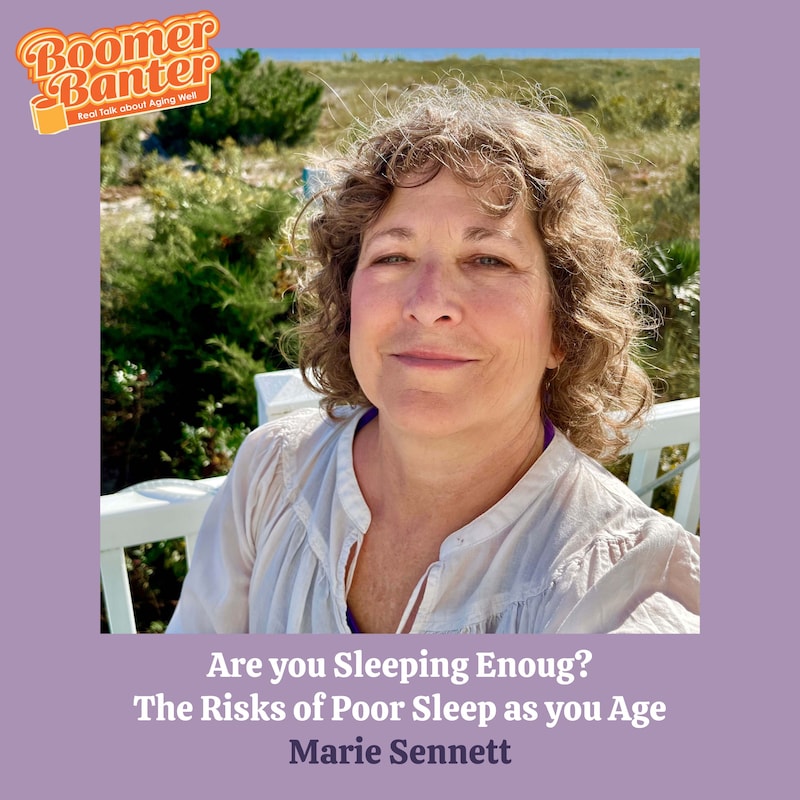
In this episode of Boomer Banter, Wendy Green dives deep into the often elusive and much-needed state of sleep. Teaming up with the insightful Marie Sennett, they explore the common sleep issues that plague so many of you. With humor and relatability, Wendy sets the stage by asking how many listeners actually get a good night's sleep, revealing that many hands remain down. Marie shares her own nighttime struggles from her days as a civil rights attorney, illustrating just how stressful and chaotic life can be, and the toll it takes on our ability to rest.
As the conversation flows, Wendy and Marie unveil the science behind sleep cycles and the changes your bodies undergo as you age. They tackle how hormonal shifts can disrupt your sleep patterns, and Marie emphasizes the importance of establishing a consistent sleep routine. You will learn about the four main sleep cycles, from light sleep to REM, and why each is vital for health and wellbeing. Marie advises on creating a calming sleep environment—think dark, cool, and peaceful—and offers tips for preparing the body for rest, such as gentle yoga stretches or winding down with soothing teas.
Filled with laughter and wisdom, this episode is packed with practical advice for anyone wishing to reclaim their restful nights. Whether it's laying off the late-night TV or creating a sleep haven, Wendy and Marie equip you with everything you need to transform your approach to sleep. By the end, you’ll feel inspired to embrace restful nights and rejuvenated mornings, ready to tackle whatever life throws your way!
Takeaways:
- Myth buster! After 50, we still need seven to nine hours of sleep each night just like everyone else does.
- Setting a regular sleep schedule is essential for improving your sleep quality and overall health as you age.
- Sleep cycles are crucial; light sleep, deep sleep, and REM sleep all serve important functions in our health and well-being.
- Creating a calming sleep sanctuary can help improve your sleep quality, so keep your bedroom dark, cool, and clutter-free.
- Avoid screens and blue light before bed to help your brain wind down and prepare for sleep.
- Simple practices like yoga and meditation can significantly improve your sleep by reducing stress and anxiety.
Links referenced in this episode:
- You can email Marie at [email protected]
- Check out the podcast, Older Women & Friends
- Want to schedule your complimentary 30-minute chat? Let's talk!
- Email me anytime. [email protected]
Transcripts
Hello and welcome to Boomer Banter. My name is Wendy Greene and I am your host.
And every week on Boomer Banter, we talk about the challenges, the changes and the possibilities that come with this season of life.
And today we're going to talk about sleep, that delightful or elusive state when our bodies are supposed to relax, our minds are supposed to get quiet, and we're supposed to drift off for many hours. Okay, raise your hands, unless you're driving. How many of you achieve that state of rest and relaxation for six to eight hours a night? Oh, wow.
Not too many hands went up. I see you. I see you.
You're saying you have trouble falling asleep and I see you, you're the one who always wakes up tired, yawning throughout the day. Or oh yeah, you, you say you're the one who wakes up to pee and then you can't get back to sleep.
Well, I am so glad that you are here today because today we're going to talk about some of the sleep challenges you're having, how they could be affecting your health and what you can do to improve your sleep.
My guest today, Marie Sennett, is a certified yoga teacher and transformational life coach who helps overwhelmed professionals break free from the grind and fully nourish their bodies and minds.
As a former civil rights lawyer, Marie knows firsthand what it's like to juggle a demanding career, community, responsibilities and family care, all while feeling there's never time for yourself. But after reclaiming her well being through yoga, meditation and intentional self care, Marie now empowers others to do the same.
Her personalized coaching approach helps clients embrace nourishing routines to bring immediate calm, energy and clarity while setting the stage for a vibrant future. So whether it's improving sleep, building strength, or flexibility, Marie provides the tools and guidance to thrive both today and tomorrow.
So I am excited to welcome Marie to our stage.
Marie Sennett:Hi, Marie. Hi, Wendy. Wow, that was very, very cool. Thanks for introducing me like that.
Wendy Green:I know. Did you see all those hands that didn't go up?
Marie Sennett:Yes. And. And there's been times when my hand would have been higher than anyone.
Wendy Green:I'm sure. So I want to start there. Tell me about your life as a civil rights attorney and the stress that must have been for you.
Marie Sennett:That was crazy. That was absolutely crazy. When I was.
Especially when I was a public defender because I had a caseload of, of 60 or more cases, which doesn't sound like a lot, but when you're dealing with 10 murders and three rapes and a bunch of robberies and Drug cases. And it's crazy. I mean, I literally.
Wendy Green:A lot.
Marie Sennett:Yeah. Yeah. I woke up in Paris the first time I was there in the middle of the night, screaming, because I was having a nightmare. Yeah.
And I was like, oh, this cannot be.
Wendy Green:No, this is not good.
Marie Sennett:No, no. So. So that's when I really started kicking in and taking care of myself with the yoga.
Because even if I only had a couple minutes, like, I started with, like, 15 minutes a day. If I could get the 15 in, if I could only get five in, that was fine. And then I added five minutes of meditation, and that got me through.
It got my blood pressure down. It got my weight under control. I didn't. Yoga doesn't make you lose weight. It makes you in tune to when you're full, which is key to losing weight.
Wendy Green:Yeah, right. Yeah. It doesn't take away all these sweets for Christmas time, though. That's.
Marie Sennett:Oh, that's for sure. That's for sure. That's right.
Wendy Green:That's right. We'll get to the new year saying. With a new resolution.
Marie Sennett:Right, right, right. Yeah. Another thing I found was I was sleeping better, but I was also more focused. My husband will attest, I became a much better partner.
Wendy Green:Okay.
Marie Sennett:Yeah.
Wendy Green:So. So what led you to yoga in the first place? I mean, how did you even have time to think about it as a practicing all of those horrible cases?
Marie Sennett:Well, it's funny, I. I was living in Buffalo, and my neighbor downstairs said, hey, I want to learn yoga. You want to go with me? And I'd seen Lilia yoga on PBS growing up. And I was like, oh, that looks kind of cool. So I. I said, sure.
So we went down the street to the Himalayan Institute, and at the end of my first, very first yoga class, we did this relaxation. And Wendy, my brain shut off.
Wendy Green:First time in a long time, right?
Marie Sennett:Yeah. So that became my addiction. You know, it was like that. The dragon I was chasing.
And for the next 20 years, my mat spent more time in the corner than it did on the floor. Until my husband said to me around the time of Paris, you know, like, we want to have a fun retirement.
And if you keep going this way, it's not going to be a fun retirement. It's going to be doctor visit after doctor visit after doctor. So that's what I was like. I got to roll out this mat. And I did.
Wendy Green:So were you aware that it was affecting your health or did took your husband to kind of say, come on, Marie?
Marie Sennett:Well, I mean, blood pressure went up. You know, I could tell I was cranky. I was, I wasn't sleeping, so I could tell. But to have him recognize it and be like, hey, girl. I was like, okay.
Yeah, yeah.
Wendy Green:So. So you started practicing your unre. Your mat, and you started practicing a little bit, but you were still working, Right, right, right.
Marie Sennett:I was still working these crazy hours, and I just, I learned how to say, I have to take care of myself. You know, I cannot say, oh, I'll get to that later. I need to first thing in the morning. Because that's, that was my time to do it.
Just go ahead and take care of me and move on.
Wendy Green:So did you just one day say, you know what? I am done with this career. I'm going to learn how to teach yoga and teach yoga.
Marie Sennett:Yeah.
Well, as I was, as I was, like, feeling better, I was like, oh, my God, like, I need to bring this to other people, you know, and make them feel as good as they do, which was great. So it took me many years later to actually become a yoga teacher because I had to quit being a lawyer. Well, part time to learn.
And then I ended up going back to law. That's a whole nother crazy story for another time. Okay.
Wendy Green:I don't know that story.
Marie Sennett:I put it all in, and I'm not sure how is what it jumped out, but I, I finally got to take that yoga teacher training, and I took it at the Himalayan Institute, which was where I first started my journey. So it, it made sense to go full circle, and it was great.
Wendy Green:And so you just quit working?
Marie Sennett:Well, I, I, I eventually quit working. I got to the point where I could retire early, and so I've been having fun with that. So I always said I was, you know, semi retired.
But while I was, while I was doing my last couple years of being a lawyer, I wasn't the public defender. I was doing civil rights law. And then I was blessed to teach law school, which was a whole lot of fun.
Wendy Green:Oh.
Marie Sennett:So I could really concentrate on building my business and then walk away from it all.
Wendy Green:Okay. And we're going to talk about sleep because that's what we told everybody we were going to talk about. And everybody has sleep issues, most everybody.
So we want to deal with that.
So I, I know that you have studied about sleep, and I just want to know from you what you've learned about why sleep gets harder for us once we're, like, over 50 or 60.
Marie Sennett:Yeah. Well, part of it is our hormonal changes and having to deal with that. Part of it is, especially when we're retired.
Like I always say to people, we need to have a schedule. You can't just stay up late and watch TV and get up whenever you want to.
You need to have the time that you go to bed at night and the time that you get up in the morning. And that has to be your main routine. And people fight me on that. I'm like, no, I'm serious.
You can go play and stay up late once in a while, but you really need that regular schedule.
You also need to have an exercise routine, especially when it comes to the hormones, because the things that are going to help keep the hormones in check is a regular form of exercise. And it doesn't have to be an hour in the gym and lifting weights and doing all this stuff. Yoga is fantastic exercise to use.
It can be meditation with walking, but you want to get some physical exercise. And if you can do 30 minutes a day, especially as a retired person, that is wonderful.
But if you can only get 15 in, that's enough to keep us healthy and keep us going. And the trick with the exercise though, is to make sure you don't do it three hours away from when you're going to bed. Because if it's. Oh yeah.
If it's strenuous exercise, that's going to get your body all crazy. So if you're lifting weights or jogging, you can do yoga before bed, but anything strenuous, you don't.
Wendy Green:So that's interesting because if you go to the gym at, you know, 5:30 in the evening, it's packed, everybody goes after work. I mean, I've always been a morning workout person, but people need to know that. Marie, most people are going after work.
Marie Sennett:Right, right.
Wendy Green:And I guess they do it to work off stress to a certain extent. And it's also kind of social.
Marie Sennett:Yeah, yeah. You know your gym friends.
Wendy Green:Right, right. So there are, as I understand it, and from, from what we had talked about before, there are sleep cycles, Right.
That, that are important for our brains and our body. So can you talk about those a little bit?
Marie Sennett:Yes. Yeah. We have four main sleep cycles. And what's interesting is melatonin comes into play with the first one.
Wendy Green:Yes, I want to ask you about that too.
Marie Sennett:Yeah. So the first sleep cycle is what we call our light sleep. And it runs about one to five minutes.
And it's basically just your body calming down and just relaxing. And it's where melatonin actually starts telling your brain, okay, it's time to relax and go to sleep. So that's where melatonin Comes in handy.
Wendy Green:And that's our. We normally have that in our bodies.
Marie Sennett:We normally have that in our bodies.
And the way to get it naturally in our bodies so that it will be helpful to us rather than taking the melatonin pills, is when you wake up in the morning, spend five minutes looking at the sunlight. That's it.
Wendy Green:There is any.
Marie Sennett:Yeah. And if. Well, there isn't, you try and find other light.
Wendy Green:We've had just clouds for days now.
Marie Sennett:Yeah, yeah. But, but you know, some, some form of light is going to get, is going to get your melatonin going.
Wendy Green:Okay.
Marie Sennett:When we're taking melatonin to help us sleep, then it's what it's going to do. It counteracts that and, and it, it prevents our body from going into deeper sleep.
So if you take it on a regular basis, you're not going to get the deep sleep that you need.
Wendy Green:Because what you're saying is that the melatonin is the one that puts you into that light sleep. It's kind of the drifting off sleep. But if you take it, it keeps you there. Is that what you're saying?
Marie Sennett:Right.
Wendy Green:Interesting. Okay.
Marie Sennett:Yeah. So I mean, if you take it, if you take it every now and then to reset your clock, that's fine.
But if you start taking melatonin on a regular basis, you're to get into that deep sleep that you need. Okay. So the second phase of sleep is our, is our light sleep. And that lasts about 10 to 15 minutes or 25 minutes sometimes.
And this is where our respiratory system slows down, our heart slows down. Our brain begins to kind of chill and process things and be like, what the heck happened today? What do I do with all this?
Wendy Green:So you're kind of thinking in a sense, while you're sleeping.
Marie Sennett:Yeah.
Wendy Green:Huh?
Marie Sennett:Yeah. Very. A little bit. Not a whole lot, but enough. And then the third sleep level of sleep is, is the really deep sleep.
And that's like 20 to 40 minutes in each cycle. And that's where our body starts doing all that rebuilding.
That's where we're rebuilding muscle, rebuilding bone, taking all those nerve endings that are like, what, and, and healing them. We're repairing our muscles. We're also strengthening our immune system.
Wendy Green:Darn nerve signals. So we have light sleep, deep sleep, and then very deep sleep.
Marie Sennett:And then the next one is REM sleep when that's when your rapid eye movement. So that's where we're dreaming.
So it's not really deep sleep because we would think that the fourth would be the deepest no, it's just a different way of our brain reacting and exercising itself.
So here's where our brain actually processes emotions, tries to make sense of what our memories are and kind of clear things around, which is, it's kind of neat, you know, and it's building, it's building a stronger neural trans. Path between our brain cells.
Wendy Green:So do we all dream? I mean, I hardly ever remember a dream.
Marie Sennett:We do dream, but, but we don't necessarily remember it. And, and we often remember dreams when we wake up in the middle of the REM cycle. But yeah, we, we do all dream. We just don't know it.
Wendy Green:And it's. And so, so the deep sleep and the REM sleep are kind of the repair stages.
Marie Sennett:Right.
Wendy Green:And we need to get to those. And so what happens when we interrupt one of those? Like it's two in the morning and I gotta go pee.
Marie Sennett:Which we all gotta go pee at 2 in the morning, so. And it's okay to go and go pee and interrupt. But the trick is, how do you prevent your brain from like becoming super active? Right, right.
Because especially like when I was a public defender, I'd be like, oh my God, that's what I need for that case.
I understand that might be off somewhere else, you know, so what, what we do is like, so don't turn on the big overhead light, have a night light so that you have that calm sense, you know, Try not to think too much if you're going to be in the bathroom for a while. So maybe you want to hum a song. You know, or, you know, tell yourself a silly story if you're going to be there for a bit.
But try not to get your brain thinking about what's going on, what's going on with politics, what's going on with your life. Just, just put that aside. And then when you come back to bed, you can do a little brain scan or body scan, so you can just like bring.
You say, I'm gonna focus on my forehead, I'm gonna focus on my eyes, my chin, and just go all the way down to kind of just get everything to relax, you know, if you don't fall immediately back to sleep, and a lot of us don't.
If you find that, that you've woken yourself up though, and you're having a hard time going back to sleep, if you're there for 15 minutes, get up and get out of that bed. Because then our brain's going to start thinking our bet our bed is not for us to sleep in.
And so you want to do something like go read a book that's not a backlit book, like a Kindle or paper white or a book.
Wendy Green:Okay, so a real book, not a nothing with that electronic lighting. Okay, what about turning on TV so that you can kind of nod off again?
Marie Sennett:No, you don't want to get that. You don't want to have that blue light. That blue light is going to get yourself activated. Your brain is not going to go back to sleep.
So you want to do something like reading or listen or listen to a podcast. Right?
Wendy Green:Listen to a great podcast. Or listen to music. Yeah, yeah, but don't. Not dance music.
Marie Sennett:No, not dance music. Something calming, something calm. Or do some more meditation, if you like meditation.
And the thing that, the thing that I like about meditation is, you know, like, yogis are terrible. I gotta tell you, we are terrible in terms of meditation. You make people think you're supposed to have this empty brain. Brain.
And, you know, nothing's supposed to happen. That is so far from the truth. It's like if I'm gonna sit in a Cave for 30 years. Yes. But. A nice guided meditation because our brains wander.
And with the guided meditation, it kind of helps us go on a story or something, and then, and then we can relax. And if our mind leaves the guided story, that's okay, too. We just be like, all right, my mind went somewhere, let me come back.
Because we have busy minds.
Wendy Green:That's right. And that's why I've read. That's why they call it a practice. Meditation is a practice because you can't heart.
Well, unless you're living in that cave that you talked about, you're probably not going to have control over where your mind is going all the time, even if you're listening to a guided meditation.
Marie Sennett:Right, right. And, and, and be kind to yourself, because that's just natural.
Wendy Green:Yeah, yeah, yeah. I, I sometimes I remember as a kid having a lot of trouble falling asleep. I'd get all nervous. I'd be the only one left in the house awake.
And so I would sing myself a.
Marie Sennett:Lullaby. Over and over in my head.
Wendy Green:Please go to sleep. Bye, baby. Oh, what a weird kid I was.
Marie Sennett:Here, Wendy. We're good.
Wendy Green:So, so how do you know? Like, you know, I wake up, you want your cup of coffee, and, and you're sleepy at first. How do you know you're not getting enough sleep?
Marie Sennett:Well, let's, let's, let's, let's step back. Right. So the time that we're supposed to get for sleep in our later years, in Life is the same seven to nine hours. Every other adult is.
We have this old wives tale that says, oh, people who are older sleep last. No, we, we actually need seven to nine hours of sleep.
Wendy Green:Really?
Marie Sennett:Yeah, yeah.
And, and then the results that we're going to get from that good sleep is our lungs and our brain and our heart are going to be rested, we're going to have energy, we're going to have a better move mood, we're going to be creative, our response time is going to be quicker, which is important when we get older. Right. Because people say, oh well, you don't respond as well, you shouldn't be driving.
Well, if you get a good night's sleep, you're not going to have that accident. You're going to respond.
Wendy Green:I hope that's right.
Marie Sennett:Yeah, yeah.
You're also going to be better at problem solving and God knows there's enough problem solving when we are in our senior years having the ability to stay present. Right. So that we can be what, what we need to be. So those are the benefits that we're going to get from the sleep.
I mean, I guess the next transition should be to talk about if we don't get enough sleep, what could happen.
Wendy Green:Which, yeah, because I, you know, I know I would say 90% of my friends and myself say, you know, okay, I had six hours, seven was a good night. You know, so. Yeah, you've just busted a myth there. So what happens if we don't get that?
Marie Sennett:Well, if we don't get that and your body, your body may actually be, you might be lucky enough where you don't actually need the seven hours, but most bodies do need the seven to nine hours. So if we don't get that, then our blood pressure is going to go up. Our, our chances of heart disease and diabete increases.
Our memory gets kind of funky. Sleep is important for that memory. It's important for taking on, on any type of dementia.
It also if, if we don't get enough sleep, then it actually increases our negative motions. Depression becomes more common. We're definitely cranky if we're tired. Yeah, yeah. And, and, and it, it can bring more stress to relationships.
And you know, let's face it, you know, like when you're retired, you're, you're spending a lot of time with the people that you live with. You know, I remember a friend of mine when, when her husband first retired. Married you for better or for worse, but not for lunch.
Get the hell out of my house.
Wendy Green:That's right.
Marie Sennett:So you want to get to sleep so that you're not having problems in that relationship. And also, if you don't get enough sleep, then you're going to lose your coordination.
You're going to have a better chance of falling and hurting yourself. Yeah. And we talked about those driving accidents. So sleep's really important as we get older. Yeah, yeah.
Wendy Green:Now, there are things that you have said also about, like in the bedroom, you know, like setting a good space for sleeping. What would that be like?
Marie Sennett:Yeah, I like to call that setting your. Your sleep sanctuary. So it kind of feels good, doesn't it? So one of the things you want to think about is, well, what's going on in that room?
What is the lighting in that room? You really want the room to be as dark as possible.
So if you can have shades that are going to keep out the light when the sun comes up, that's great. If you can't get that, then an eye mask is going to be good. Right. So you can sleep with that.
Although my grandmother used to complain about her eye mask makes making a mess of her eye cream she spent so much money for.
Wendy Green:I know.
Marie Sennett:Yeah. The temperature in the room, you really.
For sleep, you want it to be somewhere between 60 and 7, 67 degrees, which sounds cold, but that is the ideal temperature. Temperature for sleep.
Wendy Green:Why is that?
Marie Sennett:The body just rests better, huh? Yeah. Yeah. You can add blankets and stuff and as you go, but the. The temperature of the room should be cool.
Wendy Green:Interesting.
Marie Sennett:Yeah, yeah. You want to make sure that your air isn't super dry. You know, we're facing winter over here in the East Coast. That gets kind of harsh.
And so you definitely want to have a humidifier in the room. And you can put essential oils in the humidifier if you want to, or you can have a. A diffuser to kind of make everything's nice. Nice and calm and.
And pretty. You want to also declutter that room.
You don't want to have a bunch of stuff around because it's going to clutter your brain as you're trying to fall asleep. So it's a place to go and relax and rest. And it's not the room to have your tv.
Wendy Green:Oh, thank you.
Marie Sennett:Thank you.
Wendy Green:I have had that fight too many times. Don't want a TV in the bedroom.
Marie Sennett:Yeah. People say, oh, it helps me fall asleep.
Wendy Green:No, it's blue light.
Marie Sennett:It doesn't help you fall asleep. At least it doesn't get you into that deep sleep where you're going to be able to rebuild. Right. It's going to maybe give you that light sleep.
Wendy Green:Yeah, because a lot of people talk, you know, they. They fall asleep in front of the tv. I mean, that's just what they do. And I guess they've trained themselves that that's what they do.
So if you suddenly were to take the TV out of the bedroom, that's going to be a big change for people.
Marie Sennett:It is going to be a big change. And I've got some tips for that, too.
But one other thing to think about is your sheets, which is going to sound crazy, but sheets are also important for that comfort. So you want to get like, nice Jersey sheets because they're good and soft. Or if you. In a hot climate, you want satin sheets. Those are good.
One of the best style of sheets is those Lux L U X E satin sheets. They are amazing. Amazing in terms of comfort and softness.
And the big hint, J.C. penneys always has them on sale for, like, ridiculously cheap because they can go like. It's quick. Yeah. $146 for a queen set at Pennies is 60 bucks. It's nice.
Wendy Green:All right, you heard it here. And she's not getting anything from JCPenney for that little plug.
Marie Sennett:I'm not, I'm not. Although I've gotten some great sheets at a discount.
And then I talk about doing your stress mitigating or stress melting routine before you go to bed. Right. So that you got a chance to think about things so you can unwind. And so one of the things first off is go to bed at the same time every night.
And then don't look at a blue screen for an hour before you go to bed so that your brain can shut that down. And it's not going to affect the melatonin. Right. Because the melatonin will kick in.
Wendy Green:That melatonin, right?
Marie Sennett:Yeah, yeah. You want to put your phone, if you can, for sleep in another room. You don't need it by your bed.
Wendy Green:And I have case of emergency, though.
Marie Sennett:Chances are you're not going to need it that. Well, maybe for emergency. All right, we'll go, we'll do that.
Wendy Green:You know, if you're.
Marie Sennett:If you're in a situation where you think you might need it for like calling 91 1.
Wendy Green:Well. Or you have an elderly parent who's gonna call you, you know.
Marie Sennett:Right.
What I say about the elderly parents is you give them a special ring and you put the phone in another room, turn it up loud, and that ring will not only sound, but you'll also hear it and get up. But that way you're not tempted to pick it up and be like, oh, what's going on with this thing? Or what's happening with that?
So that's why I say a phone in another room.
Wendy Green:I have mine set on do not disturb after 10 o'. Clock. So I don't hear unless, unless it's my mom calling. And then I would hear that.
Marie Sennett:Yeah, if you can do that and not pick it up, go for it. Okay.
Wendy Green:Yeah. It's a security for me. And, and you had said. So I think, I think it was you that had told me reading in bed wasn't a good thing.
Marie Sennett:Reading in bed for a little while is okay to wind down.
Wendy Green:Okay, good.
Marie Sennett:Yeah. Yeah. So you want, that's, that's the thing that you can do.
You could read a book for a while and make that part of your routine because then your brain is like, oh, I'm reading and then I'm falling asleep.
Wendy Green:That's, that's my routine.
Marie Sennett:Yeah.
Wendy Green:Read. And a lot of times I'll find that I've. I'm sitting there with the book in my hand and my eyes are closed and my. Yeah. Oh, Wendy, turn out the light.
Marie Sennett:Exactly. But it's good because your body's used to that. Yeah.
And, and even when you're waking up in the middle of the night, if, if, if, you know, if you don't have anybody else in the bed and you want to read a little bit, you can do that too. But you know, books, good thing to calm you down.
Something else that a lot of my clients do is they have a list that they do at night before they go to be. They call the Let it wait list and they write down all this stuff that is like, you know, that, that I didn't get this done. I didn't get this done.
I can get this done. So they, they put that down. Others do what's on my mind. A journal. How am I feeling? A lot of my clients do a gratitude journal. They just. Yeah.
Three things that, that I'm grateful for today.
Wendy Green:I think that helps a lot too because it takes your mind off of all the clutter. That's, you know, all the stuff you have to do or think about or forget about or. Yeah, yeah, I like that.
But you were going to give us some tips for those people that are used to falling asleep with the TV in their room.
Marie Sennett:Right, right, right. Sorry. I got lost. I got all excited.
Wendy Green:I know. We got excited about other things.
Marie Sennett:So this part of what you're going to be doing is the tips is setting up this routine.
You're going to be setting up this stress melting routine so that you don't miss the TV at night and you can start taking care of yourself and developing a ritual that your body's going to be like, oh, yes, we're doing this thing, it's time to go to bed. And also there's, there's a. Doing a little bit of, of yoga that's very restful that you can actually do in bed is a great thing too. Yeah.
So what, what I've got is, is a very simple routine where you do a, a forward fold where you're just reaching and touching toward your toes. Unless you have a back injury or osteoparesis, then you just kind of sit up and reach forward rather than bending so you can stretch.
You want to put your legs up, up on the wall or up on your bed if you've got pictures on your wall. So you can do the routine, you can do the routine on the floor and then get into bed. You also can.
And then from there you can do what I like to call a reclining cobbler, where you, you lay down, have your knees bent and then you put your arms out into a T and you open your knees and just let them open. The bottoms of your feet touch.
Wendy Green:So it's just a very. Everything open, relaxed, welcoming the sleep.
Marie Sennett:Yep. Like, here we are.
Wendy Green:Yay.
Marie Sennett:Come to me.
Wendy Green:Asleep.
Marie Sennett:Exactly. Exactly.
And then another, another one is a very simple twist where you just bring your knees into your chest, have your arms out into a T, and then turn to the left for a little while and then come back to center and turn to the right for a little while. Or if you have back injuries, you just bring your knees to your chest and hang out for a bit.
And then what I do is suggest people get into bed and do just that little body scan again. Bring my attention to my forehead, breathe. Bring my attention to my eyes, breathe. And just kind of walk down the body.
Wendy Green:So you don't have to tell yourself to relax. That's what I was always like. Okay, fire forehead, relax. Okay, eyes, relax. You don't have to do that.
You're saying just think about it and take a breath and that that would let it go.
Marie Sennett:Yeah. And another piece in terms of the mindset, you know, we talk about, I gotta get to sleep, I gotta get to sleep, I gotta get to sleep.
You know, one of the things about coming back from the bathroom, don't look at the clock. You don't need to know what time it is. But think about it as, I'm gonna go rest. Not, I have to get to sleep. I'm gonna go rest.
Which is a way of saying, I'm taking care of me. Oh.
Wendy Green:So my wise mother used to tell me that. I told you I had trouble sleeping as a kid. She said, you just need to rest. Just lie down and rest. It's just as good.
Marie Sennett:Yep. She was right.
Wendy Green:So we've talked about melatonin and some of the risks about taking that on a regular basis. Right. Like, it'll keep us from the deep sleep. But what about other sleep aids like Ambien or. I don't know, are there other natural.
Herbal things that people take to try and sleep?
Marie Sennett:Yeah.
What's interesting, Ambien is, like, definitely prescription, and we have all those crazy stories of people wandering around naked with taking ambient. But basil tea, which is literally taking basil leaves and making a tea with them is, like, one of the most natural sedatives ever.
When I was doing crazy hours as a public defender, way back when, I would get home at the end of the night, and I would sit down and have some basil tea, and I'd be like, falling asleep before.
Wendy Green:Seriously?
Marie Sennett:Seriously. It's amazing.
Wendy Green:Does it taste good?
Marie Sennett:Yeah, it does. Yeah. I mean, it tastes like basil. It's a little minty, you know. Huh.
Wendy Green:If you put anything else in it, like honey or cinnamon or. No, just basil leaves.
Marie Sennett:Yep. Yep. And valerian is another herb that's good. That's not going to mess up your.
Your circadian rhythms in terms of calming down magnesium, believe it or not, which is something our bodies need a lot as we get older, because our body, we take all these. A lot of us take medications I've taking. My father gave me his curly hair and his hypertension that were genetic.
So I've been on hypertension medication since I was 36. And that just eats the magnesium out of your body like you cannot believe. And so having magnesium is going to help us rest.
And if we have restless legs, there's magnesium oil that you can.
Wendy Green:Yeah.
Marie Sennett:You can put the oil on your legs, or you can take the magnesium orally. But I, you know, I find it fun to put the magnesium oil on your legs because then you're also massaging yourself.
Wendy Green:Yeah. It's kind of soothing. Right.
Marie Sennett:I'm so stressful.
Wendy Green:That's right. I just learned that magnesium also is good to take at night for leg cramps.
Marie Sennett:Yep. Any muscle cramps even. Even in your arms?
Wendy Green:So. Is there a certain dosage to take that would help? Do you know. Or is that something to talk to a doctor about?
Marie Sennett:I would talk to the doctor to be sure, but like a low level magnesium pill, that would help. And that's. I think that's the reason why I like the oil for the. For the muscular issues. Because you don't need to talk to a doct. You just put it on.
Wendy Green:Yeah.
Marie Sennett:Basil.
Wendy Green:Basil. Tea. Valerian. Is that a tea also? Or is that.
Marie Sennett:You can get valerian as a tea. You can get it as a pill. I kind of like the ideas of the teas because that's also, like, calming.
Wendy Green:It could be part of your ritual. Right?
Marie Sennett:Exactly, exactly.
Wendy Green:Put on some soft music, have a cup of tea. Oh, and then do a few stretches. I love it.
Marie Sennett:Yeah. Do the body scanning.
Wendy Green:Yeah, yeah, I like that.
Marie Sennett:There's this cool product I'm, I'm not trying to, like, get. All these companies, like Heavy Doterra makes this great thing that they call a valerian stick.
And it is their essential oils of cedar and lavender with valerian. And it's. You just put it on your foot at the bottom at night and. And that's like, just great for helping you sleep too. It's like, what? Yep.
Wendy Green:Now, you said the room should be cold, but what about, like, wearing socks and heavy robes and, you know, because people, as we get older, we get colder.
Marie Sennett:Right. You can get. You can be nice and toasty under the covers, but you want the room to be cooler.
Wendy Green:Cool room, but moisture in the air. Okay.
Marie Sennett:Sounds like a lot, doesn't it? Dark, moist and cool.
Wendy Green:And no tv. And no tv and no blue light.
Marie Sennett:Yeah.
Wendy Green:All right, raise your hands. Who's gonna. No. So I would say if you were.
Well, when you advise your clients, like, okay, they've come to you, and now you've told them all this and they're like, like, oh, my gosh, Marie, this is so much change for me. Where do I start? I can't do everything all at once tonight.
Marie Sennett:Right, right. Well, the first thing I would do is come up with a routine that you can do.
So maybe you don't work on the room right away, but you start getting your brain ready. And the routine starts with having that schedule of getting up and going to bed at the same time. It's amazing.
What that, that, that thing alone is just. Just perfect for helping with sleep.
Wendy Green:Well, you know, it's interesting too, because you've done some coaching of. For people in retirement, too. And the. And that also is about. Get a routine, because you've lived your whole life with a routine.
And now you're, like, floundering out there, right?
Marie Sennett:Yep.
Wendy Green:So I guess we are creatures of habit and routine, and so it's hard to break the habit. So let's say tonight. You'Re gonna either do some of those yoga stretches Marie suggested or have a cup of basil tea.
Turn off the TV before you go to bed, and don't turn it on in your room.
Marie Sennett:Right, right.
Wendy Green:And do that body scan.
Marie Sennett:That's a good start.
Wendy Green:Yeah, I'm gonna do that. I don't know about the basil tea. I have to try that. So if I try it, like, this afternoon, is that going to make me too sleepy?
Marie Sennett:Yeah, it's literally like a sedative. You want to take it as you're going to bed.
Wendy Green:Okay. All right. Interesting. Well, that's pretty magical if it works like that.
Marie Sennett:I was surprised at how well it worked with this crazy busy mind as a public defender, and I was like.
Wendy Green:Wow, that is really interesting. So Marie has said that if you have further questions, you can get in touch with her by emailing her at. Marie. Marie Senate. S-E-N-N-E-T-T yoga.com.
And occasionally you do, like, sleep workshops and things like that. Is that right?
Marie Sennett:Yeah.
Wendy Green:How would people find out about those things that you do and yoga works?
Marie Sennett:Email me and we can. We can. We can talk about it. Yeah.
Wendy Green:So they can get on, like, an email list with you. Okay.
Marie Sennett:Yep. And I've also got different handouts and stuff that if people wanted to. Very minimal costs.
Wendy Green:Yeah.
Marie Sennett:If you get those.
Wendy Green:Okay. All right. Now that's good to know. So I really appreciate this conversation.
I think it's going to be helpful for so many people, and I hope that those of you listening will consider some. One of these tips that Marie shared with us to try for a better night's sleep tonight.
And I. I guess the other thing, Marie, like, if I try these new things, is it going to right away make a change or does it take a while for my body to readjust to some of these changes?
Marie Sennett:It's going to take a time for your body to readjust, you know, especially if you. If you don't have a routine and. And you watch TV to fall asleep. It's gonna. It's gonna take a while. It's not gonna be an immediate thing.
Although the basil tea, like, definitely was immediate for me. One night for sure. So if you.
Wendy Green:So. So if you. If I wake up at 2 to go to the bathroom, should I have another cup of basil tea?
Marie Sennett:As long as you don't turn on too many lights to make it. Okay. You could definitely have another cup of basil tea.
Wendy Green:Okay. Instead of turning on the TV and saying, well, I can't fall asleep, I'm just gonna watch tv.
Marie Sennett:Okay. Sit back with the basil tea in the book. Good company.
Wendy Green:Yeah. And keep the cat out of the room. She wakes you up too much. Oh, my cat. Yes. So one more thing before I go, though.
I want to tell you all about my friend Jane Leader, who has a show called Older Women and Friends and Jane. Jane is a former. Well, I. Maybe she's still a writer, but she is a writer, let's just say, and a podcast host now.
And her podcast speaks to older women about many different things. Kind of like we do art, retirement, humor, ageism. She really is a good interviewer.
She's just turned 80, so she has, you know, a perspective later than I do. And I love listening to her show. So check it out. You can find jane@jane leaderle.net.
And if you wanted to chat with me about anything, you can schedule a time.
I know this time of year can be challenging for some people and we can do a complimentary coaching call by going to count my calendly link calendly.com boomer-banter 30 minutes.
All of this will be in the show notes, so feel free to schedule a 30 minute call and let's kind of reset your craziness that happens this time of year. So, Marie, thank you so much. I have really enjoyed talking to you. You have a wonderful, light, loving way of projecting. So thank you for that.
Marie Sennett:Thank you, thank you. I had a lot. I enjoyed being here and I apologize again about the phone call, but I know.
Wendy Green:Well, I hope you can help him and. Yeah, so go, go deal with that. And thank you all for listening today and until next time.
Time take care of yourself and I wish you a restful, restorative sleep tonight.
Marie Sennett:Okay? Thank you so much, Wendy.
Wendy Green:Thank.
Marie Sennett:You.



