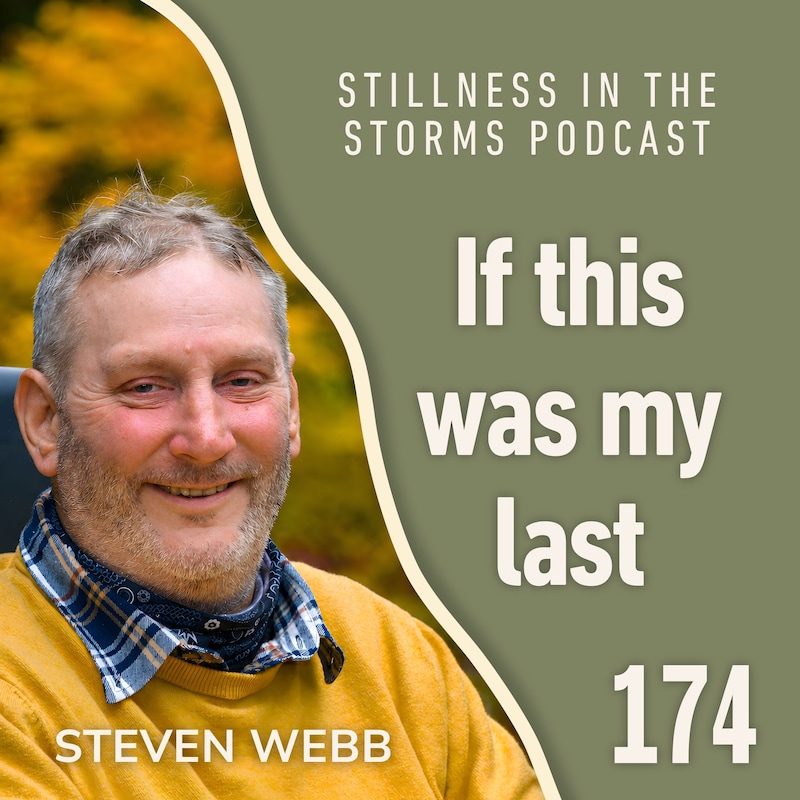
Shownotes
Links to Steven Webb's podcast and how you can support his work.
- Donate paypal.me/stevenwebb or Coffee stevenwebb.uk
- Steven's courses, podcasts and links: stevenwebb.uk
If this were my last podcast, what would I want to leave you with?
I sat down with a cup of coffee, almost no script, and one line from Rainer Maria Rilke that stopped me in my tracks.
The first thing is to accept this moment wholeheartedly. It is already here. We cannot change the weather that has arrived, the thought that has appeared or the cushion underneath us. We can only choose what we do next.
That does not mean becoming stuck. We can get comfortable with the present moment and still keep our shoes nearby. Some pain asks us to rest. Some pain asks us to move. Both can be true, sometimes within the same hour.
In this episode, I explore why difficult memories stay with us, what happens when we exile the emotions we do not like, and why listening to an inner voice is not the same as letting it lead. Rilke's poem Go to the Limits of Your Longing becomes a companion for making room for beauty and terror, while remembering that no feeling gets the run of the whole house.
I finish with a small practice. Ask what needs accepting right now, what you may be refusing to hear, and what small colour you can let back into your life.
Stillness in the Storms is independent and advert free. To contact me, join the Weekly Calm or support my work, visit https://stevenwebb.uk
What is in this episode
- (00:00) The Rilke line that stopped me in my tracks
- (00:45) If this were my last podcast, what would I leave you with?
- (01:15) Welcome and thanks to the people keeping the podcasts advert free
- (02:15) Accepting the moment that has already arrived
- (03:20) Why we cannot simply replace every difficult thought
- (04:10) Getting comfortable on the cushion, but not too comfortable
- (05:10) When suffering pulls us inward and when it pushes us forward
- (06:10) Why the difficult memories stay with us
- (07:20) Samsara and the whole spectrum of being alive
- (08:15) Grab a pillow, but keep your shoes nearby
- (08:45) Listening to every inner voice without giving each one equal weight
- (10:20) Rainer Maria Rilke and Go to the Limits of Your Longing
- (11:15) The Rilke words that inspired this episode
- (11:35) No feeling gets the run of the whole house
- (12:20) Why live with only half the rainbow?
- (14:20) How we narrow life to the colours and feelings we already know
- (15:35) Love, grief and the two ends of the same stick
- (16:40) The advice I would leave behind
- (17:50) A small practice for acceptance and a wider life
The chapter times are taken from the final transcript and should be checked against the finished audio before publishing.
One practice for this week
Pause and ask:
What needs accepting right now?
Is there a feeling or a voice I am refusing to hear?
What small colour can I let into my life?
You do not have to obey every voice or enjoy every feeling. Just let it be heard. Then decide what deserves the steering wheel.
Notable quotes from the recording
"Learn to get comfortable on the cushion you're on, but not too comfortable." (04:10)
"Grab a pillow, get a little comfortable, but keep your shoes nearby." (08:15)
"If we exile half the emotions that we don't like, we lose half the information." (10:05)
"No feeling needs to be banished. No feeling needs to get the run of the whole house either." (11:35)
"Remember all voices are valid, but they've not all got the same weight." (17:40)
"What needs accepting right now?" (17:50)
Links
- Contact Steven, join the Weekly Calm or support the podcasts: https://stevenwebb.uk
- Rainer Maria Rilke's Go to the Limits of Your Longing, translated by Joanna Macy and Anita Barrows: https://onbeing.org/poetry/go-to-the-limits-of-your-longing/
Poem credit
In this episode I quote from and reflect on Go to the Limits of Your Longing by Rainer Maria Rilke, from Rilke's Book of Hours: Love Poems to God. The English translation is by Anita Barrows and Joanna Macy and was published by Riverhead Books.
Copyright in the English translation remains with the copyright holders. The short quotation is fully credited and discussed in the context of commentary and reflection.
You can read the credited translation and hear Joanna Macy's own reading at https://onbeing.org/poetry/go-to-the-limits-of-your-longing/
Thank you
Sangha, Jesse, Anita, Sue, Evelyn and Glenn. Your support helps keep Stillness in the Storms and Inner Peace Meditations free from adverts.
Transcripts
Let everything happen to you: beauty and terror.
Speaker:Just keep going.
Speaker:No feeling is final
Speaker:I'm just sat here with a cup of coffee next to no script, and
Speaker:I just want to record a podcast
Speaker:based on partly what I've just read, a poem by Rainer Rilke, and
Speaker:that line literally stopped me in my tracks and blew my socks off.
Speaker:I will return to that line and that quote at the end of the podcast,
Speaker:and I will read the poem to you.
Speaker:But if this was my last podcast, which I sincerely hope it is not,
Speaker:what would be the one or two bits of advice at this stage in my life
Speaker:that I would leave you with that I think would be most beneficial?
Speaker:And I think it'd be a couple of things
Speaker:Hi, I'm Steven Webb and welcome to Stillness in the Storms, the podcast that
Speaker:helps you to suffer a little bit less.
Speaker:So today is about living.
Speaker:Today is about a little bit of wisdom and advice.
Speaker:It's about acceptance, and it's about not becoming stuck.
Speaker:It's about getting on with life no matter what your situation you're in.
Speaker:But just before I move on to the podcast itself, I've got to thank
Speaker:some dear friends and dear friends of the podcast and the meditations.
Speaker:Without them, you'd be listening to adverts now, and Christ
Speaker:knows what they would be about.
Speaker:So I wanna thank Sangha, Jesse, Anita, Sue, Evelyn, and Glenn.
Speaker:Glenn, huge donation.
Speaker:Thank you so much.
Speaker:You guys keep the adverts away from all my podcasts.
Speaker:I've always said I would never put adverts in them, but there's so
Speaker:many downloads now that there's no way I could do it without you guys.
Speaker:So thank you so much.
Speaker:If you wanted to support or you wanted to hear about the Inner Peace meditations
Speaker:or join my weekly calm, just head over to stevenwebb.uk One thing that I've
Speaker:learned more than anything else, being paralyzed, being bankrupt, being cheated
Speaker:on, being in severe pain, bleeding, and having, uh, the most horrendous
Speaker:days ending up in a hospital and in the most dire situations, is accept the
Speaker:moment wholeheartedly for what it is.
Speaker:Because guess what?
Speaker:You cannot change it.
Speaker:There's nothing you can do to change the present moment.
Speaker:You cannot grow your hair longer.
Speaker:You cannot lose weight in this moment.
Speaker:You cannot get younger.
Speaker:You, you cannot change the weather.
Speaker:You cannot change the color of your house.
Speaker:There, there's just nothing you can do once the moment has arrived.
Speaker:You cannot even change your thoughts.
Speaker:I talk about this quite often about people always say, and I used to preach
Speaker:this all the time, "Just change your negative thoughts into positive thoughts.
Speaker:Just think positively." Well, it just doesn't work like that because when
Speaker:you have a thought, and what's deemed negative is very often actually a positive
Speaker:thought because it's protecting you or, like, alerting you to something,
Speaker:and we have a, a bad judgment of it.
Speaker:We're like, "That's bad. We don't want those thoughts," when really
Speaker:we do need those thoughts sometimes.
Speaker:So you cannot change, even change a thought.
Speaker:So when it's arrived.
Speaker:It's there already.
Speaker:You can change what you do with it, the same as the present moment.
Speaker:So as soon as the present moment is already here, we spend so much
Speaker:of our strength and so much of our mind power and our energy
Speaker:arguing with what's already here.
Speaker:I wish it wasn't this way.
Speaker:I wish it wasn't raining.
Speaker:Just, grab the umbrella.
Speaker:It's used so much that I don't know if I even like the phrase anymore.
Speaker:It's like learn to dance in the rain, but it's true.
Speaker:There's so much depth to that brilliant quote.
Speaker:It's learn to get comfortable on the cushion you're on,
Speaker:but not too comfortable.
Speaker:Don't get too comfortable dancing in the rain that you never want it to stop
Speaker:raining, but while it's raining, dance.
Speaker:While it's uncomfortable, be uncomfortable.
Speaker:You know, if you're deep in meditation, scratch the itch.
Speaker:Another one will be along.
Speaker:Don't worry about it.
Speaker:Don't, don't worry about getting rid of some of your suffering because trust me,
Speaker:pain will come along sooner or later.
Speaker:You won't get rid of it all, but what we can do is just
Speaker:learn to accept that moment.
Speaker:And very often, sometimes we become the hero of all that pain.
Speaker:I spoke about this quite at length last week.
Speaker:That hero that suffers from the uncomfortable cushion,
Speaker:yeah, give it some energy.
Speaker:Give it some, I don't know, some empowerment, but don't give
Speaker:it too much because you won't be able to move on from it.
Speaker:That hero also has to have the drive to not only accept the present
Speaker:moment, but also to have the drive to change the present moment.
Speaker:And suffering either pulls us inward, and we rest there, or it pushes us
Speaker:forward and allow for both to be true because both are true, and both of
Speaker:them change simultaneously and change during the day, change during the hour.
Speaker:If you're anything like me or every human I've ever come across, you know, your
Speaker:energy and your energy levels can change quicker than the weather can change
Speaker:I heard a great question the other day.
Speaker:It was a guy having a conversation with ChatGPT, and he, he asked ChatGPT, " why
Speaker:do I remember the tougher times when I'm embarrassed or when I'm in shame
Speaker:or when I was feeling hurt over the times when I was happy?" And ChatGPT
Speaker:replied with, "Well, the times you were happy already did their job."
Speaker:And boom, just like that.
Speaker:Absolutely
Speaker:When things are happy, when things are okay, there's nothing
Speaker:you need to do with that.
Speaker:It's already there.
Speaker:That's it.
Speaker:It's okay
Speaker:But the times of hard, the times of pain, they, they stay there
Speaker:until you learn the lesson.
Speaker:They stay there until you've either suffered enough and you do something
Speaker:about it, or at some point in your life, a similar pain will show up and you've
Speaker:got the muscles there, and you go, "I know what to do with this moment,"
Speaker:because that happened years and years ago
Speaker:And there's no permanent end to the pain or wanting.
Speaker:Samsara is, samsara is like the map of the conscious life.
Speaker:It's just the constant cycle of born, pain, suffering, desires, wanting,
Speaker:happiness, sadness, the rain and shine.
Speaker:That's life.
Speaker:That's what's so beautiful about life.
Speaker:It's all of it rolled into one.
Speaker:It's that, the whole spectrum, the whole rainbow, the whole emotions,
Speaker:from pure enlightenment to shame and guilt, and everything in between
Speaker:So when I talk about life and sorry this podcast is going a bit here and
Speaker:there and flipping to and fro, but, you know, grab a pillow and experience it.
Speaker:Enjoy the ride, no matter if the ride is a bit uncomfortable
Speaker:We're partly in control.
Speaker:We're partly in control of what happens next
Speaker:So if you do grab the-- a wonderful metaphor, actually, just thinking
Speaker:about it off the top of my head.
Speaker:Wonderful metaphor is grab a pillow, get a little comfortable,
Speaker:but keep your shoes nearby.
Speaker:That's the whole point, and
Speaker:When we start embracing all of our voices and all of our emotions inside of us, and
Speaker:I'm not saying give them all equal weight.
Speaker:I'm not saying every emotion is valid and every emotion is equal,
Speaker:every truth is the same truth, and every truth is perfectly equal.
Speaker:No, they're not.
Speaker:And every single voice is not equally, how can I say it?
Speaker:Healthy
Speaker:But all of them do have some weight somewhere.
Speaker:And depending on where you're to and what you're doing, you know,
Speaker:if you're climbing a mountain, that voice of hunger is probably not
Speaker:the most important one to have.
Speaker:The, the voice of fear or anxiety, absolutely, that has
Speaker:a lot of weight in that moment.
Speaker:But if you're sat and you've got nothing to do, and you haven't ate for four days,
Speaker:and things are relatively comfortable, that voice of, "Hey, I'm hungry.
Speaker:What's in the cupboard?" That voice is valid and got weight in that moment.
Speaker:So all voices and all of our emotions and everything that we experience
Speaker:should be just experience it, enjoy it, embrace it, and learn to treat
Speaker:every voice as a friend in some way.
Speaker:"Hey, what you telling me? Why are you showing up now? Thank
Speaker:you for being here for me."
Speaker:And it's the same with emotions.
Speaker:If we exile half the emotions that we don't like, we lose half the information
Speaker:and it brings me back to Rainer Rilke.
Speaker:He was a Bohemian Austrian, and he was a poet rather than a
Speaker:traditional spiritual teacher.
Speaker:But I think he'd done so much for the spiritual teaching, and it comes from the
Speaker:poem, "Go to the Limits of Your Longing."
Speaker:And the poem appears in one of his books, and it was translated,
Speaker:so it may not be perfect words.
Speaker:As far as I understand and what I read about him, because when that
Speaker:poem just blew my mind, I had to go and find out a bit about him.
Speaker:And he had a lot to do with the Russian spiritual teaching and
Speaker:the English translation by Joanna Macy and Anita Burrows, I think.
Speaker:Um, I'm trying to do it off the top of my head now.
Speaker:But the line, "Let everything happen to you.
Speaker:Beauty and terror, just keep going
Speaker:No feeling is final.
Speaker:And I think living life means experiencing everything, being part of everything.
Speaker:No feeling needs to be banished.
Speaker:No feeling needs to get the run of the whole house either.
Speaker:I think that's really important.
Speaker:You know, it's like a rainbow.
Speaker:Just imagine if… Now, I don't know what the afterlife is, and I don't really
Speaker:take much time in thinking about it.
Speaker:I think my version of what the afterlife is is completely irrelevant because we've
Speaker:got to think about we're living here now.
Speaker:And, but you imagine if you did have an afterlife and there was 30 seconds or
Speaker:the elevator pitch, as some people might say, and you had that opportunity and
Speaker:someone had that opportunity to say to you, and imagine if they looked up and
Speaker:said to you, "Oh, by the way, why did you only choose to see half the rainbow?"
Speaker:Why did you only play the first two albums of your favorite band?
Speaker:That's what it would be like not living your life to the full, just living in
Speaker:the low spectrum of emotions or living in the high spectrum of emotions.
Speaker:Can you imagine spending your whole time just walking through forests and loving
Speaker:life and loving everybody and never experiencing the despair and the pain?
Speaker:That wouldn't be much joy either because it would become normal
Speaker:And I think the more we realize that we have this whole spectrum of
Speaker:emotions… So you take evolution.
Speaker:For several million years, if not more than that, humans didn't
Speaker:have these complex emotions.
Speaker:You know, dogs and cats have a few emotions, but they don't have many.
Speaker:They don't laugh and smile.
Speaker:They don't play, tell jokes.
Speaker:They're not scheming and plotting.
Speaker:Well, maybe cats are, but I don't think dogs are.
Speaker:You know, they have a feel good or they have a feel fear, but they don't have all
Speaker:the complex emotions that humans have.
Speaker:So we're living in a most amazing time where humans are now experiencing
Speaker:the biggest range of emotions that any evolved living thing on the
Speaker:planet has ever experienced, and you are at the cutting edge of that.
Speaker:You are literally at the most forefront of all these emotions.
Speaker:You can see more colors.
Speaker:You can see in more details.
Speaker:You can literally look across the room and see in such details
Speaker:anything you look at with your eyes.
Speaker:How incredible is that?
Speaker:With your ears, you can hear music and different notes.
Speaker:You can feel emotions.
Speaker:We spend too much time trying to narrow down how we're living life because we want
Speaker:to narrow it down to just being happy or just being comfortable or the, the paints
Speaker:that we like and the colors that we like.
Speaker:We have a favorite color, and I have a favorite color, earthy tones.
Speaker:You know, green and slate are my favorite colors.
Speaker:They happen to be in now, which is brilliant because I think all decorating
Speaker:has suddenly caught up with me, or they're my favorite at the moment.
Speaker:I don't know.
Speaker:But it's-- I think we just narrow it down what we like, and we stay there.
Speaker:I would love to try different things.
Speaker:Doesn't mean to say I'm gonna like them.
Speaker:It doesn't mean to say I love feelings of depression or feelings of sadness
Speaker:and shame and guilt, but what would life be if you did not experience them?
Speaker:What would love be if you did not experience pain and loss?
Speaker:And when I watched the film Albatross and the narrator at the end talking about the
Speaker:birds on Midway Island not able to leave because of the plastic pollution, when
Speaker:he looked up and said, "For the first time, I understood what grieving meant."
Speaker:Grieving and love is the same thing.
Speaker:It's a strong emotion, just the opposite ends.
Speaker:It's the same stick.
Speaker:It's the same experience
Speaker:We don't wanna chop the stick down to just the end we want because
Speaker:how would we know the difference?
Speaker:I think I'm gonna leave the podcast there because my daughter's just turned
Speaker:up, and it's great to see her, and we're gonna head up to a family barbecue.
Speaker:Seems like I'm always having barbecues at the moment, but it's summer.
Speaker:That's what we do.
Speaker:I love the burnt barbecue food.
Speaker:Um, drop me an email, drop me a comment on any of these in the review.
Speaker:And in the review, just tell me your favorite barbecue food.
Speaker:Look, just if this was my last podcast, it would be learn to be comfortable
Speaker:with the present moment because you cannot change the present moment,
Speaker:and try to experience everything.
Speaker:Put on a new album.
Speaker:Pick up a different type of paint if you're an artist.
Speaker:You know, experience different feelings.
Speaker:Ask the uncomfortable question.
Speaker:Read a book by an artist that you've never even thought about.
Speaker:Say to someone, "What's your favorite book?" And just read it, even if you
Speaker:don't think it'll fit you You might be surprised Other wisdom I could offer?
Speaker:And just some simple, like little things.
Speaker:Meet people where they are.
Speaker:Stop expecting them to meet us exactly where we are.
Speaker:Try to understand rather than overstand
Speaker:Remember there's multiple truths.
Speaker:Remember all voices are valid, but they've not all got the same weight
Speaker:And if I was to leave you with a small practice this week, it would be just
Speaker:ask what needs accepting right now?
Speaker:What needs accepting right now?
Speaker:Is there a feeling?
Speaker:Is there a voice?
Speaker:What am I refusing to see or hear?
Speaker:What small color can I let into my life?
Speaker:So there you go.
Speaker:That's my podcast, and hopefully it's not gonna be my last.
Speaker:But that's my thoughts.
Speaker:You know, accept this moment completely and wholeheartedly and expand your range.
Speaker:Just start to enjoy everything.
Speaker:Stay awake, enjoy life, see the little leaf on the tree, see all the colors.
Speaker:Ah, yeah.
Speaker:And just thank you to everybody that donates and supports and the emails.
Speaker:Thank you to everybody on my weekly calm, and look, take care.
Speaker:I'll speak to you soon, and I love you





