Shownotes
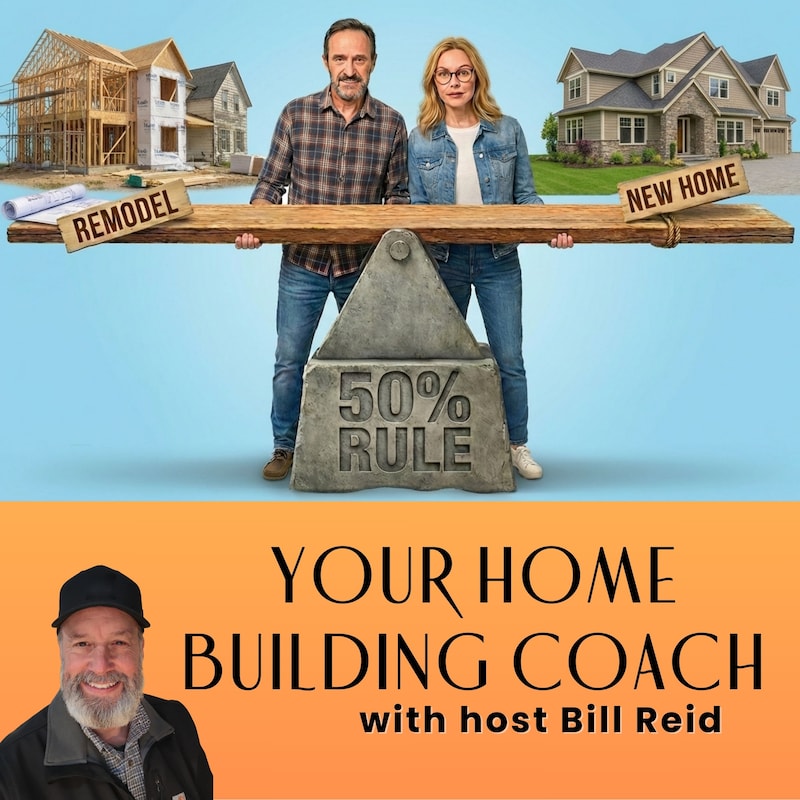
The 50 percent rule home renovation is the expensive surprise that derails thousands of renovation projects every year. Homeowners invest in beautiful designs, fall in love with their plans, submit for permits—and then discover their remodel has been reclassified as "new construction," triggering full code compliance that adds $75,000-$150,000+ to the budget.
This scenario is devastating. But it's also completely avoidable if you understand project classification BEFORE you design.
I'm Bill Reid, Your Home Building Coach, and this is Episode 41—the finale of our Understanding Design Limitations series. Over the past 11 episodes (31-41), we've covered every major restriction that can affect your custom home or major remodel project: zoning regulations, Floor Area Ratio, setbacks, height restrictions, lot coverage, easements, HOA rules, and now—the meta-rule that sits above them all—project classification.
Here's why this episode matters: The 50% rule doesn't just affect your budget. It affects whether your project even makes financial sense. It can turn a straightforward $150,000 renovation into a $225,000 nightmare. It can require elevating your entire home on stilts if you're in a flood zone. It can delay your project by 6+ months.
But when you understand this rule during the discovery phase—when you ask the right questions BEFORE you invest in design work—you can design strategically to stay under the threshold, phase your project intelligently, or embrace full compliance with eyes wide open.
🎯 In This Episode You'll Discover:
✅ What project classification actually means and how building departments categorize your work (minor remodel, major remodel, or new construction)
✅ The 50 percent rule explained: How crossing this threshold reclassifies your remodel as new construction and triggers full current code compliance
✅ The 3 calculation methods cities use to determine the threshold: • Square footage method (addition size vs. existing home) • Cost-based calculation (improvement cost vs. assessed value) • Structural assessment (load-bearing walls, roof changes, framing modifications)
✅ Why there's no single national standard: Each jurisdiction calculates differently, and some use multiple methods simultaneously
✅ FEMA's substantial improvement rule: How flood zone properties face an additional 50% threshold that can require elevating your entire structure ($100K-$300K+ added cost)
✅ Real cost impacts of crossing the threshold: • Fire sprinkler installation throughout entire home: $15K-$25K • Electrical system upgrades to 200-amp service + AFCI breakers: $20K-$40K • All windows replaced to meet energy codes: $25K-$60K • Structural seismic retrofitting in earthquake zones: $15K-$50K • Foundation elevation in FEMA flood zones: $100K-$300K
✅ The 801 square foot mistake: Why adding 801 SF to a 1,600 SF home costs $75,000 more than adding 799 SF (and how 2 square feet makes all the difference)
✅ Strategy #1: Design Under the Threshold • Calculate using your city's exact formula • Design to 46-48% as safety buffer (not exactly 49.9%) • Document everything with building department in writing
✅ Strategy #2: Phase Your Project Strategically • Complete 45-48% of work in Phase 1 • Wait 12-36 months (check jurisdiction's reset period) • Complete remaining work in Phase 2 • Critical warning: Some jurisdictions prohibit this if phases were "planned together"
✅ Strategy #3: Embrace Full Compliance (Or Consider Demolition) • Budget for code upgrades across entire home from the beginning • Leverage classification to fix existing safety issues • Consider whether full demolition + new construction makes more sense financially
✅ Critical questions to ask your building department BEFORE you design: • "Does this city use the 50% rule, and how exactly do you calculate it?" • "What specific compliance requirements apply if I cross the threshold?" • "Can I review recent similar projects for classification precedent?" • "If I phase the project, what time period resets the calculation?" • "Are there FEMA flood zone requirements for my property?"
✅ The property tax impact nobody mentions: When your remodel gets classified as new construction, county assessors often reassess your ENTIRE property at current values, potentially increasing annual taxes by $4K-$6K+
✅ Common mistakes that cost six figures: • Designing first, calculating later • Trusting "it won't be a problem" from contractors/designers • Underestimating compliance costs • Ignoring FEMA flood zone status • Believing the "49% myth" (when city uses different calculation)
✅ How BuildQuest will help: Our upcoming AI-powered planning platform with Quinn (your project guide) will help you identify 50% rule requirements specific to your jurisdiction, calculate thresholds, and develop strategic approaches
📍 KEY TIMESTAMPS:
00:00 - Introduction: When Is a Remodel Not a Remodel?
02:48 - What Project Classification Really Means
07:15 - The 50 Percent Rule Explained (Why Cities Created This)
12:30 - Three Calculation Methods Cities Use
16:45 - FEMA's Substantial Improvement Rule (The Federal Layer)
19:20 - Real Cost Impacts: $75K-$150K+ in Surprise Expenses
23:10 - Strategy #1: Design Under the Threshold
25:40 - Strategy #2: Phase Your Project Strategically
27:15 - Strategy #3: Embrace Full Compliance (Or Demolish and Rebuild)
29:30 - Critical Questions for Your Building Department
31:00 - The Property Tax Impact Nobody Mentions
32:45 - Conclusion: Wrapping Up Understanding Design Limitations Series
📚 RESOURCES MENTIONED:
📖 The Awakened Homeowner Book
Section 2.340 covers remodel classification and the homeowner who discovered their addition triggered full code compliance
- Amazon: https://www.amazon.com/dp/B0F1MDRPK7
- All Platforms: https://books2read.com/u/bpxj76
📚 The Tale of Two Homeowners (Free Story)
See the dramatic difference between an informed homeowner (who did discovery) and one who learned the expensive way
https://the-awakened-homeowner.kit.com/09608e1727
🌐 External Resources:
- FEMA Flood Map Service Center: Check your flood zone status
- FEMA Substantial Improvement Guidelines
- International Code Council Building Codes
- National Association of Home Builders Resources
🎧 Related Episodes:
- Episode 31: Understanding Zoning Regulations & Districts
- Episode 32: Floor Area Ratio (FAR) Explained
- Episode 33-35: Setbacks, Height Restrictions, Lot Coverage
- Episode 38: Easements & Right-of-Ways
- Episode 40: HOA Architectural Review Requirements
🔗 CONNECT:
🌐 Website: https://www.theawakenedhomeowner.com/
📧 Email: [email protected]
📸 Instagram: https://www.instagram.com/theawakenedhomeowner/
👍 Facebook: https://www.facebook.com/theawakenedhomeowner/
🎥 YouTube: https://www.youtube.com/@TheAwakenedHomeowner
🔗 LEARN ABOUT THE BUILDQUEST APP:
Reserve your spot for free beta testing (launching late spring/early summer 2025)
🌐 Website: https://www.buildquest.co/
👤 ABOUT YOUR HOST:
Bill Reid is Your Home Building Coach with 35+ years of experience in residential construction. He created The Awakened Homeowner methodology to enlighten, empower, and protect homeowners through their building and remodeling journeys. The mission: transform overwhelmed homeowners into confident project leaders who avoid costly mistakes through proper planning.
🔔 SUBSCRIBE & REVIEW:
If you found value in this Understanding Design Limitations series (Episodes 31-41), please subscribe to Your Home Building Coach podcast and leave a 5-star review on:
- Apple Podcasts
- Spotify
- Google Podcasts
- Or wherever you listen to podcasts
Your reviews help other homeowners discover the guidance they need to protect their projects!
🎯 WHAT'S COMING NEXT:
I'm transitioning from design limitations to a new series on understanding architectural plans—how they work, their systems, and the conventions they use so you can become an educated plan reviewer.
I'll also be inserting other relevant topics as we approach year one of this podcast in mid-April 2025.
Mentioned in this episode:
Transcripts
Just because you're planning to remodel your home doesn't necessarily mean that it's classified a
your city's planning department. If you're planning to expand your home by more than 50 % or even if you're planning
your home into a new looking home, your home could be classified as a new construction and that means that it's going to trigger that the entire structure be brought up to code.
And worse, if you're in a flood zone, FEMA is gonna tell you that you're gonna have to raise the entire structure up to the
level. Today we're gonna be diving into the studio and we're gonna be talking about the 50 % rule that could apply to your home and why knowing this now before you begin design or perhaps before you even buy a piece of property is vitally important. So let's...
Dig in, go into the studio, and I'm gonna talk all about this so that you are enlightened, empowered, and protected.
William Reid (:All right, everybody. Welcome back to your home building coach podcast, also known as the awaken homeowner mission. If you've been following along with our understanding design limitation series, You know, we've been deep diving into all the rules and restrictions
that can affect your custom home or major remodel project.
We've covered zoning districts, floor area ratios, setbacks, height restrictions, the infamous HOA rules, all the ways cities and regulations constrain what you can build. But today we're tackling the classification rule that can take all of the restrictions and amplify them. So here's the thing.
Your remodel might not be a remodel in the eyes of your city. It might be classified as new construction. And that classification can change everything, your timeline, your budget, and your code requirements. And if this rule isn't understood to begin with, this could be one of the biggest blind sides in planning a project. And I personally have dealt with this more than once, unfortunately,
with projects that were these hidden rules and regulations even as a professional, if you're not familiar with all of these, this can really upturn a project. So right now, I'm gonna call this our final episode in understanding design limitation series. There's a few more lurking about, but I'll probably circle back to those later. And it's a perfect way to wrap up because
project classification is like the meta rule that sits above all
others. It can make a non-conforming home suddenly need to conform. It can require full code compliance when you thought you were just adding a bedroom. So let's dive into this critical topic that protects you from one of the most expensive surprises in home building and remodeling.
William Reid (:All right, let's start with a question. When is a remodel not a remodel? And here's the answer. When your building department says it's new construction, and here's why that matters. So here's what classification means. Project classification is how your city categorizes your work. It sounds simple, but this one determination affects everything. Which codes apply, which approvals you need.
what timeline you're looking at, and how much your project will cost. Think of it like this, if you're building on an empty lot, the classification is really easy. It's new construction. But what happens when you're keeping part of your home and adding to it? What if you're demolishing 60 % of it and And keeping 40%. What if you're replacing all the windows, adding a second story, and expanding the footprint?
That's where classification gets tricky.
You know, cities didn't create these classification systems to make your life difficult. They created them for safety and fairness. And here's the logic. If you're substantially changing a structure, shouldn't that structure meet current safety codes? If you're essentially building a new home, but calling it a remodel, should you be exempt from current fire safety requirements? Should you be able to ignore setback rules that every home has to follow?
e an existing, we'll just say: tion rule. So you're taking a:and building apartments. the idea here is to let you know that so that if you're planning a project like I'm talking about today, you can massage that design so that it does not trigger that. Now it's not
simple as that, but that is one of the first things that the cities will look at. And unfortunately, each city has their own methods of calculating and determining what 50 % means. And you're going to want to understand this.
planning to undergo a major renovation. So most cities use three basic categories. Of course, there's new construction, empty lot to a finished home. Everything must meet the current building code and the zoning codes and everything must go through the planning department but prior to going to the building department. And then you have minor remodels. You're working with the existing
not changing the structure significantly and generally subject to lighter requirements. And then there's the major remodel or also a term that's used a lot is substantial improvement. This is the gray area. You're doing significant work, maybe adding square footage, maybe removing load bearing walls, maybe completely renovating.
This category is where classification battles happen. Because once you cross into a major remodel territory, you might face new construction requirements. So in my book, section 2.340, I discuss how one homeowner discovered their addition was being classified as new construction, triggering full code compliance. They hadn't budgeted for it.
This is what we call remodel classification. And the building department has specific formulas to determine which category your project falls into.
So now that you understand what classification is and why it matters, let's talk about the most common rule cities use to make the determination of the 50 % rule. This is where it gets really interesting and really important to your planning. And there's another thing you're gonna need to factor, which we'll probably talk about in the future, and we will definitely talk about in the future, is the term substantial completion stems from the
federal organization called FEMA, Federal Emergency Management Agency, I guess it is. And if you're in a flood zone, or if you're in a coastal property down at the beach level, or just a designated flood zone, if you're planning to remodel an existing home in a flood zone, this gets really complicated.
And if you surpass the 50 % rule plus other FEMA regulations, you could be required to elevate your entire home or at least elevate the addition portion, which is kind of crazy. So the 50 % rule is the most common classification trigger in the country. There's no single 50 % rule.
Different cities calculate it completely differently.
Let's start with the simplest version because it's the most common. If you increase your home's living area by more than 50%, your project may be classified as new construction. So even though you're submitting your project as a remodel and unbeknownst to your design pros and yourself, you've, you know, increased the home by more than 50%, which is common today where we're doing major renovations.
for not tearing down existing homes, just in some cases doubling the size of the home. You need to know that this is now considered a new construction. And knowing this now means you may actually elect to demolish your existing home and rebuild rather than trying to conform to all of the existing structures and inferior elements of that structure.
that can really limit the design, heck, you might as well demolish the building. At least consider it if you think you're gonna turn your 1,600 square foot home into a 3,200 square foot home. So if you have an 1,800 square foot home and you add 1,000 square feet, you've just crossed that 50 % threshold. The city looks at this and says, you're not just adding on, you're creating what's essentially a new home. Time to meet new home standards.
So why 50%, right? mean, if you're expanding by more than half, you're essentially building a new home.
this is the standard 50
rule remodel threshold that homeowners need to understand before designing their addition. Many California cities like Saratoga use this method.
Now, some California cities and other cities across the country, some California cities, especially in the Bay Area, use a more complex calculation that looks beyond just square footage. And I have personally dealt with these, and it is an extremely time consuming.
laborious, complicated process to determine if you really are in fact remodeling more than 50%. It's not just a square footage calculation. So they calculate square footage and linear footage of materials being removed or impacted, and sometimes also square footage of materials that are being impacted.
So this could include siding, roofing, exterior walls, interior walls, flooring. So why? So to capture projects where you're not adding much space, but you're substantially affecting the existing structure. Much harder to calculate, requires detailed construction plans. So let's say you're not adding any square footage, but you're removing all the exterior siding, replacing the roof, and re-
configuring interior walls. Under the new square footage rule, you're fine. Under the linear footage method, you might have just triggered the 50 % threshold because of all the materials you were affecting. So I want you to be thinking about your design. And if you feel like, and you can be honest with yourself, that your home is going to look like a brand new home when you're done, that you won't even be able to recognize it.
whether you're adding on or not, you might fall into this category.
Now, the FEMA rule that can affect your classification of your project is sometimes adopted by cities for themselves to determine what the classification of the project is and therefore what restrictions you have, what submittal requirements you have, and what building codes apply.
So the FEMA rule, especially in flood prone areas, particularly Florida and coastal regions, there's a completely different calculation, but it's not just limited to coastal regions.
This could be affected by any kind of watersheds, rivers, lakes, runoffs, anything that would be classified as a flood zone. And you'll be able to determine that
to the FEMA website and looking up your property. It's pretty easy to do. And if you know that you're in a flood zone, you better be careful. And this is one of the first things that your design professional
will and should do before you start digging into the design and don't assume you're not in a flood zone just because you're not near anything you never know so always check so what happens is they look at fifty percent of the structures pre-improvement market value and that's the structure value only land is not included if your repair or improvement
costs exceed 50 % of the structure value. full code compliance is required. This is primarily enforced under FEMA regulations for flood zones. So like here's a scenario from Florida after Hurricane Ian homeowners with $300,000 in damage to homes valued at $500,000 thought they could just repair and rebuild as is.
But because the damage exceeded 50 % of the structure's value, they were required to elevate the entire home to current flood elevation standards. That's an additional $100,000 to $200,000 they weren't expecting. I personally have dealt with this on more than one project, but in particular a project on the Pacific Coast in the Monterey area.
And unfortunately, it was not determined or understood that this rule applied to a particular project. And in this case, it was compounded because it was a townhouse development where there was another building attached to it. And the intentions of the homeowner were to completely renovate the interior, bring it up to high level finishes. We weren't adding any square footage, but the value of the project exceeded the 50 % rule.
And therefore, we were not able to actually do the project as designed because we were required to lift the structure up and we could not lift the entire structure up because there was another unit attached to it. What was the result? I had to do a major redesign and step back and scale the project way down. don't think you can just phase out a project because they've got that figured out too.
We'll continue on with this and I'll explain some of those more details to you. So that is what we call substantial improvement calculations under major renovation building codes.
Now here's something also that blindsides homeowners, like I just mentioned about the FEMA rules. Some cities don't just look at your current project. They look back in time. I've dealt with this personally in a project in the city of Palo Alto where we were trying to maintain the valuation of the project under the 50 % rule, but the city went back, I believe it was five years.
So some jurisdictions have one to five year what they call look back periods and they add up all the permits and improvements during that period. And if the cumulative total exceeds 50%, classification changes. I've seen this happen. A homeowner does a kitchen remodel, then a year later wants to add a bedroom. Each project individually is under the threshold, but the city adds them together and says over the past two years,
you've improved this home by 60 % of its value. Time for full code compliance. The homeowner had no idea this was coming. So these look back provisions are designed to prevent incremental avoidance of classification rules. So you can't get a little too creative with your design strategy and implementation unless you plan to do over a longer period of time.
So one of the first questions you're going to want to ask when you are planning a project with your design professional or and or go into the planning department of your city or county and ask them to explain or provide documentation on the classification process of remodel projects. So the 50 % rule isn't just one rule. It's a concept that every jurisdiction interprets differently.
And that's why you probably must talk to your specific city and planning building departments before you begin designing your project. And you might even want to think about researching this before you buy a property if that's the mode you're in. If you're in a flood zone, if you're planning to completely do a renovation and don't want to have the city telling you how much you need to bring it up to code, you might want to rethink the purchase of that property.
So what triggers classifications in Saratoga might not trigger it in Palo Alto. What matters in Florida doesn't apply in Colorado unless it has to do with specifically the FEMA flood zone rules because I believe all cities across the country are forced to adopt that in order to comply with FEMA. So if there ever is a catastrophic event, the homeowners are covered.
So now that you understand how cities calculate whether you've crossed that threshold, let's talk about what happens when you do. Because this is where your budget and timeline can get completely derailed if you're not prepared.
William Reid (:All right, so here's where the rubber meets the road. You've crossed that 50 % threshold and your project is now classified as new construction or substantial improvement. What does that actually mean for your project? So let's break it down. Point one, fire suppression systems. The most expensive surprise for most homeowners are being forced to install a fire sprinkler system in their home because they've crossed that threshold.
Now many jurisdictions require fire sprinkler systems in new single-family homes. If your project is reclassified, sprinklers may be required throughout your entire home, not just the addition. This cost could be, heck, could be anywhere from, I'm gonna guess, not guess, I've seen some of this in the past, but anywhere from five to $10 a square foot for the retrofit installation.
And that could eat right into your budget.
, which is really common from:It's worked fine for decades, but now that your project is classified as new construction, current code requires 200 amp service for a home of your size. Nah, there's another eight grand probably. And then the energy codes have gotten dramatically stricter over the past 20 years. Your entire home may need to come up to a current energy code, not just the addition that you're doing on your project. This can include upgraded insulation and walls and attic.
new windows throughout the home, upgraded HVAC efficiency, air sealing
Some cities offer compliance paths that are less expensive than full upgrades, but you need to know about them.
and as I'm going here, I'm getting bigger and bigger into some of the issues, but here's the one that catches people completely off guard. Existing nonconformities. So your existing home right now might not meet the current setback requirements. It was built before current rules as a remodel. You could keep the nonconformity.
's say your home was built in:and you'll have to verify that with your each of your individual cities. Under new construction classification, the city might require you to move the wall to meet current setbacks and which could mean demolishing more of your existing home than you planned. I personally dealt with this in a project in Saratoga, California, where the homeowner wanted to completely remodel the entire home, add square footage on multiple ends of the building.
And the left side of the structure actually was not meeting the current setback requirement. So we had the existing foundation on the left-hand side. We demolished the structure all the way down to the existing foundation, added on in multiple areas, and then rebuilt the home. On the left-hand side, we had to move that entire foundation in.
believe it was one or two feet to meet the code, the current code, because it was classified as a new home. In hindsight, I would have proposed to demolish the entire home and start from scratch although it would be more expensive to demolish the entire home because of the demolition work and the additional foundation work. Overall,
truction, and you plan to add: to your existing:and the rest of it isn't. I've personally dealt with this in the past and I've had to fight the cities and in some cases the FEMA regulations to not have to conform to this. So this is the kind of thing you want to know before you buy the property. This is the kind of thing you want to know before you begin design if you already own the property. You may want to relocate the structure outside of the flood zone if you have a big enough parcel.
I want you to really keep that in mind. So crossing the 50 % threshold doesn't just mean your addition needs to meet code. can, it can mean your entire home needs upgrades, fire sprinklers, electrical energy efficiency, accessibility, and even fixing nonconformities in your existing home that you never planned to touch. So these costs add up fast. I've seen projects increased by 50,000 to 150,000 because of the classification.
Or quite honestly get completely killed and have to redesign.
panic, let me give you the good
navigate this.
You can design your project to stay under the threshold. You can phase your work over time, or you can plan for these costs from the beginning. Let's talk about how to strategically approach the classification.
All right, so how do you navigate this minefield? Let me give you three strategic approaches, and I want you to think about which one makes the most sense for your situation. The first one is simply
design your project to stay below the classification. Calculate your threshold before you design. If you have 1,800 square feet and the 50 % rule applies,
Keep your addition under 900 square feet. This may require creative design to maximize space with the constraint.
you might want. So the 50 % rule is one thing in general, but remember,
You're going to want to talk with your city planning department to understand their project classification process for the 50 % rule because it may not just be square footage. If you just, if you think, oh, I'm just going to add 500 square feet, but I'm going to remodel the entire house, rip all the siding off, put all new windows, rip off the roof, put a new roof on, put a new front porch on. These are all the things that are going to be considered as part of the 50 % valuation.
Strategy two, phase your project. So the second strategy is to phase your work over time. Now you have to be careful here because in some cases if it's a FEMA regulated project, you may have a problem doing that unless you plan to phase it over multiple years. So do your addition now and other improvements later outside of that look back period I just mentioned, if your city has a look back period.
The look back period usually is triggered when you're under the FEMA rules and regulations, but some cities do use that as well. So this requires understanding your city's specific look back rules. The risk, rules might change between phases. The benefit, it spreads costs over time. If you were to consider doing that, doing a master plan with your design professional is a really good idea.
because this will help you determine if your project in the future phases are not impacted by the existing work that you're planning to do for your phase one.
And I spoke about that in the design process about doing a master plan because I'm sure you have a million ideas and if you're living in a flood zone or if you're living in a city that has these rules and regulations, this could be a really smart strategy because if you do a master plan, you're planning to add on a second story or the back of the house, plan to replace all the windows.
There's certain design strategy there by doing a master plan and then phasing it out to understand the impact of one versus the other so that you're not forced to redo work that you did a couple years ago.
homeowners do their addition first, then wait two or three years to do the interior models or other improvements. This can work, but you need to know...
your city's look back period. If they have a five year cumulative rule, phasing over three years won't help you. So here's the caution with this
Some homeowners try to game the system by doing work without permits to avoid the cumulative calculation. It's a terrible idea. You'll pay penalties. You might have to undo work and you put your home's resale value at risk. Don't do it.
course there's strategy three plan and budget for the full compliance the third strategy and often the best one
for it from the beginning. If you're crossing that threshold anyway, embrace it and plan for the cost. The benefit? Your entire home gets upgraded to current standards, better safety efficiency and resale value. You can leverage the classification to fit existing issues while you're at it.
And financing may be easier when the full scope of the work is clear and upfront. Now, this is a really important point that I want to mention. If you are finding with your design professionals that you're crossing that threshold of this 50 % rule, you need to pause and sit back and think that is it a smarter approach to just demolish the entire structure and build a brand new home? Because if you're willing to accept the classification,
There's a chance that it may not be more costly or may not be significantly more to demolish the entire structure and just do it and be done with it so you can live the rest of your life in your new home.
No matter which strategy you choose, this is not a DIY territory. An architect experienced in your specific city rules is critical. And you knowing that you may fall into this category is the objective here today. Whether you're in a flood zone, you're planning a major renovation, that's the goal here. So you know to ask the right questions. Because your
design professionals may not know to investigate that
it's too late.
So we want them to calculate the classification threshold during the initial design, not after. The building apartment pre-application meeting is essential. Get the classification determination in writing, budget for professional help. It pays for itself in avoidance of prizes. So this is exactly why we're launching the BuildQuest application, our AI assistant planning platform with Quinn, your project guide.
Quinn will help you understand the classification rules specific to your city and make sure you're asking the right questions during your discovery phase as questions are being posed to you by Quinn. You can reserve your spot for that beta testing at buildquest.co which is a little congregation of homeowners, design and construction pros that I'm going to be reaching out to.
come late spring, early summer to beta test for free and see what they think. So your three strategic approaches, design under the threshold, phase your project carefully, or embrace the full compliance and budget for it and consider just demolishing your entire home and rebuilding it. The worst approach, ignoring classification and hoping it doesn't come up. I guarantee you,
It will come up and by then it's too late to adjust. This brings us to the end of our understanding design limitation series. So over the past 11 episodes, we've covered every major restriction that can affect your project. Well, maybe not. I'm going to think of a few more, but this is the big ones. This is the big ones. So some other ones I'm in the back of my mind are dealing with trees, protected trees, dealing with parking restrictions that could
really affect a project in an urban or suburban location, but this is the core limitation series that if you review all of these episodes, read all of the blog posts about this, because in the blog posts I expand even more on this, and you will be an empowered homeowner to tackle your project right out of the chute and not waste time and money on design or even construction.
And this classification rule, it's kind of the capstone, the rule that can make all the other restrictions even more important. So let's wrap this up.
William Reid (:Here's what we've covered today. Project classification determines whether your remodel is treated as a remodel or as a new construction. The 50 % rule is the most common trigger, but it's calculated differently by every jurisdiction and FEMA can dip their toes into this as well. That can add a whole other layer of complexity.
Crossing that threshold can add tens of thousands or even hundreds of thousands of dollars to your project through fire sprinklers, system upgrades, full compliance, and could significantly impact the actual design of your project, as I mentioned, where you may have to elevate your structure or you may want to think about tearing down your whole structure. But with strategic planning during the discovery phase, you can design around these thresholds
or budget for them appropriately. The key takeaway, you need to understand classification before you design, not after you submit plans. And with that, we've reached the end of our understanding design limitation series over episode 31 through 41. I think I snuck one in there about project planning.
And the process to do that because I wanted you to get a refresher on that and we've covered everything that can constrain your design zoning FAR setbacks height restrictions lot coverage easements trees parking coming soon HOA's and now project classification And I want to I want to point out one other thing that you might want to look into and that is how are your
property tax is going to be impacted by your project classification. We'll be doing a future episode on that, but keep in mind that if your project is classified as a new home, even though it's not, your county assessor may use that to reassess the entire building. Not necessarily at market value, but they will reassess all of the square footage to adjust your property taxes.
So when you know these rules upfront, during that critical discovery phase, we've talked about early in this podcast, and I refreshed on it recently, you can design with them rather than against them. And that's the awakened homeowner approach. Enlighten yourself about the rules. Empower yourself to make informed decisions.
and protect yourself from costly surprises.
Keep in mind that I have a book that I've published called The Awakened Homeowner, same title of this podcast and the platform and the website. And I have this design limitation series in there along everything else that you need to consider before you do a project. And it's a great resource to sit back and read and absorb. And you can always find it on Amazon. And don't forget, we're launching BuildQuest.
And that's going to be a project planning platform for homeowners, something that's not out there today for you to take charge and not feel like you're being forced into different platforms or different solutions that maybe a specific builder has or a specific designer has. This is your own home that you're going to be able to invite them to. And you guys can share.
all the resources and the communications.
And lastly, if you found this series valuable, I'd love to hear from you. You can reach out on Instagram at The Awaken Homeowner. can see me on Facebook. I post these on Facebook and YouTube as well, where you can make comments and criticize me, whatever you want to do.
But it's good to know which design limitations surprised you the most or share your own classification story or maybe design limitations I haven't even talked about that I haven't thought of yet. By this exchange, other homeowners see this and it also gives me new fresh topics to talk about that are currently happening today. So if this episode helped you avoid a costly mistake,
Share it with someone who's planning a remodel, please. That's how we protect homeowners from the Ben and Jane scenario, my little story that I've written that's on the podcast and in the book. And I think it's even on the YouTube where I narrate the story. That's a really good way to capture all of this into how it affects real life scenarios.
Now, what's going to happen in the future here with the podcast is I'm going to start working on explaining to you how architectural plans work and their systems and the conventions that they use so that you can start becoming educated. Now that's going to a little bit difficult in a podcast all audio episode, so I might sneak in some YouTube presentations, but there's a large following now on the podcast. So I'm going to do my best to just give you some insight on understanding plans.
but I'm also going to be inserting other relevant topics throughout the rest of this podcast as we approach year one of this episode in mid-April.
So that's a wrap today. I'm Bill Reid your home building coach. Thanks for joining me for this Understanding Design Limitations series. And remember, you don't know what you don't know, but now you do. So let's make it happen.




