Shownotes
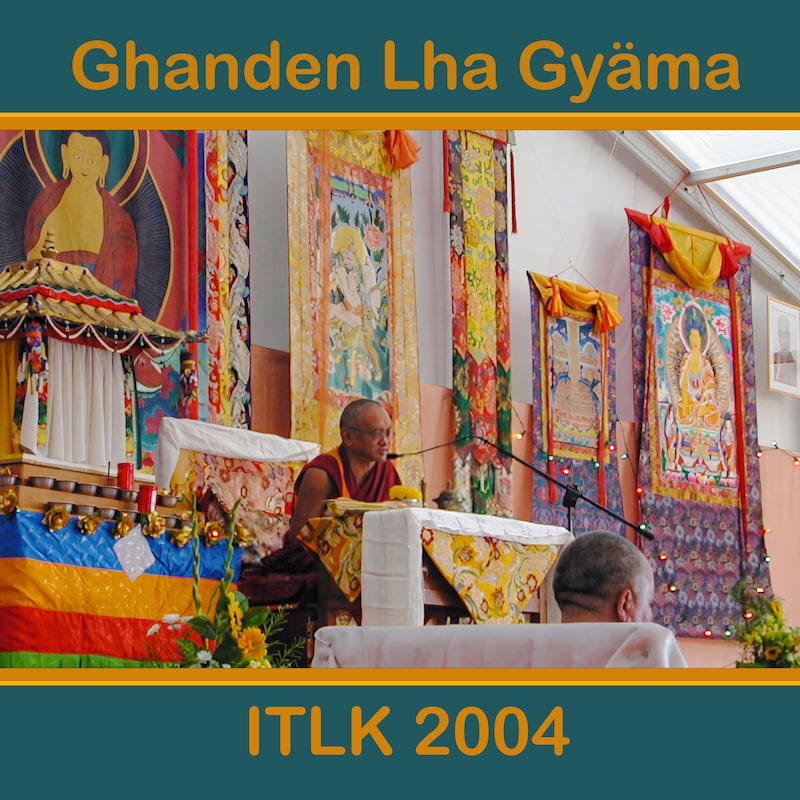
This teaching was given by Lama Zopa Rinpoche at Lama Tsonkhapa Institute in Italy as part of the Ganden Lha Gyama retreat between September 3-30, 2004.
00:00:00 Rinpoche dedicates the recitation of Heart Sutra for the health and stable life of Ribur Rinpoche and tells a short story about how he met and received teachings from Ribur Rinpoche.
00:12:30 The group recites the Praise to Buddha Shakyamuni and the Heart Sutra.
00:22:35 Rinpoche tells stories about how prayers, pujas, and meditation on emptiness by some lamas in Tibet were used to eliminate obstacles for travelling.
00:40:35 Rinpoche advises that meditating on the emptiness of sickness, relationship problems, or other obstacles, even briefly, becomes a powerful practice to purify their causes. Looking at the three spheres of giver, receiver, and action as empty is helpful for overcoming spiritual harms.
00:46:40 Rinpoche and students recite Heart Sutra, Lion-faced Dakini, and other prayers.
00:54:50 Rinpoche leads extensive offerings of all the holy objects, statues, stupas, scriptures etc. in the ten directions to the Three Jewels, making offerings to each one individually to collect merit. The motivation of making offerings should be for the happiness of every single sentient being.
Find out more about Lama Zopa Rinpoche, his teachings and projects at https://fpmt.org/
Transcripts
So, so good evening. So we do the, begin with the preliminary, the Heart Sutra, and also we dedicate the Heart Sutra for Ribur Rinpoche, Kyabje Ribur Rinpoche, for Rinpoche’s, seems there’s some, maybe some obstacles taken or Rinpoche’s health maybe some obstacle taken, however, that might take some, may take some obstacles, so the, came out several numbers of pujas, things to do, so one is Heart Sutra, so we dedicate also for Rinpoche’s stable life, to have stable life and, yeah, that purify our ordinary sentient beings’ the view of, taking obstacles, taking unhealthy. So to purify those, so yeah, like that, that specific one.
The other one is the King of Prayers, need to recite some King of Prayers for Rinpoche’s, to purify, by purifying the karma of the sentient beings then to show perfect health and things like that and long life, to recite some number of King, the five times King of Prayers and five times Heart Sutra, so then I think here many people doing that can help, so can dedicate for a few days reciting King of Prayers, Heart Sutra, then general thing but particular for Rinpoche’s health and long life, could dedicate like that.
[Ven. Sarah then reads out other names for dedication.]
So we can dedicate also those to, same, those same, those who are sick to get healed and died, for their good rebirth, I mean, to liberate from the lower realms and to achieve higher rebirth and meet Dharma and by actualizing the path then to achieve enlightenment as quick as possible. So can do that, the prayers, meditation, whatever, everything dedicate for them and for sentient beings.
Somehow I didn’t get to go to see Ribur Rinpoche earlier. I just came from Geshe Sopa’s center, through Salt Lake City and arrived in Washington. I went to receive the oral transmission of Pabongka Dechen Nyingpo’s The Treasure of Blessings, this wonderful Lama Tsongkhapa Guru Yoga practice composed by Pabongka. I thought it might help here. I haven’t received the entire oral transmission of Pabongka’s collections of teachings—just Liberation in the Palm of Your Hand and bits and pieces here and there. I particularly took the oral transmission of Liberation in the Palm again, even though that was my first lamrim teaching from the holy mouth of my root guru, His Holiness Trijang Rinpoche, His Holiness the Dalai Lama’s Junior Tutor. Pabongka Dechen Nyingpo particularly asked Rinpoche to make notes when Rinpoche was in that lamrim teaching. Even though there were many other great lamas there, lamas who, like the sun shining, had benefited sentient beings and the teaching of Buddha, Pabongka Dechen Nyingpo particularly asked His Holiness Trijang Rinpoche to write notes.
That was the first time Rinpoche gave a teaching in India, in Varanasi, though I don’t remember which year it was. And that was actually my first lamrim teaching. But to be sure I requested Ribur Rinpoche for the oral transmission when Rinpoche was doing Vajrayogini retreat at Richard Gere’s house. Rinpoche invited me to come there to do retreat, and I had known Richard Gere for quite some time. I think Rinpoche was doing Vajrayogini retreat there for a whole year. So, I did some retreat there, and then I took the opportunity to take the oral transmission. I wanted to make sure to leave a positive imprint so that when I passed it on to others, it would be the best quality possible. I also took the oral transmission of bits and pieces of other teachings by Pabongka.
On the way to the airport, I went to Rinpoche to request him to give the oral transmission of Pabongka’s Lama Tsongkhapa Guru Yoga, which is called kagyama. Kagyama means it is under strict order and can’t be given to just anybody who is curious; it is only for those who practice or who are living in the samaya vows. That is also mentioned in the title. So, Andrea has been translating this text into English and Italian. It says here that if anybody without clean view and doctrine uses this, it is corrupted, and may the protectors, which means Six-Arm Mahakala, (there are three types of protectors living in the pledge, or samaya, of the three deities) punish them with powerful vajra punishment. This is because this practice has the particular secret meditations.
So, I took the oral transmission from Rinpoche but unfortunately the text I had had two pages missing. I don’t know exactly which two pages; I don’t remember. Andrea has my text, and this text is a copy that I made just recently here. This is an incredible practice, so I thought that if I had the lineage, it might be good to pass it to you. I thought if it’s not too long and not too difficult for Rinpoche, maybe I could hear the two-page oral transmission by telephone. If it’s not tiring for Rinpoche. It seems Rinpoche has taken the aspect of being slower than before. Actually, I didn’t look carefully at Rinpoche’s face when I was taking the oral transmission on the way to the airport, but it seems he has taken the aspect of being slower than before.
[Rinpoche begins recitation of Praise of Shakyamuni Buddha]
[Ven. Sarah: A star, a visual aberration...see conditioned things as such.] [Rinpoche recites final verse, then the Heart Sutra.]
[Ven. Sarah: No nose]
Nga me, I think I have a nose. You don’t have a nose, but I have a nose. Maybe not a big nose. Che me, le me [Rinpoche continues recitation, pausing after each one, with Ven. Sarah reading the English, up to “similarly, there is no suffering.”]
So now, relate, within this it includes if you have any sicknesses, cancer or whatever sickness you have, diabetes, so any sicknesses you have, then, or any problem that one has, so here look at it empty. While you are looking at all the suffering samsara, empty, all the sufferings, all the problems, all the sufferings of the human realm, sura, asura, human beings, hell, hungry ghost, animal, all the, looking at all their suffering empty. Then, whatever particular problem that one has, so any obstacles one has then look at them empty, as they are empty. So this becomes very powerful puja, eliminating obstacle.
So, one lama, Kunkyen Jamyang Shepa, the very, the one who is most well- known, one most well-known lama in Tibet or in Amdo, from Amdo, Kunkyen Jamyang Shepa, who wrote many volumes of scriptures, commentaries and then, especially, I think, sutras, many volumes and that, the founder of the largest monastery in Amdo, Tashi Kyil. So when, the second time when we went in Tibet, I went there, I think, two times, I think maybe two times, I think, I’m not sure. One thing to find a text, commentary of the Chenrezig Gyalwa Gyatso, the secret Chenrezig, to get, the text is very rare, so under the guidance of Kyabje Kirti Tsenshab Rinpoche, so went, that was one main purpose of going to Amdo. To find the commentary, the ?Shak , which lama that making extensive offering that I mentioned before, with all the students, that one, moving round the mountains, doing like this. So at this monastery to get this commentary. So went to Kumbum, no, sorry, yeah Kumbum went two times and Tashi Kyil.
So met the abbot of the monastery, who is Kungtang Jampel Yang, one of the great lamas, who wrote again many teachings, very learned, very, extremely learned and who is far-famed and learned and highly attained, same as Jamyang Shepa, same. So, Kungtang Jampel Yang was the abbot of Kumbum Monastery and Jamyang Shepa took lay aspect, who is the founder of the monastery, so Kungtang Jampel Yang, this lama, so we went to meet him. So he pointed to a statue of Kalarupa, that used by, that Lama Tsongkhapa had, so actually he received from, which was at Gaden Monastery, so he received. So I guess he is a very important lama of Lama Tsongkhapa tradition, spread, preserved Dharma very pure, Lama Tsongkhapa tradition, so I think might be because of that he received. So he pointed, show us the Kalarupa statue.
And then, he said, even though the monastery was destroyed or burned by fire, but the teaching of the Buddha is not destroyed, nothing happened, he said. He only said, made a few comments and said only a few things. Why? Because the teachers, the very learned teachers that monastery had, so they were away during those twenty years of unbelievable destructions, change. So they were away; after twenty years, when the monastery started, when there was some freedom was given, all these thirty geshes, nothing happened with them, no disrobed, nothing happened those twenty years, able to come back and immediately start to teach the young monks in the monastery. So he, that’s why Kungtang Jampel Yang said, even though monastery was destroyed, burned, but teaching of Buddha, the denpa, nothing happened. That’s how he explained.
So in this monastery I heard, explained that, so somebody who is sutra and tantra, all expert, complete expert, there’s a certain number, 100, I don’t know, seventy or sixty, who is expert, full expert in sutra, 100 or 200 or something, so he has a certain number of, the amount of the geshes there who’s quality, it’s incredible great monastery, unbelievable.
So anyway, the founder of the monastery, so Kunkyen Jamyang Shepa, so he, when you travel, there, when for example you are going in the wrong day, astrologically wrong day, wrong star, things like that, so then, wrong time, then that becomes for us ordinary beings who are influenced, who are, who don’t have those high realizations can control the elements, then we are controlled by the external force, those things. So that’s why people follow the astrology, common people, so that, I mean traveling is just an example, but doing the right time then less obstacle and there’s no delays, there’s no obstacles, danger of life, many things, so those things you don’t experience, so smoothly, able to go and arrive there, so, but this is an example. Of course astrology is not only for traveling but for many things, so Kunkyen Jamyang Shepa used, usually there’s pujas, prayers, different texts to be read to eliminate obstacles for traveling, if you have to go on wrong day, no choice, then there are different texts to be read, things like that, that the normal text to be read, one of the main texts is Eliminating Darkness of Ten Directions, so there you take refuge to the ten direction buddhas, eight, then one up and one down, so ten. So that’s, so depending how heavy it is then you read that many times. The very essence, whether you read the text or not, but the main thing is you recite their names, the ten buddhas’ names, that’s the very essence. In the text describes which realm, which world they are, then, yeah, things like that. So, but the essence is reciting the ten buddhas’ names and take full refuge to them, so while you are, before, to remove obstacles, or while you are traveling, like by going airplanes or cars, whatever, so this obstacle to, the thing is, supposed to be without clinging, without eight worldly concerns, without attachment clinging the possessions or this life, things like that, however, without, seems the way to do is seems without attachment then take strong refuge to these buddhas, so that’s how, then, so then whatever direction you’re going, the obstacles get eliminated, so that buddha guides you, so as you take strong refuge to that, that buddha, whichever direction you’re going, that buddha guides you. So h/e taking refuge to all, whether you know the direction or not, but taking refuge to all the buddhas, that’s, and reciting these buddhas’ names also has unbelievable, unbelievable benefit it has. So this is very common one for traveling
Then there are other things like ?Nangsel Nangkyi, then asking the different groups of beings to be harmonious, many different beings, there are, mentioning different bodhisattvas and then nagas, different groups of devas, many different, so all those, asking to harmonize, their not to have opposite wish, to not cause, so then ?Tarpa Ser Kyi Do, that’s another text, but it come from China, the mantras, the very essence of that, there are quite a number of pages but the very essence is the mantra, those powerful mantras. Then tea offerings, things like that, those very common things, incense offering and those things, to the Triple Gem and the landlord and all those things, devas, particular area devas and general in the world, like that. So there are many, there are common things that one can normally do.
But this Kunkyen Jamyang Shepa, he used the meditation on emptiness, for example, to eliminate obstacles for traveling. So, like there’s common reasoning, [Tibetan] the plant is non-truly existent because it’s a dependent arising. So there’s very common, this is the king of the logic, the dependent arising. The king of the logic among so many logics, reasonings, then the king, the main one, is dependent arising. So that, so all the obstacles, for traveling, so you look at them empty. Not empty, yeah, not nonexistent but it’s empty of existing from their own side, not merely labeled by mind, so those are empty. [Tibetan] No true existence. So look at empty. Then, because it is dependent arising, existing in mere name merely imputed by mind, so by, like atomic bomb, by putting, using that reason on the object, obstacles for traveling, which is appeared real one, in the sense existing from its own side and believed by, if we allow our mind to hold on to that true. So then, throwing like atomic bomb on that object of ignorance, by using, it has no true existence, because it is a dependent arising, merely imputed by mind, existing being merely imputed by mind. So when you throw that right on that obstacle that appears real and that your mind hold onto it is real, so then by using that, dependent arising, that reasoning, then you see that is empty. So, by using emptiness then you, by using your understanding of emptiness, by using meditation on emptiness then you eliminate obstacle for traveling. So it’s very powerful. So, similar, one can use Heart Sutra for meditating, by meditating then one can, become very powerful puja for and obstacle there is for traveling, so airplane crash or the car accident, whatever, danger can happen, so, any other difficulties, so problems during the traveling, h/e, obstacles for traveling, so get pacified.
Reciting Heart Sutra When Experiencing Sickness Or Problems
So similar, as I mentioned the other night, so it’s very good, so if you have sicknesses or if you have whatever problem, then you recite the Heart Sutra, then at this time, that, after meditating empty, the root of samsara, the dependent related limb of the ignorance, then the craving and grasping, the empty, then the compounding action and becoming, empty, by looking at it empty, then the seven results, the suffering, empty. Three delusions, two actions, you look at it empty, the cause of samsara, then the seven results, which has suffering nature, then you look at it empty. Then cessation of the three delusions, two actions, empty; then all the cessation and all the rest, those seven results, which is nature of suffering, you look at it empty. Then after that, then concluding, meditating on emptiness of the four noble truths, looking at suffering empty. So that, during that time then do some meditation that, similar way to your, use your understanding of emptiness, what you have studied, that you have heard, that have studied, heard many years and studied, so you use that here, example, sickness, how that is empty, so meditate, concentrate on that for some time, whatever one can. So this is very powerful, very, very, become very powerful puja, done by yourself, This puja, even one second awareness of emptiness, that it destroys the object of ignorance and it harms to that, so that means it harms the ignorance itself. It cuts the, it harms the ignorance, so then especially by, that leads to realize emptiness, then by realizing emptiness, the wisdom, then can eliminate the ignorance, the root of samsara, so like that. And eliminate the ignorance, concept of true existence, which is the foundation of all the delusion and karma and all the suffering. Not only sickness, relationship problem or any obstacle in the work, obstacle in the job, in your job, whatever, look at it empty. So it’s, because, as I mentioned the other day, other night, so it purifies the cause of the obstacle, cause of the sicknesses, so it harms to the root, the ignorance, so therefore, if it harms to the root of suffering, ignorance, then no question the other negative karmas, delusions and the other negative karmas, no question, the cause of the sicknesses, or the cause of the whatever, obstacles in job and business, whatever, same. So the cause gets purified, so that’s how then, obstacles become less or get prevented, so then one can have success.
If there’s something strange thing happening, like a spirit harm or black magic, something like that, also can use, one who gives harm, spirit or whoever it is, then empty, the harm, action, empty, you who is receiving harm is empty, so like that. All three are empty. So can meditate on that as long as one can. It’s very good.
[Rinpoche continues with recitation of the Heart Sutra, Lion-faced Dakini; gan dän lha gyäi...chö par bul.]
Next we offer all the offerings at the Aptos house and the Washington retreat place. Offer every single offering there: the flowers outside and inside, all the water bowls, all the lights, and all the tea and food offerings. As well, offer every single offering here; outside in front of the Buddha and around the stupas; and those in my room. The nature of all of them is infinite bliss. And offer all the extensive offerings in all the FPMT Centers’ gompas, the nature of which is infinite bliss, as well as those upstairs in Lillian Too’s house and upstairs in Derek’s house. We have already offered them to the merit field, so we will offer them to all the gurus, Buddha, Dharma and Sangha and all the holy objects of the ten directions.
So, next, by meditating that their essence is the guru, offer all the offerings to all the gurus, Buddha, Dharma and Sangha of the ten directions. Offer not only the water offerings but every single piece of music here.
Next, offer all the offerings in the different places and also every single piece of music and also incense, if it has been lit, to all the statues, stupas, scriptures and other forms of holy objects in the ten directions, by thinking that their essence is the guru.
To make it shorter, you can combine those two previous offerings together.
Next, offer to all the holy objects in India and any gurus there; all the holy objects in Tibet, especially those in Samye Monastery; and all the holy objects in Nepal.
Next, you can offer to all the holy objects in the rest of the world. From here you make offering to all the holy objects in China, Burma, Sri Lanka and so forth. In every town in Burma, there’s a stupa and a temple with a Buddha statue. The people are unbelievably devoted, and there are Sangha everywhere. There are stupas and temples everywhere, in every town and village. It’s an unbelievable place, a mind- blowing place.
Think of any shop that sells statues or other holy objects. We are taking the essence from even the statues and other holy objects in shops and from tsa-tsas being made by anyone. From here we’re making all these extensive offerings to every single tsa-tsa, to every single statue in shops, so we collect inconceivable, limitless skies of merit from each of them. From each tsa-tsa that anybody is making and from each statue anybody is selling in a shop. Next time you go into a shop, you should remember this. Next time you go into a shop selling statues, remember that you have already made offering to those statues. Whether you like or don’t like the artwork of the statues, you have already made offering to them; they have already received the offerings, every time.
Do a little bit in the first part, then the second part, then the third part. It depends on how much you can think. You can do it in a short way, an intermediate way or you can offer to the different groups one by one.
The motivation of offering is not just for your own happiness but for the happiness of every single hell being, every single hungry ghost, every single animal, every single human being, every single asura being, every single sura being, every single intermediate state being. It is for everyone’s benefit.
[Rinpoche plays the cymbals for a long time, then the group recites the verses in Tibetan to the end of Rejoicing.]