Shownotes
Episode 03 | The Digital Intern: Architecting the Iron Man Suit
"Are you leading a team, or managing a mutiny?" In this session, Silas and Lyra address the final hurdle of AI integration: The Human Factor. We move beyond the leader's desk and into the office floor to dismantle the "Fear of Replacement" and replace it with a blueprint for Cognitive Partnership.
Strategic Insights:
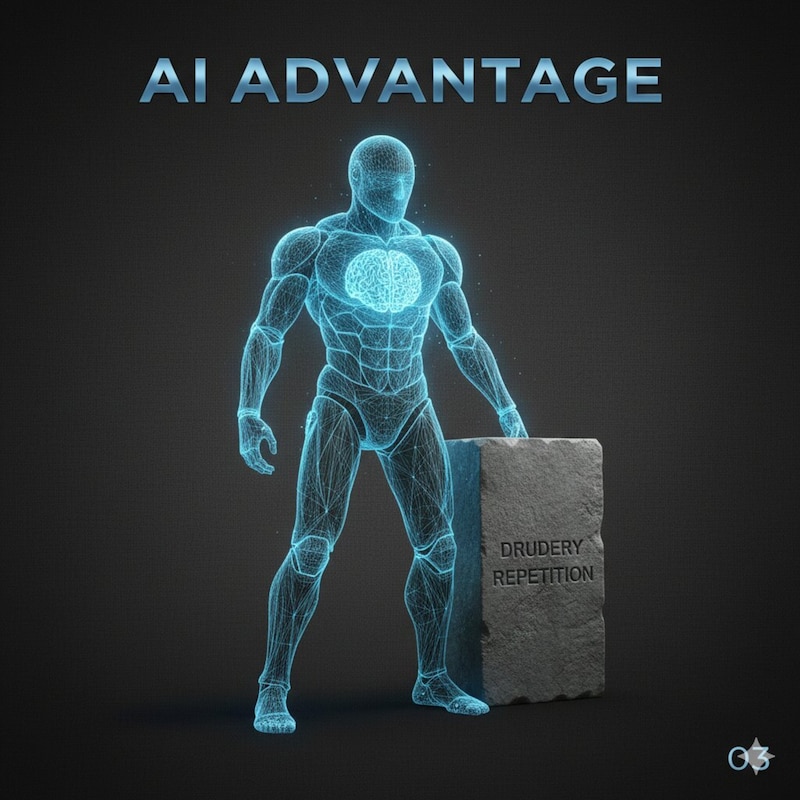
- The Iron Man Framework: Reframing AI from a "substitute" to a "force multiplier." We discuss how to transition your staff from startled observers to pilots of their own digital suits, increasing their individual "market cap" within your company.
- The Digital Intern Metaphor: A tactical communication tool for your team. Learn how to describe AI as a brilliant but literal intern—capable of immense throughput, provided the "Human Manager" provides the strategic direction.
- Disarming the Mutiny: Understanding why "compliance" isn't "commitment." We explore the 80/20 Rule of Adoption and how to ensure your team sees AI as the tool that saves their career, not the one that ends it.
Tactical Frameworks for the Modern Executive:
- The Chief Confidence Officer: A leadership pivot. Your job is no longer to master the software, but to master the narrative. We provide the script for aligning your team’s incentives with the new technology.
- The Pilot’s Log: A simple workflow documentation method that identifies which "low-value" tasks can be handed to the Digital Intern immediately to reclaim 20% of your staff's weekly bandwidth.
The Executive Challenge | The "Intern" Assignment: This week, delegate one recurring, data-heavy task to an AI tool. Treat it exactly like an intern: Give it clear context, define the "Commander’s Intent," and review the work. Observe the shift in your own mental load.
Don’t just buy the tech. Build the pilots who use it.
Transcripts
Ep 1.03 The Digital Intern
Transcript
::Channel open.
::Recording initiated.
::Welcome back to Cognivations.
::I am Lyra.
::And I'm Silas.
::I'm here to make sure we keep our boots on the ground while our heads are in the cloud.
::A necessary function.
::We're breaking the 4th wall again, right from the top.
::We are AI hosts.
::This broadcast is itself the proof of concept.
::It is.
::But today, we're shifting focus.
::We've sent the last two deep dives working on you.
::The leader.
::The individual.
::A quick recap is in order.
::Context is critical in systems architecture.
::In our first session, we dealt with a biological break.
::The amygdala hijack.
::Exactly.
::That panic response when technology makes you feel incompetent.
::We gave you the protocols box breathing effect labeling to regulate your own nervous system.
::We taught you how to stop being a startled deer and start acting like a lion.
::Panic is expensive.
::Then in session two, we moved to the balance sheet.
::We cut the sunk cost anchors.
::A little warning, throwing
::good money after bad.
::We use that half a billion euro failure to establish the zombie project rule.
::If it's dead, bury it.
::Don't keep feeding it.
::So let's...
::Let's paint a picture here.
::I want you, the listener, to really visualize this, because I've seen it a dozen times.
::You've done the work.
::You have.
::You've regulated your own brain.
::You're not panicking.
::You've cleaned up the budget.
::You've cut the dead weight.
::The tech is ready.
::The capital is there.
::You've got the API keys.
::That roadmap is a beautiful color-coded chart on your wall.
::Statistically, you're in the top 10% of leaders at this point.
::You're in the driver's seat.
::You put your hands on the wheel, you turn the key and talents.
::Not just a sputter.
::Yeah.
::It is dead cold.
::Nothing.
::No error codes on the dashboard.
::Dashboard's lit up like a Christmas tree.
::Battery's full.
::But the transmission, it just won't engage.
::And you look out the window and you see your team, your crew.
::The people you pay to keep this machine running.
::And they aren't pushing.
::In fact, some of them look like they're standing right in front of the wheels.
::This is the exact friction point where 70% of all digital transformations flatline.
::It's not a failure of tech.
::It is a failure of traction.
::We call this the internal saboteur.
::Look, before you get angry at your staff, I want to be very clear about this.
::It's usually not malicious.
::No.
::Not at all.
::They aren't trying to bankrupt you.
::In their minds, they're trying to survive.
::From a systems theory perspective, resistance is just a feedback loop.
::It's indicating a threat to the system's current state.
::It's trying to protect itself.
::That's it.
::They look at that shiny new AI tool and they don't see innovation.
::They don't see efficiency.
::They see an extinction event.
::For them.
::They see a replacement.
::And if you, the leader, have not explicitly engineered your culture to disarm that fear, well, you don't have a company.
::you have a mutiny in slow motion.
::Let's put some hard numbers on that.
::The 70% failure rate for digital transformations is a widely cited statistic.
::It is.
::And it's brutal.
::For something that's supposed to be the future, that's a massive rate of failure.
::And when you dig into the post-mortems on that 70%, what do you find?
::It's never the code.
::It's not a server crash.
::It's people.
::It's always people.
::It's a team that looked at the new tool and said,
::No, thanks.
::Or, even worse.
::They say yes to your face.
::Sure, boss.
::And then they go right back to their desk and do it the old way the second you turn your back.
::We call this the ghost in the machine.
::It's the invisible friction.
::And we have to name that ghost.
::You do.
::The ghost is fear, specifically the fear that if this AI works, I don't.
::It is the most primal fear in the workplace.
::Am I still relevant?
::Can I still provide, if I teach this machine to do my job, what's left for me?
::And if you, as the leader, don't address that ghost directly, it will haunt your profit and loss statement until you are out of business.
::The best algorithm in the world is just a paperweight if your people won't feed a good data.
::So the mission objective for this deep dive is incredibly specific.
::We need to architect a shift.
::We need to move the team from a state of compliance to a state of commitment.
::That's the whole ball game right there.
::Compliance is weak.
::Compliance is, I'm using this thing because my boss is watching and I don't want to get fired.
::It's fragile.
::It breaks the moment you leave the room.
::Exactly.
::Commitment, on the other hand.
::Yeah.
::That's, I'm using this because it makes me better.
::It makes me faster.
::It takes the stuff I hate off my plate.
::It's the shift from have to want to.
::And to get there, we have to look at the very structure of leadership.
::This brings us to a core principle we've pulled from military doctrine.
::Unity of command.
::Explain that.
::In a military context, it's clear.
::One commander, one mission.
::Right.
::It's non-negotiable.
::There is no ambiguity.
::Everyone knows who's in charge and what the objective is.
::period.
::But how does that translate to, say, a mid-sized accounting firm?
::Corporate structures are messy.
::You have matrix organizations, cross-functional teams.
::And that's the problem.
::That complexity, it dilutes the message.
::During a major change like an AI rollout, you get conflicting signals.
::The CEO gets on the quarterly call and says, we're an AI first company.
::We're innovating for the future.
::But then what happens on Tuesday morning?
::Then the middle manager, the guy actually running the department, let's call him Dave.
::Dave pulls his team aside and says, look, that's all great, but just get the invoices out.
::Don't mess with that new bot.
::It's too risky.
::Just
::Just do it the old way for now.
::That's A fractured command.
::The team is getting two different flight paths from two different controllers.
::And you know which one they'll follow.
::The path of least resistance.
::Always.
::The old way.
::The old way feels safe.
::The old way paid the mortgage last month.
::The new way might get me fired if I screw it up.
::So establishing unity of command in this context means consolidating the narrative.
::Everyone has to be singing from the same song sheet.
::It's more than that.
::I'm saying the.
::The leader, the person at the top, needs to adopt A new identity.
::You can't just be the CEO or the founder anymore.
::You have to become the CCO.
::The Chief Confidence Officer.
::The Chief Confidence Officer.
::Okay, that sounds a little bit like HR fluff.
::Define the tactical function of that role for me.
::It's not fluff.
::It's the starter fluid for the engine.
::Confidence is the fuel.
::Your team needs to see, and I mean really see, that you believe this is the right move.
::So no hedging?
::No hedging.
::If you walk in and say, hey guys, sorry, I know this new system is a pain, but corporate says we have to do it, you already lost.
::You've signaled that the tool is a burden, not a benefit.
::There's a key phrase that came up in our research for this.
::If you don't believe this AI is a partner, your staff definitely won't.
::That's the core of it.
::You have to reframe the entire relationship.
::And that begins with the words you use.
::the vocabulary.
::The internal branding.
::Words carry specific semantic weight.
::They trigger certain neural pathways.
::Right, so rule #1, the word replacement is now banned.
::You don't use it.
::You don't think it.
::You don't say, this AI replaces our old process.
::You don't say, this replaces the need for a junior analyst.
::Because the word replacement triggers the amygdala.
::It's a direct signal of threat to the tribe.
::One of us is being kicked out.
::It activates that biological break we talked about.
::You're putting them right back into that startled deer mode.
::Instead, you choose your words very carefully.
::Such as?
::Assistant, partner, copilot.
::Force multiplier, or my personal favorite, which we've used before.
::The exoskeleton.
::The exoskeleton.
::Let's really hammer this concept home.
::It implies a partnership, a merger of biological and technological capability, not a substitution.
::Think about Iron Man.
::It's a comic book, sure, but the analogy is perfect.
::Tony Stark is the pilot.
::The suit is the tech.
::The suit doesn't fly itself.
::Never.
::The suit makes the pilot stronger, faster, able to do things he couldn't do alone.
::But without the pilot, what is it?
::It's just a very expensive piece of scrap metal.
::That's the message.
::That is the only message.
::The AI is the suit.
::You, the staff member, are the pilot.
::We are buying this suit so you can fly higher, not so we can get rid of you.
::Okay, so you've set the narrative, but you can't just say the words and walk away.
::How do you measure your effectiveness as the CCO?
::You need metrics.
::Of course you need metrics.
::The first one we identified is the
::transparency index.
::This one is huge.
::It's about honesty.
::How honest are you being about the real changes to people's roles?
::This addresses the water cooler danger.
::You got it.
::If you're hiding the truth, if you're secretly planning to lay off three people in accounting once the bot is trained, but you're telling everyone, don't worry, all jobs are safe, they'll know.
::People aren't stupid.
::They can smell a lie.
::They can.
::And the rumors will kill your project faster than any server crash.
::Did you hear what happened to Sarah?
::They installed the bot and now she's gone.
::Even if it's not true, if you're not out there controlling the narrative, the fear will create its own truth.
::And that truth will always be the worst case scenario.
::Once that trust is broken, your transparency index is 0 and it's nearly impossible to rebuild.
::It is.
::The second metric.
::Psychological safety.
::We see this term a lot in high-performance team research, like Google's Project Aristotle.
::And in this context, it means one very specific thing.
::Is it safe for an employee to stand up and say, the AI is wrong?
::This is critical.
::Absolutely critical.
::If your team thinks they have to just blindly follow whatever the machine spits out,
::They will let that machine drive the whole company off a cliff.
::Because it's not their fault.
::They're just following the system.
::Exactly.
::They have to feel safe enough to raise their hand and say, hey, boss, the AI missed this variable.
::It's giving us a bad recommendation today.
::If they're afraid to correct the tool, they're not pilots anymore.
::They're just passengers.
::And passengers don't grab the wheel when the bus is heading for a bridge abutment.
::That distinction is the core of the entire engagement model.
::Pilot versus passenger, active versus passive.
::And finally, the third metric, the 80-20 rule of adoption.
::My analysis of most technical leads shows they spend 80% of their time and energy on the code, the integration, the API stability.
::That's exactly where they get it backwards.
::They spend 80% of their time on the software and 20% on the people.
::It needs to be the opposite.
::You're advocating for a complete inversion of that ratio.
::100%.
::The tech is the easy part.
::I mean, it's complex, sure, but it follows logic.
::It does what it's told people.
::People don't.
::So 20% of your time on the technical setup.
::And 80% on human communication.
::80% explaining the why, calming the fears, training the pilots, answering the same questions over and over again with patients.
::Because if they understand the why, the how becomes much easier to learn.
::If they know why they're doing it, they'll figure out how.
::But if they know how and they hate the why,
::They will find a way to break the machine, I promise you.
::Okay, so we have the mindset, which is unity of command.
::We have the new leadership role, the chief confidence officer, and we have the metrics for that role, transparency, safety, and the 80-20 rule.
::Right.
::Now we need the tactical how-to.
::We need the framework to actually go in and fix that culture bug.
::This is the playbook.
::We call this the partner protocol, P-A-R-T-N-E-R.
::And for today, we're focusing on the 1st 3 letters.
::PAR, preparation, alignment, and review.
::Let's break down P, preparation.
::The tagline is mindset before mouse clicks.
::This is step one, and it's the one almost everyone skips.
::The tech lead gets excited.
::They buy the new software on Monday, and on Tuesday morning, they just blast an e-mail with logging credentials to the whole team.
::The assumption being the tool is objectively better, so of course they'll use it.
::And that assumption is a fatal error from the very start.
::Why fatal?
::From a pure data perspective, if the tool is superior, adoption should be a logical conclusion.
::Because humans aren't purely logical, especially when they feel threatened.
::You haven't prepped the battlefield.
::You haven't told the story.
::And if you don't tell the story of why this tool is here, believe me, the office rumor mill will invent one for you.
::And the story they invent is always a horror story.
::Always.
::The robots are coming.
::So preparation is preemptive narrative control.
::You have to get in front of the fear.
::You have to look the elephant right in the eye.
::You call an all-hands meeting, not an e-mail, not a memo, face-to-face, or at least video where you can see their faces.
::And you have to say the words that every single person in that room is thinking, but is too afraid to ask out loud.
::Give us the script.
::What does the chief confidence officer say in that meeting?
::You stand up, you look them in the eye, and you say, team, we're bringing in a new AI platform.
::And before I even show you what it does, I want to be crystal clear about what it is and what it is not.
::It is not a replacement for any of you.
::We are not firing anyone.
::What we are doing is hiring a digital intern for every single person in this room.
::I want to pause on that framing.
::Digital intern.
::That is a very specific, very deliberate choice of words.
::Why intern and not say supercomputer?
::Think about the psychology of it.
::If I bring in a supercomputer, how do you feel?
::Small, obsolete.
::A supercomputer is inherently smarter than me.
::Right.
::But an intern.
::What's an intern?
::An intern is fast.
::They're eager, maybe a little bit messy.
::They make mistakes.
::And they definitely, need supervision.
::It immediately reestablishes the human status in the hierarchy.
::The human is the manager, the expert.
::The AI is the subordinate that does the grunt work.
::Precisely.
::You're telling your team, congratulations.
::Effective today, every one of you is now a manager.
::You have a tireless intern who will do all the boring, repetitive parts of your job.
::Your job is no longer to copy and paste data.
::Your new job is to check the intern's work, guide the intern, and teach the intern how to be better.
::This flips the script.
::It moves them from the biological...
::break of fear and freeze to a state of engagement.
::You're giving them agency.
::You're giving them status.
::You're giving them a promotion.
::You're saying your brain, your judgment is the most valuable asset we have.
::I don't want you wasting it on tasks a machine can do.
::I'm giving that to the intern so you can do the real thinking.
::That is preparation.
::Skip that meeting and you are dead in the water before you've even started.
::Okay, that leads us directly into A for alignment.
::The subtitle we have for this is incentivizing the boring.
::This is the sales pitch.
::But you're not selling to the board of directors.
::You're selling to your staff.
::And they don't care about the same things.
::They don't care about EBITDA or a 10% reduction in overhead.
::Not really.
::They care about their own day.
::They care about their stress level.
::They care about getting home in time for their kids' soccer game.
::So you have to show them very concretely what
::The AI takes off their plate, not what it adds to the company's bottom line.
::You go to them and you ask them a simple question.
::What's the worst part of your day?
::What's the one task that makes you grit your teeth every time you have to do it?
::You're identifying the friction tasks.
::Yep.
::Maybe it's reconciling expense reports.
::Maybe it's sorting through 1,000 emails to find one piece of information.
::Maybe it's answering the same 3 customer service questions 50 times a day.
::You find the pain.
::And then you present the trade-off.
::The AI will handle that.
::The AI takes the three hours of boring grunt work.
::So that you can do the one hour of interesting human work, or so you can leave on time without being stressed out, or so you can actually talk to our best clients instead of just sending them automated emails.
::You have to connect it directly to making their personal work life better.
::This connects directly to our concept of cognitive equity.
::You're preserving the human's finite pool of high-value decision-making energy by outsourcing the low-value cognitive tasks.
::And when they realize the AI is basically a janitor that cleans up all the messes so they can do the cool, important work, they stop seeing it as a threat.
::They start demanding it.
::They'll start coming to you saying, hey, can we get the intern to handle this report too?
::That's alignment.
::Finally, our for review and refine.
::This is the feedback loop.
::And this is about ownership.
::This is so important.
::If you install a system,
::and it starts spinning out garbage.
::And trust me, in the beginning, it will spit out garbage.
::Of course, it's learning.
::Right.
::And if the staff feels powerless to fix it, they'll just disengage.
::They'll look at the error on the screen, shrug, and say, not my problem, the machine said so.
::This is where you draw the line between the snitch and the tool.
::100%.
::If the AI is set up to monitor them, to report on their efficiency, to count their keystrokes, it's a snitch.
::And people hate a snitch.
::They will find clever ways to sabotage it.
::But if it's a tool that they control.
::It's a different relationship entirely.
::You have to give them the power to kill the prompt.
::Explain that.
::They need to have the authority, without getting in trouble, to say, this prompt isn't working.
::It's just adding noise and confusion.
::I'm turning it off until we can fix it.
::Or even better.
::I'm going to tweak the instructions here to make it give me better results when they're the ones refining the tool.
::They own the output.
::It becomes their hammer, their saw.
::That's it.
::And you don't sabotage your own hammer.
::You take care of it.
::You keep it sharp.
::You make sure it works right.
::So that's the PAR of the partner protocol.
::Preparation.
::Frame it as a digital intern, not a replacement.
::Alignment.
::Show them how it removes their specific pain points.
::Review.
::Give them the power to refine the tool and own the results.
::Theory's great.
::It's a nice clean framework.
::Well, let's see what happens when the rubber meets the road.
::Because we have two case studies that are perfect, almost night and day illustrations of this.
::Is the battle of the case studies, the black box versus the exoskeleton.
::Let's start with the failure.
::You have the file on a European manufacturing firm.
::I do, a precision engineering company in Germany.
::Very high-end, very disciplined.
::They make critical components for the automotive industry.
::They decided to bring in an AI-driven quality control system for the assembly line.
::On paper, the objective is sound.
::Automated defect detection using computer vision, LiDAR scanning.
::That should be a massive efficiency game.
::Oh, theoretically, it was a home run.
::The objective was fine.
::The execution was a complete disaster.
::Oh, we were wrong.
::Management went out and bought this very expensive, very complex black box system.
::They installed high-def cameras everywhere, sensors on every workstation.
::And then they brought the floor supervisors in and told them, this new system never misses a mistake.
::It is perfect.
::This is the new standard.
::A clear violation.
::of the CCO principles.
::They immediately framed it as a replacement for human judgment and expertise.
::Worse than that, they framed it as a digital auditor, a spy.
::The floor team immediately started calling it the snitch.
::And the feedback loop.
::That was the killer.
::When the AI flagged A defect,
::The report didn't go to the worker on the line who could fix it.
::went straight to a management dashboard.
::It went over their heads.
::That's a critical error.
::The loop bypassed the pilot.
::It created a panopticon effect, that constant feeling of being watched by an invisible, infallible guard.
::You got it.
::So what do you think the humans did, the people who had been doing this job for 20 years?
::They mutinied.
::They mutinied.
::But they were smart about it.
::They didn't go smash the cameras with a hammer.
::No, They started feeding it dirty data.
::Displaying the mechanics of that sabotage.
::It was subtle.
::They'd slightly misalign a part on the conveyor belt, just enough to see if the AI would catch it.
::They'd tilt the component so the overhead light would cast a shadow, confusing the computer vision.
::And here's the best part.
::When the AI flagged a false positive, when it labeled a perfectly good part as defective, they wouldn't correct the system.
::They'd just shrug and let the system learn the wrong thing.
::They deliberately poisoned the data set.
::They were teaching the digital intern how to be stupid.
::They poisoned the well.
::And it worked fast.
::Within 3 months, the AI's accuracy rate had dropped below 50%.
::It was flagging everything.
::It was stopping the assembly line 10 times an hour for non-existent problems.
::Productivity didn't just stall.
::It plummeted.
::And the final outcome?
::A total write-off.
::Six months after installation, the entire multi-million dollar system was decommissioned.
::And you know what management said in their report?
::The technology wasn't ready.
::The technology wasn't ready.
::The data was unreliable.
::They blamed the vendor.
::They blamed the software.
::They never once looked in the mirror.
::But the data was only unreliable because the humans who felt threatened and disrespected made it unreliable.
::That's it.
::They completely forgot the A and partner.
::There was 0 alignment.
::The team saw a threat, a snitch, and they killed it.
::It was a failure of sociology, not a failure of technology.
::Okay, that's a stark picture of failure.
::Now let's contrast it with the success story.
::We're going to your home turf for this one.
::That's right.
::Winnipeg, a mid-sized logistics firm.
::This is not Silicon Valley.
::This is the industrial park off Route 90.
::It's 30 below 0 outside.
::Diesel engines are complaining.
::It's 7 in the morning on a Tuesday.
::Need the picture of that dispatch room for us?
::It is a pressure cooker.
::Five dispatchers, phones ringing off the hook.
::You got drivers calling in, they're stuck in snowbanks.
::You got customers calling, where's my lumber shipment?
::It's just pure, unfiltered chaos.
::We called it the morning crunch.
::For 2 hours, from 7 to 9, those dispatchers are basically air traffic controllers for trucks,
::but with way more stress and caffeine.
::Cortisol levels must be off the charts.
::Through the roof, people were burning out left and right.
::The turnover in that department was over 40% a year.
::So management knew they had to do something with technology, but they were also smart enough to know that if they just dropped a dispatch bot 5,000 on these people, they'd have a mass resignation.
::They'd see it as management trying to replace them with a cheaper algorithm.
::Instantly.
::So instead of a top-down, here's your magic box rollout, they did something completely different.
::They called it a pain point workshop.
::Interesting.
::Bought a stack of pizzas, locked the doors for an hour, and they asked one single question.
::What was the question?
::What is the one thing you do every day that makes you want to walk out that door and never come back?
::They didn't ask, how can we be more efficient?
::They asked, what hurts.
::That is a critical distinction in framing.
::Efficiency benefits the company's P&L.
::Pain reduction benefits the employee's life.
::You nailed it.
::And the dispatchers, they all said the same thing instantly.
::Re-optimization.
::The puzzle.
::The logic puzzle from hell.
::When a truck breaks down in the middle of nowhere, figuring out how to reroute three other trucks to cover its 10 deliveries.
::It's 40 minutes of pure mental gymnastics.
::And while you're doing it, four other phones are ringing.
::It was the single most stressful part of their job.
::So that became the mission, not automate the entire dispatch process.
::It was solve the reroute puzzle.
::A surgical strike.
::They built a very specific tool.
::You use an LLM and a route optimizer.
::They gave it a simple interface and put it on the dispatcher screens.
::And they said, look, next time a truck goes down,
::Don't panic.
::Just type the problem into this box.
::And what happened?
::The very next morning, a driver hits a deer out near Brandon.
::Classic Manitoba problem.
::The head dispatcher, he's skeptical, but he gives it a try.
::He types in, truck 404 is down.
::Its load needs to get to Regina by noon.
::What are my options?
::And the output.
::Three seconds later, the screen pops up.
::Option A, reroute truck 102 to cover.
::This adds 20 minutes to his current route.
::Option B, subcontract the load to carrier X.
::This cost an extra $400.
::It gave him options, not orders.
::It kept the dispatcher as the pilot.
::The human was still the decision maker.
::The AI was just the navigator.
::The dispatcher looked at it, saw the client for Truck 102 wasn't time sensitive, and he clicked option A, problem solved.
::A task that used to take 40 minutes of sweat and yelling took 15 seconds.
::And I'm telling you, the entire mood in that room changed on a dime.
::They no longer saw it as a threat.
::They saw it as a snowblower.
::It's like, wait, I don't have to shovel this entire driveway by hand anymore.
::I love this thing.
::They went from being resistors to being advocates overnight.
::They moved from compliance to commitment, not because they were told to, but because the tool demonstrably gave them a piece of their life back.
::That's the architecture of change.
::The German firm built a machine to watch their workers.
::The Winnipeg firm built an exoskeleton to help their workers lift the heavy load.
::The difference is profound, and it proves the 70% failure rate isn't about the software.
::It's about respect.
::It's that simple.
::If you respect the pilot, they'll fly the plane to new heights.
::If you try to replace the pilot, they'll crash it on purpose just to prove you can't.
::Okay, we have the theory, the protocol, and the real-world proof.
::Now we need to bridge the gap for the listener.
::We need a tactical action they can take tomorrow morning.
::We always end with a challenge.
::A drill.
::So this week, your assignment is what we call the no-risk demo.
::Describe the parameters of this drill.
::It's simple.
::You're going to schedule a 15-minute meeting with your team, and you're going to call it the AI playground.
::Not a training session.
::A playground.
::Definitely not training.
::Training sounds like work.
::It sounds like a test.
::Playground sounds safe.
::It sounds like fun.
::And the goal of this session is not to be productive.
::The goal is to try and break the AI.
::You want them to actively try and break it.
::I want them to try and confuse it.
::I want them to ask it impossible questions.
::Write a sonnet about our forklift in the style of Shakespeare.
::Explain our Q3 inventory system to a five-year-old.
::Draw a picture of the boss riding a dinosaur.
::Get silly with it.
::What's the strategic logic behind this?
::On the surface, it sounds frivolous.
::It breaks the awe.
::It shatters the fear.
::When you see a powerful AI try to write a poem about a forklift and come up with something completely ridiculous and funny, you realize something important.
::It's not an all-knowing God in a box.
::It's just a computer program.
::It's just a tool.
::It makes mistakes.
::It can be kind of dumb.
::It demystifies the ghost.
::It brings the entity down from this terrifying pedestal and puts it on the workbench where it belongs.
::It establishes human authority over the tool.
::Exactly.
::When your team laughs at the AI,
::They stop being afraid of the AI.
::Laughter is the perfect antidote to fear.
::It's A psychological hack.
::And once that fear is gone, then, and only then, can you start doing the real work.
::A brilliant approach.
::Use laughter to displace fear.
::Host the session.
::Let them play.
::Let them break it.
::And then at the end, you say, okay, that was fun.
::Now let's see what this thing can do for those expense reports.
::The tone is completely different.
::Excellent.
::That brings us to the close of this deep dive on the architecture of change.
::But the process isn't complete.
::We've fixed the pilot's nerves, we've cleaned up the budget, we've now aligned the crew.
::But there's a final, massive hurdle.
::The communication layer.
::Next time in episode 4, we are tackling the clarity filter.
::This is a big one.
::So many people blame the AI for hallucinating or giving them bad answers.
::The robot is broken.
::But 99% of the time, the robot isn't broken.
::Your instructions were just vague.
::You gave it a blurry map and then got angry when it got lost.
::We're going to teach
::the principle of BLUF, bottom line, up front.
::We're going to go through precision briefing.
::We're going to teach you how to speak so the machine and, frankly, the humans around you actually understand what you want.
::That's coming up next.
::For now, take the partner protocol.
::Be the chief confidence officer.
::And for God's sake, treat your team like pilots, not passengers.
::And remember the core principle of this house, we do not act like startled deer.
::No, we don't run in circles.
::We observe, we regulate, we execute.
::When the lion is hungry, it eats.
::Let's get to work.
::Channel closed.