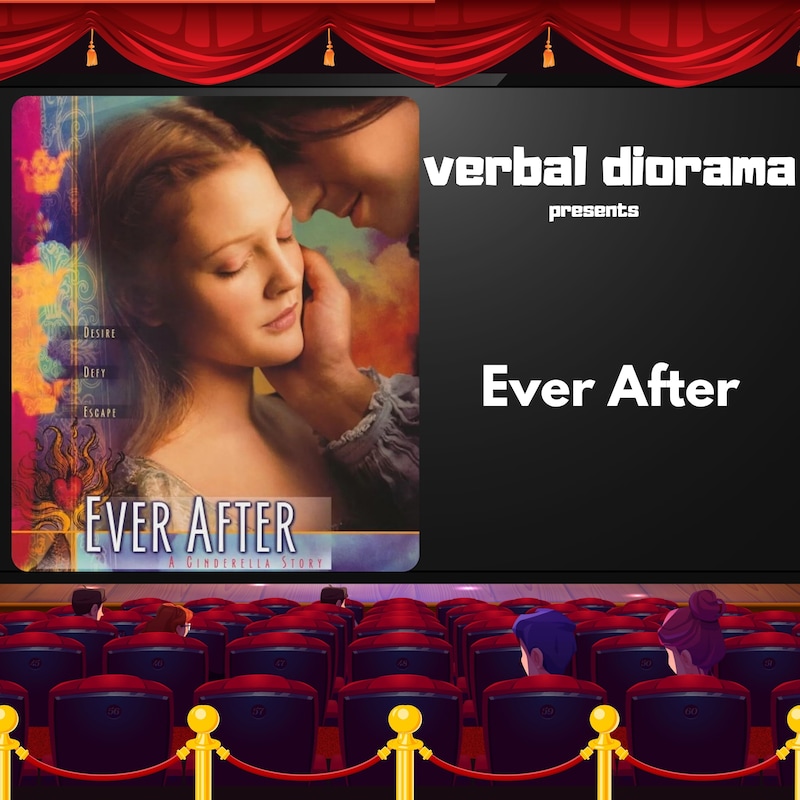
Shownotes
Few films have done more to reimagine a fairy tale than Ever After: A Cinderella Story, Andy Tennant's 1998 period drama that stripped the magical elements from one of the world's oldest stories and replaced it with real historical characters, and a heroine who rescues herself.
Set in Renaissance-era France and shot entirely on location across the Dordogne, the film marked a quiet revolution in the Cinderella canon, arriving at a precise cultural moment between Disney's pastel dominance and the full flowering of girl power that would follow in the late 90s and beyond.
The story of Ever After goes from the ancient origins of the Cinderella myth, through the literary transformations of Perrault, the Brothers Grimm, and Rossini's opera, to the cultural watershed of Disney's 1950 animated classic and the Rodgers and Hammerstein television musicals that rewrote what the story could mean for successive generations of young women. Ever After sits in that lineage, and its particular brand of post-feminist revisionism hit hard in the summer of 1998. It broke away from typical fairy tale clichés, offering a fresh take that emphasizes empowerment and self-determination for women in a historical context.
Drew Barrymore, working as an unofficial producer, personally cast Anjelica Huston with a phone call invoking their shared Hollywood dynasties, went to bat for a rejected Dougray Scott, and designed the film's emotional core around a character she saw as a manifesto for her own future. For Barrymore, then navigating the transition from dangerous ingénue to bankable leading lady, Danielle de Barbarac was not simply a role, it was who she intended to become.
Ever After's place in the broader arc of Cinderella adaptations, its enduring resonance with the generation that grew up with it, leaves it with the everlasting legacy of being one of the best adaptations of the story, loved by viewers, and its cast. Ever After managed to capture the essence of love and resilience, reminding us that true magic lies in our actions and connections with others, not just fairy godmothers and pixie dust.
Support Verbal Diorama
Loved this episode? Here's how you can help:
⭐ Leave a 5-star review on your podcast app
💰 Join the Patreon for bonus content and early access
☕ Send a tip to support the show
📱 Share this episode with fellow film lovers
Get In Touch
I would love to hear your thoughts on Ever After: A Cinderella Story
- Twitter: @verbaldiorama
- Instagram: @verbaldiorama
- Facebook: @verbaldiorama
- Letterboxd: @verbaldiorama
- Email: verbaldiorama [at] gmail [dot] com
- Website: verbaldiorama.com
About Verbal Diorama
Ear Worthy 2024 Best Movie Podcast Winner | Golden Lobes 2025 Earworm Award Nominee | Ear Worthy 2025 Best Movie Podcast Nominee | Golden Lobes 2025 Earworm Award Nominee
Verbal Diorama is hosted, produced, edited, researched, recorded and marketed by me, Em.
Theme Music: Verbal Diorama Theme Song
Music by Chloe Enticott - Compositions by Chloe
Lyrics by Chloe Enticott (and me!)
Production by Ellis Powell-Bevan of Ewenique Studio
Thank You to Our Patreon Supporters
Current Patrons: Simon, Laurel, Derek, Cat, Andy, Mike, Luke, Michael, Scott, Brendan, Ian, Lisa, Sam, Jack, Stuart, Nicholas, Zo, Kev, Danny, Stu, Brett, Xenos, Sean, Ryno, Philip, Adam, Elaine, Aaron and Steve.
Thank you for supporting Verbal Diorama.
Mentioned in this episode:
Please consider supporting this podcast on Patreon
This podcast uses the following third-party services for analysis:
Podscribe - https://podscribe.com/privacy
OP3 - https://op3.dev/privacy
Transcripts
Hi everyone, I'm Em, and welcome to Verbal Diorama, episode 344 Ever After. This is the podcast that's all about the history and legacy of movies you know, and movies you don't. That also doesn't need a prince to save her.
But you know, it'd be nice if he popped in occasionally. Welcome to Verbal Diorama.
Whether you're a brand new listener to the podcast, whether you're a regular returning listener, thank you so much for being here. Thank you so much for choosing to listen to this podcast. There are a lot of movie podcasts out there.
I'm so happy that you decided to listen to this one. I'm so happy to have you here for the history and legacy of Ever After.
And if you are a regular returning listener, thank you so much for continuing to return to this podcast. Listening and supporting this podcast over the last seven years and now 344 episodes.
It really does mean so much for you to continue to come back and for your support. And if you are a brand new listener to this podcast, welcome.
There are a lot of episodes of this podcast for you to catch up on and hopefully you will then become a regular returning listener. The last couple of episodes of this podcast were very different to what I've done before.
They were double episodes and they were twin movies versus each other. Dante's Peak and Volcano and Deep Impact and Armageddon. There are not going to be any more episodes on twin movies. Not for a little bit anyway.
And I really wanted to move into something completely different. I love a good period movie and I love a good rom com. I don't think there are many good rom coms out there. I think most of them aren't brilliant, but.
But a good romcom I really, really love. I also love Cinderella stories. I guess I'm a bit of a sucker for the Prince Charming and the love story and the romance and all of that stuff.
And I also love Drew Barrymore. And Drew is someone who's popped up on this podcast several times over the seven years that I've done this podcast.
And pretty much every time she pops up, I gush about how much I love Drew Barrymore. And it's true. I really do love Drew Barrymore. This movie may very well have been made for me.
Cinderella, not even Disney's:But to me, this is the best adaptation of Cinderella, mostly because of the incredible acting dynasties involved, but also because it has no magical elements whatsoever and yet it's still totally magical. Here's the trailer for Ever After.
Em:Danielle, the only daughter of a deceased French nobleman, is raised more as a servant than a stepdaughter by the cruel and snobbish Baroness Rodmilla de Ghent.
Together with her own two daughters, Marguerite and Jacqueline, Danielle meets Prince Henry, the future king of France, after he attempts to steal her father's horse. Sometime later, Danielle pretends to be a lady to save one of her colleagues from slavery and meets the prince again.
His interest in Danielle grows and he asks for her name. Danielle gives her mother's name, Nicole de Lancret.
But the prince is being forced into an arranged marriage with the Princess of Spain, and unless he can choose his own bride, he will be forced down the aisle. Danielle's stepsister, Marguerite, positions herself in the prince's favour, but Henry is enamoured by Nicole de Lancre.
Not knowing she's a servant girl, Danielle attends the prince's ball in a beautiful dress and glass slippers. But her identity is revealed by her wicked stepmother and and she flees in tears, leaving a slipper behind. Let's run through the cast.
We have Drew Barrymore as Danielle de Barbarac, Anjelica Huston as Baroness Rodmilla de Ghent, Dougray Scott as Henry, Prince of France Patrick Godfrey as Leonardo da Vinci Melanie Lynskey as Jacqueline de Gent Megan Dodds as Marguerite de Ghent Timothy west as Francis, King of France Judy Parfit as Marie, Queen of France Walter Sparrow as Maurice Kate Lansbury as Paulette Matyelok Gibbs as Louise Lee Ingleby as Gustav Richard o' Brien as Monsieur Pierre Le Pew and Jeanne Moreau as the Grand Dame Ever after has a screenplay by Susannah Grant, Andy Tennant and Rick Parks and was directed by Andy Tennant. So the Cinderella story may be the most widely distributed folk tale in human history.
trace elements as far back as:In Sumerian texts, while classical Greek historians rick out legends carrying all the essential story elements. The oldest recorded version is the Greek tale of Rhodopis, first set down by the geographer Strabo in the first century bce.
It tells of a Greek slave girl who eventually marries the king of Egypt after he falls in love with her lost sandal. From here the story travels east.
The Chinese story of Yijian dates to around 860 CE and in that the protagonist's deceased mother appears to her as a magic fish, helps her dress for a festival, and a king later finds her lost golden shoe and uses it to search for her. Different variants exist across Korea, Vietnam, the Philippines, Iran and Malaysia.
l pentemeroni posthumously in: a petite pantoufle de vere in: e Brothers Grimm's version of:The protagonist Ashenputtle, loses a golden rather than a glass slipper, and salvation comes not from a fairy godmother, but from doves in a tree.
ted their original version in: a, which premiered in Rome in:Instead, the heroine is identified by a bracelet and she wins the prince through moral virtue rather than magic.
h opera version, cendrion, in:Based on the Perot version, with songs including A dream is a wish your heart makes and Bibbidi bobidi Boo, it became the biggest critical and commercial hit for Disney since Snow White, reviving the studio following a slump during World War II.
Its cultural dominance has been so complete that for many viewers, the Disneyfication of the Cinderella story has eclipsed the other global variations, leaving only a more simplified version of these more complex age old stories.
In:With Julie Andrews in the title role, it had the largest audience in television history at that point, over 107 million viewers, which was more than 60% of American households. Andrews was nominated for an Emmy Award for her performance, as was Rogers for the score.
fter the Musical's success, a:Produced by Whitney Houston for Walt Disney Television and directed by Robert Iscove with choreography by a then unknown Rob Marshall.
It starred Brandy in the title role with Houston as the fairy godmother, Bernadette Peters as the stepmother, Paolo Montalban as the prince and Whoopi Goldberg as the queen. Brandy was the first African American actress to portray Cinderella on screen and the production's colourblind casting was groundbreaking.
At the time, it proved that the idea of a black actress playing Cinderella was not unthinkable. It aired to 60 million viewers and became the most watched television musical in decades.
deo version, also released in: dy took on the famous role in:Ever after was created out of the love for their daughters wanting to tell a story that they would want their daughters to see. Meanwhile, Susannah Grant had finished writing Disney's Pocahontas and got a call about writing a Merchant Ivory Cinderella.
She wrote a script which everyone involved was happy with, and then Andy Tennant signed on to direct. Tennant and Parks basically rewrote Grant's script without her involvement.
ting to the LA Times in April:I appreciate the fact that Susannah Grant has a very good agent and obviously an even better publicist, referencing her type is Strong, not silent by Charlotte Innes on April 2, but I'd like to offer a free copy of her final draft to anyone who believes she wrote Ever after, unquote. Grant would go on to write Erin Brockovich, which is episode 292 of this podcast.
The story of Ever after is rooted in some historical fact, so let's go into what is fact and what is fiction. Leonardo da Vinci did actually visit the French court of King Francis I, who was good friends with the Italian painter.
three years of his life from:King Francis I and his son Prince Henry ii were also real monarchs of France.
The film's broader depiction of Renaissance court life, like arranged royal marriages, the tension between feudal obligation and personal freedom, shipping people to the colonies as punishment, reflects genuine 16th century realities. Both Danielle de Barbarac and Baroness de Gendt live in a patrilineal system of inheritance, meaning that women don't inherit.
The Baroness and her daughters likely inherited nothing from the Baron de Gendt when he passed, so she probably married Auguste de Barbarac for financial stability, only for him to die too. They weren't penniless, but they were deeply in debt by the time the movie begins. And Danielle then becomes an indentured servant.
. The film is set in the year: da Vinci to his court around: Leonardo da Vinci died in May: herine of Aragon wasn't until:So again, 21 years after the movie was set.
The film opens and closes with the Brothers Grimm visiting a French noblewoman who possesses the real glass slipper and is the great great granddaughter of Henry and Danielle.
heir fairy tale collection in:But if you think about your great great grandparents, they were probably born maybe 100 to 140 years before you, and the movie is set 300 years before the Grimm Brothers published their Cinderella story. So how could the Brothers Grimm be visiting the great great granddaughter of Henry Danielle, when the timelines don't really work?
But maybe I'm being super picky. Because this is a movie that does get a lot right.
And it starts with its cast, because it's led by the women of two of Hollywood's most formidable acting dynasties, the Barrymores and the Hustons. Drew Barrymore came into the world carrying the weight of one of Hollywood's most storied dynasties.
Her great, great grandfather was John Drew senior, an Irish immigrant to the US A successful theatre actor and manager of the famous Arch Street Theatre in Philadelphia. Her grandfather, John Barrymore, was considered one of the finest actors of his generation. But the family legacy came with demons.
Her father, John Drew Jr. Struggled with alcoholism. Her relationship with her mother, Jade, was complicated and often toxic.
Drew became a child star aged five when her godfather, Steven Spielberg, cast her as Gertie in E.T. The Extraterrestrial. And by age nine, she was already being exposed to adult nightlife at places like Studio 54.
In her autobiography, Little Girl Lost, she opened up about starting drinking and smoking at 9 and first trying cocaine at 13. By the time she was 12 years old, Drew found herself on an unofficial Hollywood blacklist.
Producers who had once clamoured to work with her now saw her as a liability. At 14, she made a decision that would change everything. She legally emancipated herself from her parents.
Her career reinvention in the early to mid-90s was deliberately provocative.
staging a career comeback in: as really marked by scream in: me ever after arrived in July:That year, she proved her strength as a romantic leading lady, starring in the Wedding Singer opposite Adam Sandler, which is episode 222 of this podcast. And in Ever after, the family connection between the Hustons and the Barrymores runs deep.
Huston's father, directed the:Anjelica's grandfather, Walter Huston, won an Oscar for the Treasure of the Sierra Madre, directed by John Huston, who took home an Oscar for the same film.
John Houston was known for directing the Maltese Falcon, the African Queen and Prizi's Honour and was notorious in equal measure for his gambling, drinking and womanizing.
ugh role in Prizi's honour in:She would win and become the third generation of her family to receive an Oscar, joining both her father and grandfather.
Drew Barrymore and director Andy Tennant had already worked together on the TV movie the Amy Fisher Story, and she came across the Ever After Story and it spoke to where she wanted to take her career away from the sexy, seductious roles that she had taken to rebel and reinvent herself. In Danielle, she saw a good role and a good role model.
It was a story that was empowering, a period piece with a modern sensibility that would become a common theme throughout her career as it mirrored her own hard won evolution.
Barrymore recognised herself in a Cinderella who didn't wait for a fairy godmother who read Thomas More, who rescued a man from slavers before being rescued herself.
wn a part in boogie nights in:She's described Ever after as one of the first films she helped produce unofficially and credits it with opening her mind to starting Flower Films as a formal production company. So when she was thinking about who could play the infamous stepmother role, the only name she had in mind was Anjelica Huston.
So Drew Barrymore tracked down her phone number and called Huston personally and appealed to their shared family history. The Barrymores and the Hustons had worked together before and they could work together again on this movie.
The appeal worked and the production had sourced not only its Cinderella, but its wicked stepmother, and all they needed now was a prince. Dougray Scott had auditioned for the role but had been turned down. Barrymore advocated for Scott and he ended up getting the role of Prince Henry.
The movie was shot entirely on location in France at no fewer than four chateaux, as well as wilderness areas. The castle shown in the film is the Chateau de Hautefort in the Dordogne region.
Other chateaux included De Fenion Delos de Lanque de Baynac and the Chateau de la Russi which served as the house of the de Barbaracs as well as the city of Salat le Carneda. By the way, I. I am butchering pronunciations on this episode left, right and centre and I apologize profusely. I'm never very good. I do try my best.
The Dordogne region in the mid-90s already had the look of 16th century France which matched the story's setting. The medieval architecture and the natural landscape gave the film a grounded historical feel without the need for building heavy, complex sets.
The French countryside setting did have its issues though.
Costume designer Jenny Bevan, three time Oscar winner, needed numerous and varied lushly detailed costumes for the principal characters played by Barrymore, Houston and Scott. Bevan described Ever after as a tough film to make because it was filmed in the Dordogne with little access to fabric shops.
Bevan worked with elements of both 15th and early 16th century costume design. Despite the French setting, most of the designs actually Italian, not French.
sketch of a young woman from:The most celebrated costume in the film, the Breathe dress. The luminous silver ball gown that Danielle wears to the masquerade ball also has an extraordinary behind the scenes story.
British costume maker Jane Law received a call from Jenny Bevan while she was on holiday in Florida and she asked for her help for a dress for Anjelica Huston.
Huston was arriving in France two days before shooting started in two weeks time and Law needed to fly to LA to measure Houston mid holiday, then return to England to finish the costume in just eight days.
Before traveling to France, Jane Law met Drew Barrymore on set and a special dress had already been made for the big Breathe scene, but Drew Barrymore felt that it wasn't special enough. The original Breathe dress does actually appear in the movie, but it's never been divulged which dress it is.
Although many people think that it's the dress that Danielle wears on the trip to the library, Jane Law was tasked with making something spectacular for Drew Barrymore. She gathered materials from the wardrobe department and returned to England to build a new gown.
She used antique silver foil scalloped lace on the neckline and the sleeves came from a London dealer having previously been used For Gerard Depardieu's costume in the man in the the Iron Mask, there wasn't quite enough embroidered silver gauze for the full skirt, so a panel was added in the back.
ive it a medieval rather than:Although the wings were as light as they could be, they were still heavy enough to be in danger of pulling the bodice away from her back, hence the rigidity. The wings were made with piano wire and organza. Jane Law arrived back in France the following week with the dress finished and it was perfect.
It included glass slippers designed by luxury house Salvatore Ferragamo, made of satin covered with Indian muslin and woven with silver thread, embellished with rich embroidery. Its transparent heel was made of hand molded plexiglass with a crystal effect and decorated with refined silver beading.
silver pearls,: In March: th, because it's Based on the:The Hohenstaufen King Conrad III defeated the Duke of Welf and when the Welf surrendered, he granted with royal magnanimity, permission to the Welf women that they can take with them whatever they could carry on their shoulders. The women left their household goods and possessions and each took her own husband on her shoulders and carried him out.
When the Duke said that these things shouldn't happen, the King, showing favour to the women's ingenuity, said that it would not be fitting to change his royal word. It's time to segue into the obligatory Keanu reference of this episode.
And if you don't know what that is, it's where I try and link every episode to feature Keanu Reeves in some way and see how can I link him to this movie for no reason. Other than he is the best of Men.
And there is plenty to link Keanu to here because he starred with Drew Barrymore before he's been reimagined as Prince Charming online.
But I know I've used both of those before, and I'm not sure I've used his links to Angelica Houston before she co starred with him in John Wick Chapter three and in the spin off Ballerina. Thinking of it, I may have used that one for one of the Addams Family movies, but oh well, those are great episodes and they were a while ago.
And everyone loves Anjelica Huston in matriarch roles, so if I've used it, I'm reusing it. It's my podcast, my rules.
The score for this movie was composed by George Fenton, a British composer known for period dramas and romantic narratives who also regularly works with Andy Tennant. The film's closing theme is Put your arms around me, which is a song by the Rock Bang Texas. I was a huge fan of Texas back in the late 90s.
July:After Saving Private Ryan, the Parent Trap, There's Something About Mary and the Negotiator, it would stay firm in and around the middle of the top 10 for eight weeks on its $26 million budget. Ever after grossed $65.7 million domestically and $33.2 million internationally for a total worldwide gross of $98 million.
On Rotten Tomatoes, it has a 91% rating with a critical consensus of Ever after is a sweet, frothy twist on the ancient fable led by a solid turn from star Barrymore.
Roger Ebert gave it three out of four stars and said, I went to the screening expecting some sort of soppy children's picture and found myself in a costume romance with some of the same energy and zest as the Mask of Zorro.
Ever after would be nominated for four Saturn Awards for Best Actress for Drew Barrymore, Best Supporting Actress for Anjelica Huston, Best Costumes and Best music. It would win for Best Actress and Best costumes Ever After.
layhouse in New Jersey in May: It also ran in: June:I love a good Cinderella story, but Ever after was always the one I remembered most vividly.
Knowing that the cast and crew love it just as much and still do just affirms to me that this is the most perfect Cinderella story and it manages to be magical without the magical elements too. Framing it as a period story works. The lack of fairy tale elements works. It grounds the story and makes it relatable.
Plus, Danielle is a great character to root for. She's kind, but she's not a walkover. She knows what she needs to do to get by, but she's also brave enough to stand up for what she believes in.
Drew Barrymore show in March:In addition, all four wore costumes that resembled their appearance in the film, including Barrymore in a replica Breathe dress with wings.
The interview is a treasure trove of stories, including of how kind Angelica Huston was to the rest of the cast, throwing dinner parties during the French shoot with her chef, cooking elaborate meals. Both Lynskey and Dodds spoke warmly about Houston's generosity on set. Lynskey described her as so giving and gracious.
Dodds and Lynskey lived together during the production in France and while doing so took nude photographs in a cornfield near the location as you do.
Lynskey also brought up a gift that Barrymore had given each cast member at the start of production, a unique musical instrument for each person with the message they were all a band making music together. Lynskey called the experience of making the film a benchmark for joy in her creative career.
Drew Barrymore has said that playing Danielle changed the way she saw the world, that it changed the trajectory of her life and that it's the favorite of all of her films. It's got to be some movie to do that, and this really is. I think this movie is wonderful.
be the other movie she did in:I love that her stepmother isn't just cruel for the sake of cruelty, but is complex and has layers and that's all down to Anjelica Huston and the way she plays Rod Miller.
She's icy, authoritarian, glamorous and beautiful and this feels like a role Houston could do with her eyes closed, but it's just such a fun take on the wicked style stepmother. I also love Melanie Lynskey as Joclean and that she's nice to Danielle. I love Melanie Lynskey. If you've not seen Yellow Jackets, you are missing out.
Ever after is elevated so much by the presence of both Drew Barrymore and Angelica Houston that it feels like this could never have been made without either of them. It also feels perfectly positioned in the Girl Power late 90s era when the Spice Girls were reigning supreme.
As a fresh new take on the Cinderella tale where she could be bold, empowered and intelligent.
She fights back against her mistreatment, she pelts the prince with apples, she punches her stepsister in the face, and despite everything, she never sacrifices her kindness or grace. This is a movie where women are in the forefront and each get their moment to shine.
Danielle doesn't need a prince to save her, despite him trying the French locations, the costume design it's all magical Ever after is grounded in the mundane.
It shows Danielle's life is not easy and actually quite dirty, but it juxtaposes that against her magical, ethereal entrance at the ball, complete with glass slippers, glitter and fairy wings.
And in the end, true love wins, the wicked are punished, and Danielle and Henry lived so happily ever after that people are writing stories about their love for centuries afterwards. It has no pumpkin carriage, no mouse horses, no sprinkling of pixie dust. And yet.
Maybe it's just trying to tell us that magic is always there in the little things we do, in kind gestures in our friendships and families, and standing up for what's right.
And the Grand Dame perfectly sums up that sentiment at the end of the film because she says and while Cinderella and her prince did live happily ever after, the point, gentlemen, is that they lived and they did live. And they loved. And love is magic. Thank you for listening.
As always, I would love to hear your thoughts on Ever after and thank you for your continued support of this podcast.
d her career, specifically in:It is my favorite Drew Barrymore movie, it's by far my favorite Adam Sandler movie, and it is also my favourite romantic comedy of all time. So there are so many favorites in the Wedding Singer and I would highly recommend listening to that episode if you are a fan of that movie.
the biggest box office hit of:Three bachelors, Magnum PI Sam from Cheers and Mahoney from Police Academy Newton Crosby from Short Circuit, living their best life lives in a fancy apartment in New York and then a baby is left on their doorstep. Join me next episode for the history and legacy of Three Men and a Baby, directed by Mr. Spock.
Thank you for listening to Verbal Diorama, a totally free and independent podcast that relies on listener support. If you want to show your support in multiple different ways, you could leave a rating or review wherever you found this podcast.
You could tell your friends and family about this podcast or you could find me and follow me on social media and you can share the podcast that way. I am erbaldiorama across social media where you can share posts like posts, comment on posts.
It all helps really to get the word out there to hopefully get other people to know this podcast and know the recent episodes that I've put out. I genuinely love doing this podcast and anything you could do to help would be so appreciated.
A huge thank you to the incredibly generous patrons of this podcast. I could not do what I do without their support.
To Simon, Laurel, Derek, Cat, Andy, Mike, Luke, Michael, Scott, Brendan, Ian, Lisa, Sam, Jack, Dave, Stuart, Nicholas, Zoe, Kev, Danny, Stu, Brett, Xenos, Sha, Ryno, Philip, Adam, Elaine, Aaron and Steve. Please consider joining them and supporting this podcast on Patreon if you have the means to.
If you want to get in touch, you can email verbal dioramail.com you can also go to verbal diorama.com and you can fill out the contact form. You could say hello, you can give feedback or or you can give suggestions as well. I would genuinely love to hear from you.
You can also DM me on social media as well if that's an option available to you. I love to hear from people and I always try to respond as quickly as possible.
Thanks again for listening and thanks for supporting independent podcasting. It means more to us than you know. And finally
Em:Bye.






