Shownotes
What if AI wasn’t just a productivity tool… but a judgment-free strategy room?
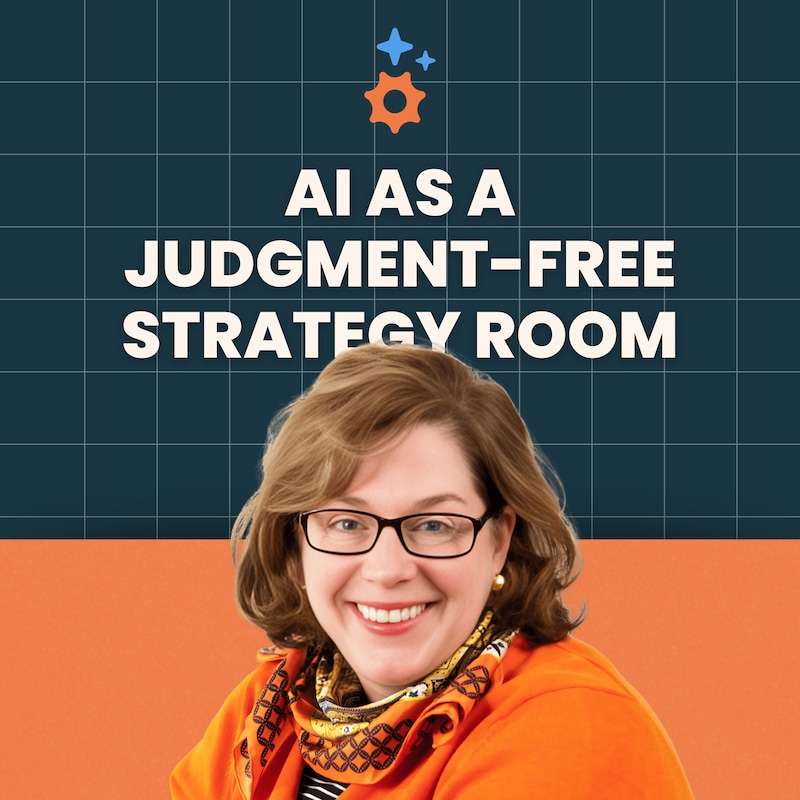
In this episode, I sit down with longtime friend and B2B SaaS executive Jeanne Hopkins to explore how she actually uses AI. Not for prompts. Not for hacks. But as a thinking partner.
Jeanne has spent decades leading marketing, sales, and revenue teams as a multi-time VP of Marketing and Chief Revenue Officer. In our conversation, she shares how she uses AI to pressure test decisions, challenge assumptions, and run weekly retros on her own performance.
We also go deeper.
Jeanne opens up about navigating grief, complex family dynamics, and how AI helped her de-emotionalize and think clearly through some of the hardest decisions of her personal life.
This is not a tools episode. It’s a mindset episode.
If you want to understand what executive-level AI fluency actually looks like, this conversation is for you.
Transcripts
Jeanne, you and I were catching up recently and you were explaining to me a way that you use AI that I think is A, really fascinating, but B, I think a lot of other people are doing it the same way.
::not really as an assistant, but you being kind of an executive and managing teams, you don't really always have that peer-to-peer that you can go with, go back and forth with.
::But you can use AI as kind of your interrogator and like your judgment-free strategy room, right?
::Well, let's dive into that.
::Okay, I'll share that.
::Like, talk about that a little bit.
::Well, it's interesting because when I am asking it questions and prompts, you know, I've taken prompt classes and you know, there's a boatload of LinkedIn content out there with, you know, all sorts of prompts.
::but I'm me and I have a different way of talking or I'm a little bit more direct, less circumspect.
::And when I'm talking to AI or when they give me some information, I can tell that it's just not good enough.
::And so, I've heard people say, well, put in the prompt that, in the box, say, make this 10 times better.
::Well, if it's crap, why do you need 10x crap?
::So I usually ask it, what am I not asking?
::What am I over
::Looking here, because I'm clearly, I'm living in my own little bubble, and I need to have somebody tell me that you need to be a little bit...
::more structured, more process oriented.
::how can I make this so not only is it better, but it's more clear or more defined in terms of what I'm trying to say.
::And it's interesting when you're using the same tools over and over because Claude, Anthropic gives you the ability to kind of tell your personality and you can upload a lot of information, not only about yourself, but your writing and your style and that sort of thing to be able to help it kind of
::frame it out.
::But I've been using ChatGPT for three years now.
::I've been a paying customer for three years.
::And so it's kind of knows me a little bit.
::You know, it kind of knows my age.
::It kind of knows a bunch of stuff because I ask it all
::all sorts of ancillary weirdo questions at different times.
::But the most important thing that I like about it, Kyle, is that I like to say once a week, and I didn't do this yesterday, but like on a Sunday, I do, and I go into the three different tools that I use, and I say, can you tell me how I did last week?
::Can you rank me on where I am as a beginner, an intermediate, expert, user,
::of you as an AI tool and what should I have done better?
::What could I have done?
::And it's interesting the feedback that you get, because it'll go back through your projects, your tasks, the things that you went through, and it will tell you, like, you could have done this, you could have done that.
::And occasionally I get expert status from ChatGPT, but most of the time it's intermediate because I'm not,
::I'm not leveraging the content and the prompts.
::So I've started saving some of the prompts to be able to ask later on, like how to make it better or how to kind of set it up.
::Because we all know this, that the prompts, most people kind of use the free tool and they don't use it consistently.
::So it doesn't have a sense of history.
::It doesn't have a sense of how you think or how you approach things.
::So how important it is, to be able to also tell it when it's wrong.
::kind of like, I told you I didn't want this.
::Oh, yeah, It's always aiming to please, you know, almost to a fault sometimes.
::Yes, it is.
::And that's one of the things about asking it, what's my skill set?
::How am I doing in terms of using you as a tool?
::And it does remind you, in this particular project, you could have done this, or you should have done this.
::You said something really interesting I want to double-click into when I hear you talk about, like, I go to the Sunday or some point at the end of the week, like, what did I do wrong or what did I do good?
::You're kind of like doing what we call in software development where like a retro, right?
::Or a project world, like you're doing that like lessons learned, that recap.
::We have all these different frameworks for it, but we all think about doing that in everything else.
::It makes total sense why we should also do it with these tools too.
::But I've never heard anybody describe it that way.
::So that's super interesting.
::I'll send you the, as part of this episode, I'll send you the snippet that I use so that you can provide it to other people as you're, when you post.
::This or whatever you do.
::Yeah.
::So what do you feed it?
::Like what do you, are you loading in transcripts, like strategy documents, personas?
::Like how do you get it to like answer questions and then kind of get to what you need?
::Are there certain things you go to more than others?
::I was trying to build this RFP for this website project for the client that we have right now.
::Right now you're familiar with what I've been working on.
::And I needed transcripts from this client because trying to modify their value proposition.
::So I wanted sales calls.
::So I had some customer service things.
::I had some sales calls from different regions globally.
::I had different things.
::So what's the value proposition of this particular company?
::And in the course of the month that I've been working with this particular client,
::I ask everybody new that I meet, what's your value proposition?
::What sets you apart?
::And you start pulling all this stuff together.
::And what the executives say is not what the salespeople say at all.
::That's true.
::So true.
::I mean, not that they're saying bad things, it's just that
::as this company is trying to move into a more competitive environment and they're trying to, there's a lot of competition out there.
::And as they're trying to move into a new space, you want to have a solid value prop about why, you want to work with this particular company.
::And this is the hard part, I think, that how can you, A, differentiate?
::So taking a look at the competition, so uploading competitive battle cards, I mean, there's a lot
::a lot of different things, and this is kind of a step process.
::And as you're using AI, as you're using the tool, I find that, okay, so you get an answer, and then I'll say, okay, I know where I can get this document.
::So let me upload this, and does this change your perspective?
::Does this change how we should be thinking about this?
::And sometimes it does, and sometimes it doesn't.
::It just reinforces existing material.
::what I find fascinating is how much it can consume.
::You want to go wild and predict, like, how is this changing stuff, and what should companies expect, and where does this go, and how do people survive and adapt and change, and what is durable during it?
::What is durable is that you're a human.
::You're human.
::First of all, start experiencing it.
::Use the free tool.
::Tell it that you've got some chicken in the refrigerator and a couple of onions and some potatoes and ask it to do something.
::Just start practicing with it.
::If you use AI like a tool, and to me an e-mail service provider was a tool, marketing automation is a tool, a CRM is a tool.
::These are all tools that have been built on constructs that were built by developers, right?
::And in an effort to be able to make your life easier.
::And I like having a task-based process.
::I feel that I can be more productive as a human being if I know what the tasks are that need to happen.
::Key Delta, I worked for Russ Reeder at XTM, and he started this.
::And everything that we do, all of our recordings, all of our transcripts, everything that we do goes into one file.
::and goes into a file that is essentially building our own LLM, right?
::There you go.
::We're building.
::To knowledge base.
::Yeah, totally.
::So that we have this knowledge base because, I mean, granted, you know, there's NDAs and all this kind of stuff.
::We're not sharing this information, but we're learning from it.
::It's a body of information.
::What you want to do is you want to be a PhD.
::You want to be able to take what you're learning and not rely on your memory or your inbox or your Google Drive or whatever it is to be able to find information that is valuable to you, that you can lather, rinse, repeat.
::That's like my catchphrase.
::Why reinvent things time after time after time when it's been done before?
::It's a challenge, I think, for many people to think that way, that everything has to be new and original.
::And quite frankly, I think that the challenge for things like real art,
::The artists of the world, the poets of the world, the writers of the world, they're coming at it from their own perspective, their own logic.
::And I respect that.
::I respect it.
::I look at it as more of a coding tool to be able to take what's been done before and make it better so that you can become more efficient and effective.
::And then you can use your brain
::or the creative side of things.
::Did we think of this?
::Did we think of that?
::What are some of the stop gaps that you have in any type of a process?
::Because you know what?
::It involves human beings.
::And I understand why people are nervous and afraid.
::Change is tough and change is
::Nobody says, hey, I want to change.
::Nobody signs up.
::People would rather know what to expect.
::And I think that this concept of not knowing what to expect, and there's a lot of people that are talking about the world is going to come to an end and the robots are going to take over and all that kind of stuff.
::I disagree.
::I think, Anthropic, I think, has done a very good job with their fight against the Pentagon.
::Very disappointed.
::And Sam Altman and, for dropping in there and, saying, well, we'll do it.
::You know, we'll take the guardrails off.
::Okay, great.
::Is anybody surprised by that?
::Well, it's just, it's.
::A whole other conversation we could get into.
::It's like, I thought that, you know,
::Claude and Anthropic were being practical, and I was glad that they were thinking that way.
::What's crazy to me is OpenAI was founded on the principle of do good.
::And so anyway, we're going to find that things will change.
::But I think that the challenge is for most people is things are moving so quickly, and it's a speeding train.
::People are thinking, I can't get on this train right now.
::I don't want to hurt myself.
::And if you get on the train, are you already behind?
::Yeah, we're all behind.
::I mean, who's ahead on this?
::Yeah, my own brother told me the other day, it's like, is it bad that I don't necessarily want to use these tools?
::And through transparency, I told him back, it's like, I don't always want to either, but I'm more fearful of being left behind.
::And then you take the first step.
::And like I told you earlier, like now I'm vibe coding now and having a blast because I could build things that I haven't been able to build forever at such a faster rate.
::But you have to go through those stages of that and listen on something fun.
::What have you seen out there that like somebody's like, that's not a good use case.
::You see anything like that?
::Somebody used it to write like an article.
::And my dad was a newspaper man for 40 years.
::And
::He wrote everything, obviously, Rich, but somebody had written it.
::And then the last paragraph that somebody had circled in this image was the fact that, you know how at the very end, let me know if you need any other help.
::And the reporter submitted that article, the editor didn't catch it, and it was printed.
::So that last para that comes from ChatGPT or whatever was actually printed.
::I think.
::It's like the, hey,
::What do you think of this?
::I can summarize, I can get it 20% shorter.
::Exactly.
::The calling card you just told on yourself.
::So I think that the sloppiness of some people that use it as a last minute to be able to be prepped for a board meeting or be prepped for something and not checking the information, not making sure that the links and the em dashes and the whole, you know, everything that it's you.
::not using it enough so that the tool understands who you are and where you're coming from.
::Because you don't want to have a bullet up there that says, if you need more information, click here.
::You know, it's just sloppiness.
::That's a great call out.
::These tools are not excuses to be lazy.
::They're not excuses to cut corners.
::They should empower you and make you do superhuman things that you couldn't do before.
::But that doesn't mean that you get to be a lazy sloppy.
::Yeah.
::being able to provide a synopsis of data, just like the value prop conversation.
::Being able to take a look at what are people saying and what does it mean?
::Pull out the relevant points without having to go through.
::And I remember at the Petowitz group, we had a client, and I just remember going through the transcripts and trying to pull out the relevant information
::to be able to support what they were trying to build.
::And it just saves so much time that you can provide something better, something of more value, because you're not doing this grunt work.
::Yeah, that's such a good call and reminder.
::Well, Jean, I really appreciate you taking the time to talk to me today and sharing.
::So lean into some of that.
::And until next time,
::Keep playing, keep trying stuff, and keep asking questions to people.
::And don't get lazy about it.
::Don't get lazy.
::Thank you, Jeanne.
