Shownotes
This episode takes a stroll down memory lane with Sally Dunbar, a gal who went from worrying about her health to strapping on her walking shoes to raise big bucks for breast cancer research. Sally’s journey is a testament to the power of saying 'yes' to new challenges, even when they scare you. It’s about finding strength in community and realizing you’re capable of way more than you think. So whether you're pondering your next move or just looking for a little inspiration, this conversation is packed with nuggets of wisdom that'll get you saying 'yes' to life!
Retirement can feel like a wild ride, right? It’s not always the beachside hammock and umbrella drink scenario that everyone dreams about. Many folks are left feeling lost and bored, wondering what to do with all this newfound free time. But guess what? That’s totally normal! It’s just a part of transitioning into a new season of life. Instead of thinking there’s something wrong with you, how about we flip the script? It’s time to explore your next chapter!
Takeaways:
- Sally's story shows us that taking one small step can lead to amazing transformations in our lives.
- Setting big goals is the first step; breaking them down makes them achievable, trust me!
- You are stronger than you think; don't let fear hold you back from saying yes to new adventures!
- Joining a supportive team can change your perspective and help you achieve the incredible, just like Sally!
Links shared:
Schedule a 30-minute complimentary discovery call with me here
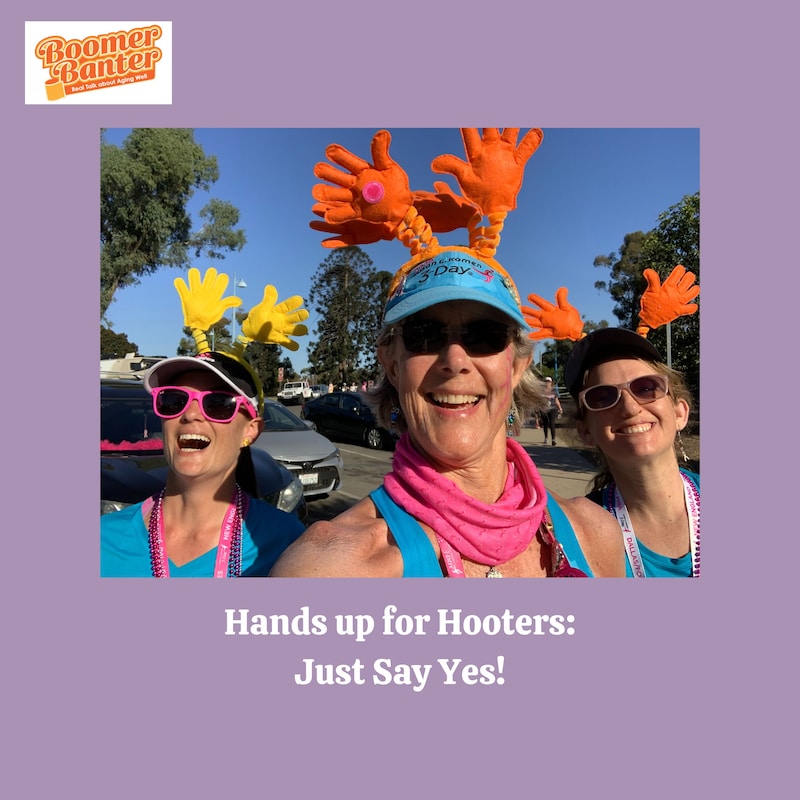
Support Sally Dunbar's team, "Hands up for Hooters."
Transcripts
SAM.
Wendy Green:Hello and welcome to Boomer Banter, where we have real talk about aging. Well, I'm your host, Wendy Green, and every week we have honest conversations about what it really means to grow older in today's world.
Navigating health, purpose, relationships, caregiving and everything in between. And I hear from people all the time that think something's wrong with them because retirement is not what they expected it to be.
They feel lost, they feel bored. They don't know what to do with their time. And this doesn't mean there's something wrong with you. It just means that you're in a transition.
You haven't lost your value. You haven't stepped into a space that you, you know, you didn't want to be in.
You just aren't familiar with this space because you were used to a routine. And this is a natural and temporary part of adjusting to a new season of life.
So what if instead of feeling like something's wrong with you, you need to be fixed? You gave yourself permission to explore what's next. Well, we can talk.
You could schedule a 30 minute complimentary discovery call with me and I promise that you will leave with a little more clarity about transitions in the process and some insights into what could be a new beginning.
de from way back in August of:In fact, you're going to hear us mention the pandemic because as you remember, everything shut down in March of that year. This episode features Sally Dunbar. Sally is a real estate agent in Sacramento, California area. She's been working in real estate for 40 plus years.
ng breast cancer in the early:What strikes me most about Sally's journey is that it started with one simple yes. Yes to a walk she thought she couldn't finish. Yes to raising money she thought was like impossible to raise.
And yes to discovering that she was so much bigger and braver than she ever imagined. Her story is a reminder that we don't need perfect conditions or certainty before we begin. We just need the courage to take that first step.
The faith to set a bold goal and the openness to let community lift us along the way. So whether your challenge is health, purpose, or simply believing in yourself again, know this. You are stronger than you think.
And it is never too late to dream a new dream or rise to a new calling. So as you go into this week, carry Sally's lesson with you. Say yes, even if it scares you a little bit.
Because in those moments, you'll find your own power, your own team, and your own triumph. So here's my conversation with Sally.
Wendy Green:Hi, Sally.
Sally Dunbar:Hi, good to see you.
Wendy Green:And thank you so much for joining us on hey Boomer today.
Sally Dunbar:Well, that was a great introduction. You actually brought tears to my eyes, I have to say.
Wendy Green:Okay, well, we're just starting, so we may have more.
Sally Dunbar:I have Kleenex, so I'm okay.
Wendy Green:Okay, good. Well, so when you registered for your first Coleman walk, you just were going to get in shape, which is a good thing, right?
Sally Dunbar:We all.
Wendy Green:20 miles is a long walk, so.
Wendy Green:But you had this epiphany. Can you tell us more about what happened on that walk?
Sally Dunbar: ackground. Had breast cancer.:And I just had things happen with business where people quit reaching out to me, I think because they thought I was sick or we gotta leave her alone. Don't want to stress her. And I'm like, I gotta make a house payment. So I decided just to ignore the whole breast cancer thing.
And I would talk about it if you asked me, but I'm not gonna bring it up. I'm not gonna be the poster child, let me tell you. So a girlfriend asked me to start walking with her just for exercise. We did.
Then Becky asked me to do the Coleman three day walk with her. And I had never heard of it. And here I was, a breast cancer survivor.
I'm sure many of you out there have never heard of it, but she said, yeah, you walk 20 miles a day. Like, I can't do that. Oh, you do it three days in a row. Yeah, no, I can't do that. And you raise $2,300. No, I was not interested.
But I googled, I saw a video, and these were like normal looking people who were doing this. So I signed up. We did the full on training. We actually got to where we could walk 20 miles a day. Shocked the heck out of me. But it's. It's doable.
We go to the walk, and I don't know what I was expecting, but it was like Mardi Gras party. I mean, cops are on this on the side directing traffic, wearing bras outside their uniforms, wearing pink Wigs. I mean, it is a Mardi Gras party.
It was fun. The whole thing was just amazing. It was fun. It was in San Francisco. And when we got to the closing ceremony, this was where the epiphany happened.
I mean, I heard a lot of stories along the way that were so moving.
We get to the closing ceremony, and they let you, as a survivor, if you choose, you don't have to do this if you don't want to be outed, but you wear a different colored shirt at the closing ceremony. And we all walked in hand in hand in rows, right?
And the rest of the walkers were there, and they do what they call the coman one shoe salute, where the walkers all take off one tennis shoe, one walking shoe, and they hold it high in the air and they salute you. And they're clapping and they're cheering, and I'm like sobbing. I had no idea this was going to happen. And the.
The first thing that happened was I looked to the gal whose hand I'm holding, and on my right, she's like a puppy. She's like 20 or 20. She's just young. And she had white blonde eyelashes. For some reason, I really remember her eyelashes. She just was young.
And I looked at her and I just said, you are. You are too young to be here as a survivor. As if I had to remind her of that. And that really struck me.
I didn't realize you could get breast cancer so young. I just didn't know. Then that one shoe salute happened, and I just got that. They were not. They didn't know me. They didn't know Sally Dunbar.
They were not cheering me. They were cheering each of us as a face of survival in the hope that if their mother or their daughter or they or their husband. Men.
Get breast cancer, too, that if one of their loved ones gets that diagnosis, it's not necessarily a death sentence. And I just got that. I mean, that was like. And that's when I came back.
And Becky Lund, who's my friend that got me doing the first one she and I signed up. Well, the next one I did was with my mother on her 90th birthday. So for those of you out there who think I can't do that, I'm 52, I'm too old.
Yeah, my mom would put you to shame. She did the walk on her 90th birthday up in Seattle, limping the whole way. But she did it.
She didn't do 20 miles, but she did five miles the first day and four miles the second day. I mean, incredible. Anyway, we did. We. I did a couple more and then I had. I just got that I can do more.
I mean, my first year, I just put it out there kind of casually and I raised $7,000. You only need to raise 2,300 to do the walk. I raised 7,000 and it was like, that was easy. So I just realized there's so much need.
And, you know, we could talk all day about what Coleman does and why Komen and the need for money, but I hit. How did they say it? I hitched my star to that wagon or I hitched my wagon to that star or whatever it is.
are your goal and it could be:And I thought, you know, you can do more. So I typed in 25,000 and I thought, you know, I did seven without even trying. That's kind of a wuss goal. I could do that.
So I typed in 50 and I thought, that's pretty high. But, you know, if I started a team, if I got people to help me, I bet I could do this. And I wanted to have new money. I wanted to be new walkers.
Not like, I'll get my other Coleman friends to come do this.
So I tell you, this voice just came from out of the blue and it said, no giant achievement has ever been accomplished without any a big ass goal that is just unreachable. So I typed in $100,000. I hit return before I had a chance to think about it, and bam, I was committed. So that was, that was how it got started.
Wendy Green:So this was your first year forming a team. You set a goal of $100,000?
Sally Dunbar:Yep, I went from one to yeah.
Wendy Green:Well, tell me how you did that.
Sally Dunbar:Okay, so I will. I'm going to say to all of you out there, I personally, I have two reasons why I wanted to do this podcast. One is I will not lie.
I want you to join my team. If you don't want to join the team, donate. We will have a link at the end.
But for those of you who, you know that's not in your cards, I hope that I can motivate you to believe that you, first of all, you can do something big ass. But get find your own charity and figure out you really can do more for them. So.
So I'm going to talk about how I did this in a way that I hope will Be helpful for you, you know, in case you want to do this for leukemia or whatever. Boy Scouts, I don't know, whatever. So I had the goal, 100,000. Like, geez minis, how am I going to do this?
just did the math. If I need:I figured I needed to have 35 walkers who actually do their, their fundraising because everybody ends up raising more than 23. It's just the way it works. So then I thought, okay, I got attrition. So I came up with goal of I need 45 walkers. 45 walkers? Do I even know 45 people?
I'm fortunately, I'm in a big real estate company, Lyon Real Estate, have to give a plug. I started asking my friends, well, Becky Lund, my one who got me started, if she hadn't signed up, I'd have been really mad. Kareen signed up.
I see she's on the call. Patty Gakutan signed up. Patty got her sister Judy, who, Judy was pretty influential out at UC Davis as a big shot out there.
She got some of her friends, clients started showing up, just, I just started putting it out there. I put a link in my Facebook signature, my email signature, I started posting on Facebook and the team started to grow.
Wendy Green:Yeah, but like you said in the beginning when you thought about talking about 20 miles a day, I mean, how many people were you talking to that were saying like, there is no way I can do 20 miles a day.
Sally Dunbar:So here's the deal about that. What I have learned is that everybody, I had all three considerations, but everybody has one of three or maybe two of three considerations.
I can't walk that far. Yeah, you're right. You get up right now. If I go out right now, I can't walk 20 miles.
But, but you just inch by inch, you start with three miles, that's one hour. Most of us with a little practice can get out there and walk up for an hour or slowly walk for an hour.
And then there's a six month training period where every Saturday and Sunday we had training walks, or we have training walks scheduled. And you show up Saturday, I tell you where to show up, what time to show up, wear good shoes, bring water. We're going to walk for an hour.
Well, we do that for a couple months and then you start slowly increasing. Instead of three on Saturday, three on Sunday, we go four and three, then five and three, then five and four. It's a very slow, gradual.
And honestly, if you just show up, you can do it. So I can't walk that far. And Trust me, my 90 year old mother, remember her? The second is I can't raise that much.
None of us think we can raise that much. But if you take a look at some of the average looking people that you see in the Komen videos, they're not special, they're just people.
And they're doing this. How are they doing this? If you want to do it, there's ways and we help.
I mean, I'm not going to do your fundraising, but I have a hundred ideas for how you can do your own fundraising and we support you. The third is I don't have time. Well, I won't even give you the list of things that I do. And I still have big time. Nobody thinks they have time.
Give up my Saturday and Sunday mornings. No, I can't do that. One of those three are what everybody has.
And honestly, if you just trust that there is a way, but you just don't know what it is. We know what it is and we will help you, we will support you. And the moral of the story is just say yes. You don't know how to do this.
You're afraid, we're all afraid. But just say yes. And I'm telling you, you can do this.
Wendy Green:Yeah. So actually there's a question that's come in from Mike that kind of leads me into what my next question was.
I want you to talk about like: Sally Dunbar:So we did our first year. I set a goal of 100,000 and we hit 148,000 our first year. I mean, from zero.
Well, from 2,300 to 148,000, there is the power of setting a goal and breaking it down. The next year we had 230 walkers that registered for your team. No, no, no, no, no. 130 walkers and we made 230,000. That was phenomenal.
So now we've, we. Last year was our fifth year. This year is our sixth year. Our goal. We so far have raised over 800,000 as a team. 800,000.
And most, I gotta just say most of our walkers were new because I don't want, you know, I'm not just Dragging money into our team. I want new money.
So we this year realized, or last year we realized that this year we can hit another 200,000 this year and it'll be our million dollar year. Million dollar cumulative lifetime. And then our friend Coleman stepped into.
Wendy Green:The.
Sally Dunbar: an Diego and bring, you know,:So they've been postponed to next year. But we will, we actually made this year if we, you know, if we could continue to fundraise, we could reach our million.
But next year we will hit our million dollar year. And I am honored to be doing this. I am so proud of my Hooter family that. And it isn't me raising all this money.
It's each of like right now we have 70 walkers on our team. Each of those 70 walkers is out there hustling, asking their friends.
Wendy Green:And Sally, I saw on your website that you have, you're going to have walks in Chicago and Dallas, I think also.
Sally Dunbar:Yeah. So Susan g. Komen has four cities that they host the three day walk in. And each walk is a three day walk, 20 miles a day. They're the same format.
Wendy Green:You were written up in a book called Women who Rise. And no wonder. Tell me about how you, how they found you to be part of this.
Wendy Green:Book and tell us a little bit about the book.
Sally Dunbar:So here it is. Women who. I'm gonna get it without the glare. I don't know if I can do that. Women who Rise. There it is. This is Kate Butler.
Kate Butler Books has put together a couple of books. Women who empower, women who motivate, women who blah, blah.
This is, I think her fifth or sixth book, which is a compilation of stories from 30 different women. So in this one, Women who Rise. And there was kind of two parts to it.
One is women who have risen above some personal challenge or women who have caused a group to rise. Hello.
So I was, you know, one of my friends had been in the book previously and she was like, you need to be in this book, you need to be featured in there. So I didn't write the book. I wrote one chapter along with 29 other women. And but the book, I will say if you just Google it's on Amazon.
Women, Women who Rise. And then put my name in or you may get a book from, you know, with somebody else's picture on it or whatever, but it's easy to find.
It's 14.99 on Amazon, and $5 from every of my book sales goes to Komen. But the women, they're so inspiring. There's a woman who talks about rising from her son's.
There's another gal who really is inspiring to me who was raised in a fundamentalist cult, and she now has a business where she helps you create a brand for your business. She had to figure out her own personal brand in life. Like, you know, you're raised from a cult, you break away.
You know, a woman who had to overcome the.
The death of her father as a pilot, and she felt as a little girl's, the way we do things, that she could have saved him had she been in that airplane and kind of had to overcome that, you know, that trau. So completely different stories. Everybody's got their own thing that they're going to write about. But it's a very empowering book.
And right now, with the pandemic and with many of us just feeling, you know, it's a very inspiring time to have this book. So is about the team, about building the team and the impact on the individual walkers from just saying yes.
Wendy Green:Yeah. And your story in that book is great. It is a very inspiring book.
So if you all need some inspiration, that would be good to get women who rise and then put Sally's name, Sally Dunbar, so that your contribution goes to the Susan G. Komen. So. So let's talk about Susan G. Komen. What do they do with the money that's raised?
Sally Dunbar:Okay, So I have to say, first, the organization came about. I'm not going to do a huge, long history, but it came about. Little Susie got breast cancer and her sister Nancy was devastated.
And when she died, sister Nancy said to sister Susie, I ain't giving up until I've done something, because this sucks. And she ended up. This was like back in, I don't know, I think 82, I want to say, or 79 or something. She started the Susan G. Komen, you know, Susie.
Susan G. Komen Foundation. And to date, I don't know the exact number, so don't quote me on this, but They've raised over $3.2 billion for breast cancer issues. They are.
And this is why. Well, it's one of the reasons why I. What is it? Hooked my wagon to this star. They are the largest contributor to breast cancer issues in the world.
ave. What have you done since:So what they do, of all their money, 25% of it goes to research. Just pure, you know, Stanford University, Johns Hopkins, Sloan Kettering, uc, all the. Whatever you.
Whoever's studying breast cancer, they apply for research grants, and they have a huge team that evaluates these grants, and they get research grants. The rest of it goes to a myriad of other things. Patient support, patient navigation, they're doing.
I won't have the right words for this, but some kind of like a genome type, cellular level database that breast cancer doctors can tap into to try to figure. They're really focusing this year a whole lot on women of color.
I mean, black women have a higher percentage of getting breast cancer than anyone, and yet there is not as much participation just in the Komen walks. It's like, we need more black women on these walks. So they are really pushing to get women of color more engaged in the.
I don't know, in just the whole process. So their money, it goes to many things. The part that just really connects for me is the research.
And it's because when I went through my breast cancer treatment, and every single woman and man who's gone through their breast cancer treatment has hopefully seen this, the doctors don't just go, well, you're blonde. Let's try this today. No, they don't just pull their treatment out of a hat.
They base it on the research of the hopefully, gazillions of women who have come before us, who were in clinical trials, in research studies based on the facts and statistics of your specific situation. So my feeling, I have two thoughts on that.
One is if I get breast cancer again, if I may repeat breast cancer patient, and I am 69 years old, and I am this and I'm that and I, blah, blah, blah. I want them to have the research on somebody who's just like me to tell them, how am I going to increase my odds of survival?
That's personal, but almost more personal. I now have three little grandkids. And when my first little guy was born, he's now three, and I just.
I just kind of looked at him and I realized, odds are he may have a husband, but odds are he's gonna have a wife. Odds are she has not been born yet. He already lost his other grandmother to breast cancer. This grandmother has had breast cancer.
I just realized that I can do something to affect his life, his future, that will affect his wife's future. She's not even born yet. And I can do something today that will make his life and her life better. And it's like, okay, I can read him stories.
I do that. I can save money for his college. Well, his parents are doing that.
There's all these things I can do as a grandma, but you know what I can do that truly will affect him, his life forever. It's empowering my team. It's empowering my team through what we're doing for Susan Komen. That's kind of why I have been very involved with the.
I'm on the three day advisory board where they have a couple of walkers from each of the cities who we meet once a month, you know, on zoom to, you know, think of better ways to make the three day walk better. I, last year was invited and I went back to Washington, D.C. to a, an advocacy summit. And that was. God, that was so powerful. And if I can.
Okay, here's something else that Komen does. They advocate for women, they advocate for health. So we were there and I spent three days, two and a half, whatever, three days.
And they trained us because I didn't know how to. What do you do with advocacy? They had four asks, four things that we were going to go talk to the senators and legislators about.
Two of them, I can't remember what they are, but one of them was pushing for increased funding for the nih, which is the National Institute of Health. That's not just breast cancer. That's not even just cancer. That is health.
So their common is spending some of our fundraising dollars to advocate to Congress about why you need to fund for, you know, for more National Institute of Health. The other thing that really struck me, I has too much detail, I suppose, but it's drug parity, which I'm like, well, really, what's that?
And it's how cancer patients, in any situation, sick person who needs drugs. There's a big disparity between getting infusions, you know, getting chemo versus how you're going to pay if you take a pill. I had no idea.
So they're, they're advocating for those two big things that are not even specific to breast cancer. They're specific to sickness. And so there's another thing that they do and very, very impressive. I was, I was blown away.
I was just really blown away.
Wendy Green:Sally, it's obvious that you are so passionate about this and what you're doing. Thinking back to when you did your first walk to where you are now. How has this whole journey changed you?
Sally Dunbar:It. I Will tell you that every.
That I, along with every member of my team, will tell you that they have been changed in profound ways and unexpected ways from health to. Probably one of the biggest is that each one of us is so much bigger than we ever thought, so much more powerful.
Six, seven years ago, if you would have suggested to me, hey, I think you can raise a million dollars for something, I would have said, I don't think so. I'm too small. I just. I don't. I wouldn't know how to do that. I don't think I can do it. Well, I'm freaking powerful.
Look what I did, and I did it with all the others. You know, it's not just me. It's. You know, I did this with these people. All I did was empower them.
So I think a huge way it's changed me is it's taught me that I am powerful. I am way bigger than I thought. And every member of my team, if I could read to you the letters that they've written to me, that is a common thread.
I will never again say, no. I will never again say, oh, no, I can't do that. I have.
Hope you don't mind if I segue into this, because I got to talk about some of my teammates and some of what's happened with them. I actually wrote. I don't know where it is now. I had all these things.
I was going to make sure I told you, but I wrote a list of the illnesses on our team. We. No, I have it right here. I got to do this because I will not. You will not believe all these illnesses we have.
Asthma, arthritis, diabetes, peripheral neuropathy, torn meniscus, which is where your knees screwed up. Hip, knee replacements.
Hip knee, knee replacements, irritable bowel syndrome, lung damage, bipolar migraines, pacemaker, Crohn's disease, fibromyalgia, being 90 and pass out unaccountably and need to have a service dog with you at all times. Some of our team members have all of these, but all of these conditions are on our team. And every one of these people said, oh, no, I can't do that.
Are you kidding? I have a service dog. Oh, no, I can't do that. I might have diarrhea. I mean, whatever. You know, I've got a torn meniscus.
So here's one gal, I asked her. Turns out her, this is Joan, and her daughter was in stage four breast cancer. I talked to her, and Joan said, there's no way I can do that.
I mean, I Have a torn meniscus. I don't want to have surgery. And I said, well, Joan, can you walk at all right now? She says, yeah, we walk about three miles a day.
Said, if you can walk three miles a day, just start and just every day just increase a little bit and see what happens. Talk to your doctor, but see what happens. So she says, okay.
She completed all 20 miles, all three days in a row, and was a blubbering, sobbing mess at the end. Couldn't believe she did this. And also felt her daughter with her the whole way. And her daughter ended up passing out or passing from breast cancer.
We did lose her. We have. I won't say her name because I don't know if I should out her because I think she's on this video.
But we have a walker who, when she joined, said, you know, I've got diabetes, I got peripheral neuropathy, and I have a pacemaker. Okay. She's. She's like the poster child. And it's like, just start walking. Can you do three miles? Yeah, I think I can do three miles. Okay, so just.
Just keep showing up. So she did. She kept showing up.
And what is phenomenal is after I'm not certain how long, but a few months or whatever, she goes to the doctor, had it. Had. Had a pacemaker and a pacemaker. It's because your heart's going to stop, right? So the pacemaker keeps your heart from stopping.
After she started walking, her doctor, you know, they go in and they read whatever they read. Your pacemaker. She had. Had no episodes since she started walking. They got her pacemaker.
She now, okay, started walking, started getting in better shape. She's off her diabetes medicine. I didn't even know that was possible. Yeah, just getting in better shape.
And fibromyalgia means you can't feel your feet. This was not a comfortable, you know, endeavor for her. We have poor Kathy. I always tell her story, and she.
She's probably sick of me broadcasting all over, everywhere. But another one of our walkers who has lung disease from having gotten a virus in Texas or so.
I hate to slam Texas, but I think that's where she got it. She has, like 45% lung capacity and is always hacking and coughing, and if she gets a cold, it turns into pneumonia.
And then she's in the hospital, and it's like. She's like, sally, I don't know if I can do this. I said, well, just. Just try. Just start. She could walk 20 minutes when she started.
She worked her way up to three miles. And then she just kept showing up. I was with her when we had gotten up to five miles. We were here in Fair Oaks.
We were coming up from a riverwalk, coming up this hill at the end, and she. We get to the top of the hill, and I'm yakking away.
She turns to me and she says, sally, that is the first time I have walked up that hill without having to stop and gasp for air.
Wendy Green:So you're giving people the gift of the team, the gift of health, helping Pullman.
Wendy Green:I mean, there's so many wonderful things that you have.
Sally Dunbar:Oh, good. And it's all fun. We have so much fun. You too.
Wendy Green:So a couple of questions that have come in that I think our good final area. Doris, who has been completely inspired by you as a survivor herself, says, what are two to three primary ways walkers raise money?
And then Susie asked, how would someone join the team? So I'm going to questions.
Sally Dunbar:Okay, go to Hands Up4Hooters.com. Hands up for Hooters.com right there. You will get an email from me telling you what the next step is if you can't remember.
Hands up for hooters dot com. If you go to, you know, just Google Susan G. Komen three day.
It's actually the three day.org but just Google that and sign up for a team and pick our team. Hands up for hooters dot com. You don't have to be on a team. You can walk alone. But why? Why would you, I mean, be on a team? What was.
Oh, so the way to raise money is to ask. Nobody wants to ask, but here's the rub. It's not the rub. Here's the deal.
Every one of you out there knows somebody who's had breast cancer, and it may be you. We all have been touched by somehow in our sphere, in our circle, in our orbit, with someone with breast cancer.
You'd be shocked how many people, when I talk to them, that's what they tell me. People want to do the right thing. They want to contribute. And people want to contribute to Komen. They are willing. If you just give them the outlet.
You'd be shocked at the people who go, oh, I always donate to them. Or, thank you for asking me. I will tell people that for a $50 or more donation, I will dedicate a mile to their angel or their survivor.
I've got people every year going, when? When are you going to walk for my cousin Susie? When? When's this going to happen?
So asking, sending out handwritten letters, sending out an Email however you want to do it on a team. One of the things that we do is we have social events, so we've had bunko.
You know, somebody will host a bunko party, and we all pay $20 to come to the bunko party. And there's. If you get 30 people, there' dollars right there. You know, paint and wine parties, just martini parties.
Anything that you can get people to pay to come, we do those things. So I actually have a list, literally, of a hundred different ideas, but it's not hard.
If you will just put it out there, and we have lots of suggestions. I hope that answers it. Hands up for hooters dot com. That's how you.
Wendy Green:Hands up for Hooters.
Sally Dunbar:Yes.
Wendy Green:So. So, Sally, I always like to ask my guests at the end, what are one or two takeaways that you would like to leave the audience with?
I mean, there's so many, so I'm.
Sally Dunbar:I know.
Wendy Green:So Trying to limit you to one or two.
Sally Dunbar:Yeah, yeah, yeah. I think on a broader point, have faith that you can do whatever you set your mind to. The hardest part is setting the goal.
The hardest part is just saying, I want to raise $100,000. That's the hard part. Then you just break it down. Well, how many does it take to do that? What's a list of ways I could do it?
What are going to be my difficulties? How can I overcome those? You just break it down. And I would say that that is the biggest.
The second is you are so much bigger than you give yourself credit for. You truly are. And a team like ours, okay, our team can help you discover that. You know, we are here to support you and to help you discover that.
And it's like, yes, we all have fear, but have fear and do it anyway. Just do it anyway.
Wendy Green:I love that.
Wendy Green:I love that you are so much.
Wendy Green:Bigger than you give yourself credit for.
Wendy Green:And that is such an important takeaway. So thank you, Sally. And you're. What a great storyteller. Thank you so much for being on the hey Boomer show today. You've had wonderful comments.
I hope you'll get to go back and look at them. But you have inspired a lot of people today, so thank you for that.
Wendy Green: 's been doing this walk since:This year is the Hands up for Hooters 10th year as a team, and since they started, they have raised over $1.5 million. Sally told me that so far this year, there are 72 registered members on her team.
Who will be walking the Susan G. Komen 3 Day in San Diego on November 14th, 15th and 16th. I'm going to put the link to register for the walk.
If you want to go to San Diego or you're in the area, or to donate to her team, I'm going to put that link in the show notes and if you're finding it difficult to say yes to the things that scare you, if you need a partner to help you find your next passion and purpose, well, let's talk about how coaching can help you navigate your transition to the life you want to live in your next chapter.
The link to schedule the 30 minute discovery call is going to be in the show notes and I truly hope that Sally's story has inspired you like it's inspired me to keep dreaming big and saying yes to challenges that scare you a little bit. Next week I'll be away exploring Mesa Verde National Park.
That is where the cliff dwelling of the early Puebloan people are, and I will be pushing back some of my fear by climbing the ladders into those archaeological sites. I'll be back live with the show on Monday, September 15th to talk about some of the newest scams that are targeting older adults and their money.
So until then, enjoy your holiday, take good care of yourself and remember, you're stronger and braver than you think.
Thanks so much for listening to this special encore episode of Boomer Banter, and if this episode resonated with you, please leave a comment, leave a like and share it with your friends. Thanks so much. Bye bye.



