Shownotes
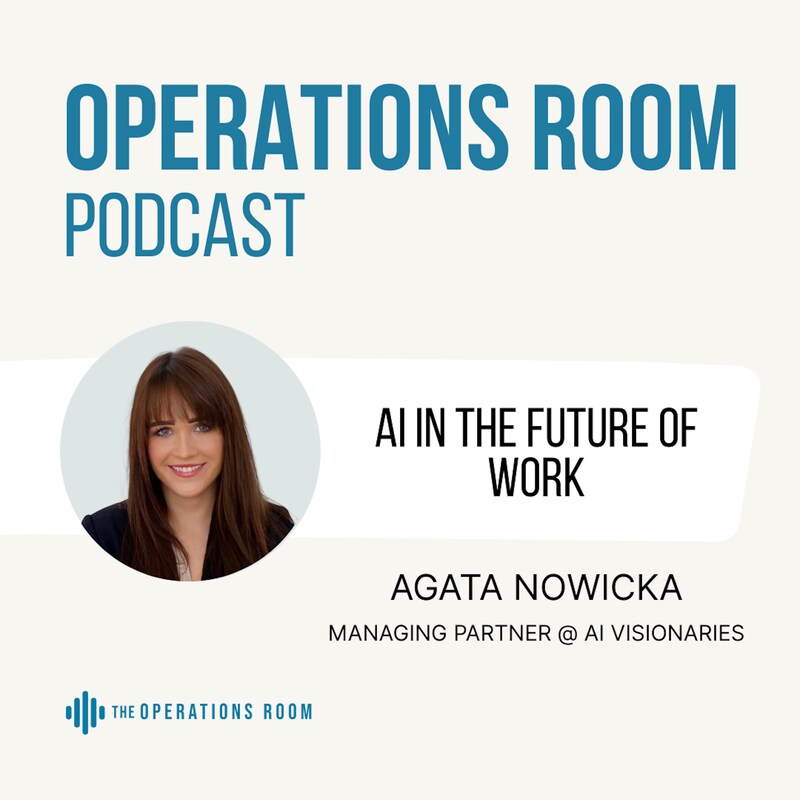
In this episode we discuss: AI in the future of work. We are joined by Agata Nowicka, Managing Partner of the AI Visionaries Accelerator.
Love The Operations Room? Please support us by rating and reviewing it here.
We chat about the following with Agata Nowicka:
- Are high-growth founders underestimating the role of distribution from day one?
- At Series B and beyond, is your monetisation model actually aligned with value delivery?
- Could your onboarding and sales process be quietly eroding the value you promise?
- Will AI fluency soon become a non-negotiable capability in your workforce?
- Are you building an AI-first company — or just layering AI onto old plumbing?
References
- https://www.linkedin.com/in/agata-nowicka/
- https://femalefoundry.substack.com/
- https://www.aivisionaries.co/
- https://www.femaleinnovationindex.com/
Biography
Agata Nowicka is the Managing Partner at AI Visionaries—an AI accelerator launched with Google to scale Europe’s most innovative AI and deeptech startups. With 12 years of experience as an angel, VC investor and founder of two tech businesses in the U.S., Hong Kong, and the UK (one exit), she is also the author of the Female Innovation Index—the largest analysis of female-led innovation and funding in Europe. Agata holds an MBA from Wharton and INSEAD and is an advisor to startups and accelerators including Techstars, the University of Cambridge Founders Accelerator, and Village Capital.
To learn more about Beth and Brandon or to find out about sponsorship opportunities click here.
Summary
39:04 – Introduction & Founder Focus Shift
42:04 – Monetisation Beyond Revenue
45:04 – Sales & Onboarding as Value Proof
48:04 – AI Fluency as a Workforce Standard
51:04 – Moving to an AI-First Model
54:05 – Business Complexity & “Plumbing”
48:20 – Resilience in High-Growth Environments
49:49 – Leadership in an AI Era
57:05 – The Future Belongs to Visionary Founders
This podcast uses the following third-party services for analysis:
Podcorn - https://podcorn.com/privacy
Transcripts
Hello everyone and welcome to
Speaker:another episode of the operations
Speaker:room a podcast for CEO's I
Speaker:am Brandon mincing and joined by my
Speaker:lovely co host Bethany errors.
Speaker:How are things going this morning?
Speaker:You ask me the question every single
Speaker:time and it is a surprise half
Speaker:the time. I'm like, how am I
Speaker:doing?
Speaker:The shocking, how are you question.
Speaker:Yeah.
Speaker:It's like the softball.
Speaker:I'm like, nope, can't answer it
Speaker:today. I am fine.
Speaker:We do these on a Friday.
Speaker:I have had a true Silicon
Speaker:Valley, the TV show week
Speaker:of highs and lows.
Speaker:I don't even know you can have that
Speaker:many highs and low in one week.
Speaker:Scale up world, of course it can
Speaker:happen.
Speaker:So we had our board meeting on
Speaker:Tuesday. I was presenting some
Speaker:new ideas and a new strategy.
Speaker:It's a little bit nervous, but it
Speaker:went down well. And I'm like, oh,
Speaker:you sorted.
Speaker:Then one of
Speaker:our top engineers, I'm trying to
Speaker:decide whether or not I can share
Speaker:it. I think it's resigned, and so
Speaker:then I'm like plummeted
Speaker:down, like, no.
Speaker:Yeah, your team is small, key
Speaker:developer out of the picture, that's
Speaker:gonna, yeah, hurt your progress.
Speaker:Well, I mean, some of it is hurting
Speaker:progress, and he is a very
Speaker:good developer and technically very
Speaker:able, but it's also like,
Speaker:I really like working with him,
Speaker:embodies the values,
Speaker:a little bit older, you
Speaker:know, I think I've mentioned this
Speaker:before that I just feel so old and
Speaker:so uncool at the company.
Speaker:And so it's nice to have a couple
Speaker:allies who are on the other side of
Speaker:40 with me.
Speaker:Yeah, so I can't go into all of the
Speaker:highs and lows, but It was just like
Speaker:that the whole week, and then
Speaker:ended on a relative.
Speaker:Hi, and our show and tell had
Speaker:a demo of the new expansion product
Speaker:we're looking at.
Speaker:In general, the product's moving
Speaker:quickly, really cool advances.
Speaker:And then get home
Speaker:to remember that I had a different,
Speaker:I was a guest on a podcast between
Speaker:seven and eight last night.
Speaker:And so I just had to dig deep.
Speaker:I know seven to eight doesn't sound
Speaker:that late, but after the week I had,
Speaker:it was like the last thing in the
Speaker:world I wanted to do.
Speaker:I would have paid money to not go on
Speaker:a pod cast.
Speaker:You're like, why did I book this?
Speaker:I do that all the time in my head.
Speaker:I'm like, do I really wanna have
Speaker:this conversation with this person
Speaker:I'm having right now? I booked it,
Speaker:so it's my fault, but yeah.
Speaker:Yeah, so I think how I'm
Speaker:doing is just, I'm so happy it's
Speaker:the weekend.
Speaker:Okay, so Silicon Valley TV
Speaker:show, any absurdities this week?
Speaker:Sometimes in this scale up, kind of
Speaker:ups and downs, there's just silly
Speaker:things that happen that are either
Speaker:tragically bad and really they're so
Speaker:bad, they're kind of humorous in a
Speaker:way, or they're so weirdly awesome.
Speaker:You're like, how, this is
Speaker:ridiculous.
Speaker:Any of that.
Speaker:This is the problem, I was thinking
Speaker:about this last night, is we
Speaker:used to be able to share so much
Speaker:more when we weren't working,
Speaker:and now we're working.
Speaker:We can't be as open.
Speaker:Like, ask me that question in three
Speaker:years' time, and I'll be able answer
Speaker:it, but I can't answer it today.
Speaker:Yeah, it's funny because this whole
Speaker:idea of the building out loud,
Speaker:building in front of people where
Speaker:people are doing blogs and talks
Speaker:around the machinations of their
Speaker:company, realistically I don't know
Speaker:how you can really do that because
Speaker:at the end of the day, the internal
Speaker:stuff, there's a fair amount of
Speaker:sensitivities just in terms of
Speaker:either people, twos and fros or
Speaker:challenges that are directly related
Speaker:to the individuals that you work
Speaker:with that if you share it, I mean,
Speaker:it will come back to bite you,
Speaker:there is like no question of that.
Speaker:Yeah, and it's all just very real
Speaker:time. I think sometimes you need a
Speaker:bit of perspective as well.
Speaker:Yeah. And not definitely not live
Speaker:blog deep in the fields.
Speaker:I had a lot of fields this week, but
Speaker:I I'm back on a even keel.
Speaker:I spend most of my time as
Speaker:a CEO using all
Speaker:of the nervous
Speaker:system regulation skills
Speaker:I have built and developed
Speaker:over the years.
Speaker:All the reservoir.
Speaker:Cheers!
Speaker:Really don't know how I
Speaker:would have done this pre those
Speaker:skills.
Speaker:I think I'd be an alcoholic.
Speaker:I think as soon as you put three
Speaker:people in a room together, you have
Speaker:people issues.
Speaker:And I do find people issues more
Speaker:stressful than business
Speaker:issues. And I react to them more.
Speaker:And so there's just like a huge
Speaker:amount of time that I'm spent like
Speaker:breathing deeply, going for
Speaker:walks, shaking it off.
Speaker:Yeah, yeah, yeah. Because you can
Speaker:get consumed by it time-wise and
Speaker:mind-share-wise.
Speaker:I mean, this is almost the trick of
Speaker:the trade, I think, for scale-ups
Speaker:because the business focus
Speaker:of getting stuff done and executing
Speaker:and winning new business and
Speaker:progress with the product and all
Speaker:that, the self-inflicted wounds in
Speaker:all these companies by far that
Speaker:consume so much time and energy and
Speaker:diverts yourself is all that stuff.
Speaker:All the people problems.
Speaker:And if you get sucked into it,
Speaker:issues with people or you take
Speaker:it too personally, You lose
Speaker:hours which mountain to days
Speaker:and You know, if you're losing time,
Speaker:I guarantee you the others are
Speaker:losing similar capacity in terms of
Speaker:their mind share.
Speaker:So it's just like a huge distraction
Speaker:that hopefully with
Speaker:experience you can kind of like
Speaker:ensure for the most part for
Speaker:yourself and hopefully for others
Speaker:around you, somehow you can make
Speaker:sure people are focused on the right
Speaker:to actual things here.
Speaker:Just don't know if it's possible.
Speaker:I think it's possible to insulate
Speaker:yourself from
Speaker:outside of the leadership team, but
Speaker:even the leadership team dynamics,
Speaker:they just come in.
Speaker:So I was talking to Ryan,
Speaker:one of our previous guests,
Speaker:about some of the stuff that was
Speaker:going on, and he was
Speaker:a previous CEO of the company
Speaker:that was sold to Microsoft.
Speaker:And he was saying that he was
Speaker:talking to one of his advisors,
Speaker:who's super senior, deals with
Speaker:like top 10.
Speaker:CEOs of the top 10 businesses
Speaker:in the world kind of level.
Speaker:And then we talked to Ryan and Ryan
Speaker:be like, oh, the leadership team,
Speaker:this, that, this person's resigned,
Speaker:that's happened, oh, this stressful.
Speaker:And like, I would just laugh and
Speaker:be like the last call I had with,
Speaker:you know, whoever massive company
Speaker:was CEO was exactly
Speaker:the same.
Speaker:Like, it always comes down to
Speaker:personalities, the best leadership
Speaker:team.
Speaker:People who are growing, people on
Speaker:the ascent, people of the decline.
Speaker:And just balancing it all the time.
Speaker:Yeah, I suppose in that way, it's
Speaker:very much undervalued, the
Speaker:intangible of the chemistry in
Speaker:particular of the leadership team.
Speaker:Do you actually have chemistry where
Speaker:there really is like a complementary
Speaker:synergistic effect and there's
Speaker:a minimum amount of
Speaker:politicking or issues or
Speaker:problem related, people related
Speaker:problems and so on where the team
Speaker:works well together, they enjoy
Speaker:working together and they know how
Speaker:to work together.
Speaker:You know, and I think that
Speaker:intentional piece.
Speaker:And I was just thinking about this
Speaker:in terms of our company, we've
Speaker:got a bit of a leadership reset
Speaker:because one of the co-founders is
Speaker:kind of spinning off in a slightly
Speaker:different direction.
Speaker:We've had a maternity leave for the
Speaker:CRO, we have some other individuals
Speaker:that are now in play from a
Speaker:seniority perspective that need to
Speaker:be I think part of leadership in
Speaker:some capacity. So that what I'm
Speaker:cognizant of is we had good
Speaker:chemistry, good momentum, we
Speaker:understood how to work together
Speaker:quite well. So this reset,
Speaker:I'm just vaguely concerned that
Speaker:somehow...
Speaker:What we had built is going to,
Speaker:I mean, it's gonna be different
Speaker:regardless, but we're not gonna be
Speaker:able to reinvigorate it
Speaker:and have the same feeling.
Speaker:I'm not going through a reset, but
Speaker:we also, on top of all these other
Speaker:things this week, it's the second
Speaker:week of our sales and marketing
Speaker:leaders, and so bigger leadership
Speaker:team settling everybody in.
Speaker:I have not spent enough time with
Speaker:them because I was prepping for the
Speaker:board meeting and then dealing with
Speaker:this other stuff, so I already
Speaker:know that I'm no following any of my
Speaker:own advice behind the curve.
Speaker:I was on the podcast last night
Speaker:feeling like an utter hypocrite,
Speaker:which is like, when you hire
Speaker:somebody who is experienced
Speaker:and you think they're great.
Speaker:Don't just bring them into the
Speaker:business and then walk away and
Speaker:like, okay, you're in charge now,
Speaker:like spend time, really
Speaker:align, be clear on your
Speaker:joint objectives and understandings
Speaker:and really make sure your values
Speaker:are aligned. I have done none of
Speaker:that. I brought them into the
Speaker:business, pointed them at problems
Speaker:and said, off you pop.
Speaker:And I have to get back to being
Speaker:a good leader.
Speaker:Also, they just, what I have managed
Speaker:to do is like the ways
Speaker:that I like to work that I hadn't
Speaker:articulated to them so then they
Speaker:don't know.
Speaker:And then I have to like, oh, by the
Speaker:way, like they were doing a lot
Speaker:of DMs.
Speaker:So like me plus two people or me
Speaker:plus one person or particularly
Speaker:because they're all like different
Speaker:combinations of the leadership team.
Speaker:So I had to finally just say, just
Speaker:send it to the leadership Team.
Speaker:It's good for everybody have
Speaker:context, even if they're not
Speaker:interested and they might not read
Speaker:it but they can scan it and
Speaker:let's have as much open
Speaker:communication as possible.
Speaker:Like there weren't things that were
Speaker:sensitive.
Speaker:But if I think about as a new
Speaker:person, you don't really know, you
Speaker:don't know what the culture is.
Speaker:You don't want to blast people with
Speaker:spam.
Speaker:It's just so much better than these
Speaker:like little tiny fiefdoms or like
Speaker:pockets of information and then
Speaker:you're trying to remember who
Speaker:knows what. Assume you know it.
Speaker:Oh, for whatever reason you weren't
Speaker:in that chat. Yeah, I hate that.
Speaker:It just slows this down.
Speaker:That's how I'm doing for question
Speaker:number one of today.
Speaker:Well, I will say that so you look
Speaker:like you're in good shape because
Speaker:some of the calls we've had
Speaker:recently, you did not look your
Speaker:best.
Speaker:Just in terms of not physically, I
Speaker:could tell you were tired and a
Speaker:little angsty, whereas today you
Speaker:look and feel kind of
Speaker:back to the Bethany that I'm used
Speaker:to.
Speaker:Yeah, I think it's just so we ended
Speaker:up other we ended up with a roller
Speaker:coaster on an upward trajectory
Speaker:on Thursday.
Speaker:So really, other than just the
Speaker:exhaustion of doing the podcast,
Speaker:like I think I've I'm in a good
Speaker:place right now.
Speaker:So let's see what today brings.
Speaker:It could be very different by the
Speaker:end of the day.
Speaker:Yeah, you never know.
Speaker:Well, it is Friday and you're
Speaker:working from home today as I am as
Speaker:well. So I feel like today's like a
Speaker:solid catch-up day on things that I
Speaker:need to be attending to that I've
Speaker:ignored for the past 24, 48 hours.
Speaker:Just before we got on the podcast, I
Speaker:was just mentioning two things.
Speaker:So one is yesterday,
Speaker:I had a massive
Speaker:headache by midday and
Speaker:it just got worse over the course of
Speaker:the afternoon and we have
Speaker:leadership in the afternoon.
Speaker:And I kind of, I had not.
Speaker:Pulled my stuff together quite yet
Speaker:for pre-reads, so it was quite late,
Speaker:so I'm kind of getting the pre-reads
Speaker:done for two things related to
Speaker:option grants and something else,
Speaker:eventually distributed it by noon.
Speaker:At that point, I was not feeling
Speaker:great, and the heading
Speaker:was killing me at that point.
Speaker:Distributed the docs, went into
Speaker:leadership, and I kind of own
Speaker:leadership in terms of running it
Speaker:effectively. So it wasn't my
Speaker:best showcase, I would say, in terms
Speaker:running that hour 45 block.
Speaker:And at the outset, there were some
Speaker:angst related to some recent issues
Speaker:related to execution on.
Speaker:Of OKRs and so on.
Speaker:So it was a bit angsty just overall
Speaker:at the beginning and I don't think I
Speaker:managed it as well as I probably
Speaker:should have.
Speaker:And then it was compounded by after
Speaker:that we had due diligence report
Speaker:that had come back from the investor
Speaker:for the latest round.
Speaker:And it's fascinating the
Speaker:observations that a third party
Speaker:has on you where they've done kind
Speaker:of like a McKinsey style job to kind
Speaker:of dissect the business from an
Speaker:external point of view in terms of,
Speaker:you know, how are we doing?
Speaker:How do they perceive us?
Speaker:What's our score So that was
Speaker:fascinating to go through with the
Speaker:group. We're all sitting around the
Speaker:table, throwing in our viewpoints
Speaker:and so on, and I can feel myself.
Speaker:I had a couple good ones, I thought,
Speaker:in terms of observations on the due
Speaker:diligence thing, but in terms to
Speaker:being able to articulate it, you're
Speaker:just like, oh my God, what am I
Speaker:trying to say here?
Speaker:So it was not my best showcase,
Speaker:so I'm just thinking at the end of
Speaker:it, as you have pointed out many
Speaker:times in the past on this podcast, I
Speaker:need to catch myself in these
Speaker:situations earlier and just say,
Speaker:look, it's not helpful to anyone to
Speaker:have and go into a session.
Speaker:And just like ramble on about stuff
Speaker:that is not clear basically,
Speaker:whether it's a leadership or in this
Speaker:kind of other session and just pack
Speaker:it in, admit defeat,
Speaker:go home.
Speaker:So that's my lesson
Speaker:learned I think from yesterday.
Speaker:So, actually something else of
Speaker:interest here, we had our strategy
Speaker:days, team days as we call them,
Speaker:last week on Thursday and Friday.
Speaker:So we ran our survey this week in
Speaker:terms of results, good report card,
Speaker:printers across the board, everyone
Speaker:enjoyed it and just good feedback
Speaker:all around I would say.
Speaker:The interesting bet, two interesting
Speaker:bets, one is the
Speaker:survey results, we'd asked which
Speaker:piece of content, if you had a stack
Speaker:rank the content over day one,
Speaker:day two, what was the most valuable
Speaker:piece of content.
Speaker:And what came back may not be
Speaker:surprising to you, but it was sort
Speaker:of surprising to me, but the
Speaker:most valuable session was the AI
Speaker:upscaling on day two, and
Speaker:we had three tracks, as I mentioned
Speaker:before, Charlie Kamen on
Speaker:ChatGBT, we had two others on
Speaker:Cursor, more for the engineers and
Speaker:in Cloud Code, and one other
Speaker:for more of like non-developers
Speaker:on the livable side of things.
Speaker:The quality of those tracks, as we
Speaker:know Charlie's fantastic at what he
Speaker:does. The other two were not
Speaker:perceived as high quality.
Speaker:Despite the concerns around the
Speaker:quality levels on tracks two and
Speaker:three, it was still considered to be
Speaker:the most valuable thing for the
Speaker:company. I think the macro point is
Speaker:people are really keen to
Speaker:get better at this stuff, basically.
Speaker:And then we asked another question
Speaker:in the survey, you know, what is
Speaker:your interest level and more AI
Speaker:up-skilling and more challenges
Speaker:and so on.
Speaker:And right across the board, it's
Speaker:either extremely interested or
Speaker:very interested. I think there is.
Speaker:A lot of enthusiasm and desire
Speaker:and appetite to do more of this
Speaker:stuff and have the time and space to
Speaker:actually do it.
Speaker:Ha ha!
Speaker:Awesome. I have like a little I told
Speaker:you so dance going on in my head.
Speaker:Yeah, but I appreciate it because I
Speaker:think all our previous conversations
Speaker:kind of led me to doing
Speaker:this in the way that I did it
Speaker:tonight. And for sure, we're going
Speaker:to have some level of ongoing
Speaker:activity, I just can't, I'm not
Speaker:quite clear right now as to what
Speaker:exactly I'm going to do.
Speaker:Well, so the thing that I really
Speaker:need to do, know I need to do, and
Speaker:again, in terms of like, not
Speaker:following my own advice, but
Speaker:have to really find the time to
Speaker:follow my own advise, is management
Speaker:training for everybody, particularly
Speaker:the engineers, because at this
Speaker:point, I think there's like little
Speaker:bits of new
Speaker:technology, new techniques, you can
Speaker:always learn somebody else has
Speaker:figured out a cool way of using the
Speaker:tech, but that's not going
Speaker:to make the biggest difference for
Speaker:the engineers.
Speaker:At this point, the biggest
Speaker:difference would be leadership
Speaker:skills, not leadership skills
Speaker:management skills.
Speaker:So what do you delegate?
Speaker:What, how do you parse up work in
Speaker:bite size chunks that
Speaker:an agent is
Speaker:equivalent to a human?
Speaker:How do you provide enough context,
Speaker:getting comfortable with slowing
Speaker:down to speed up, holding
Speaker:the agent to account rather than
Speaker:just being like, oh, whatever, I'll
Speaker:do it myself. And I
Speaker:know I need to teach these skills.
Speaker:But I have just not gotten to the
Speaker:point of like building the
Speaker:framework.
Speaker:I have 20 odd
Speaker:years of management experience
Speaker:and it just becomes second nature.
Speaker:And so I'm gonna have to think about
Speaker:which books did I read?
Speaker:Which frameworks do I use?
Speaker:What is the process that I actually
Speaker:go through? Which is now intuitive
Speaker:in order to break it down for the
Speaker:teams. And I just haven't had time
Speaker:to do it yet but I absolutely have
Speaker:to.
Speaker:Yeah. And do you think there's a
Speaker:special twist on this whereby we're
Speaker:not just talking about managing
Speaker:other people now, we're talking
Speaker:about managing agents.
Speaker:So therefore, because I mean, we
Speaker:describe is every
Speaker:company's problem on the planet,
Speaker:which is how do we make sure
Speaker:managers are highly effective.
Speaker:So do you think there is something
Speaker:fresher to be done in terms of the
Speaker:agent twist?
Speaker:I don't know if there's a fresher to
Speaker:be done for the agent twist, but it
Speaker:just means you have to go down a
Speaker:layer on management.
Speaker:And also you're asking people
Speaker:who are newer in their careers and
Speaker:have not been managed themselves
Speaker:very much. Because I think part of
Speaker:it is that by the time you become a
Speaker:manager, you've seen what works and
Speaker:doesn't work with your own.
Speaker:Whereas if you've only been in your
Speaker:career for two to five
Speaker:years or whatever, you're not always
Speaker:thinking about how have I been
Speaker:managed and how do I do it.
Speaker:And it's also really separating
Speaker:the management skills from the
Speaker:leadership skills.
Speaker:Like you don't need to motivate
Speaker:the agents.
Speaker:Come on, agentic person
Speaker:A, get moving.
Speaker:But what you do need to have, which
Speaker:I guess is leadership, is the
Speaker:ability to communicate a vision and
Speaker:what your output you're looking for
Speaker:is. And I don't know, is that a
Speaker:management skill? Is that a
Speaker:leadership skill?
Speaker:I put a bit more in leadership.
Speaker:So that's what we need because
Speaker:everybody is a manager.
Speaker:And the more effective manager you
Speaker:are, the more affective you are
Speaker:using AI.
Speaker:And I'm just hobbling the
Speaker:team by not really spending
Speaker:a lot of time with them to have that
Speaker:mind shift on how you manage.
Speaker:Yeah. So I think this is a twist
Speaker:because what we're saying is every
Speaker:single person in the company,
Speaker:regardless of your role, whether
Speaker:you're a product marketing manager
Speaker:or anybody else, you are a manager,
Speaker:flat out. So whether you have one
Speaker:year's experience, 20 years
Speaker:experience, you're manager.
Speaker:So therefore we need to level set
Speaker:across everyone in terms of how to
Speaker:manage.
Speaker:Well, I think the parts, going
Speaker:back to earlier in our conversation,
Speaker:the hardest parts of management
Speaker:and leadership are the people and
Speaker:the egos and the feelings.
Speaker:And you actually start to deal with
Speaker:that with agents.
Speaker:All give what I think are good
Speaker:instructions, lots of context,
Speaker:go for a plan.
Speaker:And then it just like starts doing
Speaker:something weird.
Speaker:And with a human, I would have to
Speaker:say, that's an interesting take.
Speaker:Click. Walk me through your
Speaker:thinking. How did we get here?
Speaker:I'm not quite sure this is where,
Speaker:you know, whereas with Claude,
Speaker:I'm just like, stop.
Speaker:Why are you doing this?
Speaker:I wanted you to do X.
Speaker:You're doing Y.
Speaker:Don't do Y.
Speaker:Do X.
Speaker:These reasons this way.
Speaker:It's quite freeing.
Speaker:I was thinking last night, I wonder
Speaker:how all this interaction
Speaker:with AI is going to affect
Speaker:the way that we interact with each
Speaker:other as humans.
Speaker:And I wonder if there is gonna be a
Speaker:level of bluntness that comes out
Speaker:because you spend all your day
Speaker:being so blunt with a machine that
Speaker:it starts to become a habit.
Speaker:Yeah, for sure. Or I could go the
Speaker:reverse, where we just lose our
Speaker:skills entirely of how to talk to
Speaker:people properly, and it ends up
Speaker:being softly, softly.
Speaker:Yeah, so good to hear that the
Speaker:training went well, it was well
Speaker:received.
Speaker:Charlie is he's just a gifted
Speaker:trainer at the enthusiasm
Speaker:level.
Speaker:And also just very clear, he's a
Speaker:great storyteller and he
Speaker:knows how to balance the variables
Speaker:of storytelling versus like trying
Speaker:to get us to understand key bits we
Speaker:need to understand within a compact
Speaker:two and a half hour time frame
Speaker:because that's always the balance a
Speaker:little bit between too much
Speaker:fluff versus like the concrete piece
Speaker:of it. Two things of interest
Speaker:actually, so the one showcase that
Speaker:we did at the end of the day was
Speaker:fabulous.
Speaker:So for our company as we're scaling
Speaker:up. We are going to be hiring quite
Speaker:a few engineers.
Speaker:And when you do engineering
Speaker:interviewing, there's always the
Speaker:task phase. And the task face
Speaker:requires a senior developer
Speaker:to look at the task as part of that
Speaker:interview process and assess that
Speaker:task and whether that task
Speaker:has been well done or it's not been
Speaker:well done. And it's a key criteria
Speaker:by which we discard candidates.
Speaker:So the time consumption for a senior
Speaker:developer due to this activity is
Speaker:enormous.
Speaker:And then compound that by the number
Speaker:of engineers, the number candidates
Speaker:are gonna be flowing through our
Speaker:pipeline over the next 12 months.
Speaker:Huge time consumption, huge suck.
Speaker:Very concerning for us as a company
Speaker:just in terms of our kind of time
Speaker:allocation.
Speaker:The AI output that we produced
Speaker:and that we showcased was
Speaker:automating that, whereby the task
Speaker:comes in and it's assessed, it's
Speaker:either a pass or it's a fail.
Speaker:That there's a bit of a gray zone
Speaker:right now that we've left in.
Speaker:Whereby a developer needs to look at
Speaker:that if it goes into that gray zone
Speaker:in the middle band where the
Speaker:developer needs to just do the
Speaker:finite assessment.
Speaker:But on balance, the production
Speaker:of whatever we produce that day
Speaker:basically works.
Speaker:So now the thought process is
Speaker:we'll run it across all the tasks,
Speaker:we'll get the developer at least for
Speaker:the initial time period to do the
Speaker:same thing they would normally do,
Speaker:compare the outputs and just make
Speaker:sure the feedback is going into the
Speaker:agent to optimize it to make it
Speaker:on balance kind of where it needs to
Speaker:be. Once we're in that state, then
Speaker:we can use it wholesale across all
Speaker:the tasks that are coming through
Speaker:for the engineering.
Speaker:So you've built yourself a
Speaker:engineering recruiter.
Speaker:Or at least automating one component
Speaker:of the process.
Speaker:What I also love with AI is there
Speaker:are many more ship-it days and many
Speaker:fewer hackathons, so
Speaker:things can get into production.
Speaker:And I was actually thinking about
Speaker:this because every person that I
Speaker:spoke to called that day something
Speaker:different.
Speaker:We're like, we're having a hackathon.
Speaker:We're having, you know what I mean? There was
Speaker:various phrasings used around
Speaker:the day itself and I was thinking
Speaker:about this afterwards.
Speaker:We probably need to like position
Speaker:this a little more clearly as to
Speaker:what we're doing here because to
Speaker:your point, I don't think this is
Speaker:really a hack-a-thon and we're like
Speaker:squashing bugs over the day or
Speaker:whatever.
Speaker:We're really producing artifacts
Speaker:or outputs that are usable in
Speaker:some form, if not a form
Speaker:like I just described where it's
Speaker:legit and we can actually use it
Speaker:going forward. That's really the
Speaker:purpose of these days.
Speaker:So making that more clear somehow to
Speaker:the group seemed like a useful thing
Speaker:to do.
Speaker:Yeah. So we're doing
Speaker:our Charlie days next
Speaker:week.
Speaker:There's definitely some themes in
Speaker:today's podcast. So there's another
Speaker:theme in that after we did the
Speaker:training last time,
Speaker:one of the clear takeaways was it's
Speaker:too much to do general training in
Speaker:the morning and specific training
Speaker:for engineers in the afternoon.
Speaker:Guess what we're in this time.
Speaker:Oh dear, what?
Speaker:100% the same thing.
Speaker:So we're general training in the
Speaker:morning, specific training
Speaker:for the engineers in the afternoon.
Speaker:And then that's all Monday.
Speaker:And then Tuesday is
Speaker:a building day.
Speaker:And so on the
Speaker:non-technical teams will be
Speaker:automating as much as they can.
Speaker:We have been compiling a
Speaker:notion list of all of our
Speaker:use case requests.
Speaker:So Charlie has access to it as well.
Speaker:He can see what we want to automate.
Speaker:Every time we have an idea, we stick
Speaker:it on that paper.
Speaker:And then on Tuesday, whatever we
Speaker:haven't done on Monday
Speaker:as part of the training, the team
Speaker:will do on Tuesday.
Speaker:And then for engineering, it's
Speaker:a slow down to speed up day.
Speaker:And so building a lot of the
Speaker:foundations that we know we need to
Speaker:put in place.
Speaker:Almost exactly like the management
Speaker:stuff. So like, this is the way we
Speaker:code. These are the, you know, just
Speaker:giving way more context and rules
Speaker:so that we can move to asynchronous
Speaker:coding.
Speaker:And that's the goal is at the end of
Speaker:the second day, we
Speaker:have entered into the world of
Speaker:asynchronous coding
Speaker:Okay, yeah, that's amazing.
Speaker:So coding that is happening when
Speaker:people are not there.
Speaker:People are asleep who wake
Speaker:up in the morning to new new
Speaker:product.
Speaker:Yeah, yeah, that's super cool.
Speaker:The other interesting little
Speaker:anecdote coming out of our one was
Speaker:we had one of our, I
Speaker:think it was the VP of AI, so one of
Speaker:out senior, kind of like
Speaker:executable of persons, highly
Speaker:talented in the AI space, he took
Speaker:on the GTM challenge of enrichment
Speaker:of our accounts and
Speaker:put together a really fascinating
Speaker:demo that did some amazing
Speaker:things.
Speaker:However, his recommendation at the
Speaker:end of that enrichment exercise was
Speaker:go license clay.
Speaker:So it's just interesting how you
Speaker:can get to a certain level with some
Speaker:of these artifacts, but there's a
Speaker:bit of a recognition sometimes.
Speaker:There is a reason why companies
Speaker:exist on top of open AI,
Speaker:which is to provide verticalized
Speaker:solutions that are easy to use, that
Speaker:provide a comprehensive set of
Speaker:outputs whereby it solves the
Speaker:problem wholesale, which in this
Speaker:case is enrichment.
Speaker:So he felt we had done a
Speaker:good job on a very specific siloed
Speaker:strand of enrichment, But was a
Speaker:broader problem to be solved with
Speaker:enrichment and also just purely from
Speaker:a usability standpoint having
Speaker:a tool that is just more integrated
Speaker:with stuff effectively.
Speaker:So that was an interesting outcome.
Speaker:All right, so we've got a great
Speaker:topic for today, which is AI in the
Speaker:Future of Work.
Speaker:We have an amazing guest for this,
Speaker:which Agatha Nowika.
Speaker:She's the Managing Director of AI
Speaker:Visionaries in partnership with
Speaker:Google Cloud.
Speaker:So before we get to Agatha,
Speaker:a couple of questions for you.
Speaker:The first one is, what are the
Speaker:skills that matter
Speaker:for the next generation of
Speaker:employees?
Speaker:And I was thinking about this
Speaker:specifically in the context of, for
Speaker:myself, we are looking
Speaker:at our job descriptions.
Speaker:There's a clear recognition in our
Speaker:job descriptions that people
Speaker:will be using AI to respond
Speaker:to our job description in terms of
Speaker:prepping for their interviews, for
Speaker:the screening calls, for sure, for
Speaker:the tasks that we're going to
Speaker:provide and so on.
Speaker:So then it got me and our head of
Speaker:talent thinking in terms how to
Speaker:set up the tasks and the
Speaker:questions that we were asking to
Speaker:really talk about much more of these
Speaker:skills for the next generation
Speaker:of human qualities of
Speaker:trade-offs, judgment and
Speaker:so on and kind of the more this like
Speaker:system level thinking and the
Speaker:analysis part of it and walking
Speaker:through crisply like how
Speaker:they think about solving problems
Speaker:to gear up our talent
Speaker:function to address that more
Speaker:directly.
Speaker:So my question to you is skills
Speaker:that matter for the next generation,
Speaker:what's your take on this?
Speaker:I've been thinking a lot about it.
Speaker:There was an episode
Speaker:of the AI Daily
Speaker:Brief podcast that I listen to
Speaker:every day, and it
Speaker:was one of these where they
Speaker:were looking at KPMG surveys and
Speaker:this survey and that survey.
Speaker:It was a survey day of insights
Speaker:coming out.
Speaker:One of the things — it wasn't
Speaker:actually so much the surveys now,
Speaker:but how rapidly things are
Speaker:moving and in
Speaker:X number of years, one year,
Speaker:maybe up to five years.
Speaker:Execution will no longer be the
Speaker:bottleneck.
Speaker:And to think about that,
Speaker:like you can say it, but then you
Speaker:actually have to think and just
Speaker:imagine like, you know, if we do get
Speaker:to this point of asynchronous
Speaker:coding, coding agents are
Speaker:really good.
Speaker:Anybody can build whatever product
Speaker:as quickly as they want.
Speaker:What is the role of humans?
Speaker:And what is your competitive
Speaker:advantage? And how do you still grow
Speaker:a business?
Speaker:Because our entire lives
Speaker:have been about leaders.
Speaker:It's ultimately.
Speaker:Allocation of resource and
Speaker:getting shit done.
Speaker:In some ways, we're going to have
Speaker:unlimited resource.
Speaker:Allocation of resource is going to
Speaker:be a whole lot less important
Speaker:because you don't have to hire a
Speaker:bunch of people.
Speaker:You can just do so much more.
Speaker:This is a bit like, I can't remember
Speaker:her name, the woman that we
Speaker:interviewed from NYU around
Speaker:the coaching.
Speaker:She was talking about this a bit.
Speaker:I had a first glimmer of
Speaker:what's
Speaker:it going to list on.
Speaker:And therefore, what are the skills
Speaker:that you need? And I think what
Speaker:you're talking about is right,
Speaker:Brandon. It's taste, it's
Speaker:judgment, it it's
Speaker:harder problem solving.
Speaker:It's having vision and understanding
Speaker:where you want to go and why.
Speaker:And then rallying your
Speaker:agents to do that either
Speaker:within an organization or
Speaker:as a single person.
Speaker:Some of the people issues I had this
Speaker:week, I was like, Oh, fuck it.
Speaker:Like, why can't I just do my own
Speaker:business of one?
Speaker:And like, are we all just going to
Speaker:be businesses of one and then
Speaker:we go and hang out in the pub, you
Speaker:know, with people in the evenings
Speaker:have nothing to do with our
Speaker:businesses.
Speaker:But yeah, I think it's that I'm
Speaker:worried about what are
Speaker:the impacts to humanity,
Speaker:because
Speaker:people who have those skills and can
Speaker:rise to the top, it's going
Speaker:to be unbelievable.
Speaker:But for people who
Speaker:don't, or you know that's not
Speaker:their passion, or they were quite
Speaker:happy.
Speaker:Entering data all day long and then
Speaker:going home and running the marathons
Speaker:or whatever like it's going to be.
Speaker:Hard if you don't care i
Speaker:don't think this would be any quiet
Speaker:quitting the other point that i
Speaker:thought when you're talking about
Speaker:everybody's gonna use a for their
Speaker:tasks is good.
Speaker:What's you don t be worried about
Speaker:but what it gives you an
Speaker:opportunity is to see how good
Speaker:they are day i so if it
Speaker:sounds good in the first reading and
Speaker:then you realize it says nothing
Speaker:it's slow.
Speaker:It's polished nothingness.
Speaker:They've helped you filter them out.
Speaker:So I wouldn't worry so much about if
Speaker:they're using AI or not, I would
Speaker:worry about the quality of the work
Speaker:that they're putting in front of
Speaker:you.
Speaker:Yes, yes.
Speaker:I think this is exactly on point.
Speaker:I mean, you can see it.
Speaker:I can see it all the time now in
Speaker:terms of documents that are created
Speaker:using chat gbt or you know
Speaker:the gemini or whatever.
Speaker:It's usually pretty clear.
Speaker:There's a lot of if you glance
Speaker:at it, it sometimes looks perfectly
Speaker:fine but we actually read it
Speaker:properly around our situation, our
Speaker:problems.
Speaker:It's missing a bunch of stuff and
Speaker:there's a genericness to it.
Speaker:And even for myself the other day
Speaker:and this is where there's a bit of
Speaker:like a weird balance happening now
Speaker:or rebalancing my mind around how to
Speaker:use this stuff effectively because
Speaker:As we all do, I use it very much to
Speaker:create what I would have done much,
Speaker:much faster where using
Speaker:my prompts and various kind of
Speaker:existing materials, dump it all into
Speaker:the mixer of chat GBT,
Speaker:add in a bunch of prompts to kind of
Speaker:restructure things and so on.
Speaker:But when it does like its little
Speaker:reworking bit, sometimes it
Speaker:rewords things in ways that are
Speaker:like, you miss it.
Speaker:Just one example from yesterday
Speaker:where everything was like,
Speaker:great, the document was good, it was
Speaker:robust, this is the option grant
Speaker:thing. There's just one statement
Speaker:around.
Speaker:Exception handling for giving
Speaker:more options than our
Speaker:table defines for a given role type
Speaker:based on exceptions that occur and
Speaker:thereby it's escalated to the CEO
Speaker:and had some examples of escalation,
Speaker:things that would justify an
Speaker:escalation basically.
Speaker:So something the wording was a
Speaker:verified competing offer constituted
Speaker:an ability to escalate.
Speaker:And I'm like, a verified compete
Speaker:offer, that's never going to happen.
Speaker:Like, so I missed it.
Speaker:And somebody in the meeting called
Speaker:it out, not in a bad way, but just
Speaker:like, well, Brandon, what do you
Speaker:mean by verify competing offer?
Speaker:I'm like, oh, chat GPT
Speaker:slop. Sorry.
Speaker:That's my mistake.
Speaker:Yeah, and I do find that that's
Speaker:something you really have to fight
Speaker:with it. It loves his adjectives
Speaker:and it loves his adverbs and
Speaker:it just throws them in
Speaker:unnecessarily and I'm constantly
Speaker:stripping them out.
Speaker:We don't need this.
Speaker:And then also likes to say the same
Speaker:thing three or four different times.
Speaker:And then I have to explain to it.
Speaker:You've said it once.
Speaker:These next three sentences are
Speaker:pointless.
Speaker:Take them out.
Speaker:And then it goes, you're absolutely
Speaker:right.
Speaker:That's a good catch.
Speaker:I was like, I don't to know that.
Speaker:Thank you. Like just take it out.
Speaker:All right, love that.
Speaker:Question number two, are COOs
Speaker:treating AI as an incremental
Speaker:efficiency tool or properly
Speaker:using it as a survival level
Speaker:strategic shift?
Speaker:Well, so we recorded this a while
Speaker:ago where it was probably more
Speaker:a efficiency
Speaker:tool, but I think it's
Speaker:all moving so quickly that there's a
Speaker:recognition around the survival
Speaker:shift. I think we're just on that
Speaker:cusp of moving to survival.
Speaker:Have you played with cloud code yet?
Speaker:I mean, I have, but not recently.
Speaker:I've been focusing on my Charlie
Speaker:Cowan training around GPT.
Speaker:So I'm just in the process
Speaker:of starting to play around with
Speaker:cloud code, mostly because
Speaker:ironically, co-work came out as
Speaker:like the non-technical
Speaker:version of cloud code, because I've
Speaker:seen Charlie was talking about
Speaker:cloud code and everything he was
Speaker:doing with it in October.
Speaker:And I was like, Oh my God.
Speaker:So they've actually made an agent
Speaker:framework that seems to work better
Speaker:than any other framework, but
Speaker:then I was, like, oh, it's terminals
Speaker:and it's hard and blah, blah, I'm
Speaker:afraid of it.
Speaker:And for whatever reason,
Speaker:co-work.
Speaker:Everybody I know who's non-technical
Speaker:who uses Claude code, tried co-work
Speaker:is like, there's no point using it.
Speaker:It's so limited.
Speaker:It's nothing like Claude Code.
Speaker:Just like put on your big girl pants
Speaker:and get on with it.
Speaker:And so, okay,
Speaker:fine. I'm going to learn how to, how
Speaker:to do everything in Terminal.
Speaker:And I'm not suggesting everybody
Speaker:goes and does it, but it's
Speaker:the best
Speaker:experience of the future.
Speaker:And the question is how soon is
Speaker:this future going to come?
Speaker:And I'm answering your question
Speaker:in a roundabout way, but I feel like
Speaker:if you're running the
Speaker:transformation in your business
Speaker:and you're making sure that we're
Speaker:getting all of the best
Speaker:strategic changes, like the
Speaker:collapsing of systems,
Speaker:you don't wanna just automate the
Speaker:existing systems, your businesses
Speaker:are gonna restructure,
Speaker:processes are gonna fundamentally
Speaker:change. As a COO.
Speaker:You need to be leading from
Speaker:the front and really understanding
Speaker:it intuitively yourself.
Speaker:And the only way to do that is to
Speaker:become a super user, regardless
Speaker:of company size.
Speaker:Because otherwise, if you don't
Speaker:understand the limit and how it
Speaker:works and the changes in your
Speaker:brain you have to make and how
Speaker:you're speeding up your life,
Speaker:how are you able to have the
Speaker:credibility and force
Speaker:the other people?
Speaker:How do you know what to call
Speaker:bullshit?
Speaker:How do know when to inspire?
Speaker:And how do you know how to create
Speaker:your vision?
Speaker:So I agree with you a thousand
Speaker:percent on this front.
Speaker:And it's a bit of like the jagged
Speaker:frontier that Charlie had talked
Speaker:about. You have to be on that line
Speaker:of using not just ChatJBT,
Speaker:but a variety of tools to see where
Speaker:this frontier lies a little bit
Speaker:and be using it aggressively
Speaker:yourself in ways that
Speaker:in the CEO capacity would be using
Speaker:it into your point leading from the
Speaker:front in this respect, I think
Speaker:matters quite a bit.
Speaker:But I think I've come to two
Speaker:thoughts now, which is, you know,
Speaker:previously, I'm gonna try to
Speaker:describe this exactly, but like,
Speaker:There's so much hyperbole around the
Speaker:AI stuff that's going to change our
Speaker:lives, change our jobs, and so on.
Speaker:And the reality right now, for most
Speaker:companies and most people, is this
Speaker:more efficiency orientation or
Speaker:assistance orientation to do what
Speaker:we were just talking about before,
Speaker:which is create better documents
Speaker:faster for different purposes,
Speaker:and that definitely is great
Speaker:and we're all kind of there.
Speaker:This question of this next step a
Speaker:little bit really is this shifting
Speaker:of the mindset.
Speaker:Into survival and being much more
Speaker:aggressive around going from
Speaker:assistant to really more wholesale
Speaker:reworking of flows within the
Speaker:company, including yourself, and
Speaker:that we're on the precipice of this
Speaker:really starting to happen in a much
Speaker:more agressive form, I guess, with
Speaker:the tools that are getting a little
Speaker:more mature to enable and to allow
Speaker:it to occur, hence your terminal
Speaker:point in this case.
Speaker:So I kind of feel this year is
Speaker:the year and there is a survival
Speaker:element to it and You know,
Speaker:this whole kickoff that you and I
Speaker:have both done in our companies
Speaker:right now, I can feel it within the
Speaker:companies, too. Everyone's kind of
Speaker:geared up a little bit.
Speaker:So I think this is the year I
Speaker:need to lead from the front.
Speaker:In my business,
Speaker:in the entire interview process, I
Speaker:talk about becoming an AI native
Speaker:company, what this means,
Speaker:fundamental changing process,
Speaker:embracing technology, getting there.
Speaker:And then we're
Speaker:just rounding out our budgets
Speaker:and everybody's come to me with a
Speaker:budget, that's the old playbook.
Speaker:And I was just like, no, we are not
Speaker:in the old playbook, you're just
Speaker:rolling out what you know and you're
Speaker:rolling out what you're comfortable
Speaker:with, go again.
Speaker:Where your it requirements
Speaker:your where your requirements.
Speaker:What are the new skills that you
Speaker:need in your teams?
Speaker:The only area where I have
Speaker:a little bit more leeway of
Speaker:maybe the old playbook is in
Speaker:sales because although
Speaker:I've been thinking about this, like
Speaker:with engineering, we're gonna be
Speaker:able to get 10X out of one engineer
Speaker:and one engineer will be able to do
Speaker:the equivalent of 10.
Speaker:In go-to-market,
Speaker:I don't like let's say
Speaker:your AEs right now
Speaker:have a million dollar target.
Speaker:I don't think efficiency is
Speaker:going to mean that they can have a
Speaker:$10 million target anytime
Speaker:soon. Even if they're not having to
Speaker:fill in HubSpot and things are
Speaker:automated for them and they don't
Speaker:have to do a lot of follow-up
Speaker:emails, they still
Speaker:can do a maximum
Speaker:of eight meetings a day.
Speaker:I don't even know if you could do
Speaker:that because you need a little bit
Speaker:of thinking time in between them.
Speaker:You need to build rapport.
Speaker:You need think through
Speaker:opportunities.
Speaker:So, I think sales
Speaker:is like a fairly safe.
Speaker:Bet for a new career, you
Speaker:know, a career where there's not
Speaker:going to see the same level of
Speaker:headcount cuts as other areas,
Speaker:because until agents buy from
Speaker:agents, people still buy from
Speaker:people. I think there will be a
Speaker:point where there is going to be an
Speaker:agent buying from agent process
Speaker:as well.
Speaker:That, for me, is going be a little
Speaker:bit slower than some of the other
Speaker:stuff.
Speaker:Yeah, for sure. But do you not think
Speaker:all the administration that a sales
Speaker:rep does today, all that's going to
Speaker:go away? So let's say they spend, I
Speaker:don't know, 30% of their time
Speaker:filling in HubSpot and doing crap,
Speaker:basically, that the 30% will be
Speaker:time back, thereby giving them more
Speaker:capacity to sign more deals.
Speaker:Yeah, so maybe they can go from one
Speaker:million to one and a half million to
Speaker:two, but I don't see that their
Speaker:quote is going to go to 10.
Speaker:And so you're fundamentally still
Speaker:just going, you're not going to see
Speaker:the same, until agents start buying
Speaker:from agents, you are not going see
Speaker:the efficiency gains in
Speaker:actual quota carrying reps as you
Speaker:are the rest of the organization.
Speaker:Yeah, I mean, you maybe just think
Speaker:of something. If we look at
Speaker:developers more specifically, the
Speaker:impact there to your point, I think
Speaker:is probably far greater in terms of
Speaker:our capacity and throughput in terms
Speaker:getting stuff done.
Speaker:And if that's the case, then the
Speaker:ratio of engineer to
Speaker:designer to product manager in a
Speaker:squad, I think that ratio changes
Speaker:quite dramatically, right?
Speaker:Because I'm just having this
Speaker:conversation the other day, what is
Speaker:our ratio right now for a
Speaker:user-facing squad
Speaker:that develops workflows that
Speaker:are directly interacting with an end
Speaker:user. What do we need in terms of
Speaker:that ratio? Is it the classic one
Speaker:product manager, 0.5 designer,
Speaker:let's say three developers,
Speaker:something like that. So that's no
Speaker:longer as an example, the right
Speaker:ratio is a more of like
Speaker:one product editor to one engineer
Speaker:now, because the engineer can do
Speaker:three times the amount as an an
Speaker:example. And if that's the case,
Speaker:then in our hiring plan right now,
Speaker:we're probably need a lot more product
Speaker:managers.
Speaker:But I think to your point, thinking
Speaker:this through a little more AI wise
Speaker:right now in our Hiring Plan
Speaker:probably makes sense.
Speaker:I also am a bit concerned
Speaker:about product as a
Speaker:discipline.
Speaker:I think the world of product
Speaker:and engineering are going to blur
Speaker:fundamentally.
Speaker:And so it's either gonna be
Speaker:product engineers or
Speaker:technical product people,
Speaker:because really what we found
Speaker:in the more that AI
Speaker:is writing our code, the more
Speaker:our engineers are spent
Speaker:specking and prototyping.
Speaker:And so we've actually changed the
Speaker:process. So we have a PRD, but
Speaker:what we have is our
Speaker:engineers are
Speaker:gathering requirements,
Speaker:creating the spec, prototyping
Speaker:it before they write any code, so
Speaker:vibe coding it.
Speaker:To our commercial team,
Speaker:walking them through it as if
Speaker:they've shipped product, getting all
Speaker:of the feedback then, changing,
Speaker:iterating, and then writing code.
Speaker:I mean, that should be also a
Speaker:product role, but what we're trying
Speaker:to do is reduce the number of
Speaker:handovers and get everybody
Speaker:closer together.
Speaker:We're a smaller team than you are,
Speaker:but my mantra right now is
Speaker:measure twice, cut once.
Speaker:So I don't want that our
Speaker:engineers are just going through and
Speaker:taking the next ticket and building
Speaker:code. I want them to be
Speaker:thinking through.
Speaker:Much more of an end-to-end solution,
Speaker:and then building the code.
Speaker:And I suppose in a way, this maybe
Speaker:kind of dovetails slightly into
Speaker:OKRs, because you want to get more
Speaker:of this holistic view on what
Speaker:problem are we solving, what results
Speaker:do we actually need, what
Speaker:initiatives actually make sense.
Speaker:Because usually those developers
Speaker:that are in OKR
Speaker:as part of that team or that cross
Speaker:functional squad, they're there
Speaker:because A, they can communicate,
Speaker:they think holistically, they can do
Speaker:this kind of systems design thinking
Speaker:and architecture piece.
Speaker:They've got the rest of their team
Speaker:to do more of the so-called coding
Speaker:as it in that case.
Speaker:So that individual that sits in
Speaker:those OKR teams is more, I
Speaker:suspect, the person that
Speaker:we're going to be wanting more of in
Speaker:the future.
Speaker:100% agree.
Speaker:I don't think it's a question of
Speaker:what's the ratio of designer to
Speaker:product manager to engineer anymore,
Speaker:but it's what roles do we
Speaker:need, what skills do we need and how
Speaker:much can one person do.
Speaker:So that was the thing for another
Speaker:group that I'm in.
Speaker:We had a master class in AI and for
Speaker:me the biggest takeaway was how
Speaker:many handovers have you eliminated?
Speaker:And so I'm constantly thinking about
Speaker:that now.
Speaker:So, why don't we wrap it here and
Speaker:get on to our conversation with
Speaker:Agata Nowicka.
Speaker:Maybe what I could say
Speaker:is that some of the
Speaker:key aspects that I see that those
Speaker:really high velocity of
Speaker:growth founders are now focusing
Speaker:on are distribution.
Speaker:Distribution is something that
Speaker:literally you need to think about
Speaker:from day one, something that maybe
Speaker:was put for post-seed
Speaker:stage afterwards.
Speaker:The first was actually the first
Speaker:indication of the value of your
Speaker:proposition. Then you are thinking,
Speaker:okay, now how can I start?
Speaker:Working on these partnerships and so
Speaker:on. Whereas distribution today is
Speaker:much more of a kind of day one
Speaker:problem, just because of the
Speaker:expectations of investors being you
Speaker:need to deliver a high ROI
Speaker:and high velocity.
Speaker:And therefore you cannot have that
Speaker:high velocity of growth if you don't
Speaker:have a pipeline already.
Speaker:And if you don't know how to
Speaker:how to convert those conversations
Speaker:quite rapidly into revenue.
Speaker:So that's the first one.
Speaker:The second one that is also
Speaker:important for early stage founders.
Speaker:And this is, I will actually write
Speaker:about it in my next newsletter.
Speaker:I just got this idea because I spoke
Speaker:with a few founders about it and I,
Speaker:and I can see how many
Speaker:founders don't really take
Speaker:this topic seriously is
Speaker:monetization.
Speaker:So actually these really successful
Speaker:high velocity founders right
Speaker:now really take monetization
Speaker:as a day one topic to
Speaker:address. And again, this is not
Speaker:what we used to see two, three,
Speaker:three years ago.
Speaker:We would be thinking, okay, first
Speaker:seed your first customer group
Speaker:and then think of, you know, go
Speaker:through that freemium model was very
Speaker:popular.
Speaker:Let's go with free.
Speaker:Let's see, seize the market and then
Speaker:let's think about monetization next.
Speaker:Whereas what we are seeing now and
Speaker:all I'm seeing definitely has a
Speaker:trend. Some of the lowest
Speaker:hanging fruits when it comes to
Speaker:investment for VCs
Speaker:are those very vertical
Speaker:solutions, addressing
Speaker:problems that are very vertical,
Speaker:very niche and deploying
Speaker:AI and that's very often
Speaker:just means automation.
Speaker:So let's say agents
Speaker:for healthcare workers
Speaker:or front workers.
Speaker:For example, I spoke with a company
Speaker:yesterday.
Speaker:Compliance for manufacturing,
Speaker:workflow compliance, you know,
Speaker:agents.
Speaker:So what I'm trying to say there when
Speaker:it comes to monetization, once
Speaker:you raise your seed round or
Speaker:kind of end round.
Speaker:Your expectation is to deliver
Speaker:that ROI that basically
Speaker:is going to show us your revenue
Speaker:within the next 12 months.
Speaker:That's it.
Speaker:You know, we've had this breakout
Speaker:success with Lovable
Speaker:that managed to
Speaker:become a $2 billion company
Speaker:within eight months.
Speaker:And fortunately and unfortunately,
Speaker:they set a very clear precedent
Speaker:when it comes to the expectation
Speaker:for growth.
Speaker:And that's, you know, they set the
Speaker:precedent for what's possible.
Speaker:And now kind of all these
Speaker:AI-first companies are working
Speaker:off that benchmark.
Speaker:And the third one I would say is
Speaker:agility.
Speaker:Again, and this is probably the one
Speaker:because as much as
Speaker:monetization, you know, probably as
Speaker:a series B company, you've already,
Speaker:you are generating revenue, you have
Speaker:monetized your products, but then
Speaker:it's also a question kind of
Speaker:what else can you do?
Speaker:What sort of value can you create
Speaker:now to rapidly kind
Speaker:of expand that revenue opportunities
Speaker:of how can you monetize
Speaker:extra value proposition.
Speaker:But the third that I wanted to
Speaker:mention is agility to innovate.
Speaker:And that's something that I
Speaker:would say series B plus
Speaker:companies might very often struggle.
Speaker:Because I'm talking about
Speaker:companies that, again, originated
Speaker:from this 1.0 or
Speaker:2.0, however you look at it,
Speaker:era, if we think that this is
Speaker:a 3.0 era.
Speaker:And Originally,
Speaker:you had to build a team and you had
Speaker:a sales team, marketing team,
Speaker:partnerships team, however you name
Speaker:it, in order to go to market.
Speaker:And these roles can be, not
Speaker:necessarily they have been taken
Speaker:out, but they are hugely augmented.
Speaker:So you end up with one person being
Speaker:a marketing person, one person doing
Speaker:sales, or a couple of people doing
Speaker:sales wherever you are.
Speaker:And therefore, that agility
Speaker:is maintained for these
Speaker:AI-first companies.
Speaker:I spoke with a few CEOs of those
Speaker:Playlabs and they are actually
Speaker:struggling because obviously on one
Speaker:hand you want to maintain culture,
Speaker:you want to make people feel
Speaker:still that you're on the top of the
Speaker:world, even though you might not
Speaker:be. I've been a founder myself
Speaker:and you're always trying to
Speaker:drive this vision.
Speaker:But on the other hand, you need to
Speaker:be reshaping your workforce in order
Speaker:to be agile.
Speaker:So these would be the three things
Speaker:that I see.
Speaker:So your answer was very much looking
Speaker:outside and go-to-market
Speaker:strategy.
Speaker:We tend to have an audience of COOs
Speaker:that worry about go- to-market
Speaker:strategy, but also worry about how
Speaker:to embed AI internally
Speaker:with both within the product, but
Speaker:more to get those efficiencies.
Speaker:Cause this is something I'm
Speaker:struggling with at work.
Speaker:And so I'd be curious is I
Speaker:can see how we can have one person
Speaker:do an amazing marketing job.
Speaker:I can see I have one person doing an
Speaker:amazing finance job because there's
Speaker:like so much that you can automate.
Speaker:But what I am not sure about
Speaker:is sales productivity,
Speaker:because ultimately, you still need
Speaker:to talk to people.
Speaker:You still need that human touch.
Speaker:Even if they're not filling in
Speaker:CRMs the way they used to and
Speaker:feedback and follow up is
Speaker:way faster, there's a
Speaker:limit to how much a salesperson can
Speaker:do. As I'm wondering,
Speaker:what's the like?
Speaker:It used to be, let's say,
Speaker:you would have a
Speaker:mid-market rep would do $750,
Speaker:an enterprise rep would be $1.2,
Speaker:$1,500.
Speaker:What do you see for productivity
Speaker:once things are augmented?
Speaker:Cracks in this is
Speaker:you need to deliver not only
Speaker:incremental value but really
Speaker:significant value to your customers.
Speaker:If you're able to show that your
Speaker:product can deliver that
Speaker:significant value, the
Speaker:whole onboarding or sales
Speaker:process can be a little bit
Speaker:compromised because eventually
Speaker:sales is you should
Speaker:be able to demonstrate that value.
Speaker:So you can play with the product for
Speaker:free. Obviously, there are some
Speaker:caps, but basically that's
Speaker:one. And then if you
Speaker:like the product, you can onboard
Speaker:yourself for that, you know,
Speaker:the first tier, let's say pricing
Speaker:yourself.
Speaker:So actually that role of
Speaker:a kind of sales rep
Speaker:is getting smaller and smaller
Speaker:and it's only allocated and I
Speaker:can see, I know because I spoken
Speaker:with founders as well that evaluate
Speaker:because obviously all this data in
Speaker:terms of signups is coming through
Speaker:their pipes and they are evaluating
Speaker:who is actually their high-value
Speaker:customer.
Speaker:And who they will definitely want to
Speaker:make sure that they want to convert.
Speaker:So it's more strategic as opposed to
Speaker:you have every rep speaking to
Speaker:every, every person.
Speaker:That's what I definitely see on the
Speaker:enterprise sales, by the way,
Speaker:AI obviously is very useful for
Speaker:anything to do with preparation
Speaker:of that meeting with origination,
Speaker:evaluating on a much more
Speaker:granular level, those prospects.
Speaker:Do you have a PLG motion, Brandon?
Speaker:It's one of those things I've been
Speaker:thinking about, but we have other
Speaker:stuff we need to get done first.
Speaker:It requires quite a bit of
Speaker:investment, but it is worth thinking
Speaker:about.
Speaker:Yeah, there's definitely a lot of
Speaker:mechanics, I would say.
Speaker:And the mechanics are very ripe, I
Speaker:would say, for AI to do some
Speaker:interesting things to make it way
Speaker:faster and way easier.
Speaker:Because we spent a lot time and
Speaker:effort crafting all the mechanics
Speaker:around PLG automation-wise
Speaker:to make it all fluid in terms of
Speaker:users seamlessly coming on board,
Speaker:interacting in ways that were
Speaker:interesting. And eventually, we
Speaker:would bubble things up from an
Speaker:individual user to a couple
Speaker:different users to a team to two
Speaker:teams. And eventually, based on
Speaker:intent and signals and usage,
Speaker:we'd have, what do we call them, a
Speaker:customer advocate person contact
Speaker:them to help them with the
Speaker:underlying subtlety of trying to
Speaker:figure out, you know, are they ready
Speaker:for an enterprise contract?
Speaker:And if so, how to service that to
Speaker:a sales rep in that case.
Speaker:So I have a question for you.
Speaker:So I've a friend of mine that
Speaker:is fundraising, and in
Speaker:their fundraise right now, they're
Speaker:trying to look at their plan
Speaker:for headcount growth over the next
Speaker:18 months based on the fundraise.
Speaker:And the question that's rising in
Speaker:this person's mind is, which
Speaker:roles in this model should I
Speaker:cut?
Speaker:That usually I would have stuck in
Speaker:that don't make sense anymore, or I
Speaker:don't think makes sense anymore.
Speaker:Which ones in that 10-count plan
Speaker:need to go?
Speaker:What's out?
Speaker:Okay, what stage are
Speaker:they?
Speaker:Series B.
Speaker:Oh, seriously? Okay.
Speaker:All of our listeners, we pretend are
Speaker:Series B, so.
Speaker:Anything that can be literally
Speaker:automated, that is a kind of analyst
Speaker:job, I wouldn't be having an
Speaker:analyst, basically, putting it this
Speaker:way. I would be definitely replacing
Speaker:the kind of junior jobs.
Speaker:And we are already seeing it, by the
Speaker:way.
Speaker:I'm not saying anything new.
Speaker:We're already seeing there hasn't
Speaker:been a worst time for graduates
Speaker:right now to get jobs for
Speaker:that reason, because all that kind
Speaker:of...
Speaker:Administrative layer is being
Speaker:replaced by AI.
Speaker:So for me, I would be definitely,
Speaker:what I would be assessing my
Speaker:workforce would be
Speaker:fluency when it comes to
Speaker:using AI.
Speaker:I feel this is a kind of must.
Speaker:So everybody in that company
Speaker:should be now retrained.
Speaker:And those people who are resilient,
Speaker:resistant, just replacing them with
Speaker:people that are not.
Speaker:I think that we've had enough time,
Speaker:and maybe I'm a little bit sounding
Speaker:harsh, but I think we've had enough
Speaker:over two and
Speaker:a half years, and especially if
Speaker:you're building a tech company, you
Speaker:want to have people who are
Speaker:embracing technology internally
Speaker:as much as building, obviously being
Speaker:part of the tech business.
Speaker:So giving them an opportunity, but
Speaker:every employee in the company today
Speaker:should have a clear view in terms
Speaker:of what's needed or what
Speaker:problem they're facing that they
Speaker:would like to at least be solved
Speaker:with AI. So have that have
Speaker:that view.
Speaker:Mother of children who will be
Speaker:entering the workforce within the
Speaker:next five to seven years,
Speaker:how do I not think that they're
Speaker:going to be living with me?
Speaker:Like, who are the young people who
Speaker:will get hired?
Speaker:What are the skills that they should
Speaker:be training for?
Speaker:I think that that topic
Speaker:is definitely going to be going
Speaker:through evolution.
Speaker:And as an engineer, the difference
Speaker:is you're not going to be required
Speaker:to code, absolutely not.
Speaker:That's like that. We're already
Speaker:seeing it. This part is going to
Speaker:definitely be executed by AI,
Speaker:but it's about system thinking.
Speaker:So those engineers that were
Speaker:software engineers, now you need to
Speaker:be thinking more as an
Speaker:architect or product architect,
Speaker:system architect.
Speaker:And, you know, I cannot definitely
Speaker:see. Areas such as
Speaker:psychology, anything that basically
Speaker:enhances our humanity
Speaker:or empathy.
Speaker:I think those skills,
Speaker:when it comes to even leadership or
Speaker:actually being expert and
Speaker:helping other people are going to
Speaker:become even more important.
Speaker:One of the topics that actually
Speaker:interests me, and I don't think that
Speaker:it's actually covered that much,
Speaker:it's also ethics.
Speaker:Because when you think about the
Speaker:fact that actually if
Speaker:things go in the same direction as
Speaker:they're going.
Speaker:A human in a loop is going to
Speaker:be put in the position of making
Speaker:much more significant decisions.
Speaker:If there is a reason to have a human
Speaker:in the loop, this means that you
Speaker:will need to make an
Speaker:important decision.
Speaker:And therefore, ethical decision
Speaker:making is something that
Speaker:I'm passionate about, but I don't
Speaker:think that I haven't found many
Speaker:conversations about this topic,
Speaker:and I think this is going become
Speaker:even more important, because
Speaker:eventually that's what will give us
Speaker:power versus machine.
Speaker:The machine not necessarily will be
Speaker:ethical. Of course, maybe at some
Speaker:point, but I think this is something
Speaker:that we should be caring about.
Speaker:So how do you get an organization
Speaker:activated to become
Speaker:AI first?
Speaker:So as within all organizations,
Speaker:everyone's using ChatGBT as
Speaker:individuals.
Speaker:Some folks are doing a couple of
Speaker:notebook LMs for various things.
Speaker:You have developers using a couple
Speaker:tools here and there.
Speaker:And that's generally what's happening
Speaker:in most companies.
Speaker:But the question of becoming really
Speaker:AI first and using it in
Speaker:a more transformational way,
Speaker:how do start doing that?
Speaker:Yes, so this
Speaker:question kind of builds on what I
Speaker:said earlier, which is
Speaker:that AI-first projects
Speaker:shouldn't be locked inside
Speaker:the IT department.
Speaker:This is like a completely wrong
Speaker:way of doing it, and I've seen it
Speaker:already fail in a couple of
Speaker:companies that I've spoken to.
Speaker:It should be a responsibility of
Speaker:every single, not only department,
Speaker:but also every single individual.
Speaker:And that starts with
Speaker:asking a question, exactly
Speaker:identifying your bottlenecks.
Speaker:And, you know, everybody, and again,
Speaker:depending on how big organization
Speaker:is, therefore, maybe it is more
Speaker:department when you get to a certain
Speaker:scale, but asking
Speaker:your employees to
Speaker:have a very clear view where their
Speaker:bottlenecks are.
Speaker:Without even knowing what's possible
Speaker:with AI, that would be a starting
Speaker:point. Everybody has got pains.
Speaker:You know, Bethany, you've just
Speaker:talked about slides.
Speaker:Maybe this is enough for sales.
Speaker:It's like, I hate doing slides.
Speaker:Okay, let's gather these ideas.
Speaker:Maybe, you know, once you speak
Speaker:with, I don't know,
Speaker:legal sales and maybe
Speaker:some other guys, you're
Speaker:going to discover that actually this
Speaker:bottleneck is...
Speaker:There across multiple departments
Speaker:or multiple people.
Speaker:Maybe there's an opportunity to
Speaker:invest into a tool or
Speaker:try a few tools that will be able
Speaker:to address that bottleneck.
Speaker:Because one of the key things that,
Speaker:again, I'm repeating myself, is
Speaker:that velocity of growth.
Speaker:So anything that limits you
Speaker:to either deliver
Speaker:a product or grow your product
Speaker:or close those sales
Speaker:should be priority.
Speaker:But now...
Speaker:As a CEO, you don't probably
Speaker:know what these things are, and very
Speaker:often it's down to very specific and
Speaker:awkward almost parts of your
Speaker:workflow.
Speaker:So first of all, it should be almost
Speaker:unlocked fast on the individual
Speaker:level.
Speaker:And secondly, it shouldn't be
Speaker:addressed on obviously strategic
Speaker:level, but still thinking about the
Speaker:top line and also about velocity
Speaker:of growth to make yourself
Speaker:competitive again with
Speaker:that new wave of
Speaker:AI-first startups as they
Speaker:scale.
Speaker:And then going back, Brandon, a bit
Speaker:to your question on, you asked which
Speaker:roles are out
Speaker:here for your friend.
Speaker:And I also think which roles are
Speaker:in and more in than they've ever
Speaker:been, which are all the BizOps,
Speaker:RevOps, ProductOps roles.
Speaker:If I were a young person, that's
Speaker:where I'd be going, because I think
Speaker:you can learn how a business works
Speaker:and you can use the tools quite
Speaker:well. We aren't at a point yet,
Speaker:we're getting there, but we're not
Speaker:to make true agents
Speaker:and true automation easy.
Speaker:There's still a level of
Speaker:both system thinking and
Speaker:I think by the end of the year there
Speaker:might be quite good, because I know
Speaker:like NAN just released
Speaker:natural language
Speaker:workflows, but I don't know how good
Speaker:it is in reality, is you
Speaker:still need to think through
Speaker:your workflow and you
Speaker:still have to have the
Speaker:plumbing.
Speaker:That hasn't gone away yet and I
Speaker:don't think it will because
Speaker:businesses are fundamentally
Speaker:complicated.
Speaker:A couple of things on that actually,
Speaker:just because I reminded myself, a
Speaker:couple of things about product
Speaker:actually and marketing.
Speaker:So firstly, definitely I'm
Speaker:seeing a trend of product
Speaker:people doing sales
Speaker:and marketing, again,
Speaker:through hackathons, demos, and
Speaker:building those communities around
Speaker:their products, actually it is
Speaker:product people are supposed to
Speaker:marketing people because they know
Speaker:so much about integration.
Speaker:Actually value and also
Speaker:they are the most knowledgeable in
Speaker:terms of where you are when it comes
Speaker:to product because you know product
Speaker:cycles have become much shorter
Speaker:because you can do things so much
Speaker:faster and therefore it is
Speaker:down to very often not even
Speaker:engineers because engineers cannot
Speaker:very often talk about products it's
Speaker:product people actually who are the
Speaker:best sales people right now and
Speaker:on marketing market is again
Speaker:unless you can program it unless
Speaker:it becomes programmatic and
Speaker:automated.
Speaker:That role of marketers is
Speaker:also shrinking or actually it is
Speaker:being reshaped.
Speaker:Again, because of the cycles of
Speaker:shipping your new features,
Speaker:new versions of your products are so
Speaker:fast that unless you have
Speaker:a tool that is able to release
Speaker:and update your customers
Speaker:rapidly on a weekly basis,
Speaker:you're going to be always playing
Speaker:that catch-up.
Speaker:And I definitely have spoken with
Speaker:multiple marketers over the past
Speaker:few months who can't really catch
Speaker:up. They don't know what's
Speaker:happening and therefore making sure
Speaker:that if you want to, if you see
Speaker:value of brand is very
Speaker:important, those aspects that
Speaker:potentially product people are not
Speaker:going to be able to unnecessarily
Speaker:add value to, you definitely
Speaker:should be bringing those two
Speaker:teams together.
Speaker:Marketing has to be up to date
Speaker:when it comes to your product right
Speaker:now in order to be useful.
Speaker:Product marketing has become more
Speaker:important than it's ever been.
Speaker:I mean, it's always been important,
Speaker:but product marketing is the most
Speaker:valuable right now because marketing
Speaker:is about the repeatability in
Speaker:the systems and product marketing is
Speaker:about content and
Speaker:connecting it, right?
Speaker:We are completely running out
Speaker:of time. I just noticed the time
Speaker:here, but nobody gets out
Speaker:without answering the final
Speaker:question, which is from everything
Speaker:that we spoke about today or just
Speaker:listening to the episode in general.
Speaker:What is the one takeaway
Speaker:for our listeners?
Speaker:Don't spend time rethinking,
Speaker:just start doing.
Speaker:Like literally, the time
Speaker:for series B companies,
Speaker:I think that is the most challenging
Speaker:right now time.
Speaker:And unless you start implementing
Speaker:some of the ideas that we've
Speaker:addressed today, or actually
Speaker:yesterday, you're just not going to
Speaker:survive. The chances are that you're
Speaker:not going to survive because the
Speaker:level of ambition, level of vision,
Speaker:the level of expectations of
Speaker:investors has been reasoned
Speaker:so much Thanks for watching.
Speaker:Unless you're truly embracing AI
Speaker:and seeing it as a huge opportunity
Speaker:for your growth and for
Speaker:driving that velocity, you're just
Speaker:not going to survive.
Speaker:Sorry for ending it at
Speaker:the negative, but that's
Speaker:the reality, that's reality.
Speaker:So, you know, the future is going to
Speaker:be, you know it belongs to
Speaker:visionary founders who are
Speaker:very good at fast execution
Speaker:and iteration.
Speaker:And that can translate that
Speaker:vision quite rapidly into execution,
Speaker:into revenue and growth.
Speaker:And there's nowhere in between.
Speaker:All right. So thank you, Agatha,
Speaker:for joining us on the operations
Speaker:room. If you like what you hear,
Speaker:please subscribe or leave us a
Speaker:comment and we will see you next
Speaker:week.



