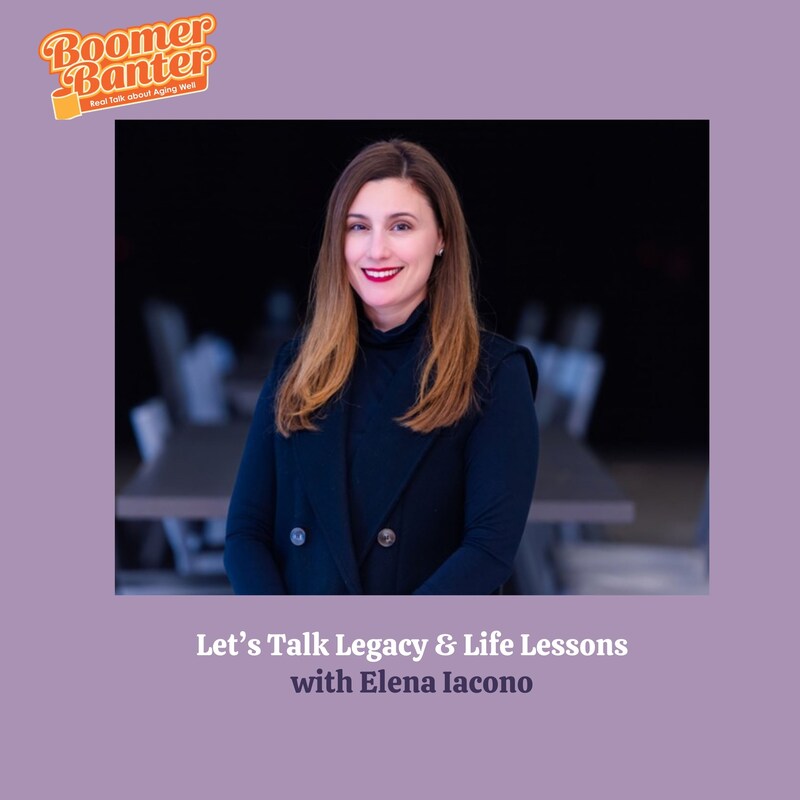
Shownotes
Today, we're diving into a topic that's super important but often overlooked: capturing the stories of our loved ones. You know, it's not just about the money or the stuff we leave behind; it's about the voices, the values, and the experiences that shape us. Our guest, Elena Iacono, is all about helping families preserve these precious memories through guided conversations that turn into beautiful keepsakes. She’s on a mission to remind us that we need to start asking those meaningful questions now before it's too late. So grab a comfy seat and a snack, because we're about to get real about legacy and making those connections that matter!
Takeaways:
- Time is a tricky thing; we often think we have plenty of it, but then it just runs out unexpectedly.
- Planning for our legacy isn't just about the money; it's about capturing our stories and values.
- Elena's work highlights the importance of human inheritance, which includes our wisdom and experiences, not just assets.
- The conversation encourages us to ask our loved ones meaningful questions to preserve their stories and insights for future generations.
Links referenced in this episode:
Transcripts
Hello and welcome to Boomer Banter, where we have real talk about aging. Well, my name is Wendy Green and I am your host.
And every week we talk about the challenges, the changes and the opportunities that come with this season of life. Before we dive into today's episode, I want to thank those of you who support this show.
And I wanted to encourage the rest of you who might want to support the show. And you can do that at buy me a coffee dot com. I will put that link in the show notes.
But I just wanted you to know how much I appreciate the support of those who, who regularly support us and those of you who enjoy what you're hearing. It's very simple. $5 buys one cup of coffee. It's not really a coffee, right? It's just a way of showing that you support Boomer Banter.
So thank you for that and let me continue to tell you about today's show. So when you think about time, you think you have plenty of time, right?
Until you don't, you think there's going to be another holiday, another visit, another afternoon when you're finally say, tell me about yourself when you were young. And then one day there isn't. And I've been thinking a lot about this lately.
You know, we're pretty good at planning for money and planning for our health care, and some of us are even good at planning for what to do in retirement, which is something we talk a lot about, I coach about, but we're not very good at planning for meaning. We assume that we're going to get around to asking those important questions. We assume our parents stories are always going to be there.
We assume our own stories don't need to be written down yet. And then something shifts. Maybe it's a diagnosis, a fall, a moment when memory isn't as sharp or a loss that comes faster than expected.
Today, we're going to talk about something that most families never think about until regret shows up. Capturing the story, not the assets, not the paperwork, but their voice, their values, their lived experience.
And I want you to listen today not just to someone with aging parents, but as someone whose story also matters. My guest today is Elena Iacono.
Elena is founder of Legacy Next, a Canadian storytelling and human inheritance company dedicated to preserving voice, values and lived wisdom.
Elena created Legacy Next to help individuals, families and advisors capture what truly shapes a life, not just what can be measured or transferred financially through calm, guided conversations transformed into beautifully crafted books and audio keepsakes designed to guide others into the future. It's grounded in trust, discretion, and care.
And Elena's work is shaped by a personal loss and a belief that the clearest version of our wisdom exists now, not later.
After losing her father and realizing she never got to record his story, she created a way for families to preserve something she calls human inheritance. Love that term. So let's welcome Elena to Boomer Banter. Hello, Elena.
Elena Iacono:Hi, Wendy. How are you?
Wendy Green:I'm well. I'm so happy to have you here and thank you for the work that you're doing. I think it's very important.
Elena Iacono:Oh, thank you. I love LinkedIn, and that's where we first connected.
And when I thought, or when I read about all the work you're doing, I thought, I just need to meet you. So thank you for making the time.
Wendy Green:Absolutely. So I want to start, if you're okay with this, with the story of your dad. You tried to record him before he passed, and that didn't happen.
So can you tell us about that?
Elena Iacono: I can. It was in:He passed at home, but I don't know where my mom went for the. She just maybe went and left the room. And I had asked my dad, you know, can I just take a few minutes to ask you a few questions?
And I. I think he knew why I was asking him that. And I think he was just so demoralized. He knew he was dying and he thought, okay, maybe another time. He just couldn't face it. He was already having.
He was having difficulty with accepting the fact that he was going to die, of course, so we didn't do it. But I know that there are other families who sit in these situations. And I really have found focus this business to not anchor on death or the end.
I'm really trying to remove fear for families to approach this because it is scary to think about, oh, boy, my story. Because does that mean I'm not going to be here? And I really have flipped the narrative around.
Like you said in your introduction, insights for the future, guardrails. And there's a memory, maybe 10 years ago, my dad, I live in Toronto, and he came to visit me with my mom, and my mom went to bed.
It was just my dad, me and my husband, we were sitting by the fire, having some drinks. It was late. My dad told me a story that I had never heard about before.
And it's not even just so much about the story, but what he got out of that moment. So that's what I hang on to. And when I work with my clients, you know, I'm not asking them questions about, describe your childhood.
Those are important questions, but I'm looking at reformative questions and how life has shaped how they view the world. And that is the gift that you can give to future generations.
Wendy Green:Oh, for sure. Yeah. And I think, you know, you give a good example. So many of us believe there's going to always be that next opportunity. And not just us. Right.
Our loved ones. Like you said, sometimes it's this fear of, oh, man, she thinks I'm dying,
Elena Iacono:so I need to do this. But, yeah, that's not it at all.
And there, you know, a lot of the barriers that I hear from prospective clients is, you know, they want their parents to do. Do this. And then they come back to me and they say my parents are too vulnerable or they're not ready to wrap their head around this.
And I always go back to them a few weeks later and help them see that this actually isn't about that, but it's about pausing. And I think I've designed legacy next to be a conduit of pause.
So this way, life's happening and we're all busy, but let's just take some time to pull this together and it's done. Like we do our wills and our estate plans.
Wendy Green:Yeah. And you use that term, Elena, Human inheritance. I love that. So tell me what that means to you.
Elena Iacono:Human inheritance means to me anything that is intangible. Values, wisdom, perspective. We're constantly working with lawyers and estate planners to build out our financial documents.
But what about everything we stand for as people? Where does all of that go? And it's a big. The term I. You know, I'm proud. I think I've coined it. My husband keeps teasing me. He's like, keep.
You gotta trademark that. That word. I should get to that. But a lot of.
A lot of family offices and a lot of financial advisors, I'm starting to see more and more this concept of family social capital and value capital. And, you know, these are such big words, but really, it is about capturing family insights that will improve the future for families.
Like money and assets will as well.
Wendy Green:Yeah. And you know what? I bet it would build stronger bonds, too, because that's. We, as the children, see our parents in a different light.
And when we start to learn about them and what life lessons they want to share with us, we start to see them as full people, not just as parents. And I think that's really important as well.
Elena Iacono:I Think so. And I, you know, one lesson that I got out of my dad's passing is, you know, he's my dad, he's untouchable, he's never gonna die.
But now I look back and there's things that I hear from other people and nothing makes me happier. Honestly, nothing makes me happier.
When I hear some, you know, leadership anecdotes that others have shared with me about him and then I see, oh, you know, this, he was a whole person. You know, there's other aspects of his life that I didn't know about, but that'd be so cool. Cool if I could.
Wendy Green:Yeah. So I think I told you when we first met that my mom and I worked with a company where we each wrote our own story.
You know, we were guided with a series of questions and we submitted pictures, and then in the end we got a hardback book. And, you know, I'm, I'm glad that we did that. Mom is now 95, and so it's, it's great to have that.
But I understand that your approach is different than the guided questions. And you know, write down your answers, so explain how you do that.
Elena Iacono:And I appreciate those models and that might be the self serve model that people want to do, but I really wanted to do this differently and I've really unpacked it all and then I rebuilt something or I built something. So specific, what I saw and even going through it when I was building this business was the questions come in once a week.
People just forget about it and it kind of falls off the desk. I've created urgency around this. It is a guided process, takes about an hour, two hours for the interview.
And, and I really want people to get this done so that it's done, it's dusted, and it's just, you know, either tucked away with estate plans and wills or you gift to your family now. And it is a very thoughtful process. And the feedback that I'm getting from clients is, thanks for helping me, number one, make the time.
Thanks for helping me think about questions I really wouldn't have thought about. And thanks for just helping me finish this.
And a lot of the research that I did and that I heard anecdotally is, you know, the questions that come in once a week are great from other offerings, but I forget about it. And I don't want to do all the writing. I want someone to ask me the questions. And so that's my background.
I mean, I've been 20 years in communications. So that interview process is the most important process because I'm able to extract from people. Questions are never templated.
They are specific to that person.
And before we jump into the interview process, I have a 30 minute call with the person or the family to get a sense of what do you want to talk about? What do we stay away from? What themes are important to you and what do you want to convey out of this?
What do you want people to know once they've closed that book or listen to your audio? And the result is something that is a viewpoint of this person. Not just memories, but really insights as to how that person lived.
Wendy Green:So in an hour and a half, basically, you've been able to get a feel, and I can tell this because you're a very good communicator and listener, but you're able to get a feel for the family and the person who will be interviewed as to what's really important. What's the. The golden nuggets, let's say.
Elena Iacono:The golden nuggets.
Wendy Green:Yeah, yeah, that, that they want to be able to share for generations. And then in an hour you do this interview with them. And then what happens after that hour?
Elena Iacono:Yeah, so as soon as, as soon as the interview wraps up. So it's a 30 minute, the 30 minute exploratory call and then an hour and a half, two hour interview question, interview process.
And if, you know, if some families are actually interested in investing a bit more and we'll do like additional hours. But what happens as soon as the interview is over is I get the transcript from the recording tool that I use.
I go through it, I read it, and then I get to work and I start writing. And I am basically the person's writer, let's say. And then the audio file is edited and the family gets a choice of a song that they can incorporate.
And then you get this. I mean, I'm a crier. I am constantly bawling while I'm editing. When I'm writing, you know, I sign
Wendy Green:in empathy in you.
Elena Iacono:Oh, it's not even so much. Oh my God. Like I sign an. I sign an NDA. So I don't talk about anything with anybody, not even my husband. But I'm like you.
You don't understand this one. This one's really good falling. But you get, you get the audio file and it's edited in such a way that my voice is never on it.
The person or the family. I'm starting to get a lot of couples who want to do this together. They're talking to their family and I just wrapped up one where the father.
Very serious men. Ended with a joke, and then the mother laughed. So what a nice way to just fade out. It was. It was great.
Wendy Green:Yeah. So are there certain themes that you're seeing that people want to talk about or don't want to talk about?
Elena Iacono:I'm seeing a lot of things with regards to. Not so much. You know, business owners don't want to talk about the mechanics of their companies, but what it took to build it. Grit, Resilience.
Offering insights as to how future generations can either find their paths or, you know, pivot. And it's okay to walk away from plans that you don't want to do anymore. That's so important. Trust. A lot of. Lot of. A lot of insights on relationships.
I'm seeing a lot of insights on how pets have changed people's lives.
Wendy Green:Dogs.
Elena Iacono:Yeah, pets. And so it actually spun off a second offering. It's. I'm getting it up off the ground. It's called Companion Stories by Legacy Next.
And it's the story of our pets and how they've shaped how we view our lives. And, I mean, I have a dog, so that she really has changed my life, and she's given me pause. So we're looking at that.
And then I'm also seeing a lot of insights on family connection and never forgetting the importance of roots and understanding where you come from. No story is the same, but, you know, human. Human narratives seem to pop through on. On. On. On. Occurrence.
Wendy Green:Sure. Yeah. You know, in.
In the show and in the training that I do, I talk a lot about usefulness, and I think there's something powerful here that would support this feeling of usefulness, and that's the idea that you still have something to share, something to give. And. And by doing this, by asking your parents to do this, you're basically telling them you still matter. Your life mattered.
Elena Iacono:Yeah.
Wendy Green:And your experience has value.
Elena Iacono:Your experience has value, but we want to learn from you. And, you know, like I said, life gets in the way. Everyone's so busy there. There are. Certainly. I have to do this with my mom. You know, she's.
We're slowly getting ready to do that. It's been a few hard years for her, but she's young. She's young and there. Yeah, it's been so tough, but, you know, there's things I need. I need.
She, you know, tells me the family story, the immigrant story. I. I know all that, but I want to learn a bit more about how she thinks and how she's viewed the world.
So Those are the things that I need to get out of her.
Wendy Green:Yeah, so we're talking about our parents, but let's shift and talk about us, the people in. In my generation, the boomer generation, you know, we. We have lived, what, 60, 70, 80 years?
But do we have to wait until we're closer to the end before we start sharing our own story?
Elena Iacono:No, I think the time is now. And, you know, I'm giving permit people permission. Legacy next is giving people permission, but also empowering people to take pause to do it now.
And, you know, my tagline is there's no better time. Wisdom is here. It's clear.
Wendy Green:We.
Elena Iacono:We have time now, so let's do it. And like, we revisit our wills or our state plans every once in a while, or we look at our financial goals.
Let's also think about capturing what we stand for, what we would want our families to know. Or, you know, this isn't a point of instruction. It's a point of insight, and I think there's ample opportunity to do that.
And to the, to the listeners of your show, you know, think about.
Think about someone in your family or someone in your community or your network who would not just benefit from hearing from you, but who, you know, would love to be able to turn back to that at a moment of challenge or someone celebration or anytime in the future or even now.
Wendy Green:Yeah, it's interesting. You know, like I said, My mom's 95, so she's the great grandmother.
And there's something about listening to the great grandmother where you are very respectful. Right. So if I was to do this or even have this kind of conversation with my kids, they might be like, yeah, yeah, mom, whatever.
But if I did it and put it with the other legacy documents, like you said, with my will or, you know, all that other paperwork, that might be the time where they say, oh, thank God mom did something like this.
Elena Iacono:Right, right.
And I've, you know, I've unfortunately had to go through that, and it would have been really nice and supportive and comforting to, you know, hear my dad or maybe have him talk to me. And, you know, and I also know that going through that process in the future is very difficult and just so nice to be able to turn to that.
And a lot of people are giving it, giving these files to their families now, but there are some that are gifting it in future, and I'm. I'm. I just can't wait. I don't know if I'll even be around, but I just imagine what that moment will be like. And it just.
That makes me want to keep doing this and go faster.
Wendy Green:So they get like, my kids would get an audio file and a written
Elena Iacono:document and a PDF.
The idea is, is that the idea, if you do tuck it along your documents, is that you've got the PDF of the book, you've got the MP3 file of the audio, and then the, you know, the book, you know, maybe you put in an envelope and you give it to your lawyer or your financial or your estate planner. This way it's all there. So that in future, when things are activated and you get those financial documents, you also get this, too.
Wendy Green:So what are some of the challenges that you've had as you've been building this business? Elena?
Elena Iacono:I'd say the. I'd say, I mean, I. I like to always spin it around and look at the opportunities.
But what keeps me up at night is how do I get more people thinking about this as not an exercise of death and not an exercise of more mortality? I think partnering with financial advisors is helping, but they have a long list of things that they need to do with their clients.
And sometimes legacy next is slipped in at the 11th hour, or maybe it's not introduced too quickly. So I don't, I don't want to not be. How do I position this? I don't want to have to rely on advisors to position this.
They aren't the progressive ones really get this, but, you know, they're busy. So I think, really trying to think about how do I get to more people.
And the barrier that I need to keep getting people to overcome is this is the best gift that you can give. The best gift that you can give is your wisdom and your insights. And it's done in a way that's not egotistical. This isn't a vanity project.
It's not memoir writing, but it really is about capturing your viewpoint and how you have lived to inspire greatness in others.
Wendy Green:So what if I was to think wisdom, my wisdom, and I have no wisdom to share, you know, how would you help me see that that's not true?
Elena Iacono:Yeah, I mean, we all live, all of us live ordinary lives, but they're extraordinary in their own way. And, you know, small examples of community work, there's a lot, there's a lot of learnings in those examples.
How you show up for yourself or your, your workplace or your family, or it's in those quiet. It's those quiet moments that we don't really think about that yield the most impact.
And there's a gentleman that I just interviewed, very wealthy, him and his wife. And they talked about small moments from the past that they have never forgotten about and that I know that their grandkids don't know.
And those small windows of how their lives have been shaped is what I'm trying to get down on paper and in audio.
Wendy Green:So do you, I mean, you know, here I am, 72, like you can't cover 72 years of my life. So do you try and help me narrow it down to where are the pieces, the parts that are really going to be impactful?
Elena Iacono:Exactly that. And so when I have that first exploratory call, you know, I get a sense of who are you? What do you stand for?
What is it that's been most shaping in your life and what are your wishes for your family or for whoever will get this? And that's where it comes down to narrowing it down. And I just had a recording session that was almost three hours.
The family paid for a few more hours, which is great. I'll do that. I want to always be respectful of people's time.
And at the end of it I thought, you know, or I asked them, is there anything else that you want to include that maybe we didn't touch upon upon. And the gentleman said, no, this isn't about, you know, the dinners I had as a kid.
This is about what I watched, how I watched my mom overcome challenges back in the 50s. And I want my grandkids to know, I mean, who's going to ever know that? So I help them tailor it down. We come down to key values, key themes.
And then it's from there that the questions go pretty deep. And maybe they're a little philosophical, but I think the questions that I ask people, they've never had a chance to really think about it.
And that's where the magic, that's when the magic happens.
Wendy Green:And you don't script this, you just kind of follow, you're very present, you kind of follow their lead as you're asking the question.
Elena Iacono:I follow their lead and I do tell them at the beginning, you know, if you open a door, I may ask a follow up question and there people are comfortable with it.
And then by the time we get to the recording, because I've already had that first conversation and you know, I'm so proud that I strike great rapport with my clients, you know, and then we exchange emails. By the time we get to the interview process, people are really comfortable. And that's what I love about this too.
Like Someone asked me, how are you scaling this business? And you know, I've got plans to do that.
Wendy Green:That's a good question.
Elena Iacono:I've got plans to do that in terms of help, you know, writers and editors and audio editors. But I don't want to tinker too much with the interview process. I don't want people speaking into an abyss.
The what really extracts what I want this to work to look like comes down to the interview process and it's me doing that. And that's where people really open up because trust has been built and without trust, people won't do the talking.
And it's, you know, at one point they're crying. I'm, we're all, it's just a business of crying.
Wendy Green:So this is a passion project for you because you have a regular full time job also, is that right?
Elena Iacono:I have a full time job. I've spent 20 years in the telecom industry.
It's been very good to me and I've learned so much and I would never be in this position without that career path. But you know, you hit a point in time. I'll be 44 this year and you think, what else can I do with my time and my gift?
I know not to sound boastful is writing and communications and just helping pull out things that families would have never thought about. So I thought, let me exploit it and let me help families. And when I say exploit, I mean exploit my, my what I can contribute.
Wendy Green:Right, right. I know that was an interesting choice
Elena Iacono:of words, but let me explain my skills.
Wendy Green:And you do a very good job of, of establishing trust and making it very comfortable for people to talk with you. So I can see that.
Yeah, I just, I wonder how you have time for all of this because right now you're doing the interview, you're doing the writing, you're doing the editing.
Elena Iacono:I make time. You know what? I just made the time. My husband always teases me, how do you do it? I just do it because I love it.
And I know what this is going to feel like for when families get a chance to listen to it. And it's, you know, just like everything else.
You've got to, I've got to take care of myself physically and work out regularly, walk the dog, take great vacations. I love to read. I love Italian, so I love to cook.
So I just, I, I make sure that I find things that really help drive my own physical and mental well being so that I have the stamina and I just make it happen.
Wendy Green:And I think you hit on the key to it. You love it.
Elena Iacono:And I love it. And I love it.
Wendy Green:Yeah. So, so let's make this simple.
If someone's listening right now and they're feeling that little nudge of maybe I should try something like this or at least reach out and say, elena, tell me about this. How would they do that?
Elena Iacono:Yeah, I would welcome anyone to reach out. So legacynext.com or send me an email, but start with the website. My email address is there and you know, a no cost call. Let's grab a cup of coffee.
Virtual chat. If you want to do it by phone, that's great too. I'd love to be on video just so that we can meet each other and just.
I'll walk you through the process, how it works, most importantly, the timelines like I mentioned earlier, in case someone missed it.
I sign an NDA, nothing is ever stored or on third party drives, all on my personal hard drive here and just have a conversation on, on intention really. And this isn't about regret, it's about presence and it's the best present you can give your family.
Wendy Green:So I'll put that link in the show notes, but talk to me about like how much time this might take and not just to record it, but to turn it around and what kind of cost are people looking at?
Elena Iacono:Of course, of course the cost varies because sometimes people will either do I offer the full collection, which is the written in the aud together. But sometimes family just prefer the book or just the audio. So let's chat about that and we'll look at those price options.
But the turnaround is very quick. I turn it around within a month. We have our conversation as soon as the interview is done because I've got my rhythm now.
I've had about 40 clients, so it's been, it's been a great first year in business. I turn out, I turn around the drafts within about a week and a half, two weeks and then yeah, it's great.
And then the family, the family has a chance to listen to it, read it, send me photos. And then we, I, while I'm doing the writing, I, I land on placeholders where I think a photo would thematically bring the page to life.
Wendy Green:Okay.
Elena Iacono:And then the family has a chance to review and we turn it around and the family gets it very, very quickly. Huh.
Wendy Green:And what are you going to say when someone calls you and says, well, it's interesting, but maybe I'll wait and do it next month?
Elena Iacono:It's interesting, but. And that's one question That I always get is, okay, first off, I always say, I'll follow up with you.
But two, I always enforce the point that life is so busy. Let's take the pause now and let's just, you know, get this done.
But also think about, think about it, because you've got the clarity and the wisdom right. Right now. And there's no better time, like you said, than the present.
Wendy Green:Yeah. And I, and I think the pause is important.
You know, I've done shows about that too, like take a pause and, and really reflect on what's important to you because this is the one life you have. So take some time thinking about that.
Elena Iacono:Take some time.
Wendy Green:And I'd like to offer the listeners a little challenge, something small but doable. And that would be.
So if, if you're fortunate enough that you have an older relative, a parent, an uncle, aunt, maybe even a grandparent, try out a question on them this, this month. Just one. Maybe ask them something about what's a lesson that you learned the hard way? Or what's something that you're really proud of? And record it.
You know, write it down and get them to start thinking and talking about themselves. Because you just never know.
Elena Iacono:You just never know.
The question that always chokes people up is, I always throw it like it's the one consistent question because I think it's always really nice at the end of the audio or the end of the book. Mom, dad, grandma, whoever. What are you most proud about yourself? And what are you most proud about of me? And that question always.
That one always gets me the most because I imagine myself asking my dad. That's one of the questions I wanted to ask my dad. And we didn't. I didn't do it. So. Yeah, like I said, crier.
Wendy Green:Yeah, that would be a good one. What are you most proud of that I've done? I like that. I. Yeah, we don't have. We hardly ever ask that.
Elena Iacono:I mean, what, what, what, what? What are my parents proud of? Okay. I graduated, married a great person, have a great life, career path, blah, blah. But certainly there's other things.
And I don't know. I mean, I know, but it would be nice to be able to listen to it.
Wendy Green:Yeah. And I think you would get that first, right. Oh, well, you've done well in school, you've done well in business.
But then you would say, but, but about me, mom, the essence of who I am. What are you most proud of there?
Elena Iacono:And the essence of who you are.
Wendy Green:Because. Right. Because that reflects back on them in a lot of ways. What lessons did you take from them? Right, so.
Elena Iacono:Right.
Wendy Green:Yeah. I think that's a. That's a really special question. So I would suggest listeners, if your parents are still here, you still have time.
And if you're still here, you still have time. So let's kind of shift how we think about legacy. It's not just about wealth. It's about voice.
And I'm telling you, Elena, I am with you with your dad, because I was very close to my dad. I don't have any recordings of his voice.
Elena Iacono:Yeah.
Wendy Green:And, you know, I'll still hear it in my head every once in a while, but it would be nice to have his voice. So thank you, Elena, for reminding us that this meaning of people's lives, of our lives, is so important and can be preserved.
It's not just the possessions that we
Elena Iacono:give to each other and captured and conveyed and gifted forward. Wendy, thank you for having me.
Wendy Green:Oh, for sure. And if this episode touched you, share it. Share it with your parent and start the conversation.
Share it with someone who might need this little nudge. And if you feel like you like the episode, you like what we're doing on Boomer Banter, buy me a cup of coffee. I'll share that link.
So until next time, live boldly, keep speaking up, and keep making a difference and share your story. My name is Wendy Greene, and thank you for tuning in to Boomer Banter.



