Shownotes
Today, we're looking at the story of Jonah, a tale that goes way beyond just a fish. I believe Jonah's journey teaches us lessons about obedience and mercy, even when it comes to those we deem as "bad people." We’ll explore how Jonah's initial reluctance to follow God's command teaches us about our own struggles with difficult tasks and the importance of perseverance in our faith. As we unpack this narrative, we’ll address some tough questions about how we respond to those who hurt us and the responsibilities we hold towards others, especially when it comes to sharing the Gospel. By the end, I hope to shed light on how God's mercy extends further than we often realize, and what that means for our own lives and the lives of those around us.
Takeaways:
- The Bible offers profound insights for finding meaning, purpose, love, and peace in our lives.
- Jonah's story illustrates the challenges of obedience to God's calling, especially when it seems difficult.
- Understanding the historical context of Jonah helps us grasp the significance of his mission to Nineveh.
- God's mercy extends to all, even those we might consider enemies, reminding us to never give up on anyone.
- The importance of follow-up in faith after conversion is crucial for nurturing lasting spiritual growth.
- Obeying God can lead to unexpected blessings, even in difficult circumstances, as demonstrated by Jonah's eventual mission success.
Links referenced in this episode:
Transcripts
The transcript for this podcast is A.I. generated and though it has all the content, sometimes has odd breaks, spelling, and spacing.
For an almost exact copy of the text, go to the www.Bible805.com site for downloadable NOTES or to the www.Bible805Academy.com for downloadable and editable Notes, Discussion Guide, Audio and Video files, plus the original PowerPoints—for your personal study or all you need to teach the lesson.
****************************************
Hi, I'm Yvon Prehn from Bible 805 and I truly believe the Bible has everything you need to find meaning and purpose, love and peace in this life, and it is a source for forgiveness of sins and eternal salvation. In this randomly scheduled podcast through longer lessons and shorter challenges.I want to tell you about it by making sometimes complex books Bible topics understandable.
So let's do that today with our podcast topic, which is from our series Ancient Prophets, Modern Messages.
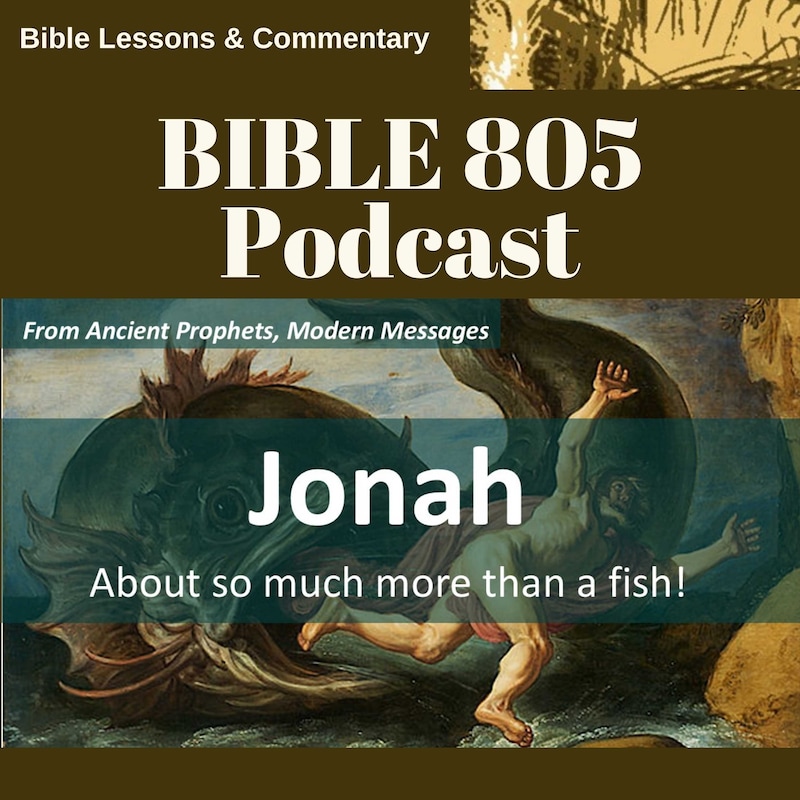
What we're going to focus on today is the story of Jonah, which is about so much more than a fish.
Now, about the ancient prophet Jonah. Almost everyone's heard of him and the story of him being swallowed by a fish.
Though some take it as just a fictional story, that is not the approach we will take because Jesus viewed Jonah as a true event when he said, a wicked and adulterous generation asks for a sign, but none will be given it except the sign of the prophet Jonah.
For as Jonah was three days and three nights in the belly of a huge fish, so the Son of Man will be three days and three nights in the heart of the earth. Not only did Jesus verify the story as a true one, but he used it to to illustrate his death and resurrection.
We will look at this story as a true retelling of events, with significant lessons for us to learn from, which will include we're going to look at the after we go over the lesson, then with the modern messages that we're going to get from it, our answers to these questions and their application to us. First of all, what do we do about really bad people? Or when people treat us badly? What does God expect from us as his followers?
And what about people who haven't heard about the Gospel? If Jesus is really the only way to God, and what is our responsibility to those we introduce into the Christian life?
These are the questions that Jonah is going to help us answer. Now let's look at where it takes place. We're looking at real history in real places.
Geography plays a big part in this lesson and in upcoming ones concerning both God's people and their enemies. Now, the nation of Israel was divided after Solomon about 930 B.C.
This happened because of his sins, and it was divided into the southern kingdom of Judah, which is with its capital at Jerusalem. Now, the kings that were in charge after Solomon's death, they were some were good, some were evil.
But God's promise to keep David's dynastic line was kept until Jesus was born. The northern kingdom of Israel, however, and its Eventual capital, Samaria, always had evil kings. It wasn't just one dynastic line.
It switched and it changed. And there was constant fighting. And it does not last as an independent nation.
After the Assyrian defeat, Jonah appears about 170 years after the nation splits.
Now, the larger world powers of the time, then and beyond, we need to keep in mind as we go through the prophets, starting here with Jonah, because all of the prophecies and the different things that happen take into consideration all of these surrounding areas. So let's just look at them real quickly.
First of all, Egypt, it was a foe oftentimes, but sometimes it was an ally, Sometimes they fought with Israel, but it was almost always a temptation throughout the histories.
And, you know, in both testaments with the prophets and all of that, there are many spiritual allegories where Egypt is used as a symbol of the place we want to return to when we don't trust God. In the Old Testament, they wanted to trust the Pharaoh to protect them and not God.
They wanted to run to Egypt when things got tough, all of these sorts of things, instead of trusting God. Then Assyria, they didn't want its help. It was a tremendously brutal nation and it was huge. It had been around for hundreds and hundreds of years.
If you are looking at the video, you can see this green area on the map, the lighter green area, the really huge area. This was what Syria controlled by shortly after Jonah's time. They were on the march, they were just conquering all kinds of things.
And they were the primary world power during that time. Then Babylon, down to the south, conquered Assyria and. And it later conquered Judah and held the people captive for 70 years.
Then media, Persia comes in, conquers Babylon and allows the Jews to return to the land. The entire area is later conquered by Alexander the Great during the time between the Old and New Testaments.
And after he dies, the land is split between his generals and local rulers. There's lots of war. All kinds of things go on.
The powers keep shifting until the rise of Rome and then Rome takes over Israel and that takes us into the New Testament. Now here is this specific setting of Jonah. It was an extremely prosperous time.
And you'll see the details of this in some of the other prophets that we're going to talk about. But listen carefully to the overview of Jonah's life prior to the book of Jonah.
In 2nd Kings 4:23, it says, in the 15th year of Amaziah, son of Joash, king of Judah, Jeroboam, son of Jehoash, king of Israel. Became king in Samaria and reigned 41 years. Now, by the way, his reign was considered extremely prosperous, profitable.
All sorts of great things happened. And here was one of them.
It says he was the one who restored the boundaries of Israel from Lebo Hamath to the Dead Sea in accordance with the word of the Lord, the God of Israel, spoken through his prophet, Jonah, son of Amity, the prophet from Gath Heifer. Now, did you catch that? Many people miss the story of Jonah's life prior to the fish story.
And that's because you don't read through your Bible in chronological order like I want you to.
Well, I mean, many people advise that you do this, but it's so important because the political setting of Israel where Jonah was raised was wealthy, prosperous, and it was in the midst of victims notorious military expansion. Jonah was a highly successful prophet of the military victories in Israel under Jeroboam ii.
He spoke good news from God to probably a very grateful people. But these military victories didn't destroy the truly threatening military power of that time.
That power was Assyria, an incredibly rich, opulent nation to the north of Israel. Now, not only were they rich and self indulgent, but they were bent on conquest, which they carried out with extreme power and cruelty.
They record images of torture, of cutting off hands and feet, of impaling, of stacks of heads, of victims. Now we have in the British Museum, this is really an extraordinary thing. It's called the Lakish reliefs.
These are carvings on a gypsum wall panel and they're from Sennacherib's palace. They wrapped around a sort of waiting room in his palace, just one part of the wall. And I have a picture of this on the video.
Please do check it out if you can. This wall piece is 39ft wide. This was just part of it and 16ft tall.
And here is what Austin Henry Layard, who discovered it here is how he described it. He said, here was the actual picture of the taking of Lachish. This is in second kings 18. It talks about it. This happened about 30 years after Jonah.
The city, as we know from the Bible, besieged by Sennacherib when he sent his generals to demand tribute of Hezekiah, which he had captured before their return. Evidence of the most remarkable character.
To confirm the interpretation of the inscriptions and to identify the king who caused them to be engraved with a Sennacherib of scripture.
This highly interesting set of bas reliefs contained, moreover, an undoubted representation of a king, a city and a people whose names, with whose names we are acquainted and of an event described in holy writ.
Now, some of the things that we can learn from the Assyrians, from the Lachish reliefs, other than just all of the great evidence for the reliability of the Bible and all of the things that it tells us. But when we look at them closely, we learn about the importance of war.
They're primarily, almost all about war and hunting and just how cruel they were. They celebrated it. They have illustrations of beheadings and skinning people alive and torture.
And again, not only did they do it, they were proud of it.
From the position for Jonah, as his popular prophet of deliverance, he was called to preach to them, to preach salvation to a hated enemy, to people again, who were known for impaling people alive, skinning people alive, piling up heads of enemies. Instead of rejoicing that God could show mercy even to the Assyrians, he ran in the other direction. His intended destination was 3,000 miles away.
Now back to Jonah. Obviously, he didn't see the big picture. He wanted to decide how he was to serve God. He did not want to follow God to do a difficult job.
It was great when he was popular and preaching that good things were going to happen, but he didn't want to do this. Maybe he thought he'd be seen as a traitor. Most definitely, he didn't want to preach salvation and mercy to Israel's threatening enemies.
However, choosing to go his own way did not go well for him. And it never will for us either. We might think it's easier to not obey God, but it never is. We might as well just do what he says to do.
Now, of course, we know the story. A huge storm hits, as it always will, and his shipmates know it's from God. After questioning Jonah, Jonah admits his sin.
The crew throws him overboard, and the sea calms. Jonah is swallowed by a great fish. But it's not the end of him.
Sometimes drastic measures are needed to calm us down, to get us to listen to God, to focus or return to our calling. Maybe we get sick. Maybe we lose our job. Maybe some sort of tragedy happens in our life. Apparently, that's what Jonah needed.
Jonah repents, though, from inside the fish. Here's his prayer. Those who cling to worthless idols forfeit the grace that could be theirs.
But I, with a song of thanksgiving, will sacrifice to you. While I avowed, I will make good. Salvation comes from the Lord. And the Lord commanded the fish, and it vomited Jonah unto dry land.
Now lesson application. Sin robs us of the love, kindness, blessings that Jonah talks about.
And let's look a little bit more at Jonah 2, 8 where this verse comes from, the word there where he talks about forfeiting the grace that was theirs. It's the Hebrew word choshed, and it can also be translated kindness, love, mercy. That's what we forfeit when we don't follow God.
And here's how various translations put it. Those who cling to worthless idols forfeit the grace that could be theirs. Those who pay regard to vain idols forfeit their hope of steadfast love.
Those who worship false gods turn their backs on all God's mercies. And finally, those who worship hollow gods, God frauds walk away from their only true love.
A related passage is Deuteronomy 7:12, where Cheshed is part of the covenant.
Moses tells God's people, and remember, this is what way back when they were promised and they all agreed to and here's where it says, if you pay attention to these laws and are careful to follow them, then the Lord your God will keep his covenant of love with you, His Chishat, as He swore to your ancestors. The point is that God wants the best for us and obeying him is the best for us, even if it doesn't feel like it or seem like it at the time.
Now, not only would the people of Nineveh been better off if Jonah just would have obeyed immediately, but Jonah would have too. When we disobey God, it's often because we think something else is better. But it never ever is. At least not in the long term.
Short term, relief from pain is never worth it. The long term results can be so devastating. The cheshed Living in the mercy of God is always the better way to go.
If we obey and do what we know God wants us to do, we need to keep doing it. We need to practice a long obedience in the same direction.
Circumstances may or may not change, but joy and peace can flood our lives in the midst of challenges if we focus on obeying God. Hopefully none of us will have to be swallowed by a fish to learn that love, mercy, grace and an obedient walk with God are what we were made for.
Here's a good quote to consider when we think about this. Maybe if we spent less time fighting God's plan, we'd have more energy for the battles that really matter.
And finally, Jonah presses ahead to do what he was called to do. Jonah obeys. He goes to Nineveh, he preaches, and a great revival follows.
And it tells us when God saw what they did and how they turned from their evil ways. He relented and did not bring on them the destruction he had threatened. How did Jonah respond?
Did he praise God for the miracle of changed hearts in this great and evil city? Did he rejoice that destruction was averted? Not really, it says in Jonah 4. But to Jonah this seemed very wrong and he became angry.
He prayed to the Lord, isn't this what I said, Lord, when I was still at home? That is what I tried to forestall by fleeing to Tarshish. I knew that you were a gracious and compassionate God, slow to anger and abounding in love.
A God who relents from sending calamity. Now, Lord, take away my life, for it's better for me to die than to live. And Jonah goes outside the city to pout. A plant sprouts up to shade him.
Then it dies. And he's even more upset about the plant dying than the fate of the people. God's response to Jonah.
But the Lord said, you've been concerned about this plant, though you did not tend it or make it grow. It sprang up overnight and it died overnight.
And should I not have concern for the great city of Nineveh, in which there are more than 120,000 people who cannot tell their right hand from their left, and also many animals? I just love that little addition there. But anyway, consider how we all desire mercy from God, but often are unhappy when God grants it to others.
That does not please our Lord. It didn't then and it doesn't now. Now what happens in the intervening years?
We know nothing more really about Jonah, nor of any follow up in terms of spiritual instruction in Nineveh. After their big revival, the nation as a whole seemingly quickly reverted to their evil ways.
At the same time, prophets are being sent to Israel, calling them to repent. They don't listen. And so only about 30 years later, Assyria brutally conquers Israel and carries them off to captivity.
And yet I can't help but think, and you know, I haven't read this anywhere, but I think it's a valid supposition.
Imagine the surprise of some of the captives to meet followers of Jehovah, God in Nineveh, or perhaps even with the army after the horror of being conquered. I would imagine God always has his people. He always keeps his people.
And it was most likely a very small minority, but there would have been followers from Jonah's revival. Now some modern messages for us. Here's how we'll answer the initial questions that we ask and three lessons to really learn from Jonah.
Number one, what about really bad people? Remember, God loves them and is more merciful than we can imagine. And we shouldn't give up on them either.
Anyone can repent and God gives second and third and fourth and many more chances. Our response should be to never give up on anyone either. Never stop praying.
I imagine in eternity the people who knew the thief that was crucified with Jesus were really surprised, surprised to see him in heaven. Who knew the last that they saw of him was when he was nailed to the cross.
I imagine few in Israel knew what Jonah did and many again were surprised when around 30 years later they met believers of Jehovah God when Assyria did conquer them and they were exiled to Nineveh or again, maybe got to know some soldiers or whatever it is. Can you imagine the stories that some of the Assyrians might have said?
Something along the lines of, you know, 30 years ago there was this really weird prophet and he told us these things and you know, the whole city repented. Now, not everybody stuck to it, but our family did. And we want you to know that we worship the same God you do. Now question number two.
What about people who haven't heard the gospel if Jesus is the only way to God? Well, first of all, how do you know they haven't heard? There's so much more going on than we know about during Bible times.
And now there are many stories, particularly in Muslim countries, of God appearing, of Jesus appearing to people in dreams. We have no idea all the things that Jesus is doing.
Though the Old Testament focuses on the story of the children of Israel, there are also pictures here and there about how God was active in the lives of other people and nations who are not the chosen people. Now this is really important to remember. Israel is chosen in that they were chosen to proclaim his message.
They weren't chosen as the only ones to be saved, as we see in the book of Job. And please go to Bible 805 for those lessons.
Remember, Job was not a Jewish and yet he was the one out of all humanity that God chose to point out to Satan as a godly man.
And we see another story here in the book of Jonah about a very unlikely group of people God sent him to the people of Nineveh, which was the capital of Syria. Again, these horrible, terrible, dreadful people. But God decides to pull out this popular prophet and send him there.
Remember, we know there is only one source of salvation. By grace through faith, we are saved. But we have no idea all the ways that God is sharing that message with the world.
The book of Jonah just gives us one more view of this. And number three, we need to remember that new believers need follow up for their salvation to make a lasting difference.
God's way of life is not automatic after salvation. In some ways, the Ninevites were sort of the original examples of what happens when one only accepts cheap grace.
Cheap grace is an acceptance of the gift of God's salvation without any further growth as a disciple. But it's very hard to grow as a believer. It's very hard for growth as a believer to happen without God's word or teaching.
And I can't help but wonder, what if Jonah had stayed to teach, to follow up, to help them learn about God? As a prophet and one raised in a Jewish setting, he most likely would have had the first five books of the Bible memorized.
He would have most likely been familiar with how people were trained in the Jewish faith. The people listened to him, responded, and he had favor with the leadership he had, the knowledge, he had the audience.
Again we ask, what if he'd stayed and taught? But we don't know because Jonah bailed out. He simply walked away. And 30 years later, his nation was brutally conquered. And it didn't end there.
Israel was never restored. Judah was brought back into the land. Israel wasn't.
People from various nations were sent to repopulate Israel, resulting in the Samaritan mixture of peoples and the hatred that it caused through the centuries. This is a huge amount of things. I mean, just think about it. What a horrific legacy because he would not stay and do the job God called him to do.
All of these really horrible things happened. Now we shouldn't make the same mistake. When people turn to God, they need follow up. They need instruction in the Christian faith.
It isn't enough to condemn people or to get them to make an emotional response. To become a believer in Jesus, they need to learn the basics of the Christian life.
After they make a decision to accept Jesus as Savior, we must get serious about fully fulfilling the Great Commission where Jesus said, in addition to going and preaching to the whole world to teach them everything I've commanded you, they need to read God's Word and learn the basics of the Christian life. Here I have an illustration that the Navigators shared.
This is a group that I was involved in in college and so thankful for it because they really drilled into us the importance of follow up after someone become believer. And here is another.
I actually redid that chart where I have the five assurances for a disciple of Jesus after someone becomes a Believer we were to share the assurance of salvation, the assurance of answered prayer, the assurance of victory over sin, the assurance of forgiveness, and the assurance of guidance. And then after that, the obedient Christian in action.
This was also called the wheel illustration where Christ is at the center and then the spokes going out from it are God's Word, prayer, witnessing and fellowship. And I have handouts and larger explanations of these in your handouts that you can Download from the Bible805 website.
So check that out and you can get handouts on these two additional resources that I have. I've written a couple of books that will help get you into God's Word. Start here. This is.
I cannot recognize it enough and I made it really inexpensive. It's a plan for curious people to begin reading the Bible.
I give you a little overview of some of the books in the New Testament, a very simple way to start, suggestions on what Bible to get, how to do it, a little reading plan, journaling pages, everything a new believer needs to start reading their Bible. And then another booklet, not saved but good. That is the chronological reading plan for going through the entire Bible.
Both of them are very inexpensive. I think I just made them $9.99 each. It was about the cheapest I could do it.
They're 8 and a half by 11 and available on Amazon.com Some final challenges we all have a Nineveh. Those we resent, fear, hate or are angry with. We're all Jonah. We want to run away. We don't want to do the task God called us to do.
Hopefully, though, we've learned from Jonah and what happens when we try to fight God? We won't win. We might as well be obedient, no matter how difficult it might be. Step by step.
Thankfully, in our obedience, we have a better example than Jonah, our Lord Jesus. Jesus didn't quit in his work, and we shouldn't either.
He kept preaching, challenging, healing and loving those he called for three years, no matter how many times they doubted him and failed in his expectations for them. And finally, he died for the sins of his rebellious, unthankful creation. He finished the job God called him to do.
And our salvation is the extraordinary result of it, as Hebrews 12 tells us, for the joy that was set before him, he endured. We have that same joy ahead of us. And not only that the risen Jesus can help us in our work.
And not only can he help us, but we desperately need his help and he will help us. Hopefully it won't take getting swallowed by a big fish to get us to finish our work or to obey Him.
But regardless of our circumstances, we need Jesus to be kind, to mean people, to trust God in difficult challenges, to be obedient in all situations, and to do the work he called us to do. In other words, to be his disciple, his apprentice, his representative to our world. And he will help us remember this promise in Philippians 1:6.
The God who started this great work in you will keep at it and bring it to a flourishing finish on the very day Christ Jesus appears. That's all for now.
Please check out the Show Notes, a complete downloadable transcript, graphic spansion and related materials at www.until next time. I'm Yvonne Pryn, your fellow pilgrim, writer and teacher for Jesus, and I'd like to close with this benediction.
May you know the invitation of God to move from confusion to clarity, from wandering to rest, from loneliness to knowing you are loved, from turmoil to peace, from wherever you are in your spiritual journey to a growing knowledge of God's word and in your personal relationship with the Father, Son, and Holy Spirit. Amen.

