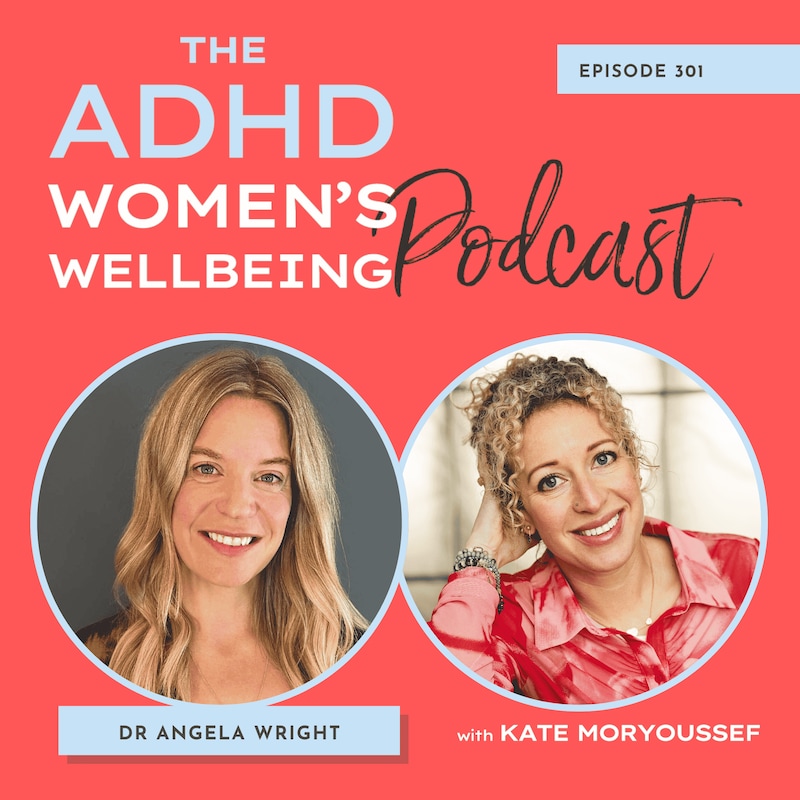
Shownotes
This week on the podcast, we're talking about something that so many women quietly experience but that very few of us actually talk about...
Sex... Perimenopause...Libido... Desire...Orgasms... How our attraction changes as our hormonal levels shift. It's a big topic and one to listen to in a safe space away from small ears!
So many women notice changes in their libido, attraction, intimacy or sexual confidence during perimenopause and menopause. For late-diagnosed neurodivergent women, these understanding shifts can feel even more confusing as hormones, attention, the nervous system and relationships all intersect.
In this episode of the ADHD Women’s Wellbeing Podcast, Kate is joined by Dr Angela Wright, a trauma-trained clinical sexologist, sex medicine practitioner and menopause clinician with a specialist interest in the overlaps between trauma, ADHD, PMDD and menopause.
Together we explore the often unspoken intersection between hormones, menopause, libido and sexual wellbeing, particularly for neurodivergent women. Many women notice shifts in their bodies, desire, or relationships during perimenopause and menopause, yet these changes are rarely explained in a way that helps them understand what’s really happening.
This conversation opens up space to talk honestly about the changes women may experience during this stage of life, and how understanding the relationship between hormones, the nervous system and ADHD can help make sense of shifts in intimacy, attraction and connection.
In this episode, we explore:
- How hormonal changes during perimenopause can impact libido and sexual desire
- Why techniques or dynamics that once worked sexually may change as hormones shift
- The connection between ADHD, novelty and desire in long-term relationships
- How hormones, the nervous system and attention interact to shape sexual experience
- Why some people experience a loss of interest in sex during midlife
- How orgasms can support relaxation, tension release and hormone regulation
- The importance of communication in relationships, including using “I” statements to express needs
- How treatments such as vaginal oestrogen and hormonal support can help during perimenopause
- The impact of progesterone and testosterone
This episode offers reassurance, insight, and practical language for women navigating changes in their bodies and relationships, helping to reduce the confusion and isolation that can accompany these experiences.
Join the More Yourself Community - the doors are now open!
More Yourself is a compassionate space for late-diagnosed ADHD women to connect, reflect, learn and come home to who they really are. Sign up here!
Inside the More Yourself Membership, you’ll be able to:
- Connect with like-minded women who understand you
- Learn from guest experts and practical tools
- Receive compassionate prompts & gentle reminders
- Enjoy voice-note encouragement from Kate
- Join flexible meet-ups and mentoring sessions
- Access on-demand workshops and quarterly guest expert sessions
To join for £26 a month, click here. To join for £286 for a year (a whole month free!), click here.
We’ll also be walking through The ADHD Women’s Wellbeing Toolkit together, exploring nervous system regulation, burnout recovery, RSD, joy, hormones, and self-trust, so the book comes alive in a supportive community setting.
Links and Resources:
- Find my popular ADHD workshops and resources on my website [here].
- Follow the podcast on Instagram: @adhd_womenswellbeing_pod
- Connect with Angela on Instagram (@spicedpeardrwright, @theholisticsexologist)
Kate Moryoussef is a women's ADHD lifestyle and wellbeing coach and EFT practitioner who helps overwhelmed and unfulfilled newly diagnosed ADHD women find more calm, balance, hope, health, compassion, creativity and clarity.
Transcripts
Welcome to the ADHD Women's Wellbeing Podcast.
Speaker A:I'm Kate Moore Youssef and I'm a wellbeing and lifestyle coach, EFT practitioner, mum to four kids and passionate about helping more women to understand and accept their amazing ADHD brains.
Speaker A:After speaking to many women just like me and probably you, I know there is a need for more health and lifestyle support for women newly diagnosed with adhd.
Speaker A:In these conversations, you'll learn from insightful guests, hear new findings, and discover powerful perspectives and lifestyle tools to enable you to live your most fulfilled, calm and purposeful life wherever you are on your ADHD journey.
Speaker A:Here's today's episode.
Speaker A:Welcome back to another episode of the ADHD Women's Wellbeing Podcast.
Speaker A:And today we are talking about something that we cover on this podcast a lot, but we're really going to go into quite a bit more detail, and that is menopause, hormones, hormone sensitivity, sex, intimacy, libido.
Speaker A:We're really going to cover it all today and I'm absolutely delighted to welcome Dr. Angela Wright here.
Speaker A:Now, Dr. Angela Wright is a clinical sexologist and she's also a British Menopause Society accredited menopause clinician, and we're going to be covering it all.
Speaker A:So if you are struggling at the moment with hormones, perimenopausal symptoms alongside your adhd, but also maybe sexual issues that you're too afraid to ask and too embarrassed to talk about, I'm hoping that we're going to cover them on Today's podcast.
Speaker A:So, Dr. Angela Wright, welcome to the podcast.
Speaker B:Thank you for having me.
Speaker A:Tell me a little bit about your journey into what you do right now.
Speaker A:What came first, the sexology or the menopause interest?
Speaker A:Or has it just been a sort of a collision of lots of interest because women are desperate for more help?
Speaker B:That is a really nice question.
Speaker B:It is a collision of my own accumulation of certificates.
Speaker B:I quite like to do extra learning, so I did the sexology first.
Speaker B:One of my kids was going back to school.
Speaker B:I had a bit more time.
Speaker B:I needed to do something a bit different.
Speaker B:So I did training in clinical sexology, which is sex therapy training.
Speaker B:So I was training with therapists and then I thought I better do the medicine that goes with that.
Speaker B:And because so many women, you know, come across problems with sex as they go into menopause, it was after I did the sexology that I did the menopause training.
Speaker B:It just became really apparent that this is like a major transition point in people's sex lives for a lot of Women.
Speaker A:Yeah, I mean, we don't understand enough.
Speaker A:Like when we're talking about menopause, you don't realize how it impacts so many parts of our life.
Speaker A:And I think it's so important to talk about this because hormones impact so much.
Speaker A:I'm going to speak as a neurodivergent woman that we're so hormonally sensitive and it impacts our brain, our mood, our sleep or regulation, and it can impact our desire in different ways, you know, from different extremes.
Speaker A:Maybe you can tell me a little bit about what you're seeing in your clinic, especially with women who are coming in who are either suspecting they've got ADHD or autistic, or perhaps they've gone through that diagnostic process and they're struggling with different things.
Speaker A:I just want women to.
Speaker A:Who are listening today to not feel alone and not to feel that they, whatever they're dealing with is something sort of stigmatized or taboo.
Speaker B:To me, it interests me that this is such a common presentation in my clinic because I wasn't specifically taught about these overlapping conditions when I was doing my GP training, my sexology training or my menopause training.
Speaker B:To be perfectly honest, it's only since I've been working that I keep seeing the same things over and over again.
Speaker B:And some of those traits are traits I recognize myself.
Speaker B:So I guess I've got that kind of extra peaked interest in this area because of that.
Speaker B:So, as you said, hormone sensitivity way more prevalent in neurodivergent women.
Speaker B:So what you tend to see is people sort of bumbling along, okay, with their structures, with everything working for them, perhaps hitting the late part of their 30s, earlier often than they're expecting things to change.
Speaker B:And before they get obvious signs like hot fleshes and period changes, they just, they're behaving differently in their worlds and that can be just normal behavioural stuff.
Speaker B:So how you get on in your relationships, how you're coping at work, coping with your kids and your partner and so on.
Speaker B:But I definitely see quite a lot of changed behaviors around sex.
Speaker B:Quite a lot of people who are neurodivergent often have quite an interest, quite a good spontaneous interest in sex, which is not always how every woman experiences their relationship with wanting sex.
Speaker B:You know, a lot of women have what we call responsive desire as their more sort of predominant way of experiencing interest, which is, I always say to people, it's like food difference between feeling hungry, which is spontaneous desire, going into the supermarket and smelling the donuts and wanting to eat, which is like responsive so most women more responsive.
Speaker B:But actually what I find in practice is the women that I see with those neurodivergent traits have often quite enjoyed sex and it's been quite an important part of their identity.
Speaker B:But they also hit problems as they go into this stage.
Speaker B:So I see a whole variety of, I suppose, presenting complaints, but people just noticing that whatever was working before suddenly isn't working in this stage.
Speaker A:Yeah, definitely.
Speaker A:And also that resilience that we might have had.
Speaker A:But as our kids are getting older, especially when we're dealing with having to get support for our kids, you know, we know neurodivergence runs in families and very often it's the women who are supporting their kids then realizing that the neurodivergence maybe comes from them possibly together as partners.
Speaker A:And sex gets to the bottom of the priority list.
Speaker A:And feeling desirable or on the flip side, it can be like an outlet.
Speaker A:It can be their way of, you know, like escaping a difficult world that they're living in, you know, dealing with challenging behavior at home, dysfunctional relationships, difficult family dynamics.
Speaker A:When I talk about ADHD in women, it's a perfect storm of just so many different areas of our life.
Speaker A:And I think sex definitely is not talked about enough.
Speaker A:I know I've teetered around this subject so much on this podcast purely out of fear that perhaps one of my kids might listen.
Speaker A:But I realized that they'll never listen to this podcast.
Speaker B:You are not interesting to your children.
Speaker B:No one is.
Speaker A:Yeah, and my kid, my husband probably doesn't listen anymore.
Speaker B:You might have listened to a few
Speaker A:earlier episodes, but I feel like, you know, we can, we can be honest and open here.
Speaker A:So tell me a little bit about how you are helping women.
Speaker B:So, I mean, I do different things.
Speaker B:I'm a therapist and a doctor, so I tend to see people and do what I would say is an integrated assessment.
Speaker B:So I'll look at them with my doctor head and my therapist head on at the same time and try and work out the jigsaw puzzle of what's going on.
Speaker B:Because sometimes it really is just hormonal.
Speaker B:So people will come and say sex is painful.
Speaker B:Or I had somebody this week who said that orgasm no longer feels like it did.
Speaker B:So there's the sort of the physical stuff that happens, but that kind of full bodied experience of orgasm has gone away and that's what's impacting her desire.
Speaker B:And for some people, actually the predominant thing that they need doing is for me to talk to them about the body stuff that's going on.
Speaker B:And the hormonal stuff, and to create, like you've said, that, I suppose, that steady baseline where your brain feels familiar again because your hormones are a bit better regulated and you just go back into coping.
Speaker B:But other women I end up doing therapy with over a number of sessions, and it can be a whole bunch of different things.
Speaker B:It's really different how it shows up for people because our previous experiences are really different.
Speaker B:So, you know, the families that you grow up in, in terms of the messages that you've received, the previous experiences you've had, good and bad.
Speaker B:And we see more trauma in people that have got neurodivergence because of all sorts of reasons that contribute to people pleasing, managing conflict, not necessarily picking up on what other people may be wanting from you.
Speaker B:There's all sorts of reasons why people may find themselves more exposed to risk and also more impacted by what happens to them.
Speaker B:I see people who have loss of interest, you know, loss of libido, but that's actually rooted in negative experiences of sex or sensory stuff or losing confidence.
Speaker B:So the common thing that people say to me is that they've lost interest in sex, but I just think that's a statement that hides a whole bunch of other things that may lead to that same final outcome.
Speaker B:We don't do stuff we don't enjoy, you know, at the end of the day for a whole bunch of different reasons.
Speaker A:Yeah, I mean, it is.
Speaker A:It's like not knowing, not understanding ourselves.
Speaker A:And so many women who have only just got this understanding of themselves much later on in life just don't.
Speaker A:Didn't have the language or can't even articulate, you know, when you talk about sensory stuff, that's something, you know, I totally relate to.
Speaker A:And there was a lot of shame for me because I wouldn't understand why I didn't like certain things and didn't like certain smells and being breathed on or anything like that.
Speaker A:And so it's kind of like, now I understand we can work with that, but when we don't understand it or there's no awareness, we just think there's something wrong with us and we shut down.
Speaker B:Yeah, absolutely.
Speaker B:I mean, I don't just work with women, you know, I work with guys as well.
Speaker B:And I think we talk about sexual scripts.
Speaker B:So the stuff that we learn about sex growing up, you know, what you see what you get as deliberate education from family and school and stuff, but also the stuff you just kind of absorb because you see it on telly and in magazines and so on, it forms the backdrop of what we think sex is.
Speaker B:And most of us go through our lives with a sense of whether we are good at this or bad at this, whether our bodies work quickly or whether they're a little bit slow.
Speaker B:And you know, 60% of women fake orgasm regularly.
Speaker B:There's different figures, but somewhere between sort of 40 and 75% of people regularly fake orgasm.
Speaker B:And I just think that really tells you how difficult it is already for us to be honest about what we need and what we enjoy and to have the language to ask for for it.
Speaker B:And then you put that on the background of the friction, of the lived experience of being neurodivergent, particularly if you don't know that you are early in life and how that impacts on your ability to say what you need and ask for things without shame.
Speaker B:So it can.
Speaker B:What I often see is that people haven't known that this is their makeup of their body or their mind.
Speaker B:And you're sort of holding people actually.
Speaker B:It can be really cathartic to start to realize that your biology is why life has felt like this.
Speaker B:But then you've got this resorting where you have to go back and reframe and re narrate what's happened and then work out how you move forwards.
Speaker B:It's quite nice work to do, but it can be quite disconcerting I think, to start to look at everything through that lens.
Speaker A:Yeah.
Speaker A:And also like we know with ADHD there's a lot of dopamine seeking as well.
Speaker A:And so I guess if you've been with a partner for a long time and you were talking about different sex drives and seeking, you know, other sexual partners and then having shame and not understanding why there's boredom or needing that novelty.
Speaker A:Is that something that you hear a lot about?
Speaker B:Yeah, loads.
Speaker A:And.
Speaker B:And you know, again on the back, the backdrop.
Speaker B:So sex is biopsychosocial.
Speaker B:That's what we're taught.
Speaker B:We're taught that there's a body based bit, there's a psychology based bit and a social aspect of it.
Speaker B:And I think socially a lot of women, we tell them that they are probably not supposed to be as interested in sex as men are, not initiate it as much.
Speaker B:Not like doing the Weir stuff.
Speaker B:You know, they're sort of meant to be partners first and foremost rather than necessarily people that initiate or write the story for it.
Speaker B:So I think you've got that element of people perhaps feeling slightly embarrassed that they've always masturbated a lot or they've always had specific sexual interests that perhaps are not Things that they felt confident about or we see a bit more kink, more novelty.
Speaker B:And I do see more people acting out, I suppose is the word that I would use.
Speaker B:But it doesn't always mean that they're doing that for dubious reasons.
Speaker B:You know, a lot of stuff that keeps us in long term monogamous relationships and makes it difficult to say that we're not happy or to leave those relationships.
Speaker B:But I do see quite a lot of women who are a bit bored, a bit disinterested and are maybe starting to find themselves behaving in ways that they don't quite understand what their drivers are.
Speaker B:And they feel a lot of conflict over the drive to do something.
Speaker B:But also their values or their, you know, their moral, ethical frameworks.
Speaker A:Yeah, God, absolutely.
Speaker A:There's that justice sensitivity, there's that need for stability, but like you say, there's like looking for novelty and interest and,
Speaker B:and self esteem and rejection sensitivity and all of that stuff.
Speaker B:And you're aging, you're changing.
Speaker B:So if people are offering you attention and interest, you know, all of these things make it really complex.
Speaker B:I think you've got to have like an incredibly compassionate eye when you're talking to people at this stage of life.
Speaker B:And actually sex is, you know, we're not taught that sex is quite novelty driven.
Speaker B:Jack Morin wrote a book about the erotic and said that the erotic equation is attraction plus obstacle equals desire.
Speaker B:So another.
Speaker B:And like that speaks to the ADHD brain, doesn't it?
Speaker B:You know, if you really, really want something and you can't have it, can you think about anything else?
Speaker B:But actually when you're in a long term relationship and you've got somebody on tap that you've slept with, you know, probably a thousand times and you've run out of novelty, these are all the drivers that sit underneath someone saying to me that they've lost interest in sex or they find themselves attracted to other people, other activities, you know, solo sex.
Speaker B:It's really complicated.
Speaker A:Yeah, it is.
Speaker A:And it's so important just to, to state all of this and then would you say that.
Speaker A:I'm thinking for women, the psychological perspective, if you are feeling connected with your partner and you're feeling understood in your own body and you have that, you have that validation.
Speaker A:Do you still think the hormone site though?
Speaker A:You kind of have to blend the two, don't we?
Speaker A:Because sometimes we just don't understand why we're not feeling in the mood or why our mood is low or why suddenly our husband is driving us insane and he's not really done anything different.
Speaker A:He's just.
Speaker A:Or the chewing or the snoring or the.
Speaker A:All the things that so many women are experiencing.
Speaker A:Midlife, like the tolerance level is gone down and we don't want to be like that.
Speaker A:Would you say that's.
Speaker A:That's when we need to start looking at hormones again?
Speaker B:I think it does all sort of blend together.
Speaker B:So you've got your, you know, your body is your tool.
Speaker B:Your body, the sort of soup of your hormones affects how you receive incoming stimulus.
Speaker B:You know, whether that's sexual stimulus, like touch, it feels different in the absence of hormones.
Speaker B:You don't get such a lot of blood supply to the genitals if you haven't got estrogen going through your system.
Speaker B:So the feeling of being aroused feels different.
Speaker B:You know, you won't feel as full and sort of wet as you get aroused as you will do when you're full of hormones versus when you're not.
Speaker B:Sex gets painful.
Speaker B:You get negative consequences like urine infections or, you know, funny smells, funny discharge.
Speaker B:Orgasms diminish.
Speaker B:So you've got the tool of your body that does often do better when you have your hormones replaced.
Speaker B:You know, you can.
Speaker B:I'm always conscious of people listening who can't have hormones, don't want hormones.
Speaker B:It's not that you can't have sex and have a good sex life without them.
Speaker B:It's just a little bit easier if you have access to them.
Speaker B:You've got the brain bit of hormones, which is, you know, how easy is it for you to fantasize, to think about sex, to respond to a cue, to feel spontaneous hunger, or to respond to the view of someone you find really hot, you know, naked and actually feel something.
Speaker B:I get so many women that sort of say, you know, Keanu Reeves could walk through the kitchen naked and I just wouldn't give a monkeys.
Speaker B:And that is often it can be to do with the hormonal part of things.
Speaker B:But then you've got your attention and your nervous system.
Speaker B:And those bits are also really, they're not separate from hormones because they're affected by them, but they're also affected by lived experience and what's going on and how you're feeling and how much stuff you're juggling, how many plates you're spinning, and the nervous system, the sympathetic fight flight side of your nervous system and the parasympathetic rest and digest bit underpin sex and they underpin sexual arousal.
Speaker B:So if you're in permanent emergency mode for some reason or another.
Speaker B:So this week I Spoke to somebody who had a big postnatal mental health issue and she's never really come out of emergency since partner didn't respond to her very well, didn't feel very safe and held and ever since she's been bit cautious about herself and her own coping skills, a bit hyper vigilant and she's lost her desire.
Speaker B:Because you don't feel desire often unless you're in that sense of safety.
Speaker B:Because physiologically, back on the plains, when we were all trying to only procreate when we had the right environmental conditions and there wasn't a lion coming to attack us, the state of our nervous system affected whether we ovulate.
Speaker B:It affects whether you can get an erection as a guy, whether you get arousal, an erection of clitoris as a woman.
Speaker B:So if you're in permanent emergency, unless you're regulating through sex, which you pointed out, some people do regulate through masturbating or through having sex, but for most people the physiology is just not switched on correctly.
Speaker B:And midlife is a menopause is a bloody nightmare for that.
Speaker B:Because most of us are caring downwards, carrying upwards at difficult point in our life, bodies suddenly become completely unfamiliar.
Speaker B:Can't get the help we need because people don't listen to us.
Speaker B:We're bored of the same old stuff with partners.
Speaker B:And like you say, the sensory stuff that they're doing is just like tipped us over the edge.
Speaker B:So it's not one bit of it, it really is.
Speaker B:I sit down with people and we just go, right, what's your jigsaw puzzle look like?
Speaker B:Where's the first big piece that we can put in?
Speaker B:Okay, it's estrogen, but actually you probably need to work out this and this and this and you know, you go through it bit by bit.
Speaker A:Yeah, I mean, it's just.
Speaker A:Thank you for saying all of this because again, I don't want to generalize, but men, I don't think they quite get the stress bucket or that that load the mental load.
Speaker A:And I'm sure I'm not the only one that's lay in bed and the husband's trying to, you know, start something.
Speaker A:And I'm literally thinking, did I send that message?
Speaker A:Or the WhatsApp group at school?
Speaker A:I forgot to send my daughter in with that.
Speaker A:Oh my God, I forgot to press the shopping button and you know, the groceries like.
Speaker A:And again, with adhd, it's so hard to turn our brain off.
Speaker A:You know, there has to be so many factors winning for me to be able to get into that zone.
Speaker A:I would say My nervous system is always sort of quite hyper vigilant.
Speaker A:So for me to relax is a really big deal.
Speaker A:There has to be like everything going for me.
Speaker A:My shoulders are just constantly, you know, intense mode.
Speaker A:And you're right, like no one's in the mood, you know, no one feels horny when you're in stress mode.
Speaker A:Which I guess is kind of why, you know, when you go on holiday and you've, you've had that first week where typically it takes me a week to settle in.
Speaker A:Once you've got past that week and you've relaxed, you kind of feel like your sex drive come back because you know, you're outside, you've got sunshine, you're relaxing, your nervous system is regulated and it's mindful.
Speaker B:Think how mindful a holiday is.
Speaker B:You put your out of office on your emails, you step into a situation where you can stay in bed until you wake up.
Speaker B:See if you're not having to get up and do the school run or deal with the dog barking.
Speaker B:You're feeling, you feel skin, sunshine on skin, sand on skin, skin.
Speaker B:You know, you feel good in your body because you're, you get a bit of a tan and you wear your nice clothes and so that the.
Speaker B:I suppose what I teach people to be aware of is what is the context that they need to find that bit of themselves.
Speaker B:I often talk about having a community of self, like there's a various different versions of me.
Speaker B:There's the mum me, the partner me, the friend, the doctor, the therapist, the daughter, there's all of those.
Speaker B:And I've got a sexual self like a lot of people have got a sexual self.
Speaker B:And very often that sexual self is the one at the back of the bus, like clinging onto the back of the exhaust pipe, nearly falling off because I am in mum mode or I am busy in work mode, spinning everything around.
Speaker B:But we've all got a context where even if we just look back and think, well, what do I need for that sort of slightly strutty, confident version of myself to come out, the one that is connected to desire and arousal and everything else.
Speaker B:And you can often look back at situations where even historically sex has been good and think, ah, it was because I was really connected with my partner because we were talking a lot and we used to go out and do this thing together and, you know, I had less on my plate so I could rest and I was actually doing sport at that time.
Speaker B:I had time off for myself and it can be as simple as going and for a lot of people it means dealing with your own needs, first of all, because you are often at birth, like, we burn out, don't we, as women?
Speaker B:Neurodivergent women burn out more often at this point.
Speaker B:And I think it's often part of that burnout.
Speaker B:It's a casualty of it that you've had to ignore your needs and your body's needs for decades.
Speaker B:Often that actually to get back in contact with.
Speaker B:I often refer to my 16 year old daughter as being a brilliant example of what I was like before I accumulated the needs of everybody else.
Speaker B:She won't even clean her room or bring her plates down.
Speaker B:She's too busy, you know, she's too busy.
Speaker B:Genuinely like says it to me and means it and you know, and you think, what happened to that version of me?
Speaker B:And we were talking about it before we started.
Speaker B:You go to uni, you accumulate jobs, you accumulate people that expect you to care for them and your needs go down, down, down, down, down.
Speaker B:So a lot of the time it's sitting in front of somebody who legitimizes that and says, actually, actually sex is quite a selfish thing.
Speaker B:You know, you need to be selfish for the team.
Speaker B:You need a healthy degree of narcissism, actually, even though we're not taught that, it's actually quite a radical act of reclaiming something about your identity and it's good for everyone that you care about actually.
Speaker B:Yeah, you just got to reframe it.
Speaker A:Yeah.
Speaker A:And you know, like we all know if we're having regular sex and regular orgasms, it's a release.
Speaker A:Yeah, it's a tension release.
Speaker A:You know, you can't hide from that, that it's good for your, it's good
Speaker B:for your nervous system if you can get there.
Speaker B:It is a form of, you know, of hit and relaxation and serotonin.
Speaker B:You release opiates, you release like morphine, like substances.
Speaker B:You can block them in animals, they did this beautiful experiment on trying to get rats into kink and they blocked their opiate release with naloxone, which you give to people who've had an overdose and they were able to get them to show a preference to rats in leather jackets.
Speaker B:You know, we.
Speaker B:Pleasure is a important part of why we have sex.
Speaker B:And again, if you've done, if you're a neurodivergent person and you've got a bit typecast in your relationship, you've had sex the same sort of way a thousand times, you know, you don't have much novelty to drive you, you're knackered and your Brain's busy with other things.
Speaker B:You often don't have the reward that makes it the thing you go to to get your dopamine hit.
Speaker B:There's probably scrolling, you know, walking outside or whatever.
Speaker B:There's that a thousand things.
Speaker B:Women after babies are more quick to get back to solo sex than partnered sex.
Speaker B:They get back to masturbating by about five months, but they don't get back to their previous habits with a partner until nearly a year's past.
Speaker B:I think that says a lot about, you know, about the relationship with this stuff.
Speaker A:I agree.
Speaker A:And I think sometimes again, as women, especially if we've had kids, we've been poured all over, we've got kids, especially if we've been breastfeeding and kids pulling at our ankles and all of that, and we just don't want to be touched.
Speaker A:It's just like, leave me alone.
Speaker A:Like, I don't want another person to need me.
Speaker B:It's a sensory onslaught as well, isn't it?
Speaker B:I've got a good friend of mine who's just.
Speaker B:He's diagnosed or dht, just had a baby and is saying the nervous system element of crying, not sleeping, breastfeeding, bodily stuff that happens once you've had a baby.
Speaker B:You know, I read a book by.
Speaker B:I forget what it's called, the Electricity of Every Living Thing.
Speaker B:It was about Catherine May looking for a diagnosis of autism around the age of 40.
Speaker B:But she was looking back at what it was like to have babies and how she'd felt.
Speaker B:It was so difficult for her, you know, back at that time.
Speaker B:And I sort of really feel that, that we don't talk about the experience of womanhood through the eyes of the neurodivergence, where just the fact that your body leaks and does weird shit and people pour at you.
Speaker B:And I think all of that lives in our nervous systems and in our bodies.
Speaker B:And some of it really does come up as you go through this transition, which is a.
Speaker B:It's a closure, it's an ending.
Speaker B:So there is a sort of an evaluation part for a lot of people about what it's been like and what hasn't been metabolized in our bodies.
Speaker A:Following from that, from a sensory perspective, do you help people move through that so they can communicate?
Speaker A:And like, you know, again, if we say in a joint neurodivergent relationship, very often we're attracted to other neurodivergent people.
Speaker A:Sometimes it's, you know, obviously different traits and often balancing or scaffolding each other.
Speaker A:But we do know that rejection, sensitivity is prevalent in neurodivergence.
Speaker A:And if you turn around and say I've got this sensory need or this preference and that other person then takes offense or thinks that it's something, you know, how do you navigate that together as a couple?
Speaker A:Do people move through that like, because again, as women we do feel historically we've been stifled, we've been told what is appropriate, what's not appropriate, what we can ask for, what's right.
Speaker A:Even just stating our sexual needs feels a bit uncomfortable.
Speaker A:How do you navigate that?
Speaker B:The short answer is it's.
Speaker B:It's a little bit different for each couple that sit in front of you.
Speaker B:And we've talked about, about opposite sex couples, but obviously with, you know, see a lot of same sex couples as well and sometimes hitting menopause simultaneously or male partners can be struggling with testosterone levels on their own issues.
Speaker B:So it's a little bit different in every relationship.
Speaker B:But there are rules that kind of are the same for everybody.
Speaker B:We encourage talking in the language of responsibility, of ownership.
Speaker B:So if you use I statements when you talk to a partner about something, so it's not.
Speaker B:You always want to do this thing and it makes me feel icky because I don't like the smell of it or whatever.
Speaker B:But if you say I prefer this, I get really excited by that.
Speaker B:I really enjoy this.
Speaker B:I find this difficult.
Speaker B:And you own that emotion.
Speaker B:What happens is it's a lot less likely for the person you're talking to to feel offended and be defensive because you're not talking about them.
Speaker B:So I often say to couples that try really hard to use the language of ownership and of responsibility, own your feelings, apologize for things where you think you've got something wrong and state what you would like rather than using you statements.
Speaker B:I think you've got to go into conversations like this with a bit of an agreement over ground rules as well.
Speaker B:So it's difficult stuff most of us haven't benefited from.
Speaker B:You know, I've had loads of therapy, I had loads of education around this.
Speaker B:My language is much more comfortable than most people.
Speaker B:So people stumble through these conversations quite a lot.
Speaker B:And I think you have to maybe have a chat first of all about trying not to shame each other, trying to be quite accommodating about what's being said and like genuinely making it a.
Speaker B:Not a safe space, but a brave space.
Speaker B:It's okay to say something, it's going to get treated with respect.
Speaker B:And choosing your moment eye contact is challenging anyway for a lot of neurodivergent individuals.
Speaker B:But if you're sitting across from somebody.
Speaker B:It's quite difficult.
Speaker B:Loads of people will say, my children talk to me in the back of the car on the way home from school.
Speaker B:They tell me everything when I'm in there, but they won't talk to me face to face.
Speaker B:And partners are like that.
Speaker B:So walking side by side, regulating your nervous system and looking ahead can be a really good time to talk.
Speaker B:Lying side by side, sitting side by side in the car, sometimes those moments are way more successful than sitting across from somebody and planning what you want to get out of the conversation first.
Speaker B:I sometimes think you've got a vague feeling, but you haven't really worked out what it is that you want.
Speaker B:Actually taking five minutes to think, what am I?
Speaker B:What am I asking here?
Speaker B:What am I trying to say can help as well.
Speaker A:That's, you know, so helpful.
Speaker A:And I mean, from your clinical perspective, do you think that most partners, you know, if they've been together for a long time, would always benefit from this type of therapy?
Speaker A:Because, I mean, I guess what I'm trying to say is, do you think marriages can be saved?
Speaker A:And a lot of marriages maybe go down that divorce route when actually it's been a communication breakdown around sex and then someone's gone off and has an affair and then that trust has been broken down and perhaps if we learn these new communication models, perhaps more relationships that are actually solid could be saved.
Speaker B:Yeah, I mean, there's a really good book, two really good books by a lady called Esther Perel who you may or may not have heard of.
Speaker B:She's just, like, immense in this subject.
Speaker B:And she's written Mating in Captivity, and she wrote the State of Affairs.
Speaker B:So anyone who's listening, who is, like, thinking it's been difficult to be in monogamy or who's had either been on the receiving end of infidelity or found themselves stepping out of a relationship, they're really good reads.
Speaker B:But I suppose the core of what's in those is, you know, you end up in a relationship breakdown or stepping out of your relationship because communication's gone wrong for all sorts of reasons, you found it difficult to state your needs, and that's really normal.
Speaker B:And if you're able to make.
Speaker B:Make a repair in terms of what's happened and find common ground in terms of understanding, understanding what was lost, but maybe what's still there that binds you together, then, yeah, Couples therapy can be brilliant about almost kissing goodbye to the old relationship and saying, well, that marriage has gone, but we're building a new relationship.
Speaker B:From now.
Speaker B:And this is.
Speaker B:These are the ground rules and this is what we've learned and this is what we're going to do going forwards.
Speaker B:But I suppose it is important to bust the myth of monogamy because again, we're raised in a society that tells us monogamy is natural, normal, ethical, moral and correct.
Speaker B:And there's a lot of science that says, actually we're not necessarily all wired in that way, but we do try to shoehorn ourselves into these boxes.
Speaker B:For some couples, the right thing to do is to open the relationship up or to break up and to move on into different structures that reflect who we are.
Speaker B:Now, sometimes it can be the right thing to get to the end of a relationship or to realise things are so bad that you find yourself, yourself stepping outside of the relationship.
Speaker B:And there can be these really conflicting needs for stability, security, routine, what I know, what I recognize over here.
Speaker B:And when I've got that stability and routine, I feel safe over here to explore, take risk, play.
Speaker B:So I suppose it's about understanding what the meaning of it was for you.
Speaker B:Was it a great sexual awakening that you really needed, or was it actually coming from a place of grief and disconnect because the person that you really wanted that with was your partner?
Speaker B:But I'm a big advocate for therapy, exploration.
Speaker B:Understanding what the crap you're up to, I think is really important.
Speaker A:I want to talk to you about hormones and maybe sort of talk about some of the myths and some of the things that we can maybe lean on to help.
Speaker A:Do we know for sure that testosterone given to women does boost our libido?
Speaker A:Because I. I hear lots of mixed opinions on this, that it does help some women, and some women just don't feel anything with their libido, but they feel it in other ways in their life.
Speaker A:And is there a hormone that you think that is that?
Speaker A:Libido booster, especially in perimenopause.
Speaker B:So we know that there's evidence that testosterone replacement can improve sex for some women.
Speaker B:Probably about 50% of women will get some benefit with it.
Speaker B:They reckon it's something like one additional sexually satisfying encounter per month.
Speaker B:It's hardly anything really, that when you look at the stats.
Speaker B:But again, I would do a thousand caveats with that.
Speaker B:The studies that we do, they're not real world studies.
Speaker B:They don't take into account other stuff that we've been spending the whole podcast talking about in terms of where your head is and everything else.
Speaker B:If you're not in the same room as your partner, if you don't like them if you don't feel connected to them, if you don't want to masturbate, you're not going to get many more partnered sexual encounters.
Speaker B:Even if testosterone is doing what it's supposed to do.
Speaker B:You've also got the fact that there's evidence that we are differentially sensitive to our hormones.
Speaker B:So in some people, our hormone receptors are built in a way that's sensitive.
Speaker B:In other bodies, they're less sensitive.
Speaker B:So the same drug can have a different impact.
Speaker B:And we've already talked about the internal sensitivity in terms of how much our state of mind is changed by hormones.
Speaker B:If you're a neurodivergent woman versus not.
Speaker B:So there's all of this in the mix.
Speaker B:But sex needs some testosterone, usually for it to work well.
Speaker B:It's really important for genital function and health, clitoral blood flow and sensitivity, nerve sensitivity, the health of the tissues and touch sensitivity.
Speaker B:And it's quite helpful in the brain for thinking about sex.
Speaker B:So I always offer it if someone's struggling with sex, it's bloody difficult to get sex back on track.
Speaker B:Anyway, as a woman at midlife, got enough barriers, so I will always offer them, if they want it, estrogen, systemically and in their genitals.
Speaker B:Like, we really need lots of hormones.
Speaker B:Even if you don't want systemic or can't have systemic hrt, vaginal estrogen and vaginal androgens can be game changers.
Speaker A:So often, vaginal androgens.
Speaker A:So is that testosterone?
Speaker B:You can use testosterone on the vagina.
Speaker B:In this country, we do not have a product that is directly putting testosterone onto the vulva and the vagina.
Speaker B:But in the US and in parts of Europe they do.
Speaker B:But we have a product called Intrarosa, which is dhea.
Speaker B:It's Prosterone, which provides the building blocks that the cells turn into some testosterone and some estrogen.
Speaker B:And that can be really helpful for some women.
Speaker A:So does that help sort of with stimulation and feeling pleasure, Tissue health, blood
Speaker B:flow, tissue resilience, you know.
Speaker B:So if I could show you a slide, I'd show you that a young vagina or an estrogenized vagina, it's 2/3 thicker on the walls than a postmenopausal vagina.
Speaker B:So when you get friction from penetration, it's still sandpapery when you're older because you just do not have that kind of friction for those cells to rub off and safely recover, whereas when you're younger, you do.
Speaker B:So my approach is, I don't deny anybody who it's Safe to try hormones in as their base building block.
Speaker B:But I do listen really carefully because some women are bumbling along really happily, having a great time, and then they have a hysterectomy and their ovaries out and suddenly it's shit.
Speaker B:Really easy then, isn't it, to know what's going on.
Speaker B:Other women, it's not been great for a long time, gradually changes in those women, it might, might give them a percentage of benefit to give them hormones, but it's much more likely something else is going on.
Speaker A:And tell me about the vaginal estrogen.
Speaker A:And is that still prescription only?
Speaker A:It's not something you can get over the counter now.
Speaker B:You can get it over the counter now.
Speaker B:So there's Gina is.
Speaker B:Or Gina is one of the brand names over the counter.
Speaker B:But there's caveats.
Speaker B:You can't have it if you're pre menopausal and you can't have it.
Speaker B:I think if you've got any history of breast cancer, whereas you can have it on prescription.
Speaker B:In both of those situations, if you go and see a clinician, he will talk through the risks and benefits.
Speaker B:So the over the counter cream and tablets, they're expensive, it's a way to access it, but it's sometimes not as accessible to people as it would be to go through their gp.
Speaker B:But we're still in a world where, I mean, if I think about what I was like 20 years ago, before I did this training, I wouldn't have been a very good GP in treating patients with this.
Speaker B:I didn't know much about it.
Speaker B:And there's still a lot of gps that don't really understand the severity and the impact of the loss of oestrogen on genitals, that it isn't just dryness, it's sensation, it's orgasm, it's infection resilience, it's urinary function.
Speaker B:We just don't teach our clinicians adequately about it and we don't allow doctors to say I don't know very easily.
Speaker B:So they tend to sort of act like they know.
Speaker B:Yeah, exactly.
Speaker B:Or say, no, I'd much rather they said, oh, I'm not really sure about that, I'll go and look it up or I'll ask a colleague.
Speaker A:I've just.
Speaker A:I've just had adopt a gp, say to me it's against the guidelines, or that's not safe, or I'm not going to prescribe that.
Speaker A:The vaginal estrogen.
Speaker A:Is that something that you can start as like a beginning, or would you have to have like the dryness or the discomfort?
Speaker B:No.
Speaker B:And that's a really good point to underline.
Speaker B:So I get a lot of women who don't even notice dryness.
Speaker B:If anything, they feel wetter, they've got more of a discomfort discharge, or they don't have a problem lubricating with sex.
Speaker B:And so they may not think they need it, but actually they may notice that sensations diminished or they don't climax as easily, they get infections.
Speaker B:So I often say to women, why don't you try it for six weeks if you're at perimenopause?
Speaker B:If they're already here and we think they're perimenopausal, I'll often say just, just do it for six weeks.
Speaker B:If anything improves, hang on to it.
Speaker B:But if you don't notice any difference, just drop it for now.
Speaker B:But be aware that it's at some point in the future, you may well notice that you need it.
Speaker B:And I had a woman just on Tuesday, he said to me, I didn't really think I needed that, but actually my sensations really improved.
Speaker B:Can I keep it?
Speaker A:And you can use that on top of Estrogel?
Speaker B:Yeah.
Speaker B:So you can use vaginal estrogen on its own if you want to at any age, lifelong.
Speaker B:And you can use it on top of hrt.
Speaker B:You can also use it when you're breastfeeding and you can use it if you're on the contracept receptive pill or the progesterone only pill, because they also sometimes make you feel like you're dry or anyone who's gender dysphoric.
Speaker B:So you know quite a lot of gender dysphoric individuals who are neurodivergent who might be listening.
Speaker B:If you transition into being a trans male, for example, sometimes you'll keep your vulva and you'll notice it becomes dry with the hormone changes.
Speaker B:And it is possible to use vaginal estrogen without feminising, but it can really help with symptoms.
Speaker B:So really useful to know.
Speaker A:Yeah.
Speaker A:So interesting.
Speaker A:And progesterone.
Speaker A:So if we are taking progesterone, could that be a sex dampener or however you want to call it, if you are using progesterone because it's helping you with bleeding or sleep or just anxiety, could that also have a negative impact on your libido?
Speaker B:It can.
Speaker B:The thing about progestins is if you're using oestrogen, you normally have to have a progestin because of having a uterus.
Speaker B:So there's different types and doses and ways that you can have it, but it's not optional.
Speaker B:You usually need to have some.
Speaker B:Although again, you probably know, your audience probably knows that some women are offered hysterectomy because they struggle so much to tolerate progestins.
Speaker B:One form of hormone sensitivity can show itself as being really intolerant of all sorts.
Speaker B:Other women find them really helpful.
Speaker B:It's really Marmite progestin for a lot of women, or progesterone for a lot of women.
Speaker B:Then there are synthetic ones which are man made and there are natural ones which mimic and they act very differently on different people's systems.
Speaker B:I'd also say if you're not sleeping and you're anxious, for a lot of people without progestin, their fight flight is in overdrive and they feel constantly anxious at first four in the morning and don't know why they're awake and what they're worried about.
Speaker B:That makes sex crap as well.
Speaker B:So actually for some people, a bit of progestin that makes them sleep and gets them feeling more settled and soothed actually can have an opposite effect.
Speaker B:So I wouldn't say it's an always or never.
Speaker B:I'd say be aware it might have an impact monitor and then hopefully you can adjust if you find that you get a negative impact with it.
Speaker A:Yeah, I mean, from what I know from speaking to lots of neurodivergent women and myself included, is the synthetic progestin that I didn't agree with, didn't agree with me, but I'm on the body identical progesterone, part of my HRT protocol, which I take quite a high dose of and it's starting to not work as well.
Speaker A:I've always sort of said, oh, it's working, I sleep again.
Speaker A:And now as I been on HRT for three years, it's like, oh, why is it not working as well?
Speaker A:And I do wonder also, is it a dampener?
Speaker B:Is it, it can be in high doses.
Speaker B:I mean, it mimics, you know, the luteal phase, which is the second part of your menstrual cycle where you are no longer able to get pregnant.
Speaker B:So again, like, why would it, why would it drive those behaviors when actually you would have been trying to implant if you'd have conceived that cycle or you would have been late in pregnancy when you were, you know, making quite a lot of that hormone?
Speaker B:I mean, to your point, when you're in perimenopause, your own production of hormone changes as you progress through the menopause transition.
Speaker B:So I see quite a lot of women whose dose needs Change as they go through, because what they're contributing from their own ovaries, if they're still active, can vary as they get through.
Speaker B:But it's also worth saying.
Speaker B:So, for example, if I take natural progestin, it absolutely mimics my premenstrual syndromes and I want to get in the car and drive away.
Speaker B:And actually, synthetic progestin, for me, I can tolerate, and I see that in clinic, it is super individual as to whether you can tolerate any all natural, synthetic.
Speaker B:And that's the challenge as a clinician.
Speaker B:I listen to people and say, so what have you tried?
Speaker B:What happened?
Speaker B:What are you liking your cycle?
Speaker B:When's your good moment, when's your bad moment?
Speaker B:And you build it around how they've reacted up to this point, which can be really complicated.
Speaker A:Yeah.
Speaker A:And that's it, isn't it?
Speaker A:It's this individualized care.
Speaker B:So individual.
Speaker B:It's like an umbrella diagnosis.
Speaker B:You know, big chunk of people have got ADHD or a big chunk of people have got autism or hormone sensitivity, but how that's going to show up individually for them seems to be quite different.
Speaker B:And I think that's why we've got this shifting diagnostic criteria.
Speaker B:We're starting to realize that probably a lot of these conditions are linked and have the same underpinning biology, but it just shows up quite differently in different people's bodies.
Speaker B:And I suppose that's where the danger comes, because I get quite a lot of people who.
Speaker B:They're put on to HRT by somebody who doesn't really understand this aspect.
Speaker B:They get given a synthetic progesterone, usually, and then they get a good two weeks and they feel awful for two weeks.
Speaker B:And that's.
Speaker B:That's usually the sign that you've got that sort of.
Speaker B:That level of sensitivity or intolerance to certain ingredients.
Speaker A:Yeah.
Speaker A:I mean, I wish to God that every clinician who's prescribing HRT right now can listen to this conversation, so they can really understand this from some different.
Speaker B:I mean, I've been involved in setting up the syllabus for the.
Speaker B:One of the training courses for menopause, and we've made sure that we put it in, and I think it is in the other syllabus now to an extent.
Speaker B:But this just as a gp, I was not taught about this when I did this training and I was still working as a gp, I almost broke the system with the amount of workload I created, because a lot of my patient load, I could suddenly understand what I hadn't been able to treat before.
Speaker B:And so we had loads more people coming in.
Speaker B:Lots, you know, lots of people moving to the system, to our practice, because word got out that somebody knew what they were doing and it's like.
Speaker B:But it wasn't because I was clever, it was because nobody had taught me.
Speaker B:I hadn't been given the information.
Speaker B:This is all over the shop.
Speaker B:So many women experience this.
Speaker A:Yeah.
Speaker A:And you've got guidelines that are outdated.
Speaker B:Yeah.
Speaker B:And they're not very accurate, you know, they're not very useful.
Speaker B:And yeah, it's a, it's an absolute pain in the backside trying to.
Speaker A:Oh, God.
Speaker A:I'm wondering what's going to happen after this comes out because you're going to get contacted.
Speaker A:But I mean, I, I genuinely think that hopefully it's a ripple effect and more gps that listen to this episode and you're able to train more GPS than this can filter out and help, you know, the thousands and hopefully millions of women who, desperate for this, you know, support.
Speaker A:I was speaking to a friend of mine the other day who's a GP and she just said she's now being inundated by women wanting HRT and menopause advice.
Speaker A:And that's because menopause has always been there.
Speaker A:But we didn't know the signs and we didn't have the awareness or we
Speaker B:thought we had to suffer.
Speaker B:You know, I think, I think even that idea that this is something that's the same with testosterone.
Speaker B:I think testosterone is now acting like Viagra did for men.
Speaker B:It's a legitimate reason to go to your GP and say, look, sex is shit and it's a problem in my relationship and will you help me?
Speaker B:And we didn't have that ticket of admission before.
Speaker B:And when I teach about this to professionals, I try to encourage them not to think of it as a heart sink moment, that suddenly you're going to get into a conversation that means that you can have a battle or that the woman's not going to leave your consulting room.
Speaker B:There is so much misery under the surface in people's relationships.
Speaker B:There's so many women having joyless sex.
Speaker B:They're consenting to it, but they're struggling with it.
Speaker B:And we have such an opportunity just to provide little windows of space to help people to not feel so isolated and alone with this.
Speaker B:If they're coming in to talk to us about testosterone, great.
Speaker B:At least they're coming in to talk to us about it.
Speaker A:Yeah.
Speaker A:And we all know with women, it's our body.
Speaker A:We know if we're.
Speaker A:It's always our body that tells us what's going on and if we're relaxed, enjoying it, there's something that's happened.
Speaker A:That's right.
Speaker B:Humans do what they want.
Speaker B:I mean, that's what I always find.
Speaker B:You know, it's not.
Speaker B:We talk about sexual distance dysfunction and I don't think many of our dysfunctions are dysfunctions.
Speaker B:There are bodies holding a really inconvenient no or I'm not sure in a system that wants us to say yes unconditionally, regardless.
Speaker B:So when you, when you have that, I think you have to be really honest and quite forensic with asking yourself, you know, would this be the same in all situations?
Speaker B:Like you said, if I, I used to say to my patients, if I could send you away for a week to the Maldives, in the first week all you did was rest, rest and sleep and look after what you needed.
Speaker B:And the second week I send you somebody you find attractive and that you can ask them to do anything you want to you with no expectation of you doing anything back.
Speaker B:Would you feel a flicker of interest in a massage or this or that?
Speaker B:Loads of people kind of go, oh, actually, yeah, I would.
Speaker B:I wouldn't mind being touched all and being touched in the way that you want to be touched.
Speaker B:Not, you know, so that's the thing, isn't it?
Speaker B:Sex tends to be A to B to, and it tends to favour one person's orgasm and not the others and it favors penetration rather than the bits that might be more what female bodies need at this stage.
Speaker B:So again, if you can say to somebody, well, what touch does your body like and why aren't you allowed to ask for that touch?
Speaker B:You know, it starts to help people make a bit of sense about why maybe what they were doing before doesn't hold so much interest.
Speaker B:But you know, an hour of a back massage, a foot massage and then maybe five minutes of penetration, great.
Speaker B:It's fine, just change the balance 100%, I think.
Speaker A:Listen, I could talk to you all day, but I'm just so grateful for your honesty, like clear cut talking, you know, just, it's fantastic.
Speaker A:Are you open for new clients?
Speaker A:Like how, how are you working at the moment and where can people get in touch with you?
Speaker B:It's a good question.
Speaker B:I am, I am not diagnosed neurodivergent, but my working week makes a lot of evidence that probably I should be.
Speaker B:I work in a lot of different, a lot of different settings, so spinning a lot of different plates.
Speaker B:I work online as part of Spice Per Health.
Speaker B:I work face to face in London and in Cheshire, privately under Ms. Claire Mellon Associates.
Speaker B:I do work in the NHS in East Yorkshire and I do a lot of voluntary work and teaching with sort of cancer charities and things.
Speaker B:There's quite a lot of outreach in those settings as well.
Speaker A:Well, honestly, you're doing really.
Speaker A:You're doing God's work, I would say.
Speaker B:I love the idea that God was a sexologist.
Speaker A:Listen, he was all about procreation and pleasure and joy and all of that.
Speaker A:So.
Speaker B:Yeah, so.
Speaker A:But what I can hear you're doing is validating and giving women meaning and couples and helping families, and it's a big deal.
Speaker A:And so thank you.
Speaker B:It's lovely work.
Speaker B:I mean, you know, it's.
Speaker B:I never imagined that I would end up doing this necessarily, but it is the nicest work to do with people for that reason, because you.
Speaker B:You sort of give them a.
Speaker B:You give them an explanation that takes the shame out.
Speaker A:Yeah.
Speaker A:I think what I'm gonna say is we might do a part two, if you're up for it.
Speaker B:Yeah.
Speaker B:Okay.
Speaker A:And if people are listening right now, and I've not covered certain things because I'm very conscious that perhaps we've not covered lots of different aspects.
Speaker A:And this comes out and you are listening and you think, well, she's not covered this.
Speaker A:And I wanna ask that maybe people can submit some questions and we can do a bit of a Q and A if you're up for that.
Speaker B:Yeah, that sounds fun and we'll take
Speaker A:it from there, but I have a feeling that you will have lots of interest.
Speaker A:But thank you so much for your time today.
Speaker A:Dr. Angela Wright.
Speaker B:Thank you for having me.
Speaker B:Kate,
Speaker A:if this episode has been helpful for you and you're looking for more tools and more guidance, my brand new book, the ADHD Women's Wellbeing Toolkit, is out now.
Speaker A:You can find it wherever you buy your books from.
Speaker A:You can also check out the audiobook if you do prefer to listen to me.
Speaker A:I have narrated it all.
Speaker A:My.
Speaker A:Thank you so much for being here and I will see you for the next episode.


