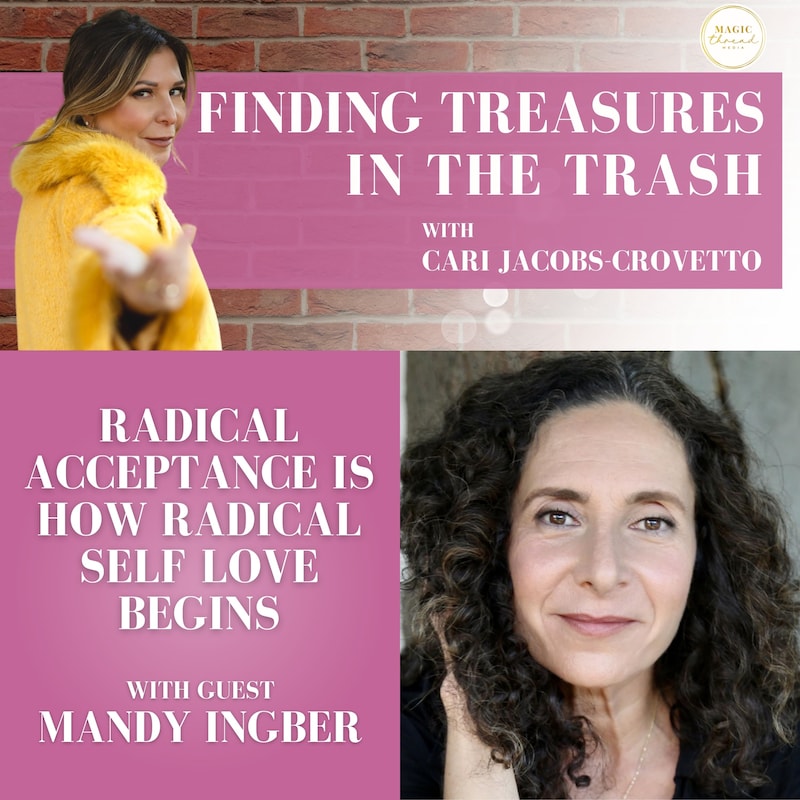
Shownotes
Content Note: This episode includes a brief first-person account of physical and sexual assault. Listener discretion is advised.
This episode is about Radical Acceptance and Radical — and I mean radical — Self Love. Acceptance of uncharacteristic looks. Acceptance of our race. Acceptance of real physical pain. Acceptance of aging. But ultimately, it is about accepting the shadow all the way through — every part and every way it can show up, from childhood through the crone. Radical Acceptance without flinching. Mandy Ingber has lived her entire life finding treasures in the trash. She has lived this work like no one I have met yet. “When you push away the shadow, you get rid of your own power.” So she has done the opposite. Nothing gets cut out, nothing gets pushed down or away — everything is there to be experienced in this life. To have transformation, you have to have the difficulty — it doesn’t feel good, and that’s why we don’t want to be in it. But that’s the doorway. Like the yoga she’s taught to celebs like Jennifer Aniston and Kate Hudson, we dig deep to make it through the pose to find the true gold in the challenges of life.
Key Takeaways:
- Pouring yourself into what’s labeled a “negative.” Because of Mandy’s looks, she was cast early as a villain—asked to embody exaggerated shadow parts by playing those roles.
- Being cast as your shadow. Moving toward the scary parts of yourself in a conscious, safe way. For Mandy, this meant facing deep fear connected to her father by eventually becoming that fear herself when cast as a villain.
- Our relationship to appearance. Being “cast” by the world based on how we look can be debilitating—or it can become a portal into radical acceptance, especially when our appearance is intertwined with race.
- Nose jobs and fixing the outside. Changing our exterior doesn’t resolve the complexity of what we feel inside or how we accept ourselves. The old self doesn’t disappear—it waits in the shadow to be transformed into treasure.
- Our looks as a proxy for conditioning we don’t talk about nearly enough.
- Insecurity as a doorway. How feeling insecure can open us to experiencing life more fully and honestly as human beings—without fear.
- Going through physical pain to find freedom. We find joy, resilience and more when we can lean into the entirety of our experience.
- Jiminy Cricket and wishing upon a star as consciousness and focused attention
If you’re ready to start reclaiming the parts of yourself you’ve pushed aside, head to https://bravedirections.myflodesk.com/5daystotruth to sign up for ”Five Days to Truth”—a free guided meditation series to help you begin that process with clarity and care. It’s a powerful companion to this work, and Cari’s gift to you.
About the Guest:
Mandy Ingber is a Los Angeles based New York Times best selling author, wellness expert, and astrologer who has spent more than 30 years guiding clients to understand their life’s purpose through their birth charts and embodiment practices. She is the creator of the YOGALOSOPHY method and the author of Yogalosophy: 28 Days to the Ultimate Mind Body Makeover and Yogalosophy for Inner Strength: 12 Weeks to Heal Your Heart and Embrace Joy. Her work has earned awards from Los Angeles Magazine and LA Weekly, and she has been featured in major publications including Vogue, Harper’s Bazaar, People, and The Oprah Magazine, with television appearances on Good Morning America and the TODAY show. Her private client list has included Jennifer Aniston, Kate Beckinsale, Helen Hunt, and Brooke Shields.
In addition to her wellness work, Mandy is deeply committed to supporting people through life’s transitions. She is a certified Death Doula who guides individuals and families through advance medical directives, living trusts, and final wishes, and she serves as a minister for both end of life celebrations and weddings. She is also a sought after speaker and spokesperson for wellness brands, serves on the advisory committee for the Cancer Prevention Clinic at Providence Saint John’s Health Center, and brings a unique creative background from her earlier career on Broadway, television, and film.
https://www.instagram.com/mandyingber
About Cari:
Cari Jacobs-Crovetto is an executive and leadership coach and the founder of Brave Directions, where she works with senior leaders and C-suite executives to strengthen interpersonal and team relationships, navigate conflict skillfully, and deepen self-awareness, influence, and confidence.
Before becoming a coach, Cari spent three decades in marketing and product leadership roles across Fortune 100 companies, media networks, consulting firms, and venture-backed startups. In 2019, she was named one of Forbes’ Top 50 Chief Marketing Officers.
Cari brings together decades of operating experience with more than 45 years of Buddhist meditation study and practice, integrating deep inner work with practical leadership development.
She facilitates the renowned Interpersonal Dynamics (“Touchy Feely”) course at Stanford Graduate School of Business where she also coaches grad school students, leads meditation classes and leadership workshops, and hosts the podcast Finding Treasures in the Trash.
Her mantra: Fierce Heart — where compassion meets bold, badass leadership.
https://www.bravedirections.com/
https://www.linkedin.com/in/carisf/
https://www.instagram.com/cari_bravedirections/
Thanks for listening!
Thanks so much for listening to our podcast! If you enjoyed this episode and think that others could benefit from listening, please share it using the social media buttons on this page.
Do you have some feedback or questions about this episode? Leave a comment in the section below!
Subscribe to the podcast
If you would like to get automatic updates of new podcast episodes, you can follow the podcast on Apple Podcasts or your favorite podcast app.
Leave us an Apple Podcasts review
Ratings and reviews from our listeners are extremely valuable to us and greatly appreciated. They help our podcast rank higher on Apple Podcasts, which exposes our show to more awesome listeners like you. If you are enjoying the show, please leave us a review on Apple Podcasts.
Mentioned in this episode:
This show was brought to you in part by the Magic Thread Media Network. To learn more visit: https://magicthreadmedia.com/
Transcripts
It's this idea of, if you get rid of the thing that is, like the destructive or the shadow, you kind of also get rid of the power. So there's this, I think, that as especially as a child, you know, there is this fear of power, and also there's no context for power when you're a child, of course, it's terrifying, but as you lean into it, and I think that is what happened to me early when I leaned into this, this dark character, and I started to have fun with it. I started to just, I think I started to feel my power.
Mandy Ingber:Cari Jacobs-Crovetto: What if real, lasting transformation happens when we're willing to face our shadows, the messy, uncomfortable parts of ourselves we'd rather not look at. And what if the things we avoid out of fear or shame are actually the treasures that wake us up? I'm Cari Jacobs-Crovetto, executive coach and meditation teacher, and this is Finding Treasures in the Trash through raw, unfiltered conversations. I invite you to turn toward what you've disowned and begin integrating it back into the whole beautiful human you were meant to be. Your treasure doesn't always live in the light. Sometimes it's buried in the trash. So grab your gloves. Let's go dumpster diving.
Mandy Ingber:Hello and welcome to Finding Treasures in the Trash with Cari Jacobs-Crovetto, I'm Cari, so glad to have you with us again. I could not be more excited for today's guest. I have to say that I do prep calls with every one of my guests, and I can tell you that this one is going to move you, inspire you, challenge the way you think. So. My guest today is Mandy Ingber. Mandy is a best selling New York Times author of the book yoga philosophy. She was a Broadway star and child actor by the age of 14, and that went on for some time before she became an established yoga teacher and astrologer. She has taught some of the most famous yoga celebrities we know, including Jennifer Aniston. And who else did you teach? You wrote me so many people, so many people, big stars. Just throw out a couple names, just to impress people.
Mandy Ingber:And I always hate to throw out names. I feel like you should be doing that, because how do I pick one? I mean,
Mandy Ingber:Cari Jacobs-Crovetto: how do you pick one? Okay, I'll pick some of the ones that I have on the list. We've got Helen Hunt, Ricky Lake, Jennifer Lawrence, Jennifer Mayer, Brooke Shields, Kate Beckinsale, just to name a few, to name a few. And now you're here to talk with us today about finding treasures in the trash. And I have to tell you, Mandy, this is just raw truth right now, I meet a lot of people. I talk to a lot of people. I mean, I'm involved in Stanford University. I'm an executive coach for international clients all around the world. I sit in meditations. I do all kinds of certifications. And I do have to say, our prep conversation really rocked my world. Wow, yeah, and for a couple of reasons. One is, first of all, the authenticity at which you come at your life is really impressive. Thank you. Second of all, I just had never heard some of what you said. You know, I feel like sometimes we're just like regurgitating, which is fine by me, if we're leaving artifacts for the young people that come after us. I'm just fine with repeating things in new and different ways. But you just said things that I'd never heard of before. Oh my gosh. Well, no pressure, no pressure here, Mandy, no pressure. But I thought we would start where you and I started, okay, which is we kind of started at the beginning, and we started at the beginning of your life. But we talked about the idea that, you know, you dove right in, that sometimes a shadow isn't a dark thing.
Mandy Ingber:Ah, yes, okay, so I remember this part of the conversation. You know, I just want to say one thing that's just popping into my head right this second, which is our culture is so obsessed with keeping things like on the high and whether things are good or bad. You know, it's like people want to, like, focus on the good. There's something about including all of it that that's actually really a relief. I have found for myself, that's just like a main thing that I wanted to say is that we can include all of it, and so. So you're right, that's part of it. Like, I think maybe that was it. I have a tendency to lead with my darkest self. Like, if I go on a date with somebody I like, immediately want to show them, like, all my flaws. That's how, that's what I lead with. And so the thing of that sometimes a shadow isn't always the dark part of yourself. For me, a shadow part of myself is kind of like a ditz, because I'm so smart and I, you know, it's like, I always think I have to know everything, and I want to be an expert and all that. So my shadow is actually kind of being like a bit of a ditz. That's one of my shadows
Mandy Ingber:Cari Jacobs-Crovetto: you had talked about. Certainly, the whole thing doesn't need to be us going back and, like redoing this conversation, but these, this was just something that really stayed with me. You talked about uncovering as a young woman going to and I want to let you tell the story, but you talked about going to a really creative school that kind of unleashed a joyful shadow, this entertaining, this piece of you that you had kind of disowned or shoved to the background of your life up until that point or didn't even know was there.
Mandy Ingber:Maybe Yeah, so when I was when I was in the fourth grade, my my parents sent me to this school for experiential learning, and I had done really well in grade school, like I fit really well into that bell curve. I'm good student. I know how to take tests. You know? I'm that kind of a I was born like that, and not everybody's like that, right? Because not everybody thinks the same way. I just so happen to be able to think in that way. So when I went to this school for experiential learning, all of a sudden, it like unleashed a lot of the creativity that was in me, within me, and so that, that is when I started to incorporate acting into my life. And in this particular school, there was actually a we did this thing called theater on wheels, where we would go to, like old people's homes, and we would perform. And we did a take off on the Empire. Strikes Back. And my two best friends who were like, you know, one, what is the blonde prettiest girl in the school? One was the brunette, prettiest girl in school, you know, we always overheard them one time saying, like, You're the prettiest. No, I'm the prettiest and you're the second prettiest, you know, like that, that kind of a thing. So those two, of course, got, like the Princess Leia part, and then the, you know, like the hand solo, or whatever. And I was cast as the Darth Vader, character, death Vader. And I was just like, more. I was like, I don't know, I don't remember how I processed this alone, but it was just, I remember feeling like, so bummed that I had to be the bad guy. That was really a bummer to me and but I ended up throwing myself into the character. And it ended up, of course, being the most fun part to play, you know. And I we so we would go do we'd perform for little kids and old people. And I just remember, like, getting the huge response from everybody you know, based on this villain. And so that was, I think, a really positive experience that I had with pouring myself into
Mandy Ingber:something that I thought was a negative and that is actually as an actor, I often did play character roles because of the way that I look, because of my looks, and they are often sort of exaggerated shadow parts, because the ingenue is usually like the, you know, like the everything great. And then the shadow, you know, the shadow character is either like the best friend who's like the geek, or like the or like a somebody who's like a real hard ass bitch, or, you know, like whatever those character things are. And I actually remember there was a teacher, and I think I shared this with you in our talk before there was a teacher, and I think her name was Sandra sea cat. I never went to her personally, but I remember my friends, some of my friends, telling me that her theory was that people got cast as their shadow, who I had a few roles like that.
Mandy Ingber:Cari Jacobs-Crovetto: I just, I just need to take that in for a minute, like people get cast as their shadow. And I kind of like, I'm just in the theater world. But I also there's also kind of a wondering that I have about, is there something that you know, somebody like this teacher sees, where they're seeing right through into what the potentiality of somebody is in their sort of, like hidden moment.
Mandy Ingber:What I will say is that as an actor, I think that that's something that's very healing about being an actor, is that you really can move toward these scary. The scenes and parts of yourself in a safe way, which is originally why I was drawn to acting. I think because I had a I had a volatile father, and that pushed me. And this is definitely a Finding Treasures in the Trash kind of thing. I think that finding a place like on a stage in front of people was a safe space to explore the more intense emotions that I think I was feeling as a result of being in a scary environment. To my childhood, you know, to my to my little self, my father was just way too young when he had me and didn't have a filter, you know. So I was taking in a lot that was too much for me at the time, and acting really saved me in that way. So I think that there's, like, this version of working stuff out, you know. I think a lot of actors work things out by the roles that they get. I don't know if that's, you know, sometimes I think the universe just works out that way. I do think there's, it's a healing process, probably for the actor, and then probably as a result, for the viewer, the audience, being brought into the experience. You know that whatever the transformation that the actor is going through. I think that with really good actors, that they bring people into the experience with them by very healing thing for the shadow stuff. You talked about
Mandy Ingber:Cari Jacobs-Crovetto: this, you talked about your looks, which I really relate to, because I have very exotic looks as well. And you talked about, you know, you shared about, always sort of being cast as next to the ingenue as you went on in your career. And you did more and more work, I think you got more prolific parts. How did that shape you?
Mandy Ingber:What was my experience of looking the way that I look, is that what you're is Yeah,
Mandy Ingber:Cari Jacobs-Crovetto: particularly Yes, but particularly in regards to the journey you were taking with acting and your relationship to it.
Mandy Ingber:Well, I think in the I think that especially at the age, because I became an actor, you know, people say child actor. And although that is true, I really started when I was 14, which is, you're an adolescent, or becoming, supposedly becoming an adolescent. I leaned into an eating disorder, which prolonged my, you know, my childhood in a way, in that, in physically, but I think that I I just, I felt ugly, you know, when I was a kid, in a way, because I looked more like, say, the Wicked Witch than the princess in the fairy tale, you know. So I think that just being Jewish looking is what I will say. It's like, my favorite look for many reasons. And I think that felt, it made me feel like conspicuous and and also because, I mean, this is like we can go deeper and deeper. It's like, I feel like I'm digging deeper and deeper into the shadow. But you know, my family, my mother, on my mother's side, they were, my mother was born in a displaced person's camp right after the Holocaust, and so my family, you know, my mother's father's family was killed in the Holocaust, and so there was a part, and they were like my grandfather was a blonde, blue eyed Jew. And then I look super Jewish, you know, I kind of look like my father's side of the family. And I think that looking like that made me feel like I was failing in a way, you know, because I couldn't pass and I couldn't have passed. So a lot of my self criticism, I think, revolves around like looking too Jewish, to be honest. But I but what I do believe about in acting was that I probably the thing I thought that my looks limited me, but looking back, it was probably my looks that, you know, got me some roles, even though I was, you know, I think I was a good actor, but so it really to me. It wasn't
Mandy Ingber:Cari Jacobs-Crovetto: in terms of work, it wasn't a problem. It was more, I think I just,
Mandy Ingber:I just felt like it was really more about, are guys gonna like me,
Mandy Ingber:Cari Jacobs-Crovetto: yeah, but I can see that being so complex, right? Like, you know, I feel like I got my nose fixed when I was 18, I fixed everything so that I looked more white pasting. I'm Middle Eastern. Yeah, there's kind of a rite of passage in Lebanese culture where, you know, you fix your nose at 1617, 18, that thing is gone, right? And you're told you're like, indoctrinated from the time you're like, 567, years old, that this is what. You're going to do? Yeah, I lighten my hair. My hair is normally really dark, so, like, you wouldn't even know, right, right, but I still have inside this complexity around, like, what I feel like inside, versus acceptance.
Mandy Ingber:Yeah, thank you for you know, being so vulnerable, sharing all of that, because, um, yeah, I mean, I, I'm the person that you know. I think it has a lot to do with my upbringing. Like my mother had a prominent nose, but actually a beautiful nose, and she never, she never got it fixed. My mother has not had any plastic surgery. She didn't dye her hair. You know, it's like she kind of didn't do all that stuff. And so I think, in a way, I'm a product of that, but also, so I don't know there's, like, there's part of me that I, on the one hand, I feel like I don't like it, and on the other hand, I defiantly accept who and what I am so I understand what you're saying, and it's just a choice that I've made in this lifetime. And ironically, I did get used to my nose. I think by the time I was like, 21 years old, I even look I talked about my with my eight, with one of my agents when I was, I don't remember what age, because, but I talked about maybe getting my nose done. And he said, Yeah, but then you would just still look like yourself, but with your nose done, you know. So, yeah, yeah. I just said that to me, and I just, I was like, Okay. And then when I was 22 I actually was physical. We didn't talk about this, I don't think, but I was physically assaulted and attempted raped when I was that age, and so one of the two people that was involved in that assault punched my face a lot and broke my nose. And I it was like, I was like, Oh, I just got used to my nose. And so my nose, I did not, I didn't. I had to get two surgeries, and I didn't fix it. Look a certain way, but it def it's not my original nose. I actually had a thinner bridge, and, you know, all this stuff. So it's funny because I miss my original nose, which was also too big and but so for whatever reason, my nose did get shattered and broken, but I again, and now I just accept that. Like I have a lot, I have a lot of cracks in my face and all of that, you know, so I don't know. I mean, I don't,
Mandy Ingber:Cari Jacobs-Crovetto: yeah, well, and I think, you know, first of all, I just want to take a moment to acknowledge what you're sharing here about being assaulted and being hit in the face. I mean, that just sounds brutal and horrific. And also, you know, you shared with me about your mom cutting out the pictures of all the any wicked witches, right, in all your in all your books, to almost like cutting out like, as if it didn't exist.
Mandy Ingber:Well, let me share that story, because it kind of doesn't make sense unless I say it so I so my mother. You know, being the eternal optimist that only like a person born after the Holocaust would be, you know, love Disney and love Disneyland and all that stuff. And so when I went back to look at when I was a kid, I was really, really afraid of anything that was like, like, the Wicked Witch. I was really afraid of the Wicked Witch. And so my mother, being like a young, 20 year old mother, you know, she was like, Oh, I know, I will. I'll just go into these books and just cut out the thing that's upsetting my daughter. And so when you go back to my Disney books, it's just like Snow White and the Seven Dwarfs and everywhere that there would have been a witch is just like a hole. And I think it was brilliant of her to do that, but I had already seen the witch, so I knew what. I knew what was, what had been there. And so my mother just, she didn't really teach me how to self soothe. And so I'm just sitting there going, well, she's cut, you know, like she's cut this out, and then on, subconsciously, I think there might have been a thing of, like, there must be something wrong with me, you know, too,
Mandy Ingber:Cari Jacobs-Crovetto: totally, right? Yeah, my mom used to tell me the story of the ugly duckling, and the story, I don't know if you I'm sure you remember this, but for, maybe for younger listeners here, you know the story is that there's this ugly duckling that's born to a family of swans. And I, you know, my mom was blonde haired and green eyed. She was on the Scottish side of the family, Scotch Irish. And she was really skinny and tiny. And I was a little rounder. I couldn't see I had these coke bottle glasses, and she would read to me from like five to like 14. Literally, she. Tell me, you know, the end of this story, of course, the duckling keeps looking in and feels so ugly and grows into thinks it's going to be a duck, and then one day, looks into the water and lo and behold, it's turned into this beautiful swan, right? Say to me, you know, fully well intended, like someday you're going to be this beautiful swan, and we'll get your nose fixed and all the things. But like, what she didn't realize probably, is the messages that she was sending. And there was a way that, I think, she didn't love herself enough, and eventually was drug addicted most of her life, but there was a way that she didn't love herself enough, and she sort of put that into my energy in some way,
Mandy Ingber:yeah, like, the idea that what you already are isn't isn't beautiful in the right way. And I didn't my I wasn't having that message sent to me by my parents, but, but by society. You know, that is the background noise. And yeah, like, it's just this whole idea that there, there is a right way to look, you know, that yeah is a, I mean, that is a cultural issue that we have, yeah.
Mandy Ingber:Cari Jacobs-Crovetto: And so now I'm just going back, you know. So here you are, you know, adolescence. And then you, you get cast as the you don't get cast as, you know, the pretty friends, you got cast as Darth Vader or the dark character and it and, you know, I really have a lot of like, I don't know if it's awe that I have for you, that you took those moments and those moments became the, I mean, It is Finding Treasures in the Trash. You took those moments and that became the grist for the mill that became the learning.
Mandy Ingber:It was the most fun. I mean, that's the thing, I think that we start to discover is like, well, this is the most fun. And I think that as I then was growing up, yes, I may have been playing roles that, I mean, I was not. All of the roles were like, you know, she's not pretty. I mean, it wasn't like that. But I in my real life. I mean, people you know, like I was attractive enough to the, you know, like the people that I liked liked me too, you know, but, but I think that the some of those experiences, once you start having those experiences, I think that it it reinforces something in you, like, oh, there is something about me, you know, I think you have to find those things about you. Now we live in a society where there is a sameness about things that we are conditioned to want to be so like, for instance, I have super curly hair. I did straighten my hair like until I was 17, I used to, I used to blow it straight, and I would, I would, you know, pull it back tight and put in a curler, and I would make sure it was perfectly straight. And then, in my rebellion, I guess in the, you know, like in the late 80s, I started to let it be curly. And fortunately, Jennifer Beals came along and for just to, like, open the door for like a second with Flash Dance, which was annoying. Like, oh, great, okay. Like, my hair is gonna style for a year. But I just, I don't know, it's like, this weird thing that I have. It's like a defiance too, because I'm a little bit like, I want to hold, I want to hold space for an alternative, yeah, yeah.
Mandy Ingber:Cari Jacobs-Crovetto: And, you know, I think that it's like, don't cut like, I'm using that as a metaphor, because it was very meaningful to me when you shared it. It's like, don't, why are we cutting dark, exotic, like women out of the picture? Like, why does that? Why is why did that? Why did the story get written in that way?
Mandy Ingber:Yeah, I mean, but also, like, nothing's, it's, like, nothing's inherently wrong with it. It's, it's, I think that what it is ultimately for Okay, so we talked about bringing astrology into it. And what I just want to say for a second is, so there's the same planet that represents destruction, represents power. The same planet that represents fighting and war represents sexuality and desire. So it's just kind of, it's like, it's this idea of, if you get rid of the thing that is, like the destructive or the shadow, you kind of also get rid of the power. So there's this, I think that as especially as a child, you know, there is this fear of power, and also there's no context for power. When you're a child, of course, it's terrifying, but as you lean into it, and I think that is what happened to me early. When I leaned into this, this dark character, and I started to have fun with it, I started to just, I think I started to feel my power and and I think may have a lot to do with why, you know, why women are, you know, I don't want to just limit it to women, but in a way, we are taught to be disconnected from our shadow, because we are taught to be disconnected from our power. And I think that that is changing,
Mandy Ingber:Cari Jacobs-Crovetto: yeah, but it isn't, you know it is. But then you look at like, AI and what's happening out there in the world, and this the kind of, just like you said, the sameness of everything. It's like, I noticed now that the people I'm drawn to, like, if I'm scrolling through Tiktok or Instagram, I'm stopping more and more on the people that are like, Don't look. Don't have this perfect look to look about them. You know, like, I had a moment where I was like, do I even put lipstick on anymore? Do I like, do I just, you know, because there's something about being raw and real and standing in your true power, like, because there's nothing fake about it anymore.
Mandy Ingber:Yeah, I've played with all of that. I mean, I, you know, like, I played with wearing my pajamas everywhere in the 80s, you know, I played with, like, I don't wear makeup very often. I just, I play with it. I play with I play with authenticity. I suppose is a way to say it. And I don't know, I've just gotten really comfortable with, I've gotten comfortable with the fact that I don't have to like everything about myself. I don't have to like every line that I'm getting. But we talked about this, like, I don't like every line that I'm getting on my face, but that doesn't mean that I get rid of it. You know, it's like, I have a friend who, you know, just, she was, she just got a facelift. And I have a lot of friends that are getting facelifts now, because I'm 57 and that's what my friends are doing, is they're getting facelifts. That's where we're at on the timeline. So I love myself, but I just didn't love, you know this, you know this. I just wanted to cut this out. And I'm just like, Yeah, I don't love, I don't love, like, my, you know, my jowls, I don't love that, but I'm going with it, yeah, about what that will be like to lean into my, you know, my, what's a good word, my Crone, I guess that's the that's the word, or my being like an elder,
Mandy Ingber:Cari Jacobs-Crovetto: well, and I think you're talking about so I call my methodology inner truth work. And, you know, I tried, I just kind of spilled out of my mouth one day because I knew that there was something I was practicing that wasn't necessarily exactly aligned with everything I had learned from all my Buddhist teachers and all my yoga teachers exactly the way I was doing it, which, and in some ways, Mandy, it was Like compulsive, like I would feel something that felt shadowy or felt like I was pushing, like a wrinkle, for example, or something I didn't like, or something I didn't like about myself, or a relationship moment that had gone sideways, and instead of like turning away, I would sit in meditation, and it was almost like, you know, as I Talk about it now, it's almost like I was challenging it to come forward like come all the way forward so I can see you. I want to see all of you. I want to see now I have not. I admit, one of the reasons you're inspiring me is that I've not made that with my own looks, but I have made that with how I show up and land on people, right? Like, I can be a polarizing person. Some people really like me. Some people like, I don't know what it is I don't like her, you know, and for a long time, I would just beat the shit out of myself for the side that didn't like me. Like, why don't they like me? And I was fixing and fixing and fixing and in that this sort of like, show me all the way what you don't like about yourself, that did, like, refine that power that you're I want to hear about astrology, but it refined the power, and it refined the power, and it refined the power until I just didn't have the, I didn't care anymore as much.
Mandy Ingber:Yeah, that's cool. Oh, yeah, it's funny. As you were speaking, I think that's great. I mean, I think that, yeah, exaggerating. It's the same thing. It's really the same thing as talking about, like, getting a role where you're playing a shadow, you know, it's you get to exaggerate parts of yourself that exist. You know, really, is what I mean, that's what actors are doing is they're just embodying parts of themselves, and so villains or whatever, is just that person as that part of themselves, but talking about insecurity as well. I mean, there's also a thing of like, that's a shadow, right? Like feeling insecure, like around who likes you and who doesn't think. That that's okay too. You know, it's like totally, there's nothing that is off limits and in terms of our experiences as human beings, and I think that's the most, that's where we don't have to be so afraid of things anymore.
Mandy Ingber:Cari Jacobs-Crovetto: And what a relief. You know, I think of like, because I want to just talk a little bit about the yoga and then the astrology, but like, what the way that I, and I would love your take, because I'm not the expert, but I always think of, like, you know, one of the hardest poses for me, for whatever reason, was reverse triangle. And I began to think of every moment that I that did feel shadowy, or did feel hard, like my reverse triangle right? Like I would just have to breathe and lean into the hardest poses, the hardest poses for me to try and find some like loosening and some opening and some widening, and I'm curious if that tracks for you in terms of like going from acting and then moving into yoga and astrology,
Mandy Ingber:yeah, well, so what came right after acting was spinning, which was my introduction into teaching and that that was like revealing, the way that I talked to myself, the way that I myself talk my that was where I actually got To explore the the this, the positive shadow, which is how I bring myself through difficulty, you know, like, in order to really find that voice and to have transformation, you have to find the difficulty. I mean, there's that that's the that's the problem with the shadow, right? It's like it doesn't feel good, and, you know, at first it doesn't feel good, and that's why we don't want to be in it. And I think that, like the sensations that come for me, I'm a very I'm a kinesthetic person, so I feel a lot in my body. Okay, so for yoga, for instance, or let's say you're doing any physical activity and you hit a wall, or you hit a place that doesn't just feels impossible or doesn't feel good, that's when you get to tap into another part of yourself that's almost intangible that is able to it's almost it's like when you lift weights at the gym, it's hard, and the reason and as it's hard, it's strengthening the part of yourself that actually can do it. And so in order to touch the part of yourself that is transformational and can do it, and does have the power you have to hit a point where you want to give up, like, that's a part of the process of being empowered is being first, like, like, really hitting your limit and being disempowered. So to me, what you're saying is you hit a point where you feel like you're not good, or you can't do it or whatever, and then as you stay with it, you start to find a part of yourself that you couldn't access without hitting that limit, right? I mean, is that?
Mandy Ingber:Cari Jacobs-Crovetto: Yep, right, yeah, yeah, that's completely accurate. Or, I mean, we turn away the great, I love that you're paralleling it to physical activity, because I think we're conditioned to think, okay, like when we hit a wall. Hit a wall in physical activity, we you know, we dig deep, and we find that that next rung that we didn't know was there to like, push through and in a way we're not really taught that in the same way about our psychology or our mental health, right? Like, and I'm not saying we should, like, push when we're in trauma, or just push to push, but there is a way that I feel like we disown and we put things in that, you know, I call it in, you know, the giant jewel case, the treasure trove behind us, as if it's not there. Like, look at me. Just like, paddling like crazy, to let you see all the parts of me that are hard or dark or sad or shameful or joyful or hiding, whatever it is we're hiding, and so like this, pushing through to be able to turn in the same way that you turn in physicality, to be able to turn into it and dig deeper. I think that's the piece that I hear you saying. That feels true for me. Yeah.
Mandy Ingber:So, so, um, psychologically, I'm just asking this question. So you're saying that we don't, because I think that, I think that doing physical activities brings you, it's that's the that's where so. That's a way in to developing the psychology like that's a for me, that's been it's an easy in and I'll and the reason is because you are putting yourself that's another version of being in a scene, like in an acting class. Another version is okay, I'm going to put myself in in a situation where I'm going to hit my limit, and then I'm going to find the thing where I can, I can elevate out of it or move past it, find my strength that does translate then to the psychological to the mental health issue. That's why I think, I mean, this is my this is a theory, and I'm but I think that that's why many people who are either depressed or have mental health issues are very supported by physical exercise routines, because you actually do start to find a part of your psychology that is only strengthened by difficulty. And I think that is helpful. I think that's always a helpful, a useful tool. I don't know. I feel like maybe I got off track.
Mandy Ingber:Cari Jacobs-Crovetto: No, I don't think you did at all. I'm thinking back to the episode that I did with Stanford professor Henry most and he talked about how oftentimes, you know, in the maturation of a young person to an adult, there's this moment right where our shadow kind of comes up, and in that moment, it's usually kind of in between, like 28 and 32 ish. It can be any time, but that's like the sweet spot. And I'm sure you have something to say about astrology, about that age, but we're seeing so often, you know, can happen at 2522 whenever, but it's sometime in that sort of late adolescence where predominantly we're also prescribing anti anxieties, right? Because it's as if we're saying to younger people, oh, this is so hard. You can't do it. So we'll just give you. And I'm not, I'm not saying that medicine is not important. Yeah, so please, listeners, don't hear that. I know and I do think we're over.
Mandy Ingber:I know it's such a hard conversation to have these days.
Mandy Ingber:Cari Jacobs-Crovetto: It is, but, I mean, that wasn't available to us. Mandy, we had to figure out, how do we push through? No, I know it toughened us up. I mean, I hate to sound so Gen X, well,
Mandy Ingber:when I was, when I So, when I was in my early, mid 20s, which I think is really for me, it was the hardest. It was the most challenging time of my life. Like from the between 22 and 2625 right? That was the hardest transition for me, one of them. I mean, I've had a few hard transitions, but that was one of them. And I used to say, well, if people don't like my mood swings, they can go on medication. Because I love that, because I did have mood swings then I was, you know, you're going through a lot at that age, obviously. I mean, it is a huge leap that you're making. From being a child, you know, to being an adult in the world. Of course, you're gonna have some feelings about that, no matter where you come from.
Mandy Ingber:Cari Jacobs-Crovetto: You shared a story with me that I then used, well, I used it right away in my meditation class that I teach on Monday nights here in Lafayette, California, and I'm hoping you'd be willing to share it with the listeners. But it was about your accident, and it was about the fact that you basically took one day of pain medicine when you had basically a broken body, and you talked about how you reckoned with the pain in the same way that we're talking about digging deep to face, yeah, our hardships in life, whatever they may be. Can you share that?
Mandy Ingber:Yeah, okay, so I was in a major, near fatal car accident, and I was in the hospital, and not too long ago, it well, it was, it was, it was in 2018 so it was long enough now, but, but in my when I was 50, when I was 50, which was so long ago, now, what direction? But anyway, that's great. No. And so I was in this car accident, and I had, basically, I had a punctured lung. My spleen was lacerated and burst. So, so that happened, I had, like, four broken ribs. My spine was broken down to my my my from my lower lowest rib to my sacrum. The sides of my spine were broken. My actual spinal cord was fine. My sacrum was broken and my sternum was broken. So the after the first night I had and when I had the ax. It a pain is a very general term that people use. And so I was feeling into, okay, like, pain, yeah, but it's like, what exact what kind of pain is this? Is it a searing pain? Is it a is this a pulse? Is it a burn? Is, you know, like, what is this? So that was part of, just for me, identifying what I was feeling was important. This is, this is before. I didn't take the medication. But I actually, I don't know what I was on, because I was in the hospital, I wasn't on anything. Actually, that's true. I wasn't on anything yet. I was waiting, was waiting to get diagnosed. So I was in a lot of pain, and so I teased out all the different sensations that I was having. That's something that I learned from teaching, and I think it's something maybe I was born with. I reframing, you know, like, rather than pain, it's like, okay, what is the sensation? So, got all the sensations, and then my strategy after that is, okay, this is where I'm feeling the pain. But where am I feeling where am I feeling free in my body? You know what I mean? So like my left, my whole left side was broken, but my legs felt okay. My head felt okay, my right arm felt okay. So once you locate where it's hurting, then you can go okay. So where am I feeling good, and then put your
Mandy Ingber:energy into the places that are feeling good. So that's really, like, the basic strategy. And I did share that with one of the nurses in the hospital, and she said, Oh, this is, like, that's some new information that we're getting from whatever meditation. I'm like, Yeah, this is what I'm doing, but in terms of not taking the medication. So the first night I got, I got oxy. And I thought, Okay, well, whatever I'll get, I'll get a I'll get a good night's sleep, because it's this happened at night, then the next night, it's like, okay, I'll get a good night's sleep. I'll do the Oxy. The oxy took away my ability to feel the good places, and just kind of dulled it just dulled everything down. So it actually took away my ability to put my head into the places that feel good. So it was, it was detrimental to me. So the next day, I was like, I don't want anything. I don't want any ass. I don't want anything. I want to feel what my body feels like, because I knew that on day two that would be the maximum amount of pain that I would be feeling. Because usually day one, your body's in shock. Day two is when you're going to feel it, you know, most engines, yeah, that, right? Or even if you work out of the gym, it's usually day two where you feel your muscles. So I felt it, and I felt into all the sensations. And then the next day it was like, Okay, then I'll was like, Okay, then I'll do like the, you know, like the the ibuprofen or whatever, twice a day, whatever it was the minimal amount. But I knew that once I had felt the maximum amount, and I just I knew that once I felt that, that then I would understand that from there on, it was just going to get better and so that really was and the ibuprofen didn't take away my ability to feel, you know, like the good places in my body, but it was very important for me to be able to first identify what is, where is the pain, where? What is the pain? Not just where is the pain, but what is the sensation. Wow.
Mandy Ingber:Cari Jacobs-Crovetto: I mean, I just hearing that story a second time. It's even more profound to me. There's so much metaphor in it, but also the reality that you're most of your body sounds like it was broken. I mean, I know there were places that weren't broken, but and you said, if I can, just wasn't
Mandy Ingber:most of my body. It was 14 bones. It was 14 places.
Mandy Ingber:Cari Jacobs-Crovetto: But I'm hearing that Mandy, and I'm like, but that's not most that feel. I mean, I get a little shoulder ache, and I'm like, so I just, it's, I just have so much respect for the way that you do this. This is like, inner truth work, but doing it through broken bones, right? It's like, oh my gosh, Mandy, and it stayed with me. Recently, I had a, you know, I have had just this back problem, and you were so inspiring to me. I was like, you know, Cari, yeah, your back hurts, but so much of yourself does not hurt. There's so many parts that you can access this kind of like, accessing our resilience, accessing the places of joy, actually accessing the places that don't
Mandy Ingber:hurt but, and that is the so that is the opposite of the shadow, meaning that the if we're bringing it back to shadow or, and I guess that doesn't have to be the thing, because this is just Finding Treasures in the Trash, right? It's like, it's like, it doesn't have to be a shadow thing at all.
Mandy Ingber:Cari Jacobs-Crovetto: But, well, I think, I think a shadow, what you have shed light on, for me is the shadow doesn't have to be some darky, negative thing. The shadow is just a shadow. You can't have the shadow without having a light. And I think we get confused. Because we're like light somehow means it has to be dark or painful, right? It's just a different kind of treasure that you're finding in the trash, different. It's different to resilience treasure,
Mandy Ingber:yeah, I mean, you got to have both, you know? I mean, I think it's like you got I think that's the thing, is that we and that was what I started with, which is, we are so, um, trained to focus only and to only talk about, you know, the victory, the result. You know, we don't, it's like you don't want to hear my stories about, you know, the days that I can't get out of bed because I looked at my phone too much. You know, it's like nobody wanted to hear that, like all of us. I had a day like that the other day where it was like, Uh, I just felt terrible. And it was mostly because the whole day I didn't have all of my human contact was through the computer, and my relaxation time was also in the computer, and I was just in this disembodied place. And I, what I noticed was that that, yeah, that just didn't feel good, you know, the next day. It's not an interesting story.
Mandy Ingber:Cari Jacobs-Crovetto: But, well, it is interesting because I think you're talking about something so profound that so like, this is like, an everyday thing, right? Where, like, we get lost in the news, or we get lost in our computers, and then suddenly, two hours go by, and we look around and we're like, why am I sad, right? Why do I feel lonely? Right? Well, it's because you've completely abandoned your body, you've abandoned nature, you've abandoned connection, right? Like, that's why you're lonely and sad. It's not just because you're alone, quote, unquote, right?
Mandy Ingber:And I do think that that's a huge for me, it's a huge key is being embodied. I think being embodied is incredibly it's incredibly important. And it's, I guess that, I guess it's not overlooked, but it is overlooked. You know what? I mean? It's like, it's undervalued, it's undervalued. And I think that's why we really go through the hardest times. It's like, Oh, I'm just so happy to be alive.
Mandy Ingber:Cari Jacobs-Crovetto: Yeah, yeah. I really feel that. And I feel it in so many parts of your life. You've really lived your life in such a way. Okay, so we have something here on Finding Treasures in the Trash called Your Trash Can Cards. And it's kind of, it's like a, we're just gonna spin the wheel. And by wheel, I mean, I'm gonna close my eyes and point to a question, okay, and then you'll just answer that question. It's kind of the closing it's like the closing shot,
Mandy Ingber:okay? Andy,
Mandy Ingber:Cari Jacobs-Crovetto: ooh, this is a good one for you. If healing had a mascot, what would yours be?
Mandy Ingber:Wow. Well, the first thing that popped into my head was like a little tiny fairy godmother. I guess it would be the Blue Fairy from Pinocchio. Say, more? Well, oh no, no, no, you know what? It's Jiminy Cricket.
Mandy Ingber:Cari Jacobs-Crovetto: It's too many cricket. I don't know. I love this, by the way, because you picked the Blue Fairy, which is kind of ingenuity, and then you were like, no, no, no. It's actually Jiminy Cricket.
Mandy Ingber:Because I because it popped into my head. And I thought, I thought at first it was Tinker Bell, and then I was like, and then I was like, No, it must be like, I was trying to, like, put it together for myself. And I was like, Oh, it's from Pinocchio. And then I was like, Okay, it's the Blue Fairy. And then I realized, no, no, it's actually Jiminy Cricket. So it did organically pop into my head. I just didn't recognize it. But, yeah, so Jiminy Cricket. So when I was a kid, I my, you know, because I didn't really relate to the Disney princesses. I really, I found myself relating to locking into Jiminy Cricket, which is the conscience and, you know, like, it's like When you wish upon a star, you know, all that stuff. And I think Jiminy Cricket has always been like, you know, it's basically like, whatever you wish, if you wish for something, that it will come true. And I actually do believe, I mean, for me, everything that's happened is all of my dreams that I've ever had have come true. So of all of my fears. So it's just this idea that where I focus my attention, that's what's coming and Jiminy Cricket is like the total mascot for me, because I locked into the conscience. That's just what came to me. That's why it came to me. And you said, what's what would healing be like? Yeah, I think that it's like you have to follow. You just have to follow your like your guide. You have to follow your inner, inner compass.
Mandy Ingber:Cari Jacobs-Crovetto: All right. Well, this has been wonderful. Mandy, thank you. Thank you so much. Thank you so much for having me. That was really fun. We'll have you back Bye.
Mandy Ingber:Thanks for spending time with me and for having the courage to listen inward. If you'd like to continue the journey, you can find me at Brave directions.com. Com, and there you can sign up for my newsletter and something really exciting if you're ready to begin exploring your own inner terrain, I've created something called five days to truth. It's a complimentary five day meditation journey that helps you start gently digging into your own trash and discovering what's there waiting for you. So until we meet again, be kind to yourself and trust what's emerging, because inside the muck lives the gold you.




