Shownotes
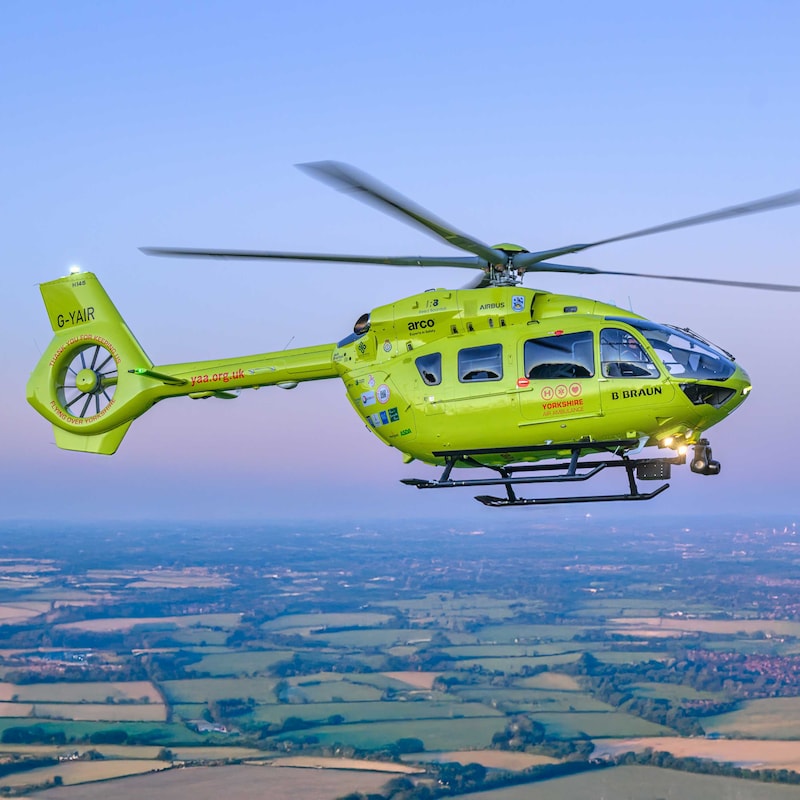
Ever wondered what it’s like to fly a Yorkshire Air Ambulance helicopter?
We go behind the scenes with pilots Owen McTeggart and Paul Smith.
They share what it takes to prepare a helicopter each morning, the training needed to stay mission-ready, and how they work alongside medics to deliver critical care across Yorkshire.
Each month, our crew is called to deliver urgent, lifesaving care, and regular donations help us stay ready for every mission.
To set up a regular gift, text YAA5 to 70460 to give £5 a month.
Thank you
If you want to find out more about Yorkshire Air Ambulance you can visit our website Yorkshire Air Ambulance
Transcripts
Welcome to Summat In t'Air, the podcast by Yorkshire Air Ambulance. 2025 marks 25 years of Yorkshire Air Ambulance flying helicopters and saving lives across the region. So to celebrate, we're sharing stories of rescues and a glimpse of life at the charity.
Paul Smith:Helicopters have got lots of spinny bits. They're notoriously very, very, very, very uncomfortable at times just because of the level of vibrations. However, these aircraft are smooth. They are silky smooth. Smoothest helicopters I've certainly ever flown.
Jon Mitchell:When I hear the helicopter flying overhead, I often wonder what it's like to be at the controls. And today I get to find out and so do you. As we hear from Owen and Paul, two of the pilots at the Yorkshire Air Ambulance, I start my conversation with Chief Pilot Owen McTeggert who explains some of the procedures they go through.
Owen McTeggart:Get in at just before 7, duty starts at 7, and then I've got to unlock the air base and then I've got legally from the CAA I need to have 30 minutes of aviation prep. So that's looking at the aircraft, checking the weather, checking the notice to airmen and other bits and pieces. So I'll get on my day by checking the aircraft. First of all.
Jon Mitchell:So what's a notice to airmen? Tell me what all that's about.
Owen McTeggart:Well, it's just any aviation kind of things that we need to know about. So if somebody's operating drones in the area, it regularly happens at kind of Pontefract racecourse. And so if that's something unusual, they'll put a notice to airmen out to be aware there's drones over the race course.
Jon Mitchell:Okay. And do you have a sort of a weather briefing?
Owen McTeggart:Yeah, we do have a weather briefing. On nice days it's really quick, going to be a nice day. There's no weather implications today, unless it's a bit warm, then that might affect the performance. But on a normal kind of English weather day, we talk about the fronts coming through, what's that going to do to the visibility of the clear base and what effect that will have on missions in certain parts of Yorkshire?
Jon Mitchell:And how do you prepare the aircraft? Do you have to check the oil and wind it up or something?
Owen McTeggart:Yeah, you get the old fashioned quote from kind of World War II where you kick the tyres, light the fires. We don't do that. We do a mini MOT every morning, takes about 20 minutes. So we open all the cowlings, check the oils, check the pipes, check nothing's come loose, check everything as it should be, really. And yeah, that happens once a day for each aircraft.
Jon Mitchell:Do you have to Refuel? 02:28
Owen McTeggart:Refuel after every mission. So only if there's been a late job the day before, do we have to refuel in the morning before we start flying.
Jon Mitchell:You're there, you're ready to go. How do you fill your time if you don't get the call?
Owen McTeggart:Every day has a different kind of job to do, you know, whether it's checking with currencies, checking the aircraft kind of documents and just kind of catching up on old jobs. Because every time we have a flight we've got to log that somewhere and then that needs checking. So when you have a particularly busy day, all that work kind of stacks up. So the next pilot on the next day will probably catch up on that for me.
Jon Mitchell:Let's talk about the aircraft, comparing it to yours or my car, for instance. I go out in the morning, I jump in the car, start it up and drive away. You obviously can't do that with a helicopter, can you? What's the difference?
Owen McTeggart:Well, besides the 20 minute mini MOT, every morning we've got to check the fuel and we need to take a sample of fuel from the five fuel tanks we have in the aircraft. And we're looking for, to get water ingress into fuel tank. Now, how does water get in a fuel tank? Well, it's just condensation. So if your fuel tank's not full, you get a little condensation develop on the top of the fuel tank and then that drops into the bottom. And if you put water into the engines, that's inside the fuel tank, that's not good for the engines because it tends to stop. If you're driving your car and your engine stops, that's not the end of the world. If we're flying at a thousand feet over Bradford, an engine stopping is a big thing for me.
So, yeah, so we check there's no contaminants in the fuel.
Jon Mitchell:What if there is contaminants? What, what measures do you take?
Owen McTeggart:We just flush out because whenever you've got a, an empty tank, so this is going to be some water, some condensation develops and we just keep flushing that out until there's no water in the sump. And it's just fuel. so, and we need to check the systems every day. You know, it's, it's an Airbus requirement and most aircraft do this, so we do that. As soon as we've done the aviation brief and the medical brief, we'll go out and start the engines. So I'm checking that the engine parameters are all within limits and they Start as I should do. I'm checking the autopilot works fully because legally need the autopilot when we're flying at night and in cloud. I'm checking all the other systems like the, the lights work for night and things like that.
So we'll do a full systems check each morning and that means whenever a job comes in afterwards, we can just start the systems knowing they're going to be working correctly. So that takes us about 10 minutes. And while we're doing that we, we connect some kind of horsepower to the engines and give the engines a quick clean. A jet engine is like a little, lots of little propellers inside it and they get lots of little dust and pollution on the propeller. And that little bit of dust and pollution affects the, how the engine works and performs. And if the engine is not performing 100% it means when I need that power in the hills, I haven't got it. So we flush the engines through once a day to make sure all the contaminants are got rid of from the engine blades. And after that we do a quick power check to make sure the engine's working as it should do and then we good to go.
Jon Mitchell:So you say engines plural. Does the aircraft have two engines?
Owen McTeggart:Yeah, it has two engines. And as I kind of see a requirement for kind of flying at the heights we do other, other towns and cities because if we lose one engine, by the way, I don't mean lose it, it's still there. But if one engine fails it means your engine. We can still fly normally.
Jon Mitchell:Okay.
Owen McTeggart:And, and then go to an airport and get a service.
Jon Mitchell:So how much is a fill up? How many gallons of fuel does it take?
Owen McTeggart:Oh, you don't want to know. Yeah, so we have about 600 litres of fuel in our tank and that lasts about one hour, 45 to two hours on a good day. It's. But it seems a lot, but we can get to most parts of Yorkshire in 20 minutes. So yeah, a lot of fuel, but we get there quickly. It's aviation fuel. So you could put it in the car but it won't do your car any good. And we have a 60,000 litre fuel tank outside next to the aircraft so we can refuel after each mission.
Jon Mitchell:Right, fascinating. Yeah. You don't have to pay for it.
Owen McTeggart:Well, not me personally, just the good folk of Yorkshire do.
Jon Mitchell:So, and how fast does the aircraft fly when it's flat out?
Owen McTeggart:120 knots. It's a layman's turn that's about 150 miles an hour. The speed's not the main thing. It's going in a straight line. No traffic lights, no roundabouts, Nobody getting in our way. And that's the key to it.
Jon Mitchell:And do you ever come into conflict with air traffic over Leeds, Bradford or military in the Vale of York kind of.
Owen McTeggart:Airspace is not a big issue because if we're on a HEMS mission, we have priority over all of aircraft. So even though it sounds like a pain, if we get a job on kind of the approach to Leeds Bradford airport, other aircraft have got to get of our way, so that's okay. The Vale of York and the Vale of pickering for military aircraft. We have a special frequency we can speak them on so we can coordinate with them is a risk, but it's not a big risk because we, we coordinate with them on that and we have kind of six monthly meetings with the RAF to make sure we're all doing the same thing and doing it properly. My biggest fear is drones and things like that who. Don't talk to me. Yeah. Don't get in my way. Yeah.
Jon Mitchell:So talking to you earlier, Owen, you have a military background. You flew Gazelle helicopters and Apache gunships, which sounds terribly exciting, but how does flying the Airbus, the Yorkshire Air Ambulance compare to that?
Owen McTeggart:Well, actually, the, the Airbus EC145 is the first helicopter in the civilian world I've flown that kind of matches the Apache in technology, you know, because the autopilot is good. Actually, it's better, a little bit better than the Apache's autopilot that I flew. So it's fantastic to fly. It's a pilot's helicopter, this. But the missions are so much better. This is a rewarding job.
Jon Mitchell:Let's talk a little bit about training and sort of keeping sharp between missions.
Owen McTeggart:We do try to do our currency training during missions. So, for instance, if we go to Leeds Emily Infirmary, I'll try to get an instrument approach at Leeds Bradford Airport before I come home to keep me going. But twice a year we go to the simulator in Germany and that's because the simulator, we can do anything we want to in the simulator. And if it goes wrong, we just control, alt, delete and start again. You can't do that in the aircraft.
Jon Mitchell:True.
Owen McTeggart:And every pilot needs to do a test every six months. We don't do fitness tests, by the way, thankfully. But yeah, I've got to test my pilots and I'm an examiner and Gary Brasher is the other examiner and we take them through their paces twice a year
Jon Mitchell:Landing at LGI is on a rooftop. Am I right? And do you have to practice that?
Owen McTeggart:If we get a new pilot and never done it before for. We need to train them on landing on an elevated helipad. It just looks different from landing on a place, on a road or on in a field. Yeah. So we need to train on that. And we need to maintain two landings a year to maintain currency for elevated helipad. We do that easily because LGI is one of our major hospitals. So we land there a lot more than twice a year.
Going to airports. We, we fly in cloud if we need to. So we've got to keep currents here to do an instrument approach into major airports just in case we, we have an emergency. We need to need to climb and get into cloud. And the night flying, that's a big thing for us because not many air officers around the country do night flying. So that's a specific skill set. So both pilots and TCMs, we need to take them through a night flying package to be able to put goggles on and land at HEM sites at night.
Jon Mitchell:A TCM is a.
Owen McTeggart:It's a technical crew member.
Jon Mitchell:Okay. And you wear these very expensive night vision goggles. All right.
Owen McTeggart:They enable to see hazards at night like telephone wires, poles, masts, things like that. So when we need to land at kind of that small site in the middle of Leeds Bradford, we can see these hazards and make a safe landing.
Jon Mitchell:So that's what the pilots get up to at the base. What about when the alarm goes off? Paul Smith joins me to share what happens in the air
Paul Smith:So it can sound like it takes quite a while with all the checks that we do, but when that buzzer does go off, typically airborne within about three minutes. And that's from buzzer to takeoff
Jon Mitchell:That's pretty quick.
Paul Smith:Yeah, it is really quick. Our aircraft's great. It allows us to do it at that speed, which is fantastic.
Jon Mitchell:I've noticed that you take off backwards. Is there a specific reason for that? You can tell me the pilot.
Paul Smith:Yeah, yeah, yeah. We don't just do it to show off our backwards flying skills. Planes can't do this. No. So we have two engines on our aircraft. So when we take off, we have to take into consideration what happens if one of those fails. And it's all to do with the safety thing. We fly what we call profiles.
So the idea being if one of the engines fails, we either need to be able to land back on the ground ground safely, or to continue flight. That means that for everybody on board and of course the surrounding areas, we were as safe as possible. So the reason that we go backwards, that's one of the profiles that we fly. Of course a helicopter can go vertically as well, but we go up and back. That's to give us a good view of the landing site between our feet, where we've got a little glass panel there. So we try to put the landing site basically between our feet. It gives us a good view of it, but it also gives us a steep profile, if you like, meaning that it's fairly vertical so we're not, you know, moving towards the ground at a rate of knots.
Jon Mitchell:What happens when you land at the hospital?
Paul Smith:The medical crew typically decide which hospital is most appropriate for the patient. And depending on the nature of the hospital will depend on the nature of how we activate the helipad, for want of a better term. So if we're going to Leeds General Infirmary, for example, that's got a rooftop helipad and the, that's got a team there, a highly trained team of firefighters. They work other areas in the hospital as well. But this is their other task. So they'll activate the helipad for us, staff for the helipad. So if we were to have a problem, they're ready to go. However, if we go to Hull for example, that's a helipad, that's surface level.
So they need a team of security there just to make sure that the helipad is safe for us to land in. So depending on where we go and what we do, the nature of the helipad will depend on how we're activating it
Jon Mitchell:What happens next?
Paul Smith:So if we just touch down on the pad at LGI, the helicopter requires at least a minute of cool down period. Now with a patient on board, that can feel like an eternity. However, once we've landed, if the crew need to unstrap and attend to the patient, they can. But once we've shut down, it's then a process of getting the patient out of the aircraft and onto the hospital stretcher into Ved.
Jon Mitchell:So you're heading back to base, you're heading back to Nostell. What happens next after you land?
Paul Smith:Well, so even before we land, it could be a case if we get re tasked to another job that's dependent on fuel, that's dependent on the kit that the medical crew have used, whether they can take another job. I think from a kit point of view they carry spares specifically for that reason. From a fuel point of view, it depends on what we've done previously, but we're quite lucky with this new model of aircraft that we're able to carry a bit more fuel. And that bit extra fuel might be the difference between can we get the crew to that job or do we need to refuel on route? And of course, that refuel would create a delay and that might be detrimental to the patient. So being able to get the crew there with that little bit extra fuel can make a difference.
Jon Mitchell:So assuming that that isn't the case and you've landed safely back here at Nostell, just give me a little bit of an idea of what happens to yourself as a pilot and the aircraft itself.
Paul Smith:So whereas they say in aviation, you know, you spend an hour flying, you can spend three hours doing paperwork. So there's part of that, it's aircraft records and things like that. But our priority from an aircrew point of view, you is trying to get the aircraft fueled and serviceable. Ready for the next call. But then let's get ourselves fuelled and serviceable as well. You know, get finish off that lunch that didn't quite finish or what have you. Yeah, exactly. That get bites.
Jon Mitchell:I know when we were called out before, you had half a can of pop there on the desk and you finished it off when you came back after the job, it was still there, Nobody had moved it.
Paul Smith:Yeah, exactly. It just needed to be finished, get it down.
Jon Mitchell:So these latest Airbus helicopters have an extra rotor blade. Does that mean it's smoother?
Paul Smith:Yeah. So we're extremely lucky that we've got a fleet of three Airbus H145D3 helicopters, which is an improvement on our previous set, which was a D2. So it's a new mark, if you like. What that fifth rotor blade allows us to do is carry a bit of extra weight, which is fantastic for us, it's a bit more kit or a bit more fuel, but really the benefit is the vibration levels. Helicopters have got lots of spinny bits. They're notoriously very, very, very, very uncomfortable at times, just because of the level of vibrations. However, these aircraft are smooth.
They are silky smoothest, smoothest helicopters I've certainly ever flown. Whilst that's nice to have from a crew comfort point of view and certainly a crew fatigue point of view, that really benefits the patient. If they're suffering from a broken limb, for example, we've got a doctor and a paramedic that's giving them painkillers. But if you can imagine the broken bone and the two brakes in that bone are rubbing against each other. That's extremely uncomfortable for the patient no matter what you do. So the smoothness of the aircraft really contribute to patient care as well, just by reducing that level of discomfort, pain and it's even just a weird environment for someone who's lying on their back looking at the ceiling. If you add vibration to that, it just can make it a bit worse for them as well. So we've taken that away with this new model of aircraft.
Jon Mitchell:I know you're very busy as a pilot, but do you just look out the window and sometimes think, yeah, this is nice?
Paul Smith:Yeah, I think when people ask you, why do you fly? I think that those days where you get to look out the window and go, not many people get to do, this is amazing. This is crikey. You know, I think that's, that's helping people is great. I love doing it, but from a pilot point of view, it's. It's cool to be able to look out the window and go, yeah, this is good.
Owen McTeggart:Can I just say something about the team? It's kind of a bit serious now. This team shouldn't really work, you know, because most teams have a leader and have lots of kind of leaders on their A game, top of the tree, whatever you want to say, and then lots of people lord them who aren't as skilled or kind of a kind of second class, whatever. We don't have that. We're full of alpha males and alpha females because everybody's at the top of their kind of pinnacle of their career, whether it's doctors, the paramedics, the pilots or the TCMs. So we've got lots of leaders and we work well together for some reason. And I think it's because we're all working to the same goal and we all understand that in certain phase of the mission we all take the lead and other people just follow naturally. But we can also all dip in, out and take leadership at any point, which is really, really good.
Owen McTeggart:So we shouldn't work. But for some reason we do.
Jon Mitchell:Hearing from Owen and Paul today shows just how much skill and preparation goes into every mission, from the first checks of the day to that moment the helicopter lifts off. If you want to support the work the Yorkshire Air Ambulance does, go to our website, you can yorkshireairambulance.org UK where you can easily donate. Thank you for listening to Summat in t'Air if you've enjoyed the podcast, please share it and tell your friends to listen.


