Shownotes
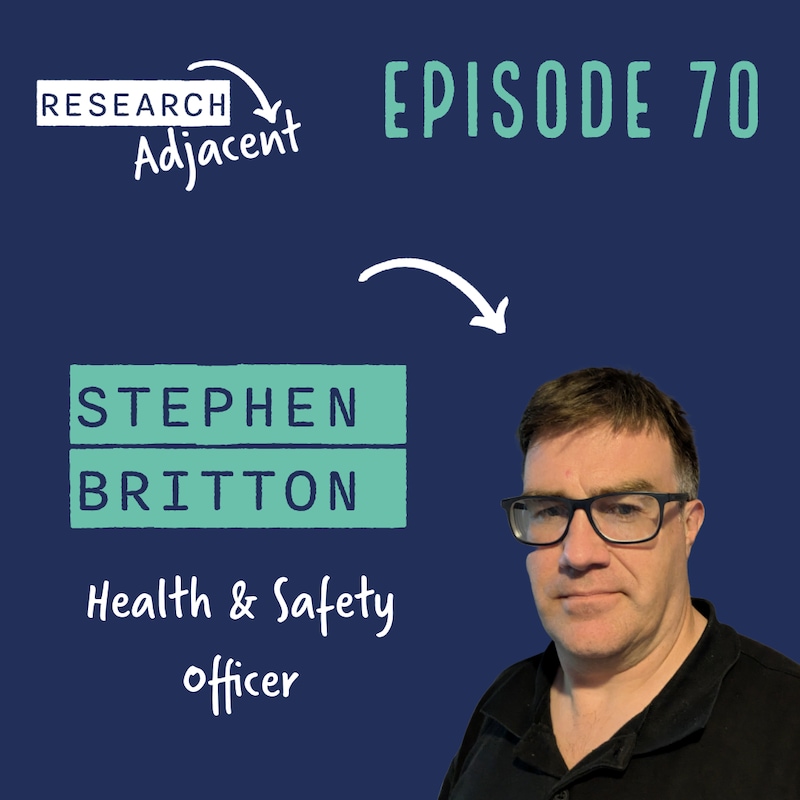
Stephen Britton, Health & Safety Officer (Episode 70)
Sarah's guest for this episode is Stephen Britton. Stephen is currently a Biological Safety Officer at Durham University. Prior to that he spent over 20 years working for the UK Government's Health & Safety Executive.
Sarah and Stephen talk about
- Our changing appetite for risk and what life might be like without health and safety regulations
- Some of the major incidents he has investigated
- Why the constant churn of university research projects creates safety challenges
- The far-reaching impact of his chosen career compared to staying in research
Find out more
- Read the show notes and transcript on the podcast website
- Connect to Stephen on LinkedIn
About Research Adjacent
- Fill out the research-adjacent careers quiz
- Sign up to the Research Adjacent newsletter
- Follow Research Adjacent on LinkedIn Instagram and BlueSky
- Email a comment, question or suggestion
- Leave Sarah a voice message
Mentioned in this episode:
Member of the Month: Duncan Yellowlees, DY Training
Let’s put rubbish presentations in the bin – where they belong. Get in touch with Duncan for specialist research presentation skills training www.duncanyellowlees.com
Come along to our Manchester networking event
Join host Sarah McLusky and fellow research-adjacent professionals on Thursday 12 March 2026 at 5.30pm. Find out more and register here https://researchadjacent.circle.so/c/open-events/manchester-research-adjacent-community-networking
Transcripts
I always say to people, even if you're not gonna write something
Speaker:down, say it out loud to yourself or someone else, and you'll go, yeah.
Speaker:Does that sound like a good idea?
Speaker:Really, you're gonna stand in that wheelie chair and put those
Speaker:Christmas decorations up here.
Speaker:You've got a grant for an electron microscope.
Speaker:That's fantastic.
Speaker:Do you know how much the power supply is gonna cost?
Speaker:It now needs to be in a temperature monitored room, and it needs to
Speaker:be in a dust free environment, and it now needs an access control.
Speaker:Now it needs to be a clean lab.
Speaker:That's all 200,000 pounds worth of spend that you don't have that we're
Speaker:now gonna have to find somewhere.
Speaker:Actually, I think I've had far greater reach and impact doing
Speaker:what I've done subsequently than I ever did working that research.
Speaker:Hello and welcome.
Speaker:I'm your host, Sarah, and this is episode 70 of the Research Adjacent Podcast.
Speaker:Today we turn our attention to health and safety, and if you've ever
Speaker:worked in a lab, the mere mention of those words might make you groan.
Speaker:But today's guest, Stephen Britton, is here to help us
Speaker:appreciate these unsung heroes.
Speaker:Honestly.
Speaker:Stephen is currently biological safety officer at Durham University, but before
Speaker:that, he spent over 20 years working for the Health and Safety Executive, the
Speaker:government department, which sets and enforces health and safety legislation.
Speaker:In our conversation, Stephen paints a picture of what life would be like without
Speaker:the current regulations, some of the major incident that he's been involved
Speaker:in investigating and why the constant churn of university research projects
Speaker:can throw up particular challenges.
Speaker:Listen on to hear Stephen's story.
Speaker:Welcome along to the podcast, Stephen.
Speaker:It's fantastic to have you here, we know each other already in
Speaker:a slightly different context.
Speaker:So this is gonna be a first to hear all about what you do for work.
Speaker:So tell us what is it that you do?
Speaker:Currently I do health and safety and biological safety at Durham Uni.
Speaker:So way back in the nineties I did a PhD in human genetics and from there I
Speaker:went straight to the Health and Safety Executive who were the the National
Speaker:Regulator for Health and Safety in the UK.
Speaker:So I spent about 10 years doing general health and safety.
Speaker:Started out doing agriculture and woodworking.
Speaker:We then became more general groups where I covered every type of sort
Speaker:of general manufacturing industry on top of that I then moved
Speaker:across to the chemicals division.
Speaker:So I would inspect big chemical plants on Teesside and quite a few fires and
Speaker:explosions and that sort of stuff.
Speaker:And then one of my former colleagues, had moved to Durham Uni and become head of
Speaker:health and safety there, and he enticed me into kind of knowing my background to
Speaker:come and bring my knowledge of chemical and biological safety plus sort of, so
Speaker:I've ended up kind of 20 years later, back and in university environment, but
Speaker:in the sort of professional services side of the university, the sort of always the
Speaker:slightly worse off half of it that universities are very structured towards
Speaker:their academic activity and kind of professional services are kind of
Speaker:the unsung heroes in the background, helping everything actually happen.
Speaker:Yeah, definitely.
Speaker:That's very much the theme of this podcast is to do something, to tell the
Speaker:stories I think of those unsung heroes.
Speaker:So anybody who's worked in a research lab will have some vague sense of
Speaker:health and safety, but their sense of it is probably just oh, I have to fill
Speaker:in like risk assessments or something.
Speaker:Tell us a bit about what, what working in health and safety means.
Speaker:That's, that that's always been the problem of it.
Speaker:And when, back when I worked in a lab, someone suddenly thought,
Speaker:oh, we should do some safety.
Speaker:So we had this big folder of SDSs, literally, I would say
Speaker:probably six or 700 of them.
Speaker:And we had to sign to say that we'd seen all these.
Speaker:What's an SDS?
Speaker:The safety data sheet.
Speaker:Oh, yes.
Speaker:Every substance that you use, they used to be called MSDSs they've
Speaker:been called SDSs for a while now.
Speaker:But yeah, so you know the product data sheet if you like, of
Speaker:like how that affects people.
Speaker:And you would just sign the thing and every now and then you'd go, oh,
Speaker:we're having a safety inspection.
Speaker:So we would clear the lab up and we'd shut all the fire doors back up.
Speaker:'cause we had the long kind of a long lab with various.
Speaker:Rooms through it, which we used to prop the fire doors open all
Speaker:the time in because 'cause you needed to carry stuff through.
Speaker:Yeah.
Speaker:And now that I work in health and safety, I know that is perfectly legitimate if
Speaker:you are in control of the door and in an emergency you would shut it behind you.
Speaker:So it's like we used to do stuff and kind of hide things from people.
Speaker:I ended up doing safety stuff because I randomly, I was writing up my PhD. I'm
Speaker:thinking about what I want to do next.
Speaker:I would, I'd been applying to various scientific jobs,
Speaker:so I'd been to AstraZeneca.
Speaker:I'd been for interviews and Unilever even who have techie people that are
Speaker:involved in making various things.
Speaker:And got reasonably close to landing some of those jobs.
Speaker:And then in a pub one night someone had suggested, I give health and
Speaker:safety a go because I'm quite good at talking to people and quite good
Speaker:at putting technical stuff across.
Speaker:And they worked as an operational inspector and it was like, they'll take
Speaker:you in and they'll train you and you didn't have to pay to retrain or whatever.
Speaker:So you go, oh, they're fantastic.
Speaker:So I got through that selection process and you then move into the real world,
Speaker:and everyone's come across a risk assessment as a thing, but everyone does
Speaker:it as a set of two tick boxes almost.
Speaker:That's this risk is this number and now it's that number, and that doesn't help
Speaker:anybody and it's just unproductive a lot of that, that it's it's so boring
Speaker:and what you're actually wanting people to do is think about what it is that,
Speaker:what is it you're doing and what.
Speaker:Is there an industry standard out there that tells you
Speaker:what you need to do about it?
Speaker:So it's is there already a code of practice, like
Speaker:putting scaffolding up, right?
Speaker:Something that you'll see on every street.
Speaker:They're always built the same way and they always look identical.
Speaker:Funnily enough, there's a code of practice they have to
Speaker:follow and it's that approach.
Speaker:So yes, you use that number system and all of that, and that's usually
Speaker:used to justify spending money on stuff that you go, we have this
Speaker:problem, we need to sort it out.
Speaker:And because it's such a high hazard, you, there's a justifiable spend behind it.
Speaker:So you've gotta get that past your finance people, but at a local
Speaker:level and stuff within your control.
Speaker:That's always the thing I advocate, is find a benchmark standard.
Speaker:Look at that, see how that applies to what you're doing and write down the
Speaker:stuff you're gonna do to keep people safe.
Speaker:And that's as simple as it needs to be, but it's all a tedious form filling
Speaker:that everyone thinks that's getting in the way of what I'm trying to do until
Speaker:something goes wrong or someone's got a bit of ill health and then suddenly
Speaker:you are looking back at all this paperwork and going why didn't we think
Speaker:about that and why didn't we do this?
Speaker:Yeah.
Speaker:And if only, and all of that stuff.
Speaker:And I've even had that.
Speaker:People having incidents, having attended one of our sessions, having
Speaker:the equipment available in a nearby shed, but choosing not to use it.
Speaker:Yeah.
Speaker:Because it's just a two minute job and then the fallen out of the
Speaker:bucket of a telehandler to their death and you're going, you had a
Speaker:cage that you could have put on the
Speaker:on the fork truck, 25 meters away, it would've taken you two minutes
Speaker:literally to go and fetch it.
Speaker:But you didn't bother because you thought it was just gonna
Speaker:be straight up, do a thing.
Speaker:Yeah.
Speaker:Fall down and it, that's the, I guess what I wasn't ready for
Speaker:joining the national regulators.
Speaker:You always.
Speaker:In terms of incidents, you go to the worst stuff that happens, so the scale
Speaker:of the incidents are so much more than people have in other sectors, like Yeah.
Speaker:Not long after I joined the chemical sector, we had an aerosol
Speaker:warehouse that burned down.
Speaker:So I was months and months in investigating that.
Speaker:And that evening I found myself in police headquarters advising them whether or
Speaker:not the plume of smoke coming out of this warehouse was likely to impinge on the A1
Speaker:or the Great North train line and whether or not they should shut the train line.
Speaker:Oh, goodness me.
Speaker:And you're thinking, and you're thinking, wow, welcome to the chemical sector.
Speaker:Yeah.
Speaker:I wasn't expecting this.
Speaker:And it was fireworks night and that's where the organized fireworks
Speaker:display was supposed to happen.
Speaker:So they had to cancel all that.
Speaker:'cause they were busy and half their fire engines were obviously busy.
Speaker:Yeah.
Speaker:And of all the days in all the world when you don't want the fire
Speaker:brigade to have a lot to deal with.
Speaker:November the fifth is definitely the one where you're like, wow.
Speaker:Yeah.
Speaker:So I ended up having a very long day that day.
Speaker:Yeah.
Speaker:Yeah.
Speaker:And it's as a result of that, we realized that aerosol warehouses
Speaker:don't burn down in quite the sort of, it, it was always invis, it was like
Speaker:a pop type uhhuh scenario that each individual aerosol would go burst.
Speaker:Yeah.
Speaker:And it would just immediately go on fire.
Speaker:What you actually had was you could have buildups of gas at certain
Speaker:points and get quite large explosions.
Speaker:So we ended up doing quite a lot of different sort of policy stuff
Speaker:in the background to look at how you store large quantities of
Speaker:these types of materials because
Speaker:obviously once they start Yeah, you can't put it out.
Speaker:You basically just sit back and watch it burn for three days.
Speaker:That must be really interesting with some things.
Speaker:'cause there must be quite a lot of stuff.
Speaker:Technology's moving on all the time, chemicals, products, all sorts
Speaker:of stuff moving on all the time.
Speaker:And sometimes it must be like that, that you don't know until something happens
Speaker:and then you say, oh goodness me, we didn't think it was gonna go like this.
Speaker:No, exactly.
Speaker:And it the thing about the history of health and safety is that whenever someone
Speaker:says, oh, it's health and safety gone mad, and you go, okay, then which set
Speaker:of regulations do you mean here then?
Speaker:You name me a set of regulations that you don't just read and think
Speaker:actually that all makes sense.
Speaker:Yeah.
Speaker:And if there's a big regime that's come into being.
Speaker:You can normally trace it back to something that happened
Speaker:immediately leading up to it.
Speaker:So you go, the health and safety at work act.
Speaker:Why did that happen?
Speaker:There was Flixborough and there was the Aberfan disaster.
Speaker:They pulled the UK together into kind of there was two huge disasters
Speaker:involved, quite large numbers of people.
Speaker:And we realized we weren't dealing with the risks of those particularly well.
Speaker:And that's how the health and safety worker came into being.
Speaker:From formally the factories act.
Speaker:'cause that only applied to factories.
Speaker:Okay.
Speaker:And there was nothing in place for members of the public affected by
Speaker:stuff, which is what Aberfan was about.
Speaker:Obviously there was a. A large pile of coal slag, which
Speaker:I was gonna say was the landslide onto the school that Yeah,
Speaker:that's the one that people have seen on the, episodes of the Queen that like 105
Speaker:children died or something wild like that.
Speaker:So yeah, when you scale stuff up to big sizes.
Speaker:That's when you realize that's where all the regimes have come into place.
Speaker:So for, so for example, the reason we have building regulations
Speaker:of how you build buildings was after the Great Fire of London.
Speaker:So it's yeah, we have to have a really big disaster.
Speaker:And then we go oh oh well.
Speaker:That didn't go well.
Speaker:Why don't we think about that a bit better so that we design
Speaker:buildings so that they don't have fire breaks and all of that stuff.
Speaker:And, the more recently you can pull that forward to Grenfell where
Speaker:obviously large buildings with an inability to fight those fires had
Speaker:never really been thought about before.
Speaker:Yeah.
Speaker:So the reason HSE got that job is because we've been looking at chemical
Speaker:plants and how you bring together different agencies to monitor those
Speaker:kind of environments for decades.
Speaker:So they're the obvious agency to then go we know how to do, we
Speaker:know how to do this sort of thing.
Speaker:Or how to pull the expertise together to 'cause that was the.
Speaker:The great thing about working in that environment was there was always an expert
Speaker:somewhere that you could call upon Yeah.
Speaker:To go, we've come across this, we don't really know what, where we
Speaker:are with this, and put feelers out to come up with a position on it.
Speaker:To actually think stuff through from first principles or commission research.
Speaker:Yeah.
Speaker:The aerosol warehouse stuff, I knew that we'd done things like this.
Speaker:They have a, a lab in Buxton where they can test things and do all sorts yeah.
Speaker:Going back to your original kind of point when you're trying to assess something,
Speaker:walking through a process and thinking about stuff as it comes up in a sequence
Speaker:is often a good way of thinking about it.
Speaker:'cause
Speaker:Yeah.
Speaker:And where are the points where you need to do something
Speaker:and it's usually where there's a handover between one person and another.
Speaker:There's a fitter who does this bit.
Speaker:There may be a fitter that does that bit, but there's something in the
Speaker:middle which you haven't identified that anyone has to do anything with.
Speaker:So it, that's often how things drop through the cracks whatever it is,
Speaker:there's some kind of process flow.
Speaker:Yeah.
Speaker:And people are really good at the main bit.
Speaker:Making the thing, looking after the thing.
Speaker:They're not really very good at deliveries.
Speaker:They're not very good at getting rid of the waste.
Speaker:I always used to start at the peripheral bits.
Speaker:The bits you don't really care about.
Speaker:They're the bits that are gonna catch you out and horrible maintenance stuff.
Speaker:And like the main process is usually pretty well controlled
Speaker:and people thought about it 'cause there's quality issues or whatever.
Speaker:And you are measuring that because that's how you make all your money.
Speaker:But it's actually thinking about the other bits on the back end where
Speaker:you will have the biggest inroads.
Speaker:'cause you suddenly find the stuff that's a bit unloved and not looked
Speaker:after that's gonna let you down one random, wet, rainy weekend.
Speaker:Yeah.
Speaker:And you're gonna climb up a rickety ladder to try and get it to go again.
Speaker:Yes.
Speaker:you're gonna come a cropper.
Speaker:Yeah, exactly that.
Speaker:That is really, and it makes a lot of sense actually
Speaker:'cause I think even.
Speaker:I think in terms of any job, like you say, whether it's a factory or whether
Speaker:it's like doing what I do, I might pay good attention to doing the podcast and
Speaker:so on, but I don't always pay attention good attention to some of the kinda admin
Speaker:things or the legal things or the things around the periphery that, you know.
Speaker:Yeah.
Speaker:I'll get round to that at some point.
Speaker:Exactly.
Speaker:Yeah.
Speaker:And in universities, for example, they.
Speaker:The thing I've had thrown at me in the couple of years I've been
Speaker:back in that environment is they go it's, we are different to
Speaker:industry because we're changing all the time and doing new things.
Speaker:And you're going.
Speaker:Yeah.
Speaker:You don't know how industry works at all, do you?
Speaker:Because,
Speaker:oh, so yeah.
Speaker:I was gonna ask you, what are the d the big differences that you found
Speaker:coming into the university now in the
Speaker:So people have this idea that a chemical plant, for example, is this dedicated
Speaker:thing that just does one thing and they chug away, making whatever it is.
Speaker:There are plants that do that, but they're becoming fewer and far between,
Speaker:and there's a lot more like toll manufacturing where you say, I need.
Speaker:A couple of hundred liters of this product.
Speaker:And they will make that for you.
Speaker:So they go through a management of change process to do that.
Speaker:They go how do we need to configure the plant?
Speaker:Are there any specific safety concerns?
Speaker:What do we need to think about with that mix?
Speaker:Set the alarms, set the trigger points, the, all of that stuff.
Speaker:Universities don't have a much proper management of change process.
Speaker:You just have some people, they apply for some grants, they win a grant.
Speaker:They then go, I need a room converting to do this thing.
Speaker:And they may or may not have consulted all the right people to know, do
Speaker:you know what infrastructure you need to support that piece of kit?
Speaker:Brilliant.
Speaker:You've got a grant for an electron microscope.
Speaker:That's fantastic.
Speaker:Do you know how much the power supply is gonna cost?
Speaker:It now needs to be in a temperature monitored room and it needs to
Speaker:be in a dust free environment and it now needs an access control.
Speaker:Now it needs to be a clean lab.
Speaker:That's all 200,000 pounds worth of spend that you don't have that we're now
Speaker:gonna have to find somewhere that you could have applied for in proper grants
Speaker:if you'd thought about it properly.
Speaker:And it's because academics aren't given the right training early enough to
Speaker:go when you're applying for a grant, this is actually a project that you're
Speaker:trying to build and these are what, what needs to come into that project?
Speaker:Do you know, it's interesting this business of actually having
Speaker:conversations, so I, in the world I work in is the kind of communication
Speaker:and public engagement side of things.
Speaker:And I would be saying the same thing.
Speaker:If you'd come and spoken to me before you put the grant application in, we could
Speaker:have properly costed for you to have, an animation or a website or a podcast
Speaker:or whatever else it is that you want.
Speaker:And it's so interesting that you're saying exactly the same thing.
Speaker:It's yeah, talk to us before you.
Speaker:Start down this path,
Speaker:And there's even experts within
Speaker:bits of the university who would know how, which fundings you can probably tap into.
Speaker:And the problem they have is they're busy teaching, they're
Speaker:busy doing the current work.
Speaker:Applying for grants is time consuming.
Speaker:And you get one in 10 of them or something.
Speaker:Yeah.
Speaker:And it's if you get the grant, it's whoa, and now what do we do?
Speaker:So it's so hit and miss as to whether or not you're gonna get it.
Speaker:They consider it difficult then to plan strategically to put stuff together.
Speaker:Yeah.
Speaker:But yeah, I am working on it.
Speaker:Yes.
Speaker:Because having been in a different environment, you can come to it with
Speaker:different eyes to be able to go we haven't got an end-to-end process here.
Speaker:Have we, we haven't thought about those elements.
Speaker:If we can get closer to that and have my colleagues in estates and
Speaker:facilities kind of areas more clued into when you want to cost up a job.
Speaker:Yeah.
Speaker:It's not, this isn't costing up a real job that's actually happening.
Speaker:This is just that, a ballpark figure.
Speaker:Yes.
Speaker:In order to be able to put on the application.
Speaker:Yeah.
Speaker:So they go, all right, okay.
Speaker:Yeah.
Speaker:Because they didn't know that was a thing kind of thing.
Speaker:So it's, you nobody knows stuff outside of their sphere of influence.
Speaker:Yeah.
Speaker:Until you pull them together,
Speaker:start pulling it together.
Speaker:Yeah.
Speaker:Yeah.
Speaker:A lot of what you end up doing.
Speaker:Some of it is safety related, but most of it is efficiency related.
Speaker:And so you, there's often a, like in a lot of environments safety and environment and
Speaker:quality are often pulled together 'cause.
Speaker:If you get the quality that you know you are doing good research.
Speaker:Yes.
Speaker:But that's so getting back to the point earlier of the main activity you
Speaker:are trying to do, if you've put good quality processes in place to make
Speaker:sure you make widgets of the right quality chances are the safety elements
Speaker:will fall into place because of that.
Speaker:Yes.
Speaker:Because they have to Yeah.
Speaker:In order to get the quality output.
Speaker:Yeah.
Speaker:It's repeatable and, and, within parameters and all of that stuff.
Speaker:So there, there won't be any safety hazards built out of that 'cause in
Speaker:order to be reproducible, chances are the kit is all properly thought through.
Speaker:Yeah.
Speaker:Yeah.
Speaker:Makes a lot of sense.
Speaker:So you've said there you told us a little bit at the beginning
Speaker:about your journey into this.
Speaker:So you originally did a PhD and then ended up, So it is civil service, isn't it?
Speaker:Health and safety executive.
Speaker:Yes.
Speaker:They're a Civil Service Department.
Speaker:Yes.
Speaker:And it And was that a, like a training program that you went into?
Speaker:Yeah, they run a two year program to bring you up to speed and send you on a you
Speaker:have to do a post-graduate diploma so that you have a similar level of level level
Speaker:theoretical knowledge as folk out there.
Speaker:But the, and there's specific courses on different aspects like machinery
Speaker:safety and construction safety and chemical stuff and extraction and
Speaker:Legionella and you, you think of a topic and I've been on course on it.
Speaker:So it's a very, it's a very broad training to cover all kinds of eventuality.
Speaker:Yeah.
Speaker:All sorts of stuff.
Speaker:So you are, you're a a real generalist.
Speaker:So you're a master of nothing, but you have enough savvy to
Speaker:know what you're looking at.
Speaker:From the get go.
Speaker:But then you have technical experts lurking in other
Speaker:parts of the organization.
Speaker:If you're not sure about something, you can take pictures and go seen this?
Speaker:Yeah.
Speaker:What do you think?
Speaker:Or, you pass it by colleagues and so on 'cause nobody knows everything from the
Speaker:get go, but you very quickly get very familiar with, different environments,
Speaker:but that gets to a point of tedium that like you walk in somewhere, you
Speaker:glance around the room and you know what you're going talk about for two hours.
Speaker:Like you just go that that, and that.
Speaker:Okay.
Speaker:Which order do I want to do?
Speaker:A minute?
Speaker:I'll guess I'll go clockwise or, yeah.
Speaker:I often used to go goods, like I used to follow the process,
Speaker:like goods into, goods out.
Speaker:Used to be the way I would
Speaker:Just walk.
Speaker:Walk through it.
Speaker:Yeah.
Speaker:Yeah.
Speaker:Walk me through a process and we'll talk about the stuff as it comes up.
Speaker:Yeah.
Speaker:Over and above what you can see.
Speaker:Because that's always my problem with people doing safety
Speaker:inspections or that kind of thing.
Speaker:It's just you are just looking for the obvious.
Speaker:Yeah.
Speaker:And it's mostly trivia.
Speaker:Like a bit of tripping hazard here or a bit of whatever.
Speaker:Yeah.
Speaker:Actually having a proper conversation with people about what they do.
Speaker:Then unearths stuff that you go, oh, that's interesting.
Speaker:Not sure that's the best way to do that.
Speaker:Yeah.
Speaker:And then you can get into that conversation and and again, sometimes
Speaker:that involves a large degree of spend, but actually the place is usually
Speaker:thankful for your input because.
Speaker:You've pointed something out to them, which could lead them to
Speaker:financial disaster down the line.
Speaker:Yeah.
Speaker:Because almost invariably, if you have a big incident there's a huge fine.
Speaker:Yeah.
Speaker:There's consequences for the the institution.
Speaker:Their reputations dragged through the mud.
Speaker:Yeah.
Speaker:It nothing good comes of it.
Speaker:No.
Speaker:It's usually really easily prevented.
Speaker:That's always the irony of most kind of incidences.
Speaker:I always say to people, even if you're not gonna write something
Speaker:down, say it out loud to yourself or someone else, and you'll go, yeah.
Speaker:Does that sound like a good idea?
Speaker:Really.
Speaker:You're gonna stand in that wheelie chair and put those
Speaker:Christmas decorations up here.
Speaker:That doesn't sound like a best idea.
Speaker:I'm gonna stand on my desk.
Speaker:Yeah.
Speaker:Okay.
Speaker:Does it look sturdy?
Speaker:Not really sure.
Speaker:Should we go and get the ladder?
Speaker:Yeah, maybe.
Speaker:Yeah.
Speaker:Maybe speak.
Speaker:Ah, what's the risk?
Speaker:Why are you always going on and you go do you do know that 60%
Speaker:of all fatal accidents are less than two meters off the ground?
Speaker:Which is most of all of that sort of stuff
Speaker:but that's always the challenge with the stuff is there are people
Speaker:who are overly fussy and overly paperwork focused who drag it down
Speaker:to it, oh God, why am I doing this?
Speaker:Which then undermines the kind of the purpose of it for others.
Speaker:Yeah.
Speaker:That there are better ways or, everyone can be a bit jobsworthy sometimes.
Speaker:And there's no need.
Speaker:And it's that's not its purpose.
Speaker:So there, there's often people are just told that they have to do a thing
Speaker:and they don't really understand.
Speaker:Actually, if you have that conversation of what it is you are
Speaker:bringing to the party, they can then understand what they're doing.
Speaker:And know when to ask for help.
Speaker:'cause often people aren't taking shortcuts for, usually
Speaker:for sometimes they're in a bit of a hurry or that kind of thing.
Speaker:But often people are trying to save the company time and effort and bother.
Speaker:They're genuinely trying to help.
Speaker:In doing so have put themselves at a bit of risk and over time
Speaker:your perception of risk changes.
Speaker:So like I, if you or I tried to use a circular saw, I'd give you a push
Speaker:stick and you'd keep your hands a good 30 centimeters from the blade
Speaker:and be very happy that you still had all your parts attached when you
Speaker:got a bit of wood to go through it.
Speaker:Over time doing that several thousand times a day, you become
Speaker:completely blase to that risk.
Speaker:Yeah.
Speaker:And I've seen people putting their fingers either side of a saw blade
Speaker:making a notch in something and you wait.
Speaker:Yeah.
Speaker:And then interrupt them to go, can you please stop doing that?
Speaker:Yes.
Speaker:And go, why are you doing that with that machine?
Speaker:You've got other equipment in here.
Speaker:You could do that safe completely safely.
Speaker:Yeah.
Speaker:Without any loss of time.
Speaker:And how have you ended up Yeah, just doing it like that when the slight slightest
Speaker:slip and you're gonna lose fingers.
Speaker:Yeah.
Speaker:And they don't go back on off saw blades usually either.
Speaker:'cause they
Speaker:I don't even really want to think about it if I was, to be absolutely honest
Speaker:The expertise you pick up working in safety is a unbelievable, that's like
Speaker:you've met enough people who've had surgery on different things that it's like
Speaker:you know what is or isn't going to work.
Speaker:And yeah, it's it's one of those areas where, I don't know, everyone thinks,
Speaker:oh, God, safety, they're so boring, and why would you wanna do that?
Speaker:But actually saving people from themselves is and feeling like I've
Speaker:actually influenced that organization I was challenged once in a very well
Speaker:performing chemical plant, and he'd say what do you think you bring to a job?
Speaker:And I'd say, okay.
Speaker:So companies often don't know how they're performing because
Speaker:everyone lies to their manager.
Speaker:Or you may have a bully or someone.
Speaker:And the truth, we can't tell you the truth because you'll all start yelling at us.
Speaker:So then you end up getting a consultant to find out why are things not working
Speaker:the way we want who come around and famously just tell everyone exactly
Speaker:what they already know and have been saying for years, but because it's
Speaker:now from a third party, you can't shout at 'em and that's all great.
Speaker:Where I think a regulator comes in is I do all that same stuff.
Speaker:I find out from your people exactly what they think of the systems they've got and
Speaker:how confident they're and they're working.
Speaker:And I then make you fix it to a time scale that we think is reasonable so
Speaker:that we get stuff done and sometimes that's quite expensive and the
Speaker:company has a bit of a twist about it.
Speaker:But ultimately you walk away thinking I've added value to that process in
Speaker:that there's people way safer there now than there ever was before.
Speaker:Yeah.
Speaker:So it feels like you get that job satisfaction there.
Speaker:Yeah.
Speaker:Yeah.
Speaker:And and investigating incidents.
Speaker:I remember a good, a really good colleague when I was being trained, and
Speaker:he said, if you can prosecute somebody, and at the end of it they thank you
Speaker:for it, you know you've done it right?
Speaker:That, that you've punished them for the thing that they've done, but
Speaker:they've learned something from it and you've pushed them onto a different
Speaker:paradigm and they all of those people will learn something from it.
Speaker:The difficulty is trying to embed that in the place.
Speaker:Because those individuals that's in them now.
Speaker:But in an organization, you're going, yeah, everyone will learn
Speaker:from that one incident that time.
Speaker:But if you can embed that in the way people think about stuff
Speaker:and why they think about it,
Speaker:you've then made a better sort of place to work for people.
Speaker:And yeah, that's all right.
Speaker:Isn't an outcome.
Speaker:That's pretty good.
Speaker:It's pretty good to be able to say you've done that.
Speaker:Yeah.
Speaker:So I started out thinking, oh, I want to help people.
Speaker:I want to do stuff.
Speaker:I was studying a genetic disease and you think I've now found how this has caused
Speaker:and that might influence, oh, I dunno, 25 people around the world maybe but actually
Speaker:I think I've had far greater reach and impact doing what I've done subsequently
Speaker:than I ever did working that research.
Speaker:That's why I wanted to escape that lab and just feel like I'm
Speaker:sat just pipetting stuff around.
Speaker:This is not for me.
Speaker:Like there's so much more I could be doing.
Speaker:And it does sound like what you've done has made a difference in
Speaker:lots of different workplaces.
Speaker:So I think as I like to ask my guests that if they had a magic
Speaker:wand, what would they do differently in the world that they work in?
Speaker:What would they change?
Speaker:What do you think?
Speaker:So I'll stick with the health and safety stuff.
Speaker:What I would like as a magic wand would be that companies always act
Speaker:in a responsible manner, rather than always push for shareholder value.
Speaker:That they actually do what they know is the right thing to do rather than
Speaker:get round things because they've got shareholders on their backs.
Speaker:If you think there's a good example of that Boeing.
Speaker:Boeing were famously brilliant.
Speaker:Engineers were always in charge of their decisions.
Speaker:They made really good, robust equipment and they had a great safety record.
Speaker:And then because they were falling behind Europe the European manufacturer,
Speaker:they introduced a new variant of a plane that they knew was unstable.
Speaker:Rather than put a safety system in to, to solve the problem that had two
Speaker:instruments and the computer taking both instruments, like readings, and then
Speaker:taking action based on the pair of them.
Speaker:Yeah.
Speaker:Which is really quite easy to engineer and what the engineers wanted to happen.
Speaker:They didn't want to do that because they'd have to tell the
Speaker:regulator they'd done a thing.
Speaker:And then, so they took the shortcut, which was just to have the computer randomly
Speaker:pick one of the instruments and just believe what it said, and if it failed, it
Speaker:then tipped those aircraft into the sea.
Speaker:So that's the 7 3 7 Max, yeah.
Speaker:Sort of stuff that happened.
Speaker:And it just boils down to it just chasing corporate greed and letting
Speaker:the managers do things, which the engineers were desperate not to do.
Speaker:Yeah.
Speaker:So it's that above everything that you go, being able to go, no, we're
Speaker:gonna do the right thing by our people.
Speaker:Yeah.
Speaker:Not just the shareholders.
Speaker:Yeah.
Speaker:It feels like very similar to what's going on with the water companies at the
Speaker:moment as well, and sewage and everything.
Speaker:It's, oh,
Speaker:What do you call them?
Speaker:Macquarie have farmed what?
Speaker:A billion pounds out of Thames Water.
Speaker:Yeah.
Speaker:And then left.
Speaker:Left that organization and then it their infrastructure
Speaker:has been rotting around them.
Speaker:Yeah.
Speaker:Yeah.
Speaker:That's really shocking.
Speaker:That feels to me like poor regulation.
Speaker:Yeah.
Speaker:And that's always what I always read into whenever there's a political
Speaker:discussion about we need to get rid of all this red tape that is always code
Speaker:for, we'd like to start like ruining somebody's lives because we want to
Speaker:make more money by taking shortcuts, and that's never the right thing to me.
Speaker:Anyone that talks about deregulating something, you always wanna prick
Speaker:your ears up to exactly what it is they're talking about.
Speaker:Yeah,.
Speaker:it's the bad press that safety stuff gets when actually, do you want people
Speaker:to go to work and not come home in the same state they were when they started.
Speaker:Yeah.
Speaker:Yeah.
Speaker:Or do you, do we wanna look after people?
Speaker:Because if we've broken that person, then we're gonna have to look after them.
Speaker:Yeah, absolutely.
Speaker:Wouldn't it be better just to stop
Speaker:time and money and everything else?
Speaker:But that company doesn't necessarily have to fund the costs of all that, and
Speaker:that's when you go that's not right.
Speaker:I would say the take home thing I would want folk to take from this is,
Speaker:yeah, sometimes the forms are tedious.
Speaker:And you can always work with the person that came up with the forms
Speaker:to go can we make this a bit better?
Speaker:Or can we make it electronic?
Speaker:Or can we do something and make sure we share stuff around each other so that
Speaker:I'm not rewriting the same flipping thing that everyone else is doing.
Speaker:But actually getting to the meat of that to go, what do
Speaker:I need to do to this safely?
Speaker:And thinking about the process as you go along is invaluable, and the
Speaker:chances are if you've done that you'll get a better outcome anyway because
Speaker:you'll have planned it properly.
Speaker:Yeah.
Speaker:And you'll get a better experiment.
Speaker:You'll get a better result for whatever it is you're trying to achieve.
Speaker:Yeah.
Speaker:And I think that's what all any of us want, isn't it?
Speaker:Do a good job, come home safe and in one piece.
Speaker:Yeah.
Speaker:So thank you so much for sharing all of those insights in your career story.
Speaker:If anybody wants to get in touch with you, do you hang out on social media at all?
Speaker:To a limited extent, I have to say.
Speaker:Yeah.
Speaker:It's not a place I live.
Speaker:I am on LinkedIn.
Speaker:Yeah.
Speaker:If and yeah, I've, when you were talking about, the evangelism part of it, I do
Speaker:believe some of that is very good and useful and yes, I do talks and bits.
Speaker:If folk were want, wanted me to do presentations on things I've
Speaker:done many of them over the years.
Speaker:Excellent.
Speaker:Oh, people can track you down there.
Speaker:I'll get a link and pop that in the show notes.
Speaker:Thank you so much, Stephen, for coming along and telling us all about what
Speaker:it's like to work in health and safety.
Speaker:Thank you.
Speaker:Thank you very much.
