Shownotes
ABOUT THIS EPISODE
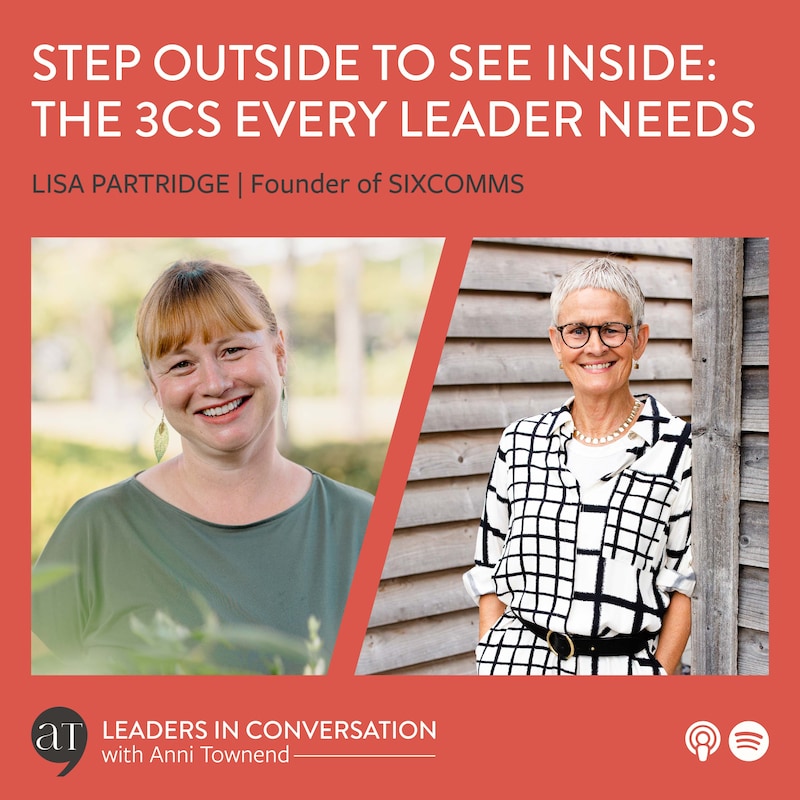
Today’s guest is Lisa Partridge, communication skills specialist, facilitator, founder of SIXCOMMS and host of the SIXCOMMS podcast. I had the joy of getting to know Lisa through following each other on LinkedIn, and through our shared passion for working in nature with leaders. Lisa invites people to ‘Come Curious, and Leave Connected’.
In our conversation Lisa offers valuable insights into:
- The 3Cs of human-centred effective communication: Connection, Curiosity and Compassion;
- The benefits of taking conversations outside in nature;
- How being in nature allows us to listen more deeply and be more present with ourselves and each other;
- How taking our conversations outside in nature can unlock insight and give us the clarity to see the path ahead.
Lisa’s Three Key Encouragements to Leaders:
- Connection first, always.
- Step outside to see inside.
- Slow down to lead strong.
About Lisa:
Originally from the UK and based in Singapore since 2009, Lisa Partridge is a communication skills specialist, facilitator, and founder of SIXCOMMS. She has worked with leading organisations including Singapore Airlines, Marina Bay Sands, Maxwell Chambers, and ADB Bank. Guided by her 6Cs of Effective Communication: Connection, Curiosity, Compassion, Clarity, Customization, and Consistency, Lisa helps leaders and teams communicate with greater impact. She also hosts The SIXCOMMS Podcast, now with over 70 episodes, and leads 6Cs walking sessions in Singapore’s parks, where a community of professionals “Come Curious, Leave Connected.”
To connect, follow and find out more about Lisa:
LinkedIn: www.linkedin.com/in/lisasing/
Website: www.sixcomms.org
Instagram: @sixcommslisa
YouTube: www.youtube.com/@sixcommsconversations2025
Lisa's Podcast: sixcomms.buzzsprout.com
Free download: The 6Cs of a Thriving Communicator Guide
To listen to other Leaders in Conversation with me Anni Townend go to my website, www.annitownend.com; to listen to Finding Your Collaborative Edge with Lucy Kidd and I, to do go our website www.Collaboration.Equation.
Transcripts
Foreign hello, welcome.
And welcome back to Leaders in Conversation with me, Annie Townend, podcast host and partner to executives, leaders and their teams, co founder of Collaboration Equation and of the podcast Finding your collaborative edge with Lucy Kidd. Leaders in Conversation is the podcast in which leaders weave together the threads of their life and leadership stories.
The people, places and experiences that have shaped them, their values, beliefs, passion and purpose to encourage and inspire you to be even more confident and courageous in your leadership. Today's guest is Lisa Partridge, communication skills specialist, facilitator, founder of six Comms, and host of the six Comms podcast.
In our conversation, Lisa offers valuable insights into the three Cs of human centered, effective communication, connection, curiosity and compassion.
The benefits of taking conversations outside in nature, how being in nature allows us to listen more deeply and be more present with ourselves and each other. And finally, how taking our conversations outside in nature can unlock insight and give us the clarity to see the path ahead.
Lisa invites people to come curious and leave connected. And that's very much what we hope you will feel the listener in our conversation today. Come curious and leave connected. Welcome, Lisa.
Lisa Partridge:Thank you so much, Annie. It's a pleasure to finally meet you.
Anni Townend:I know. And we follow a similar path as in we're both passionate about walking in nature, being in nature, and taking our conversations into nature.
And I would love to start by asking you, who are the key people, places and experiences that have shaped you and informed how you lead, how you facilitate and all that you do?
Lisa Partridge:Yeah, I think the first people that come to my mind are my parents, both my mother and father. My father's been an entrepreneur all his life. He recently retired, so I remember growing up watching him getting ready for his meetings.
He used to own a greeting cards distribution company with my uncle, and it was all about relationship building and connecting with his customers. And he had very loyal customers. And I think that really showed me the importance of building trust and building rapport from a very early age.
Likewise, my mum has always been in the service industry and in more recent years she was a carer in a elderly people's home. So in terms of the caring and the compassion and the nurturing, I got that very much from my mum and I got my entrepreneurial spirit from my dad.
So I think they had a massive influence in what I do now and how I facilitate spaces and how I try to build relationships with others.
Anni Townend:And is it the entrepreneurial spirit in you that took you to Singapore? Because the place that you are, where you do your walking and talking and taking people outside into Nature for conversations is Singapore.
Lisa Partridge:Yes, it's interesting because I actually was running my own business in London when my partner at the time, he's now my husband, had this opportunity to go to Singapore, and it's going to be 16 years this September. So back then we were living in central London. I was running a business and he's in finance.
And at that time there was a credit crunch, so a lot of people were losing their jobs and this opportunity came up and neither of us knew anything about Singapore. So it was one of those situations. Do you take that chance? Do you go? The worst that could happen is we didn't enjoy it and we'd come back.
But I left my business and maybe naively thought I could run it from Singapore. Unfortunately, that never happened. So I then ended up finding employment.
But I was out of work essentially for the first six months while my husband was transitioning into this new job. And we were getting used to being in Singapore, which we really didn't know a lot about. We had our three children here and we've never left.
So, yeah, actually coming to Singapore wasn't out of an entrepreneurial thing. I left my business, but it's definitely something that we don't regret.
Anni Townend:And was your business in facilitating, leading, helping people to have conversations, Lisa?
Lisa Partridge:Yeah, it was definitely supporting people to have conversations. But when I graduated from university, I went into English language teaching, so English as a second language, because I always wanted to travel.
So I went off and did some traveling and was teaching in all different parts of the world. And when I came back to London, eventually I decided that I didn't want to work for anyone else, but I wanted to create my own business.
I did English language teaching to individuals and groups in company, real range of different clients. And I went here, there and everywhere across London, providing that training.
Anni Townend:And what took you outside, Lisa?
Lisa Partridge:I've always loved the outside. I've always loved nature. And we were lucky enough to grow up in a place where we were surrounded by beautiful countryside.
In fact, we had a very big oak tree in the front of our house. Many a childhood time was spent around that tree, having picnics, throwing snowballs, inviting the neighbors over.
I had a great relationship with nature from an early age, but more recently it was during COVID and I think this is probably true of many of us, where my appreciation for nature just grew so much more. And at that time I was in Singapore in an apartment with three children under five in lockdown.
I suppose the thing that kept me sane and able to just cope with it was that hour that we were allowed. Once a week, I would get out and I would walk a lap of my reservoir, my local reservoir, which we're lucky to live near.
And I'd put my headphones on, I'd listen to my favorite podcast, and I just so enjoyed it. And then when we came out of lockdown, I decided to leave my previous organization and started the business.
I knew that I would need to go out and network and connect with others and build that up. But what I was finding was the indoor structured networking was just so exhausting to me and I found it quite transactional.
So it was a bit more like collecting business cards, but really looking at those business cards and thinking, okay, what do I do with this? Now, one of the six Cs of my business, the first one is connection, and is having that human centered approach.
So I just by accident started to invite people for a walk. It was just one or two people, and then within the space of a few months, it was becoming part of my routine.
And at that point I had no idea that it was going to become an integral part of the way I do business. People started to really enjoy it, and then a friend would share it with another friend. And before I knew it, I had five people in a WhatsApp group.
And then that five became 10, and then that 10 multiplied.
And at one point, one of my friends who unfortunately recently left Singapore, she said to me with a kind of knowing look, like, what are you going to do with this? And I was put on the spot a little bit and I thought, what does she mean? But she was right.
A few months later, I've made it part of the way that I connect and the way that I build relationships and it became more of a community. So, yeah, it was more structured and now it has a monthly theme and it's grown and yeah, it's just been amazing.
But it really did just start very organically.
Anni Townend:It's really wonderful to hear you describing how being in nature and walking lent itself to networking and people connecting with each other. I found through our work, both with walking partnerships and in all our work with collaboration equation.
Walking and talking side by side in nature is an integral part of the way in which we work, the way in which we help people to connect with each other and to create a community through being on a journey together, on a path together.
And it's lovely to me that your first three Cs of human centered communication is connection, because I do think there is something so very powerful about connecting with ourselves.
As you found on your own around your reservoir during lockdown, but then connecting with others through being in nature, and someone described it to me the other day through being shoulder to shoulder with each other. And for me that can be. If people are sitting outside, being in nature facilitates a different conversation.
Lisa Partridge:Absolutely.
And I kind of drive myself a bit mad at how passionate I am and I get quite frustrated when people don't share in the excitement of having a conversation and walking outside in nature. And yeah, absolutely, as you said, you don't need to have the ability to walk. It's just sitting on a bench, side by side.
There's something about it that unlocks people and you're just so much more present and it's just so nice not to be distracted by all the tech that we have to deal with on a daily basis. So, yeah, I just love it. I'm a great champion for it and I advocate it all the time.
Anni Townend:And that's how we found each other, isn't it? Through LinkedIn and following each other. And I love all that you share on LinkedIn.
And you always like and share what I'm up to with my colleagues Lucy and Natalie Sherring as well.
Lisa Partridge:Yeah, I've really enjoyed seeing your posts and it's always great to meet someone that's as passionate about this as I am. And I know that there are people out there, but when you find someone very generous in their sharing, which is.
Anni Townend:Lovely and very curious. Which is your second of your three Cs of human centered, effective communication.
And you've described connection, something that you learned early on in childhood from both your parents, the connections that your father made through his work, and the way in which your mother also connected with and nurtured relationships, being at the heart. Moving on to your second C, that of curiosity. How did that come about, Lisa?
Lisa Partridge:Yeah, so I have a saying that I think connection and curiosity are best friends. So they play off of one another and there's a great synergy between them.
It's interesting because for this conversation I'm just focusing on the three Cs of the human centered part of it. But actually there are six of them that work that are interconnected, all underpinned by attentive listening.
How did I come about with these six Cs and how did I come about with the six comms as a name?
Interestingly, for 11 years that I was working for the British Council Professional Development center here in Singapore, one of our bread and butter courses was a writing course and it had a framework in there. Which was the six Cs, and it was used for editing your written communication.
And I think only one of my C's that I have now was in there, and that was clarity.
But basically, when I was trying to decide the name of the business, I went back to that framework and said, okay, if I was to just think of overall communication, what would my six Cs be? And very easily, I came up with the first three. The connection, curiosity, and compassion.
So I really do believe that that trio is definitely something that is the starting point. And when I'm having a difficult conversation, I always go back to that trio. Okay, come on, let's connect with myself now.
Try to connect with the other person. Ask some curious questions. How might they be feeling? What might their perspective be?
And okay, if I put my compassionate hat on now, what would I say, do, and how would I like the other person to feel? So when I start doing that, it always gives me energy. It gives me a positive energy rather than getting stuck in a difficult conversation.
Anni Townend:Absolutely.
I'm smiling because, again, with our collaboration equation, our three Cs of mindset and behavior overlap with yours, which doesn't surprise me, given that we're walking this similar path together, Lisa. And they are curiosity, care, and courage. So we have the curiosity there.
We also have the care, the compassion, and then we have courage, curiosity, care, and courage.
But really interestingly, where it all started was I came up with seven Cs, and one day, Lucy and I were having a conversation, and I found I couldn't remember all seven of my C's. And so we worked together on which were the core three Cs that in leadership, in getting to find your collaborative edge, really matters.
So it's lovely to me to hear that there's an overlap with your six Cs, our original seven Cs, and how we, like you, whittled to three core, really important Cs that help leaders create cultures of connection, which is what we're all about.
I absolutely love your come curious and leave connected, which is such a lovely way of thinking about what you offer to people who join you, and an invitation to people in whatever scenario, a meeting, a conversation, any exchange. To come curious and to leave connected is really powerful.
Lisa Partridge:Yeah, I can't claim credit for that, actually. That was from a focus group I did out in Nature, and I had a bit of a competition. If we had a tagline for our walking community, what would it be?
And that was one of the suggestions. So, yeah, it just goes to show, you always put it out there and collectively you can come up with something.
Anni Townend:Wonderful and that you were outside in nature when that came to you and how nature speaks to us.
And it would be lovely to hear more about your experience of how nature supports us in our leadership when we're being in nature, that stepping outside to see inside of ourselves.
Lisa Partridge:Yeah, I think there are an array of natural elements that just invite us to have more perspective, be more present and be able to listen a bit more deeply. Fortunately, I'm in Singapore and so we have really great accessible green spaces everywhere.
So I can be by water, I can be by the sea, you can be on the beach and look out in the vastness of the sea and the tide. But equally I can very conveniently hop on public transport under half an hour.
I can be in the middle of a beautiful park surrounded by tropical trees, heritage trees, tropical plants, and always there's wildlife around. And so I think it invites us to notice those things and then draw comparisons, draw synergies with these natural elements.
If we're stuck, we can look out at an expansive area and it can feel a bit more hopeful and I think hope is something that's needed nowadays if we look at the world news on a more day to day basis, I think we're always competing against the, the digital distractions.
So just being in the calm of nature and I'm just in awe of what I see in nature, like the heritage tree that has so many stories within it, what it's seen over the generations and how a plant grows on the trunk of a tree. And what does that tell you about collaborating and connecting with others of different communication styles?
So you can use the natural landscape to help you access feelings or thoughts that you wouldn't be able to easily do within the confines of an indoor space or a more traditional boardroom. And that's something that I've witnessed and I feel on a regular basis I've been walking beside someone, I've got someone in my mind now.
And we were talking and we went past a heritage tree and at the same time we both looked down at our arms and we had like goosebumps.
And it's very hard to describe that to others, but it's an incredible, I would even say it's a spiritual kind of connection that we have with the land. And certainly I have lived in Singapore for 16 years this month. But I wasn't born here. My children were born here, but I wasn't born here.
And I think a big part of me going out into nature is to Have a greater appreciation and a connection to the land that I'm on. And that became very important to me during COVID because Singapore I now class as my home. I'm very attached to it.
But I think that attachment has been made so much more powerful by regularly going out into the natural spaces and having more of an awareness of the environment around me. I would encourage people to go out and notice more about the land. And it doesn't have to be far away. It's just like, you know, outside your doorstep.
Anni Townend:I'm with you, Lisa, on that noticing and that being such an important quality and skill to practice in our leadership. Noticing and paying attention to the context in which our leadership shows up. And I think nature, the landscape.
I walk the same path more or less every day, at least once a day, and yet every day it's different.
And sometimes I'm walking the path with a client where they're on their headphones and I'm on my headphones and they're walking in their landscape and I'm walking in my landscape. And often where they're walking is where they walk regularly. And where I'm walking is where I walk regularly.
And yet through our connecting with each other and through our conversation, pausing, stopping, noticing, paying attention, it's always different. It may be the same landscape, the same ground that we're walking on, but everything is different.
A different time of day, maybe the atmosphere, the weather is different. I think it helps leaders flex that muscle of paying attention, of noticing and responding to the environment and which is so important as well.
I am curious, Lisa, and I imagine listeners are. What are your other Cs we've talked about connection, curiosity and compassion.
We haven't talked very much about yet, but I know there's compassion and three other Cs as well.
Lisa Partridge:Yeah, there's so many words that begin with C that are so brilliant. The three Cs that I've mentioned are the human centered approach. And then the remaining three are what I categorize as the strategic communication.
So the other three Cs are the strategic Cs so clarity, customization and consistency. So yeah, so they work with the human centered approach as well. And they're all interconnected.
They play off of each other, shall I say, like a very nice thriving ecosystem.
Anni Townend:And in what other ways does nature really support people in accessing that strategic thinking as well as the connection, curiosity and compassion?
Lisa Partridge:So I developed a three hour workshop that I do in nature, which is called the Clarity workshop.
And this is done at the beginning of the year, it's a good time to do it mid year and towards the end, it's about really reflecting on what has passed, what we've accomplished, what are some of the strengths. And I facilitate it using the appreciative inquiry method because it's such a lovely strength based approach.
So it's about celebrating what's been and what is present for us now and what are some steps or actions that we want to implement to take us to that vision, whatever that vision may be in the chosen timeline that you have. So whether that be in the next three months, the next six months or even a year.
I have plotted out a route in one of my favorite parks here called Fort Canning park, where there's lots of areas where you can pause for each section of the workshop. You can work in small groups or in pairs. And we go through six steps and we use the nature around us to inspire us.
And I have a little exercise that I do which I call the Visioning tree, where people get very creative with lots of post it notes and draw their own tree, which could be inspired by a tree that they've liked in the area. And they're just like brainstorming how they want to get that vision to come alive through using that tree element.
So each part of the tree represents something different. So the roots and the trunk and the leaves. So the roots being, what values am I going to draw on?
The trunk being what do I want to feel in the desired future. And then the leaves are like the doing parts. What are the activities that I want to be doing and that visioned future.
And then we end it with there's a lovely area that has some stepping stones.
And I actually get participants to jump across the stepping stones, shouting out the steps that they want to take in order to achieve that vision or that target. Yeah, I just love being able to use the natural elements to design the facilitated spaces and use that as an inspiration.
Anni Townend:It really does support us in our work, doesn't it, Lisa, that the stepping stones helping us to embody physically jumping from one stone to another stone, taking these steps.
And certainly in the work that I do with Lucy Kidd and Natalie Shering for our walking partnerships, we, like you use different locations, but we are always responding to the location and using it as a way of really helping people to embody their leadership, to take their next steps. And often we choose transitional points in the year.
So we offer three of those days per year in three different locations where we invite people along to experience the power of nature and the Power of walking and talking in nature, but in particular it's about transitional points, a little bit like yourself at the start of the year. So we'll have one in spring, summer and autumn.
And I enjoy all of them and I'm always delighted by the people who come together and express, experience the power of the walk and talk in nature.
Lisa, as we come to the end of our conversation, what key three encouragements would you give to leaders to give them more hope, to help them find their tree, if you like the tree that will help them to connect with themselves, to be curious and to take care of what they are leading for?
Lisa Partridge:I'm going to come back to the trio, the three C's Connection. So connect first, please don't forget the human behind the screen. So connection first and foremost, curiosity.
Step outside into nature and it doesn't have to be so far. Step outside to see inside to go internal. What are you thinking? What are you feeling?
And just becoming present with that and aware of that and notice that. And then of course the third one, compassion.
I think this always starts with the self slow down to lead strong slowing down and walking a bit slower than you usually do.
And I'm saying this for myself as well because I do have a tendency to walk fast but intentionally walking slower and noticing and not responding and reacting.
Anni Townend:Thank you, Lisa.
And I'd like to ask you one final question which is as a result of our conversation today, who is the person you're going to have a conversation with and what will the conversation be?
Lisa Partridge:Oh my goodness, that's such a good question. It's interesting. I had a conversation, a very illuminating connecting conversation yesterday with a friend of mine.
I'll give her a shout out, Mangler, who is another business owner here. And I think I might have another conversation coming up with her and a few other of my active walkers. I think it's time for a meetup.
Maybe not outside this time, but maybe it's time for some tea and cake.
Anni Townend:Wonderful. Have a wonderful tea and cake conversation, Lisa.
And for people who would like to connect with you, people in Singapore who would like to join you, people who would like to follow you, ask more questions, who are curious and really want to connect and learn more, how best.
Lisa Partridge:For them to do so well, very active on LinkedIn. So yeah, just type in my name, Lisa Partridge. And I post very much consistently on there.
I do have an Instagram, six comms and the website and I have a podcast as well. So you can download some episodes from that. That would be great. I really delve much deeper into these six Cs with some amazing guests as well.
Anni Townend:And I can highly recommend your podcast to people and to listen to it whilst walking, which is something I do but not very often because I'm usually listening and noticing and paying attention to where I'm walking and or with whom I'm walking and talking. But I have listened to a few of your podcasts and really enjoyed them. So I do encourage you, the listener, to listen.
And if you'd like to listen to more Leaders in Conversation with me, Annie Townen, do go to my website annietownen.com to listen to my podcast with Lucy Kidd, do go to Collaboration Equation and listen to Finding your Collaborative Edge. And a huge thank you not only to you Lisa, but also to Smogus Media for the wonderful production and marketing of the podcast.
And if you would like to have a conversation with me, please contact me on anniennytownend.com I look forward to connecting with with you via email, via LinkedIn and through leaders in Conversation. Thank you for listening. Thank you Lisa.
Lisa Partridge:Thank you so much.


