Shownotes
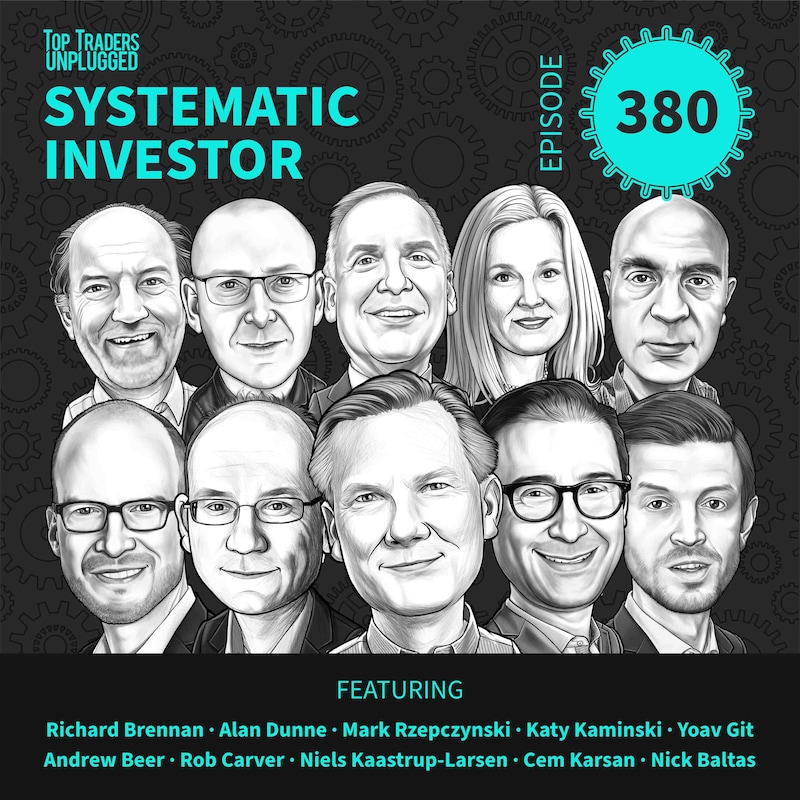
Niels is joined by all 9 amazing co-hosts, to discuss a year that refused to behave. In part one of the annual "roundtable", Niels and the group map why 2025 produced such striking dispersion across trend followers. They revisit the Liberation Day shock and the uncomfortable truth it exposed: results often came down to unglamorous choices like market selection, time horizon, and how quickly risk is resized after clustered volatility and sharp reversals. The conversation then widens to a structural theme: the rapid growth of strategies investors hope will sit outside stocks and bonds, from managed futures and multi strats to structured products, gold, and crypto, plus the liquidity, reflexivity, and selection challenges that follow when everyone reaches for the same diversifier.
-----
50 YEARS OF TREND FOLLOWING BOOK AND BEHIND-THE-SCENES VIDEO FOR ACCREDITED INVESTORS - CLICK HERE
-----
Follow Niels on Twitter, LinkedIn, YouTube or via the TTU website.
IT’s TRUE ? – most CIO’s read 50+ books each year – get your FREE copy of the Ultimate Guide to the Best Investment Books ever written here.
And you can get a free copy of my latest book “Ten Reasons to Add Trend Following to Your Portfolio” here.
Learn more about the Trend Barometer here.
Send your questions to [email protected]
And please share this episode with a like-minded friend and leave an honest Rating & Review on iTunes or Spotify so more people can discover the podcast.
Follow Nick on LinkedIn.
Follow Alan on Twitter.
Follow Katy on LinkedIn.
Follow Andrew on Twitter and LinkedIn.
Follow Cem on Twitter and LinkedIn.
Follow Richard on Twitter.
Follow Mark on Twitter.
Follow Rob on Twitter.
Follow Yoav on LinkedIn.
Episode TimeStamps:
00:00 - Opening and introduction to the Systematic Investor Series
02:24 - Setting the agenda for the year-end group discussion
06:04 - Return dispersion and the shock around Liberation Day
10:41 - Market selection versus trend speed as performance drivers
15:17 - Volatility adjustment and why mid-speed models struggled
21:11 - The rapid growth of non correlated assets
26:40 - Liquidity limits and reflexive effects of large inflows
31:23 - Is dispersion healthy or a hurdle for allocators
37:17 - Investor behavior versus strategy outcomes
42:56 - Are model design choices ever truly obvious
46:22 - Objectives, factor exposure, and what investors really buy
50:49 - Dispersion as differentiation or classification problem
57:07 - Evaluating managers in a world of randomness
01:02:02 - How much data is enough to judge performance
01:11:05 - Closing remarks and preview of part two
Copyright © 2025 – CMC AG – All Rights Reserved
----
PLUS: Whenever you're ready... here are 3 ways I can help you in your investment Journey:
1. eBooks that cover key topics that you need to know about
In my eBooks, I put together some key discoveries and things I have learnt during the more than 3 decades I have worked in the Trend Following industry, which I hope you will find useful. Click Here
2. Daily Trend Barometer and Market Score
One of the things I’m really proud of, is the fact that I have managed to published the Trend Barometer and Market Score each day for more than a decade...as these tools are really good at describing the environment for trend following managers as well as giving insights into the general positioning of a trend following strategy! Click Here
3. Other Resources that can help you
And if you are hungry for more useful resources from the trend following world...check out some precious resources that I have found over the years to be really valuable. Click Here
Transcripts
You're about to join Niels Kostrup Larson on a raw and honest journey into the world of systematic investing and learn about the most dependable and consistent, yet often overlooked investment strategy. Welcome to the Systematic Investor Series.
Niels:Welcome and welcome back to this week's edition of the Systematic Investor series with Katie Kaminski, Jim Kassan, Rob Carver, Mark Rasimsimski, Rich Brennan, Alan Dunn, Nick Bolters, Andrew Beer, Yoav Git and me Nils Kast Verlassen as you can tell from this introduction, today and next week will be very special episodes because it's the time of the year where all 10 of us get together for one big conversation and debate.
So firstly, let me start by thanking all of you for making the time for this extended recording today, with which I really have been looking forward to. And of course for all the time and energy you put into making every weekly episode that we produce and have published this year.
It means a lot to me and based on the feedback we get from the audience, I know it means a lot to our community. We are recording on December 17th and this conversation will be split into two parts and published on December 27th and January 3rd.
We have a great lineup of topics that all of you shared beforehand.
g to be discussing the period:We're going to be discussing whether model designs are ever obvious within our world.
We're also going to be talking about how long or how much data is practically sufficient time for allocators to make inference about manager performance.
We're going to be talking about the process stability in a changing market landscape and also if we should move to high volume versions of CTA products. And also we're going to be discussing a little bit about drawdowns, whether it's better to have a deep or a long drawdown, and so on and so forth.
So as you can hear, we really have a packed agenda, so let's just dive right into it. The format for our conversation will be that each of us will select a topic and then it'll be open to comment on by the rest of the group.
But generally we are going to keep it a bit fluid to see how we get on and since it's become a bit of a tradition to let the ladies go first, why don't you, Katie, pick your first topic and feel free to direct it to whomever you would like to comment on this. And of course, afterwards, if someone else wants to voice their strong views, feel free to jump in. And otherwise I may prompt one or two of you.
But Katy, over to you.
Katy: al review of the year and for:I'd say that you've had some sizable return dispersion this year across different managers. And this is definitely precipitated by this huge shock that we had in April around Liberation Day.
And what we found, which was interesting, we examined a couple key factors. First, market selection. Second, speeds of trends.
And third, we also looked at volatility sizing and how all of these factors adjusted relative performance. And we found sizable dispersion across many of these themes. I'll start first with market selection.
If you select the 10 largest markets, that has performed significantly better than sort of a diversified approach this year. And so that makes sense because things like gold having a sizable allocation to that was the right call.
But that does show sort of the dispersion of depending on your market set, you could have very different results this year. Secondly, for speeds, we found that very slow trend strategies and very fast trend strategies weathered the storm this year.
So either reacting very quickly to what was going on or sort of being complacent was actually the best way to be. So around eight months was probably the worst place that you could be in terms of a typical trend window.
And that shows sort of how, you know, different choices in your time horizons is also quite important for providing very different returns, especially in a year with a big shock. And finally, we looked at volatility adjusting.
And this is important because when you do have a big shock, like what we saw recently in Covid, we studied our turbulence metrics and what you saw around Liberation Day was three days in a row of extensive shocks, not one, and then a quiet period and then a reversal, which is in some sense a very challenging price trend signal for trend following strategies.
look across different years,:So actually being faster would have gotten you in and out of those positions more aggressively.
So I think our key takeaway this year is that given the extremity of the moves this year, subtle decisions in your allocation, subtle decisions and speed created very, very different results.
Which you know is an important point to remember that each year is very different for the space and that we'll see this commonly with trend strategies that rely on price based information to make these decisions.
So I would love to ask my fellow panelists like if they have been looking at these sources of dispersion in the space and some of the thoughts that they have about these particular factors and how to navigate, how to think about that dispersion this year.
Niels:Yeah, I'd love to hear from, from many of you.
But actually let me just add one thing to that and that is I'd love to have your thoughts also on whether you think market selection was more or less important than, than actually speed. Because I think that that is a tricky one. So anyone who has an opinion about this, feel free to jump in.
Katy:We found market selection in our, our goal. So imagine if you just trade gold and you know, or oil or just and corn.
You would see that those happen to be the markets that tre trended the best this year idiosyncratically. And that's not the case over a 25 year history, but it is the case for this year.
Niels:Yeah, Andrew, you raised and well that's.
Andrew:I mean that's, it's.
That mirrors the analysis that we've seen this year that from a replication perspective, particularly the concentration in markets, if you look at the performance of our strategies versus the overall industry, you know, you can see that for instance when the euro spiked earlier in the year, we looked over concentrated in the Euro because we only trade two commodity, two currency contracts.
On the other hand, when the yen ripped, sorry when, when yen started collapse later in the year, you know, our concentration, it really helped and also to reiterate the point on slowness is that you know, there is somewhat of a delay in terms of our rebalancing so definitely helped us around Liberation Day and I used to use this analogy was that the shorter term models, you know, were almost kept taking Trump too literally that he would say something and then they would, you know, the markets would respond and the shorter term models would immediately respond or, or the volume controls would kick in. Whereas the longer term things were really much more. Most investors which are, let's just see how this plays out a Little bit.
So I, yeah, we've definitely seen that.
Niels:On our side, I would agree.
Katy:But I would say that we found the shorter term models actually weren't as bad, which was interesting. It was more the mid range that was actually the challenge, like the eight month to six to eight month period.
So I think those perhaps were overreacting more than the shorter term. Just adding to that, we've done something.
Nick:Very similar to what Katie was kind of saying. I just pulled out some, some charts just to effectively comment specifically on the points. I would make maybe two points.
The local assessment of what evolved heard me speaking over the last few months, all those V shapes. So if I go back, let's say last August or even the SVB or even obviously Liberation Day, we found the exact same thing that Katie mentioned.
If you're too quick in a V shape, you'll get some of the first part and some of the second part. Right. If you're too slow, you just stomach the first part, get all the recovery.
If there's something in between, it's almost like the soldiers walking on the bridge in a synchronous manner. The bridge is basically falling. Right.
So there's a bit of spot here whereby the speed, not being too fast, not being too slow gets all those V shapes exactly as painful as they can get. So that's like the local comment I would make. So I totally agree on this one. Maybe kind of bigger scale.
Year by year we've done a very similar exercise. The way we've done it, it's actually quite nice if I were able to kind of even show you.
We literally just ranked anywhere from 2 months to a 12 month half life. And then we took samples of universes a very small and concentrated. Actually we had 10 markets.
I don't know if we had some sort of a number in mind, Katie. And then we had a couple of medium sized universes, but not too random. So somehow there's a bit of thought process to how we would put them together.
Kind of representative. And then a very large one, like more than 80 markets. And then every year we kind of rank them either by speed or by universe.
So here's the gist of it.
The last three years, at least based on our calculations, have been the only three years in the last 25 that the longest speed or the slowest was always the best. So the last three years, 23, 24, 25, the best. Never ever in those 25 years had we had all three together.
Sorry, never had about three years consecutive. And then let's say it's nine months, for example. So like relatively slow being the best.
years, if you now go back to:It happened however, that still a smaller universe was, was, was a better one to have. So in summary, I think locally you have the situation that, you know, the middle ground of the speeds is the worst.
ct contrast to what we had in: Niels:Interesting, Yoav.
Yoav:Yeah, I think what's interesting, I'm not going to comment about the results, but the perception from clients was very different.
So throughout H1 first half of the year, the question that most investors were asking, given Trump, given the speed, given the uncertainty around Trump decision making process, should you be speeding up? So that is a question that we had to field throughout the year, which is should you be trading faster and faster.
And in fact it's quite interesting that the models that actually performed the best are actually the ones that were slower, which I found it very ironic.
Mark:This is a really important question because we need to figure out a way to classify different trend follower CTAs. Because you may find that there isn't a single manager that does everything you want.
And the classification scheme that I use is, I call it a three factor classification, it's called STM style, timing and markets. And you can think of this almost in three dimensions.
You know, what's the style, which could be the volatility response, markets, what are the number of markets you trade and timing, which would be the speed.
And then when you think of this as a three dimensional continuum, you'd say like, well, do I have managers that fit within different speeds, different sets of markets or different styles? And so when I build a portfolio as an investor, I don't want to have just one single type of manager in my portfolio within this CTA space.
Niels:Yeah.
And I was just going to add to that before we go on to, to Cem's topic and that is that I think it was Nick today shared with us the latest Quantica paper which specifically talks about speed. But also in their conclusion they kind of end up saying things change.
between what worked prior to:So it's not just a static, you know, set of parameters that you use. And that seems to me to be a logical conclusion. So anyways, very interesting topic. Now we're going to probably go to something very different.
Cem, what's on your mind?
Cem:Well, I'm going to try not to go, going to start today with a step back and looking at the, the broad picture, not just trend, but what I would consider non correlated assets.
I think one of the most important things that we have really been talking about for the last year is the massive correlated growth of non correlated assets. And what I mean by that is I really. And they're not all assets, let's say strategies and assets.
I think very few people are talk about how precious metals, crypto, and the growth of those is also very correlated to the growth in structured products, right. And hedge fund strategies, non correlated strategies and the amount of AUM flowing into all of these.
I think the reality is that we sit in a world where long assets broadly globally is about 400 to $500 trillion. And up until about three years ago, assets in hedge funds were about $2 trillion. That was about two and a half years ago.
Those numbers, precious metals in terms of actual assets out of the ground, right, was about about $3 trillion. This is about again three years ago. Structured products were at about $500 billion three years ago.
And when I say structured products, by the way, I'm including ETFs that do the same thing and mutual funds and buffers and everything that essentially does those types of things. And then crypto was at about 1/2 trillion. Fast forward 3 years, they've all doubled, tripled, quadrupled in assets.
And most of them it's a hockey stick, right? It's a very kind of slow growth or no growth.
You know, in the case of hedge funds, basically sideways for about you know, six years and then all of a sudden boom, three years later. Hedge funds are at four and a half trillion, crypto is at four and a half trillion. Precious metals goes from three to nine, right.
You know, structured parts 500 billion to 2 trillion. And I think this is something very few people are talking about is that we're riding a incredible wave of, of money flowing into this space.
When I say this space, all of these spaces.
And I think the driver is all the same, which is that you have $500 trillion on one side and on the other side you've Gone from call it 6 trillion to 20 trillion dollars. But the big point is there's only 20 trillion dollars in non correlated assets relative to call it 4 to 500 trillion on the other side.
And you could argue that these, this wave of assets rolling in is still not just early innings but very nascent.
That that the need for non correlation could very, you know, is very likely going to be higher when long assets are not performing as well if they do so for some extended period of time. And also as interest rates go higher and do it for some longer period of time.
tween stocks and bonds in, in:But also I think you know, record valuations and equities and a lot of assets, increasing debt, loss of US Hegemony and you know, or control to some extent. All of these things are risks that are undeniable.
And I think seeing those risks and then also seeing the lack of bonds being able to necessarily offset equity risk is really the main driver. It's logical. But again it's hard to find capacity for non correlated assets. And so I think this is probably the biggest conversation of all.
How are we, how is the infrastructure and the liquidity going to build in non correlated assets? What are non cor. You know, what else can be non correlated and seen as non correlated?
I think if you ride that wave now these are early adopters coming into the space still given the risks and given what we're talking about and if big, if interest rates go higher, if more secularly if we see risks begin to develop and like a lot of people expect a longer period of underperformance of long assets.
This could be a very interesting decade for not just trend and hedge funding or non correlated type strategies but for all of these things and anything related to non correlated. And I think that's probably the biggest issue of all.
Niels:I think it's a great topic and as always he already see three people wanted to jump in on this. So. So Rob, you, you came in first.
Rob:Yeah, I'll be really quick just on terminology I think be very clear, we're talking about things that are perceived as non correlated and which Absolutely. Recently have empirically been non correlated. That doesn't mean to say that they won't be non correlated especially in some kind of market shock.
And obviously I'd be more.
I mean some of these things clearly are design uncorrelated and like a pure tail Protection strategy that buys out of the money straddles or something like that.
It's probably, you could probably say, well that's probably non correlated, but other things just have happened to be non correlated and investors think they're non correlated and they may well not be in the future.
Cem:Absolutely.
Niels:Yeah.
Yoav:You have, I think it's interesting because there are different type of investors who went into each of those markets. So if you look at the crypto market, you will see a lot of retail flow into crypto.
And if you look at gold, there is a much more, there's a much more central bank flowing into gold and you can understand the rationale in terms of the dollar and whether that's an inflation hedge.
And when you look at, at, at sort of multi strategies or the hedge fund universe, that's actually more from allocators, from portfolio construction sort of behavior. So although you're listing all three items as the same, actually there are different players of. Oh, Sorry, I apologize. Four of them.
There's CTAs as well. We are all, There are different players who go into trying to solve their problems and they each take a different path.
And I think that's actually related from our perspective, the most exciting thing is actually the total portfolio allocation.
This methodology which says I want to have uncorrelated strategies in my portfolio because I'm thinking about my portfolio as a whole and how do I get myself a better portfolio? The answer is I want to get something which is actually uncorrelated to the long, only the, the delta one in bonds and equities.
And I think that is, that's a, that's a, that's a good thing that we're seeing in terms of. People are kind of beginning to value uncorrelated investment methodologies, investment paths.
Niels:Andrew, you must have some thoughts on this.
Andrew:Yeah, no, look, I first, I completely agree, agree with all of it and I, I. Jim, I agree with you that it's, it's early stages just because of the sheer dollars involved. I mean you look at the ETF world, it's a $13 trillion market with basically.
No, I mean you talk about things like buffered ETFs and stuff, they're still just scratching the surface. That's why Goldman just paid 2 billion for Innovator.
But you know, I think, I think what's also happening underneath the surface, which I see very, very much on the wealth management side is, is people getting smarter and more educated.
And the first time I went to a major wealth management platform and spoke to the ETF research people about future, about an ETF that trades futures contracts. They didn't know what futures contracts were. And I was getting questions like, you know, what happens if the two year treasury goes to zero?
And now you have, you know, Fidelity and blackrock and you know, great podcast you just did Neil's with, with, with blackrock. You know, now you have basically this sort of gradual process of education.
What that does is it also drives demand because now people have a skill set, right. And they understand it now. They've been tasked with.
s my theory about right after: have happened in the, in the:I think there's the seismic shift going on where there's now a bucket. And a lot of the challenge that people are facing is they now have a bucket, now they've had to figure out how to fill it.
Niels:Yeah, Alan, thanks.
Alan:Yeah, just to echo Rob's point, I think that's really important.
le. We saw this in, you know,:But even you have to keep in mind that, you know, global liquidity can drive a bull market in many assets and they can move up in an uncorrelated way. So things like crypto, obviously, even gold benefiting from liquidity conditions.
But then the question is, you know, which strategies are inherently adaptive and have the ability to generate convexity in times of stress. So I think that's, that's the next level of thinking that maybe a lot of investors don't have yet.
You know, uncorrelation, but over what period are you measuring that correlation and then looking into the mechanics of the assets or strategies and do they have that ability for convexity? So yeah, people are getting more educated, but maybe not making that distinction yet.
Niels:Cem, back to you.
Cem:Yeah, I think one thing that is so critical about this is Just, you know, because it's early days and there's still a lot of infrastructure and product being rolled out, there's a lack of liquidity to support the amount of inflows coming in. And, and you know, the most scalable strategies tend to be the most simple and often imperfect.
And the more flows that those structure very kind of specific strategies, whether they're hedge fund strategies or, you know, or structured products, they themselves are having massive reflexive effects on the underlying assets themselves. And so I think that's a critical point too.
We're seeing, just this year we saw several really dramatic effects from, from both structured products and hedge funds. And there, and we're starting to see the interaction of these, those effects as well. And I'll give one great example here.
This summer, you know, we've started to see a lot of, when, when liquidity goes down in markets, we're starting to see a lot of volume compression because the amount of structured product issuance and the amount of volume compression, that's natural flow, it overwhelms the amount of liquidity and other flows. And so a period like the summer, you're starting to see dramatic vault compression.
This is the second year in a row and we're seeing it with, you know, exponentially higher amounts of volume supply. That volume compression leads to dispersion because that volume pression primarily is at the index level. Right.
And so when you're compressing volume at the index level, that means because idiosyncratic crystal exists, singlest constituents of the indexes start moving away from each other. So we start to see massive dispersion during the summers when volume is being compressed.
These are effects because of the massive growth of structured product, but it's being exacerbated because the growth in hedge fund assets, particularly long, short asset equity, is also dramatically higher. And so what's happening? Well, liquidity is low volume compression is happening at the index level. Dispersion is happening.
And where is the dispersion happening exactly? In the, the, the, the, where the positioning is the biggest in long short equity.
So there was a massive structural pain and long short equity land this summer. And so these types of massive effects are, massive growth is having dramatic structural effects in the outcomes underneath, underneath the market.
And, and this is early innings. You know, imagine next year, the year after, the year after here in this type of environment.
These things are actually going to be the primary driver at some point of the underlying assets themselves. And, and so I think a critical thing to be aware of.
And, and again, if, if this Thesis is right, that this is all being driven by a move towards non correlation and it's really a supply and demand imbalance between people needing non correlation and the amount of non correlation available. That is maybe the most important thing to understand in finance.
Nick:Nick, back to you now just add one point.
I think what Jim said was extremely interesting because and I think Rob said it in the beginning, starting historically the behavior, statistically speaking of those vehicles, however you want to call them strategies and that's on paper what the correlation is.
But I think what we have to be very careful about is the externalities that we would bring as allocators in assessing the statistical behaviors and eventually allocating into those strategies.
So like if for example strategy A and B historically are uncorrelated but today all of us end up investing into and all of us have the same objective which is, I don't know, maximize the long term geometric returns and all of us respond to a VIX shock, we're going to reduce the exposure at the same time. So we will experience correlations not in a backtest but in reality.
So I think those externalities become much, much, much more relevant in the way that those portfolios are actually managed.
Niels:It's interesting.
So just from my perspective, I mean obviously these things non correlation, that's kind of how we started decades ago talking about why trend following would be interesting now people seem to come around to it and you mentioned the conversation with BlackRock.
Actually we also or Alan had a conversation with HSBC Asset Management and they specifically mention, you know, how they want to incorporate more hedge funds. And I'm just wondering one is, you know, what's the trigger to why they think now is the right time.
But also I wonder if this will actually change the fee compression at some point that we've seen because there might be, you know, more demand for the best strategies to deliver this non correlation. Jim, you raised your hand.
Cem: ht? I mean we have seen since:And if you really get under the hood and think about why and Niels, you and I have talked about this on the macro pods et cetera, the structural driver we've talked about for four or five years before this rally started.
To be clear, the the pressures in the system are for higher interest rates and they may be able to counteract that for some time, but those pressures are real.
And, and the benefit of these non correlated strategies is not just non correlation which we're talking about, but for a lot of them is, is capital efficiency. You know, the benefit of using options.
Cem:Is not just non correlation or using part. You know, a lot of these strategies you can get exposure with dramatically less capital at stake.
of people don't realize that: s been scalable. But prior to:So that breakdown in correlation and also not just that, but the capital efficiency that you gain, I think is what people are waking up to and I think critical to kind of the outcome going forward.
Niels:Absolutely. Alan.
Alan:Yeah, I think the shift in the correlation is one performance across the space has improved, that's the second and I think higher interest rates are a component of that.
But to your point on the fees, like we are seeing that already, particularly I would say in macro, discretionary macro, where there's not a huge number of managers with very long term track records, established names and they've been able to raise their fees in the last one to two years. And obviously we've seen the growth of the multi strats which have been able to charge enormous fees relative to what was historically the norm.
hange from what we saw in the: Niels:Yeah, no, for sure. All right, very good. Nick, what's on your mind? What topic would you like to bring to us?
Nick:Let me go back to maybe the first topic, but you know, look at it from a very different perspective. I think as a group for the last couple of years we've been discussing about kind of growing the pie and I think some success has been achieved.
In all fairness, I'm sure Andrew will attest to that.
So this kind of growing the pie, which is the aspiration or maybe like a bit of subtle objective, how can we contrast that to the performance dispersion?
Like, we're talking about the growth in a space that somehow shares some commonality, but obviously within that commonality there is some dispersion when it comes to speed universe, so on and so forth. I think this year this was actually quite elevated. So here's now my question. We all speak to investors in a variety of, I guess, of ways.
Is that dispersion a concerning factor or should we think of that as the alpha or however you want to call it, what fees should pay for? Does that go in line with the growing the pie objective? Does it go against? Is that healthy competition?
I'm just very, very keen to see what people think about that because in my reading, this performance dispersion can also be a bit of a hurdle to grow further because then the whole selection exercise kicks off and kicks off quite aggressively.
And then once you see the spectrum of like, you know, plus 15 to minus 15, it can start appearing a bit more concerning, specifically when, you know, investment committees have to approve those investments. Right. So it's more of a question to the group, how do you think that dispersion plays out for the industry as a whole?
Niels:Katy, you came in first.
Katy:Yes, Nick, I think this is a great question. I think it's both a challenge but also a positive thing.
I mean, my view is you have, obviously it's been very exciting with the growth of the ETF space and different types of products and reaching a completely different investor universe.
And I think it's interesting, we wrote a paper about this last year about the managed future space, and most of the assets are really in the institutional space.
And as we grow that, you know, it's, it's going to give more investors access to things that are at least something that's different from what they have. Right. But I do agree with you that the challenge of the return dispersion will be a big challenge.
And it's something that we're going to have to spend a lot more time educating investors about.
Because the truth is, like, when you have a 20% difference between one product and another, it, you know, you're gonna all go through those cycles, Right. So one year, if your product is challenged, you're gonna be answering lots of questions.
In another year, another product will be challenged when the other one isn't. I mean, we know that with that type of dispersion, there's a lot of explaining to do. We'll be writing a lot of papers, that's for sure. Right, Nick?
But, but I'd say That that will be a challenge because it's one thing to join in the industry, but when the benchmarks and the dispersion is that high, it's very hard for investors to understand sort of which of these should I be invested in. I still do think though, with that challenge, a lot of investors, especially in the ETF space, they've never had this.
So I'm happy about, you know, that we're actually making these type of strategies, are giving them finally something different, whether it's CTAs, whether it's structured products. But it is, it is going to be an education hurdle for sure.
Andrew:We often try to think about the investor base as a monolithic whole. And I think there is extraordinary heterogeneity and wildly different preference functions.
There are investors, I mean, so in a sense what we've tried to do is build our business around a completely underserved market market, which is somebody who's building a model, model allocation is not an expert in managed futures, but can recognize the statistical benefits of a 3 or 5% allocation to the strategy, but does not want to spend a year getting up to up the learning curve to try to figure out how to evaluate whether that dispersion can play for or against them.
So that's one particular client base, but there are others on the institutional side who, you know, where again you have a job structure where it's somebody's job to make that evaluation and they have, they're not subject to line it of constraints, they're often not subject to the same all in fee pressures that you see in other parts of the universe.
So I think, I think what you'll see, you know, broadly is what's really been happening, which is that you know that within the universe you will have people who will view dispersion as huge positive because it allows them to make, you know, allows them to pick somebody who did well last year or beat up on somebody who didn't do well and then constantly kind of reconfigure their portfolios and there'll be others who say just give me a simple solution and you know, something beta like.
And I think, you know, what I've learned over the years is that people invest in what they like and it's, you know, you can try to come up with a, you know, so which is the, who is the best person in the space? You know, who's the.
You can make those arguments in certain hedge fund categories like don't bet against Stanley Druckenmiller over time, don't bet against, you know, Andreas Halverson of the Equity long, short space. Don't bet against, you know, Ken Griffin in the multi strat space.
But this space has, has a, a perception of a lot of randomness as we've even, even started this conversation into who does well or not well in a given year.
And I think that's the narrative challenge is separating when outperformance or underperformance is attributable to luck or what people, the answer that people want is it's attributable to skill, good or bad.
Niels:So actually I'd like to ask Jim something because obviously at Kai wealth you look at managers and you look at finding the best strategies to put together.
So I'd love to hear your thoughts about kind of the challenge that dispersion within a sector, within a strategy might present or maybe as Andrew and Katie said, the opportunity set, if you understand the strategy.
Cem:Well, yeah, I mean, obviously it depends on the strategy.
But look, there's always this balance between diversification, going as diversified as possible, which is a cheat code and we want to do that as much as possible if we do not know.
But if you are able to evaluate and determine that there is some reason to prefer one over the other, clearly you do not want to diversify to the ones that are less good in that scenario. And that's a line we're always walking. But there's a lot that we don't know and we, we don't overestimate what we know.
We, we, we are and more times than not we're looking to really spread out that allocation when we really have no strong confidence. There are things but we're fortunate to be in a position to evaluate better than others.
And I think being able to have that edge is important on the margins.
But, but you know, again, there are very few things that are free in this world and diversification is the one thing that if you can, you know, that that is free. And, and I think that's, that's where we tend to lean when, when we don't have that specific edge.
Niels:Katy?
Katy:Yeah, I think I, I do want to make one point which I think agree with Nick a little bit. And what I worry about is the difference between returns and investor outcomes a little bit.
And so I think return dispersion does impact that, so behavioral effects.
So for example, if you look at a return series where you buy the top manager and sell the bottom one off and on and don't just hold the strategy, you get a very different return profile.
And I think that's what is concerning about the return dispersion because it will exacerbate behavioral effects where people buy the winners that don't persist. And you know, and instead of just saying, just allocating to the space and holding.
And so I think investor outcomes and index returns can be very, very different. And I think that's where, you know, the challenge just gets harder when you have more return dispersion and less explainability.
Niels:Yeah, and I think that's a good point.
And I think we certainly have seen over the last decade or two some real live cases of managers who became very popular only to see their AUM implode in the following years. And clearly that's not a good outcome from the underlying investor.
Now Andrew, it is your time, it's your turn to bring up a topic that you'd like to discuss.
Andrew:So it actually sort of dovetails with this discussion about dispersion because so Katie and I were at, at a, in Stockholm together at a, at a round table of managers in the space and, and to me what's always fascinating is when I sit down with investors and they ask us about design decisions that we've made with respect to replication models, they're always kind of disappointed in our answers and that because our answers are usually like, you know, like okay, what, how many days do you look back at it? Well, we kind of like this, but if we switch it a little bit, it wouldn't matter that much. Which factors did you pick?
What are the very, very best factors we could use? Well, we kind of picked these factors, but what made us comfortable in all of this was the robustness of it.
You could switch out factors, you could change out window lengths.
And the reality is that again, I'm not a quant by background, but in working with the team and having now been in the space for quite a long time, you know, the fascinating thing to me is that there's usually there are very, very, very few circumstances where you can say it's obvious, it's obvious.
Yoav:Right?
Andrew:And even this whole conversation to me is it's not, I mean, dispersion is because it's not obvious.
And in sitting at this, at this roundtable, somebody would throw out something, you know, should you have more short term models in it and you get two incredibly smart people on the, on, on different sides of it basically, you know, basically taking different positions, you know, AI, should you use AI for this? Should you use, you know, machine learning? Should you like.
So I think what's, but I think what happens and I think Part of the frustration that the end investors get is that by the time people have made these design decisions and they go in to explain why they made those decisions, they, they do it with almost like a, like an exaggerated sense of confidence.
Like it was obvious, you know, like it's totally obvious that you should be in, in these kinds of markets, it's totally obvious you should use these kinds of all controls.
And I think what it does, it puts investors, the end investors, the fund selectors, in the position of basically saying, all right, well now I've got to challenge you and I've got to question you because if this is such a wonderful idea, why didn't you do it five years ago? Why didn't you do it 10 years ago?
Show me evidence that this incremental improvement that you made, and I think that's just a narrative issue with the space.
So I would love to hear from panelists in terms of when you've looked at some of these design decisions, you know, are there circumstances where you think it's really obvious and it's an absolute statistical no brainer to make some sort of a modification or is it always, as our experience has been, kind of a judgment call at the end of the day?
Niels:So I'm going to turn it over to yor first but actually I just want to maybe warn Rich a little bit that I actually would love to hear his thoughts as he is designing a lot of models and just to make sure that he's still awake down there in Australia. But Yoav, you go first.
Yoav:Yeah, I think the obviousness doesn't come from necessarily from better, but I think the obviousness comes from what are we providing to investors which may be different to what everybody else is providing. And I think you've gone through this exercise with etf.
It says I'm going to concentrate on the low cost market and I'm going to concentrate on the most liquid futures which have the highest beta to what I call global macro factors.
So in your case it's not necessarily that the exact timing, the exact period, the exact market really make a difference, but the general principle is I'm going to try to harvest alpha from the highest financialized universe.
And when you come for, if you look at what my universe is, where we try to find the market to have the least beta or they have a beta to a factor like inflation in the commodity universe, which is really very different to this universe. What is one providing to the investor?
You say I'm providing something different, which is a risk factor which the Soc gen index doesn't really provide you and most CTAs don't necessarily. And again, I think in the case of volatility driven trading, trading strategies or maybe high frequency trend followers, what am I providing?
I'm trying to provide convexity. Right.
So the idea is that if we look at what the investor wants to construct for his portfolio or for her portfolio, we are saying what are you actually holding at the moment and what are you holding CTAs for? Okay. And different investors will have a different criteria, what are they looking to build?
And depending on that, it will be actually quite obvious what they actually want to hold. So you know, many a times I would have a discussion with an investor and I say listen, actually you don't really want alternative markets.
It makes no sense to you. You're not buying it for like, you know, you don't need insurance against, you know, Japanese power price spike. That just completely doesn't help.
You go for, you know, a really low cost solution, long term trend in equities, that kind of what you're looking to harvest. That's fine. Okay, so obviousness is not, it's not a quant decision in terms of the implementation.
We can argue until we are blue in the face whether volatility adjustment, the style that Mark spoke about, whether this style or that style are different. We obviously want different CTAs that we invest in to be solid. Right. We want them to know what they're doing.
And that I think comes from talking to the people who are actually running those CTAs.
But I think the obviousness comes not from the mathematics, but it comes from what are the factors that I am looking to buy, what exposures I'm looking for. I want inflation, I want commodities, I want equity growth, I'm going to get to the ETF space. And that's I think where the obviousness come from.
Niels:Now Rich, I'm going to turn it over to you, but I will say I was reminded about our conversation about categorizing e.g. cTAs or trend followers into different categories. Just to give you a little bit of inspiration to your thoughts.
Rich:Yeah, well look, I'll respond to Andrew's first, you know, this call on whether design decisions are ever obvious. And I inevitably find when people say that it's from a position of hindsight.
So it's very easy from that position to actually say something's very obvious. But I find design decisions are never obvious and there's inevitably trade offs in everything I do in amended designs. There's inevitably trade offs.
So you know, I tend to think that, you know, we're dealing with uncertainty on the right hand side of the chart going forward. You know, if we're relying on a precedent regime, I tend to think that's overfitting curve fitting.
So you know, I tend to sort of take the opposite view that these design decisions are never obvious and it's only, you know, when we saw Winton for instance, you know, I think it was in about, you know, that decade long winter, Winton were really questioning their allocation towards trend and they were significantly reducing their trend. That was a design decision effectively from Winton's perspective, which was accompanied by a really nasty regime.
There was a precursor to that and they probably paid the price of this behavioral drift and then suddenly we found this resumption back into trends. So that's how I'd view it.
But look in relation to Nick's question about dispersion, I actually think it's very healthy in our trend following sector because I think where investors tend to get it wrong or the assumption is that we're a homogenous clan, we're a pretty broad church and we have all of our intricacies, our design intricacies. Some of us are outlier hunters, some of us are tracing a benchmark, some the of us are seeking crisis alpha, some of us are doing this, doing that.
So you know, I think it's this dispersion is healthy, but I think it's upon ourselves to have to explain to the investors what are the objectives we are seeking with our approach. Unfortunately in this world of trend following we all tend to be treated by the same metrics, the same performance metrics.
But you know, the metrics that might justify someone who wants a smooth portfolio outcome is going to be different to the metrics that satisfy someone that rides the brocking bunco with an outlier hunter, for instance. So there are different metrics for different objectives.
And I think it's really probably in the interest of the trend following camp to start categorizing themselves into what are the objectives they're seeking.
Because there's nothing more disconcerting to an investor when they think that they're going into the broad church of trend following to find that their expectations are totally dismayed when they suddenly find that they're trading a Mulvaney when they wanted smoothness, you know, so I think it's up to us to be able to give further information to our investors to say what are the objectives we're seeking, what are the performance returns to expect from this outcome. Why did we perform badly during this period? Well, for our particular objectives, there were no outliers in this particular, you know, period of time.
So we're not in the game to chase returns. We're there to address these outliers when they emerge under uncertainty.
So that therefore changes the expectation of the investor to say, oh well, there were no outliers during this particular period. I totally understand that.
And that accounts for the poor performance as opposed to the expectation that, you know, the broad church of trend following did well in this particular period. So why didn't you do well? Well, it's up to you to explain what your objectives were.
Niels:Yeah, no, absolutely. Katy, over to you.
Katy:Yeah, maybe I'm a good person to answer this question to just given sort of that we do some replication and CTA like strategies and we do more classic full asset trend following.
I do agree that it's really about what is the objective of the program and it's about making the decisions and design decisions based on that objective. And I think there's very different objectives.
For example, we believe that a CTA like product that does use liquid markets, that gives you something similar to CTAs is a great one stop solution for somebody who doesn't have any CTAs and doesn't want to make the selection choice.
But at the same time we work with institutions that have risk mitigation strategies that want to understand exactly how everything works and they understand why and when things do or don't work.
And the decisions are very different in those type of programs by design of the investor, what the investors are actually looking for to add to their portfolio. So I'd say we tend to not, I wouldn't be a person that would say anything is obvious.
And in fact in finance like we all know that we're in such a space where so many there are no obvious decisions, but there are some decisions that are well thought through. And I think by thinking about what the objective of your program is, there are decisions that you will make to be consistent with that objective.
And I think that Yoav mentioned this as well.
Just this concept of a client that's looking for convexity is going to, you're going to make a different decision than a client who's looking for CTA like returns. And so I don't think any of those things are obvious.
I just perhaps think in the, in that audience when we were talking, Andrew, you definitely see sometimes a little bit of spiciness of a lot of conviction in what they do. And so maybe it comes across as sounding obvious, but from my perspective, none of those things are ever obvious.
Niels:Mark, over to you, Rich.
Mark:I'm going to take the exception to your idea that dispersion is healthy.
I think it actually is unhealthy in the sense is that then it's harder to classify what is a cta and in some senses that this has been an age old problem, that there's a difference between trend followers and someone who could be a CTA because they might have other strategies embedded with trend following.
And so I think that this really puts the burden on managers to try to explain or provide a narrative to what they do that's unique and special and why they would do better in some environments and do worse in others. So I think that if anything is that you go through other hedge fund strategies, there probably is less dispersion version. And so it's a.
So it's a little bit easier to say there are factors that you could define that are associated with those strategies that we could actually then describe the strategy and then, you know, potentially replicate. Now it's healthy in the sense is that that, that allows for a lot of different differentiation across managers.
But I think it's unhealthy for investors because they have a harder time now trying to figure out who is the right manager to fill into this bucket.
Niels:Yeah, you are.
Yoav:Well, dispersion basically means diversification and that is not actually a bad thing for investors to have.
So a lot of the time we would have a discussion with an investor and they will say, well actually holding a CTA is actually very difficult because it's a sharp one strategy, maybe a little bit less, maybe a little bit more. And it's kind of difficult to sit within my IC and they will come to us and say how come they've lost money this year? Okay.
So I think what is nice about having dispersion within the CTA universe is that there are different sources of alpha, like fast or slow alternative markets, liquid futures. Right.
And that means that actually if you want to create a joint portfolio which has a little bit of this, a little bit of that, each of these things will give you alpha. Overall, I'm actually going to get something which is much easier for me to hold, which has a CTA like behavior but actually has a higher alpha.
So I think this Persian within the CTA universe is actually very helpful. Of course, if you go and you say, well, I don't have a pure CTA here, I've got some other strategy inside Then of course all bets are off.
But I think generally in terms of the discussions the investors like to have, you know, here's seven macro traders and all of these macro traders are actually doing different things and investors like it and they don't find that like why, why aren't you all getting the same returns? Right. They can cope with that, with that ambiguity. Right. You never people, you never hear different investors complaining.
Why are all my long short strategies looking the same? Right. Because all long shot strategies actually look, looking very different and that's an opportunity for them. I don't think that's a barrier.
I think it would be nice for the CTA industry to target different risk factors.
And in fact I think that having a homogeneous high correlation to sort of an index in some sense is a problem because they go and they meet different CTAs and they get exactly the same story and they get exactly sort of the, the same sort of index like behavior and then it's actually very difficult for them to tell each of the CTAs apart. I think it's much nicer.
I think the way that Katie is talking about it, if different programs have different objectives and they target different risk factors, then it actually gives the investor a true choice and also clarity about when each of these component is likely to perform and that gives them much more confidence in, in allocate and just wait for that strategy to perform and do its job when it's supposed to be doing its job.
Niels:Andrew, over to you.
Andrew:Yeah. So I look, I think about growing the PI and adoption. I think one of like I honestly I think this is a challenge right outside of the.
I think this is a group of people who are very, very technically sophisticated I think who spend a lot of time in you of.
In terms of the clients you're talking to, if they have a preference function around Japanese power markets like, like then you're, you're talking to the.01% of the world out there.
I think, I think the challenge that, that people are waiting to hear on the other side is, is, is the human element of like no one on this, if we'd done this four years ago would have predicted the outcome that, that Nick laid out in terms of very, very long term models work, you know, like major markets work over the next three years. What most people are looking for is somebody to say I knew that was going to happen and I reconfigured my models because of that. Right.
And I think that's the challenge in this space is that when it goes wrong And I said no when it goes wrong, I mean just like the markets don't behave as expected and you get bad luck and you do worse than expected or a strategy that's been performing well does poorly or vice versa.
I think that randomness is very, very hard for most allocators because when dispersing version feels to a typical person looking at the space that it just stuff happens and markets behave in unexpected ways, it's very, very different than the narrative you get in equity long short.
If I'm an equity long short guy with a 30 year track record and I'm getting killed, but then I have a narrative around, well look, this looks a lot like this period of time when it came round bounding back. And look all those stocks that I was smart buying them at six times EBITDA now because of these crazy markets are all trading at 4 times EBITDA.
There's always a compelling narrative, a rebound narrative. And I think I just.
My observation is this space really struggles with that is and a lot of the discussion in the space is about kind of to me this is a very, very human business of people making very human decisions around how they decide to build their models. But the explanation is often of a technical one that I think most allocators it just leaves them feeling flat.
Niels:Before I get over to Alan and his topic, I know that Nick had a comment to this.
Nick:I'm actually glad my question brought a lot of debate. Maybe I summarize it.
I think we all agree that some dispersion is good but too much of it is going to create too much fuss for us understanding what's going on.
Rob:Right.
Nick:I think that's what I'm kind of trying to summarize out of that. Beyond that, I actually agree with some of the comments that Rich made on the question about what can be objective in the design.
I think is just a matter of aligning your culture to avoid overfitting and address the blind spots and acknowledge the trade offs and make a decision that is in line with what your clients are basically here to to solve for. So that that's all on my side.
Niels:Well, Alan, all the way from Dublin, what's on your mind?
Alan:Well, I feel like we've been skirting around my topic already quite a bit because it's back to kind of manager evaluation and how long you need.
So we've kind of been touching about this dispersion theme and how performance can go up and down a lot and then obviously what you tend to see from investors and investors I work with they'll say, oh, this is working in this environment or this manager is doing well and the kind of assumption is that it's going to continue.
And then you talk to quants or statisticians and they'll say actually the amount of data you need to evaluate a manager and to get conviction that their realized sharp is or true sharpe is way longer than what most investors realize that we could be talking 10 years plus.
So on the one hand you have, as Andrew is talking about this aversion to randomness or misappreciation of randomness, and you've got whenever anybody's doing well, there's a narrative to support that. And then there's the bias, the recency bias. And then you've got other biases. Career risk. Very hard to defend an underperforming manager.
So, I mean, there's a couple of questions.
One is for the statisticians, for the quants, just, it is useful to reiterate how long, how much data do we actually need to make that manager assessment. And then practically, I mean, as kind of educators in the space, what should we be saying to investors?
I don't think we say this enough that we really rely on performance data.
We kind of say it, but then kind of default back to, hey, look at the performance as educators in the space, what should we be saying to investors to kind of shift their mindset away from just making decisions based on one, two, even three years performance?
Niels:Rob, perfect that you raised your hand.
Rob:Yeah, I'm going to do the maths. That's okay because that's the easy one. Much harder to know how to talk to clients about uncertainty and randomness.
And unfortunately I don't have to. Yeah. So the two things that kind of input into the equation as to how long you need are the degree of outperformance. So someone's outperforming by.
Say someone's outperforming the S and P by 20% a year, then it's not going to take you very long to conclude that statistically they are better than the S&P 500. So that's the thing to be clear, are we talking about what a statistician would call a test against a hypothesis of zero returns?
In other words, can we be confident this return or additional return is positive or are we talking about a specific number? So we're looking for an outperformance by a given benchmark.
Obviously it's much harder to say this person's 20% better than to just say they're better. And the Other thing that comes into it, and this kind of feeds back into the conversation we had, is correlation.
So if two variables are highly correlated, then you need much less data to determine if one has got a higher return than the other one. So the more weird and obscure your CTA is versus everybody else, the harder it will be to say that they're doing a better job.
Whereas if your mandate, and I'm not pointing at anything as anyone here, but if your mandate's to beat, say, a CTA index by 50 basis points a year and to get a very high correlation to that index in the process, then okay, 50 basis points isn't a big outperformance. So that will take a while.
But the fact that you're trying to get a very high correlation against something means that you will be able to find that kind of outperformance quicker.
But in general terms, we are talking about years, if not decades, often to actually say with something like a 5% critical value, which is kind of the, you know, what statisticians use to be honest, 5% is ridiculous. Like most, most people would be happy if they were 75% confident that X was better than Y.
So, you know, we can probably use much shorter periods of time than you would for a pure statistical significance. But yeah, I think the more, the more dispersion is in the industry, the harder it is to say whether people are outperforming other people.
Because it's just random, really.
Niels:Yeah, you have.
Yoav:I don't think the decision is actually living in the space of statistics, to be honest, because by the time you think you actually have a statistical point of view, then the universe have changed. Right. So just to give you an example, you're sitting in the alternative markets, people.
It took about 10 years for people to think, oh, my God, alternative markets are great. And then it takes a year or two of underperformance and then suddenly, oh, it's overcapacity. The place is too crowded.
The universe has changed in some sense.
Okay, so I think what you're looking for in determining a manager is really understanding what the manager is doing and understanding that they are solid, that they're doing things that are sensible. I think Katie talked about understanding that we have well thought out design questions. They don't have to be the best, but they have to be solid.
They have to be understood.
And you kind of need to understand also how the manager would, you know, would have proper control over trading, over data, over, like, you need to have a confidence that the person actually knows what he's doing and the way that he would respond to crisis or she would respond to crisis.
So I think one of the interesting questions that we have seen from investors in the last three years was about how do you respond to the current crisis in your CTA universe while being true to the CTA hypothesis, what aspects of your trading you can actually improve on? Is it execution, is it risk management that you can do things while actually being committed to trend following?
I think Winton was a great example where you go through a situation where a manager basically drifts away from core competency and then has to retrace the steps and drift back into CTA land.
So I think the decisions to which manager you want is really about actually how well thought out his thought process is how solid are the execution, data ingestion, computation, release process, operational due diligence and then all the way to execution. And then how they handle the changing dynamics in the market, I think is another thing that I think some managers behave differently to others.
Niels:All right, Alan, I hope you got some thoughts on that. Nick, actually you wanted to jump in here. That's great.
Nick:Maybe add a few comments, slightly different perspective. Obviously, looking into the QIS space.
We launch investment strategies, we kind of monitor them, sometimes we have to update them, and so on and so forth, forth. I guess if I were to paraphrase the question from Adan, when do we change the strategy?
Or what is the point beyond which we feel that a particular strategy is not viable enough? And I don't know, the market has changed.
I would say, and I agree with Y a lot, it's extremely hard to come up with a statistical framework that gets you there. In reality, it is a fundamental reason why we built a systematic strategy. We have to assess the reasons why. The initial premise is not there yet.
Maybe the markets became less liquid or more expensive, and that's a different story. So if it's not a cost discussion, it has to be the reasons why the premium was there in the first place. I'll give you a good example.
Commodity congestion. Some of you might be very much well aware of this premium.
It's all about petty rolling those benchmark rolls in those commodity futures because you'd expect a lot of money flowing into kind of passive commodity exposure.
. So there came a time around:Now obviously the question here is, you know, where is the premium?
And obviously spending a bit amount of time you realize that you know, there was not too much of commodity allocation or maybe investors became a bit more sophisticated, they would end up kind of rolling on the back end of the curve. That was not a crowding situation. The subtle difference here is that crowding would make the strategy underperform, not plot out.
Because flattening out an excess supply or an excess demand for a particular asset that is beyond any risk taking should just flatt it out. And maybe I can now use one of the points that Jim made in the beginning.
If we see all this demand about autocalls or maybe structured products that have specific impact on the supply and the demand for volatility, maybe dispersion becomes a better theme. But there is no particular reason to actually feel that tomorrow investors become risk loving and we're not over buying those index puts.
So when can we come out and say look, selling volatility is not a profitable strategy. It's actually quite impossible because that goes against the economic nature of how investors operate.
So I think bottom line, the bar is extremely high. Of course we can change things, but that's more procedural and more maybe methodological.
But there are a few cases whereby if the fundamental reason underlying a strategy is more of a structural temporary shift, then there could be a case that we know, we start considering how the strategy maybe should be redesigned or maybe removed.
Niels:Right.
Nick:That's not about manager evaluation but I think it kind of touches upon that from a pure kind of designs perspective. So that's basically my take on that.
Niels:Sure. You're.
Yoav:Yeah, I think QIS brings out another aspect which is different allocators prefer alignment. So one of the, I think big issues in CTAs is we've seen a drift from performance only from performance related pay to you know, flat management fee.
And that's great.
So you know, in a lot of the spaces in the, in the, in the universe of the etf, a lot of, a lot of investors want that and that's a select, that's part of the selection process is, you know, it's just, it's just cheaper equally you might have a situation where managers where allocators actually want you to rely, they want you to have skin in the game. They want you to, to know that how you are making money out of that product and they want you to have the same exposures to them.
And that's very different from whether you go into sort of the ETF, the QAS, the sort of the management fee only CTAs, all the way to the more niche CTAs. So again it's a choice for you in terms of your manager selection, but we find that actually is important to the people who invest in us.
Niels:On that note, let's wrap up part one of our year end group conversation. We hope that you've enjoyed it as much as we did making it for you.
And if you want to show your appreciation for all the work that the amazing co hosts put into making these episodes each week, I would encourage you to head over to Apple Podcast or Spotify or wherever you listen to your podcast and leave a nice rating and review. We really do appreciate all of them. Next week we will publish the second part of our group conversation.
back for more and to hear our:Until next time, Happy Holidays and take care of yourself and take care of each other.
Ending:Thanks for listening to the Systematic Investor Podcast series. If you enjoy this series, go on over to itunes and leave an honest rating and review.
And be sure to listen to all the other episodes from Top Traders Unplugged.
If you have questions about systematic investing, send us an email with the word question question in the subject line to infooptoptradersunplugged.com and we'll try to get it on the show.
And remember, all the discussion that we have about investment performance is about the past, and past performance does not guarantee or even infer anything about future performance.
Also, understand that there's a significant risk of financial loss with all investment strategies, and you need to request and understand the specific risks from the investment manager about their products before you make investment decisions decisions. Thanks for spending some of your valuable time with us and we'll see you on the next episode of the Systematic Investor.




