Shownotes
Episode takeaways:
Long-Distance Relationships is a big topic and there is a lot of generic advice on social media. Here are 3 essentials for a successful time apart. I have lived various configurations of time apart from my husband over the last 20 years, as well as studying the topic and interviewing hundreds of families who live like us. These three strategies are what I consider the core basics needed for time apart to work. In this episode I also share excerpts from my book 'Holding the Fort Abroad' which was written from a home-based parent's perspective.
1. Create a Joint Life
Building a joint life means creating shared experiences, nurturing friendship, and remaining emotionally present even when living in different places. Couples who spend significant time apart can easily fall into separate routines, focused only on logistics, parenting, schedules, or survival. But strong long-distance couples protect emotional intimacy by continuing to share everyday life, not just major events. Small conversations, daily stories, photos, shared projects, future plans, and regular couple time help maintain connection and prevent emotional distance.
In a nutshell:
- Book Excerpt: Chapter 3 pp63-67
- Work on a Project together
- Make Plans
- Share daily trivia
2. More than logistics
In a long-distance relationship or frequent travel lifestyle, communication can easily become centred around schedules, parenting, finances, and problem-solving. While logistics matter, strong couples know that emotional connection requires much more than managing daily responsibilities.
In a nutshell:
- Book Excerpt: Chapter 3 pp73-77
- Share an activity
- Play!
- What do you talk about?
- What kind of couple are you?
- Write letters
3. Know yourself and know your partner
Strong long-distance relationships are built on more than love alone. Couples who spend significant time apart need to understand themselves, understand each other deeply, and continue updating that knowledge as life changes. It is important to know what matters most to you and to your partner. What are your core values? What helps each of you feel loved, respected, safe, and emotionally connected?
In a nutshell:
- Book Excerpt: Chapter 3 p77
- John Gottman ‘7 Principles for Making Marriage Work’
- Attachment Style: anxious or avoidant or disorganised? Watch this video to find out more:The Impact of Attachment Styles on Trust in Long Distance Relationships - YouTube
- Take the attachmentquiz
- Cross cultural communication
Resource Centre link
If you want to go deeper and find out more, you can find the following top tip sheets and workshops in my Resource Centre Apart But Together: Resources for Split Location Families
These resources are specifically designed for long-distance couples (LDR) & couples who spend time apart
- Playful and easy games
- Communication Course
- Maximise your phone calls
- Top Tips for Connecting Across Difficult Timezone Differences
- Repairs after conflict when geographically apart
- How humour can improve your relationship
- The Shared Life Audit
- Reflection questions - being a strong couple when living apart
Reflection prompts
Here are a few questions you can use as reflection prompts. If you want the full list of questions, you can download it here.
- What currently makes us feel like a team rather than two people managing separate lives?
- What is something new we could build together even while apart?
- When was the last time we had a conversation that was not about calendars, children, travel, finances, or problems to solve?
- Under stress, do I tend to pursue connection, withdraw, become controlling, over-function, or shut down?
Further resources
Books:
- Gregory Guldner, ‘Long DIstance Relationships: The Complete Guide’
- John Gottman ‘7 Principles for Making Marriage Work’
HTFA Podcast Episodes:
- #5Facing the Challenges of Expat Life Together– Vivian Chiona
- #16Relationship Caregiving– Dr Wiebke Anton
- #24Myths that threaten Split Location Marriages– Jennie Linton
- #37Love Knows No Borders: Connection and Intimacy in long-distance relationships– with Phillips Hwang
- #72Long-Distance Love: Handling Porn, Apps and Real Talk– withKarina Lagarrigue
- #81Improve your long distance relationships with attachment– with Bryan Power
- #86(Re) Build Intimacy in Long Distance Relationships– with Dr. Veronique Elefant-Yanni
Contact Rhoda: [email protected]
Receive news regularly on new episodes of HTFA Podcast and on new events and resources. Subscribe to my newsletter.
Buy the book: Holding the Fort Abroad
Your partner's job opportunity in another country seemed like an exciting idea, but lengthy work assignments mean you're holding down the family fort - alone.
OR Your partner is working and living in another country, and you feel like you are shouldering all the home responsibilities alone.
You may be wondering:
- How can we be a family when we're miles apart?
- Can I cope, alone, when troubles arise?
I believe there are answers to the above questions, and the answers start with you. In this context, it's more important than ever to invest in yourself, to care for yourself, to set your own goals and to watch yourself grow. Equally important is to nurture your relationship with your partner and learn to parent together.
I wrote this book during Covid when my husband was in Kabul and I was in Switzerland (his home country) with our boys. It is written from the home-based parent's perspective but can be very useful for the parent who is away as well, not only to understand what their partner may be going through but also for useful insights into parenting together, staying involved in family life and keeping a strong couple relationship.
Transcripts
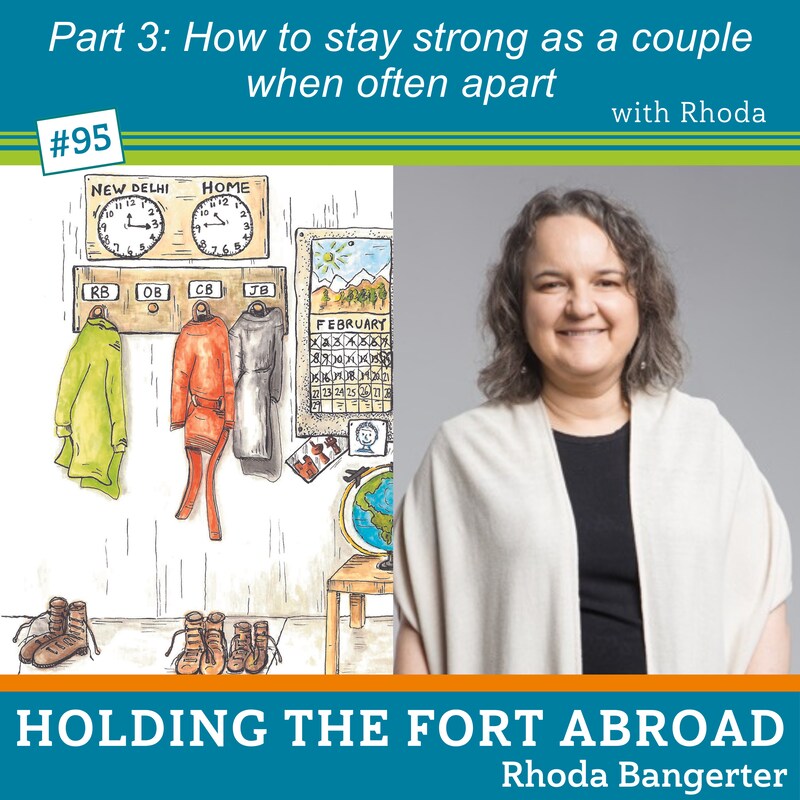
We were reading the same books and then writing to each other about what it was. It really got us to know each other at a much deeper level than I think if we were just going to the movies and having an ice cream afterwards. Welcome to Holding the Fort Abroad, the podcast Podcast for families where one parent works away from home and for those who support them. I'm Rhoda Bangerter, here to help you build connections across the distance. Today is part 3 in a series based on my book Holding the Fort Abroad. In the first part, I looked at the home-based parent and what it's like for them emotionally, and with these intense emotions. The second part was professionally, and this third part is the strong couple. So this is more about long-distance relationships and when you spend time apart or at a distance when you're a couple.
Rhoda Bangerter [:Now there is a lot on the internet about long-distance relationships Even if you type in time spent apart as a couple, it will immediately refer you back to long-distance relationships. Long-distance relationships is a big topic. There's a lot, a lot, a lot to say on effects of distance on the couple relationship, coming back together again for brief periods, or coming back together again for, you know, for good or for foreseeable future. There's leaving well. Every time you leave well, you don't want to be caught in the middle of an argument. It has happened and it can happen that, you know, you leave but you might have been in the middle of a disagreement or something. Speaking of disagreements, there's the conflict and repair. How do you repair at a distance? There's the different media that you use.
Rhoda Bangerter [:You could be looking at, you know, do we use more WhatsApp? Do we use more Signal? Do we use email? There's different ways of communicating, different— do we use Zoom? Different means for different reasons to communicate, not different, different formats, let's put it that way. There's technology for connection and intimacy. There's a whole other thing. There's trust. There's the different couple stages. Are you a new couple at a distance? Did you meet and were you already at a distance? Or did you meet and then you went into a distance relationship? Or have you been doing it for a long time, maybe? Or has your rhythm changed? Maybe you're Monday to Friday at a distance, or maybe you're a couple of weeks a year, or maybe you're many, many, many, many, many months of the year separate. It's slightly different. Then there are time zones, how far apart you are.
Rhoda Bangerter [:You could have a very small time zone, you could have a big, very big time zone, you could have a very small direct flight, or you could have a very long trip with multiple flights. And there's all the topic of the benefits and reasons why people do it. And if you want to hear more about our story, and we started off long-distance dating Um, and then we've done multiple different scenarios with Monday to Fridays, irregular, 2 weeks at a time, um, up to 8 to 12 weeks at a time. Um, and there's, there's episodes, uh, on our story. It's— I'll put the episode number in the show notes. And there's a lot of generic advice on social media. You could type in long-distance relationships and you'll have people telling you that you have to communicate every day, you and communicate every day. You've got to do this, you've got to do that.
Rhoda Bangerter [:There's plenty out there, but today I want to focus on 3. I want to make 3 main points really, and I suppose everything that's out there on social media or everything I could tell you on all the topics I listed earlier is a lot of it boils down to these 3 main points. The first one is creating a joint life. The second one is more than logistics. I'll explain that in a minute. The third one is know yourself and know your partner. Getting to know yourself and your partner, keeping knowing yourself and knowing your partner when you're apart. So number one, create a joint life.
Rhoda Bangerter [:Let me read From my book, it's chapter 3, pages 63 to 67. Start us off here. Create a joint life. When asked in the Holding the Fort Abroad survey to choose the top 5 challenges of a couple's relationship due to work travel, staying friends and emotional intimacy Came out top above reconnecting after a trip, parenting children, and agreeing on finances. Yes, it could easily lead to living separate lives. Up to now, our entire married life has included work travel for him. The first few years he was doing 1 to 2 week trips, although the twist was that he could get dispatched at any moment in case of a crisis. One trip in 2008, which is forever etched in our memories, began with an emergency call asking Olivier to travel to Kenya where there was post-electoral violence.
Rhoda Bangerter [:We were brand new parents and that trip deeply affected both of us. He was seeing newborns the same age as his son in dire circumstances. I was a new mom in a country that was not my own. He was in a war zone. I was in a country at peace. He was seeing the effects of violence on ordinary people. I was crying myself to sleep because I was struggling to nurse the baby. Neither of us could see what the other was living, nor truly understand the extent of the challenges faced.
Rhoda Bangerter [:Not only were our geographical locations different, so were our experiences. Over the years, he has frequently traveled to dangerous places. I remember once when he called on a satellite phone from a wadi— that's a valley that is dry except in the rainy season— in a war-torn country. Hello? There's a question mark in my voice as I answer the phone from an unknown number. I don't normally answer those calls, but I can't miss it in case it's him. Hello? A man's voice answers. Olivier, I cry out, is that you? I thought you wouldn't be able to reach me at all during this trip. I managed to find a satellite phone and I just wanted to hear your voice.
Rhoda Bangerter [:I'm okay, everything is going well, he says reassuringly. Relief floods my body as I had been worried about his safety, but then I freeze, not knowing what to say. All I can think of is that this call is probably costing him a fortune and I don't want to waste the few minutes we together, telling him about the antics of the neighbor's cats or some other unexciting tidbit of my ordinary everyday life. I find out later that he likes it when I share stories from my life. Not only does he crave a bit of normality, but it helps him to stay abreast of what is going on with me, even if my life may seem mundane. The family back home isn't living the only reality there is. I have my reality too from what I've lived, Olivia shared with me recently as we discussed the need to stay connected. Now when we tell the other what has been going on, we consolidate our stories to make one out of two.
Rhoda Bangerter [:Béatrice de Carpentier underscores the importance of telling each other about our everyday lives because, quote, it means sharing our respective realities and therefore builds up our life together, end quote. One mother puts it this way, quote, it takes work to consolidate a joint life since this is made up of 3 realities: the absent spouse, the holding the fort spouse, and the joint reality of shared time together. For my husband and I, an important aspect of our joint life together is that wherever possible, I have visited the places where he has been working. To share his experiences. This is something that we both value and have invested in. It has not always been possible. However, it is something we aspire to creating together. When it's not possible, I'll still want to be part of his reality in creating a joint life for us both.
Rhoda Bangerter [:So I share photos, stories, all the mundane details of everyday life with colleagues, shopping, meeting local people, whatever it is, I share as best I can. Quote, in holding the fort, he is able to come and go from my reality largely. Perhaps my going away for a few days while he is home has enabled him to experience a deeper sense of my reality in terms of childcare, managing home life, and so on. This has helped us both, and for me, to feel he gets it, my reality. Both of us sharing in the deepest way possible feeds into our joint reality, our joint life, which of course is both home and away, says a mom. Beatrice also highlights the importance of the right heart attitude for a couple to stay together. Are you focusing on a life and future together, or have you let the possibility of separating as a couple creep into your thinking? She asks. She has seen with her clients that often one partner presents the threat of separation as a way of getting the other person's attention.
Rhoda Bangerter [:This is actually expressing a cry to stay together. This only plants a seed, she says, that germinates and may end up leading the couple down a road they didn't want. She suggests that if the partner in fact wants to get closer to his or her partner, it is better never to mention separation but to find other ways to say it. Another way of creating a joint life could be to work on a joint project that involves both of you. Be it just a holiday away or a common passion. You can both be developing it whether geographically apart or together. This provides continuity throughout the traveler's comings and goings. One expat mom living in Thailand whose husband regularly travels for 1 to 3 weeks at a time writes, quote, stay in contact even just by text or quick chat to talk about the small daily stuff.
Rhoda Bangerter [:Make space in the diary in the days before and after for time together. Make it non-negotiable. End quote. I'm going to talk about transitions afterwards, and I'll come back to reading in a bit for my second point. But basically, the idea is to not only connect as 2 people in a relationship but also to connect your lives, to connect what's going on with each one of you, to share. Maybe it could be photos, just going back and forth, making plans for the future, sharing daily trivia. That has come up again and again in different interviews that I've done. So that's the first one, create a joint life.
Rhoda Bangerter [:And at the end of this podcast, of this episode, I'll put a couple of reflections Questions for you. Number 2, more than logistics. Chapter 3, pages 73 to 77. Living apart because of frequent business travel could actually present the ideal opportunity to work on your friendship. The trick is to use the distance to your advantage and adapt tools that are available. One traveling British husband living in New Zealand pointed out in the Holding the Fort Abroad survey that frequent business travel actually gives each— gives you each time to reflect on the relationship. Share an activity. We have always liked reading a book together.
Rhoda Bangerter [:At the beginning of our marriage, one of us would read a chapter of our current book out loud to the other in bed. We spent many a happy evening curled up in this manner. It gave us common references and fostered togetherness. As children arrived and life took a more hectic turn, we abandoned this practice. This year has been its revival in our relationship. We may not be able to read together in bed as much, but each having our own copy, reading the same chapter, and spending time discussing it online has been a creative way to recreate the togetherness reading the same book brings us. If you're not sure which activities to do, write a list separately first. Then eliminate any that one of you won't enjoy and settle on those that you will both enjoy to some degree.
Rhoda Bangerter [:Andrea Schmidt is a Global Girl Coach. Her husband works in the hotel industry and travels at least 3 weeks every month. They have made it a habit to say good morning and good night every day. Our neighbors have breakfast with each other every morning on Skype. Some ideas for long-distance activities could be to play an online game together, Watch a documentary at the same time. Take a walk outside while video calling each other. Do some online shopping together. Dates.
Rhoda Bangerter [:Quote, make sure you have a weekly date night. It is absolutely vital that you spend time together to continue being friends, we were told in no uncertain terms at the beginning of our marriage. We have failed miserably at being consistent with dates. I mean, how on earth can we have a weekly date night if half the time we're on opposite sides of the planet? On top of that, every time we found a great babysitter, we moved or they moved. Grandparents or siblings lived too far away to offer to take the children so we could have a weekend away. I remember the first time Olivia's parents took the children. We hadn't had proper time together in 2 years. Does that mean our friendship is doomed and our marriage destined to fail? Exciting date nights seem to be the answer, and those are totally doable when frequently upon.
Rhoda Bangerter [:According to Tara Parker Pope, couples don't need more pleasant activities, they need more exciting ones in order to hold on to the rush they felt when they first fell in love. So don't despair if you don't manage to get in as many dates as you would like. Phone dates, 4 types of conversation. Over a coffee date one day, Olivier and I identified 4 different types of conversations we have on a regular basis. Identifying these has mostly helped to decide when he's traveling, when we will have which conversation, and at what frequency, depending on their level of priority. Number 1, small interactions daily. These are essential, like saying good morning and good night, checking in to see if the other person is okay. Some couples need to touch base at least once a day.
Rhoda Bangerter [:Others can go a few days without. Number 2, logistics conversations. These are unavoidable, but they could easily take over the bulk of your talking time. There are holiday dates and destinations to be determined, to-do lists of bills to pay and errands to run. We aren't always good at this, but when Olivier and I are able to list and discuss them in bulk rather than in a piecemeal fashion, it means that they aren't necessarily part of every conversation we have. You might want to schedule a specific time each week where you and your partner go over your planning and to-do lists. Number 3, conversations about the children and taking parent decisions— parenting decisions together. These again could easily take over all of your conversations.
Rhoda Bangerter [:Again, we try to list the topics and bring them up in bulk, jotting down the decisions taken and potentially even the actions to be taken, like for the minutes of a business meeting, tends to be helpful. Number 4, the conversations about your relationship. Listed here last, but by no means least important, are the conversations that touch on the dynamics between you, your needs as a couple, and your level of intimacy. They tend to get pushed to the side as the busyness of life shouts louder. They will also be a place to share your dreams and goals and how you will support each other. Jennifer Petriglieri, author of Couples That Work: How to Thrive in Love and at Work, noticed during her research that most couples wanted to support each other but were not always clear on what they were supporting. She shares on episode 168 of the Tandem Nomads podcast, Dual Careers Couple and Putting the Business at the Same Level as the Partner's Job, that sometimes partners think they are being supportive when in fact they're not giving the right type of support. By the way, evenings after you've both had a long day may not be the best time to have these chats.
Rhoda Bangerter [:You may want to ensure you're both in a good headspace before embarking on them. Conversations around these topics need to be put in the calendar intentionally. We have recently decided on a weekly phone date wherever he is in the world, unless at home of course, that is exclusively dedicated to talking about our relationship and how we can strengthen it. Unless there's an emergency, of course. Identifying these different types of conversations and what proportion of time is dedicated to what topics ensures that not one type takes over above the others. It also means that we're able to pin down which conversations to have when he is back home. Okay, so this point is mostly about thinking about what you talk about, what you spend time talking about, especially in the long distance, right? Is it all about to-dos? Is it all about children? Is it all about when you're coming home next, when, what you're going to do this, what you're going to do that. Logistics really tend to take over.
Rhoda Bangerter [:And so since writing this book, I've also found, and it is something that we have done a lot of, especially when we're long distance, we tend to sort of do, it's called parallel activity. So he does his stuff, we open a Zoom, he does his thing, I do my thing, and you're sharing a space. It comes back to that creating a joint life in a way, but it also also means that that time where you're just, you're doing your thing, he's doing their thing, you know, your partner's doing their thing, means that then you're not talking about logistics but you're spending this relationship time together. You don't have to talk all the time. Some couples play, you can have games. One that I really like, it's very easy, is like would you rather. Would you rather go to the moon or dive deep into the ocean, things like that, just to play. But some couples don't play.
Rhoda Bangerter [:We, we don't tend to play that much. We might send each other a couple of funny emojis or, um, send each other some photos, but different couples have different histories, different ways of interacting with each other. The other one that I love Well, reading more about his writing letters to each other. When we first started dating, we wrote a lot of emails to each other. And same things, we were reading the same books and then writing to each other about what it was. It really got us to know each other at a much deeper level than I think if we were just going to the movies and having an ice cream afterwards. If, you know, if you can't, if you can't send the letter, it doesn't matter. You can still write it in bits and then give it to them when you see them or send it to them.
Rhoda Bangerter [:But there's something about the letter writing as well, that's the, the, the fact that it's written by hand. It, when the person, the other person receives it, it feels there's something tangible. So I suppose this is to encourage you To think of creative ways to connect that are more than logistics. The other thing that's really interesting about frequency and length is to see, like, ask each other what you prefer, how you feel most connected. You want a lot more frequent but shorter calls, or less frequent and longer calls, or do you want a little bit of both? Um, well, this is helpful for any long distance. I asked my mom the other day because she lives quite— she lives in another country, and I said, what do you prefer? Do you prefer short and sweet and frequent, or do you prefer longer conversations? She said, a little bit of both. Fair enough. I can call you more often just to say hello, quick, quick call, and from time to time I can do a longer call.
Rhoda Bangerter [:But it's just helpful to know, and then, um, that we can share how we feel more connected. So the first point was creating a joint life. The second one is more than just— more than just logistics, and I suppose that is sort of expanding from creating a joint life. And the third point is knowing yourself and knowing your partner. I think there's 2 things that can happen. Is the first thing when you're in a long-distance relationship or you spend a lot of time apart is this idea that you're gonna have different experiences and gradually, gradually you can drift from each other and you stop knowing each other, knowing about the other person. So you've got the differences of experiences and the second one is that just over time Things just don't come up as often because you're not sharing evening meals together, you're not sharing your evenings together, you're not sharing your mornings together, you're not sharing spending weekends together, and so things come up less. So you have to be a little bit more explicit about bringing them up and speaking about them and sharing about yourself.
Rhoda Bangerter [:So let me read book excerpt, chapter 3, page 77. Know your partner well. Dr. Gottman has more advice for couples. His very first principle in his book, The 7 Principles for Making Marriage Work, is to make sure couples have an up-to-date love map of each other. They remember the major events in each other's history, and they keep updating their information as the facts and feelings of their partners will change. They know each other's life's goals, hopes, and dreams. This knowledge will strengthen the couple's relationship, which will in turn help them stay connected and weather together the storms of life.
Rhoda Bangerter [:Keeping love maps updated is even more crucial if one or both partners travel for work. Over the past few weeks— yeah, sorry, I should have said they know each other's life goals, hopes, and dreams, end quote. This knowledge will strengthen the couple's relationship, which will in turn help them stay connected and weather together the storms of life. Keeping love maps updated is even more crucial if one or both partners travel for work. Over the past few weeks, Olivier and I have asked each other the 60 questions in Dr. Gottman's list, such as Name one of your main rivals or enemies. Or, what is my dream getaway place? These are questions we may once have known the answers to, but as our lives take on separate focuses and time is spent apart, the answers change, and our partner may not know us in the present, and vice versa. And I think even, I mean, for a couple who is under the same roof, it's very important to also to know yourself, to know where you're wounded, to know how you're reacting from that, the pain maybe from a previous relationship or how you grew up, what triggers you, what annoys you, why you react the way you react, and knowing what they're about and how they feel loved and how they've been hurt and Um, what's important for them.
Rhoda Bangerter [:And John Gottman— so it's the book 7 Principles for Making Marriage Work, and that specifically one. So he has a series of questions you can ask each other, which, which I think, um, really kind of helps to bond as well. The other thing I wanted to mention here is the attachment styles. Are you anxious or avoidant or disorganized? And that is also going to play into long distance. We often think about it in our relationships and how we, you know, if we're securely attached, that means we, we trust that the other person loves us or cares for us, and we're not anxiously trying to get reassurance from them. or on the other hand kind of being avoidant and going, I'm, you know, it's fine, it's fine, kind of not. And so there is in the show notes, I'll put a video on the impact of attachment styles on trust in long-distance relationships. She speaks really quickly, with the captions on it's helpful, and I'm going to work on a kind of a visual as well because I find it easier sometimes to see a visual.
Rhoda Bangerter [:But then there's a quiz as well that you can take to see your attachment style, and I've also recorded an episode, episode 81, Improve Your Long-Distance Relationships with Attachment, with Brian Power, and we go through in detail how the different attachment styles can So how distance can trigger you and affect you depending on your attachment style. The last thing I wanted to say about this one about knowing yourself and knowing your partner is cross-cultural communication. You've grown up in a family, they've grown up in a family with a specific background. There's ways of behaving, ways of expressing yourself, ways of grieving, ways of asking for help, ways of of, um, saying what you think, not saying what you think, you know, that's high context, low context, um, things about, um, the extended family. There's so much here, and I've spent quite a bit of time looking at how cross-cultural communication can affect, um, can sort of show up in long distance, and that I've got a whole series of videos in my resource center that has gone live a couple of weeks ago, and someone actually said to me that that is worth the whole thing, just even having that bit. And it's how you say please and thank you in different languages, how you say sorry— not in different languages, I mean in different— with different— when you're grown up in different backgrounds. And those are under the surface, but they might create that conflict, that friction on the phone or when you're communicating at a distance. And then sometimes it's harder to repair it quickly because you're at a distance.
Rhoda Bangerter [:So that's also something very important to think about. And there's quite a few pages in at the end of that chapter on the cross-cultural communication between a couple in long distance. As I said, there's a lot in the resource centre. You can also download reflection prompts. There's a whole list of questions around these 3 points: creating a joint life more than logistics, connecting more than logistics, And knowing yourself and knowing your partner. Here are some reflection prompts for you that are in the show notes. What currently makes us feel like a team rather than 2 people managing separate life— lives? What currently makes you feel like a team? Second question, what is something new we could build together even while apart? Is there a project you can work on together? Something you're passionate about that you can do. Maybe you can do some crowdfunding together.
Rhoda Bangerter [:Maybe you can work on a, on a, on a volunteering project, and then that ends with a trip. You could be, I don't know, planning to build a, find a vacation place or retirement place. When was the last time we had a conversation that was not about calendars, children, travel, finances, or problems to solve? Sometimes be a tricky one. It's like for couples under the same roof, you're like, let's go for a meal, let's go for a movie. For this one, it's like, okay, how are we going to spend time and how are we going to have conversations that aren't around logistics? And then finally, under stress, do I tend to pursue connection, withdraw, become controlling, over-function, Or shut down? Under stress, do I tend to pursue connection, withdraw, become controlling, over-function, or shut down? And that's important to know how you do it and how they do it so that, um, you can be aware when communication kind of, um, struggles. It's important to know. that maybe you're withdrawing, uh, or becoming controlling, or becoming anxious and pursuing, like trying to get absolute reassurance and oversharing, um, to try and get reassurance from your partner. So I'll put in the link in the show notes, the link to be able to download the full list of questions if you want to spend some time doing that.
Rhoda Bangerter [:There's a whole list of questions. In the next episode, I'll be looking at chapter for when storms come, and that's when you're going through difficulties and you're far apart. So it could be illness, it could be death of a loved one, it could be aging parents, many different situations where it's just an extra, an extra thing happening on top of your long distance. I'll also put further resources. There's a book by Gregory Goldner, Long Distance Relationships: The Complete Guide, and he has a very interesting questionnaire you can fill out in his book. His book is older, it's from the '90s, and there's not a lot of the technology in there, but that book has got some, some interesting things on how to stay connected and repair And then of course John Gottman's, and then I've got a whole list of podcasts. I've got 7 or 8 podcasts that you can listen to. There's one on, a few on intimacy that I don't think I've seen anything else, you know, really delving into some of these topics.
Rhoda Bangerter [:So thank you very much for listening. If you are in a long-distance relationship I encourage you, it's not always easy, sometimes we really, really miss each other. Think about these 3 main points, and if you know someone who's in a longer distance relationship who would benefit from, from this, please, please share this episode. Thank you very much for listening. I hope that you found this episode encouraging and that maybe you found ideas to apply in your own situation. Please leave me a review of what you found helpful, what you would like to hear about, and any other comments you would like to leave. This helps other people find this podcast, and it also gives me feedback, so it's very helpful. Thank you very much, and until next time.


