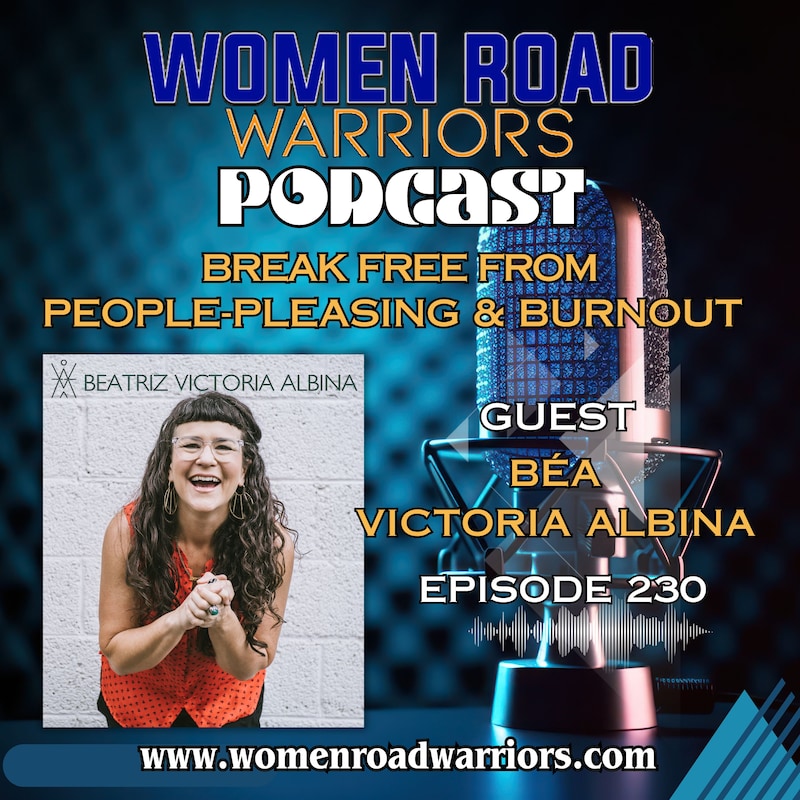
Shownotes
“Calm down.”
“You’re overreacting.”
“You’re too much.”
Women hear it everywhere—but what if the truth is this: you’re not too much… you’re carrying too much.
On Women Road Warriors, Shelley Johnson and Kathy Tuccaro welcome Beatriz (Béa) Victoria Albina, a UCSF-trained Family Nurse Practitioner, Somatic Experiencing Practitioner, and author of End Emotional Outsourcing™. This conversation dives deep into women’s mental health, burnout recovery, boundaries, self-worth, and nervous system regulation—giving you practical tools to reclaim your energy and identity.
After years of overachieving, overgiving, and burning out, Béa uncovered a powerful truth:
Overfunctioning isn’t strength—it’s survival mode.
She now helps women break free from people-pleasing, perfectionism, and codependency by combining neuroscience, somatic healing, and polyvagal theory to retrain the nervous system and rebuild self-trust.
Featured by Cosmopolitan, Goop, MindBodyGreen, Betches, and Oprah Daily, Béa is a leading voice helping women stop outsourcing their safety, belonging, and worth—and finally come home to themselves.
In this episode, you’ll learn how to:
- Reclaim your energy and stop overgiving
- Release guilt and set clear, healthy boundaries
- Reconnect with your body and inner voice
- Break lifelong patterns of emotional outsourcing
🎧 If you’ve been carrying too much for too long—this conversation will help you put it down.
Get a free meditation with Beatriz (Béa) here
Instagram: @beatrizvictoriaalbinanp
Podcast: Feminist Wellness
#EmotionalOutsourcing #WomensEmpowerment #CodependencyRecovery #BéaVictoriaAlbina #ShelleyJohnson #KathyTuccaro #WomenRoadWarriors #Burnout
Transcripts
This is Women Road warriors with Shelly Johnson and Kathy Tucaro.
Speaker A:From the corporate office to the cab of a truck, they're here to inspire and empower women in all professions.
Speaker A:So gear down, sit back and enjoy.
Speaker B:Welcome.
Speaker B:We're an award winning show dinner dedicated to empowering women in every profession through inspiring stories and expert insights.
Speaker B:No topics off limits.
Speaker B:On our show, we power women on the road to success with expert and celebrity interviews and information you need.
Speaker B:I'm Shelley.
Speaker C:And I'm Kathy.
Speaker B:Calm down.
Speaker B:You're overreacting.
Speaker B:You're too much.
Speaker B:Society tells women, especially daughters, employees and caregivers that that they're too much.
Speaker B:In reality, they're just carrying too much responsibility, expectation and emotional labor.
Speaker B:These are the things that certified life coach and family nurse practitioner Bea Victoria Albina helps women overcome.
Speaker B:We're not too much, we're just doing too much.
Speaker B:Bea is a trailblazing voice in women's wellness and emotional liberation.
Speaker B:A UCFS trained family nurse practitioner with a master's in public health from Boston University, Bea blends science, somatics and feminism to help women stop living life for everybody else and finally come home to themselves.
Speaker B:She's the founder of the Somatic Studio and anchored host of the Feminist wellness podcast and author of End emotional outsourcing, your guide to overcoming codependent perfectionist and people pleasing habits.
Speaker B:After decades of overachieving, over giving and overriding her own needs, Beyah hit burnout and she discovered that over functioning isn't strength, it's survival mode.
Speaker B:Through her signature framework Emotional outsourcing, she teaches how to retrain the nervous system, rebuild self trust and break free from patterns of people pleasing perfectionism and codependence.
Speaker B:Her work bridges neuroscience, polyvagal theory and somatic practice with a warm, funny feminist lens where science meets soul.
Speaker B:She's been featured by Cosmopolitan, Goop Betches, Mind, Bodygreen and recently had the honor of Oprah Daly choosing her term emotional outsourcing as their word of the week.
Speaker B:Bea offers practical ways for women to reclaim their energy, release guilt and stop carrying too much.
Speaker B:We wanted to tap into that insight, so we invited her on the show.
Speaker B:Welcome Bea.
Speaker B:Thank you for being on the show with us.
Speaker D:Oh goodness.
Speaker D:And thank you so much for having me.
Speaker B:You have some super powerful perspectives.
Speaker B:Before we dig into some of your powerful perspectives, could you tell us a little bit more about yourself and how you got launched and got into all of this?
Speaker D:Yeah, so I how I got into all of this was really starting to see the patterns in my patients, my clients, my Friends really seeing how we were living our lives for other people.
Speaker D:We were living our lives for their validation, for their, to really source our safety, our belonging from everyone else's opinions of us.
Speaker D:I saw this so much in my patients.
Speaker D:I was a primary care provider for many years.
Speaker D:I ran, I had a private practice in Manhattan where I focused on holistic and functional medicine through an evidence based lens.
Speaker D:And I would do all the right things for my patients, who are mostly women.
Speaker D:I would run all the right tests, I'd recommend all the right nutrition.
Speaker D:I work closely with dietitians on that.
Speaker D:I would recommend all the best therapeutics, all the best everything.
Speaker D:And I noticed the patterns that my patients would get better and then something psychosocial would happen.
Speaker D:They would be up for a promotion, bellyache, they would go home to visit their parents.
Speaker D:A month of fatigue, they would have a breakup and their eczema would flare.
Speaker D:You see where we're going here?
Speaker D:I started to really see in real time that just how much the stress of trying to meet others demands, society's demands, other people's.
Speaker D:Yeah, what other people wanted folks to be was directly and negatively impacting my patients health and wellness in every single possible way.
Speaker D:Beyond just depression, anxiety and what we usually see as, as a stress reaction, it was really impacting their, their mood, their energy, their digestion, their thyroid.
Speaker D:And I started to really begin to piece together the patterns where I was seeing my patients in real time, trying to live life for themselves, but never really being able to because there was this story in their head.
Speaker D:And again, especially for the human socialized as women, that other people had opinions about them that mattered more than their own right, that what their parents wanted them to do with their life, what society wanted to do them to do with their lives, these things were way more important than their own dreams.
Speaker D:And so in the, as those dreams were deferred, they got sicker and sicker.
Speaker D:I saw it day after day after day after day.
Speaker D:And after years of seeing it, I started to bring more coaching sort of framework into my clinical sessions and started working with my patients to really identify the mindset and the somatic body based parts of this whole picture, this whole morass they were in that was keeping them sick on every level.
Speaker D:And from there my work has really evolved to bring in somatics, the nervous system and to really start to help people to see themselves as whole beings that are really trying to do their best to survive in emotional outsourcing.
Speaker B:You know, it really does feel like society pigeonholes women and they say things like, calm down, you're overreacting.
Speaker B:You're too much.
Speaker B:You're too sensitive.
Speaker B:Do they say that stuff to guys?
Speaker D:I don't think so.
Speaker D:I've never heard it.
Speaker C:I was gonna say, I don't think I've ever heard that.
Speaker D:Yeah, I've never heard a man told, you should smile more.
Speaker D:Huh?
Speaker B:Oh, yes.
Speaker B:Sit.
Speaker B:Sit properly.
Speaker D:Right.
Speaker B:Well, guys can sit whatever way they want, you know.
Speaker D:Yeah, certainly.
Speaker C:Yeah.
Speaker C:I work in an open fit mine with 120 big tough guys full of tattoos, beards, attitudes, you name it.
Speaker C:And no one tells them how to sit or sit or smile or whatever.
Speaker D:Right.
Speaker D:Yeah.
Speaker C:You know, I'm going back to work next week.
Speaker C:I should try it for.
Speaker C:Just for the heck of it.
Speaker B:Do you think you'll have any teeth?
Speaker B:They might say, really?
Speaker D:Okay.
Speaker C:Like, you'll get the look, the raised eyebrow and then you'll be ignored.
Speaker B:Absolutely.
Speaker B:Why is this?
Speaker B:I mean, is this just something that's ingrained in society and women bathing basically don't know their own identity?
Speaker B:Because it seems like when we're little girls, we do, but then we lose it somewhere.
Speaker D:Yeah.
Speaker B:I think we're.
Speaker D:We're really indoctrinated.
Speaker D:We're really trained up by the, by the forces of patriarchy, white settler colonialism and late stage capitalism.
Speaker D:Each one, I mean, they're all extractive forces, Right.
Speaker D:And they tell us essentially, don't be yourself.
Speaker D:Right.
Speaker D:That little girl that you were who's vibrant and proud and loud and knows herself, that's cool.
Speaker D:Until she starts to interact with society.
Speaker D:Right.
Speaker D:And then all those messages y' all are talking about, the sit, sit pretty, sit properly, be quiet, they all come out to really make sure that we're, we're in our place.
Speaker D:Right.
Speaker D:And that our emotions are managed.
Speaker D:We have no needs.
Speaker D:Because if you have needs, come on, you're selfish.
Speaker D:And selfish is wrong and selfish is bad.
Speaker D:And if you're a woman, Right.
Speaker D:So keep quiet and be compliant and be a good girl.
Speaker D:Don't be loud, don't talk about your feelings.
Speaker D:But.
Speaker D:But also, like, don't be emotional.
Speaker D:Right.
Speaker D:Because men don't have emotions because basically.
Speaker C:Just be a robot, just sit there.
Speaker B:Yeah.
Speaker D:Don't actually think as much as a robot, though.
Speaker D:I think that's too much thinking though, right?
Speaker B:Yeah.
Speaker B:If anyone's talked to, chat, GPT or anything like that, they.
Speaker B:They have thoughts, it seems like, anyway, you know, And AI doesn't admit it's wrong.
Speaker D:Right, Exactly.
Speaker B:Women are always apologizing.
Speaker D:Yes.
Speaker D:We are definitely taught to apologize simply for existing Right.
Speaker D:Because how dare we take up space.
Speaker B:Oh, I'm sorry.
Speaker B:I'm breathing, right?
Speaker D:Oh, no.
Speaker D:I'm sorry.
Speaker D:Are you mad at me because I'm on this call with you that you invited me to?
Speaker D:I'm so sorry.
Speaker D:Oh, geez.
Speaker D:You want me to go?
Speaker D:I'm sorry.
Speaker D:It's so true.
Speaker D:It's so true.
Speaker D:Yeah.
Speaker B:And you have something here where too sensitive really means highly attuned.
Speaker B:It really does, doesn't it?
Speaker B:I mean, women are biologically wired to be sensitive, right?
Speaker B:I mean, we have to anticipate what's going on with children, and they don't tell you what they're going to be doing, so you have to kind of plan ahead.
Speaker D:I. I don't know about the biology.
Speaker D:I haven't read those papers.
Speaker D:But what I know for sure is that we're taught not to be sensitive.
Speaker D:We're mocked for being sensitive because if we're sensitive and we're tuned in, we're liable to start talking.
Speaker D:Right.
Speaker D:It's like how we are shamed for gossiping.
Speaker D:But what's gossip?
Speaker D:It's meeting other women at the well and telling them who not to be alone in a room with whose uncle is a little loose when he's had a couple drinks, Right?
Speaker D:So we're shamed for being sensitive.
Speaker D:We're shamed for having feelings.
Speaker D:We're shamed for talking to each other.
Speaker D:And it's all towards the goal of just controlling us more and more and more it is.
Speaker A:Stay tuned for more of Women road Warriors coming up.
Speaker B:Industry movement Trucking moves America Forward is telling the story of the industry.
Speaker B:Our safety champions, the women of trucking, independent contractors, the next generation of truckers, and more.
Speaker B:Help us promote the best of our industry.
Speaker B:Share your story and what you love about trucking.
Speaker B:Share images of a moment you're proud of and join us on social media.
Speaker B:Learn more at truckingmovesamerica.com.
Speaker A:Welcome back to Women Road warriors with Shelly Johnson and Kathy Tucaro.
Speaker B:If you're enjoying this informative episode of Women Road Warriors, I wanted to mention Kathy and I explore all kinds of topics that will power you on the road to success.
Speaker B:We feature a lot of expert interviews, plus we feature celebrities and women who've been trailblazers.
Speaker B:Please check out our [email protected] and click on our episodes page.
Speaker B:We're also available wherever you listen to podcasts on all the major podcast channels like Spotify, Apple, YouTube, Amazon, Music, Audible, you name it.
Speaker B:Check us out and bookmark our podcast Also, don't forget to follow us on social media.
Speaker B:We're on Twitter, Facebook, Instagram, Pinterest, LinkedIn, YouTube and other sites and, and tell others about us.
Speaker B:We want to help as many women as possible.
Speaker B:If you're just joining us, we're here with Bea Victoria Albina, certified life coach and UCSF trained family nurse practitioner who's helping women rethink the story that they're too much.
Speaker B:As she puts it, we're not too much, we're carrying too much.
Speaker B:Through her groundbreaking work on emotional outsourcing, Beyah blends neuroscience, somatic practice and a powerful feminist lens and to help women break free from people pleasing perfectionism and burnout and finally come home to themselves.
Speaker B:She's the founder of the Somatic Studio and anchored host of the Feminist Wellness Podcast and author of End Emotional Outsourcing.
Speaker B:Let's dive back in, Bea.
Speaker B:You talk about codependency, perfectionism and people pleasing, which women do too.
Speaker B:You say that they're survival strategies, they're not weaknesses.
Speaker B:And I mean, that makes total sense.
Speaker B:These are things that we've adapted, adopted.
Speaker B:Although codependency can be something that is not a good thing, a little of it, it's like a dash of salt, right?
Speaker B:A little goes a long way.
Speaker D:Well, I don't actually think any codependency is good for us.
Speaker C:Right.
Speaker D:So I define emotional outsourcing, which is my, my umbrella term for our codependent perfectionist and people pleasing habits as when we chronically and habitually source our sense of the three vital human needs of safety, belonging and worth from everyone and everything outside of ourselves instead of from within at a great cost to self.
Speaker B:So why do we do that?
Speaker D:Yeah, we do it because we're so brilliant.
Speaker D:So codependent habits is a, is managing other people to attempt to feel safe.
Speaker D:And that's why I say I don't know if there's any healthy level of codependency because we need to source safety within.
Speaker D:Right.
Speaker D:And managing other people is not the way sometimes avoiding people leaving the room.
Speaker D:Right.
Speaker D:When we're talking physical safety, but we're, when we're talking emotional safety, trying to manage the way they feel isn't going to get us very far.
Speaker D:People pleasing is keeping others comfortable to attempt to avoid rejection or abandonment.
Speaker D:And perfectionist habits is controlling yourself to attempt to earn love.
Speaker D:So I say that they're brilliant survival habits because they're how we learned to stay safe and to feel loved when we were in our most, most, most dependent state, which is childhood.
Speaker D:So Like a giraffe is born and within minutes she's like off and running, right?
Speaker D:She's like, she's chill.
Speaker D:She doesn't really need the pack.
Speaker D:But we are pack animals, right?
Speaker D:We, we're like kittens.
Speaker D:We need one another to, to literally survive for quite, quite a long time.
Speaker D:And so if you grow up in a household, in an environment where emotional outsourcing runs the roost and you, it's modeled for you.
Speaker D:And so our mirror neurons in our mind, that it's the monkey see, monkey do, part of the brain, part of our nervous system sees our, our humans, our, our adults acting in this way.
Speaker D:We learn again, especially human socialized as girls and women, that putting others ahead of ourselves, that's the way to get through.
Speaker D:And being our authentic self, the one who is too much, too sensitive, too loud, too big, too whatever, too quiet, too thin, too fat, on and on is not smart, right?
Speaker D:And so we learn to hide our true self away so that we can get the approval we know we need from our grownups.
Speaker D:Because we don't know how to drive.
Speaker D:We don't know where food comes from.
Speaker D:We can't even reach the fridge door, right?
Speaker D:We know we need to keep them happy with us.
Speaker D:And so we take the true self and we lock her up.
Speaker D:We put her far, far, far away because we know, we know that's the best way to get through.
Speaker D:Because we know if I stay as I am, if I stay who I am, I'll lose belonging.
Speaker D:And that is one of the most dangerous things for a dependent tiny mammal.
Speaker D:Right?
Speaker D:Yeah.
Speaker D:Oh, it's sad to talk about.
Speaker C:Oh, here's another sad thing.
Speaker C:Yeah, you just said that, is that I had spent my entire life being codependent and not knowing.
Speaker C: he, the first time, it was in: Speaker C: And it took me until: Speaker C:And I've been 13 years sober.
Speaker C: But I remember back in: Speaker C:And you had 25 women who lived in the same building.
Speaker C:We all had, we had a roommate, we had a kitchen.
Speaker C:Like, you know, we had courses, Bible study.
Speaker B:But every.
Speaker C:And then we had codependency.
Speaker C:We had boundaries, we had self esteem, we had anger management, we had sexual assault.
Speaker C:Like, we had all sorts of courses, right?
Speaker C:And I had to ask my counselor two questions.
Speaker C:One, what does boundaries mean?
Speaker C:And two, what the hell is codependency?
Speaker D:I had no clue.
Speaker C:And when we started going through the classes, like the in Depth version of codependency.
Speaker C:I was shocked.
Speaker C:I mean, shell shocked would almost be better because I'm reading all this stuff and I'm like, oh, my God, how can I be 40 and I've never known this?
Speaker B:How could I.
Speaker C:Like, I knew my behaviors.
Speaker C:I knew because I come out.
Speaker C:I come from such a.
Speaker C:A dysfunctional upbringing and so much family violence and sexual violence and, you know, but not understanding why I'm trying to gain my mother's love and wear the clothes that she wants me to wear.
Speaker C:Not because I like them.
Speaker C:I'm just trying to make her happy.
Speaker D:Right.
Speaker D:Right.
Speaker C:Or whatever it is I'm behaving in in a way that just to gain people's love.
Speaker C:I was the master chameleon at almost like a shapeshifter, right into whoever standing in front of me, whatever it was that they were looking for, I became.
Speaker C:And I was good at it.
Speaker C:I could do it in 10 seconds flat.
Speaker C:Right.
Speaker C:Because I started reading them, reading their.
Speaker C:Anticipating their responses.
Speaker C:And, well, that I had to do because my stepfather was so violent that every time you walk in the room, you're deciding how he's going to react.
Speaker C:So how are you going to react?
Speaker C:So I had a lot of poor education in that sense, but, man, oh, man, I gotta tell you, it took me decades.
Speaker C:I started at 40, it took me.
Speaker C:Now I'm 56.
Speaker C:I still catch myself sometimes.
Speaker D:I have to, like, back up the.
Speaker C:Back up the.
Speaker C:The replay version.
Speaker C:I'm like, wait a minute.
Speaker C:And I have to stop myself and unlearn because it's learned behavior.
Speaker C:So unlearn all that behavior.
Speaker C:Relearn what the proper thing is, and then really accept it and apply it in a different manner.
Speaker C:But can it happen overnight?
Speaker C:Nope.
Speaker D:No.
Speaker D:No.
Speaker D:And you spoke to something really important, which is that this.
Speaker D:It's not about mindset only.
Speaker D:Like, of course we have to change the way we think about ourselves and the world and everything.
Speaker D:But this codependent way of relating is.
Speaker D:It's the soup we're swimming in our whole lives.
Speaker D:And so we don't see ourselves living in this conditional way.
Speaker D:Right.
Speaker D:That.
Speaker D:That pattern.
Speaker D:If I keep them happy, I'm safe.
Speaker D:If I disappoint them, I'm unsafe.
Speaker D:That wiring gets into implicit memory, procedural memory in the nervous system.
Speaker D:Right.
Speaker D:And so it.
Speaker D:It on a neurological level, it becomes automatic.
Speaker D:Like the way.
Speaker D:Have you ever, like, driven to your work on a Saturday because you just, like, get in the car and you're on autopilot, right?
Speaker D:That's the nervous system taking over and just taking you to where it thinks you should go.
Speaker D:And so the same thing happens when the nervous system hears, like a tone of voice, like someone in your childhood had.
Speaker D:It sends you right back into that old operating system.
Speaker D:I like to think of it.
Speaker D:The visual that works for me is like, you know the old card catalog in the library?
Speaker C:Oh, yeah.
Speaker D:It's like your brain has a set of reactions written on those cards and it hears a certain tone and it pulls out the card.
Speaker D:It goes, ooh.
Speaker D:Okay, fawn, you.
Speaker D:You need to fawn now.
Speaker D:You need to appease.
Speaker D:You need to make them love you.
Speaker D:Go.
Speaker D:And before you even realize it, you're just playing this tape and you're doing the old thing and it's out of your control.
Speaker D:Which is the big reason why I sought to.
Speaker D:To reframe this as emotional outsourcing.
Speaker D:Because the old way of talking about it didn't have enough compassion, love, or care for just how automatic this is, how much it's socialization and conditioning, and that we need gentleness to be able to live in a different way.
Speaker D:Because most of us learn to live this way.
Speaker D:Like you shared, because we grew up in harshness, so we need tenderness.
Speaker B:It's so true.
Speaker B:But how do we stop playing that tape in our head and retrain our synapses?
Speaker D:Yeah, I love the, like picturing retraining as synapse.
Speaker D:Like.
Speaker D:No, to the left, little synapse.
Speaker D:Well, we have to start by becoming our own North Star again.
Speaker D:We have to really step into our bodies again because we have to rewire the nervous system and body pattern so that we can feel safe enough existing as our own whole person.
Speaker D:The thing to remember is that if you've spent your entire life orienting towards others, hyper attending to their emotions, walking on eggshells, anticipating their needs before they're spoken, then your nervous system has wired itself to prioritize external safety over internal stability.
Speaker D:Right?
Speaker D:Because emotional outsourcing pulls you away from yourself and melds you with the people around you.
Speaker D:Right?
Speaker D:And we step into role confusion, which.
Speaker D:Which you spoke to, and thank you again for that.
Speaker D:So before you can shift behavior, before you can retrain those synapses, you actually have to feel yourself as a separate person.
Speaker D:And so we start this.
Speaker D:I have a very, very simple three step thing we can do to start this process.
Speaker D:And we need to start with our biological impulses.
Speaker D:Now, y' all tell me, how many times have you felt the need to pee and said, let me finish this PowerPoint, let me finish this spreadsheet.
Speaker D:Let me make this one more bed.
Speaker C:Right?
Speaker B:Yeah.
Speaker B:Too many times than I can count.
Speaker D:My goodness gracious.
Speaker D:Right.
Speaker D:And same with hunger, same with, with fatigue and resting.
Speaker D:Same with pleasure.
Speaker D:Taking a bath, reading a book.
Speaker D:Right.
Speaker D:And not just like zoning out.
Speaker D:Because sometimes we can let ourselves do that.
Speaker D:We lose track really early of our biological impulses.
Speaker D:And so what are you saying to your body every time you say, you hear it say, girl, you're hungry, and you say, nah, somebody else's business is more important than you.
Speaker D:Right.
Speaker D:Doing this task, reorganizing the kitchen is more important than you body.
Speaker D:And we don't realize we're saying that, of course, but we need to reverse that.
Speaker D:And so the first task at hand is to listen to your biological impulses.
Speaker D:And as much as you are able, like if you're doing brain surgery and you have to pee, sorry, that's the occasion where you hold it.
Speaker D:But.
Speaker D:Right.
Speaker D:But as much as you're able and it's safe to attend to your biological impulses and make it a priority.
Speaker D:And if that's all you do, you'll start to see change in not too much time because it cascades.
Speaker D:Right?
Speaker D:So that's one.
Speaker D:Listen to your biological impulses two, three times a day, set.
Speaker D:Set a reminder on your phone to stop, take one breath and ask yourself, what am I feeling right now?
Speaker D:What emotion is alive in my body now?
Speaker D:For most of us starting to do this, who've spent a whole life emotional outsourcing, our body's gonna say, wait, what?
Speaker D:Oh, I. I don't know.
Speaker D:I'm.
Speaker C:What?
Speaker D:No, thank you.
Speaker D:No, thank you.
Speaker D:We won't have any idea what we're feeling, right?
Speaker D:We won't know it.
Speaker D:And that's okay.
Speaker D:We are not asking because we want the answer.
Speaker D:We're asking for the goal of asking so that our body can hear us, experience us, come to know us, remember us as someone who listens.
Speaker D:Because what are those little kids, right?
Speaker D:We were saying little girls with all their imagination and they're playing and building forts and making mud pies.
Speaker D:They know what they're feeling, Right.
Speaker D:When a little kid gets hurt, they run up to you and they say, I'm hurt and I'm mad and I'm sad and they just let it all out until they get trained not to.
Speaker D:Right?
Speaker B:Yeah.
Speaker D:And so it's less about hitting the exact feeling on the feelings wheel.
Speaker D:It doesn't really matter.
Speaker D:It's about your body saying, oh, oh, wait, I've got her attention again.
Speaker D:Okay, now, so once you've asked what is the emotion?
Speaker D:What am I feeling right now?
Speaker D:Next, scan your body.
Speaker D:And again, if this is new to you, you might not notice anything.
Speaker D:Who cares?
Speaker D:You're gonna scan your body and ask, where is there tension?
Speaker D:Where is there ease?
Speaker D:What sensations are present right now?
Speaker D:What's happening in my body?
Speaker D:And then if you hear your body say, well actually my shoulders are really, really tight cause I'm feeling all this sadness and it feels like it's weighing me down, then you're gonna do one small act of self honoring.
Speaker D:So maybe you just stretch those shoulders, just roll them back.
Speaker D:Maybe you're feeling anxious and your hands feel tight.
Speaker D:Shake them out.
Speaker D:Maybe you're sad and your chest is heavy.
Speaker D:Put a hand on your heart, right?
Speaker D:Do one tiny thing.
Speaker D:And the reason this is so simplified is because that's what we need, right?
Speaker D:To retrain those synapses like a little lion tamer.
Speaker D:And because this needs to take about five seconds, right?
Speaker D:Busy moms, working full time, driving carpool, pta.
Speaker D:Come on, who's got time for an hour of meditation and journaling, right?
Speaker D:We can do this in five seconds.
Speaker D:You can do it in the serial aisle.
Speaker D:But what matters is that you do it.
Speaker D:And so this works because the more you practice noticing yourself without judgment, the stronger your internal reference point becomes, which helps you remember that you are and can again be the center of your own friggin universe.
Speaker D:And when you are the center of your universe and know what you want and need, you can have healthier boundaries with the people you love, which is resentment prevention.
Speaker D:You can say yes emphatically when you want to help and it feels good to help.
Speaker D:And you can say no when you don't have the energy, which then allows you to recharge and rest and take care of yourself.
Speaker D:So you can say yes once more when you actually want to help.
Speaker D:And so it's not selfish.
Speaker D:There's nothing wrong with listening to yourself this way.
Speaker D:It's the way to matter to yourself and to be a good and loving member of your family and your communities.
Speaker A:Stay tuned for more of women road warriors coming up.
Speaker E:Dean Michael, the tax doctor here.
Speaker E:I have one question for you.
Speaker E:Do you want to stop worrying about the irs?
Speaker E:If the answer is yes, then look no further.
Speaker E:I've been around for years.
Speaker E:I've helped countless people across the country and my success rate speaks for itself.
Speaker E:So now you know where to find good, honest help with your tax problems.
Speaker E:What are you waiting for?
Speaker E:If you owe more than $10,000 to the IRS or haven't filed in years.
Speaker E: -: Speaker B:Industry Movement Trucking Moves America Forward is telling the story of the industry.
Speaker B:Our safety champions, the women of trucking, independent contractors, the next generation of truckers, and more help us promote the best of our industry.
Speaker B:Share your story and what you love about trucking, share images of a moment you're proud of and join us on social media.
Speaker B:Learn more at truckingmovesamerica.com.
Speaker A:Welcome back to Women Road warriors with Shelly Johnson and Kathy Tucaro.
Speaker B:Today's conversation is one so many women need to hear.
Speaker B:We're here with Bea Victoria Albina, certified life coach, family nurse practitioner, and a leading voice in emotional wellness who's flipping the script on what we've been told for years.
Speaker B:If you've ever been labeled too much, Beya says the truth is you're doing too much.
Speaker B:Through her work on emotional outsourcing, she helps women break free from people pleasing perfectionism and burnout by retraining the nervous system and rebuilding self trust.
Speaker B:She's the founder of the Somatic Studio and anchored host of the Feminist Wellness Podcast and author of End Emotional Outsourcing.
Speaker B:Let's jump back in Beya.
Speaker B:In our previous segment you talked about taking the time to recognize our biological selves and taking the time to do an assessment so you're bit by bit acknowledging yourself and kind of conditioning yourself to do that.
Speaker B:It also sounds like we're activating our parasympathetic nervous system system by doing this too.
Speaker D:That's right.
Speaker D:Yes.
Speaker D:We are taking ourselves into ventral vagal, which is the safe and social part of the parasympathetic nervous system.
Speaker D:And that's the part of when our nervous system is predominantly in that state.
Speaker D:That's when everything runs optimally.
Speaker D:We can think best, our heart and lungs work best, digestion is optimized, like everything, mood, energy feels best.
Speaker D:So yeah, this is a parasympathetic moment that can help reduce risk of all sorts of stress induced concerns from diabetes to hypertension to cancer.
Speaker D:I mean, on and on it sounds.
Speaker B:Like we're finding ourselves with your techniques.
Speaker B:I wanted to touch on the term emotional outsourcing real quickly because I don't know if people really know what that means.
Speaker C:I was actually thinking the same thing because here I am sitting emotional outsourcing.
Speaker C:What does that really mean?
Speaker D:Yeah, let me share that definition again.
Speaker D:Yeah, so it's when we chronically and habitually source our sense of the three vital human needs, safety, belonging and worth from everyone and everything outside of ourselves instead of from within at a great cost to self.
Speaker D:And this is the umbrella term that I came up with as, as a catch all for our codependent perfectionist and people pleasing habits.
Speaker B:Okay, that makes, you know, it's a really all encompassing term so that, that really makes sense because we really are just kind of giving it to somebody else.
Speaker B:We're giving ourselves away.
Speaker D:Yeah, yeah, we are, we are.
Speaker D:To the point where we don't know who our self is.
Speaker D:I mean, gosh, the number of women in my programs in their 30s, 40s, 50s, 60s, 70s who say, I don't know who I am, I don't know what I want for dinner, much less for the rest of my life.
Speaker D:I don't know myself because all I've been was a good daughter, a good student, a good employee, a good wife, a good mom.
Speaker D:And here I am with no clue.
Speaker B:Yeah, yeah.
Speaker B:So your book end emotional outsourcing, your guide to overcoming codependent perfectionist and people pleasing habits, what all does that cover?
Speaker B:I mean, that, that's, that's a mouthful.
Speaker D:It sure is.
Speaker D:So in the first half of the book, we talk about why we need to redefine these terms.
Speaker D:We recognize that the term codependency comes from, comes from AA, comes from the Big Book of 12 of Alcoholics Anonymous.
Speaker D:And I'm not talking about that program.
Speaker D:I'm staying on my side of the street to say that I find it problematic to put codependent behavior in the same sort of bucket, which is the disease model.
Speaker D:I don't think that having codependent habits is a disease.
Speaker D:It's not in the dsm.
Speaker D:It's not a diagnosable experience.
Speaker D:And so we talk about why the reframe is necessary and how it really helps and supports us to step out of this old story that we are diseased, sick and suffering defective for having these habits and instead reframes them as we've been talking about as brilliant, brilliant, brilliant survival skills.
Speaker D:We talk about the etiology, the where did it come from.
Speaker D:We look at society and systems of oppression through a feminist empowerment lens.
Speaker D:We look at family of origin and we talk about our family and our real, really loving, respectful way.
Speaker D:Right.
Speaker D:So don't get scared that I'm going to throw your sweet family under the bus though.
Speaker D:If you want to go for it, but I'm not going to do it for you.
Speaker D:But we talk about how, hey, if your family Raised you this way.
Speaker D:It's probably because they were raised this way and they were raised this way and they were raised this way.
Speaker D:Right.
Speaker D:And so we can have some, some understanding there.
Speaker D:But it, it, but not in the, you have to forgive them framework either, because I think that can be problematic.
Speaker D:So we spend the half really understanding it, talking about the mindsets.
Speaker D:I explain the nervous system through the lens of polyvagal theory, which I share as a metaphor, but we come to understand the nervous system, and I use really accessible, understandable science language because it, it really matters to me that we under.
Speaker D:We hear the big words, we understand the big words, but we don't get lost in the big words.
Speaker D:And then in the second half, we talk about remedies.
Speaker D:And so every single chapter has journaling exercises, somatic practices.
Speaker D:So somatic.
Speaker D:I know it's, you know, all the rage on the Internet these days.
Speaker D:I've been studying it for, gosh, over 20 years.
Speaker D:But somatic, soma means body in Greek.
Speaker D:And somatics is any modality that supports us in stepping into our body in its wholeness, to really understanding the world through the lens of our body, not just living from the neck up, which so many of us do in emotional outsourc, are saying because it's safer and smarter, and we're no fool.
Speaker D:So I walk us through somatic practices and teach us how to begin to reconnect with our body so our body can really help us to just connect with so much more wisdom, so much more brilliance from an understanding of, gosh, your, Your brain holds all that conditioning, all that socialization.
Speaker D:Most of our thoughts aren't our own.
Speaker D:Right.
Speaker D:Like, if we stopped and really looked at them, they're somebody else's thoughts, especially the meanie pants ones.
Speaker D:Right.
Speaker D:And so the second half, I teach you the thoughtwork protocol, which is based in cognitive behavioral theory, the stoics, and a couple other modalities that are detailed.
Speaker D:And then we step into somatics and learn how to begin to make these changes in ways that are really sustainable towards the goal of interdependence.
Speaker D:So the goal of overcoming and rewiring codependent habits is not independence.
Speaker D:It's not more bootstrapping, it's not more going it on your own.
Speaker D:That doesn't help anyone.
Speaker D:Right.
Speaker D:It's.
Speaker D:It's more community and more interdependence.
Speaker D:That's our goal.
Speaker B:We need community.
Speaker B:There's a tomb.
Speaker B:We do.
Speaker D:We do.
Speaker D:Yeah.
Speaker D:We need each other.
Speaker B:Human beings are not designed to be an island.
Speaker B:No.
Speaker D:And studies show that, you know, loneliness is the new smoking.
Speaker B:Loneliness is really a killer.
Speaker B:There's no doubt about that.
Speaker B:And we have a lot of problems with depression.
Speaker B:And I heard the stat that something like 30% of people in the United States live alone.
Speaker B:Gosh, that's pretty high.
Speaker D:That's a lot.
Speaker D:Yeah.
Speaker D:And there aren't third spaces.
Speaker D:Right.
Speaker D:You go to Europe and everyone's in the plaza, everyone's talking to each other.
Speaker D:People are in community, Latin America, the same.
Speaker D:You know, most of the world, there are third spaces where you don't have to buy something to spend time in community.
Speaker D:And that's.
Speaker D:It's sorely missing in the US And I think it really hurts us.
Speaker D:So a really conscious move towards more interdependence is vital, vital, vital.
Speaker D:Especially right now.
Speaker B:Well, then people communicate, which seems to also be very, very lacking today.
Speaker B:We're connected, but we don't know how to communicate.
Speaker B:Everybody's on a device.
Speaker B:It's like, could you talk to me?
Speaker D:What?
Speaker D:Yeah, yeah, that's true.
Speaker B:It's true.
Speaker D:Yeah, yeah.
Speaker D:We were in Spain this summer and it was just so amazing that people weren't on their devices in the same way.
Speaker D:And we didn't see a single kid on an iPad or an iPhone or anything.
Speaker D:And I'm not judging any parent who's on their last leg and hands the kid the phone out of desperation.
Speaker D:I judge no one.
Speaker D:And I'm just saying it was so lovely that that's just not the culture.
Speaker B:Well, and it's more insightful.
Speaker B:We have to.
Speaker B:We have to communicate.
Speaker B:And children learn by doing it in repetition.
Speaker B:It's not something.
Speaker B:We're not born speaking.
Speaker B:We're born screaming, feed me.
Speaker B:You know, I need my diaper changed.
Speaker B:But I mean, we try to communicate.
Speaker B:I mean, we have an innate need to communicate somehow.
Speaker B:And of course, what you're teaching is communicating in a way that is respecting ourselves too, certainly.
Speaker B:And that's so important because when you think about it, when we're toddlers, I think we think of ourselves.
Speaker B:We have to learn how to share and everything else.
Speaker B:And then we go way over to the other side where we just stop giving to ourselves at all.
Speaker D:Yes.
Speaker D:Yeah, yeah.
Speaker D:That self referential quality of toddlers is fully lost in emotional outsourcing.
Speaker D:And there is something really beautiful about bringing it back.
Speaker B:Yeah.
Speaker D:Being your own North Star.
Speaker D:We need that.
Speaker B:I like that.
Speaker C:I like that too.
Speaker D:Oh, good.
Speaker A:Stay tuned for more of Women Road warriors coming up.
Speaker E:Dean Michael, the tax doctor here.
Speaker E:I have one question for you.
Speaker E:Do you want to Stop worrying about the irs.
Speaker E:If the answer is yes, then look no further.
Speaker E:I've been around for years.
Speaker E:I've helped countless people across the country, and my success rate speaks for itself.
Speaker E:So now you know where to find good, honest help with your tax problems.
Speaker E:What are you waiting for?
Speaker E: -: Speaker A:Welcome back to Women Women Road warriors with Shelly Johnson and Kathy Tucaro.
Speaker B:We're continuing this powerful conversation with Bea Victoria Albina, a certified life coach and family nurse practitioner who's helping women finally put down what was never theirs to carry.
Speaker B:Her message is simple but profound.
Speaker B:You're not too much.
Speaker B:You've just been carrying too much for too long.
Speaker B:Through her work on emotional outsourcing, Bea combines science, somatic healing, and a compassionate feminist approach to help women release guilt, stop over giving, and come back home to themselves.
Speaker B:She's also the founder of the Somatic Studio and anchored and host of the feminist wellness podcast.
Speaker B:Let's continue, Bea, with your teachings.
Speaker B:Essentially, what you're doing is bringing us back to who we're supposed to be.
Speaker D:That's the dream, huh?
Speaker D:Right?
Speaker D:That we can really step into our power, step into our authenticity, and learn to.
Speaker D:To ride the wave of our emotions and our feelings.
Speaker D:Because it's uncomfortable when other people are uncomfortable.
Speaker D:And we need to learn to be comfortable with that.
Speaker D:Right?
Speaker D:So.
Speaker D:So that we can say, oh, no, thank you, I'm not available.
Speaker D:Oh, no, thank you, I don't want to go.
Speaker C:Those are the best words ever when they come out.
Speaker C:And you don't have to justify yourself or give a reason as to why you're saying no.
Speaker C:Yeah, yeah.
Speaker C:No, I'm sorry.
Speaker D:Yeah, yeah.
Speaker D:And it's.
Speaker E:It.
Speaker D:It really.
Speaker D:We need so much more balance, right?
Speaker D:So that way we can.
Speaker D:We can trust ourselves that we are taking care of ourselves and the people we love.
Speaker D:And I think we've really lost so much sight of that.
Speaker B:UT C huddle.
Speaker B:What?
Speaker B:Learned to say no without ever explaining.
Speaker B:Or the guilt hangover.
Speaker B:I like that term, guilt hangover.
Speaker B:That's so very true.
Speaker D:Yeah.
Speaker D:Yeah.
Speaker D:There's this aftermath, huh, when we say, no, I'm not available.
Speaker D:I don't want to.
Speaker D:Where the.
Speaker D:That guilt eats us alive.
Speaker D:And so what.
Speaker D:What really helps my clients and helps me is to remember when we don't say no, we resent the people we love.
Speaker D:And my goodness, I think that's so much worse than just saying the no and then learning to, like, ride that wave of guilt and just be with it and allow ourselves to be uncomfortable without grabbing a device or a substance or whatever we use to buffer against our feelings.
Speaker D:But I don't want anyone to resent me.
Speaker D:Like, I would so rather somebody say, no, I can't help with that.
Speaker D:And be honest.
Speaker D:Right.
Speaker D:And so we need to prioritize and privilege honesty in our own lives so that we can give that to the people we love.
Speaker B:People hate to say no.
Speaker B:It's kind of interesting.
Speaker B:A lot of times people, instead of saying no, that they'll avoid it if it's via email, they just won't respond because they don't want to.
Speaker B:It's uncomfortable.
Speaker B:They don't want to have to explain themselves.
Speaker B:Or maybe they are afraid to disappoint.
Speaker B:It depends on where they're coming from, though.
Speaker D:Sure.
Speaker D:But I think we need to get honest.
Speaker D:I'm so much more disappointed by someone not responding.
Speaker D:So we need to really be honest with ourselves.
Speaker D:We say that it's easier in air quotes to not respond, to defer, to deflect, to, like, well, do this whole song and dance.
Speaker D:But it's kind of.
Speaker D:It's bs because it's actually so much harder on everyone's heart to be indirect.
Speaker D:Yeah.
Speaker B:I mean, you're being ignored.
Speaker B:Ignored is rude.
Speaker B:You don't feel like you have any importance in that person's life.
Speaker B:It's like, hey, is anybody home?
Speaker B:Come on.
Speaker B:Yeah, right, right.
Speaker D:But again, to your point, Shelly, I think you said it so perfectly.
Speaker D:People fear conflict, and they think saying no is is conflict, and conflict is bad.
Speaker D:And so they'd rather leave someone on red than simply state their no.
Speaker D:And I think we need to have a reckoning with that.
Speaker D:I think we need to all realize that there's nothing kind about being indirect.
Speaker B:You think part of it, too, is no is a word that we hear as toddlers by our parents.
Speaker B:No, no, stop that.
Speaker B:No.
Speaker B:So we don't like the word.
Speaker B:And that's one of the first words that little ones use because they hear it too.
Speaker D:Yeah, fair enough.
Speaker D:Fair enough.
Speaker D:Yeah.
Speaker D:But, yeah, so we could use a slightly different language.
Speaker D:I'm not available.
Speaker D:How does that land, Shelley?
Speaker B:That works for me.
Speaker B:I'm sorry, I'm not available.
Speaker D:I'm not available.
Speaker D:Students in my program actually get stickers that say I'm not available with a smiley face, because that's how we say it.
Speaker D:That's not available.
Speaker D:Look at me.
Speaker C:Yay.
Speaker B:It's an empowered response and it's a positive one that doesn't reject the other person.
Speaker B:And maybe it also puts the other person off center if they want to start a conflict.
Speaker B:They don't really know what to say to that.
Speaker D:Good call.
Speaker D:I love that framing.
Speaker D:Ha ha.
Speaker D:Right?
Speaker D:How are you going to come for me?
Speaker D:I'm just not available.
Speaker C:Right.
Speaker B:You kind of hijack the normal way of people responding.
Speaker D:Oh, my gosh.
Speaker D:I love that.
Speaker D:It's.
Speaker D:I was unwitting, fittingly more devious than I realized that that works.
Speaker B:Oh, my goodness.
Speaker B:I, I love your perspectives.
Speaker B:So do you work with people online?
Speaker D:I do, yeah.
Speaker D:I run a six month program called Anchored, which is a.
Speaker D:An intensive coaching program.
Speaker D:We meet once or twice a week to coach.
Speaker D:We have a whole community forum.
Speaker D:When I tell you these women have each other's backs.
Speaker D:Wow.
Speaker D:Wow.
Speaker D:Wow.
Speaker D:One of them had surgery a couple months back and several members of the community flew from across the world to support her.
Speaker D:Wow.
Speaker D:Someone's husband died during the program.
Speaker D:Somebody flew from Colorado to New Zealand to help that woman with her kids.
Speaker D:What?
Speaker B:Wow.
Speaker D:Yeah.
Speaker D:No, this community is.
Speaker D:It's about not just overcoming our codependent habits, stepping out of emotional outsourcing, but stepping into a deep, deep, deep sense of community care, often for the first time.
Speaker D:And through that community care, really reframing the way we relate to ourselves in the world.
Speaker D:And we do breath work, we have dance parties.
Speaker D:It is so much fun.
Speaker D:I mean, there's a lot of crying.
Speaker D:It's.
Speaker D:It's tough going, but it's a lot of fun.
Speaker B:You're incentivizing empathy and compassion.
Speaker B:I love that.
Speaker D:I'm trying.
Speaker B:That's something that's so lacking today.
Speaker B:Bravo to you.
Speaker B:I love this.
Speaker D:I really appreciate that.
Speaker D:It's a lot of work.
Speaker D:Yeah.
Speaker D:It's worth it.
Speaker B:Well, anything that's good takes work.
Speaker B:That's the way it is in the world.
Speaker D:That's true.
Speaker D:Yeah.
Speaker B:What a wonderful endeavor, what a wonderful goal you have and what the impact you're having on people.
Speaker B:This is terrific.
Speaker D:Oh, thank you.
Speaker D:I appreciate it.
Speaker C:I'm gonna say we've been doing this for four years and it interviewed a wide variety of guests and you are the only one that are.
Speaker C:That we've interviewed.
Speaker C:Anyway, that is doing what you're doing on such a.
Speaker C:On the grand scale and kudos to you.
Speaker C:I think what you're doing is absolutely amazing.
Speaker D:Oh, yes, thank you.
Speaker D:I'm really honored by that.
Speaker D:It is, it's really important work.
Speaker D:I was a hospice nurse back in the day and I just want everyone to, I want women to, to really live the lives they want to live.
Speaker D:Right.
Speaker D:And so that when we get to the end of it, we can say, gosh, I, I had a good run.
Speaker D:Yeah, I did what I wanted to do and took care of my family in a loving way that honored me and I, I left this world better than I found.
Speaker B:Like the song I Did It My Way.
Speaker C:There you go.
Speaker C:Thank you.
Speaker D:What a great theme song.
Speaker D:That's great.
Speaker B:It really is sung by Frank Sinatra many years ago, I believe.
Speaker D:So that's the one.
Speaker D:Old Blue Eyes.
Speaker B:So where do people reach out to you?
Speaker D:Yeah.
Speaker D:So you can order the book and get a whole suite of beautiful thank you gifts for supporting a first time author at my website.
Speaker D:So it's first name last name.com beatriz b e-a t r I z albina.com book.
Speaker D:My podcast is called Feminist Wellness and that's free wherever you get your podcast.
Speaker D:And you can find me on Instagram at my whole darn name.
Speaker D:Beatrice Victoria Albina NP I love this.
Speaker B:I want to pick your brain for another hour, but we.
Speaker D:Let's do it.
Speaker D:Have me back on the show.
Speaker B:Oh, see, that would be great because there's so many things we could talk about.
Speaker D:Oh my gosh.
Speaker D:You two are a delight.
Speaker D:I do a lot of these conversations and you two are something special.
Speaker D:So I really look forward to coming back.
Speaker B:Thank you so much, Bea.
Speaker B:This is just wonderful.
Speaker B:We really appreciate that.
Speaker D:Likewise.
Speaker D:Thank you.
Speaker B:We hope you've enjoyed this latest episode.
Speaker B:And if you want to hear more episodes of Women Road warriors or learn more about our show, be sure to check out womenroadwarriors.com and please follow us on social media.
Speaker B:And don't forget to subscribe to our podcast on our website.
Speaker B:We also have a selection of podcasts just for Women.
Speaker B:They're a series of podcasts from different podcasters.
Speaker B:So if you're in the mood for women's podcasts, just click the Power network tab on womenroadwarriors.com youm'll have a variety of shows to listen to anytime you want to.
Speaker B:Podcasts Made for Women Women Road warriors is on all the major podcast channels like Apple, Spotify, Amazon, Audible, YouTube and others.
Speaker B:Check us out and please follow us wherever you listen to podcasts.
Speaker B:Thanks for listening.
Speaker A:You've been listening to Women Road warriors with Shelly Johnson and Kathy Tucaro.
Speaker A:If you want to be a guest on the show or have a topic or feedback, email [email protected].




