Shownotes
Audio • Series 1 • Episode 12 • Series 1 Episode 12 - The Protestant Crusade in Holland.
© 20 26 The Rise of the Protestants., Author, Shaughan Holt.
Series 1 • Episode 12 • The Protestant Crusade in Holland
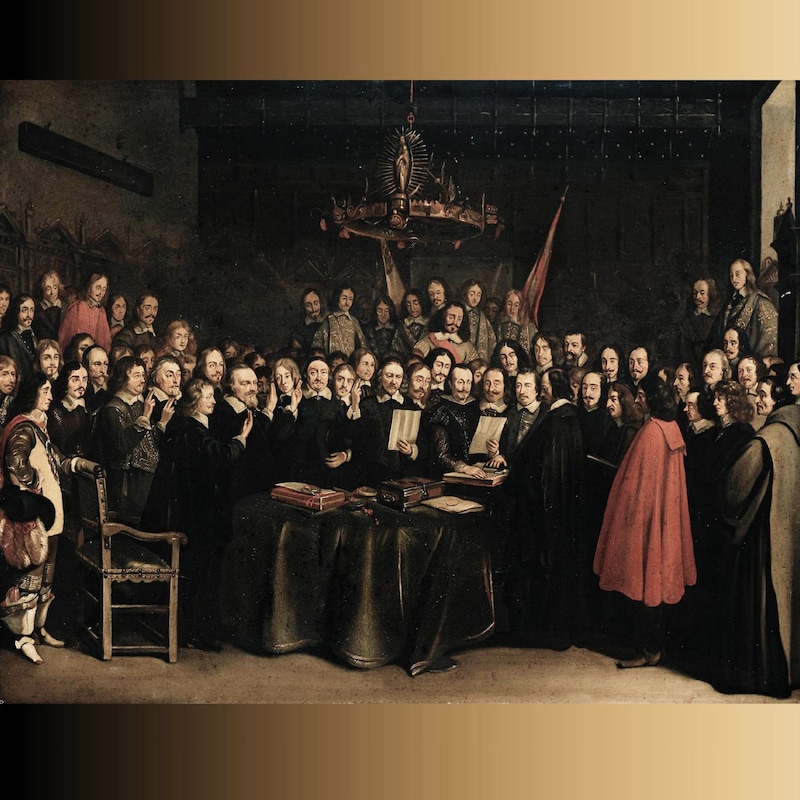
The artwork is "The Ratification of the Peace of Münster".
Painted in 1648, by Gerard ter Borch, 1617 to 1681.
It depicts the treaty between Spain and the Dutch Republic, signed in the town hall of Münster, Westphalia on 15 May 1648.
The music is Ave Verum Corpus – Composed by William Byrd and performed by The Sixteen.
William Byrd, circa 1540 to 4 July 1623, was an English Renaissance composer.
Considered among the greatest composers of the Renaissance, he had a profound influence on composers both from his native country and on the Continent.
He is often considered as one of England's most important composers of early music.
Byrd wrote in many of the forms current in England at the time, including various types of sacred and secular polyphony, keyboard and consort music.
He produced sacred music for Anglican services, but during the 1570s became a recusant Catholic, writing Catholic sacred music, later in his life
© 20 26 The Rise of the Protestants., Author, Shaughan Holt.
"All rights reserved. No part of this podcast may be reproduced, translated, distributed, or transmitted in any form or by any means, including photocopying, recording, or other electronic or mechanical methods, without the prior written permission of the copyright holder, except in the case of brief quotations embodied in critical reviews and certain other non-commercial uses permitted by copyright law".
Requests regarding translation, licensing, or republication should be directed to: [email protected]
Your feedback matters, send me an email at [email protected], with any comments, suggestions, or criticisms.I read every message.
Transcripts
© 20 26 The Rise of the Protestants., Author, Shaughan Holt.
"All rights reserved. No part of this podcast may be reproduced, translated, distributed, or transmitted in any form or by any means, including photocopying, recording, or other electronic or mechanical methods, without the prior written permission of the copyright holder, except in the case of brief quotations embodied in critical reviews and certain other non-commercial uses permitted by copyright law".
Requests regarding translation, licensing, or republication should be directed to: [email protected]
Your feedback matters, send me an email at [email protected], with any comments, suggestions, or criticisms.I read every message.
Series 1.
Episode 12.
The Protestant Crusade in Holland.
In 16 48, Gerard ter Borch painted "The Ratification of the Treaty of Münster," which can be found in the Rijksmuseum in Amsterdam Netherlands.
This artwork, captures the historic moment, when the States General of the Seven United Netherlands, and the Spanish Crown, signed a peace treaty, agreeing to terms worked out on 30 January 16 48.
This agreement, stands as a pivotal point in Dutch history, as it officially recognised the independence of the Dutch Republic, and signalled the end of both the Thirty Years' War and the Eighty Years' War.
Although it was negotiated alongside the Peace of Westphalia, it was not included in that treaty.
The Westphalian System, also known as Westphalian Sovereignty, is a principle in international law, that each state has exclusive sovereignty over its territory.
The principle, developed in Europe after the Peace of Westphalia in 16 48, is based on Jean Bodin's state theory, and Hugo Grotius's natural law teachings.
Edwin Sandys, graduated with a Bachelor of Arts degree from Corpus Christi College, Oxford, in 15 79.
His impressive academic achievements, led to his admission as a Fellow of the college in the same year.
Born on 9 December 15 61, in Worcestershire, he was the second son of Edwin Sandys, who served as the Archbishop of York.
In 15 82, his father appointed him to the esteemed position of Prebendary at Wetwang, which is part of York Minster.
However, Edwin made the bold decision to forgo ordination, and ultimately resigned, from both his fellowship and his Prebendary position.
In December 15 80, William Brewster began his studies at Peterhouse College Cambridge, as an undergraduate, likely as a sizar, aged around 15.
Peterhouse, the oldest college at Cambridge, was founded in 12 84 by Hugo de Balsham, the Bishop of Ely.
Brewster attended Peterhouse for over a year but did not graduate, with the college records last noting his presence in December 15 81.
After leaving Cambridge, Brewster spent the following year, assisting his father in managing the stage horses, for their mail business in Scrooby.
Around 15 80, dissenters and nonconformists began to recognise that there was little hope for meaningful reform within the Church.
While these groups were grounded in Puritan ideology, they aimed to take the purification of the Church, several steps further.
Consequently a new movement, known as Separatism, began to emerge.
The year is 15 81.
John Greenwood entered Corpus Christi College Cambridge, as a sizar on 18 March 15 77, and began his Bachelor of Arts studies in 15 81.
He was born in 15 56 in Heptonstall, a small village near Hebden Bridge in Yorkshire.
At Cambridge, a sizar was a student who financed his studies by performing menial tasks within his college.
Greenwood was likely profoundly influenced, by the intense theological controversies at the university, during this period.
Archbishop Whitgift had previously removed Cartwright from his professorship, and prohibited him from preaching at Cambridge.
Despite this, Cartwright’s influence remained strong, and the legacy of Robert Browne endured.
Cartwright was ordained as a priest by Thomas Cooper, the Bishop of Lincoln, and made a deacon by John Aylmer, the Bishop of London.
As a young man, he also served as chaplain to a Puritan nobleman, Lord Robert Rich, in Rochford Essex.
In 15 81, Bishop Edmund Freake arrested, and imprisoned Cartwright’s close friend Robert Browne, for preaching without authorisation.
Thanks to his extensive social network, John Greenwood was able to secure the position of Vicar at All Saints in Rackheath Norfolk, just five miles from the surviving Brownist Church in Norwich.
John Greenwood was one of the leaders of the early English Separatists.
It is unclear, whether Robert Browne's teachings, as a graduate of the same college, influenced his beliefs.
However, Greenwood held strong Puritan opinions, which led him to adopt a stubborn and unyielding view of Separatism.
Edmund Campion was born on 25 January 15 40, in London.
He was an English Catholic Jesuit priest.
After spending time in England Ireland, and France, Campion travelled to Rome on foot, disguised as a pilgrim, to seek admission to the Jesuits.
In April 15 73, he became the first novice, accepted into the Society of Jesus in Rome.
The Society of Jesus, also known as the Jesuit Order or the Jesuits, is a religious order of clerics regular with pontifical rights for men, within the Catholic Church, headquartered in Rome.
Founded in 15 40 by Ignatius of Loyola and six companions, with the approval of Pope Paul III, the Society of Jesus requires its members to profess perpetual poverty, chastity, and obedience.
They also vow a special obedience to the sovereign pontiff regarding missions.
Today, the Society of Jesus engages in evangelisation and apostolic ministry, across more than 100 countries.
Jesuits are involved in education, research, and cultural pursuits.
They also conduct retreats, serve in hospitals and parishes, sponsor various social and humanitarian initiatives, and promote ecumenical dialogue.
By 15 80, Campion had commenced his Jesuit mission in England.
While operating an illegal underground Catholic ministry in Anglican England, priest hunters tracked and apprehended him.
On 14 November 15 81, the authorities charged Campion and several others at Westminster Assizes.
They accused him of conspiring in Rome and Reims, to incite sedition and overthrow the Queen.
On 20 November 15 81, Father Edmund Campion and two other men faced trial.
After listening to their plea for three hours, the jury deliberated for just one hour, before delivering a guilty verdict.
Lord Chief Justice Edward Wray then pronounced their sentence: "You will be returned to the place from which you came, there to remain, until you are drawn through the City of London, to your place of execution."
And there, you will be hanged, and let down while still alive, your private parts cut off, and your entrails taken out, and burnt in your sight.
Finally your heads will be cut off, and your bodies divided into four parts and disposed of, at Her Majesty's pleasure, and may God have mercy on your souls.
Campion responded to the verdict by stating:
“By condemning us, you condemn all your ancestors, all our ancient bishops and kings, and all that once was the glory of England, this island of saints and the most devoted child of the See of Saint Peter”.
Campion, aged forty-one, spent his final days in prayer, before being taken with the other priests to Tyburn, where all three men were executed on 1 December 15 81 by being hanged drawn and quartered.
Having been already savagely racked and broken, Campion arrived at Tyburn.
In his heart-wrenching cries, he sighed, calling out to Christ.
On that frozen winter's morning, Campion, the most faithful priest, stood ready to meet his fate.
A faint Tay Deum drifted up from the crowd.
Even the hangman, moved by compassion, hesitated.
And so, when the executioner's noose snapped, tightening around Campion, his twitching legs, were pulled back, snapping his neck, sparing him the horrors of a live disembowelling and the hacking off of his limbs.
Sir Christopher Wray was born in 15 24 in Bedale, which was historically part of Yorkshire’s North Riding.
He served as an English judge and later became the Chief Justice of the King's Bench.
In the United Kingdom, a riding is a division of certain large historic counties.
It typically consists of three parts; the term itself originates from the Old English “trithing”, which itself is derived from Old Norse and means 'third part'.
Although Wray did not complete his education at Buckingham College Cambridge, he experienced the institution's significant restructuring in 15 42.
As a student, he witnessed Buckingham College's transition into the prestigious College of Saint Mary Magdalene.
Wray was admitted as a student at Lincoln's Inn on 6 February 15 45, and was called to the bar in January 15 50.
We will hear more about Lord Chief Justice Wray, and his actions, in the future.
In 18 86, Pope Leo XIII, declared Edmund Campion blessed, and in 19 70, Pope Paul VI recognized him, as one of the Forty Catholic Martyrs of England and Wales.
Established in 15 93 by the Society of Jesus, Stonyhurst College is a prestigious independent co-educational, Roman Catholic day and boarding school.
Situated in a Grade One listed building, it proudly holds the distinction of being the oldest Jesuit school in the world.
Stonyhurst College, boasts notable alumni, including Sir Arthur Conan Doyle and J.R.R. Tolkien.
Among its significant features is the display of Campion’s execution ropes, preserved in glass tubes.
These ropes, are prominently displayed on the altar of St. Peter's Church, during the Mass held on 1 December, to commemorate the feast day of Saint Edmund Campion.
The year is 15 83.
After Edmund the king of East Anglia, was killed by the Vikings in Hoxne in 869, his body remained in a nearby chapel for over 33 years.
In 903, Saint Edmund’s remains, were finally moved, to what is now Bury Saint Edmunds, where a large monastery, later developed around his shrine.
The name Bury, is derived from the same root, as borough.
Similar terms, in other Germanic languages, also mean “fortress”, or “castle”.
The second section of the name refers to Edmund, King of the East Angles, also known as Edmund the Martyr.
Bury Saint Edmunds, is famously known as "The Cradle of the Law," as it is where a group of barons met in 12 14, to swear they would force King John, to accept the Charter of Liberties, the precursor to the Magna Carta.
It was also, a notable site for witch-trials, in the 17th century.
By the 16th century, Bury Saint Edmunds was a prosperous market town with a jail, hospital, almshouses, two large parish churches, and, after 15 39, an abandoned abbey.
The formal name of the diocese is "Saint Edmundsbury", and the town is colloquially known as Bury.
During the Bury Stir Disorders, the City Council highlighted a longstanding dispute, involving John Coppin and Elias Thacker, both of whom were being held in custody.
The Bury Stirs, were a series of religious conflicts and disturbances, in and around Bury Saint Edmunds.
These conflicts involved numerous individuals, such as Edmund Freke, the Bishop of Norwich, judges of the Eastern Assize, members of the local clergy, townspeople, and villagers.
While John Coppin, Elias Thacker, and Thomas Gibson--a bookbinder from Bury--were imprisoned, the authorities formally charged them with violating the ecclesiastical laws of the realm, and conspiring to distribute books written by Browne and Harrison.
On 4 June 15 83, Sir Christopher Wray, the Lord Chief Justice, presented the individuals at the summer Assizes court.
Thomas Gibson was found guilty, and fined for orchestrating the vandalism of the Royal Arms.
However, he was cleared of providing the prisoners with literature and was subsequently released.
Judge Wray managed to obtain a confession from the remaining two men.
They acknowledged that "Her Majesty governs in civil matters," but they refused to say anything further, even after an extended period of questioning.
This was not surprising, as they were ardent supporters of Browne and his teachings on Congregationalism.
Their original offence was solely related to circulating seditious books; however, Judge Wray, irritated by their admissions, ruled that they would face the death penalty for denying the Queen's supremacy.
The court sentenced both men to be hanged at Tay Fen, just outside Bury's ancient wall.
Upon receiving his sentence, Thacker confidently addressed Judge Wray, stating, “My lord, your face we fear not, and for your threats, we care not.”
For his outburst, the judge ordered Thacker's immediate removal from the court, and he was hanged at the conclusion of the day’s legal proceedings.
Coppin was soon to follow him, hanged on 5 June, the following day.
Following their execution, Lord Chief Justice Wray asserted that many individuals in the town endorsed, the aims of Copping and Thacker and believed that their example would serve as a deterrent.
In 15 83, William Dennis, a preacher with separatist beliefs, was also executed in the nearby town of Thetford.
By the end of 15 83, the judicial authorities had managed to quell the reforming enthusiasm, within Bury Saint Edmunds.
Copping, Thacker, and Dennis would later be recognised, as three of the six early martyrs of Congregationalism.
In 19 04, a memorial was erected on Whiting Street in Bury Saint Edmunds, to honour John Copping and Elias Thacker.
Meanwhile, while others were arrested and hanged for selling his books, Browne, the well-connected author of these publications, remained at large.
Many people, have since regarded Browne, as the father of Congregationalism.
Power was held by Archbishop John Whitgift, from 15 83 to 16 04.
On 14 August 15 83, Queen Elizabeth appointed John Whitgift Archbishop of Canterbury, succeeding Edmund Grindal.
Grindal had been placed under house arrest, due to his disagreement with the Queen regarding prophesying and, unfortunately, died while still in office.
John Whitgift served as Archbishop of Canterbury from 15 83 until he died in 16 04.
He was known for his hospitality and lavish lifestyle.
The Whitgift family is believed to have originated in the Yorkshire village of Whitgift, which is located near the River Ouse and the port of Hull.
John Whitgift was a firm opponent of Thomas Cartwright, arguing that church governance was a practice, rather than a core aspect of the Christian faith.
Whitgift also argued that since England was a monarchy, it was appropriate for the Church to adopt an Episcopal style of governance.
In 15 81, John Udall had graduated with a Bachelor of Arts from Trinity College Cambridge.
In 15 83, he took holy orders and became the curate of Kingston-upon-Thames, under the absentee vicar, Stephen Chatfield.
During his tenure, he gained a reputation as a powerful preacher and a staunch Puritan, who questioned the scriptural justification for the Episcopacy.
Despite his growing influence and support from prominent patrons, local bishops and clergy harboured concerns and resentments regarding Udall's insistence on a literal interpretation of scriptural teachings, which they felt undermined the orthodoxy of the Church of England.
After Queen Elizabeth’s unsuccessful proposal for Archbishop Grindal's resignation, his sequestration remained unchanged.
However, towards the end of 15 82, he was reinstated after finally apologising to the Queen.
Despite this, his health was declining, and on 6 July 15 83, the Archbishop of Canterbury, Edmund Grindal, passed away at the age of 64 while making preparations for his retirement.
He was interred in Croydon Minster, the parish and civic church of the London Borough of Croydon.
During the Middle Saxon period, the people established this medieval church as a Minster Church, where a group of clergy lived communally and assumed pastoral responsibility for the surrounding district.
The Domesday Book, published in 10 86, includes references to this church.
As the oldest record in The National Archives, the Domesday Book provides valuable information about 11th-century England.
King William the First, sent inspectors to local courts to gather details about land ownership, residents, and livestock.
Compiled in ten volumes, it reveals that 200 Normans now controlled land, that had once belonged to 2,000 Saxons, and introduced a new taxation system.
In its final medieval form, the Church predominantly showcases the Perpendicular style, which was prevalent in the late 14th and early 15th centuries.
The West Door is decorated with the coats of arms of Archbishops Courtenay and Chichele, both of whom significantly contributed to its construction during the 14th and 15th centuries.
William Courtenay, who lived from around 13 42 until 31 July 13 96, served as the Archbishop of Canterbury from 13 81 until his death in 13 96.
Prior to this role, he held the positions of Bishop of Hereford and Bishop of London.
In 18 67, Croydon Parish Church was ravaged by fire and subsequently reconstructed under the guidance of Sir George Gilbert Scott.
It was granted the honour of becoming Croydon Minster on 29 May 20 11.
Croydon Minster is the final resting place of six Archbishops of Canterbury.
Among them is Henry Chichele, who served as Archbishop from 14 14 to 14 43 and left a significant mark on the institution's history.
Chichele had the longest tenure in the position, serving for nearly 29 years.
Both Archbishops Courtney and Chichele were buried at Canterbury Cathedral.
In addition to his ecclesiastical contributions, Henry Chichele is also recognised for founding the prestigious All Souls College in Oxford.
Its official name is The College of the Souls of All the Faithful Departed.
In 15 83, John Smythe, the uncle of William Brewster, served as the Mayor of Hull.
At that time, Hull was among the busiest ports in England, handling cargo from as far north as Russia to as far south as the Canary Islands, and financing whaling expeditions to the Arctic.
As a seaport, Hull was plagued by the vices typically associated with such bustling trade activities.
To establish order in the town, Hull employed Puritan ministers who diligently enforced the civic and religious standards, set by the city authorities.
During Mayor Smythe's term, Hull appointed Francis Walsingham as its High Steward.
Walsingham was a fervent Protestant and a prominent member of the Privy Council.
In exchange for his influence over the town's social and commercial affairs, Hull paid Walsingham a fee.
This position, made Walsingham a supporter and patron of Hull at Elizabeth’s court.
As the Queen's Secretary of State, he strongly advocated for English military interventions to support Holland.
About a year after departing from Cambridge, eighteen-year-old William Brewster, still a country lad, became a junior assistant to William Davison, Sir Francis Walsingham's most trusted subordinate.
Walsingham seemed to grant a favour to the Mayor of Hull by securing a job for the mayor's nephew, in gratitude for his appointment as High Steward.
Now in his fifties, Davison came from a modest background and had advanced in his career through his own merit.
He had undertaken challenging missions and married advantageously.
Previously, Queen Elizabeth had sent William Davison to Scotland as her envoy, with assignments that included engaging with Mary Queen of Scots, and securing an audience with King James VI.
Tactful and helpful, Davison collaborated closely with the Queen's agent, Robert Bowes, until September 15 84.
At that time, both Davison and Walsingham were leaning towards Puritan beliefs.
In 15 83, Robert Harrison published, "A Little Treatise on the First Verse of the 122nd Psalm," a manuscript exploring ecclesiastical governance, alongside another work titled "Three Forms of Catechisms", which addressed fundamental aspects of faith.
As Browne and Harrison's writings gained popularity, they began to be sold in England, leading to a Royal Proclamation banning them.
By that year, Robert Browne had earned the nickname "Troublechurch Browne."
Later in 15 83, he departed from Zeeland with a small group of followers and travelled to Scotland.
Meanwhile, Robert Harrison led his congregation in Middelburg.
Browne and his followers preached throughout Scotland before being summoned by the church authorities in Edinburgh.
Browne was imprisoned but was eventually released after a conflict arose between secular and religious institutions.
To ensure his safety, he returned to England.
The year is 15 84.
In the 15 84 Parliament, the Puritans proposed substituting the Book of Common Prayer for the Geneva Book of Order.
Their initiative aimed to strengthen the influence of Presbyterian beliefs and practices within the church.
However, their efforts were in vain.
John Penry graduated with his Bachelor of Arts on 21 March 15 84.
He was born in 15 63 in Brecknockshire Mid-Wales, on a farm near the village of Llangamarch.
In 15 80, he left his native Wales, likely as a Roman Catholic, and enrolled at Peterhouse Cambridge.
Andrew Perne, who would later be a target of Martinist criticism, served as the College Master.
Penry would soon convert to Protestantism and embrace Puritan tendencies.
After graduating, he disappears from the college records for a year, during which he likely spent time in Northampton, a significant centre of Puritan activity at that time.
In the coming years, Penry would attend a Presbyterian Classis meeting in Northampton.
The Presbytery, or Classis, governs groups of local churches through a higher assembly of elders.
In 15 84, John Udall was granted a Master of Arts degree by Trinity College Cambridge.
Through his studies, he gained a practical understanding of Hebrew.
John Penry was one of his undergraduate friends.
William the Silent, also known as William of Orange, was the leading figure in the Dutch Revolt against the Spanish Habsburgs, that set off the Eighty Years' War from 15 68 to 16 48.
This revolt, eventually resulted in the formal independence of the United Provinces of the Netherlands in 15 81.
On 10 July 15 84, William was assassinated at his home in Delft, Holland, by Balthasar Gérard, a Catholic and supporter of Philip II of Spain.
The authorities, apprehended Gérard before he could flee, and inflicted severe torture upon him before his trial on 13 July.
His sentence was to be an execution, brutal, even by the standards of that time.
The magistrates, ordered Gérard's right hand, to be severed with a hot iron, with his flesh torn from his bones in six separate places, then quartered and disembowelled while still alive, then his heart torn from his chest and thrown in his face, and his head finally severed.
The year is 15 85.
Antwerp, known for its Calvinist zealots, was the main starting point of the Dutch revolt, against the Spanish invasion.
At that time, Antwerp was the busiest port in Western Europe.
The Dutch fleet remained stationed on the River Scheldt, blocking the city and preventing the Spanish forces from accessing the sea.
Thus, the fleet effectively isolated Antwerp, from international trade and the resupply of Spanish forces.
However, after a siege that lasted from July 15 84 to 17 August 15 85, the Spanish forces finally forced Antwerp to surrender.
According to the surrender agreement, Protestants had four years to settle their affairs, and leave Antwerp.
As a result, many residents chose to migrate north, particularly to Amsterdam, which would eventually become the capital of the Dutch Republic.
This migration, laid the commercial foundation for the subsequent "Dutch Golden Age" of the northern United Provinces.
The Anglo-Dutch alliance, was a cornerstone of English foreign policy.
It aimed to uphold the Dutch frontier defences, against the increasingly aggressive Catholic Spain.
However, during that period, Holland was fraught with internal dissent, resulting in a violent power struggle among the Dutch factions.
After extensive debate, Queen Elizabeth finally concluded, that England must support the Dutch rebels, to prevent Spain from occupying and controlling the entire eastern side of the North Sea.
With the Queen's authorisation, a naval war was initiated.
Sir Francis Drake attacked the Spanish fleet in the Caribbean, while an English expeditionary force of seven thousand men, commanded by the Earl of Leicester, was dispatched to assist the Dutch Republic.
On the afternoon of 3 September 15 85, William Davison arrived at the port of Vlissingen, in the Dutch province of Zeeland.
Alongside him stood William Brewster, who was about to witness the Protestant crusade in Holland firsthand.
At that time, the strategically crucial Dutch island of Walcheren was home to two main towns: the coastal port of Vlissingen, and the commercial trading town of Middelburg, located eight miles inland.
Together, these towns controlled the long sea routes leading to the port of Antwerp.
When Davison's diplomatic party arrived in Vlissingen, they learned that invading Spanish troops were only 35 miles away.
Davison promptly travelled to The Hague, where he officially signed an agreement, permitting the temporary transfer of the towns of Vlissingen and Brielle to the English defenders.
These fortified towns were vital, as they offered a secure refuge for arriving English troops, protected from naval threats by the English navy.
Shortly thereafter, the Earl of Leicester arrived with a substantial English military contingent.
In the 17th century, the Dutch port of Vlissingen, located on the island of Walcheren, served as the main harbour for the trading ships of the Dutch East India Company.
Because of its strategic location between the Scheldt River and the North Sea, Vlissingen played a crucial role as both a shipyard and a harbour, serving as the docking point for the Dutch Navy's vessels.
During this period, Vlissingen was significant enough to have acquired an English name, historically called "Flushing."
Also present in the United States, Flushing was originally a Dutch colonial village founded in 16 45 and is now part of Queens, New York City.
It was initially named Vlissingen, by its Dutch founders, after its namesake in Holland.
As English settlers began to inhabit the New York village, they shortened the name to "Vlissing."
By 16 57, the name was officially changed to the English version, Flushing.
Francis Johnson received his MA from Christ's College in 15 85.
He became a Cambridge fellow before Lady Day in 15 84, having already obtained a BA in 15 81.
Born around 15 62 in Richmond, he was the eldest son of John Johnson, a former mayor of the North Yorkshire town.
In response to Archbishop John Whitgift's increasing push for conformity, clergyman John Field proposed organising the Puritans in England into a hierarchy of Presbyterian synods.
Believing, that this would reduce formalism and gestures in public prayer, while emphasising preaching more.
As a result of Field's actions, he faced legal sanctions and was prohibited from preaching.
However, the punishment was not as severe as originally sought, as Field had acquaintances close to Queen Elizabeth in her Council.
By the 15 80s, religious life in England had reached an all-time low.
Forty years after Henry VIII's dissolution of the monasteries, more than eighty per cent of English congregations had never heard a church sermon.
In a bid to rectify this situation, the Church prioritised the training of clergy members at the universities.
Nonetheless, by the end of Elizabeth’s reign, reaching this goal would still necessitate more qualified preachers to fill even a quarter of the vacancies.
Following his numerous appointments and publications within the Church of England, Richard Bancroft earned a doctorate in theology from Cambridge in 15 85.
After that, he began investigating Puritan "heretics".
He was also appointed to more prominent positions in the Church, including treasurer of St Paul's Cathedral in 15 86 and canon of Westminster Abbey in 15 87.
Around September 15 85, Greenwood finally and publicly embraced Brownism, renouncing his ordination as wholly unlawful; he resigned from All Saints and travelled to London to join the underground Church.
The Anglican Church authorities, questioned Greenwood upon his arrival, but did not subject him to any further action.
The Church met in fields in summer and houses in winter from 5 a.m., sometimes worshipping all day, and allowing any member to preach.
It rejected written liturgy, as "babbling, in the Lord's sight".
According to a visitor, "In their prayers, one speaks, and the rest groan, sob, or sigh, as if crying".
Robert Harrison, the leader of the Dutch Middelburg congregation, died in 15 85, at the age of forty-five.
At that time, Robert Browne was also unwell, suffering in both body and mind.
On 12 February 15 85, Richard Clyfton returned home as an ordained minister after studying at Cambridge University.
He was born in 15 53 near the Nottinghamshire village of Babworth.
He was instituted to the vicarage of Marnham, a civil parish in the Bassetlaw district of Nottinghamshire.
In 15 85, Thomas Cartwright faced the significant challenge, of returning to England.
His return without permission, would always be perilous, particularly as he was highly critical of the established Church.
In the end, his situation was addressed in Parliament relatively swiftly, leading to his short imprisonment.
Sir Peter Wentworth and George Carleton, were prominent representatives in the House of Commons, who advocated for Thomas Cartwright.
Their main objective in Parliament, was to push for further reformation of the Church, along Presbyterian lines.
George Carleton, born in 15 29, was a lawyer, landowner, and Member of Parliament with Puritan sympathies.
He believed that hard-line Protestants like himself, were the only loyal subjects of the Queen.
Carleton argued, that these "Servants of God" should be concentrated near London, and organised as a militia, ready to protect the regime from Catholic subversion.
Sir Peter Wentworth, also born in 15 29, was a notable figure in the English Parliament, and a prominent leader among the Puritans.
In 15 76, Wentworth delivered a speech advocating for freedom of speech in Parliament.
As a result, Queen Elizabeth imprisoned him in the Tower of London, but later released him.
This event marked a significant shift in the politics of the English Parliament, symbolising the beginning of a new era.
In 15 85, Cartwright was appointed Master of the Earl of Leicester's Hospital in Warwick, following a brief imprisonment in the Fleet.
During his time in this role, he introduced new regulations for the hospital, which emphasised preaching, personal piety, and the authority of Scripture.
The hospital was founded by Robert Dudley, the Earl of Leicester, who purchased the premises and extensive gardens to provide a home for twelve retired soldiers and their wives.
The facility, composed of impressive half-timbered medieval buildings, functioned more as an almshouse, than a traditional hospital.
Before modern society's safety net, which encompasses aspects such as elderly care, welfare, food provisions, and subsidised housing, the almshouse, also known as the poorhouse, served as a means of support, for those living in poverty, the ill, and the elderly.
In February 15 85, William Parry, a Welsh courtier, was convicted of plotting to assassinate Queen Elizabeth.
The court sentenced Parry to death by hanging, drawing, and quartering, and he was executed on 2 March in Westminster Palace Yard.
Although Thomas Morgan, an agent of Mary Stuart, was implicated in the plot, the authorities did not believe that Mary herself was involved.
In January 15 85, Elizabeth appointed Sir Amias Paulet, a Protestant and staunch Puritan, to be the jailer of Mary Queen of Scots, replacing Sir Ralph Sadler, whom Elizabeth felt had allowed Mary too much freedom.
During Christmas, Paulet relocated Mary Stuart to the moated manor house at Chartley in Leicestershire.
William Cecil, found Elizabeth’s indecision regarding Mary Stuart, extremely frustrating.
He believed that Mary needed to be executed, as she had become a rallying point for Catholics, thereby aiding the Spanish and the Pope.
By the close of 15 85, Walsingham's network of spies had revealed, that Jesuit missionaries had developed a discreet and highly efficient underground system, for the transportation and support of Catholic priests, arriving from and departing to the Continent.
