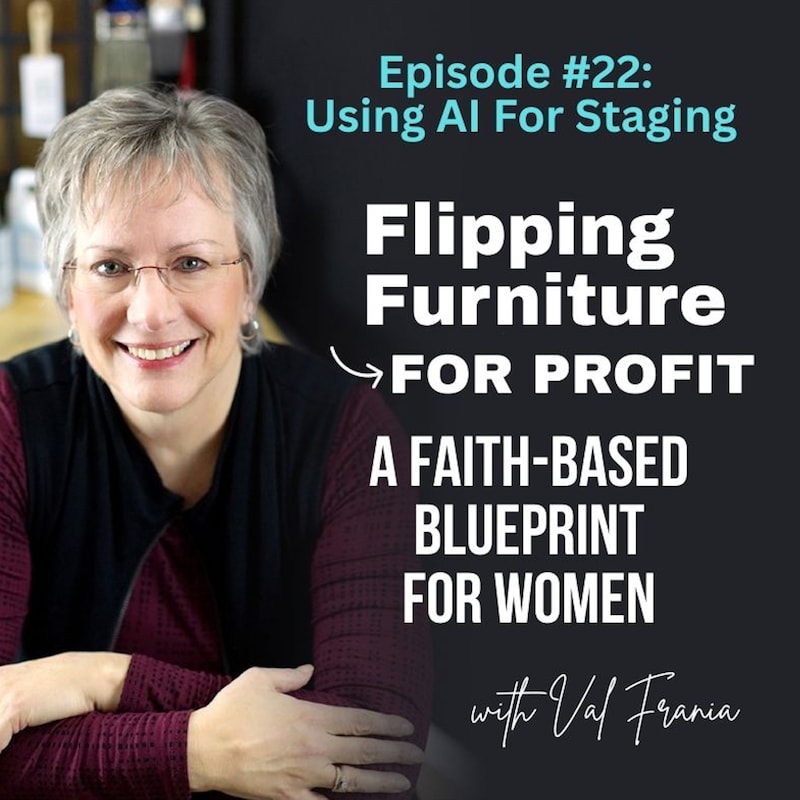
Shownotes
Wisdom, Not Fear: Using Ai As a Tool, Not a Shortcut
AI is one of the most talked-about — and misunderstood — tools in the furniture flipping world right now.
Some creators are excited about it.
Others are wary, unsure, or even afraid of using it “the wrong way.”
In this episode, I want to slow the conversation down and bring some clarity.
AI staging isn’t about tricking buyers or cutting corners. When used wisely, it can help buyers see a piece more clearly, reduce hesitation, and help finished furniture move out the door faster — without compromising honesty or craftsmanship.
In this episode, I share how I’m personally using AI staging in my own listings, what I’ve learned through real-world experimentation, and where I believe the ethical lines should be drawn.
This is not about chasing trends.
It’s about using tools thoughtfully, so they serve both sellers and buyers well.
In this episode, we talk about:
- Why AI staging feels intimidating to so many furniture sellers
- The difference between ethical staging and misleading images
- What AI staging should never change about a piece
- How staging can help buyers visualize scale and placement
- Why clarity builds trust — and trust sells furniture
- When AI is helpful, and when it isn’t
- And...how $27 can fix what $40 in paint never will
If you’ve been curious about AI staging but unsure where to start — or concerned about using it responsibly — this episode will help you think through it with confidence and discernment.
Related Resource
I’ve also created a short, practical mini course that walks through how I use AI staging step by step, including prompts, refinements, and ethical guidelines.
You can learn more here:
About the Podcast
Flipping Furniture for Profit is for furniture sellers who want clear guidance, honest conversations, and practical strategies for building skill, confidence, and momentum — without hype or pressure. New to flipping? Start here: ValFrania.com/ClearPath
Transcripts
Val Frania:
Hello my furniture flipping friends. I'm glad you're back to hear what I have to say today on flipping furniture for profit. This conversation is about clarity, how we make decisions, where we invest our energy and our money, and why some tools move us forward faster than others. And then next week, I want to talk about why we sometimes resist that clarity, even when we know it could help. Or maybe we don't even know that we need clarity.
We need an open mind and open heart, and we need to really think through where we're spending our time and money. I'm glad you're here, and I want to talk about something that keeps coming up lately, especially among us creatives and other small business owners. That's AI. For some people, it's exciting. To me it is. For others, it feels really unsettling, and for many it's a mix of curiosity and caution. So if that's you, I want you to know right away you're not behind. You're not wrong for feeling hesitant. This isn't going to be a technical episode. I'm not here to convince you one way or another to use anything, download anything, or keep up with the trends.
This is a wisdom conversation because when it comes to tools, any tools really wisdom is what matter most. I've been thinking a lot about how every generation faces new tools that feel really disruptive at first, iffy, concerning. Power tools once raised eyebrows, so did online selling. Oh boy. So did social media. Do you remember when Facebook first came out and even email? Believe it or not, there was a lot of hesitation over these new tools. And every time the real question was never about the tool itself, it was always about how people chose to use it. Any tool, when used properly, can be a great asset. That's true of AI, just like it's true of a table saw, a paint sprayer, or even money. The tool isn't the issue. The heart, the intention, the wisdom behind its use.
That's where everything is decided. In Proverbs four seven it says, "Wisdom is the principal thing. Therefore get wisdom, and with all thy getting, get understanding." Not speed, not efficiency, not innovation for innovation sake. Wisdom. Wisdom slows us down just enough to ask better questions. Is this honest? Is it helpful? Does this serve people well? Does this align with how I want to conduct my business and live my life? And here's something important that I've learned. AI doesn't remove our responsibility. If anything, it increases it. "When tools become powerful, discernment becomes even more necessary. Let me give you an analogy that will probably resonate if you work with your hands. A table saw is incredibly useful tool in the right hands. It saves time, improves precision, and helps create beautiful, functional things. But used carelessly, it can do real harm.
The saw itself isn't dangerous, it's a lack of skill, care, and respect for the tool is what causes damage. I remember watching an episode about a family that needed a home, and then a non-profit came in and built them a home for, I think it was a mom and maybe three kids. Well, there was a little boy, the son that knew there was a need in the house, and he went to work on a table saw to build something for his mom, and he cut his hand off. And this poor kid was disabled for life just because he loved his mom and wanted to meet a need. It wasn't the table saw. It was his lack of experience, wisdom, and maturity. All of those things come into play when you're using a new tool. Fortunately, that family got a new home, so that was a really fun episode.
But, you know, your heart goes out to that son that wanted to help his mom. AI is no different than that table saw. It can support good craftsmanship or it can cheapen it. It can clarify your communication or it can distort truth. It can really help your business or it can hurt it. Wisdom is what determines which direction we go. I think one reason so many creators feel uneasy right now is that they're afraid of losing something important. They don't want shortcuts to replace skill. They don't want to mislead their buyers.
They don't want to feel like integrity is slipping through the cracks in the name of convenience. If that's you, I actually think that hesitation is a sign of maturity. It shows that you care. Scripture tells us in James one five, "If any of you lack wisdom, let him ask of God, that giveth to all men liberally, and upbraideth not, and it shall be given him." God doesn't shame us for asking questions. He doesn't rush us. It reminds me I don't have to react quickly. I can move thoughtfully. I can figure it out. I can think about how this is going to impact my business, how it's going to impact how people see my business.
So I want to share a bit of my own experience, because I don't think theory is very helpful here. Over the past year, furniture sales have really slowed. Buyers are overwhelmed. Scroll fatigue is real. People are seeing hundreds of listings a day, and even good, well-made pieces are getting lost. I had furniture that I knew was solid, thoughtfully refinished, carefully staged in person. I love staging. That's one of my favorite parts. I really enjoy staging. I love taking the photos. I love editing them. I love picking out which ones to use. But these pieces were sitting longer than they should have. Not because it wasn't good, but because buyers couldn't imagine it in their own homes.
We we need to present our pieces and that's why we stage so carefully. We need to present our pieces to the people looking for furniture in a way that they can envision in their own home. So I began experimenting with AI staging because sometimes I'd run into I didn't have enough room, like I had a four piece bedroom set, that there's no way I could have displayed it well enough to show them how it would look in their bedroom. So I experimented. I got on ChatGPT and I gave prompts to get the piece displayed in a bedroom that was neutral, that would show off the furniture. I spent a lot of time playing around with it and it was very intentional and very cautious. I wasn't trying to improve the furniture I wanted the furniture looked exactly as it is. I wasn't trying to make it something it wasn't. I was simply trying to provide context to show scale, placement and possibility. The furniture stayed exactly the same. What changed was the environment around it, and something interesting happened. Buyers slowed down. They paused. They messaged me. They asked me questions. In one case, I had that bedroom set, which I referred to a minute ago. It has stalled for months and then suddenly sparked real interest after I posted the AI staged photo. I ended up selling two dressers.
The tool didn't replace my skill, it supported it. But there are lines I won't cross. And this is where wisdom draws clear boundaries. I'll not alter furniture look better than it is. I'll not hide flaws. I'll not misrepresent the finish. I won't remove my responsibility to be honest. Proverbs eleven one says, "A false balance is an abomination to the Lord, but a just weight is his delight." Back when people would bring things in to the office that would pay for gold or grain or whatever it was you were selling, they would put your item on the scale, and then they would put up the weights on the other side of the scale. And where the false balance came in is occasionally you would get these dishonest people working in that office, would put their thumb on the scale to change the weight, to change the price that would be paid out, or vice versa.
Really, if someone else was selling something, they also could do such a thing. A false balance is an abomination to the Lord. That verse applies to business more often than we admit. Honesty isn't just moral, it's practical. It builds trust, and trust builds longevity for your business. Shortcuts might create quick wins, but wisdom builds something that lasts. And that's what we're here for. We want to build a lasting business. So here I've come to think about AI, and not as a replacement for craftsmanship, because I'm a good stager, I'm very good at presenting my pieces. Well. But I tell you, it sure has come in handy to grab the attention of those scrollers looking through marketplace. It's not a shortcut around integrity, but you use it as a tool, one that can be used with restraint and transparency when used wisely. It doesn't deceive. It clarifies. It helps buyers understand what you've already created with your own hands. It helps them picture it in their home.
And wisdom always asks the same question, "Does this serve people well?" So breathe a little easier. It's my hope that you will look into the tools that will make our jobs easier and help our buyers see our pieces for what they are. They're just beautiful creations, and we need to stop them from scrolling long enough to take a really good look. And remember, fear rarely produces good decisions, but wisdom almost always does. If you'd like to see exactly how I use AI staging in real listings step by step with real photos and clear disclosure, I did create a small a short mini training walking through my process. It's practical, calm, and designed to help you use a tool without fear. Overwhelm. No pressure, just an invitation.
And I leave you with this thought. Wisdom isn't loud. Wisdom is steady. And in a world that's moving so very fast, there's something deeply valuable about creators who choose discernment over reaction. Use tools, but don't let them use you. Stay honest, stay thoughtful, and trust and integrity still matters. And thank you for spending the time with me today. There's a deeper reason behind why we hesitate using new tools or looking into new ideas, or accepting them has less to do with money and more to do with how we're wired as humans. I'll share a personal story next time that brings all of this together. Meanwhile, go take a look at my new mini course. You can find it at ValFrania .Com forward slash AI Staging
ValFrania.com/AiStaging We'll see you next week.

