Shownotes
Audio • Season 2 • Episode 4 • Series 1 Episode 4 - Bloody Mary - Shorter listen (Transcript added).
© 20 26 The Rise of the Protestants., Author, Shaughan Holt.
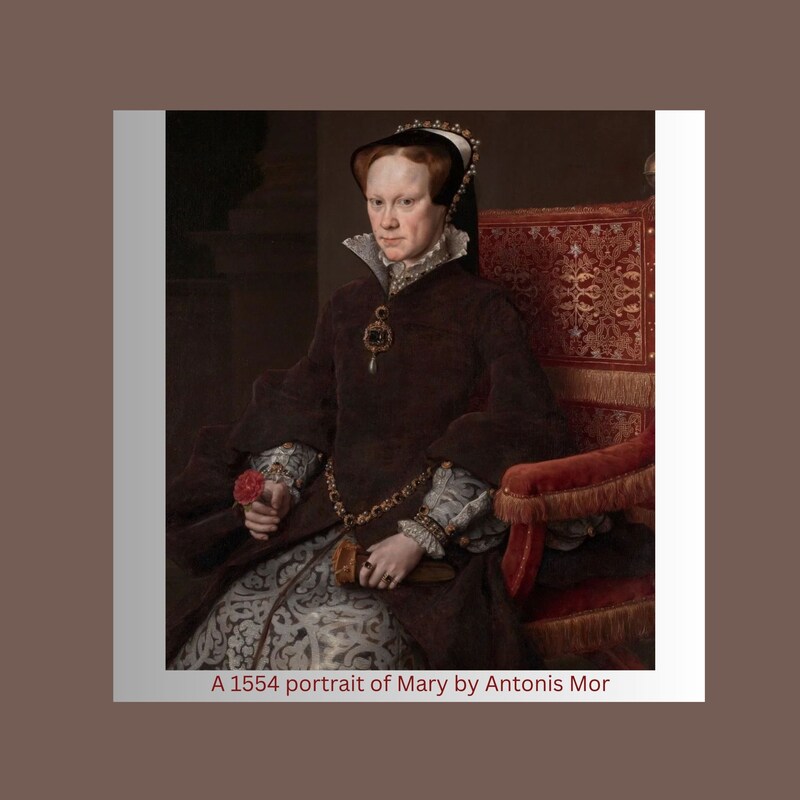
The Artwork is Portrait of Mary by Antonis Mor. c.1554
The Music is The Lord is my light and my salvation (Psalm: 27) Anglican chant.
This is a shorter version of the original episode, - for a quicker read !
After Edward's death, Lady Jane Grey was proclaimed Queen on 10 July 1553 but was soon replaced by Mary Tudor, who fled to East Anglia for safety.
On 1 October 1553, Mary was crowned Mary I at Westminster Abbey, becoming the first queen to rule England in her own right.
Known as "Bloody Mary," she ordered the execution of 280 Protestants in an effort to restore Catholicism, which led to the emergence of a hidden Protestant church in London.
Notably, Cranmer, Ridley, and Latimer were burned at the stake in Oxford.
Thomas Cranmer's trial began on 12 September 1555 under papal jurisdiction, and the Vestarian Controversy arose during this time, marking a key moment in the Puritans' reform campaign.
© 20 26 The Rise of the Protestants., Author, Shaughan Holt.
"All rights reserved. No part of this podcast may be reproduced, translated, distributed, or transmitted in any form or by any means, including photocopying, recording, or other electronic or mechanical methods, without the prior written permission of the copyright holder, except in the case of brief quotations embodied in critical reviews and certain other non-commercial uses permitted by copyright law".
Requests regarding translation, licensing, or republication should be directed to: [email protected]
Your feedback matters, send me an email at [email protected], with any comments, suggestions, or criticisms.I read every message.
Transcripts
© 20 26 The Rise of the Protestants., Author, Shaughan Holt.
"All rights reserved. No part of this podcast may be reproduced, translated, distributed, or transmitted in any form or by any means, including photocopying, recording, or other electronic or mechanical methods, without the prior written permission of the copyright holder, except in the case of brief quotations embodied in critical reviews and certain other non-commercial uses permitted by copyright law".
Requests regarding translation, licensing, or republication should be directed to: [email protected]
Your feedback matters, send me an email at [email protected], with any comments, suggestions, or criticisms.
I read every message.
This is a shorter version of the original episode, - for a quicker read !
Series 1.
Episode 4.
Bloody Mary. - shorter listen.
The year is 15 53.
Mary Tudor was the first Queen, to rule England in her own right.
She aimed to end the English Reformation, and restore the Church of England, to full communion with the Roman Catholic Church.
Known as "Bloody Mary", she persecuted Protestants, executing some 300 people, by burning them at the stake, in a vain attempt to re-establish Catholicism.
In the January of 15 53, the 15-year-old King Edward VI, fell ill with a fever and cough, and his health remained unstable.
Fearing the restoration of Catholicism, and the reversal of Henry VIII's reforms, Edward had previously disinherited his half-sisters, Mary Tudor and Elizabeth, in favour of his cousin, Lady Frances Grey.
Mary Tudor was born on 18 February 15 16, in Greenwich, the only surviving child of King Henry VIII and Catherine of Aragon.
Her life was blighted, when Henry separated from her mother, and, following the annulment of their marriage, Mary was declared an illegitimate child.
Henry's next wife, Anne, - Boleyn, gave birth to another daughter, Elizabeth.
On 25 May 15 53, John Dudley, the first Duke of Northumberland, arranged the politically advantageous marriage, of sixteen-year-old Lady Jane Grey, to his fourth son, Lord Guilford Dudley, at his mansion in London.
This event was part of a triple wedding, which also included Lady Jane's sister, Katherine Grey, and her sister-in-law, Katherine Dudley.
Born in autumn 15 37, Lady Jane was the eldest daughter of Lady Frances and Henry Grey, the Marquess of Dorset, a high-status family that resided at Bradgate House Leicester.
Lady Jane was thin and freckled, with sandy hair.
She was so short, that she needed to wear elevated shoes.
As the great-niece of Henry VIII, she was third in line to the throne, which made her a significant figure, among the nobility.
On 6 July 15 53, King Edward VI died, from what was likely a tuberculosis infection.
Fearing for her safety, Mary Tudor fled to her estates, in East Anglia.
On 9 July, from her residence in Kenninghall, Mary instructed the Privy Council to formally recognise her, as the legitimate heir to Edward's throne.
With considerable popular support, and a growing military presence on her side, Mary was in a strong position, especially as nearly all of Northumberland’s followers had abandoned him.
On 10 July, the Council unexpectedly declared Lady Jane Grey as Queen, and placed her in the Tower of London, until her coronation could take place.
Circumstances changed on 19 July, when the Privy Council of England, recognising the overwhelming public support for Mary Tudor, shifted their allegiance and declared her Queen, effectively ending Jane Grey's claim to the throne.
Reports indicated that Jane, received the news of her dethronement with joy, and expressed a desire to return home to her family.
Despite her brief reign of just nine days, Jane was imprisoned in the Tower of London, and not allowed to return home.
On the 18th of August, Jane's father-in-law and benefactor, the Duke of Northumberland, was accused of treason and subsequently tried at Westminster Hall.
He was convicted, and executed by beheading, at the Tower of London on 22 August 15 53.
In September, Parliament officially recognised Mary as Edward's rightful successor, denouncing and revoking Jane's claim to the throne, as that of a usurper.
On 1 October 15 53, the English Catholic bishop Stephen Gardiner, crowned Mary Tudor as Mary I, Queen of England and Ireland, in a ceremony at Westminster Abbey.
Stephen Gardiner (14 83-15 55) was a significant English Catholic bishop and politician during the English Reformation.
Educated at Trinity Hall Cambridge, he served as secretary to Cardinal Thomas Wolsey, gaining experience in foreign politics, amidst King Henry VIII's divorce from Catherine of Aragon.
Gardiner was known for his conservative stance, often clashing with the progressive reforms of his time, particularly with Archbishop Thomas Cranmer.
While he supported King Henry's authority to annul his marriage, he ultimately, fell short of achieving his goals, regarding the obtaining of a papal decree.
During the reign of Edward VI, Gardiner had been sidelined from the council, and even imprisoned, due to his resistance, to the many Protestant reforms.
However, upon Mary Tudor's accession, he was released, reinstated as Bishop of Winchester, and became Lord Chancellor, where he focused on the restoration of Catholicism, and legitimising Mary's birth.
He died on 12 November 15 55, and was interred in Winchester Cathedral.
When Mary ascended to the throne, Vermigli found himself in a difficult position, due to his stated opposition to the Catholic Church.
As a result, he was placed under house arrest for six months, facing the threat of capital punishment.
On 14 September 15 53, the Star Chamber Council, called upon Cranmer to address the serious charges of sedition, levelled against him.
On the same day, after bidding farewell to Vermigli, Cranmer was escorted from the Star Chamber, to join Latimer and Ridley in the Tower prison.
Following Cranmer's advice, Vermigli now asked permission to leave England, and his request was granted.
He arrived in Strasbourg at the end of 15 53 and resumed his previous teaching position.
Jane Dudley, known as Lady Jane Grey, was brought before the court, and charged with high treason, along with her husband, Guildford Dudley, two of his brothers, and the former Archbishop of Canterbury, Thomas Cranmer.
The charges against Cranmer were supported by false witnesses, who claimed that he had authored and disseminated heretical writings.
Their trial, ordered by a special commission, took place on 13 November 15 53, at Guildhall in the City of London.
The commission was chaired, by Sir Thomas White and Thomas Howard, the 3rd Duke of Norfolk.
Jane Dudley was convicted of high treason, for having unlawfully assumed the title and authority of the monarch, as evidenced, by several documents she had signed, as, "Jane the Queen".
Her sentence was, "to be burned alive on Tower Hill, or beheaded, as the Queen pleases".
In England, burning was the traditional punishment, for treason committed by women.
Queen Mary, initially showed leniency toward Jane, deciding to spare her life.
However, discovering that Jane's father had backed Wyatt's rebellion against Mary's marriage to Philip II of Spain, Jane came to be viewed, as a potential threat to the Crown.
Tower Hill, located in the London Borough of Tower Hamlets, surrounds the Tower of London and rises to 48 feet (14.5 meters).
Known for public executions from the late 14th to mid-18th century, it extends on both sides of the Roman built, London Wall.
High-profile traitors, criminals, and innocent Catholics and Protestants, were all executed in this location.
The year is 15 54.
On the morning of 12 February 15 54, the authorities took Guildford Dudley, from his rooms in the Tower of London, to the public execution place at Tower Hill, where he was beheaded.
His remains were brought back to the Tower Chapel of St. Peter ad Vincula, which could be seen from the quarters of Lady Jane Grey.
Soon after, Lady Jane was taken to Tower Green, an area inside the Tower grounds, where she too was executed.
Both Jane Grey, and Guildford Dudley, were laid to rest in the Chapel of St. Peter ad Vincula, located on the northern side of Tower Green.
Built in 15 20, "Saint Peter in Chains" served as the church for the Tower of London and is the final resting place for several notable prisoners.
Among those interred here, are three English queens: Anne Boleyn, Catherine Howard, and Jane Grey, all of whom faced execution in the 16th century, and were laid to rest without memorials.
At the time of his execution, Guildford was only 19 years old, and Jane, was even younger, at 17.
Just eleven days later, on 23 February, Jane's father, the Duke of Suffolk, was executed by order of the Crown.
These executions did little to improve Queen Mary’s or her government’s standing, with the public.
Five months later, the Scottish reformer John Knox, referred to the couple, as Innocents, stating, "Neither laws nor witnesses, could prove they done anything wrong".
After executing Jane Grey, and the other rebels, Queen Mary, was to turn her attention, to the leaders of the Reformation.
On 8 March 15 54, the Privy Council ordered Cranmer, Ridley, and Latimer to be moved to Bocardo Prison in Oxford, a fortified tower beside Saint Michael’s Church.
Mary Tudor was the first queen to rule England, as a monarch.
Her reign was marked, by her efforts to halt the English Reformation, and restore the Church of England to full communion, with the Roman Catholic Church.
As a result of her policies, approximately one thousand English Protestants, known as the Marian exiles, fled England, to escape potential imprisonment and execution.
The term "Marian" originates from the medieval era, when the name Mary was widely used.
After initially facing hostility in German Lutheran regions, the exiles were able to establish English Protestant congregations, in towns such as Wesel, Frankfurt, and Strasbourg, as well as in Swiss cities, like Zurich Basel and Geneva.
While in exile, they immersed themselves in the practices and philosophies of prominent Calvinist congregations, particularly those based in Geneva.
Many of them expressed a strong desire, to incorporate these concepts into England, if they ever returned.
The Marian underground.
During Queen Mary's reign, a secret Protestant Church was established in London, serving as a precursor to the Underground Church, which came to prominence, during Queen Elizabeth's reign.
The movement emerged, in response to the Queen's decision to restore the Catholic Church, as the official religion of England and Wales, along with her efforts to persecute Protestants.
Initially, the assembly met in private homes and inns, with only 20 members; however, the number of participants eventually grew to over 200.
Sadly, some members, like Deacon Cuthbert Symson and Margaret Mearing, were executed alongside John Rough.
At the age of 37, Queen Mary, now turned her attention to securing a marriage, and producing an heir, to guarantee a Catholic succession to the throne.
Her goal was to prevent the Protestant Elizabeth, who was the next in line, from succeeding her.
Mary aimed to restore Catholicism in England, and sought to marry Philip II, the eldest son of Charles V, the King of Spain.
This possible marriage was not well-received by the English population.
Gardiner and his supporters opposed it out of a sense of patriotism, while Protestants were concerned, that the return of Catholicism, and the possibility of a Spanish king, might result in the Inquisition, targeting Protestant heretics.
Additionally, many people in England had a vested interest in the prosperity of the Protestant Church, particularly because they had acquired church lands and funds, after Henry VIII dissolved the monasteries.
In 15 54, Mary had suppressed a rebellion, led by Sir Thomas Wyatt, and, taking advantage of the situation, she quickly married Philip.
Their wedding took place at Winchester Cathedral, on 25 July 15 54, just two days after their initial meeting.
Philip did not speak English, so they communicated in a mixture of Spanish, French, and Latin.
He had no romantic feelings for Mary; instead, he pursued the marriage for political and strategic gain.
His aide, Ruy Gómez de Silva, wrote to a correspondent in Brussels, that the marriage was concluded, "for no fleshly consideration", but to remedy the disorders of England, and to preserve Spanish control of the Low Countries.
The "First Book of Common Prayer", had been introduced in 15 49, during the reign of Edward VI.
Compiled by Archbishop Thomas Cranmer, it aimed to replace the Roman Rite, with a Protestant liturgy.
The Catholic Mass, the principal act of medieval worship, would now be substituted with an English Communion Service.
This prayer book significantly influenced the theology of the Church of England, steering it in a more Lutheran direction.
However, its similarities to Catholic practices, led to dissatisfaction among some Protestants, prompting Edward VI, to release, "The Second Book of Common Prayer", in 15 52, which reflected Reformed theology.
When Mary ascended to the throne, she reinstated Catholicism, and withdrew the formal recognition, of Edward's Book of Common Prayer.
Edward Grindal, born around 15 19, came from Cross Hill House in Saint Bees Cumberland.
This hamlet was the birthplace of two archbishops during Queen Elizabeth's reign: Edmund Grindal, the Archbishop of Canterbury, and Edwin Sandys, Archbishop of York.
Edmund Grindal, was educated at Magdalene and Christ's Colleges, and later at Pembroke Hall, all in Cambridge, where he earned his Bachelor of Arts in 15 38, and became a fellow, completing his Master of Arts in 15 41.
Ordained as a deacon in 15 44, he served as a proctor in 15 50, and was the Lady Margaret Preacher from 15 48 to 15 49.
Although the political events, leading up to Queen Mary’s rise to power, did not endanger him, he chose to resign from his Westminster prebend by 10 May 15 54.
Afterward, he chose to relocate to Strasbourg, as one of the Marian exiles.
In 15 46, a twelve-year-old boy named Thomas Cartwright, began his educational journey, at Clare College Cambridge.
Born around 15 34, to a yeoman in Royston Hertfordshire, he began his studies in theology at St. John's College Cambridge, in 15 53.
In English history, a yeoman is traditionally recognised as a landowner, representing a social class that served as a bridge between the gentry and the working class.
When Mary Tudor became Queen, Cartwright's college tutor, Thomas Lever, who would later become a Marian exile, chose to resign, rather than compromise his faith.
Cartwright, however, waited until 15 56 to resign, later working as a clerk, which suggests that his conversion to Puritanism had already occurred.
Clare College, founded in 13 26, is the second-oldest college at the University of Cambridge.
Originally named University Hall, it became Clare Hall in 13 38 after a donation from Elizabeth de Clare, and was renamed Clare College in 18 56.
Known for its progressive values, it was one of the first three colleges at Cambridge, to admit women as undergraduates in 19 72.
The year is 15 55.
In May 15 55, John Whitgift was elected a fellow of Peterhouse College Cambridge.
Born around 15 33, the eldest son of a merchant from Great Grimsby, he began his studies at Queens' College in 15 49, but switched to Pembroke Hall the following year, where John Bradford, a Protestant martyr mentored him.
John Whitgift, served as Archbishop of Canterbury from 15 83, until his death in 16 04.
Thomas Cranmer's trial, began on 12 September 15 55, under papal jurisdiction, at the request of Queen Mary.
During interrogation, he admitted to the facts presented to him, but denied treachery or heresy.
On 4 December, the Papal Court found him guilty, resulting in his removal as Archbishop, and thereby allowing English authorities, to decide his punishment.
The trials of the Protestant bishops Latimer and Ridley, followed soon after.
They were found guilty, and subsequently burned at the stake, in Oxford, on 16 October 15 55.
Stripped and tied together, they faced execution, while Cranmer was forced to watch.
Latimer, famously encouraged Ridley with, "We shall this day, light such a candle, by God's grace in England, as I trust shall never be put out".
A cross in Broad Street Oxford marks the spot of their execution.
The Vestment or Vestarian Controversy arose during the English Reformation, due to concerns, regarding vestments and clerical attire.
The first wave of this controversy, which occurred between 15 51 and 15 56, posed a significant challenge, to the Puritans' reform efforts.
John Hooper, as the appointed Bishop of Gloucester, was instructed to wear the surplice and rochet, —the white ceremonial vestments, required for his anointing, as specified in the 15 49 Book of Common Prayer.
However, he chose not to comply with these instructions.
After consulting with Martin Bucer and Peter Martyr, he eventually reached a compromise with the Privy Council, no doubt influenced by the threat of dire consequences.
Vermigli, whilst recognising Hooper's desire, to remove elaborate garments from the Church, did not believe that the Church explicitly prohibited them.
He therefore advised Hooper, to adhere to the authority of the Council and the Bishops, which likely influenced Hooper's eventual decision, to conform, in February 15 51.
Finally, and only after spending several weeks in the Fleet prison, he decided to comply, and was ultimately consecrated on 8 March 15 51.
John Hooper, who is believed to have been born around 14 95, was a significant figure in the English church establishment.
He served as the Anglican Bishop of Gloucester and Worcester, and became a prominent Protestant reformer, advocating for the English Reformation.
Due to various circumstances, Hooper often relocated to Europe.
Upon his return to England in May 15 49, he emerged as a leading supporter of Swiss Calvinism, which further cemented his role, in the Protestant movement.
When the Catholic Queen Mary, ascended to the throne, Hooper emerged, as a champion of the more radical factions of Protestantism.
During Mary's reign, which marked a return to Catholicism, Hooper associated himself with extreme Protestant groups, while facing increased criticism from his fellow bishops.
In December 15 54, Parliament revived the heresy laws, through a new act, and on 22 January 15 55, Bishop Stephen Gardiner, formally charged Hooper with heresy.
Unable to flee to Europe, Hooper sought refuge at Sutton Court Manor; however, the authorities arrested him, and transferred him to the Fleet Prison on 1 September 15 55, based on a false accusation of debt.
In 15 54, Queen Mary had begun to overturn many of the church laws, that Edward VI had established.
One new regulation she enacted, was the re-establishment of clerical celibacy, which led to the removal of John Hooper from his position, after he refused to abandon his marriage.
Subsequently, Edmund Bonner, the Bishop of London, further stripped Hooper of all his official roles.
And so, on 4 February 15 55, the Queen's Council, condemned Hooper to death by fire, for supporting the right of priests to marry, and for defying the doctrine of transubstantiation.
Just days before his execution, Sir Anthony Kingston, who had previously been offended by Hooper’s reprimands concerning his sins, came to visit him.
He urged Hooper to put his safety first, and encouraged him to reconsider his position.
On the morning of 9 February 15 55, John Hooper awoke, knowing it was the day of his execution.
As the hour approached, soldiers arrived, to escort him to face his fate.
When they arrived, Hooper assured them calmly, “I am no traitor; I would have faced the stake alone, troubling none of you".
Upon arriving at the execution site, Hooper gazed at the crowd gathered to witness his death, many of whom were former members of his congregation.
Kneeling in prayer, and under orders not to speak, he was offered a stool by a soldier.
On that stool, lay Hooper's pardon from Queen Mary.
The crown was presenting him with a choice: accept the pardon and live, or reject it and face death.
When he saw the pardon, Hooper exclaimed, “If you love my soul, take it away.”
After that, the soldiers securely bound him to the stake.
John Foxes Book of Martyrs, describes Hooper’s execution, noting, that, "the executioners used green branches to carry out the horrific execution, making three attempts over 45 minutes".
During Queen Victoria's reign, a monument to Bishop Hooper was erected in Saint Mary's Square, Gloucester.
This monument is located near the site of his execution, where he was burned at the stake, making him a Protestant martyr.
The memorial features a sculpture of Hooper in his bishop's vestments, holding a book under his left arm, while blessing the gathered crowd with his right.
A plaque on the monument reads:
“Gloria soli Deo, for the witness of Jesus and the Word of God, not accepting deliverance”.
“John Hooper, Bishop of Gloucester and Worcester, was burnt to ashes on this spot on 9 February 15 55”.
The year is 15 56.
Between January and February 15 56, Thomas Cranmer ultimately succumbed to pressure, and renounced his Protestant beliefs.
In four separate recantations, he acknowledged the authority of the King and Queen, and accepted the Pope, as the true leader of the Church.
Initially held at Bocardo Prison, and later transferred to the residence of the Dean of Christchurch, he debated doctrine with a Dominican monk.
However, on 14 February, he was stripped of his Holy Orders and returned to Bocardo Prison.
Dissatisfied with Cranmer's minimal concessions, Bishop Edmund Bonner issued a writ on 24 February, for his execution on 7 March.
Two days after the writ was announced, Cranmer issued a fifth recantation.
In this final document, Cranmer renounced all doctrines of Luther and Zwingli, fully embracing Catholic theology, including the supremacy of the Pope, and the concept of transubstantiation.
He asserted that salvation was impossible for those outside the Catholic Church, and expressed his joy in returning to the Catholic faith.
Cranmer, now sought and received sacramental absolution, and was permitted to partake in the Holy Eucharist.
As a result, his execution was delayed, and on 18 March, the now-broken Cranmer, submitted one last denunciation of his previous beliefs, and admitted to his transgressions.
Despite a specific legal provision stating, that heretics who retract their views should be spared, Mary remained firm in her decision to enforce his sentence.
She condemned his sins and obstinacy against God and her Grace, as too severe for either leniency or mercy to intervene, instructing the officials, to carry out his execution.
On 21 March 15 56, Bishop Bonner informed Cranmer, that he could make a final public recantation at the University Church before his execution.
After starting with a prayer, Cranmer then deviated from his prepared speech, renouncing all his previous recantations.
He was quickly taken down from the pulpit, and brought to the site in Oxford, where Latimer and Ridley had been executed, six months earlier.
Upon arrival, he denounced the Pope as an enemy of Christ, referring to him, as the Antichrist.
In keeping with his vow of self-punishment, for signing his retractions, he thrust his right hand into the flames before, any other part of his body.
His final words were, "Lord Jesus, accept my spirit, I glimpse the heavens parting, with Jesus stationed at God's right hand".
In the sixteenth century, St. Michael-at-the-Northgate Church, in Cornmarket, marked the northern limit of Oxford.
A trench, often used for the disposal of rubbish, flanked the city's fortifications in that area.
Beyond this trench, there was an area of uncultivated land, now known as Broad Street.
The three Protestant martyrs of Oxford, Ridley, Latimer, and finally Cranmer, were executed, at the stake in this location.
In Oxford, there is a granite cross, on Broad Street near Balliol College, which marks the site, where Latimer and Ridley were burned at the stake, followed by Cranmer a few months later.
It serves as a lasting reminder of this tragic event.
