Shownotes
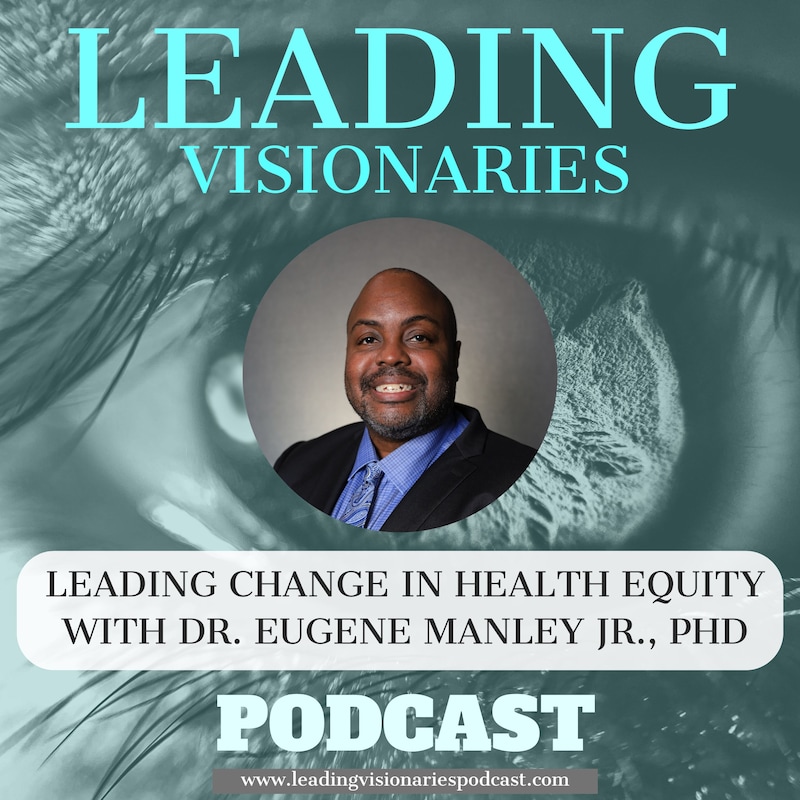
What does it really take to turn a big idea into meaningful, measurable impact? In this episode of the Leading Visionaries, host Anjel B. Hartwell sits down with Dr. Eugene Manley Jr., PhD, Founder and CEO of the SCHEQ (STEMM & Cancer Health Equity) Foundation, where he leads national efforts to improve cancer outcomes and diversify the STEMM workforce. A first-generation scholar and nationally recognized speaker, Dr. Manley bridges science, policy, and lived experience to drive measurable, community-centered change. Dr. Manley shares his powerful journey from navigating undiagnosed ADHD and systemic barriers to becoming the founder of the SHE STEM and Cancer Health Equity Foundation and launching his consulting firm, Innovation for Impact LLC.
This conversation goes deep into the realities of leadership, the challenges of building a nonprofit from scratch, and the importance of understanding both impact and income when bringing a vision to life.
What You Will Learn
THow lived experiences can shape powerful, purpose-driven innovation.
Why vision alone is not enough and how to operationalize big ideas into action.
What it takes to launch and sustain a nonprofit organization.
How to navigate healthcare systems and advocate for yourself or others.
The importance of combining impact with income for long-term sustainability.
How leadership is developed through both experience and self-awareness.
Why celebrating small wins is essential for long-term success and motivation.
FAQ:
What is health equity and why does it matter?
Health equity ensures that everyone has fair access to healthcare, resources, and outcomes regardless of background, income, or identity. Dr. Manley highlights how systemic gaps can lead to disparities in care, making advocacy and education essential.
How do you turn an idea into a nonprofit organization?
It starts with a clear mission and vision that resonates with people. From there, founders must establish structure, secure funding, build a board, and develop sustainable systems to create long-term impact.
Can nonprofits make money?
Yes, nonprofits can and should generate revenue. The key difference is that profits are reinvested into the mission. Sustainable nonprofits often rely on multiple income streams, including grants, services, and partnerships.
Connect with Dr. Eugene Manley Jr., PhD
Join the Leading Visionaries Community
Transcripts
LVP 128 Eugene
===
Ad: [:Now here's your host, Anjel b Hartwell.
Anjel: Welcome to another episode of the Leading Visionaries Podcast, where we celebrate the ingenious, insightful, innovative, and inspired leading visionaries of our time, and provide our listeners with world class examples of the kind of courage. Clarity and confidence it takes to bring visions into reality.
ne Manley, Jr. Dr. Manley is [:Where he leads national efforts to improve cancer outcomes and diversify the STEM workforce. He is also the founder of Innovation for Impact LLC, and he is a first generation scholar and nationally recognized speaker. Dr. Manley Bridges science policy and lived experience to drive measurable community centered change.
I'm so excited to have you here. Welcome to the show.
Eugene: Oh, thank you so much for having me. It's such an honor to be here.
always been somebody who had [:Were you the little kid that you know, would come in and say, oh my God, I have this bright idea, let's go do it. Or did vision, was vision something that was cultivated over time and through your life experience?
Eugene: I was the one that had big ideals, but I also had undiagnosed A DHD, so I always had big ideals.
But unfortunately, when you go through life with undiagnosed A DHD, the world tries to put you in a box and can confine you to this. And then if you do regular jobs, you're in a box, you do interviews, you're in a box. And even when you try to do research, oh, well we can't do this, or, you know, it's too big.
through my lived experiences [:Anjel: beautiful.
And so why don't you share with us like one of your big ideals for navigating healthcare?
Eugene: Well, the biggest ideal was just inspired by my own experience with medical racism last year. So, I was on Medicaid because I had launched a nonprofit and I had a slip and fall that led to a fracture of my ankle, and then I had to have reconstructive surgery of my foot.
While I went into the hospital with clear goals and objectives and the surgeon and I were in agreement, the hospital staff decided that they knew more than a person with a background in biomechanics and the surgeon. So they decided to lie in my medical records. They said I had no pain. They said I could ambulate.
oh, so I learned a lot more. [:Uh, learning to make sure you read your records in real time, which normally would not have been an issue if I wasn't on opioids and loopy and so. So, and then I learned really how to report and file things so that you can make sure if something happens to you in a hospital, you can try to hold the staff accountable or at least get it reported.
have a proxy that can do it [:Anjel: Wow. Okay. Well, and now that you're telling me this story, right, I'm curious about, you know, biomedical innovation. So I'm curious about what that means in your bio. Like what kind of innovation are you desiring or visioning to bring into being that will correct. Things like that?
Eugene: Part of the work is related to making sure that patients know how to navigate healthcare, know how to ask questions in just general medical settings.
hat have been developed since:And then we don't do a lot on the survivorship side because. For the longest we didn't have lung cancer survivors surviving 5, 10, 15 years, and now we're having this. And so there's this whole burgeoning field of survivorship and what do we call them? How do we help them? And and the biggest challenge is after you finish your therapy, then.
What happens after you finish your clinical trial? What happens to you as a patient? Are you still ignored or do you just get forgotten? So how do we make sure you find resources to keep you engaged?
Anjel: So tell us where the vision came from for shek.
generation in Detroit, I saw [:While she was walking and then when she became unable to walk. For me being a, having to be a caregiver for my grandparents from 10 to about 16 years old and just seeing how healthcare is, how people are taught to or disregarded as I navigated academia, because I was a engineer and then a mechanical engineer.
A biomedical engineer, and then I became a molecular biologist. While those degrees are great, you, you learn different skill sets. But over time I still saw that there was a lack of diversity in higher ed then, and there still is one today, but the students don't necessarily always get the information or resources to help them navigate these spaces.
spaces? And then you have to [:But if you translate that from academia to nonprofit to companies, it's sort of the same thing. So you have to learn how to navigate. So it made me want to make sure we help these people coming through understand how these spaces work. How to find new resources, how to find a group to help you navigate and so you can get to a position where you can be successful.
And then as I did the research, I started then learning about the disparities and then that sort of made an effort on how do we get information to people to help them advocate. So it was a combination of things. But if you had asked me about six years ago, would I go work at a nonprofit, it was never on my mind.
And if you had asked me three and a half years ago, would I launch a nonprofit, I would've looked at you like you were crazy.
ow I want you to speak to us [:You made the decision to go ahead and start this nonprofit. Can you talk a little bit about. The process, like the internal process that you went through to come to the decision first to found something. Right. Because this podcast, we talked to a lot of people who are founding things and bringing their visions into reality.
First to found something, and second, to make the choice for it to be a nonprofit, which is its own animal.
hat you have the skillset or [:Everyone can have an ideal, but it's how do you think about operationalizing it? So it has impact now. Mine just happened to become a nonprofit. Partly because I saw what patients like my mother dealt with and how they don't have information and resources, and some of the stuff I wanted to create was intentionally going to be free because it's a nonprofit.
But what people don't understand or they seem to forget is just because it is a nonprofit does not mean it cannot make money. It just means you have to be really. Diligent about how you find funding resources and you have to have multiple revenue streams, which I did not exactly do very well. So you that as a f, as a founder, that's something you think about.
going to launch a nonprofit [:So it needs to be something you don't want it super long 'cause you want it something catchy or mine is an acronym, but it's something that you can say fast. And then once you get that and you think people have, are receptive, then you go through the whole process of, you know, trying to file the paperwork, getting the, you know, the.
siness development you know, [:So I already, I run, I had to look for it because I forgot, I, I didn't forget I had done it. But, you know, I, at that moment it was like, oh, I have done something like just let's go pull up this market assessment. So it really helped. I know I laugh, I say sometimes you do stuff and then it comes back to your head.
You're like, this was really useful. Even though the program was designed for us to go into biotech, you can still translate all that stuff into running a nonprofit. So that is what really helped.
Anjel: Beautiful. All right. We're gonna take a quick break. When we come back, we're gonna talk a little bit more about your new company, and we're gonna let our listeners know where they can find out more about you.
st.com. If you're interested [:Discover more about this [email protected] slash creative age leader lab. Or click the Connect with Anjel button on the website to apply and qualify for a consultation for more personalized access and support. Be sure to share this show in your own spirals of influence with the people who you think might benefit from our content.
our listeners in Antigua and [:And we will be right back with Eugene Manley Junior PhD.
Ad: The Leading Visionaries Podcast is brought to you by the Creative Age Consulting Group. Are you the one who thinks differently, who is called to create a significant conscious change in the world? Who is seeing and dreaming of a better way for your industry, your community Humanity Creative age consulting group is hired to guide leading visionaries just like you, who want to break through the static in order to clearly express and confidently enroll support for their vision in a way that makes it inevitable that it will come to pass.
njoy with our compliments. A [:The book is yours by visiting gift dot Leading visionaries podcast.com.
actual LLC as well. Tell us [:Eugene: So, you know, as a PhD we often sometimes forget we can do things that will generate money and also help people. I mean, beyond just going into pharma and doing the job, sometimes you. The degree sometimes make you become more humble than you should, and then you, you have drive, you have passion. So I decided to finally start leveraging my skills into something that can make sustainable income, which is reality.
You still have to pay your bills, you can run a nonprofit, but if you can't pay your bills, you also cannot have a nonprofit. So I decided to. Leverages brain of mine. 'cause I, I work in many spaces and I've done a lot of different things to really focus on helping organizations develop mentorship and training programs.
ing strategies to get grants [:Anjel: Beautiful. All right. And what inspired you to call it Innovation for Impact?
Eugene: I went back and forth with a lot of names. I really, I tried to find something that. I wouldn't necessarily run into copyright or trademark issues with, but also reflected my broad expertise and, and inspiration and drive. So it was a lot of words to sift through.
This is what people forget. [:So I sort of settled on innovation for Impact Consulting LLC, but because there were other innovations, four or innovations with the number four, I had to play some magic to get the. Psych.
Anjel: Understood. All right, well let's talk a little bit about leadership, Dr. Manley, because, um, obviously going all the way through to get your PhD requires a lot of self-leadership and then.
You know, stepping into the foundership of a nonprofit requires a lot of leadership skills, including working with governance, you know, working with boards and so forth to get things moved along in the organization. And now you've taken the leap of. Of starting your own company, uh, consulting company on top of all of this.
out your leadership journey. [:You know, just your life experience.
Eugene: I'm going to say something that you've probably laughed at. When I was a kid, I was always in the hospital 'cause I was a chronic asthmatic for like from till I was from five to 10. I was in the hospital about 20 to 30 times a year just for my asthma. So there always had me interested in medicine.
racks stay in the back of my [:I never knew I was going to be a leader, but I also had undiagnosed A DHD, which meant I was a, wouldn't say a problem shot. I just was one that asked a lot of questions, way too many, and it was always why, and why and why, but also. My brain was not wired like everyone else's. So just 'cause everyone else looked at something and cried.
I would not do that just because everyone else behaved the same way. I would not do it. But because I was always in my books reading, doing logic puzzles, I got called a nerd sell out. I got called all kinds of things. Um, and often when you're even in inner city environments. Usually your parents beat it, not for literal beating, but you are forced to often try to suppress this stuff and, and I'm just like, no, I'm just going to do my own thing.
e learned that, you know, as [:Eugene, you were going to do the road less traveled. You're gonna make an impact. And I think she knew I never would fit and do the norm, but I would do my own thing. So I've always had this streak of leadership or resolute independence, but I will always do what I think is right.
Ad: Mm-hmm.
Eugene: And along the way, I've done different leadership training and programs, but I think of leadership also from the lens of, you can look at who, how others treat people.
ip as a way of real. Leaders [:And whether they leave your org or not, you should be happy if someone leaves, if it's going to help them grow. And, and that's generally always the philosophy I have when working with people. My job is not to hold you. My job is to be your champion. And no matter what, what do you wanna do? What do you wanna learn, and how do we put you in a position to get there?
Mm.
Anjel: Beautiful. I love that. Well, I wanna go back a little bit to the, the kid, the kiddo that you were, that you were always in the hospital and you had your gobos and your transformers. And I just wanna reflect to our audience members that sometimes the, the greatest innovations come from. These foundational experiences that then end up getting like later down the road that got merged in your life, right?
steners, I, I'd just like to [:You know what I mean? Can I put. Being in the hospital with asthma, with transformers and, and make something of that that is unique. And so I just, I really wanted to point that out to our listeners. So I wanna ask you now about you know, what do you do to keep yourself motivated? Especially as a founder, especially as an innovator, especially in the area of money and monetization of what you're doing.
You know, like with the nonprofit, you wanted to offer free services, but nonprofits also need to make money and they need to either fundraise or they need to have things that they sell to, to support, to underwrite the free services. Tell us a little bit about your, your money journey.
e: That has been a challenge [: You know, I launched, yeah,:The challenging part is I was writing pharma grants and not the rest, not that I was gonna forget the stuff. The goal was to start with the pharma and then expand to the other stuff. But you know, money and funding is still hard to come by because you can know one person at a company. Then if they move or switch jobs, then you've lost your contact.
hallenge, you know? And when [:So you have to try to. Not do everything and not do everything every day and you just block, okay, if this is one thing I need to do, I do this. But you have to learn to time block or channel or if you can try to find the money to get a va, which I don't have, but you have to find ways to do this. And as you said, you need to find ways to monetize services.
ely, but I can do my premium [:Then I can always go back and turn that into the nonprofit and then build in the additional funding mechanisms and, and, and resources.
Anjel: Yeah. Beautiful. Well, one of the things that I like to, to teach my clients, and I've had to learn it myself, is that sometimes you can have a heart project, right? But you gotta, you gotta have your financial health in order, and you've got to create in ways that you're, your non-profit or your philanthropic or your, you know, give, your, give experiences are coming from your overflow, right?
, whether it's a for-profit, [:Otherwise, we're. We're investing our life literally in something that is, is gonna deplete us. So in the last minute, Dr. Manley that we have, is there anything else that you would like to share, either about being an innovator or about your businesses, or about being a leader with our listeners?
Eugene: I just think people need to find something that excites and inspires them and gives them.
The drive to do stuff day to day because we have wins, we have losses, we have ebbs and flows, and it's the wins that keep us going when we go through the downturn. So just stay focused on the prize and celebrate the wins more than we often do.
t's one win before we close? [:Eugene: Uh, you put me on the spot. Yeah, one, one win is that, uh, I know this is gonna sound silly and it's so trivial, but I was just at the grocery store last week and I had brought some eggs and I got home and one egg on each side was cracked. And I said, oh. And I just was like, I'm not gonna worry about, and then I went back in the store today and I told the lady, she said, oh, well go get another car.
And I said, I don't want, she's like, I was like, you know, a lot of people try to come up with these things. They're trying to get stuffy. She said, go grab another car and take it you So Sean's trip. But it was a win because I was like, okay, extra eggs. Now it, so, but this is something, and this is a little win, but it is.
It's still a win. It's a moment of levity. A yes,
nt of levity. All right, Dr. [:By joining our community, sharing your takeaways, asking questions, or submitting guest suggestions, you can weave your visionary thread into our fabric by opting in on our [email protected] or by interacting with us on social. Look for the handle at Leading Visionaries Podcast across all the major platforms.
Thanks for tuning in your eyes, ears, and hearts open. And remember, you are here to create conscious change.
ring the leading visionaries [:To welcome wealth and cultivate a web of collaborative support to bring their vision to life. We invite your feedback and guest suggestions and invite you to subscribe to our mailing list to be notified of new [email protected].
