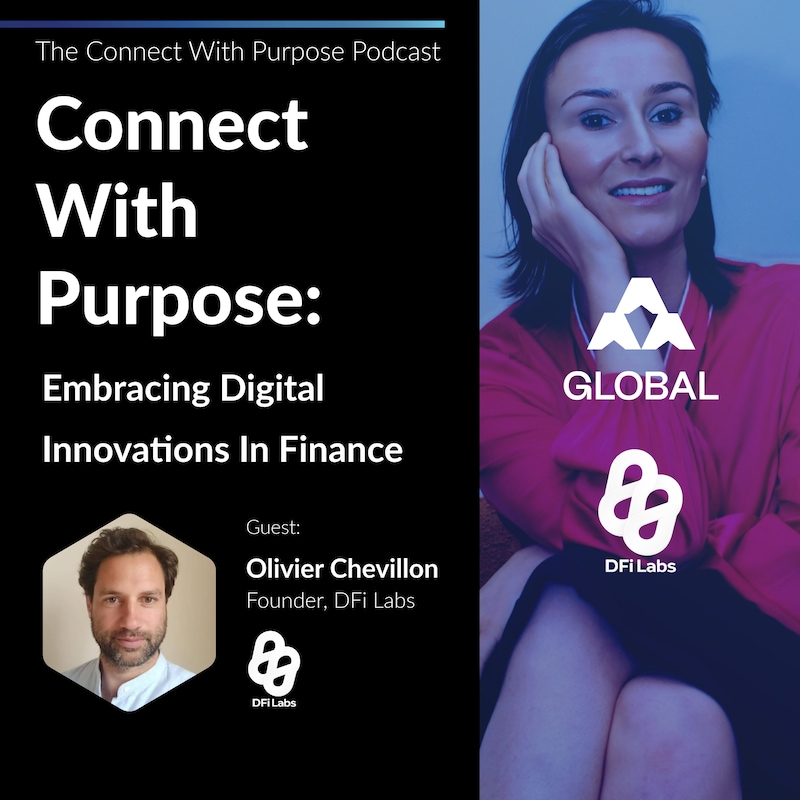
Shownotes
Embracing Digital Innovations In Finance With Olivier Chevillon
In this insightful episode of 'Connect With Purpose,' we sit down with Olivier Chevillon, founder of DFi Labs.
Olivier shares the journey of creating a quantitative investment firm specialising in digital assets and systematic investment products within the crypto space.
He delves into the unique challenges and opportunities in the realm of digital assets, the crucial role of risk management, and the impact of AI on research and operational efficiency.
Learn about the future of digital assets, the importance of deep expertise, and the value of consistency in this fast-evolving market.
This episode is a must-watch for anyone interested in crypto investments, AI in financial strategies, and the future of digital finance.
Chapters:
00:04 - Introduction and Guest Welcome
00:23 - Olivier Chevillon's Journey and DFi Labs
02:07 - DFi Labs' Market Focus and Future of Digital Assets
05:10 - AI's Role in Digital Asset Management
08:28 - Impact of AI on Workforce and Hiring
17:21 - Managing Stress in the Crypto Market
19:51 - Risk Management in Crypto Trading
25:28 - Motivation Behind Starting Defi Labs
27:21 - Long-term Goals and Purpose
31:38 - Advice for Aspiring Professionals
Takeaways:
- Olivier Chevillon emphasises the importance of understanding risk management when navigating the volatile cryptocurrency market.
- The evolution of DFi Labs was driven by Olivier Chevillon's recognition of the need for systematic investment products in digital assets.
- Augusta Mirchandani and Olivier Chevillon discuss the necessity of robust strategies in the face of market instability and unpredictability.
- The speakers advocate for a strong work ethic and continuous learning as essential attributes for success in the rapidly evolving financial technology landscape.
- AI plays a crucial role in enhancing investment strategies, but requires skilled individuals to interpret and validate outcomes effectively.
- Olivier Chevillon shares insights into the future of digital assets, predicting they’ll surpass traditional finance in the coming years.
Companies Mentioned In This Episode:
- DFi Labs
- AWS
- GCP
- World Quant
- Cube
Transcripts
Welcome to the next episode of Connect with Purpose.
Speaker A:Today I'm joined by Olivier Chevalon, who is the founder of Defi Labs.
Speaker A:So welcome, Olivia, and thanks for, thanks for coming on today.
Speaker B:Thank you, Augusta.
Speaker B:Very nice to spend time with you.
Speaker A:Yes, you too.
Speaker A:Well, I think to start, what would be really useful would just be to understand a bit about Defi Labs and what, what you've managed to create so the audience can just hear about the firm and also your story and getting there.
Speaker B:So the story of Defi Lab is the story of someone who's been in quantitative investments for over 20 years.
Speaker B:And it's been the story of being on the derivative side, being on the equity systematic side, and then discovering that there were a new asset class.
Speaker B:And by new asset class, I meant crypto and thinking.
Speaker B:Okay.
Speaker B:I mean it's a very data driven environment, yet I mean the offering of systematic product is very low.
Speaker B:Question is, how do we shape this needed?
Speaker B:I mean, does it really exist or not?
Speaker B:The, there's no product, so you can't even know if it works or not.
Speaker B:And so the idea is we traded Defi Labs because we saw there was the need to have tadfi style systematic investment product in the crypto space.
Speaker B:And then it's been the long story of discovering how to avoid all the pitfalls of a new asset class, which is very, very different in a way from what we have in sapfi.
Speaker B:So that's the story and it's been running for over five years now.
Speaker B:So it's been a lot of hit and miss, but quite a lot of success now.
Speaker A:Amazing.
Speaker A:And are you trading in traditional markets as well or is it now predominantly across crypto?
Speaker A:And.
Speaker B:We sell like.
Speaker B:So we're a research firm first and foremost.
Speaker B:And so the core, what we do was built on cloud fee.
Speaker B:So we still have like cloud fee clients with whom we do.
Speaker B:I mean we, we still run the same strategies, but we are mainly focused on digital asset.
Speaker B:And the reason is developing a product.
Speaker B:And by products, not only research, but the full package takes a lot of time, a lot of focus and ends.
Speaker B:If you spread too thin between right, left and center, you're not going to be good.
Speaker B:So what is legacy is legacy and it works well.
Speaker B:But the core focus is, what we are doing is digital assets.
Speaker A:What, what, what do you think the future of digital assets is?
Speaker A:Do you think that the space is going to at some point overtake traditional finance?
Speaker A:Like what, what do you think the future is?
Speaker A:Maybe in the next two years, five years, 10 years for that sector?
Speaker B:So first of all market neutral person.
Speaker B:So the kind of person who have no opinion on things and will just kind of arbitrage or try to find relationship between things and then make money out of those relationship that they believe they are able to do to identify.
Speaker B:So I don't have a macro perspective but as, as a, as a professional, but as an individual I do have like a personal opinion.
Speaker B:And my personal opinion is I wouldn't be in this space if I didn't believe that long term there is value which will be created.
Speaker B:Is it named Bitcoin eth or something else?
Speaker B:I really don't know yet.
Speaker B:What is sure is that a lot of inefficiencies of trad fee are.
Speaker B:I mean people are trying to solve them in digital assets.
Speaker B:And I mean I believe Larry Finks knows a few more things than I do.
Speaker B:And when he signed that, I mean Patri is going to move on chain.
Speaker B:I cannot believe that he has a better perspective than I and that most assets will be tokenized kind of seems like very intuitive.
Speaker B:Especially if you're American and you're seeing how in.
Speaker B:I mean banks settlement and so on is kind of a 70s business.
Speaker B:So will it happen?
Speaker B:To my mind, yes.
Speaker B:When is more the question mark.
Speaker B:How long does it take before it's fully efficient and that you can properly trade trillions all the time?
Speaker B:That's more the question.
Speaker B:But it's not a question as of if, but more of question of when.
Speaker A:And how is how is AI impacting this space then within digital assets?
Speaker A:Are you using AI a lot in your work or less so.
Speaker B:We are very much an AI firm in every sense of the world to me.
Speaker B:I mean first of all in strategies, when building strategies.
Speaker B:I think the value of AI is it enables you to be faster, it enables you to see, I mean to identify relationship that otherwise with more linear type of models, I mean like a traditional regression or combination of features you're not able to identify.
Speaker B:Hence there is a lot of value in AI.
Speaker B:The issue is people always find a result and believe that because they have a great result then it's great product.
Speaker B:The issue is this result is also a function of what how you fed and modelized everything.
Speaker B:And so here the skills and the expertise in building this model is very key because I mean the overfeed issue is something that you only realize once it's live.
Speaker B:And when it's live it's too late because I mean it's a lot of time developing, it's a lot of time implementing and it's probably a lot of time, a lot of money lost before you realize that you were wrong in some.
Speaker B:And so for us it's been like five years.
Speaker B:A lot of it has been hit and miss.
Speaker B:A lot of it has been also upskilling.
Speaker B:And now that's something that I mean all models are AI based.
Speaker B:I mean not neural networks but more like LGBM and random forest and stacking and so on.
Speaker B:But this is a reality and I do see that various linear models that we benchmark for models against then we do have alpha.
Speaker B:So in the research side and that makes a lot of sense.
Speaker B:And I would say also as a firm, I mean we kind of have done all the processes are AI based.
Speaker B:So like KYC onboarding, everything is now gen AI driven and so it's, it helps to emulate reporting.
Speaker B:Also everything kind of is automat automatized with AI.
Speaker B:And I would say the big difference from like a startup investment firm is before you needed a lot of people to be able to do a certain number of tasks, not to achieve the same number of tasks, then you need a lot less people.
Speaker B:And the good thing is often when you don't have legacy then it enables you to start from kind of scratches with AWS or GCP and then build like systems which are almost top institution great without I mean like in matters of days or so because you can build great tools with AI gen AI not every interesting.
Speaker A:So the, the type of people that you're replacing with AI is that software development predominantly or is that also on the research side are you needing less qrs and depth or less of.
Speaker A:Less of everything?
Speaker B:I think you need less people, you need better people.
Speaker B:Because I mean when you use AI the same is everyone can get a result, I mean in two minutes anyone can get a result with I mean even like any AI model.
Speaker B:The issue is you can't understand what you've achieved.
Speaker B:So you need to understand everything that from the data, from the, the way you, I mean you, you get your, your course working, how long does it take you to get a result?
Speaker B:How stable are my results and so on.
Speaker B:So it's more like to me it's more, you need stronger people, you need less people, but a lot stronger because the skill set that you need to be able to understand what you're doing is at the moment a lot higher.
Speaker B:It's not about producing the result a lot easier but it's more being able to question the result that you produce so that once it goes into production then it's robust enough that you do deliver value.
Speaker B:So who is impacted?
Speaker B:I mean, I would say kind of it's more like the junior level.
Speaker B:We work a lot with universities like NCERA and so on in France.
Speaker B:And I think the level, I mean the number of hours that you need to have worked on models or IT implementation to be able to produce a good product is very high.
Speaker B:And hence on the junior level, unless you, I mean, work kind of 12 hours a day, two years or a year and a half, then you're quite far away from the level which is required to be kind of autonomous and being able to question your results or put things in production because all the IT that will be required, I mean there's like a real job of ML engineer, it's not a fake job.
Speaker B:It's like so complicated to get an ML model in production that I mean, this is kind of highly technical and this, you need to have spent a lot of time working on it before you're very able to deliver.
Speaker B:So it's more, the bar has been put higher even though getting a result has been put a lot lower in terms of requesting.
Speaker A:Are you, when you come to hire people and you look for talent, then what do you look for now?
Speaker A:Are you looking for people who have got, have done the hours so they've got more experience, or are you looking for people who maybe have done, I mean, statistics or courses at university within AI or what, what do you look for on the talent side to make it useful?
Speaker B:It's very much what you're saying, but one is not exclusive of the other.
Speaker B:If you don't have both, then probably you're not good enough.
Speaker B:That's very much the issue.
Speaker B:And I think that's the main takeaway of AI is it has made everything possible for everybody.
Speaker B:But, but then to be able to produce something which has value, then instead of just being one level, you need two levels which is understanding plus hours plus understanding of it.
Speaker B:And then suddenly you have the full package which is the multiplier, not just like one level.
Speaker B:And so unfortunately you need the boss now instead of just one to be good enough.
Speaker B:That's my take.
Speaker A:Interesting.
Speaker A:And are you like, how big is Defi Labs now?
Speaker A:How many people are, are you managing to create all this research with?
Speaker A:How many people are you?
Speaker A:Just for context.
Speaker B:We'Re quite small.
Speaker B:I mean we're life sized people.
Speaker B:We're always, I mean, I would say I said people need to do the hours and that must say, for instance, we are very AI focused, MN focused, yet we also invest quite a lot in people because it's very tough to find people who are good enough.
Speaker B:And hence we, I mean like we take people we believe have the right work ethic, we have the right mass level and then we grow there.
Speaker B:And hopefully some of them, I mean, will stay with us.
Speaker B:Some of them will go to like top quantums, like cube or like of them.
Speaker B:But I mean that's to us the only way to, I mean properly have a chance because the bar is so high that if you want to hire those people, they are quite expensive.
Speaker B:So for us it's easier to grow the people into this level.
Speaker B:But you need not start from here, but from already a very high base.
Speaker B:And so that's what we have.
Speaker B:And currently we are five.
Speaker B:And because we're very much focused on research, I mean it's not, we're not going to be 50.
Speaker B:I mean like digital assets are not currently a business where you run 50 people.
Speaker B:It's more like a business where I mean you're max 10 and that's including one person for sales or that kind of science.
Speaker B:But in research side, the size of the market is not large enough at the moment.
Speaker A:Okay, is the volatility in the markets then within the crypto space because obviously it's so volatile, Is that a good thing for you because you're using, you're creating such technical research and technical strategies as the volatility then benefit?
Speaker B:Well, I would say it's a good thing because I mean, if there's no volatility, there's no opportunity.
Speaker B:But at the same time, I think the key element is what's very tough in crypto is that things are so volatile that one day you're Euro, the next day you're zero.
Speaker B:And so risk management and understanding how to build a product with a certain type of risk profile then becomes an edge.
Speaker B:Because I mean, in the same way that you can get an AI model to give you an output very easily to, I mean, backtest something which has worked and then say, look, I have a great product, just run it and then wait till you die is very easy.
Speaker B:The only thing is to be consistent in time.
Speaker B:Then the way you need to modelize is kind of very different.
Speaker B:And so the fact that it's volatile in a way it's good.
Speaker B:I mean it's bad because it makes some people look like hero for a while and then they die or their strategy died, but they got quite a lot of attention for a while.
Speaker B:And I mean you don't get this.
Speaker B:But on the other end, if you look at a more longer term then it also, this volatility also makes sure that the people were consistent.
Speaker B:And I do believe in consistency in the return and the research process and execution and so on.
Speaker B:Then that's what makes a difference between a short term relationship and the business that you can grow.
Speaker B:That's my perspective, I must say.
Speaker B:It also tied to the fact that crypto used to be very much a casino night.
Speaker B:It's more and more institutionalized in the sense that you've got people who are more professional in the investment side and in the allocation side.
Speaker B:And so track records are still very short.
Speaker B:So I mean everyone can be a euro or zero easily but every day is kind of an incremental, is increasing the number of points.
Speaker B:And so then we can start to a bit see who is good, who is not good and so on.
Speaker B:And so consistency is really, I think what will be very key in digital asset because I mean is Bitcoin worth 130, 220 or 80?
Speaker B:I mean you can have both, you can have all of them in a year.
Speaker B:So it's tough to be consistent.
Speaker A:It's, it's, it sounds like it's a very stressful market to actually manage.
Speaker A:And I know obviously it's also, I mean it never stops crypto.
Speaker A:So how do you manage that?
Speaker A:How do you, I mean, how do you, how do you, I mean just outside of work, how do you all within work, how do you manage the level of stress that it must take to be a founder?
Speaker A:But also within this, I mean very, very stressful sector.
Speaker B:I think there's two components.
Speaker B:One is the stress of running a strategy in an environment and one is the stress of running company with uncertainty on revenues but certainty of cost.
Speaker B:So and both of them, I mean when you come from flat feeds, very rare that you launch a new venture in flat feed, you tend to be more like in a body, in a large fund, which is a very different perspective because you're only focused on generating revenues.
Speaker B:Not really what are all the costs associated to it and all the admin associated to it and all the legal associated to it and all those dimensions which unfortunately you have to have once you're running an investment firm, especially in something which can be viewed as toxic.
Speaker B:So this is like quite stressful for the investment part.
Speaker B:I think it's also very different because in fact fee is I mean nine to five in a way and five days a week, not seven days a week with no stop.
Speaker B:So here's one thing which is very different is the Way you look at it, when you're a researcher in catfi, then you're focused on research.
Speaker B:But I mean it's a commodity.
Speaker B:The execution also here because it's 24 7, if you are not able to deliver on the IT side, robustness, if you're not able to be good on the execution side because liquidity can vary massively, then you have a big problem.
Speaker B:So that's one thing you need to pay a lot more attention to dimension which in fact here are not that important because they are commodity.
Speaker B:And then after that's to get a product.
Speaker B:Once you have a product, then there's the how do you handle the rescale of it?
Speaker B:Because it's a 24 7, 365 issue.
Speaker B:And so here, I mean the good thing about PRADVI is you learn a lot about risk management and so you're focused on P and L but also a lot on the risk adjusted or everything which goes behind the.
Speaker B:And so the good thing is it helps in crypto because you need to pay attention to that because what's sure is at some point something bad will happen.
Speaker B:So if you're not prepared to all the bad cases, then what sure is they will come and eat you.
Speaker B:I mean this year we had like 10th of October where liquidity disappeared, some major coin lost 80%, you had AGL everywhere.
Speaker B:So if you're not prepared before then you're probably dead at some point.
Speaker B:I mean your strategy and the thing is it's about understanding risk, it's about preparing all the indicators to be able to manage it.
Speaker B:Still that's, that's a blue sky scenario where I mean things happen the way you expect them, which is always not going to happen at some point.
Speaker B:So you also need to have things which are going to monitor in real time 24 7, a certain number of variables which can put you at risk.
Speaker B:And so as I create a risk template and it's also because I will be sleeping, because I need to sleep every day.
Speaker B:And that's the same for everyone in the team, otherwise everybody will die and become insane, insane and then die.
Speaker B:So what you need to do is you need to create a lot of alerting and processes to be able to handle those moments which will necessarily happen in the course of a year in the crypto side.
Speaker B:So what's very interesting is in a way you can have a great strategy but if you don't have the correct risk management infrastructure, what issue is that it will fail at some point and it can be a great strategy but when blows up then it's not a great strategy anymore.
Speaker B:So that's really part of all the learning experience of being in the space which constantly evolves where all the actors are also maturing.
Speaker B:But not everything is super mature when one exchange is different from another and so on.
Speaker B:And there is, it's not as unified and as well sought as intra fee example.
Speaker B:We don't have circuit breaks like on the S and P and so on in the crypto space.
Speaker A:Yeah, that's, it's, it's, it's, it's incredibly interesting I think.
Speaker A:Do you, do you then think part of your edge is the fact that you spent so many years in tradfi and therefore your risk management is better than people who have just done crypto because you've had such a long understanding of markets for so many years and you had that risk management.
Speaker A:Do you think that's one of the edges that you have?
Speaker B:I think the main edge is in understanding how to build a strategy.
Speaker B:How I mean understanding volatility, market neutrality and so on.
Speaker B:That's creating a product.
Speaker B:But then after risk management it does help that in prep fee my first boss always told me first you don't lose money, then you make money.
Speaker B:And so it's about understanding all the risk which can be associated to something.
Speaker B:For sure you will miss some things that you assume are correct and in fact they will turn out not to be.
Speaker B:Which also means you need to add extra layers to 1.1Something is not unexpected.
Speaker B:So all this, it's more like it's not really.
Speaker B:I mean part of it is the knowledge, but part of it is the knowledge of the fact that there are things that I will not know and that I still need to get prepared for things that I'm not aware of but will happen.
Speaker B:And so I think that's more this mentality of being humble in what you know and not know to be ready to things which will happen.
Speaker B:It's not a question if something bad will happen, something bad will happen, it's just when and how prepared are you for that.
Speaker B:So it's more mentality than for sure there is an edge and it's an attention to detail on everything that's.
Speaker B:I mean a lot of people on the 10th of October thought, I mean Dogecoin cannot lose more than 30% it lose 80% in one day in and 40% in two hours.
Speaker B:You think it's not possible?
Speaker B:It is possible.
Speaker B:So you need to be to have system in place in case something happens pre warn them then Know what to do.
Speaker B:Have your.
Speaker B:So it's more like this mentality of paying attention to even things which looks so remotely impossible that.
Speaker B:Well in fact they will maybe happen, maybe not, but maybe what, what made.
Speaker A:You start your own, your own fun?
Speaker A:Like what was the, what was the motivation behind that?
Speaker B:Because I really thought there was like an opportunity in this space and that it was not covered.
Speaker B:And then assume everyone has its own preferences.
Speaker B:The way he likes to work.
Speaker B:I mean I can't.
Speaker B:I mean I, I view myself this as an entrepreneur.
Speaker B:Like I like to learn things, I like to, to grow things and so to develop a business, build as we say in crypto.
Speaker B:So that's very much I think a way of looking at things.
Speaker B:And I really thought there was like an opportunity.
Speaker B:If I didn't think that this was.
Speaker B:If I thought that was an overtrolytic opportunity, I would not have gone there just to for the sake of joding, but because I saw it's kind of a blue ocean where it's kind of no one is too much there or not that many good people.
Speaker B:And I thought okay, there's an opportunity.
Speaker B:Hopefully we are able to be one of the players.
Speaker B:I mean it's still work in progress, but I still believe it will happen.
Speaker B:This will be like a big space and you will need all those years of experience making mistakes, understanding them and so on.
Speaker B:It's not like you come from trad fee and you're like, you know what?
Speaker B:I've already seen everything.
Speaker B:I mean in it you've not seen in liquidity, you've not seen 24, 7, 365 you have not seen.
Speaker B:Once you've used all those things then probably you can start saying quite a lot of them.
Speaker B:But that was the idea.
Speaker A:Is your target with the firm to become one of the leaders and leaders in this space when it, when it becomes, I mean something huge or what.
Speaker A:What is your target with the firm?
Speaker A:Long term?
Speaker B:Yeah, I want to become something meaningful.
Speaker B:So I mean like the idea was not to run my own money, but to be like, to be able to deliver great products.
Speaker B:I mean I have, I mean I view firms like World Quant or Cube as, I mean your role model.
Speaker B:I think the way they've grown is the way a quant firm should try to grow if it's not for like a retail or retail style.
Speaker B:And that's very much the ambition.
Speaker B:I mean I love complicated things and because I believe there's an edge in it very much like the AI stuff.
Speaker B:And so aim is to Be fighting with those guys at some point in this space, not in all space.
Speaker A:Makes sense.
Speaker A:What's your overall purpose then?
Speaker A:Within, within work.
Speaker A:Are you, I mean what keeps you in this game?
Speaker A:Obviously you're building a firm, you're, I mean you're, you're wanting to dominate in this sector.
Speaker A:But what is, what is the thing that keeps you going for.
Speaker A:Yeah, keeps you, keeps you in this, I mean, challenging space.
Speaker A:What's the purpose behind everything?
Speaker B:Like what I do, I mean I find it interesting intellectually, you know, how like I'm a middle aged white person and normally I should be, I mean something close to unemployment.
Speaker B:So I feel very blessed to have been able to constantly upgrade and upscale in everything which is AI in terms of.
Speaker B:I was good in AI five years ago, now I've been, I've become decent in it, which I never thought that would be possible.
Speaker B:So.
Speaker B:But you can't do AI if you don't understand it.
Speaker B:And then if you want to grow a firm then you need to understand how to hire people.
Speaker B:You start and you can, I mean you need to understand how to run money.
Speaker B:I mean like paying salaries and understanding all those things.
Speaker B:So it's like a multi dimensional job which is very challenging and where you're learning a lot.
Speaker B:And so as a kind of an semi old person I find I really like the challenge of, I mean getting new things to learn.
Speaker B:And to me it's been great because if I had not done everything on AI then I wouldn't understand half of the, of what happens now.
Speaker B:Whenever there's new model, I know, okay, this worked this way, this work this way.
Speaker B:And it's a way of looking at the world or understanding the products which are being built, which I find great because even a guy who was just out of university only understands, I don't know, half of it or a third of it.
Speaker B:And so I mean it's pleasant.
Speaker B:It makes me feel like very alive and in the world we live in.
Speaker B:So that's quite pleasant.
Speaker A:Yeah, I think that's, I think that's great.
Speaker A:You have actually interest in the work you're doing.
Speaker A:I always ask this question and I think it's.
Speaker A:Everyone's purpose is so different.
Speaker A:Some people's purpose is just to make a lot of money.
Speaker A:Some people's purposes to build something.
Speaker A:Everyone has a different purpose.
Speaker B:I think that's, it's interesting to be honest.
Speaker B:It's very funny but indeed it was my, I mean end of the day money is like a key variable for, to measure success.
Speaker B:But it's not where I would stop.
Speaker B:I mean it's more like an outcome rather than the main driver.
Speaker B:These are very.
Speaker B:In how we've grown probably.
Speaker B:But that's secondary.
Speaker B:That's the outcome rather than the path.
Speaker A:I think when you're.
Speaker A:I think when your purpose is fashion because you enjoy something, I think that long term you always actually end up making more.
Speaker A:That's what I just see generally speaking.
Speaker A:So yeah, I think that's good.
Speaker A:What's your advice to somebody.
Speaker B:Maybe about.
Speaker A:To go and do their masters or PhD in terms of what should they be doing in terms of course or in terms of extra studies or extra work to get the hours in so that when they get to actually getting a job they have a higher chance of being able to be in this.
Speaker A:In this space.
Speaker A:What would your advice, your advice be.
Speaker B:Had to confront themselves with reality.
Speaker B:So like they need to get on project, they need to get the end dirty to research.
Speaker B:Research fail.
Speaker B:I mean it's.
Speaker B:Especially when you're young and that's.
Speaker B:I mean to us a key criteria in the people that we work with that we draw.
Speaker B:It's the work ethic.
Speaker B:If you're not interested in what you do, it's probably the you should be doing something else.
Speaker B:If you're interested in this architecture of science, I mean data science and MA then you need to work in a lot.
Speaker B:And so it's a lot less about the money that you're making.
Speaker B:I mean anyway when you're an intern, I mean some firms pay like massive salaries but most firms don't pay that much.
Speaker B:So it's less about the money you're making than the experience that you're getting.
Speaker B:And getting it with the right people who are going to constantly give you work but also help you and challenge you and what you do.
Speaker B:So my take would be really try to find people who are good work with them irrelevant.
Speaker B:I mean if you can get in firms which pay you like a large amount of money, maybe that's great.
Speaker B:But it's more about the job that you're doing having as much of an holistic and as much as as much responsibility as you can.
Speaker B:Because I mean 5k or 10k or whatever at that stage of your life is a lot less important than the knowledge that you're getting and the experience that you're getting.
Speaker B:And the work edit also again.
Speaker A:Yeah.
Speaker A:So it sounds like you hire a lot one attitude.
Speaker A:Somebody's what they actually their work ethic and how much they want to be in this space.
Speaker B:Well, if you're not good, you're not even there.
Speaker B:But once you're good enough then I mean the work, I mean it's what makes the difference between someone who will succeed and someone who will not.
Speaker B:I mean and I can really talk from experience because I was, I was never the guy who was always giving 100% when I was a kid because I never saw the point of being 100% in anything because I was doing well enough.
Speaker B:But I believe that in this space if you want to be really good and that's the ambition that people should have then you need to have very cool commitment.
Speaker A:Amazing advice, super, super useful and I think it's great for the audience to hear your views because I think it's getting more and more competitive all the time.
Speaker A:So I think that's great.
Speaker A:But thank you for your time today Anivia and enjoy watching it and I'm sure we'll speak speak again very soon.
Speaker B:Have a nice day.







