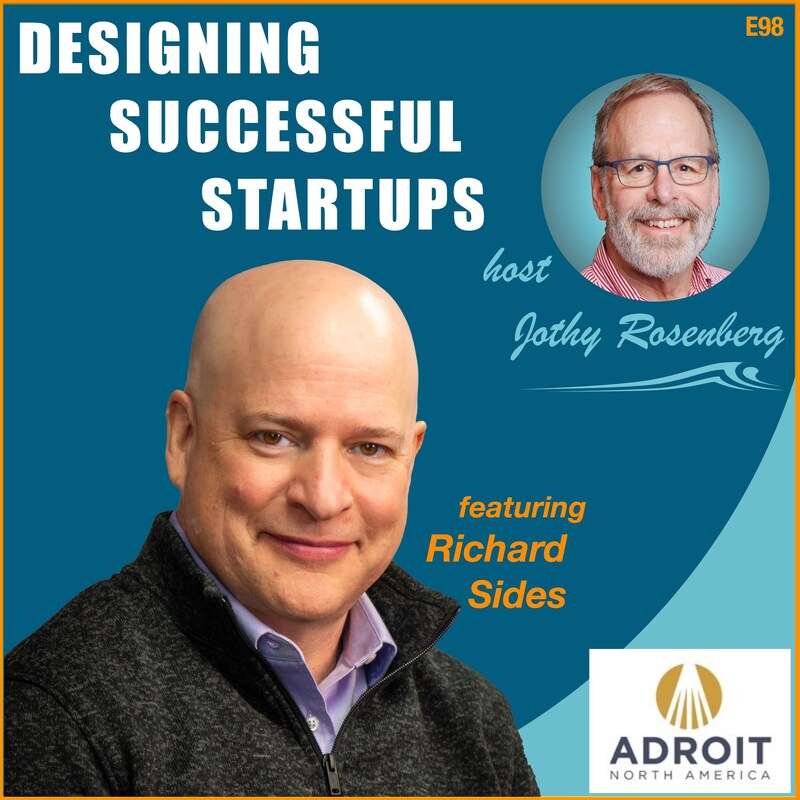
Shownotes
Richard Sides
Bio
Richard Sides is Founder and CEO of Adroit North America and Adroit Hardware Solutions. Adroit North America was recently named to the Inc5000 at #1026 representing annual growth in excess of 40%. Rich is a driven entrepreneur that has founded and exited multiple ventures, some more successful than others including lawn care, systems consulting, an E-Commerce based chocolate truffles business, foreign language translations, supply chain software, ERP systems reseller, and plant floor computing hardware and integration. He has a passion for the food and beverage industry having started his career at Kraft Foods in 1990 and serving as SVP Of Information Systems at Preferred Meal Systems. He formed a jazz band called Blue Orbit Combo in 2019 that plays regularly through the Chicago area and speaks decent Spanish which he started to learn about 15 years ago.
Intro
Richard Sides’ transformative journey from a timid engineer to a successful entrepreneur underscores a pivotal revelation about career security: corporate loyalty is an illusion. This profound realization was catalyzed by witnessing his father’s abrupt termination after three decades at U.S. Steel, an experience that imbued him with a steadfast resolve to forge his own path. Throughout our conversation, Richard recounts his evolution, detailing how he overcame his introversion by immersing himself in consulting, ultimately leading to the establishment of multiple thriving enterprises within the food industry. He elucidates the critical importance of cultivating resilience and adaptability in the face of challenges, as well as the necessity of creating one’s own security through skills and relationships. Join us as we delve into Richard’s insights, which illuminate the intricate interplay between personal growth and entrepreneurial success.
Conversation
Richard Sides' journey from a seemingly secure corporate environment to the precarious realm of entrepreneurship unfolds like a compelling narrative, punctuated by significant life events that shaped his perspective on career security. At the tender age of seventeen, Richard witnessed the abrupt termination of his father's three-decade career at US Steel, an event that indelibly altered his understanding of corporate loyalty and job security. This pivotal moment instilled in him a profound conviction to never relinquish control over his professional destiny. As the discussion progresses, we delve into Richard's evolution from a shy, introverted engineer who struggled with interpersonal interactions to a formidable entrepreneur who has successfully launched multiple ventures in the food industry. His decision to pursue consulting as a means of personal growth is a testament to his resolve to confront and overcome his inherent challenges. Through his experiences, Richard elucidates the importance of cultivating skills, fostering relationships, and embracing calculated risks to build one's own security and autonomy in an ever-changing job market.
Takeaways
- The notion of corporate loyalty is fundamentally flawed; individuals must cultivate their own security and resilience.
- Richard's early experience with his father's sudden job loss profoundly influenced his entrepreneurial journey and career decisions.
- To achieve personal growth, one must confront discomfort; Richard's choice to pursue consulting forced him to overcome his introverted tendencies.
- Success in entrepreneurship relies on mastering delayed gratification; setting long-term goals allows for sustained effort and achievement.
- Building optionality through skills and relationships is critical; do not wait for unforeseen circumstances to compel your growth.
- Richard's journey illustrates the importance of navigating failures as learning opportunities, essential for eventual success in business.
- Adroit hardware
- Adroit North America
- Who Says You Can't Startup | Full Bundle | Incorrigible Entrepreneur - The online course for startup founders
- Jothy's TEDx talk - On why those with disabilities tend to overachieve
- The Who Says I Can't Foundation - Jothy's non-profit that helps disabled kids get back into a sport they love to restore their self-esteem
- Our YouTube channel
- Designing Successful Startups — Jothy Rosenberg | Author | Speaker | Podcaster - Site with all podcasts
- Tech Startup Toolkit book
- Please leave us a review
Transcripts
Yeah.
Richard Sides:You can like go through your life and to sort of look back to sort of like key points. Right. If this hadn't happened or this hadn't happened. Right. And choices that you made.
Jothy Rosenberg:Picture this. A 17 year old watches his father walk through the door after 32 years at US Steel and announce he's been terminated.
That single moment rewired everything Richard Sides thought about career security and set him on a collision course with entrepreneurship. Today's guest went from mowing lawns for 3, 25 an hour to building multiple successful companies in the food industry.
But here's what make Richard's story extraordinary. He was a painfully introverted engineer who couldn't make eye contact.
And he deliberately threw himself into consulting to force himself out of that shell. You'll hear how witnessing corporate loyalty evaporate shaped his entire approach to building businesses.
d over defense contractors in:If you've ever wondered whether entrepreneurs are born or made, Richard's journey from shy engineer to serial founder, we'll answer that question. I'm Jothi Rosenberg and this is Designing Successful Startups. Well, hello Richard, and thanks for joining the podcast. Thanks.
Richard Sides:Hey Jothy, thanks for having me.
Jothy Rosenberg:Absolutely. So context setting, where are you originally from and where do you live now?
Richard Sides:Yeah, so I grew up in Pittsburgh and I live in Chicago.
Jothy Rosenberg:And I understand from something you told me that way back in the day that your dad worked for U.S. steel.
Richard Sides:Yeah, that's true.
Jothy Rosenberg:But then the steel industry in the US was getting hammered and I guess he got caught up in those layoffs. And I wonder how that affected you because you were pretty young at the time. And just how did that affect your view on entrepreneurship?
Richard Sides:Yeah, so my, so my dad worked for US Steel for over 30 years. Like 30, 32 years, something like that. And started like way back in at the Johnstown Works and then moved into Pittsburgh.
And really just for my whole life, right. He was just part of the US Steel industry. And I just saw him just one day come home and basically say he had been, had been terminated.
And I kind of looked at that and I was like, I never want that to happen to me. I'm never going to put myself in a position. I was like 17 at the time.
So I was like getting ready to graduate from high school and it just like this really kind of stuck with me that I need to never put myself in a position where I'm going To be like in a super bad position because I got terminated from a company.
And it just kind of struck me that at the end of the day it's business and the whole concept of family and loyalty, especially within larger corporations, this doesn't really exist.
So it just, I remember like after that, like as I went to Lehigh for college and I remember just having a conversation and I sort of laid out this plan. It was like, okay, yeah, I'm gonna get an engineering degree with the idea that I'm gonna get. Be employable coming outta school and stuff.
But ultimately I wanna be in a position where I can sort of drive my own destiny, my own career and not be so reliant.
Jothy Rosenberg:And so when, when did it happen and what was your first business where, where you basically got started down this entrepreneurial path?
Richard Sides:Well, that was all the way back in high school, right? So I was working for the local school district for 325 an hour.
Kind of at the time just doing, you know, cleaning services, mowing lawns and for the school district and all that kind of stuff. And I just really. And I picked up a couple of lawns in the neighborhood.
And like, I realized that, you know, so like the first thing I said was like, well, I'm going to be a professional and I'm going to like do your lawn like a really nice way and all this kind of stuff. And I realized that I could be making nine, ten dollars an hour doing my own, my own lawns versus, you know, working for, for the school district.
And so I just started scouting all the folks in my high school that were doing lawns. And as they aged out and went to college and stuff, I asked for introductions.
And by the time I graduated, I assembled like 10, 11 lawns that I was doing for 20 bucks a pop. So I was making for me 2, 200, $250 a week, which is dramatic compared to like 325 an hour.
And so it just kind of just really stuck with me that like again, by driving your own destiny, you can really kind of like move up a big step in terms of opportunities. I mean, there's a little bit of risk to it, but so that's like kind of. That was like the first thing that I did.
Jothy Rosenberg:I got started doing lawns in my neighborhood too. It was, it was a suburb of Detroit called Birmingham. And, and it was great because I used their equipment. But you know, I rode my bike to each house.
I had 10, so I could do two a day for five days and have the Weekends off, and it was great. And I, and I did make good money. It was, it was fun. Okay. So, and so as you're.
As you're still in this pretty early age, especially for being an entrepreneur.
Richard Sides:What.
Jothy Rosenberg:Were, what were things that you did that sort of set you up for the future? I mean, maybe the lawn jobs is one example.
Richard Sides:Yeah. So out of school, I went to work for Kraft Foods. And ironically, I was quite introverted at the time.
I had trouble making eye contact while I had, like, this desire. Right. My personal characteristics didn't really fit. And I was.
I was pretty accomplished in systems at craft and building and learning to project management and stuff. But I realized that I needed to sort of shake myself out of this introverted shell that, that I was in this.
This shy, you know, and I would sort of force myself over it. And a friend of mine, a couple of friends of mine left Kraft, went into consulting.
And I really like that path because I. I felt like, number one, I get exposure to a lot of stuff, and number two, it would really put me on the line. Right. So I went into. I went to consulting and went over to what's called McLadrian Poland.
It's called RSM today, but it was called Poland at the time.
And over the course of about three years, this is like in the late 90s, I was, like, consistently put in front of, you know, senior management, making recommendations, and, like, it just really like, got me out of my shell and sort of got me out of the introverted view of things, as well as getting exposed to all these. All entrepreneurial businesses and companies and seeing, like, the.
Just the amazing breadth of things that you could do out there to, like, have a business and make. And make money. So that kind of set me up.
And then I made my first move into being an independent consultant, you know, under a company name via some contacts and that kind of stuff. And that was sort of like my first move to independence was via contacts and other folks.
I was able to pick up a couple of accounts and to sort of do direct consulting and really be independent. And then I brought in a couple of folks to work for me. And this was in like, the, the dot com bubble era. So that was like my first move.
But it was set up because I went into consulting and got used to that consulting model and learned from those around me and stuff and just sort of studied and then just sort of took the leap.
Jothy Rosenberg:Were you already interested in the food industry when you took the first job at craft?
Richard Sides: So. So this is in:I mean, nobody remembers that, but I remember it because I applied for, like, 75 companies to get a job.
And so basically what I would do is going into every interview, I was updating my resume, where my objective became the job that I was interviewing for. And so it just so happened I actually had two offers. One was to go into food, and the other was to go into the defense industry. And, you know, the.
The wall had just fallen in Germany, the USSR was blowing up, and all that kind of stuff. And so I felt like the fence probably wasn't the angle that I wanted to go.
And I thought it'd be a little bit more altruistic to kind of go into the food for. With craft. And so that's. I had two offers. In other words, I could go defense or I could go into food. So I took food. So that became my passion.
Jothy Rosenberg:So it's still your passion?
Richard Sides:Yeah, for sure. I can't tell you how many food plants I've been in, but there were.
Jothy Rosenberg:Several craft products which my family, when I was growing up, was quite addicted to. And they might make you laugh, but one was that my. My dad was absolutely addicted to Velveeta cheese.
And every morning he had a English muffin, and he used one of those, the kind of cutters that uses a. Has a wire, and he would cut up, you know, uniform slice of Velveeta. And. And. And so we all.
We all got hooked on that, and most of us stopped that once we became adults. I have an older brother, however, that to this day still is, like, that's his staple for breakfast is the Velveeta cheese.
And of course, we were also big into macaroni and cheese. And my. In my, you know, early years as a kid, yeah, I worked on those.
Richard Sides:Lines, by the way. So, like, the. The. The cheese formulation. So there's a series of calculations based on inputs to figure out, like, how to make a standardized output.
Right? Because inputting, like cheese comes in very. It varies by block of cheese, right? Different fat and all this kind of stuff. Right.
And so there's these programs based on samples to solve for, like, how much ingredients you need to add to make it a standard. The standard Velveeta that. Right. So, like, I worked on all that, and I worked on all, like, the inventory tracking.
So, like, that was up in Newell, Minnesota, was like. Was like one of the big Velveeta plants for craft. So, like, I worked on all that so maybe some of the cheese that I influenced your brother ate.
Jothy Rosenberg:Oh, yeah, I'm sure, I'm sure because he eats so much of it. And we're going to talk about your current company in just a minute. But, but between.
Between the first craft job and now, what were some of the companies that you. You worked at and, and especially ones that you founded along the way?
Richard Sides:Several. Some more successful than others, but so coming out.
So I did my independent kind of consulting gig for a while, and then the dot com bubble started to blow up and I kind of saw the wind. So I ended up moving into working for a food company as a cio.
So I did that for like six years and then jumped over and worked for an ERP company out of India.
So these were like, really kind of foundational experiences for me in terms of just understanding the full scope of running a business, like as the CIO and all that.
opened my eyes. This was like:So it really opened my eyes to this concept of a virtual company because I was running in the US and leveraging the Internet back into India. So it opened my eyes to this concept of leveraging resources globally.
And it opened my eyes to this concept of a virtual, like, which was kind of like a really novel thing at the time was like, how to do that. So coming out of ramco. And the reason that that kind of fell apart for me is because of the next recession, right?
Which was around 08, and Ramco pulled all their funding. And so in this case, and it's kind of a key learning is like when your back's against the wall and your safety net's gone, right?
That's really the impetus to make meaningful change because you don't really have a choice. So the best moves that I've made have been under duress, like I found. And so I was under duress and I formed a company called Blue Ocean Global.
And I formed it with a partner because I was not sure that I could really be effective in the sales and marketing areas. Again, back to my sort of personality. So I felt like if I had the right person in that seat with me, that would, like, help me.
But the thing is, is that I chose the wrong person. I chose the wrong partner, which is like super key. So private equities and folks like, they really look for like partners.
They don't necessarily as much like the individual solo entrepreneur. They tend to like partners for a variety of reasons on their end.
Not necessarily that's a driver of success, but for control and, and that kind of stuff. The PE groups like look for that. But if you have the wrong partner, it's just a nightmare. And so for me we started growing the company.
We were offering E Comm services, we were offering general consulting services and infrastructure services, IT infrastructure services. But we've had complete disconnects on core values to the point that it was like there were like legitimate ethical concerns and things that came out.
So I literally, I just walked away from, walked away from the partnership. Rather than kind of compromise.
My, my, my ethics, which kind of has been a theme a few times, is that you know, your integrity and your ethics are everything. And I wasn't willing to compromise for that.
So I stepped away from, from Blue Ocean Global, took a very small exit from my partner simply because I didn't want to with, with the integrity questions.
And so as a result of that I had the non compete right which is part of kind of like the settlement and the operating agreement and all that kind of stuff. And so I went into some really kind of interesting angles.
I formed a chocolate truffle company called William Strauss Chocolate where I was private label and I was my branding with a supplier. In essence kind of drop shipping.
Again this was, this is right as E Comm was was starting to really kind of in terms of the concept of drop shipping and explored that for a while and really learned how to go about building a brand. But it was again it was the wrong, the wrong product for the wrong economy at the wrong time. It was like a high end chocolate.
But I get again it like set me up because I got myself out there and really got myself bloodied up.
In terms of how do you build an E Comm, how do you build a website, how do you build an E Comm engine, how do you go about how do you approach, how do you build a brand? Like packaging design. There was all this stuff that was involved.
So while it was a failure, the skills that I learned again really kind of came right.
So it was like each of these failures build on to ultimately like what we're accomplishing in a droid today because I didn't really have a concept of that.
And then there was like a language translation business that I was kind of doing where I was just brokering, brokering Opportunities for Polish translation, some of my contacts that got me into that and just leveraged them in the legal industry. So those are a couple additional things that we did.
And then I jumped over back into a company for a while and I was in my 40s, my kids were growing up, so it was really about just trying to getting some balance back for about seven, eight years. That's. My kids were kind of through that critical age. So I sort of took a step back from entrepreneurship.
Again, I got pretty bloodied, like multiple times. Loved it. But again, it wasn't, it wasn't all roses, I guess would be the point, right?
Jothy Rosenberg:Hi. The podcast you are listening to is a companion to my recent book Tech Startup Toolkit how to Launch Strong and Exit Big.
This is the book I wish I'd had as I was founding and running eight startups over 35 years. I tell the unvarnished truth about what went right and especially about what went wrong. You could get it from all the usual booksellers.
I hope you like it. It's a true labor of love. Now back to the show.
And some of that must have given you a little bit of a flashback to when your dad had to look at 30 year career that he didn't have any longer.
Now yours was not from a big company, but still you got, you had to leave a company and whether it left you or you left it and pick yourself up and do the next thing, those are, those are always hard moments. No matter how, how many times you've done it and how, how experienced you are, it's like, yeah, well, crap, what do I do now?
Richard Sides:See, the thing is, is myself and my wife at the time were, were always very conservative financially, right. So never was I really. So like we were like big savers like all the way through that.
And so like just, and then aggressive investing in the stock market, you know, et cetera. So financially, while I'm taking these risks, I'm continuing to do okay financially, right. And kind of to build that, that cushion.
And that's sort of like the whole key for this whole thing is like you either need to be in a, I think either need to be in a position where you don't have anything to lose or where you have enough of a cushion that the risks, right. Aren't, aren't viewed as so, so traumatic. So yeah. So like emotionally I was getting beat up and certainly my ego bruised a lot through that stuff.
Never was I like in a position where I was like, oh my gosh, what am I going to do? From like a financial perspective, so.
Jothy Rosenberg:Sure. Understood. And you have to have enough confidence in your ability to land on your feet and go find something else interesting to go do next.
Richard Sides:Yeah, Mostly like, what I learned to do is accept failure as a learning experience, period. Right. And you know, fast forward to like, what we're doing in, in Adroit now.
And we've had tons of failures along the way, you know, and the failure and even engaging the market and getting beat up in the market is extremely valuable is like, what I find. So it's like we can design a product, we can design our software product forever, Right.
But until we get it out there and have people puke on it, we don't really know.
Jothy Rosenberg:Okay, so it's called Adroit. And where did the, the idea for it come from?
Richard Sides:So as I sat in Altra, which is like a ERP selection services firm, right. So as I sat there, I watched.
So we would facilitate businesses to come in and help them figure out which ERP system to implement, business system to implement.
Um, and then I would see the budgets and I would see the opportunities related to like actually implementing the solution and being tied into the product and that type of stuff. And those budgets were, you know, three to X, like what we were, we were earning on the services for Ultra.
And then I also looked at the business model and it was like, you know, I started to understand the concept of recurring revenue was like another thing. And as I looked at Ultra, great company. But as I looked at.
And I had a great mentor in Jeff and learned a ton from him, but as I looked at it like there was no recurring revenue.
So the only thing you could really do is scale is like customer acquisition, yet constantly going out and find new customers so you could reinvest and continue to build your sales and marketing engine. Right. But there's sort of like a finite thing you can do with that if you don't have like ongoing income coming in.
So I saw sort of those faults of it and now, like, once again, economic impacts. It was like Covid came in and, you know, and I had a little bit different opinion in terms of like, how to deal with COVID in the business.
So I just decided, like, that was a good break point for me. So, like, I just stepped away sort of without a plan and took a couple months off and then just sat down and wrote a business plan.
And as I wrote it, I liked the idea of establishing a partnership with a known software brand that had like a good partner network as sort of like a starting Point and so I looked at several partner programs.
Some were very expensive to get in into and I sort of had this criteria that ultimately I wanted to be number one, two or three in the partner ecosystem. So I eventually found Apptian and I had always liked the software of Apptian and I knew that they had opportunities on the services side.
Cause at the time the issue ironically was finding resources to implement software. It's like there was like a massive crunch on IT resources through Covid.
So I just reach out to my contacts and Appian and kind of formed a droit with the idea that I would figure out how to go find and recruit folks to be able to deliver these services for Apptium was sort of like the genesis or the incubation of a droit.
And then it was really a case of looking at inside the partner ecosystem for Aptian and figuring out where the weaknesses were of like the, the large company Aptian. I think they were like at the time they were like 600 million. They're probably pushing a billion dollars today.
But it was like looking at and just really understanding like what their weaknesses are. And so we sort of coined a phrase internally which is to rise on the shoulder of giants, especially if you're in tech. Right.
So there's, there's, there's few dominant players in the tech industry and you have to figure out how you want to play in those niches and of the ecosystem of like the world. Right. Whether it's in the Oracle world or in the Microsoft world. Right. And so with App Team we're kind of like slotted into the Microsoft world.
So stage one was really just about adopting consulting services to fit into what they were looking for.
So the first couple years my marketing was, was mostly around how to recruit and retain talent because it wasn't really a question of like going and finding clients.
The clients were there because for whatever reason the change in approach to work during COVID or the isolation really highlighted to a lot of businesses how susceptible they were to their existing it.
And so it just triggered this like massive upgrade in business Systems from like 20 to 21 to 22 which I think the work from home model and all that kind of stuff really just exposed like the deficiencies in it. And so it was sort of like a little bit of luck combined with all my whole career of prep. Right.
So like that was sort of stage one was the services aspect and then it was like okay, let's look at. And we were focused in on business central.
So then it was really just an analysis of like what are the weaknesses of Business Central in the market and the weaknesses of apting in the market and how do we figure out a niche for us? And so we settled in on the forecasting capabilities of Business Central. Pretty weak.
And Business Central has a great framework that you can establish solutions via kind of like an app store into Business Central. So we just basically from there just decided to build a forecasting solution on what I thought was going to take six months, took us 18 months.
We didn't really know anything about product development or any of that kind of stuff and had a couple of false starts with wrong partners and all this kind of stuff.
We ultimately settled on the right partner, got the product out, got a sponsoring customer and build it out, you know, and now we're starting to really kind of go through the adoption curve with the software. But it was all incubated initially by the partnership with Appian.
Jothy Rosenberg:And what does the product do?
Richard Sides:It's a statistical forecasting for. So, so in ERP Solutions, which stands for Enterprise Resource Planning. Right. So they're business systems for, for companies.
So like for a manufacturer they need to figure out how much stuff to buy and how much stuff to make and a lot of times the lead times are greater than the time that they need to provide the product to their customer. Right. So then you have, you have to make some estimates in terms of like, well, how much do you buy? Right.
So say you're going to buy from overseas and you've got a two month lead time on the product to bring it in, but your customers want you to provide them the product within a couple of days, Right. So you have to pre order at least the raw materials, if not pre make the product.
So you have to base your bets based on what's happened in the past combined with what you think is going to happen in the future, the economy and all this kind of stuff.
So forecasting as a big part of that is looking at what's happened in the past and using statistical models and machine learning and artificial intelligence to come up with a view of what's going to happen in the future with a high degree of confidence so that you can then use that to figure out how much stuff to buy.
And so that's what we've, we've built is that, that estimating that forecasting based on what's happened in the past to fit into the overall planning of Business Central.
Jothy Rosenberg:And did you have to integrate it with like SAP as Well and other ERPs?
Richard Sides:Yeah, so I'm a big believer in niches for your entry into the market. Right. Versus like just trying to have a broad thing. And so we really focus in on just Business Central.
Business Central has what they call their extension architecture. Right. So it's built specifically for Business Central.
And we kind of looked at the overall global market and there's if you include the legacy of nav, navision. So Navision became Microsoft Business Central.
So if you look at all that there's a couple hundred thousand companies worldwide and you know, you kind of look at your addressable market and we felt like that addressable mark within the niche we were at was plenty, plenty big enough for like what we needed to do.
So I mean at some point if, you know, we become, if and when we become like the global standard for forecasting for Business Central, you know, then we'll start looking. But we're a ways away from that yet.
Jothy Rosenberg:Well, when, when you're building something that sounds like it's a great add on capability to, you know, piece of infrastructure like that, it kind of sounds at least like it, it should. It'll set you up to be acquired by them. And that's one option.
Richard Sides:Sure.
Jothy Rosenberg:Okay.
Richard Sides:Yeah, there's a couple, there's a couple things there. So obviously we have a great relationship with Appian. We're working on getting a relationship with Microsoft. Right.
We're working on getting awareness inside the overall Microsoft ecosystem which is fairly cliquish. Right. So there's, there's entrenched solutions for, well, not necessarily internal but external and. Right.
So people like you're trying to like upstart and there's folks that have been in this, in this niche for 20 years. 15, 20 years. Right. So it's just been interesting to be like the new kid on the block that's sort of disrupting things.
And there's been a variety of responses to us because of that because we're like we're upsetting the ecosystem. It's just been interesting.
Jothy Rosenberg:So you're not that connected to the food industry anymore?
Richard Sides:No, we are because of so apting as their food and beverage erp. Right. So on one hand we're connected in the food industry with APD and food and beverage erp.
So we're able to leverage all of my background and everybody that I brought in in terms of the food. So that's sort of like again that was phase one.
Phase two now is with the forecasting and planning solutions that we have is now we're getting outside of the food industry into more general manufacturing distribution. But like our cash Cow, so to speak, is in the food and beverage industry with Aptian food and beverage erp.
Jothy Rosenberg:Excellent. I was hoping you were still connected to the food business.
Richard Sides:Oh no, for sure. And there's unique planning requirements and stuff like that for food too. Right.
So like, I mean that's like our niche of our niche and obviously every, every food and beverage ERP deal that we're doing is an opportunity for us to leverage our forecasting solution. Right. So there is cross pollination between them. You know, it's the whole concept of reference chains. Right.
So we build references within Appian food and beverage erp and then with that then we can leverage those references into the forecasting and planning.
And then once we're in the forecasting and planning now we have references into industries outside of food and beverage which can, then we can ultimately leverage into sort of straight business central or what we call planning as a service and stuff. But you have to be thoughtful in terms of how you build out your reference chains.
You know, there's a great book called Crossing the Chasm which I'm sure you've read.
Jothy Rosenberg:I've read, I've read it. Yeah, you bet.
Richard Sides:Which has been like a great, great. That was eye opening when I read that.
And this really kind of informed how I approach business development in like business strategy is like just constantly being able to protect those, those, those reference chains.
Jothy Rosenberg:There's another book he wrote where he talks about the, the market.
You, you should pick a, a, a very narrowly defined and only one market which he calls a bowling pin because you can theoretically anyway, you can only hit one pin with the ball. Uh, and, and I, I think that's a, a really good strategy.
Although I disagree with him and I've met him a couple times and told him I disagree with the, with saying it's one because if you, and the reason that you do this is because it makes your marketing much more efficient.
But if you have it be one and you put all your eggs in that basket and you, and you're, you know, several months into that investment and then you realize, well, this isn't actually such a good market for us, then you're kind of starting over. Whereas if you do two and you're doing them simultaneously and one of them turns out not to be so great, you drop it and you stay on the other one.
And I, and I found that works really well for my, my startups is to have two bowling pins.
Richard Sides:Yeah, I, I would agree with that. Our chief marketing officer, Kay Kay and I've had a Lot of conversations, right?
Cause we actually kind of have three pins right now, which is Aptian Food and Beverage erp. Second pin is our supply chain solutions with the Direct Forecaster. And the third is we have a hardware business and for us it's okay.
Is that too much of a spread right. For the stage of the business to really pursue. 3 and so we've kind of like deprioritized a bit.
The hardware with a focus on the food and beverage and the supply chain seems to be like the right size for like what we can do right. With, with free cash. I think 3 I would agree with you, 3 is too much unless you're well funded. Right? Cause you got it like that's just a lot.
If you're sure about your niche, I would say one if you're not sure about your niche too.
Jothy Rosenberg:In addition to the podcast, you might also be interested in the online program I have created for startup founders called who says yous Can't Start up in it, I've tried to capture everything I've learned in the course of founding and running nine startups over 37 years with no constraints like there were with my book. The program has four courses, each one about 15 video lessons plus over 30 high value downloadable resources.
The QR code will take you where you can learn more. Have you been able to sell, fund or have you had to go out and get some investments?
Richard Sides:No, I have a hundred percent self funded. Again, some of it's luck, right. So I stepped into and I'm hugely grateful and forever will be with Appian.
You know, it was like a marriage made at the right time.
Jothy Rosenberg:Right.
Richard Sides:So I mean I put, I put some money in but it was like right out of the gate. They were, they were feeding me because I showed an ability to recruit and build teams to deliver the services. Right.
So I was like immediately able to. And you can start a service company with like virtually no overhead, right. Versus if I try to do the software company first.
That's been a major investment over, over a couple of years, right. Which I funded via the margin that was coming off of the services side.
So if I'd flipped a sequence, yeah, I would have need to fundraise but because I had the services group and was able to like take and retain the margin.
Just be thoughtful about the sequence of how I built a management team and not taking really much out of the business for the first 18 months, really nothing out of the business for the first 18 months. I didn't need to.
Jothy Rosenberg:I love that model and I Was able to pull that off once where I had a services business. And over time, about two years, we had a really nice product offering.
And so we were slowly switching our margins from 35% over here on the services business to 80 and then ultimately 90% on the software business. So it's a great model, but you can't always do it.
Richard Sides:Yeah, those are comparable. I mean, that's the whole thing is. Right. Virtually anybody can get into the service business fairly quickly.
It's just really coming up with the niche and the need that people have. Right. And you can do it. It's for folks that are starting into entrepreneurship.
That's sort of the natural thing versus going all in Hail Mary with a product, which we learned is a. It's a couple year process to really perfect the product, get it in the market, and then probably another couple years for adoption. Right.
It's like not a trivial thing to go to market with. I mean, yeah, there's the moonshots that you hear about, but for every moonshot, you know, there's 20 that it's a grind.
Jothy Rosenberg:I want to switch gears a little bit and talk about, talk about you. For us, for us, for basically our last question, which is, you know, it's. It's obvious that you have a lot of grit.
Everybody I've ever met who's done startups has a lot of grit. And you told one story which was about your dad. Where else did do you think the. Your grit, the grit you have, where did it come from?
Richard Sides:I think it goes back to childhood, a lot of it. Right.
And family dynamics and being like the number two child, having somewhat of a dysfunctional setup, just sort of psychologically, it's like I, I have something to prove. Right. So it's almost like a little bit of a chip that I consistently have of like, I gotta prove something, you know.
And then because of those dynamics, like I got into endurance sports. So like I was like a fairly accomplished runner in high school and went on to run for Lehigh.
And so I learned a lot about delayed gratification, invest a lot patience over time, hard work pays off, kind of a mentality. And then again, the sort of the financial impacts that I saw from my dad's layoff and subsequent choices that he made and that kind of stuff. Right.
So I became super, super focused on my finances every year. So I think it all goes back to childhood.
Jothy Rosenberg:Right.
Richard Sides:Now, I'm not a psychologist, but it's like, right. So it's like that I have something to prove, kind of a kind of a thing to myself, but not really to others. Right. But it's more like, I don't know.
I have high aspirations. I always have goals. Like through my whole life it's been like, okay, like, what are my goals for like the next five years? Right.
Set the goal and then just drive to attain and just be like just merciless to achieve those goals.
Jothy Rosenberg:We have a lot in common. I'm also a second child.
You know, working hard and setting modest, achievable goals over and over again was when I'd lost my leg when I was 16 and I had to fight back and get, you know, get good at, well, first get good at sports because that was a way to rebuild one's self esteem to just quicker than anything else. And I still help kids do that now with a foundation I've set up. That's super fun and. But it was great to hear people's grit stories. They're.
They're all really fascinating.
And I think that we're all actually armchair psychologists because you're, you got this thing sitting up here and you're trying to figure out how it works all the time.
Richard Sides:In general, the more, more accomplished somebody is, sort of the more insane they are.
Jothy Rosenberg:There's always something. My wife would agree with you on that.
Richard Sides:There's always something going on.
Jothy Rosenberg:So, yeah, yeah, I, I was always enamored with Northwestern. And I, and I had applied and got in to a master's in math program when I was finished finishing college.
But then I met this girl who I'm still married to 45 years later, and she was going to Duke. And I knew that our relationship was way too new to survive that. So I dropped the whole Northwestern thing and applied late to get into Duke.
And I succeeded somehow kind of browbeat them into letting me in. And here we are, all this, all these years later.
Richard Sides:Yeah, you can like go through your life and to sort of look back to sort of like key points. Right. If this hadn't happened or this hadn't happened. Right. And choices that you made, you know, location's such a big one. Right.
So if I'd have gone the defense route. Right. You just don't realize that it, whatever. 21.
The stakes that are involved in the choices that you're making and like, and what it does to trajectory your life, it's hard to get that across to folks that are 21.
Jothy Rosenberg:No kidding. No kidding. But you're right.
I, I was just thinking about this the other day, about all these, these, you know, events, decisions, and how many different ways things could have gone. Well, listen, this was. This was great, fascinating, fun, entertaining.
Richard Sides:Thank you. I enjoyed it.
Jothy Rosenberg:I enjoyed it too. And thank you so much. And here are your toolkit takeaways. Takeaway number one Corporate loyalty is a myth. Build your own security.
Richard watched his father give 32 years to US Steel, only to be terminated overnight at age 17. He made a decision that shaped his entire career. Never put yourself in a position where someone else controls your destiny.
Don't wait for a layoff to teach you this lesson. Start building skills, relationships and side projects now that give you optionality. Your employer isn't your family. You are your own safety net.
Takeaway number two Force yourself into uncomfortable growth. Richard was an accomplished systems engineer who struggled to make eye contact. So what did he do? He deliberately chose consulting.
A role that would force him in front of senior management repeatedly until he broke through his introverted shell. Identify your biggest weakness as a founder and engineer situations that force you to confront it.
Your comfort zone is where your potential goes to die.
Takeaway number three Master delayed gratification with five year goal cycles from endurance running to building businesses, Richard learned that meaningful success requires patience and relentless focus. Set ambitious five year goals, then be merciless about achieving them. Not one year sprints that lead to burnout, but sustained effort over time.
Hard work compounds, but only if you stay in the game long enough to let it now go. Identify the one area where you're avoiding discomfort and engineer a situation that forces you to grow through it. That is our show with Richard.
The show notes contain useful resources and links. Please follow and rate us@podchaser.com designing successful startups. Also please share and like us on your social media channels.
This is Jothy Rosenberg saying TTFN Tata for now.

