Shownotes
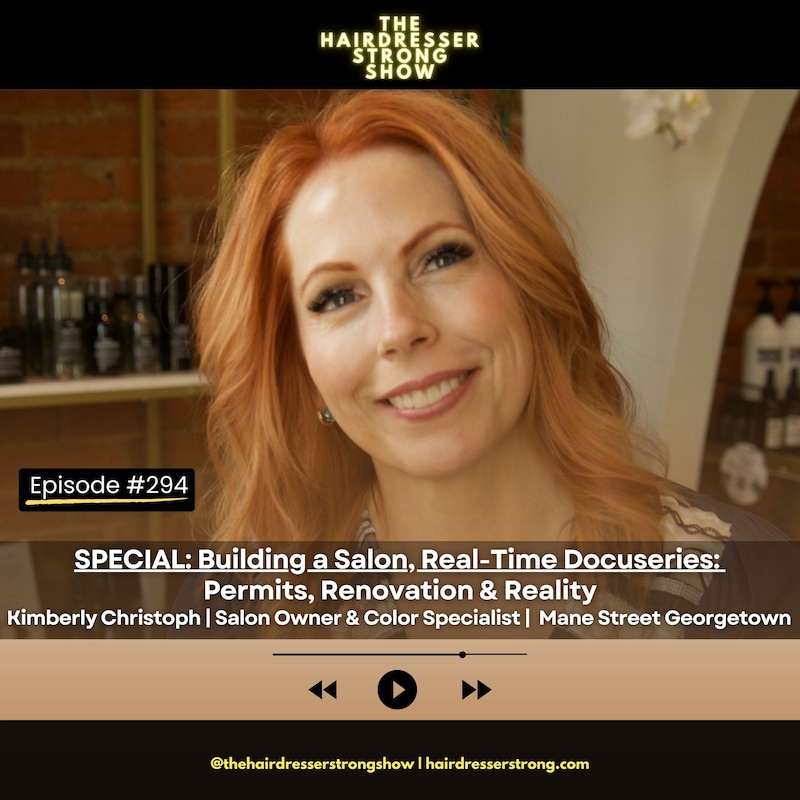
Join us for Part 1 of our docuseries with Kimberly Christoph owner of Mane Street Georgetown, as she shares the real-time experience of opening a salon and navigating the realities of renovation, permits, and building out a space.
With 22 years in the industry and 1 year into ownership, Kimberly breaks down the unexpected delays, design pivots, and decisions that come with turning a vision into a functioning business.
👀Watch this episode on YouTube to see the salon!
Follow/subscribe to be the first to know when new episodes are released. Like what you hear? Leave us a review!
KEY TAKEAWAYS:
🔅Opening fast comes with trade-offs – Moving quickly helps retain clients, but can create operational and construction challenges.
🔅Permits take longer than expected – What feels like a simple build-out can turn into months of delays depending on city requirements.
🔅Understand “change of use” before signing a lease – A space not previously used as a salon can require full building permits and infrastructure upgrades.
🔅Renovations are more than aesthetics – Electrical, plumbing, and HVAC upgrades are often the biggest costs, not the design itself.
🔅Your original vision will likely change – The space, budget, and constraints will shape the final concept more than your initial idea.
🔅Do due diligence before signing anything – Research zoning, permits, infrastructure needs, and negotiate as much support as possible upfront.
🔅Landlords are not responsible for your build-out – Any incentives, time, or support must be negotiated before signing the lease.
🔅Hiring expectations need to be clarified early – Assumptions about stylists bringing clients or committing full-time can lead to misalignment.
🔅Benefits matter more than expected – Health insurance and a collaborative culture are key factors in attracting talent today.
👀Watch this episode on YouTube to see the salon!
RELATED LINKS
👉Follow Mane Street Georgetown on Instagram
👉See what opportunities are available at Mane Street Georgetown HERE
The Hairdresser Strong Show is all about Salon Owners, Rising Stylists, and Seasoned Stylists sharing their experiences, successes, failures, and advice to inform, educate, and empower their Fellow Hairdresser. We won’t stop until we are all: Hairdresser Strong.
CONNECT WITH US
📬 Subscribe to our free newsletter
The views and opinions of our guests are theirs and important to hear. Each guest's views and opinions are their own and we aim to bring you diverse perspectives, career paths and thoughts about the craft and industry so you can become Hairdresser Strong! They do not necessarily reflect the positions of HairdresserStrong.com.
Transcripts
Hey, what's up, everybody?
Speaker A:I am your host, Robert Hughes of the Hairdresser Strong Show.
Speaker A:I am here with Kimberly Kristof, the owner of Main Street Georgetown.
Speaker A:How long have you been open for?
Speaker B:10 Months.
Speaker A:10 Months.
Speaker A:So we're going.
Speaker A:This is docu series episode one, and we are in the space now, and we'll do a walkthrough in a minute.
Speaker A:But, Kim, why don't you just introduce yourself, tell us a little bit, you know, how long you've been in the industry, how long you have been here, and any other piece of information you think would be relevant to the audience.
Speaker B:Okay.
Speaker B:I'm Kimberly Kristof.
Speaker B:This is Main Street Georgetown.
Speaker B:We have been here, as you said, for 10 months.
Speaker B:I've been in the industry for 22 years.
Speaker B:I have been a colorist the entire time, which now that I'm opening my own salon is, is a significant part of that because I need a team to work with me.
Speaker B:So being a specialist has definitely changed the game for opening my own place.
Speaker A:Interesting.
Speaker A:Interesting.
Speaker A:And I have.
Speaker A:I'll have a couple questions about that.
Speaker A:Okay, so, so let's just make, just to make sure that I got this right, we are, you came in here, you got the place up and running relatively quickly, but you're going to do renovations.
Speaker A:Can you give us that, that, that story, that storyline first?
Speaker B:Yeah.
Speaker B:Moving from the place that I was at and coming and opening my own place in the way that I did.
Speaker B:It was a difficult transition given the longer that you wait to go from one place to another, the more, you know, you clientele that you lose.
Speaker B:So I needed to do that quickly.
Speaker B:So in the matter of seven weeks, I left the salon that I was at and opened this place.
Speaker B:I signed a lease for a space that I knew I was going to have to renovate.
Speaker B:But the renovation, what I thought was going to be, you know, oh, it'll take me a couple months.
Speaker B:I can start with half the space and, you know, move into the other half once I do the renovation.
Speaker B:It's been 10 months and I'm still, still waiting on my permits.
Speaker A:Oh, wow.
Speaker A:So it's the permits mainly that's holding you up?
Speaker B:Basically, yes.
Speaker B:Yes.
Speaker A:Well, let's, let's take a look at the space that as it is now, it's, you'll see it's a beautiful space already.
Speaker A:You might even be like, well, why are you renovating?
Speaker A:Well, this is what half the space that people are going to see.
Speaker B:Yes.
Speaker A:Okay.
Speaker A:All right, well, check this out.
Speaker A:And if you're listening on Podcast.
Speaker A:You can check us out on YouTube or on social media to see the walkthrough.
Speaker A:All right, here you go.
Speaker A:All right, cool.
Speaker A:So it's a beautiful space that was.
Speaker A:Wouldn't everybody agree?
Speaker A:So tell us a little bit about.
Speaker A:Let's talk about the aesthetics of the space now.
Speaker A:Tell us a little bit about, like, what your thoughts are when you think about the aesthetic.
Speaker A:You can talk about brand, you can just talk about inspiration.
Speaker A:Just tell us a little bit about speaking about design of the space.
Speaker B:That was a hard journey for me, given the fact that this was not a brainchild that I had been conjuring up for years and years and years.
Speaker B:A lot of people, when they want to open their own place, think about it for a long time and really have their idea of this is what I really want.
Speaker B:I went from working in a salon to the possibility of opening my own brand new place within a matter of couple months.
Speaker B:So I had to go through that entire creative process fairly quickly.
Speaker B:So what I started with and what I ended up with were apples and, and, and vegetables.
Speaker B:It was a totally different concept, really, what I started out.
Speaker A:How, how.
Speaker B:So what I thought I wanted, I needed to, to find a space for that type of concept.
Speaker A:Could you give us a little information to help us understand?
Speaker B:I, I was trying at first.
Speaker B:I was going with a much more open, industrial vibe of like bare bones conceptual of loose and not necessarily refined, which was what I ended up with was like high end luxury, very refined.
Speaker B:A total opposite of what I started with.
Speaker A:Gotcha.
Speaker B:Because I needed to go with the space.
Speaker A:So tell us about that decision.
Speaker A:Okay, so understanding.
Speaker A:You're like, okay, I can't really do the industrial.
Speaker A:First of all.
Speaker A:What about the space made you feel that way?
Speaker B:That I couldn't go that direction.
Speaker B:It's too refined to begin with.
Speaker B:And then the cost of even going that route, which I didn't, I thought that would be like, oh, that's a much cost effective way.
Speaker B:No, it's actually not.
Speaker A:Yeah, it's really not.
Speaker A:But it's so funny.
Speaker A:Like, I was trying to renovate one of our condos and I was like, you know what?
Speaker A:It would be so much easier if we just had concrete floors because we have tenants in there and tenants don't take care of property.
Speaker A:So, like, I was like, can we just make this place, like, super indestructible?
Speaker A:And it was so much money to like have a finished concrete floor.
Speaker A:It was like five figures.
Speaker A:It was crazy.
Speaker B:Yeah.
Speaker A:Anyway, okay, so I, I totally get what you're saying.
Speaker A:Okay, so you're like.
Speaker A:You come to space.
Speaker A:You're, like, industrial.
Speaker A:You're like, whoa, psych.
Speaker A:Let's look at the space.
Speaker A:So tell me about this luxury Refined.
Speaker A:Tell me about that.
Speaker A:So that's where we're at now.
Speaker B:Right?
Speaker A:Right.
Speaker A:Okay, so tell us about the brand.
Speaker A:Give us some context.
Speaker A:What's your inspo.
Speaker A:Where do you look to, like, get inspired?
Speaker B:Yeah.
Speaker B:So I literally just started looking at different companies for equipment and figured I have to start with a piece of equipment that really is going to, you know, set the definition of the brand, let alone the actual design of the place.
Speaker B:So I started with my chairs, and that's really.
Speaker B:Which is in my logo.
Speaker B:That's literally how I started with.
Speaker B:Okay.
Speaker B:It's very structured.
Speaker B:It's very defined.
Speaker B:It has its own color palette, and that's what everything has built off of, basically, is my chairs.
Speaker B:And I figured I had to start with one.
Speaker B:One specific piece in order to branch off of that.
Speaker A:Gotcha.
Speaker A:Nice.
Speaker A:Okay.
Speaker A:And so, like, luxury has, I feel, like, different meanings to different people.
Speaker A:So what.
Speaker A:What does luxury mean to you?
Speaker B:Luxury means feeling like you're in a space that.
Speaker B:That.
Speaker B:That.
Speaker B:That definitely.
Speaker B:It just gives you that feeling of opulence and beauty.
Speaker B:And I feel comfortable here, but I'm definitely in a place that's curated and put together with thoughtfulness.
Speaker B:It's.
Speaker B:It's not necessarily that.
Speaker B:It's, you know, glitter and gold and.
Speaker B:And opulence and, you know, you know, peacocks walking around.
Speaker B:You necessarily, it's.
Speaker B:You feel like my tables were.
Speaker B:Were picked out for a reason.
Speaker B:The stations were picked out for a reason.
Speaker B:Everything kind of goes together, and it makes you feel like it just works.
Speaker A:Totally cool.
Speaker A:Awesome.
Speaker A:All right, so now you're about to go under construction.
Speaker A:Tell us a little bit about what that experience has been like.
Speaker A:So, well, first of all, you.
Speaker A:When you came in, did you.
Speaker A:In order to start using the space, did you have to do anything?
Speaker A:Did you have to be, like, in process of doing renovations?
Speaker A:Was there any issues just coming into the space and starting to work?
Speaker B:I could write a book about the problems of the space.
Speaker A:Give us the first three that come to mind.
Speaker B:In order to change use for a space, for a certificate of occupancy and the district, you actually have to go through a whole building permit process.
Speaker B:And I thought, well, all I need to do is put in a couple shampoo bowls and maybe bring in some stations.
Speaker B:And the city said, no, no, no.
Speaker B:You need a building permit.
Speaker B:And does anybody know what that actually means?
Speaker B:No, I don't.
Speaker B:Not until you actually have to go through it.
Speaker A:Okay.
Speaker B:And having to go through that process and think I need to open my doors in order to be able to take clients, to be able to pay my rent.
Speaker B:So going through that entire process and trying to do it in the most straightforward and legal way that you possibly can was quite difficult.
Speaker B:So getting your cfo, getting your plumbing in and being able to pay your rent right away is, is, Is difficult in a, in a space that was not set up for what we're using it for.
Speaker A:So I guess that's one follow up question would be, did the landlord help you out with any of this?
Speaker B:No.
Speaker B:It's.
Speaker B:It's literally not their responsibility to set up your business for you.
Speaker B:Their, their responsibility is with guidance or.
Speaker A:Give you a break on rent so that you could get permits or anything.
Speaker B:No.
Speaker B:Zero guidance.
Speaker B:That's part of your, your, your rental negotiation before you sign your, your, your lease.
Speaker B:I knew I was going to need some time and I got the most time out of them that I possibly could.
Speaker A:Okay.
Speaker B:Which in the grand scheme of things was, Was nothing.
Speaker A:Dropping the bucket.
Speaker B:Yep.
Speaker B:Yep.
Speaker A:Totally.
Speaker A:Totally.
Speaker A:Okay.
Speaker A:All right, cool.
Speaker A:So I think that's really good information for all of you listening and watching and the.
Speaker A:It sounds like, okay, actually I'm not gonna say anything.
Speaker A:If you, at this point in the journey, you're, we're probably talking.
Speaker A:The person who you'd probably be talking to if you're gonna give a piece of advice would be the person that is about to.
Speaker A:Is shopping for a space and about to sign something.
Speaker A:Based on your experience coming into the space, is there any sort of advice that you would give to anybody?
Speaker B:Take your time and do your due diligence on the space.
Speaker B:How it was, what your CFO said, the spaces CFO said before you were there, if it's a change of use, think about what it actually is going to take you to turn it into a beauty salon and do a lot of research.
Speaker B:ChatGPT actually helps a lot in this scenario.
Speaker B:AI gives a lot of information about what you actually need.
Speaker B:But do your due diligence before you sign your lease because if you can get more assistance out of your landlord, the real estate company, whatever it is beforehand, it definitely really helps.
Speaker B:I didn't realize how much infrastructure I was going to have to do to the building in order to be able to get the services that I needed upstairs.
Speaker B:Because I'm, I'm on the second floor.
Speaker A:Right.
Speaker B:So take that time.
Speaker A:So this little random question, just because it Came to my mind.
Speaker A:Do you have you used AI to with a, like turn your video camera and look at the space and say, hey, how would you design this?
Speaker A:Or anything about construction or anything like that?
Speaker B:I have.
Speaker B:I have not, but I know that my architect has.
Speaker A:Oh, really?
Speaker B:Yeah.
Speaker A:That's awesome.
Speaker A:Okay.
Speaker A:All right, so.
Speaker A:So tell us about what's coming, what to expect, like you're.
Speaker A:You're about to do.
Speaker A:Tell us like what are you doing?
Speaker A:What's the scope of.
Speaker A:Of stuff?
Speaker A:You don't have to give all the details, but maybe like, like the high level bullets points.
Speaker A:Because I know you're doing some plumbing, I know you're doing some electricity.
Speaker B:Y.
Speaker A:Can you give us like what, what are the, like the main pillars of the.
Speaker A:The scope of work you're doing first?
Speaker A:And then we'll go into like what, what to expect of the layout and stuff like that.
Speaker B:Yeah.
Speaker B:So high level.
Speaker B:I have to do what's called a heavy up for the electricity.
Speaker B:Everybody knows hair dryers take a lot of electricity.
Speaker B:So I need for 12 chairs, 12 dedicated circuits.
Speaker B:And that does not include any of the other electricity that's going on in the place.
Speaker B:Like I have electric shampoo bowls and a head spa going in and all of the other infrastructure things.
Speaker B:So that's number one.
Speaker B:Number two is hair salons take a lot of water.
Speaker B:I have to bring in more water from the city, which means I have to expand the water capacity for the building from the city, which is a huge ticket item.
Speaker A:Sounds very expensive.
Speaker B:Huge ticket item.
Speaker B: her thing is codes changed in: Speaker B:Hair salons now, hair salons and nail salons now require more air ventilation due to chemicals and powders for nail services.
Speaker B:So that changes my entire H VAC system.
Speaker B: ilding for my space, which is: Speaker B:So those are the high level major things.
Speaker B:Not even counting all of the really pretty things that I'm actually excited about.
Speaker A:Gotcha.
Speaker A:Okay, so what we saw in the walkthrough was six stations, right?
Speaker A:Six double sided stations, Three double sided.
Speaker A:Three double sided stations and two shampoo bowls.
Speaker A:A front desk.
Speaker A:And so what we didn't really see is we didn't.
Speaker A:There's like on the.
Speaker A:It's like half of the space, 900 square feet.
Speaker A:So like on the other side there's all these different rooms which, you know, we saw like the changing room and like the break room, but you know, we didn't really, really explore because there's.
Speaker A:Those rooms are Empty.
Speaker A:So tell us, tell us, like, what.
Speaker A:What your kind of vibe is, like, what you're thinking for the new, new space, the new layout.
Speaker B:So the new layout will be because of the.
Speaker B:The way the building is set up.
Speaker B:I have.
Speaker B:I have windows in the front and I have windows in the back.
Speaker B:So every wall that I can't get rid of between window to window is going to be gone.
Speaker B:So it opens the entire space up.
Speaker B:So when it looks bigger, because it is bigger, but then it allows for maneuvering of the space when needed.
Speaker B:So if I want to teach a class in here, I can move the stations out of the way.
Speaker B:If we want to do an event, it makes the space super open.
Speaker B:So this space that we're in, there will literally be a front desk.
Speaker B:That's right here where the wall is behind us.
Speaker B:There'll be a big color bar which can be turned into, like, you know, a display buffet area, you know, very, very easily.
Speaker B:But it'll all aesthetically be pleasing as well, because it'll all be, like, cohesive together.
Speaker B:And then there'll be another, you know, two shampoo balls and a head spot in the back as well for the.
Speaker B:The other side.
Speaker A:Nice.
Speaker A:So is.
Speaker A:Is what we saw on the side that's done?
Speaker A:We're already done.
Speaker A:Is it gonna look like a mirror image of that?
Speaker B:Basically, yes.
Speaker B:Yes, basically.
Speaker A:So you're doubling your capacity or more than doubling.
Speaker B:Doubling.
Speaker A:You only have six stations on the other side as well.
Speaker B:Yeah.
Speaker A:Okay, cool.
Speaker A:Well, this is.
Speaker A:That's exciting.
Speaker A:So how long is that construction expected to take?
Speaker A:Take?
Speaker B:Well, they say that it should take nine to 10 weeks, which we all know will translate to 16, right?
Speaker A:Yeah, so that.
Speaker A:But that's still.
Speaker A:That's a lot of time for them to even say nine to ten weeks.
Speaker A:Yeah, I'm trying.
Speaker A:Did.
Speaker A:Did you get more.
Speaker A:Did anybody bid you faster time than that?
Speaker A:No, more.
Speaker B:More.
Speaker A:Oh, really?
Speaker A:So this is the low one that you know is going to extend, Correct, Correct.
Speaker A:That's definitely a thing with construction.
Speaker A:It's like, I'll do it faster.
Speaker A:And then like, halfway through, they're like, it's going to.
Speaker A:We're going to need to extend this and it's going to cost you more money, right?
Speaker B:Oh, we're waiting on, you know, an inspector, a permit or, you know, whatever.
Speaker A:Yeah, exactly.
Speaker A:Well, that's exciting.
Speaker A:So it is mid February, and so when do you expect the construction to start?
Speaker B:Given the fact that I'm still waiting on my permit that I've been waiting for for four months, that's Crazy.
Speaker B:Yeah, I, I honestly, I have no idea.
Speaker B:My assumption is it's going to be at least another six weeks before they can start.
Speaker A:Okay.
Speaker A:Yeah.
Speaker A:So like end of March and then.
Speaker A: So end of March,: Speaker A:So by like July, August, it's.
Speaker A:Yeah, it should be done.
Speaker A:So like by the, for the fall, so for the busy season, you'll be ready to go.
Speaker B:That's my hope.
Speaker A:Cool.
Speaker A:Yeah, that's exciting.
Speaker B:Yeah, it's very exciting.
Speaker A:Exciting.
Speaker A:So we'll come back after.
Speaker A:Actually, we should come back during construction so we can see some of the demo and then, and then we'll talk about how it's going, if any changes have made, you made or, or any surprises, both positive or not exciting and, and then we'll do another one maybe three to six months after you open to talk about how it's going.
Speaker B:Great.
Speaker A:Cool.
Speaker A:Awesome.
Speaker A:Well, I guess the last piece of information is since you've been open for 10 months, I should ask you one very important piece of information because you kind of alluded to it, but not really, is talk about your team.
Speaker A:How big is.
Speaker A:You came over by yourself.
Speaker B:Yeah, right.
Speaker A:Yeah, but not by yourself.
Speaker A:You have tell us who you came, who you started on day one with and then tell us what it looks, what your team looks like now.
Speaker B:So I came over with my right hand, my left hand, and probably most of my right foot as well.
Speaker B:Who is Leah?
Speaker B:My salon.
Speaker B:What do we want to call you?
Speaker B:Your salon mate?
Speaker B:I call her.
Speaker A:Leah's watching.
Speaker A:She's in the background.
Speaker B:So she takes care of everything that I can't take care of because I'm behind the chair the majority of the time.
Speaker B:She does all of our marketing, our social media, takes care of all of the clients, makes incredible coffees.
Speaker B:So she's definitely the person that, the glue that holds the whole place together.
Speaker B:She also does all of our first interviews so I don't have to go through that entire process.
Speaker B:So as of right now, I have myself, as I said, I'm a specialist.
Speaker B:I only do color.
Speaker B:And then I have.
Speaker B:We just hired number four other ladies that are not specialists.
Speaker B:They do everything correct.
Speaker A:Okay.
Speaker B:Yeah.
Speaker A:And are they full time, part time,.
Speaker B:Three full time, one part time, one of the full time is about to go on maternity leave.
Speaker A:Okay.
Speaker B:But she will be back in two.
Speaker A:Months, so that's pretty good for 10 months.
Speaker A:I feel like there's a lot of people that struggle to build a team,.
Speaker B:So yeah, it is.
Speaker B:It is definitely been interesting.
Speaker A:Yeah.
Speaker A:Have you hired and let go of people or had people leave?
Speaker A:How many people have you been through?
Speaker B:I.
Speaker B:The original lady that I started with, we parted ways after four or five months.
Speaker B:It just wasn't the right fit for her.
Speaker B:The level that we were looking for wasn't the right fit.
Speaker B:And then I also parted ways with an associate that I brought on that just wasn't ready for the industry.
Speaker A:Okay, so two.
Speaker A:That's not bad.
Speaker A:How many people, and I don't know if you know this, maybe are mysterious.
Speaker A:Leah in the background knows this.
Speaker A:How many people have you all interviewed?
Speaker B:20.
Speaker A:20.
Speaker A:Okay.
Speaker A:All right.
Speaker A:I think that's really good context for anybody out there who's thinking about, like, what this journey looks like.
Speaker A:And mind you, we're in Georgetown, which is really center of a lot of stuff, so if you're further out in the suburbs or in a rural area, you.
Speaker A:I think you should, like, take the con, understand the context here.
Speaker A:But you've been.
Speaker A:You've done 20 interviews.
Speaker B:You've had out of probably 50 applicants.
Speaker A:Okay, so 50 applicants, 20 interviews.
Speaker A:That left you with two people that it didn't work out with, but you ended up with four other people, which sounds like a pretty good conversion.
Speaker B:Yeah.
Speaker A:You know, so that's awesome.
Speaker A:So that's very positive news.
Speaker A:Awesome.
Speaker A:Well, um, before we sign off, do you have any last things that you want to say to everybody?
Speaker B:Um, the.
Speaker B:The thing that I had alluded to before about.
Speaker B:It's.
Speaker B:It's definitely different concept when you're a specialist and you're bringing on a.
Speaker B:A crew of new people that want to build their business.
Speaker B:It's something to think about when you are.
Speaker B:When.
Speaker B:When you're going out on your own.
Speaker B:If you are a specialist, because I'm not taking new clients because I want to build the rest of my crew, they should be the people that I'm building with the brand.
Speaker B:I have a wonderful and loyal clientele that I take referrals, definitely, but I want to be able to build them.
Speaker B:So as a specialist, they are the ones that are taking care of my.
Speaker B:The, the second half, my blow dries and the cuts.
Speaker B:So it's not necessarily building them as.
Speaker B:As quickly as they would like.
Speaker B:As far as the color, given the, the clientele that already comes to the salon, they're solely relying on new clients that, that the.
Speaker B:The brand can bring in.
Speaker B:And you can only bring in so many.
Speaker B:You know, at this, at this point, we're bringing in anywhere between 10 and 20 client, brand new clients a month.
Speaker B:Which two, three people that are trying to build a clientele.
Speaker B:That's not a lot.
Speaker A:Right?
Speaker A:Right.
Speaker A:So I guess, I guess you're making me think of, you're making me think of another question or maybe even a whole nother conversation.
Speaker A:But like, well, when you're, when.
Speaker A:Because the space that we like to talk about the most is the hiring.
Speaker A:The, the act, the, the recruitment, acquisition, development, retention of talent.
Speaker A:And, and would you.
Speaker A:So it's like hat.
Speaker A:What we've noticed is that salon, there's quite a few salons that have opened up that we've been talking to the owners that are saying that they've had various ish.
Speaker A:Situ.
Speaker A:Ish challenges bringing and building up a talent like a, like a deck of talent.
Speaker A:Have you, could you tell us anybody who's out there who maybe not even be new?
Speaker A:It's just maybe there's a salon owner out there that's trying to like attract people.
Speaker A:Can you tell us like your, what your experience has been?
Speaker A:Like, have you had stylists who have books?
Speaker A:Are they mostly people who don't have clientele?
Speaker A:And like what is, what, what is that conversation?
Speaker A:Like, what do, what do people who have come to you, what have they said that they want from you and what do they said that they're trying to do with their career?
Speaker A:I don't, I have some ideas and I want, but I don't want to say anything.
Speaker A:I want to see what you, what you say.
Speaker B:That has been part of the evolution of this scenario because I've hired people in the past, but I've never hired an entire crew of people.
Speaker B:The amount of questions and the way that the interviews evolve into the different conversations has definitely really structured a very clear understanding of how to interview people and have realistic expectations of them as well as get their expectations of you out of them.
Speaker B:Because there's a lot of assumptions.
Speaker B:Like I, I, I, I've, I hired one woman who's wonderful and talented and she's been in this industry, in this area, not specifically Georgetown, but in the, the D.C. area for 20 something years.
Speaker B:And she said, you know, she, the salon she was at before had closed and she was looking for a new home.
Speaker B:And my assumption was, of course she's looking for a new home.
Speaker B:She wants, you know, to, to bring the clientele that she already has into, you know, her new space because her space had closed.
Speaker B:Total assumption on my part that that meant that she wanted to actually move her entire clientele here and work here full time and Be like a committed employee.
Speaker B:She was already had already established herself renting a chair somewhere else that was very close to where she was before, had zero intention of moving that clientele to here and had zero intention of working full time here at any point.
Speaker B:So it was my assumption of the conversation of what she was saying versus I should have asked, what does that actually look like for you?
Speaker B:So those conversations have really, really gotten very, very specific and defined compared to, well, of course she's looking for a new home.
Speaker B:That means that she wants that to be her, you know, full time home.
Speaker B:That wasn't the case whatsoever.
Speaker B:And that was on me because I didn't, I didn't clarify that with her.
Speaker B:And she's perfectly lovely and she's a part time employee and it's working out great.
Speaker B:She was concerned about the price point that she was at before and the price point that she is at here.
Speaker B:Those two things don't mix with the clientele that she has at her other place and she didn't want to lose them.
Speaker B:So I totally understand.
Speaker B:So that conversation has really evolved and gotten much more specific and much more detailed with the lady I just hired just the other day.
Speaker A:So if you had to track or let's just say if you.
Speaker A:Is there any common thread through what people want from you and your business?
Speaker A:Like, are there any things that are similar or.
Speaker A:I mean, I'm sure there's a lot of differences, but what are the similar things that people say that they are wanting when they come in asking for a job?
Speaker B:Benefits.
Speaker A:Oh, yeah.
Speaker B:First and foremost.
Speaker A:Really?
Speaker B:Oh, yeah.
Speaker B:They want benefits.
Speaker A:Like what type of benefits?
Speaker B:Health care.
Speaker A:Health care.
Speaker B:Yep.
Speaker A:Interesting.
Speaker B:Yeah.
Speaker B:They want insurance.
Speaker A:Health insurance.
Speaker B:Health insurance, yeah.
Speaker A:And do you provide health insurance?
Speaker B:I do.
Speaker B:Because it's like the first thing everybody has asked for.
Speaker A:Wow.
Speaker A:I feel like we need another whole nother episode for that.
Speaker A:We definitely should talk about that.
Speaker A:Okay.
Speaker A:What else do they say?
Speaker B:A collaborative environment versus a, you know, this is your job, just do your job environment.
Speaker B:They want it where it's an open conversation and they can come with grievances and it's not, you know, the end of the world.
Speaker B:They want to be able to tell me, you know, I need you to change this.
Speaker B:And they want to be told, I want you to change this versus, you know, having that uncomfortable feeling of I don't want to have to talk to my owner about something because I know it's going to go badly.
Speaker A:Okay.
Speaker A:Okay, cool.
Speaker A:So benefits and like good communication.
Speaker B:Yeah.
Speaker A:Vibes and.
Speaker B:Yeah.
Speaker A:Maybe like transparent transparency.
Speaker A:Yeah.
Speaker B:Yep.
Speaker A:Anything else?
Speaker B:They want you to immediately build them up to, you know, six figure salary.
Speaker A:Totally, totally.
Speaker A:Do you guarantee them anything or no?
Speaker A:No, no.
Speaker B:I mean, in D.C. you have to guarantee them, you know, they're going to make minimum wage every week.
Speaker B:But outside of that, I do not guarantee.
Speaker B:I don't think that's a good business practice.
Speaker A:Gotcha.
Speaker B:Because, I mean, who knows what's going to happen?
Speaker A:So the benefits, the health insurance thing, like I said, we're going to have a whole conversation because I want to understand how you're able to afford that.
Speaker A:But.
Speaker A:But the other piece about wanting to be built up, that makes sense.
Speaker A:And transparency is.
Speaker A:I mean, we hear benefits for sure.
Speaker A:I just don't know that many people that are providing health insurance.
Speaker A:So, like, I definitely think that that's a really powerful conversation to have, which I think which should draw you, bring you a lot of attention because that's pretty unique.
Speaker A:And also the transparency thing is definitely something we hear.
Speaker A:And wanting to be built quick is obviously it makes sense that they're looking for a place to like, start making that money, right?
Speaker A:Yeah.
Speaker A:Cool.
Speaker A:Awesome.
Speaker A:So this was super valuable.
Speaker A:I didn't expect to get that extra information.
Speaker A:So thank you and I'm sure you all appreciate that, listening and watching.
Speaker A:Okay, so we'll be back here in a few months to kind of check on the progress.
Speaker A:And until then, thank you so much.
Speaker B:Thank you.
Speaker A:All right.
Speaker A:All right, everybody.
Speaker A:See you.

